第2次世界大戦の英雄と、日本の過去との向き合い方
2020年8月16日
ルーパート・ウィングフィールド=ヘイズ東京特派員
画像提供,GETTY IMAGES
画像説明,
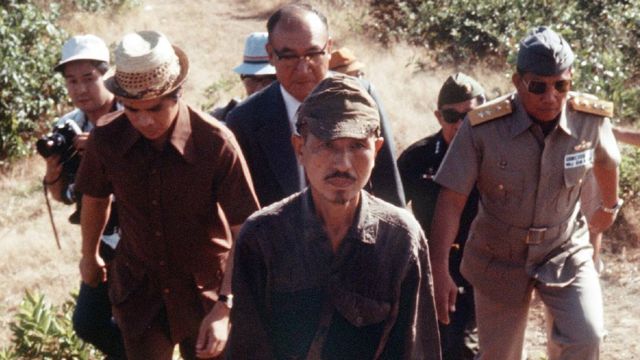
小野田寛郎少尉(前中央)は1974年にジャングルから出てきた
第2次世界大戦の日本の軍人で、敗戦後、最後に正式投降したのが小野田寛郎だ(文中敬称略)。
小野田少尉は1974年3月9日、やっと自らの剣を引き渡した。29年間、フィリピンのジャングルで持ちこたえた。日本に帰国後のインタビューや手記では、日本が降伏したことを受け入れられなかったと述べた。
部外者には小野田は狂信者に見えた。しかし帝国時代の日本では、彼の行動は完全に理にかなっていた。小野田は決して投降せず、天皇のために死ぬと誓っていた。女性を含めた他の国民も全員、同じ事をするはずだと彼は信じていた。
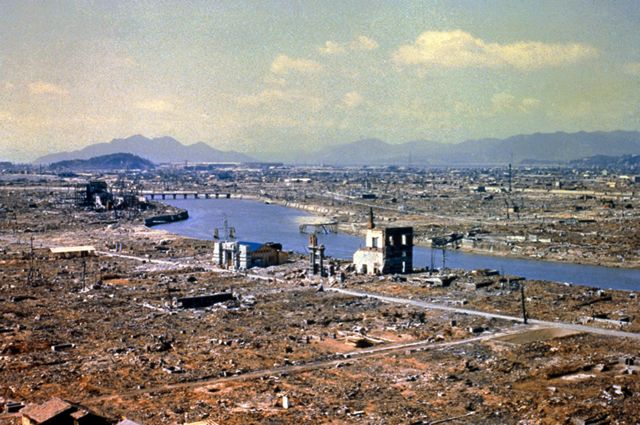
だがもちろん、そんなことはなかった。1945年8月15日、日本の最高神である裕仁天皇は、天皇として前例がなかったことをした。ラジオに現れたのだ。原子爆弾が広島と長崎を破壊していた。2つ目の原爆が投下された日、ヨシフ・スターリンが日本に宣戦布告した。ソビエト連邦軍はすでに、満州を席巻していた。数週間以内に、ソ連軍は北海道に上陸するとみられた。裕仁はアメリカへの降伏が最善の選択だと受け入れた。
画像提供,GETTY IMAGES
画像説明,
広島は原爆によって壊滅的な被害を受けた
それでも、天皇の降伏演説はもう少しで実現しないところだった。8月15日朝、若い将校らが部下を率いて皇居の敷地へと入り込んだ。演説の録音を奪い取るのが狙いだった。彼らは戦争にはまだ負けていないと信じていた。日本本土は侵略されていなかった。中国にいた大規模な陸軍の多くは、まだやられずに残っていた。
将校らは、アメリカの爆弾で多数の民間人の犠牲者が出たことを、ほとんど気にかけていなかった。彼らの関心はただ1つ、天皇制の維持だった。天皇の安全が約束されないうちに平和交渉をするなど、もってのほかだった。
若い将校らは放送を阻止できなかった。しかし、望みは実現した。降伏後、アメリカは裕仁を戦争犯罪人として裁かないことを決めたのだ。その代わり、彼は天皇の座にとどまり、実質的なアメリカの操り人形となった。
これは1949年まで日本を支配したダグラス・マッカーサー米司令官による、抜け目のない判断だったといえるだろう。マッカーサーは自らの施策――保守的な日本をアメリカ式の憲法をもつ近代的民主主義国家に変革する――を推し進めるため、天皇を利用したのだった。
画像提供,GETTY IMAGES
画像説明,
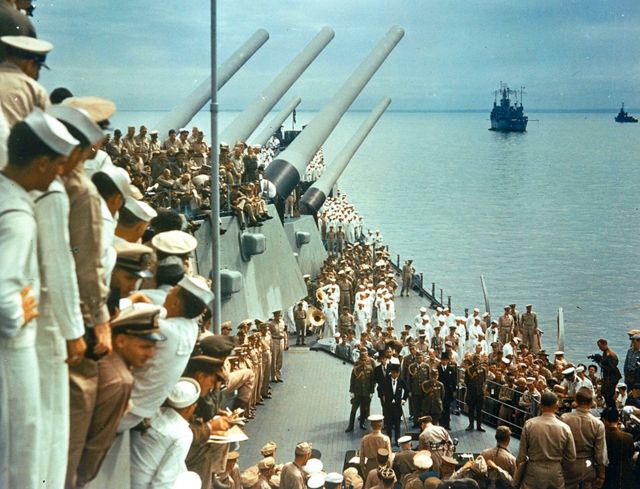
日本の全権団は米戦艦ミズーリの甲板で降伏文書に調印した(1945年9月2日)
戦争に勝った連合国は、日本の戦時中の指導者28人を裁判にかけた。東条英機首相ら7人が絞首刑となった。しかし、その他の人たちは何ら責任を問われなかった。天皇のおじで、中国の首都南京(当時)における悪名高い大虐殺の際に日本部隊を率いていた、朝香鳩彦王子もそうした1人だった。
彼らを不問に付すことを、マッカーサーは必要悪と考えていた。だが彼の判断は、日本が過去と真剣に向き合うのを避けることを許し、奨励すらすることになった。
裁判を逃れた別の人物が岸信介だ。岸は満州の占領で重要な役割を果たし、東条英機の側近でもあった。アメリカは彼を不起訴にし、1948年に釈放された。アメリカが日本を占領していた間は、公職から追放された。
しかし1955年、岸は新たな政治勢力の形成を画策した。自由民主党だ。まもなく彼は同党の党首となり、日本の首相になった。彼にとってのリハビリ期間は終了し、彼が創設に関わった政党はその後の65年間のほとんどにおいて、日本を支配することになった。
画像提供,AFP
画像説明,
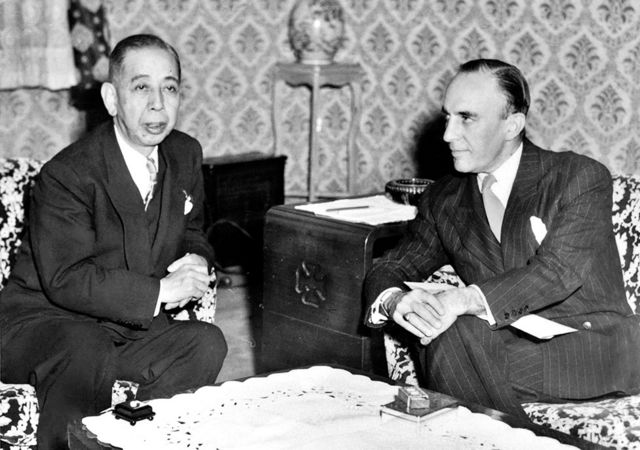
岸信介首相(左)とアメリカのダグラス・マッカーサー2世駐日大使(1957年)
岸信介の娘は、別の有力政治家一族の息子、安倍晋太郎と結婚した。彼はのちに日本の外相にまでなり、晋三という名の息子をもつようになる。
安倍晋三首相のこうしたルーツは決して珍しいものではない。日本の政治家一族は極めてしぶとい。
安倍晋三は祖父と親しかったと言われている。祖父は若き日の晋三の政治観に深い影響を与えた。多くの右派の仲間と同様、岸信介も自身がかろうじて免れた戦争犯罪の裁判を、勝者の裁きと考えていた。戦後の平和憲法を破棄することが、彼の生涯の目標となり続けた。
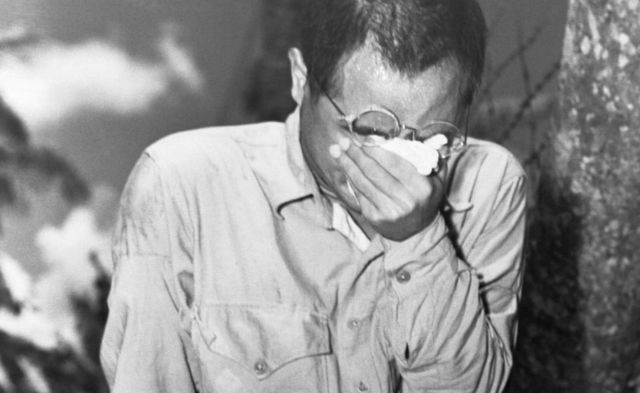
画像提供,GETTY IMAGES
画像説明,
裕仁天皇の降伏の言葉を聞いて泣く日本人の戦争捕虜
1965年のスピーチでは、岸は「日本の敗北とアメリカの占領の影響を完全に消し去る方法」として、日本の再武装が必要だと主張した。
日本に批判的な中国と韓国の人々は、日本が第2次世界大戦でした事に対して一度も適切に謝罪していないと言うが、それは間違いだ。日本は繰り返し謝罪している。問題は、日本の有力政治家らによる他の言葉や行動だ。それらのせいで、日本の謝罪は完全に心のこもったものではないと受け止められる。
1997年、日本の政治エリートによって1つの新しい団体が設立された。日本会議だ。秘密結社ではないが、その存在や目標を知る日本人は少ない。
この団体の目標は、皇室を中心として日本の国としての誇りと一体感を取り戻すこと、平和憲法を破棄すること、国旗・国家や国の歴史への敬意を広めること、日本の軍備を増強することだ。
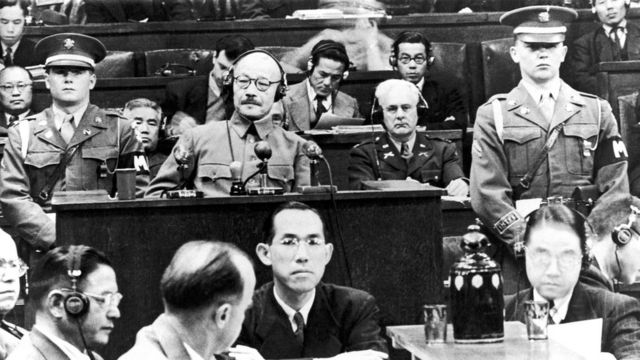
画像提供,GETTY IMAGES
画像説明,
戦争犯罪をめぐる裁判に出廷した東条英機元首相(1948年)
日本会議の会員約3万8000人の中では、安倍晋三首相、麻生太郎副総理、小池百合子東京都知事といった存在が目を引く。
会員の1人だったのが、生前の小野田寛郎だ。1970年代になって小野田少尉が帰ってきた日本は、彼が好むものではなかった。戦後世代は軟弱になったと彼は考えていた。一時ブラジルに移住し、牛の牧場で生計を立てた。その後日本に戻って学校を開き、ジャングルで30年間生き延びるのに役立った技能を日本の若者に教え込んだ。
小野田寛郎が2014年に91歳で死去した時、追悼を述べた安倍首相の報道官は感情をあらわにした。彼は小野田の孤独な戦争の無益さについてはみじんも触れず、日本が降伏して何年もたってから小野田が殺したフィリピンの村人たちのことも言及しなかった。その代わり彼は、小野田寛郎は日本の英雄だと述べた。
(英語記事 A WW2 hero and a reckoning with Japan's pas
VJ Day: A WW2 hero and a reckoning with Japan's past
By Rupert Wingfield-HayesBBC News, Tokyo
15 August 2020
Share this with Facebook
Share this with Messenger
Share this with Twitter
Share this with Email
Share
Related Topics
World War Two
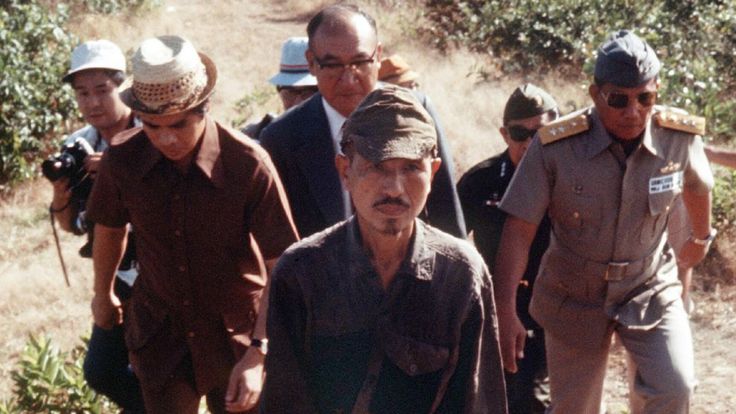 Image copyrightGETTY IMAGESImage captionLieutenant Hiroo Onoda (centre) walks from the jungle in 1974
The last Japanese soldier to formally surrender after the country's defeat in World War Two was Hiroo Onoda.
Lieutenant Onoda finally handed over his sword on March 9th 1974. He had held out in the Philippine jungle for 29 years. In interviews and writings after his return to Japan, Lt Onoda said he had been unable to accept that Japan had capitulated.
To many outsiders, Onoda looked like a fanatic. But in imperial Japan his actions were perfectly logical. Onoda had sworn never to surrender, to die for the emperor. He believed the rest of his countrymen, and women, would do the same.
Of course they hadn't. On 15 August 1945, Japan's supreme divine being, Emperor Hirohito, did something no emperor had done before: he went on the radio. Atom bombs had destroyed Hiroshima and Nagasaki. On the day the second bomb was dropped, Joseph Stalin declared war on Japan. Soviet forces were already sweeping across Manchuria. Within weeks they would be landing on the northern island of Hokkaido. Hirohito accepted that surrender to the Americans was his best choice.
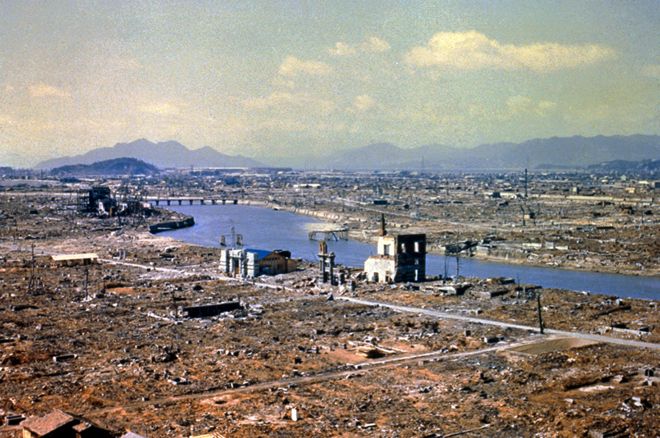 The devastated city of Hiroshima after the atomic bomb blast
Even so, the emperor's surrender speech nearly didn't happen. On the morning of 15 August, a group of young officers led their troops in to the imperial palace grounds. They were trying to seize the recording of that speech. They believed the war was far from lost. Japan's home islands had yet to be invaded. Its vast army in China was still largely undefeated.
The officers were little concerned by mass civilian casualties inflicted by the US bombing of Japan's cities. Instead they were focused on one thing: the survival of the imperial system. Japan must not sue for peace until the emperor was secured.
The young officers failed to stop the broadcast. But they got their wish - after the surrender the US decided Hirohito would not be tried as a war criminal after all. Instead he would stay on the throne, effectively an American puppet.
It was perhaps a shrewd move by Douglas MacArthur, the US general who ruled over Japan until 1949. MacArthur used the emperor to push his own agenda - to transform conservative Japan in to a modern democracy with an American-style constitution.
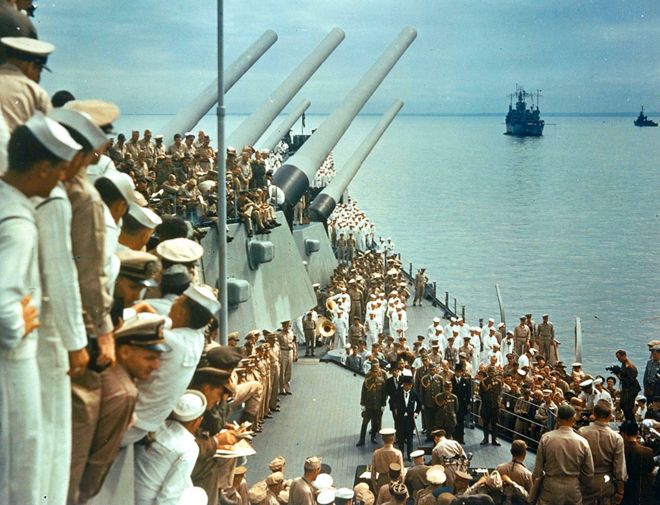
Japanese representatives surrender aboard the USS Missouri, 1945
The victorious allies put 28 members of Japan's wartime leadership on trial. Seven, including Prime Minister Hideki Tojo, were hanged. But others were never charged. Among them Prince Yasuhiko Asaka, the emperor's uncle, and the man who led Japanese troops in the infamous rape of the Chinese capital, Nanjing.
Sparing them was seen by MacArthur as a necessary evil. But his decision has allowed, even encouraged, Japan to avoid a deep reckoning with its past.
Another man who escaped trial was Nobusuke Kishi. Kishi had played a leading role in the occupation of Manchuria and was a close ally of war leader Hideki Tojo. The Americans decided not to charge him. Instead in 1948 Kishi was released. He was banned from politics while the American occupation lasted.
But in 1955, Kishi engineered the formation of a new political force - the Liberal Democratic Party. Soon he would be its leader and Japan's prime minister. His rehabilitation was complete, and the party he helped create has ruled over Japan for most of the proceeding 65 years.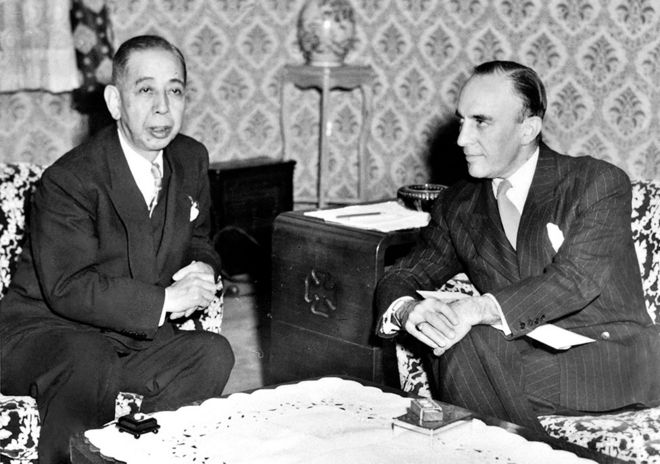
The victorious allies put 28 members of Japan's wartime leadership on trial. Seven, including Prime Minister Hideki Tojo, were hanged. But others were never charged. Among them Prince Yasuhiko Asaka, the emperor's uncle, and the man who led Japanese troops in the infamous rape of the Chinese capital, Nanjing.
Sparing them was seen by MacArthur as a necessary evil. But his decision has allowed, even encouraged, Japan to avoid a deep reckoning with its past.
Another man who escaped trial was Nobusuke Kishi. Kishi had played a leading role in the occupation of Manchuria and was a close ally of war leader Hideki Tojo. The Americans decided not to charge him. Instead in 1948 Kishi was released. He was banned from politics while the American occupation lasted.
But in 1955, Kishi engineered the formation of a new political force - the Liberal Democratic Party. Soon he would be its leader and Japan's prime minister. His rehabilitation was complete, and the party he helped create has ruled over Japan for most of the proceeding 65 years.
Prime Minister Nobusuke Kishi (left) with US Ambassador to Japan Douglas MacArthur in 1957
Nobusuke Kishi's daughter married the son of another powerful political dynasty - a man named Shintaro Abe. He would go on to become Japan's foreign minister, and to father a son of his own, named Shinzo.
Prime Minister Shinzo Abe is far from unique in his family history. Japan's political dynasties have proved remarkably resilient.
Shinzo Abe was reputedly close to his grandfather. The old man had a profound influence on young Shinzo's political views. Like many of his allies on the right, Nobusuke Kishi thought the war-crimes trials he narrowly escaped were victor's justice. His life-long goal remained the scrapping of the post war pacifist constitution.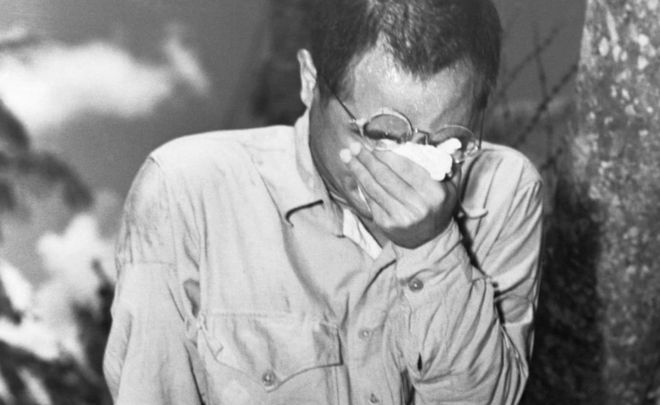
Nobusuke Kishi's daughter married the son of another powerful political dynasty - a man named Shintaro Abe. He would go on to become Japan's foreign minister, and to father a son of his own, named Shinzo.
Prime Minister Shinzo Abe is far from unique in his family history. Japan's political dynasties have proved remarkably resilient.
Shinzo Abe was reputedly close to his grandfather. The old man had a profound influence on young Shinzo's political views. Like many of his allies on the right, Nobusuke Kishi thought the war-crimes trials he narrowly escaped were victor's justice. His life-long goal remained the scrapping of the post war pacifist constitution.
A Japanese prisoner of war reacts after hearing Emperor Hirohito's surrender
In a 1965 speech, Kishi called for Japan's rearmament as "a means of eradicating completely the consequences of Japan's defeat and the American occupation".
When Japan's critics in China and Korea say the country has never properly apologised for what it did during World War Two, they are wrong. Japan has made repeated apologies. The problem is the other words and actions taken by Japan's leading politicians. They suggest those apologies are not completely sincere.
In 1997, a new group was established by Japan's political elite. It is called Nippon Kaigi. It is not a secret society, but many Japanese remain unaware of its existence or its goals.
Those goals are to "rekindle Japanese national pride and identity, based around the Imperial family", to scrap the pacifist constitution, to institute respect for the national flag, national anthem and national history, and to build up Japan's military strength.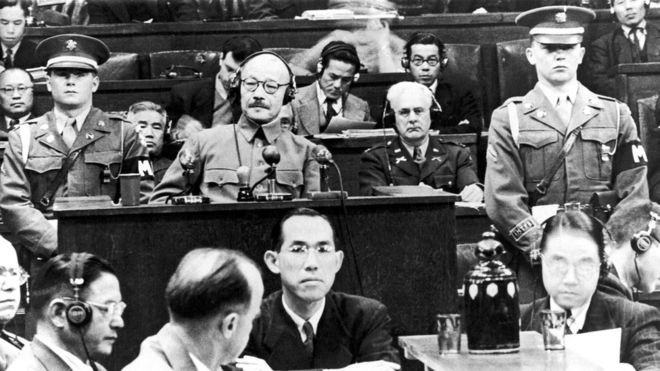
In a 1965 speech, Kishi called for Japan's rearmament as "a means of eradicating completely the consequences of Japan's defeat and the American occupation".
When Japan's critics in China and Korea say the country has never properly apologised for what it did during World War Two, they are wrong. Japan has made repeated apologies. The problem is the other words and actions taken by Japan's leading politicians. They suggest those apologies are not completely sincere.
In 1997, a new group was established by Japan's political elite. It is called Nippon Kaigi. It is not a secret society, but many Japanese remain unaware of its existence or its goals.
Those goals are to "rekindle Japanese national pride and identity, based around the Imperial family", to scrap the pacifist constitution, to institute respect for the national flag, national anthem and national history, and to build up Japan's military strength.
Japanese Prime Minister Hideki Tojo seen during his trial for war crimes in 1948
Prominent among Nippon Kaigi's 38,000 members are Prime Minister Shinzo Abe, Deputy Prime Minister Taro Aso and the governor of Tokyo, Yuriko Koike.
Another member of Nippon Kaigi, until his death, was Hiroo Onoda. The Japan that Lieutenant Onoda had returned to in the mid-1970s was not to his liking. He believed the post war generation had gone soft. For a time, he moved to Brazil and lived on a cattle ranch. Later he returned to Japan and opened a school to train young Japanese in the skills that had helped him to survive his three decades in the jungle.
When Hiroo Onoda died in 2014 at the age of 91, Prime Minister Abe's spokesman was effusive in his eulogy. He gave no hint of the futility of his lonely war, or mention of the Philippine villagers he had killed long after Japan's surrender. Instead he described Hiroo Onoda as a Japanese hero.
Prominent among Nippon Kaigi's 38,000 members are Prime Minister Shinzo Abe, Deputy Prime Minister Taro Aso and the governor of Tokyo, Yuriko Koike.
Another member of Nippon Kaigi, until his death, was Hiroo Onoda. The Japan that Lieutenant Onoda had returned to in the mid-1970s was not to his liking. He believed the post war generation had gone soft. For a time, he moved to Brazil and lived on a cattle ranch. Later he returned to Japan and opened a school to train young Japanese in the skills that had helped him to survive his three decades in the jungle.
When Hiroo Onoda died in 2014 at the age of 91, Prime Minister Abe's spokesman was effusive in his eulogy. He gave no hint of the futility of his lonely war, or mention of the Philippine villagers he had killed long after Japan's surrender. Instead he described Hiroo Onoda as a Japanese hero.
----

No comments:
Post a Comment