

Audible sample
Follow the author
Andrew J. BacevichAndrew J. Bace…
Follow
After the Apocalypse: America's Role in a World Transformed Paperback – 11 October 2022
by Andrew Bacevich (Author)
4.4 4.4 out of 5 stars (172)
Part of: American Empire Project (33 books)
The purpose of U.S. foreign policy is, at least theoretically, to keep Americans safe. Yet as we confront a radically changed world, it has become clear that the terms of that policy have failed. Washington’s insistence on a market economy, its faith in the idea of the “West” and its “special relationships,” its conviction that military primacy is the key to a stable and sustainable world order―these have brought endless wars and a succession of moral and material disasters.
In a bold reconception of America’s place in the world, informed by thinking from across the political spectrum, historian Andrew Bacevich lays down a new approach based on moral pragmatism, mutual coexistence, and war only as a last resort. Confronting the threats of the future―climate change, a shift in the international balance of power, and the rise of information technology as a weapon of war―his vision calls for a profound overhaul of our understanding of national security, setting out new principles to guide the once-but-no-longer sole superpower as it navigates a transformed world.
Book Description
"An excoriating call for change . . . Bacevich's arguments are well-informed and stoked by a sense of moral outrage. Readers will agree that U.S. foreign policy needs a massive rethink."
―Publishers Weekly
About the Author
Andrew Bacevich is the author of The Limits of Power, Washington Rules, and, most recently, The Age of Illusions: How America Squandered Its Cold War Victory. His writings have appeared in the New York Times, the London Review of Books, and the American Conservative, among other publications. Having served in the army for twenty-three years, he is currently a professor emeritus of history and international relations at Boston University and founder and president of the Quincy Institute for Responsible Statecraft, a Washington think tank dedicated to foreign policy. He lives in Walpole, Massachusetts.
Product details
Publisher : Metropolitan Books
Publication date : 11 October 2022
Customer Reviews:
4.4 4.4 out of 5 stars (172)
About the author
Follow authors to get new release updates, plus improved recommendations.
Follow
Andrew J. Bacevich
Andrew J. Bacevich grew up in Indiana, graduated from West Point and Princeton, served in the army, became an academic, and is now a writer. He is the author, co-author, or editor of a dozen books, among them American Empire, The New American Militarism, The Limits of Power, Washington Rules, and Breach of Trust. His next book America’s War for the Greater Middle East: A Military History is scheduled for publication in 2016.
Page 1 of 25
Top reviews from other countries
Malcolm MacPhail
4.0 out of 5 stars An honest review of the current state of the American EmpireReviewed in Canada on 9 July 2021
Verified Purchase
Always can count on Andrew Bacevich to deliver readable and penetrating analyses of the current state of the US and that country’s failed quest for World dominance.
Report
Michael Macijeski
5.0 out of 5 stars Radical prescription for healing AmericaReviewed in the United States on 14 September 2021
Verified Purchase
Without revealing the details of Bacevich's proposals, suffice to say he does not recommend the U.S. continue stumbling along as it has been. It is time to thoroughly re-evaluate America's role in the world, in light of the frightening array of events he calls the apocalypse of 2020.
I am still digesting Bacevich's thinking and ideas, but I can say that having someone with his sophisticated level of understanding of the military and security worlds make the recommendations he does is both refreshing and frightening. Change is rarely easy, especially when it involves admitting mistakes and re-evaluating our place in the world. Yet being honest about failures and willing to adjust may be just the new lease on life our country needs.
Report

David F. Teachout
4.0 out of 5 stars a Chomsky-lite analysis worth the readReviewed in the United States on 7 March 2022
Verified Purchase
Where Chomsky ignores the qualities of America that provide the space to express his hatred, Bacevich comes right up to that line and then doesn’t cross it. The analysis of myth here is excellent, disconcerting at times, and downright infuriating at other points, yet even when disagreement may exist with certain issues, a critical read will find that it’s largely a matter of emphasis than outright difference of opinion. Bacevich does what we all need to do, as citizens in a country who’s mythology has inspired greatness and also a narrowed vision to the wrongs actively and ignorantly committed, and that is reflect on what future we want to attempt building to future generations. This means stepping away from the primacy of feelings and into a world where facts matter, even the ones that don’t fit an easy story.
Report
jvern
5.0 out of 5 stars Excellent portrayal of it’s really going on in our world and why were all confusedReviewed in the United States on 10 October 2021
Verified Purchase
My husband just finished this book and he said it was really wonderful! He reads a lot but tends to mix and match his newer books and so it could be an actually seen recently that’s new and it was very interesting that when he explained it all philosophical and yet for the exact time it is it sounds like you have a really good tune to the universe and several times he mentioned some thing about politics and it’s funny because he just mentioned that in the book and he walked away from a very happy just this week. I thought you had a lot of people asking you if it’s a good book making a really funny comment?
Report
Duck
5.0 out of 5 stars Exceptionalism? Bah!Reviewed in the United States on 8 September 2021
Verified Purchase
Up to date examination of the dream that once was the American dream. For some, the breadth of the coverage and the suggestions for reform will be threatening. Need to have some historical background to remember and apprecaiate the author’s views. He and I were born in 1947, so our stars are the same, though he went to West Point and I went to Penn. And he is a Conservative Catholic and I a Liberal Reformed Jew. We do end up at the same place. And he does put Trump, Bush, Obama and Billy into proper perspectives. As for his Biden views, right on.
Report
==

Carefree in Tennessee
3.0 out of 5 stars Some good ideas but off-putting presentationReviewed in the United States on 27 November 2023
Verified Purchase
Bacevich does have some good ideas in this book but even a basically sympathetic reader like myself was put off by his highly polemical style. On his biggest points: the 2nd Iraq War and the longest war probably most agree and Bacevich basically lost his own flesh and blood in 2nd Iraq, his son. So I understand some rancor, etc. I just thought the book would be more persuasive if written in a more independent minded and more academically grounded style. Also, I might add that here it is 2023, almost 2024, and I'm not sure 2020 was a true apocalypse, although Covid was bad for sure and the insurrection very threatening. But Apocalypse?
2 people found this helpfulReport
Michael Hays
5.0 out of 5 stars The Most Honest Political Writer in AmericaReviewed in the United States on 10 December 2022
Verified Purchase
As always, Dr. Bacevich writes with clarity and passion about the ills that effect America. All of his works have been relatively short and if you highlighted everything in his books worth remembering, the books would be one great highlight. If all conservatives were like him, we'd all be conservatives.
3 people found this helpfulReport
Nhan
4.0 out of 5 stars Explanations are a little dubious, but conclusions are goodReviewed in the United States on 14 January 2022
Verified Purchase
Bacevich offers the perspective that Americans need to take stake in their recent history that brought upon the "Apocalypse" of 2020 in order to understand the path forward into an uncertain world. Particularity, he focuses on the assumptions of the West and American supremacy on the world stage, our use of the military as power projection, and the assumptions that need to be overturned.
I generally agree with Bacevich's point of view and would suggest this book for other liberally-oriented thinkers. However, I think it is unlikely that Bacevich will change any minds with this book. He tends to go on long winded excursions without much related point to a general thesis. Only in the conclusion does he offer specific recommendations, but at that point he hasn't built the basis to convince anyone who doesn't already agree with his perspective on those recommendations.
2 people found this helpfulReport

Yehezkel Dror
3.0 out of 5 stars GOOD OBSERVATIONS, BUT NO DEEP DIAGNOSISReviewed in the United States on 17 August 2021
Verified Purchase
Iconoclasm and social criticism are important; and the book makes some good points. But it is more on the level of dermatology than medical sciences, or at least internal medicine.
A super power which loses unnecessary wars one after another and fails to cope well with an epidemic, not to mention an attack by its citizen on its center of government, wildfires, politics of hate and so on, suffers from some deep malaise. Incompetent policy elites are a symptom, not a cause in a country with outstanding universities and Think Tanks.
Thus, it may well be that major parts of the Constitution are obsolete, basic belief systems hinder understanding of much of the world, a tradition of “pragmatism” leads to muddling through when transformations are required, the power of money corrupts politics and so on.
But, in the main, the book does not ask deep questions and does not penetrate beyond what meets the eye. It fails in achieving real understanding as essential for true self-knowledge and effective resetting.
Professor Yehezkel Dror
The Hebrew University of Jerusalem
23 people found this helpfulReport
Jerry
5.0 out of 5 stars AN UNCOMPROMISING LIFE OR DEATH CHALLENGE WHICH USA CITIZENS WILL NEVER ACCEPT!!Reviewed in the United States on 20 August 2021
Verified Purchase
Thank you, Andrew Bacevich, for the most cogent, deconstruction, analysis and discussion of our current Imperial Dilemma!
Will WE, the American Citizens, EVER, EVER address the REAL CATASTROPHES, which directly result from our false faith in our disingenuously, CONTRIVED EXCEPTIONALISM AND ACTUALLY HONESTLY WORK WITH THE ENTIRE WORLD TO RESOLVE THEM TO EVERYONE's MUTUAL SATISFACTION AND ADVANTAGE????
I truly know that such a resolution will forever be ILLUSIVE, under USA-styled CAPITALISM!!
It's so so so sad, what could have been! We have switched off the light to our children's FUTURE!!!!
2 people found this helpfulReport
==
Philip Kuhn
5.0 out of 5 stars Should be required reading for all citizens of the U.S.Reviewed in the United States on 10 June 2021
Verified Purchase
Andrew Bacevich pulls together cogent facts to call for a drastically needed change in our national priorities and direction. He speaks truth to power, hypocrisy, and illusion. A retired military officer, he speaks of the urgent need to reorder our budget priorities away from the military-industrial-political complex and toward the real needs facing our nation today. As he says, the facts, the facts, the facts; not a continuation of an illusory and damaging national mythology. I urgently suggest that all who wish to be conscientious citizens of this country and this earth should read this thin book now!
28 people found this helpfulReport
Straycat
5.0 out of 5 stars A rational and compelling projectReviewed in the United States on 12 June 2021
Verified Purchase
The premises supporting the themes of.this book are really, at this point in time, beyond question. However, I despair at anything close to these suggestions coming to fruition. That the Republicans in Congress want to build roads and bridges and not prepare for the added energy and pollution burden that will follow from a limited, short sighted infrastructure program leads me to conclude that we're doomed. Have icy has been right for years, but in the age of Trump and QAnon nothing useful.will be done.
7 people found this helpfulReport
Walter L. Adams Jr.
3.0 out of 5 stars Misstatements on American Civil War.Reviewed in the United States on 19 March 2022
Verified Purchase
Unfortunately, Mr. Bacevich repeats the orthodoxy of the war's court historians when he claims the Confederate generals (and common Confederate soldiers) fought to destroy the Union. The Southerners who wore the gray fought to leave the Union, not to destroy it. The "Union" would have gone on as before, minus the seceded states. If Lincoln had not invaded the South, the soldiers that Bacevich cited would not have died.
2 people found this helpfulReport
RodH
5.0 out of 5 stars Vintage BacevichlReviewed in the United States on 30 August 2021
Verified Purchase
This is vintage Bacevich. He is a national treasure and all Americans should read this book.
Report
Ivan Sipos
5.0 out of 5 stars AB is telling it as it isReviewed in the United States on 5 February 2022
Verified Purchase
AB is telling it as it is
Report
daniel r altschuler
5.0 out of 5 stars A MUST READReviewed in the United States on 20 September 2021
Verified Purchase
A great analysis of what is wrong with the US
Report
Judith F.
1.0 out of 5 stars Shallow bookReviewed in the United States on 22 September 2021
Verified Purchase
Disappointed in this short book. Nothing much to read here.
Report
==

The end of endless wars?
Andrew Bacevich and Samuel Moyn each seek a reckoning on how the United States uses its military abroad.
by Amy Frykholm in the May 4, 2022 issue
ShareShare on TwitterShare on FacebookEmail to a friendPrint
In Review
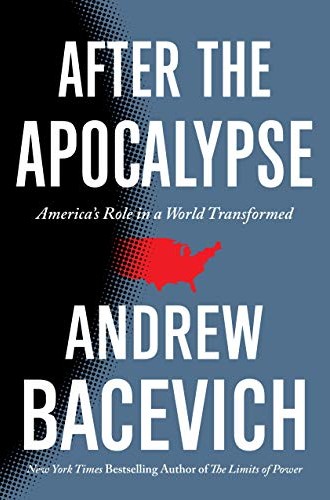
After the Apocalypse
America’s Role in a Transformed World
By Andrew Bacevich
Buy from Bookshop.org ›
America’s Role in a Transformed World
By Andrew Bacevich
Buy from Bookshop.org ›
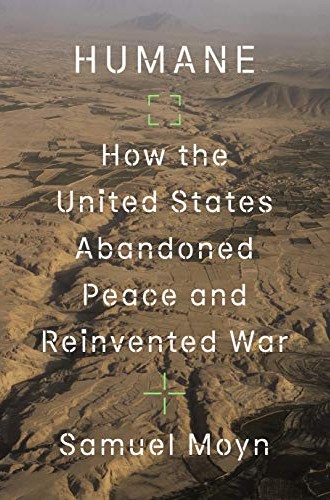
Humane
How the United States Abandoned Peace and Reinvented War
By Samuel Moyn
Buy from Bookshop.org ›
Until Russia’s invasion of Ukraine, the international positioning of the United States was for several decades defined by the war on terror. This framework led us to conduct simultaneous wars in Iraq and Afghanistan. It propelled us into dramatic new forms of drone warfare. In many ways, it continues to define our military’s efforts and military spending. And yet the need to rethink the nation’s military role in the world is urgent. The future that the war on terror projects for us involves trillions of dollars and millions of human lives wasted in the name of an imagined safety that is poorly defined and even more poorly created.
Two recent books attempt to build a vocabulary for a different way forward. Although they arise from different sets of concerns and ultimately propose different solutions to our dilemma, each is comprehensive in its own way—and each sees the need for a reckoning.
Andrew Bacevich is a retired military officer and military historian who has positioned himself as a central critic of our current foreign policy and the use of our military internationally. His most recent book tries to “identify the connecting tissue between the delusions of the recent past and the traumas that are their progeny.” The delusions of the recent past are military delusions: that we can use our supreme military dominance to solve problems that are essentially political in nature. “The traumas that are their progeny” are a little more wide-ranging. Bacevich places both the war in Afghanistan and COVID-19 in that category.
It may seem strange to find a common root to these disparate events, but it makes sense once you realize that his essential argument has two components: one ideological and the other financial. What you spend money on tells you what you think the world is and what is of value. And in Bacevich’s opinion, the United States’ checkbook couldn’t be more poorly proportioned.
For example, if you think the world is full of dangerous enemies who are out to get you (as the war on terror instructed us to believe), then you’ve got to spend an enormous amount of money trying to figure out how to track these enemies down and kill them before they kill you. And this is exactly how the US military is arranged, with huge amounts of funding aimed at fighting these enemies on a global scale.
However, Bacevich argues, if you note that the greatest threats to our national security happen right here at home (including COVID-19 and climate change–related disasters), then you might allocate your spending differently. You might start to think that spending a little less on the latest and greatest drone technology designed to defeat foreign enemies and a little more on remaking the infrastructure of our own country so that we might create more safety in people’s daily lives is a good idea. Even a responsible, necessary idea.
But, Bacevich moans, we have learned nothing. A pandemic, a $1.6 trillion war with no discernible positive outcomes, and climate change disaster after climate change disaster have not caused us to pause in the war on terror or recalculate our role as the global police. All “the myriad disappointments and miscalculations of the post–Cold War decades have left the historical consciousness of 1947 remarkably intact,” he writes. We still think our wars are righteous and our tactics are the right ones. We still need to scan the world for the bad guys and blow them up, wherever they may be. Russia’s actions have perhaps exposed the haplessness of this way of thinking.
But Russia’s invasion of Ukraine has also been hard on some of the ideas that Bacevich pushes forward in this book. He would very much like to see us get rid of the idea of the West. It has done us no good, he says. The West does not really exist, and we need to part ways with the ideology it represents.
Second, we need to put the United States first. This is not the Trumpian “America first,” but it does say that we should start with securing our own well-being and then move outward, something Bacevich doesn’t think has happened since perhaps 2001. The war in Afghanistan cannot be said to have served the American people, he argues. So who did it serve?
Third, he believes that we need to withdraw all of our military bases around the world (except the ones in the Far East), let Russia have Ukraine, leave Israel to its own devices, withdraw from NATO, and spend a few decades using all the money we’ve saved on preventing climate change and ensuring the well-being of the people here at home. Since Russia’s invasion, Bacevich has come forward to argue that we are to blame for it, for “recklessly” expanding NATO when we should have been retracting it and reimagining it for a post–Cold War world.
There’s a lot to disagree with here, and in this mode, Bacevich’s argument lacks nuance. But on this point, I find him convincing: “A national security paradigm centered on military supremacy, global power projection, decades-old formal alliances, and wars that never seem to end [is] at best obsolete, if not itself a principal source of self-inflicted wounds.” This is the kind of “national security” Russia is currently enacting, and we know that it doesn’t work.
By the end of After the Apocalypse, you might find yourself thinking, “Why are we so stupid?” Law professor Samuel Moyn’s contribution to this conversation takes us quite a good distance beyond stupid toward an understanding of how we find ourselves in this situation.
Humane traces one through line in global history from the 19th century to the present day: the idea of world peace as it interacts with the idea of the humane war. In the 19th century, world peace—that nations might stop waging war entirely—seemed like a plausible political goal. But the idea that war could be made more humane, Moyn shows, is what captured our political and global imagination over the next century.
While 20th-century wars cannot be called humane by any means, the idea of humane war eventually created the conditions for what Bacevich calls, in After the Apocalypse, “wars that never seem to end.” With the United States spending more on its military than all of the world’s other large economies combined, America has been the primary creator of both the technology of humane war and the ideology of it. The imagined ideal is that the United States can use its military supremacy to control the world while reducing the human costs of war.
Sadly, this idea did not prove true as we watched Afghanistan crumble. And it has not found fertile new ground in Ukraine, as Russia has used decidedly inhumane tactics to conduct a costly and brutal ground war. But the idea and even passion for the humane war was on all of our minds as we wondered if the military could get the “good people” out of Afghanistan alive, save the starving children, and keep the Taliban in check. And it stays on our minds as we talk about Russia engaging in outdated techniques with an 18th-century mentality.
The humane war, Moyn argues, is not the same as the good war. The humane war is never interrogated for its greater purposes. Just war theory does not apply. Instead it is relentlessly criticized and investigated for its tactics. In the midst of a humane war, very few ever ask, “Why are we fighting in the first place? Should we even be here?” Instead they ask about targeted killings and civilian casualties.
In Moyn’s assessment, Barack Obama was this century’s greatest architect of the humane war. Obama created what Moyn calls a “drone empire” while working on a legal framework in international law that would allow the United States to go to war anytime with anyone anywhere in the world. Meanwhile he focused on correcting the errors of the Bush administration by expanding the humanity of the wars’ tactics: ever more precise weapons, an end to torture, and an “intense concern” for both the ethical and optical dimensions of making war humane. His administration created very high standards for the humane war and then tried to meet those standards, never mind that the very idea of perpetual war was in violation of decades of international law.
The war on terror, announced by the George W. Bush administration, was the vehicle that allowed the incredible expansion and duration of this global and never-ending war—because terrorists are always bad, and they can be anywhere, in any nation, ignored or supported by any government. The imagined result of fighting the war on terror is not an end to terror but a vast expansion of American power, while doubling down on the idea that Americans are always right wherever and whenever they choose to fight.
Moyn and Bacevich agree on this: wars fought like this can’t be won. The endlessness of the war in Afghanistan was not an accident. Our failure to secure a victory wasn’t due to carelessness or the failure of political will. It wasn’t the result of surging or failing to surge. It was the logical end of these new tactics and these new ideas about how war should be fought.
Unfortunately, with the new circumstances on the ground and the rapid shifting of global dynamics, the reckoning which both Moyn and Bacevich call for may be further off than ever. That doesn’t make it less necessary.
This review appears in the May 4, 2022 issue.
Amy Frykholm
The Century contributing editor is the author of six books, including the novel High Hawk.All articles »
==
==
Regarp Book Blog
Reviews & Essays
Home
Review of: After the Apocalypse: America’s Role in the World Transformed, by Andrew Bacevich
I often suffer pangs of guilt when a volume received through an early reviewer program languishes on the shelf unread for an extended period. Such was the case with the “Advanced Reader’s Edition” of After the Apocalypse: America’s Role in the World Transformed, by Andrew Bacevich, that arrived in August 2021 and sat forsaken for an entire year until it finally fell off the top of my TBR (To-Be-Read) list and onto my lap. While hardly deliberate, my delay was no doubt neglectful. But sometimes neglect can foster unexpected opportunities for evaluation. More on that later.
First, a little about Andrew Bacevich. A West Point graduate and platoon leader in Vietnam 1970-71, he went on to an army career that spanned twenty-three years, including the Gulf War, retiring with the rank of Colonel. (It is said his early retirement was due to being passed over for promotion after taking responsibility for an accidental explosion at a camp he commanded in Kuwait.) He later became an academic, Professor Emeritus of International Relations and History at Boston University, and one-time director of its Center for International Relations (1998-2005). He is now president and co-founder of the bipartisan think-tank, the Quincy Institute for Responsible Statecraft. Deeply influenced by the theologian and ethicist Reinhold Niebuhr, Bacevich was once tagged as a conservative Catholic historian, but he defies simple categorization, most often serving as an unlikely voice in the wilderness decrying America’s “endless wars.” He has been a vocal, longtime critic of George W. Bush’s doctrine of preventative war, most prominently manifested in the Iraqi conflict, which he has rightly termed a “catastrophic failure.” He has also denounced the conceit of “American Exceptionalism,” and chillingly notes that the reliance on an all-volunteer military force translates into the ongoing, almost anonymous sacrifice of our men and women for a nation that largely has no skin in the game. His own son, a young army lieutenant, was killed in Iraq in 2007. I have previously read three other Bacevich works. As I noted in a review of one of these, his resumé attaches to Bacevich either enormous credibility or an axe to grind, or perhaps both. Still, as a scholar and gifted writer, he tends to be well worth the read.
The “apocalypse” central to the title of this book takes aim at the chaos that engulfed 2020, spawned by the sum total of the “toxic and divisive” Trump presidency, the increasing death toll of the pandemic, an economy in free fall, mass demonstrations by Black Lives Matter proponents seeking long-denied social justice, and rapidly spreading wildfires that dramatically underscored the looming catastrophe of global climate change. [p.1-3] Bacevich takes this armload of calamities as a flashing red signal that the country is not only headed in the wrong direction, but likely off a kind of cliff if we do not immediately take stock and change course. He draws odd parallels with the 1940 collapse of the French army under the Nazi onslaught, which—echoing French historian Marc Bloch—he lays to “utter incompetence” and “a failure of leadership” at the very top. [p.xiv] This then serves as a head-scratching segue into a long-winded polemic on national security and foreign policy that recycles familiar Bacevich themes but offers little in the way of fresh analysis. This trajectory strikes as especially incongruent given that the specific litany of woes besetting the nation that populate his opening narrative have—rarely indeed for the United States—almost nothing to do with the military or foreign affairs.
If ever history was to manufacture an example of a failure of leadership, of course, it would be hard-pressed to come up with a better model than Donald Trump, who drowned out the noise of a series of mounting crises with a deafening roar of self-serving, hateful rhetoric directed at enemies real and imaginary, deliberately ignoring the threat of both coronavirus and climate change, while stoking racial tensions. Bacevich gives him his due, noting that his “ascent to the White House exposed gaping flaws in the American political system, his manifest contempt for the Constitution and the rule of law placing in jeopardy our democratic traditions.” [p.2] But while he hardly masks his contempt for Trump, Bacevich makes plain that there’s plenty of blame to go around for political elites in both parties, and he takes no prisoners, landing a series of blows on George W. Bush, Barack Obama, Hillary Clinton, Joe Biden, and a host of other members of the Washington establishment that he holds accountable for fostering and maintaining the global post-Cold War “American Empire” responsible for the “endless wars” that he has long condemned. He credits Trump for urging a retreat from alliances and engagements, but faults the selfish motives of an “America First” predicated on isolationism. Bacevich instead envisions a more positive role for the United States in the international arena—one with its sword permanently sheathed.
All this is heady stuff, and regardless of your politics many readers will find themselves nodding their heads as Bacevich makes his case, outlining the many wrongheaded policy endeavors championed by Republicans and Democrats alike for a wobbly superpower clinging to an outdated and increasingly irrelevant sense of national identity that fails to align with the global realities of the twenty-first century. But then, as Bacevich looks to the future for alternatives, as he seeks to map out on paper the next new world order, he stumbles, and stumbles badly, something only truly evident in retrospect when viewing his point of view through the prism of the events that followed the release of After the Apocalypse in June 2021.
Bacevich has little to add here to his longstanding condemnation of the U.S. occupation of Afghanistan, which after two long decades of failed attempts at nation-building came to an end with our messy withdrawal in August 2021, just shortly after this book’s publication. President Biden was pilloried for the chaotic retreat, but while his administration could rightly be held to account for a failure to prepare for the worst, the elephant in that room in the Kabul airport where the ISIS-K suicide bomber blew himself up was certainly former president Trump, who brokered the deal to return Afghanistan to Taliban control. Biden, who plummeted in the polls due to outcomes he could do little to control, was disparaged much the same way Obama once was when he was held to blame for the subsequent turmoil in Iraq after effecting the withdrawal of U.S. forces agreed to by his predecessor, G.W. Bush. Once again, history rhymes. But the more salient point for those of us who share, as I do, Bacevich’s anti-imperialism, is that getting out is ever more difficult than going in.
But Bacevich has a great deal to say in After the Apocalypse about NATO, an alliance rooted in a past-tense Cold War stand-off that he pronounces counterproductive and obsolete. Bacevich disputes the long-held mythology of the so-called “West,” an artificial “sentiment” that has the United States and European nations bound together with common values of liberty, human rights, and democracy. Like Trump—who likely would have acted upon this had he been reelected—Bacevich calls for an end to US involvement with NATO. The United States and Europe have embarked on “divergent paths,” he argues, and that is as it should be. The Cold War is over. Relations with Russia and China are frosty, but entanglement in an alliance like NATO only fosters acrimony and fails to appropriately adapt our nation to the realities of the new millennium.
It is an interesting if academic argument that was abruptly crushed under the weight of the treads of Russian tanks in the premeditated invasion of Ukraine February 24, 2022. If some denied the echo of Hitler’s 1938 Austrian Anschluss to Putin’s 2014 annexation of Crimea, there was no mistaking the similarity of unprovoked attacks on Kyiv and sister cities to the Nazi war machine’s march on Poland in 1939. And yes, when Biden and French President Emmanuel Macron stood together to unite that so-called West against Russian belligerence, the memory of France’s 1940 defeat was hardly out of mind. All of a sudden, NATO became less a theoretical construct and somewhat more of a safe haven against brutal militarism, wanton aggression, and the unapologetic war crimes that livestream on twenty-first century social media of streets littered with the bodies of civilians, many of them children. All of a sudden, NATO is pretty goddamned relevant.
In all this, you could rightly argue against the wrong turns made after the dissolution of the USSR, of the failure of the West to allocate appropriate economic support for the heirs of the former Soviet Union, of how a pattern of NATO expansion both isolated and antagonized Russia. But there remains no legitimate defense for Putin’s attempt to invade, besiege, and absorb a weaker neighbor—or at least a neighbor he perceived to be weaker, a misstep that could lead to his own undoing. Either way, the institution we call NATO turned out to be something to celebrate rather than deprecate. The fact that it is working exactly the way it was designed to work could turn out to be the real road map to the new world order that emerges in the aftermath of this crisis. We can only imagine the horrific alternatives had Trump won re-election: the U.S. out of NATO, Europe divided, Ukraine overrun and annexed, and perhaps even Putin feted at a White House dinner. So far, without firing a shot, NATO has not only saved Ukraine; arguably, it has saved the world as we know it, a world that extends well beyond whatever we might want to consider the “West.”
As much as I respect Bacevich and admire his scholarship, his informed appraisal of our current foreign policy realities has turned out to be entirely incorrect. Yes, the United States should rein in the American Empire. Yes, we should turn away from imperialist tendencies. Yes, we should focus our defense budget solely on defense, not aggression, resisting the urge to try to remake the world in our own image for either altruism or advantage. But at the same time, we must be mindful—like other empires in the past—that retreat can create vacuums, and we must be ever vigilant of what kinds of powers may fill those vacuums. Because we can grow and evolve into a better nation, a better people, but that evolution may not be contagious to our adversaries. Because getting out remains ever more difficult than going in.
Finally, a word about the use of the term “apocalypse,” a characterization that is bandied about a bit too frequently these days. 2020 was a pretty bad year, indeed, but it was hardly apocalyptic. Not even close. Despite the twin horrors of Trump and the pandemic, we have had other years that were far worse. Think 1812, when the British burned Washington and sent the president fleeing for his life. And 1862, with tens of thousands already lying dead on Civil War battlefields as the Union army suffered a series of reverses. And 1942, still in the throes of economic depression, with Germany and Japan lined up against us. And 1968, marked by riots and assassinations, when it truly seemed that the nation was unraveling from within. Going forward, climate change may certainly breed apocalypse. So might a cornered Putin, equipped with an arsenal of nuclear weapons and diminishing options as Russian forces in the field teeter on collapse. But 2020 is already in the rear-view mirror. It will no doubt leave a mark upon us, but as we move on, it spins ever faster into our past. At the same time, predicting the future, even when armed with the best data, is fraught with unanticipated obstacles, and grand strategies almost always lead to failure. It remains our duty to study our history while we engage with our present. Apocalyptic or not, it’s all we’ve got …
I have reviewed other Bacevich books here:
Review of: Breach of Trust: How Americans Failed Their Soldiers and Their Country, by Andrew J. Bacevich
Review of: America’s War for the Greater Middle East: A Military History, by Andrew J. Bacevich
==
==
==
How the United States Abandoned Peace and Reinvented War
By Samuel Moyn
Buy from Bookshop.org ›
Until Russia’s invasion of Ukraine, the international positioning of the United States was for several decades defined by the war on terror. This framework led us to conduct simultaneous wars in Iraq and Afghanistan. It propelled us into dramatic new forms of drone warfare. In many ways, it continues to define our military’s efforts and military spending. And yet the need to rethink the nation’s military role in the world is urgent. The future that the war on terror projects for us involves trillions of dollars and millions of human lives wasted in the name of an imagined safety that is poorly defined and even more poorly created.
Two recent books attempt to build a vocabulary for a different way forward. Although they arise from different sets of concerns and ultimately propose different solutions to our dilemma, each is comprehensive in its own way—and each sees the need for a reckoning.
Andrew Bacevich is a retired military officer and military historian who has positioned himself as a central critic of our current foreign policy and the use of our military internationally. His most recent book tries to “identify the connecting tissue between the delusions of the recent past and the traumas that are their progeny.” The delusions of the recent past are military delusions: that we can use our supreme military dominance to solve problems that are essentially political in nature. “The traumas that are their progeny” are a little more wide-ranging. Bacevich places both the war in Afghanistan and COVID-19 in that category.
It may seem strange to find a common root to these disparate events, but it makes sense once you realize that his essential argument has two components: one ideological and the other financial. What you spend money on tells you what you think the world is and what is of value. And in Bacevich’s opinion, the United States’ checkbook couldn’t be more poorly proportioned.
For example, if you think the world is full of dangerous enemies who are out to get you (as the war on terror instructed us to believe), then you’ve got to spend an enormous amount of money trying to figure out how to track these enemies down and kill them before they kill you. And this is exactly how the US military is arranged, with huge amounts of funding aimed at fighting these enemies on a global scale.
However, Bacevich argues, if you note that the greatest threats to our national security happen right here at home (including COVID-19 and climate change–related disasters), then you might allocate your spending differently. You might start to think that spending a little less on the latest and greatest drone technology designed to defeat foreign enemies and a little more on remaking the infrastructure of our own country so that we might create more safety in people’s daily lives is a good idea. Even a responsible, necessary idea.
But, Bacevich moans, we have learned nothing. A pandemic, a $1.6 trillion war with no discernible positive outcomes, and climate change disaster after climate change disaster have not caused us to pause in the war on terror or recalculate our role as the global police. All “the myriad disappointments and miscalculations of the post–Cold War decades have left the historical consciousness of 1947 remarkably intact,” he writes. We still think our wars are righteous and our tactics are the right ones. We still need to scan the world for the bad guys and blow them up, wherever they may be. Russia’s actions have perhaps exposed the haplessness of this way of thinking.
But Russia’s invasion of Ukraine has also been hard on some of the ideas that Bacevich pushes forward in this book. He would very much like to see us get rid of the idea of the West. It has done us no good, he says. The West does not really exist, and we need to part ways with the ideology it represents.
Second, we need to put the United States first. This is not the Trumpian “America first,” but it does say that we should start with securing our own well-being and then move outward, something Bacevich doesn’t think has happened since perhaps 2001. The war in Afghanistan cannot be said to have served the American people, he argues. So who did it serve?
Third, he believes that we need to withdraw all of our military bases around the world (except the ones in the Far East), let Russia have Ukraine, leave Israel to its own devices, withdraw from NATO, and spend a few decades using all the money we’ve saved on preventing climate change and ensuring the well-being of the people here at home. Since Russia’s invasion, Bacevich has come forward to argue that we are to blame for it, for “recklessly” expanding NATO when we should have been retracting it and reimagining it for a post–Cold War world.
There’s a lot to disagree with here, and in this mode, Bacevich’s argument lacks nuance. But on this point, I find him convincing: “A national security paradigm centered on military supremacy, global power projection, decades-old formal alliances, and wars that never seem to end [is] at best obsolete, if not itself a principal source of self-inflicted wounds.” This is the kind of “national security” Russia is currently enacting, and we know that it doesn’t work.
By the end of After the Apocalypse, you might find yourself thinking, “Why are we so stupid?” Law professor Samuel Moyn’s contribution to this conversation takes us quite a good distance beyond stupid toward an understanding of how we find ourselves in this situation.
Humane traces one through line in global history from the 19th century to the present day: the idea of world peace as it interacts with the idea of the humane war. In the 19th century, world peace—that nations might stop waging war entirely—seemed like a plausible political goal. But the idea that war could be made more humane, Moyn shows, is what captured our political and global imagination over the next century.
While 20th-century wars cannot be called humane by any means, the idea of humane war eventually created the conditions for what Bacevich calls, in After the Apocalypse, “wars that never seem to end.” With the United States spending more on its military than all of the world’s other large economies combined, America has been the primary creator of both the technology of humane war and the ideology of it. The imagined ideal is that the United States can use its military supremacy to control the world while reducing the human costs of war.
Sadly, this idea did not prove true as we watched Afghanistan crumble. And it has not found fertile new ground in Ukraine, as Russia has used decidedly inhumane tactics to conduct a costly and brutal ground war. But the idea and even passion for the humane war was on all of our minds as we wondered if the military could get the “good people” out of Afghanistan alive, save the starving children, and keep the Taliban in check. And it stays on our minds as we talk about Russia engaging in outdated techniques with an 18th-century mentality.
The humane war, Moyn argues, is not the same as the good war. The humane war is never interrogated for its greater purposes. Just war theory does not apply. Instead it is relentlessly criticized and investigated for its tactics. In the midst of a humane war, very few ever ask, “Why are we fighting in the first place? Should we even be here?” Instead they ask about targeted killings and civilian casualties.
In Moyn’s assessment, Barack Obama was this century’s greatest architect of the humane war. Obama created what Moyn calls a “drone empire” while working on a legal framework in international law that would allow the United States to go to war anytime with anyone anywhere in the world. Meanwhile he focused on correcting the errors of the Bush administration by expanding the humanity of the wars’ tactics: ever more precise weapons, an end to torture, and an “intense concern” for both the ethical and optical dimensions of making war humane. His administration created very high standards for the humane war and then tried to meet those standards, never mind that the very idea of perpetual war was in violation of decades of international law.
The war on terror, announced by the George W. Bush administration, was the vehicle that allowed the incredible expansion and duration of this global and never-ending war—because terrorists are always bad, and they can be anywhere, in any nation, ignored or supported by any government. The imagined result of fighting the war on terror is not an end to terror but a vast expansion of American power, while doubling down on the idea that Americans are always right wherever and whenever they choose to fight.
Moyn and Bacevich agree on this: wars fought like this can’t be won. The endlessness of the war in Afghanistan was not an accident. Our failure to secure a victory wasn’t due to carelessness or the failure of political will. It wasn’t the result of surging or failing to surge. It was the logical end of these new tactics and these new ideas about how war should be fought.
Unfortunately, with the new circumstances on the ground and the rapid shifting of global dynamics, the reckoning which both Moyn and Bacevich call for may be further off than ever. That doesn’t make it less necessary.
This review appears in the May 4, 2022 issue.
Amy Frykholm
The Century contributing editor is the author of six books, including the novel High Hawk.All articles »
==
==
Regarp Book Blog
Reviews & Essays
Home
Review of: After the Apocalypse: America’s Role in the World Transformed, by Andrew Bacevich
I often suffer pangs of guilt when a volume received through an early reviewer program languishes on the shelf unread for an extended period. Such was the case
 with the “Advanced Reader’s Edition” of After the Apocalypse: America’s Role in the World Transformed, by Andrew Bacevich, that arrived in August 2021 and sat forsaken for an entire year until it finally fell off the top of my TBR (To-Be-Read) list and onto my lap. While hardly deliberate, my delay was no doubt neglectful. But sometimes neglect can foster unexpected opportunities for evaluation. More on that later.
First, a little about Andrew Bacevich. A West Point graduate and platoon leader in Vietnam 1970-71, he went on to an army career that spanned twenty-three years, including the Gulf War, retiring with the rank of Colonel. (It is said his early retirement was due to being passed over for promotion after taking responsibility for an accidental explosion at a camp he commanded in Kuwait.) He later became an academic, Professor Emeritus of International Relations and History at Boston University, and one-time director of its Center for International Relations (1998-2005). He is now president and co-founder of the bipartisan think-tank, the Quincy Institute for Responsible Statecraft. Deeply influenced by the theologian and ethicist Reinhold Niebuhr, Bacevich was once tagged as a conservative Catholic historian, but he defies simple categorization, most often serving as an unlikely voice in the wilderness decrying America’s “endless wars.” He has been a vocal, longtime critic of George W. Bush’s doctrine of preventative war, most prominently manifested in the Iraqi conflict, which he has rightly termed a “catastrophic failure.” He has also denounced the conceit of “American Exceptionalism,” and chillingly notes that the reliance on an all-volunteer military force translates into the ongoing, almost anonymous sacrifice of our men and women for a nation that largely has no skin in the game. His own son, a young army lieutenant, was killed in Iraq in 2007. I have previously read three other Bacevich works. As I noted in a review of one of these, his resumé attaches to Bacevich either enormous credibility or an axe to grind, or perhaps both. Still, as a scholar and gifted writer, he tends to be well worth the read.
The “apocalypse” central to the title of this book takes aim at the chaos that engulfed 2020, spawned by the sum total of the “toxic and divisive” Trump presidency, the increasing death toll of the pandemic, an economy in free fall, mass demonstrations by Black Lives Matter proponents seeking long-denied social justice, and rapidly spreading wildfires that dramatically underscored the looming catastrophe of global climate change. [p.1-3] Bacevich takes this armload of calamities as a flashing red signal that the country is not only headed in the wrong direction, but likely off a kind of cliff if we do not immediately take stock and change course. He draws odd parallels with the 1940 collapse of the French army under the Nazi onslaught, which—echoing French historian Marc Bloch—he lays to “utter incompetence” and “a failure of leadership” at the very top. [p.xiv] This then serves as a head-scratching segue into a long-winded polemic on national security and foreign policy that recycles familiar Bacevich themes but offers little in the way of fresh analysis. This trajectory strikes as especially incongruent given that the specific litany of woes besetting the nation that populate his opening narrative have—rarely indeed for the United States—almost nothing to do with the military or foreign affairs.
If ever history was to manufacture an example of a failure of leadership, of course, it would be hard-pressed to come up with a better model than Donald Trump, who drowned out the noise of a series of mounting crises with a deafening roar of self-serving, hateful rhetoric directed at enemies real and imaginary, deliberately ignoring the threat of both coronavirus and climate change, while stoking racial tensions. Bacevich gives him his due, noting that his “ascent to the White House exposed gaping flaws in the American political system, his manifest contempt for the Constitution and the rule of law placing in jeopardy our democratic traditions.” [p.2] But while he hardly masks his contempt for Trump, Bacevich makes plain that there’s plenty of blame to go around for political elites in both parties, and he takes no prisoners, landing a series of blows on George W. Bush, Barack Obama, Hillary Clinton, Joe Biden, and a host of other members of the Washington establishment that he holds accountable for fostering and maintaining the global post-Cold War “American Empire” responsible for the “endless wars” that he has long condemned. He credits Trump for urging a retreat from alliances and engagements, but faults the selfish motives of an “America First” predicated on isolationism. Bacevich instead envisions a more positive role for the United States in the international arena—one with its sword permanently sheathed.
All this is heady stuff, and regardless of your politics many readers will find themselves nodding their heads as Bacevich makes his case, outlining the many wrongheaded policy endeavors championed by Republicans and Democrats alike for a wobbly superpower clinging to an outdated and increasingly irrelevant sense of national identity that fails to align with the global realities of the twenty-first century. But then, as Bacevich looks to the future for alternatives, as he seeks to map out on paper the next new world order, he stumbles, and stumbles badly, something only truly evident in retrospect when viewing his point of view through the prism of the events that followed the release of After the Apocalypse in June 2021.
Bacevich has little to add here to his longstanding condemnation of the U.S. occupation of Afghanistan, which after two long decades of failed attempts at nation-building came to an end with our messy withdrawal in August 2021, just shortly after this book’s publication. President Biden was pilloried for the chaotic retreat, but while his administration could rightly be held to account for a failure to prepare for the worst, the elephant in that room in the Kabul airport where the ISIS-K suicide bomber blew himself up was certainly former president Trump, who brokered the deal to return Afghanistan to Taliban control. Biden, who plummeted in the polls due to outcomes he could do little to control, was disparaged much the same way Obama once was when he was held to blame for the subsequent turmoil in Iraq after effecting the withdrawal of U.S. forces agreed to by his predecessor, G.W. Bush. Once again, history rhymes. But the more salient point for those of us who share, as I do, Bacevich’s anti-imperialism, is that getting out is ever more difficult than going in.
But Bacevich has a great deal to say in After the Apocalypse about NATO, an alliance rooted in a past-tense Cold War stand-off that he pronounces counterproductive and obsolete. Bacevich disputes the long-held mythology of the so-called “West,” an artificial “sentiment” that has the United States and European nations bound together with common values of liberty, human rights, and democracy. Like Trump—who likely would have acted upon this had he been reelected—Bacevich calls for an end to US involvement with NATO. The United States and Europe have embarked on “divergent paths,” he argues, and that is as it should be. The Cold War is over. Relations with Russia and China are frosty, but entanglement in an alliance like NATO only fosters acrimony and fails to appropriately adapt our nation to the realities of the new millennium.
It is an interesting if academic argument that was abruptly crushed under the weight of the treads of Russian tanks in the premeditated invasion of Ukraine February 24, 2022. If some denied the echo of Hitler’s 1938 Austrian Anschluss to Putin’s 2014 annexation of Crimea, there was no mistaking the similarity of unprovoked attacks on Kyiv and sister cities to the Nazi war machine’s march on Poland in 1939. And yes, when Biden and French President Emmanuel Macron stood together to unite that so-called West against Russian belligerence, the memory of France’s 1940 defeat was hardly out of mind. All of a sudden, NATO became less a theoretical construct and somewhat more of a safe haven against brutal militarism, wanton aggression, and the unapologetic war crimes that livestream on twenty-first century social media of streets littered with the bodies of civilians, many of them children. All of a sudden, NATO is pretty goddamned relevant.
In all this, you could rightly argue against the wrong turns made after the dissolution of the USSR, of the failure of the West to allocate appropriate economic support for the heirs of the former Soviet Union, of how a pattern of NATO expansion both isolated and antagonized Russia. But there remains no legitimate defense for Putin’s attempt to invade, besiege, and absorb a weaker neighbor—or at least a neighbor he perceived to be weaker, a misstep that could lead to his own undoing. Either way, the institution we call NATO turned out to be something to celebrate rather than deprecate. The fact that it is working exactly the way it was designed to work could turn out to be the real road map to the new world order that emerges in the aftermath of this crisis. We can only imagine the horrific alternatives had Trump won re-election: the U.S. out of NATO, Europe divided, Ukraine overrun and annexed, and perhaps even Putin feted at a White House dinner. So far, without firing a shot, NATO has not only saved Ukraine; arguably, it has saved the world as we know it, a world that extends well beyond whatever we might want to consider the “West.”
As much as I respect Bacevich and admire his scholarship, his informed appraisal of our current foreign policy realities has turned out to be entirely incorrect. Yes, the United States should rein in the American Empire. Yes, we should turn away from imperialist tendencies. Yes, we should focus our defense budget solely on defense, not aggression, resisting the urge to try to remake the world in our own image for either altruism or advantage. But at the same time, we must be mindful—like other empires in the past—that retreat can create vacuums, and we must be ever vigilant of what kinds of powers may fill those vacuums. Because we can grow and evolve into a better nation, a better people, but that evolution may not be contagious to our adversaries. Because getting out remains ever more difficult than going in.
Finally, a word about the use of the term “apocalypse,” a characterization that is bandied about a bit too frequently these days. 2020 was a pretty bad year, indeed, but it was hardly apocalyptic. Not even close. Despite the twin horrors of Trump and the pandemic, we have had other years that were far worse. Think 1812, when the British burned Washington and sent the president fleeing for his life. And 1862, with tens of thousands already lying dead on Civil War battlefields as the Union army suffered a series of reverses. And 1942, still in the throes of economic depression, with Germany and Japan lined up against us. And 1968, marked by riots and assassinations, when it truly seemed that the nation was unraveling from within. Going forward, climate change may certainly breed apocalypse. So might a cornered Putin, equipped with an arsenal of nuclear weapons and diminishing options as Russian forces in the field teeter on collapse. But 2020 is already in the rear-view mirror. It will no doubt leave a mark upon us, but as we move on, it spins ever faster into our past. At the same time, predicting the future, even when armed with the best data, is fraught with unanticipated obstacles, and grand strategies almost always lead to failure. It remains our duty to study our history while we engage with our present. Apocalyptic or not, it’s all we’ve got …
I have reviewed other Bacevich books here:
Review of: Breach of Trust: How Americans Failed Their Soldiers and Their Country, by Andrew J. Bacevich
Review of: America’s War for the Greater Middle East: A Military History, by Andrew J. Bacevich
==
==
==

No comments:
Post a Comment