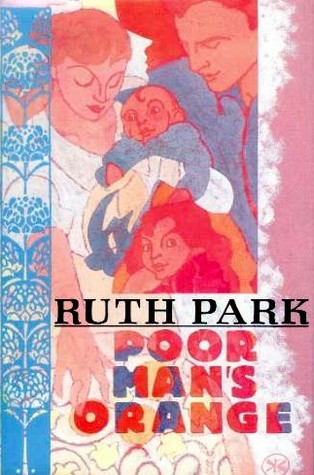
Ruth Park
4.20
1,071 ratings66 reviews
First published in 1949 as the sequel to the award-winning "The Harp in the South", this novel continues the story of the Darcy family of Sydney.
It’s the early 50s. The Darcy family have made a home for themselves in Surrey Hills, NSW. The elder daughter, Roie, is pregnant with her second child to her husband Charlie and Rosie’s sister, Dolour, finds comfort in doting over her niece Moira. Father Hughie and Mumma live downstairs, as irrepressible as ever. Continuing the history of the Irish Darcys begun in Missus and continued in The Harp in the South , this third installment of a trilogy reacquaints readers with the vicissitudes of slum life in a Sydney suburb. An unforgettable family and a cast of unforgettable characters enliven a story that is sometimes tragic but often humorous in a time of poverty and destitution, hope and promise.
GenresAustraliaFiction ClassicsHistorical FictionHistoricalNovelsLiterature
...more
274 pages, Hardcover
First published January 1, 1949
Original title
Poor Man's Orange
Series
Harp in the South (#3)
Setting
Australia
This edition
Format
274 pages, Hardcover
Published
January 1, 1987 by St Martins Pr
===
PaperbackPenguin Books Australia1977
PaperbackPenguin Books1978
PaperbackTBS The Book Service Ltd1980
PaperbackPenguin1987
Audio CDABC Audio2012
MP3 CDBolinda Audio2013
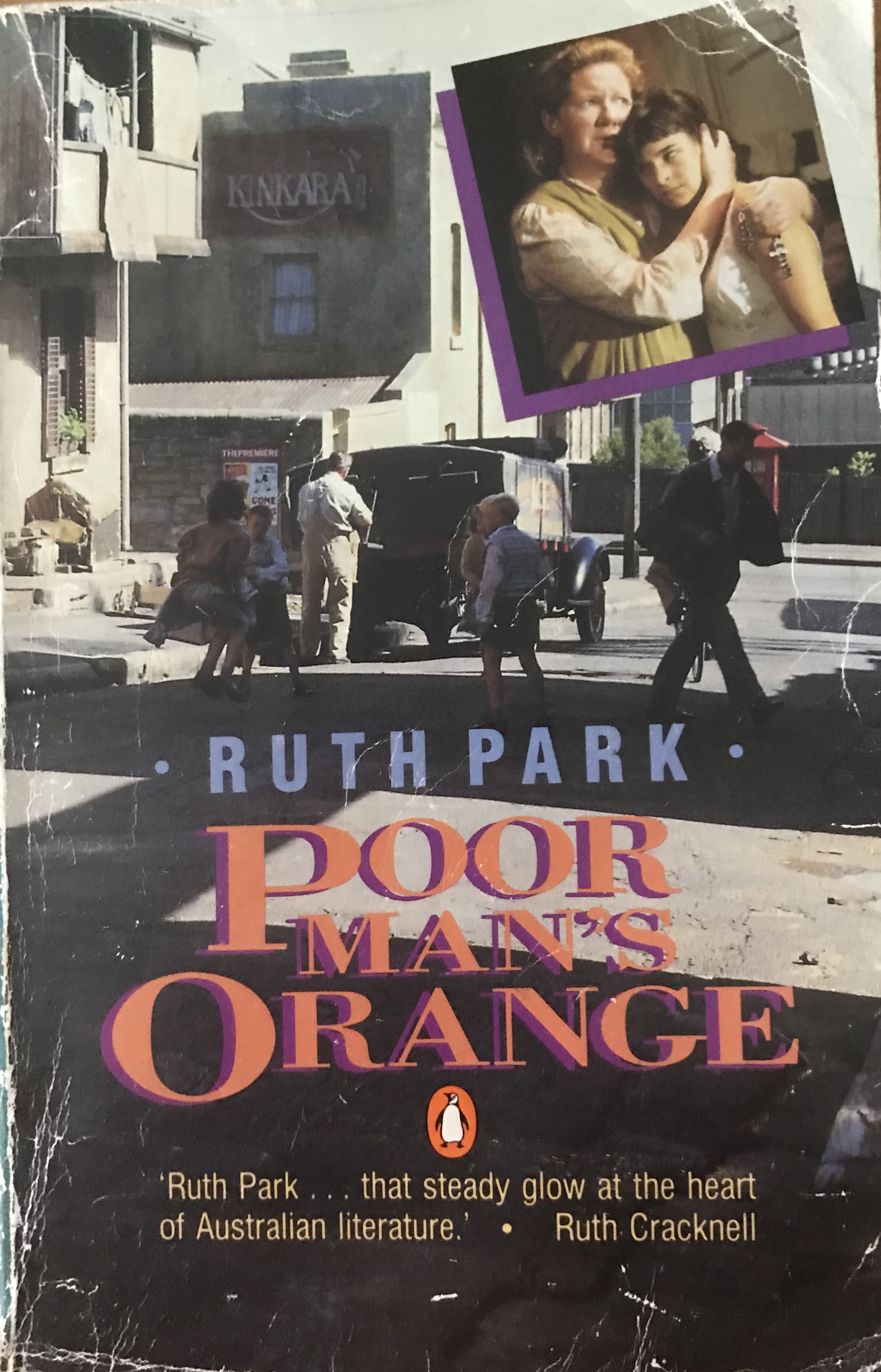
PaperbackPenguin Books
HardcoverSydney: Angus & Robertson1992
AudiobookBolinda Publishing Pty Ltd2012
HardcoverAngus & Robertson1952
PaperbackHorwitz Publications1961
MP3 CDBolinda Audio2013
HardcoverHalstead Press1949
Mass Market PaperbackPenguin Books
MP3 CD
Audible AudioBolinda Publishing Pty Ltd2012
HardcoverMichael Joseph1950
MP3 CDBolinda Audio2015
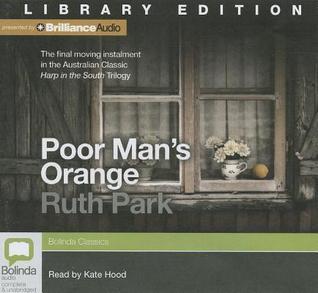
Audio CDBolinda Audio2013
Show all 22 editions
More information
Book statistics
Fewer details


5 people are currently reading


607 people want to read
About the author

Ruth Park80 books111 followers
Follow
Ruth Park was a New Zealand-born author, who spent most of her life in Australia. She was born in Auckland, and her family later moved to Te Kuiti further south in the North Island of New Zealand, where they lived in isolated areas.
During the Great Depression her working class father worked on bush roads, as a driver, on relief work, as a sawmill hand, and finally shifted back to Auckland as council worker living in a state house. After Catholic primary school Ruth won a partial scholarship to secondary school, but this was broken by periods of being unable to afford to attend. For a time she stayed with relatives on a Coromandel farming estate where she was treated like a serf by the wealthy landowner until she told the rich woman what she really thought of her.
Ruth claimed that she was involved in the Queen Street riots with her father. Later she worked at the Auckland Star before shifting to Australia in 1942. There she married the Australian writer D'Arcy Niland.
Her first novel was The Harp in the South (1948) - a story of Irish slum life in Sydney, which was translated into 10 languages. (Some critics called it a cruel fantasy because as far as they were concerned there were no slums in Sydney.) But Ruth and D'Arcy did live in Sydney slums at Surry Hills. She followed that up with Poor Man's Orange (1949). She also wrote Missus (1985) and other novels, as well as a long-running Australian children's radio show and scripts for film and TV. She created The Muddle-Headed Wombat series of children's books. Her autobiographies are A Fence Around the Cuckoo (1992) and Fishing in the Styx (1993). She also wrote a novel based in New Zealand, One-a-pecker, Two-a-pecker (1957), about gold mining in Otago (later renamed The Frost and The Fire).
Park received awards in Australia and internationally.
Winner of the Dromkeen Medal.
Readers also enjoyed
The Flight of the Falcon
Daphne du Maurier
3.53
2,840
Community Reviews
4.20
1,071 ratings66 reviews
5 stars
Displaying 1 - 10 of 66 reviews

Carol She's So Novel꧁꧂
943 reviews816 followers
Follow
September 9, 2024
Now if there was one thing more than another that maddened Hughie, it was being prayed for. He was not good friends with God, and with the things that had happened to him, Hughie thought that it was no wonder.
And this quote, from very early in the book, encapsulates a lot of the feckless Hughie's attitudes - which are central to this book.
This is the sequel to The Harp in the South The poverty stricken Darcys are still in Surry Hill, still living in unimaginable squalor, contending with filth, violence, bed bugs & Hughie's alcoholism.
Some of the descriptions are quite harrowing & I will say the book moves in a different direction than I thought it would take from Harp in the South. I thought Roie having slept once with Tommy was going to be an important plot point. The grimness of the story is lightened by some humour. For me Park's writing gifts are so complete.
The book still seems episodic - I don't know if, like Harp in the South, this book was originally serialised in a newspaper, but that is how it feels. & writing this makes me realise that Park at her best reminds me of Charles Dickens
I've now read all three parts of this series. Missus is a prequel & I don't feel it added anything to my enjoyment of the story. I would say that one is for Park completists only. I gave it 3.5★, but the other two are 5★ reads.
Still my favourite New Zealand novelist.

https://wordpress.com/view/carolshess...
2024-blk-challenge aotearoa-authors classics
35 likes
5 comments
Like
Comment

Karen
75 reviews
Follow
August 14, 2014
A truly Australian novel which depicts generational poverty in such a way that the reader is confronted with the reality of what poverty truly means.
I found it easy to picture my grandmother living during this time in Australian history. The dirt and pollution from the coal factories, the dull acceptance that the terraces where they were living were to be pulled down and replaced with high-rise, the fact that woman had no expectation of going to school past 14. On the other hand the sense of community was real, people who had nothing always found something to give to those less fortunate than themselves.
I would make this compulsory reading for the teens of today and ask them how and why did living conditions and working conditions 'improve'. I wonder if they have any understanding of the politics and sacrifices involved in creating a society that they now enjoy.
9 likes
Like
Comment

Sean Kennedy
Author 41 books1,008 followers
Follow
February 26, 2013
The Harp in the South trilogy can be called a bittersweet one, but PMO takes it even further. There is a lot of tragedy in this final volume, but Park's writing is a testimony to the hard knocks that life gives us, but how we struggle on regardless, even though we wonder why we do so. The poor man's orange has been tasted by everyone, and I think this book would resonate with all readers.
8 likes
Like
Comment

Nia Simone
Author 29 books9 followers
Follow
August 11, 2013
This book was recommended to me and I read it without having read its predecessor, in the trilogy.
In Poor Man's Orange, we start off right in the middle of the family. The style has a slice-of-life feel. And it's subtle. I didn't immediately know who the hero and heroine were for a long time.
Charlie's transformation is so fantastic. I hate these lazily written books where the hero just has a sudden thought that he loves her and so he’ll be totally different now and become the man we want the heroine to marry.
No! Prove it to me. And Park does. How she does!
Charlie’s fall to the bottom is like a bungee jump in slow motion. We get to agonize for pages and chapters about whether that rope is going to be the right length. Or will he slam headfirst into despair and ruin as do so many people in the slum?
The slum, by the way, achieves that to which all writers either aspire or should aspire, an environment so alive, so vibrant in its detailed reality that it rises to the level of a character in its own right.
What Park does, not by standing on a soapbox and waving a finger at us as she lectures us about not judging the poor for being dirty, but by showing us the absolute impossibility of keeping a clean house when you are impoverished. Mumma is burdened and defeated by filth, Roie destroyed by it. Dolour fights it, but of course she cannot defeat it. The most Dolour ever accomplishes is cleaning one small corner. The way Dolour manages to escape the grip of filth cannot be to overcome it because that would defeat the author’s purpose of showing how impossible it is to defeat dirt when you are poor. Park manages to keep Dolour above it, not of it, by having Dolour turn away from it, to show us the unconquerable cleanliness of her spirit. But the inevitability of dirt reigns supreme in this book. The slum never gets cleaner, never improves, never changes, even as it is about to be wrecked.
The leveling planned for the neighborhood is for the benefit of the land owners and developers, not the poor inhabitants. They will all go somewhere even worse, the elderly shunted off to die prematurely from stress as the homes they spent a lifetime in are knocked down in minutes.
The redemption and triumph of the hero is brilliant. Even as Charlie almost falls into the miasma of sin Dolour feels swirls everywhere around her, ready to suck her and anyone who becomes weak into it, the reader sympathizes with him for the reader has lived through his reasons with him.
And then his transformation. Park earns it. At the end -- no -- I'm not really going to tell you the end. But Charlie's transformation, wow. You get it. You can believe it.
Park also builds character by showing, again through a poignant scene, what Dolour admires. Or, to be more precise, who Dolour admires. The nuns who maintain inner tranquility and order, holding themselves bulwarks against chaos. I love the bit about Dolour and her friends wondering what the nuns take in their small travel valises, which represent the sum total of their worldly possessions. Park uses this as a way to show again, as she shows over and over again, the romantic sensibility of the heroine. In this scene, what Dolour imagines in the sisters' valises is romantic, by contrast to the cynical guesses of her friends.
The crowning glory on this book was the subtle revelation only at the end that it followed The Ugly Duckling story archetype.
This book has already helped me with my work in progress.
Show more
6 likes
Like
Comment

Chrissie
2,811 reviews1,429 followers
Follow
not-for-meMarch 15, 2023
See instead the separate books of the series:
*****************************
The Harp in the South Trilogy
*Missus TBR
*The Harp in the South TBR
*Poor Man's Orange TBR
*Swords and Crowns and Rings 2 stars
audible-uk australia hf
...more
5 likes
Like
Comment

Carolyn
1,245 reviews12 followers
Follow
April 1, 2020
I loved and was deeply moved by this book. When I read Harp in the South for our book group, I bought the trilogy but only just now got round to reading this last book of the three.
I had read and taught this novel years ago but so appreciated re-reading it. It is certainly the strongest of the books set in Surry Hills. I think this is because Park sees even more clearly the dirt and despair of slum living while still showing how some people (notably Dolour in this book) struggle to find a better life. Park also recognised that the changes she was fighting for (particularly better housing) were coming at a price for the inner city communities as they were moved either to high rise flats or to outer suburbs. There is a clarity to Park’s vision here that really impressed me. And I still enjoyed all the characters that I’d come to know in Harp in the South. Certainly a book of its times in many ways, in others timeless.
5 likes
Like
Comment

M.J. Johnson
Author 3 books228 followers
Follow
April 2, 2016
Excellent. This is a really enjoyable series and Poor Man's Orange is the final part in the trilogy - although it was written second (published 1949) by Ruth Park (she published The Harp in the South in 1948). I chose to read them in the order they were written and I'm happy with this choice (the first part, chronologically speaking, is Missus, but this was actually written over thirty years later, and published in 1985). If like me you were almost totally ignorant about Australian literature I can definitely recommend reading this series! Definitely plan to read more by and about Ruth Park.
favourites
5 likes
Like
Comment

Tania
492 reviews16 followers
Follow
April 22, 2020
3.5 ⭐️ The best of the ‘trilogy’. Initially, it felt directionless with each chapter being like an anecdote of the Darcys’ lives, but it began to draw together half way through. There is valuable post-WWii-Sydney content within the story, especially relating to the lives of women at the time. Park also captures grief beautifully.
new-zealand-australian-author sequel
3 likes
Like
Comment
Toni Kely-Brown
472 reviews8 followers
Follow
May 14, 2022
The sequel to Harp in the South, this continues the story of the Darcy family. Ruth Park continues to depict the poverty and tragedy of living in Surry Hills in the late 1940's and early 1950's. But there's always hope, a sense of community and the characters feel like long lost friends. I'm so glad I had a glimpse into the lives of the Darcy family with all their faults and poor choices, but still a genuine love for each other.
During this novel the poor are moved out of their cramped, overcrowded and run-down terraces to the outer suburbs to make way for a high-rise. How times change! Terrace houses are now highly sought after in inner-city Sydney and Surry Hills has gone from a slum to one of the most expensive places to live in the world!
authors-australian genre-classics type-audio-book
3 likes
Like
Comment
===
A review by hazeyjane_2
Poor Man's Orange by Ruth Park
5.0
Once more Ruth Park has outdone herself. Her prose is magical, and as smooth as cream in this sequel to The Harp in the South, which is about the continuing existence of the Darcy family and their neighbours in the nineteenth-century tenements of Surry Hills. Poor Man’s Orange is bursting with detail, evocative, rich in imagery.
This is as much a tragedy, and a novel about poverty, squalor, spirituality and change, as it is a bildungsroman. Most of it is from sixteen-year-old Dolour’s perspective (there are shades of A Little Princess in Dolour’s delicious imaginings of the filth, sordidness and disorder around her transforming into untold luxury), but we get a good look at the whole ensemble from THITS - drunkard Hughie Darcy and his wife, ‘Mumma’, calm, practical Charlie Rothe, dreamy Roie. And of course, the colourful and often insistently multicultural cast of neighbours, from benevolent old Lick Jimmy to the Sicilianos. They might verge on stereotypes, but they are strangely charming for all that, and although Park’s non-white characters are less three-dimensional than her white ones, they are not spared the keenness of her observation, her sense for character development, her ruthless ‘chronicling’ of their sins, or the subtlety and sympathy she evokes so beautifully. Her characters are far from saints.
Her character development is ample in this novel, and each character is given time to make mistakes. Like its predecessor, PMO is a slow paced novel, gliding from perspective to perspective with ease. It’s a slice of life book worth its salt.
The love story is none too subtle, but Park wafts it toward you as beautifully as incense, so that you don’t mind the ending not being quite as you expected.
The only sour notes are the racism and ableism.
===
===

No comments:
Post a Comment