Hardcover$174.22
Paperback$34.99
International
FREE International delivery Tuesday, 19 August.
===
https://www.abebooks.com/9780824823559/Victim-Hero-Ideologies-Peace-National-0824823559/plp
Buy Used
Hard cover fine, no dustjacket.
View this item
US$ 16.80
Convert currency
US$ 8.00 shipping within Australia
Destination, rates & speeds
Buy New
==

James Joseph Orr
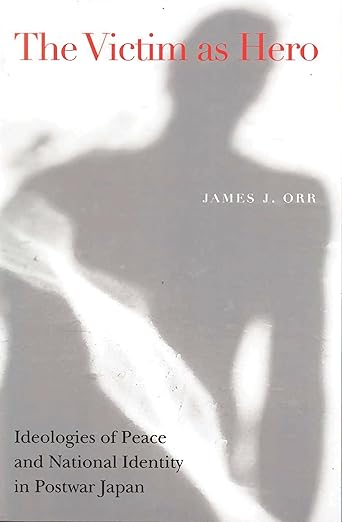
Victim as Hero: Ideologies of Peace and National Identity in Postwar Japan Paperback – 1 April 2001
by James J Orr (Author)
4.1 4.1 out of 5 stars (4)
This is the first systematic, historical inquiry into the emergence of "victim consciousness" (higaisha ishiki) as an essential component of Japanese pacifist national identity after World War II. In his meticulously crafted narrative and analysis, the author reveals how postwar Japanese elites and American occupying authorities collaborated to structure the parameters of remembrance of the war, including the notion that the emperor and his people had been betrayed and duped by militarists. He goes on to explain the Japanese reliance on victim consciousness through a discussion of the ban-the-bomb movement of the mid-1950s, which raised the prominence of Hiroshima as an archetype of war victimhood and brought about the selective focus on Japanese war victimhood; the political strategies of three self-defined war victim groups (A-bomb victims, repatriates, and dispossessed landlords) to gain state compensation and hence valorization of their war victim experiences; shifting textbook narratives that reflected contemporary attitudes and structured future generations' understanding of the war; and three classic antiwar novels and films that contributed to the shaping of a "sentimental humanism" that continues to leave a strong imprint on the collective Japanese conscience.
==
이 책은 희생자로서의 일본의 담론이 번갈아가며 전개되던 여러 영역을 다루고 있습니다. 바로 원자폭탄과 그것의 생존자들, 구 일본 식민지에서 귀환한 사람들, 미국이 도입한 개혁에 의해 대규모 토지 소유자들입니다. "군대에 의해 발명된" 황제의 모습, 학교 교과서에 나타난 갈등에 대한 설명, 이야기와 영화에 대한 증언 등이 그것입니다.
불에 탄 고기는 일본과 세계 대전에 대해 일반적으로 널리 퍼진 생각들을 수정할 수 있게 해주는 다면적이고, 다방면의 그리고 시대착오적인 관점을 위한 것이다.
그것은 일본이 전쟁의 희생자로서 국가의 이미지의 중심을 다소 늦게 차지한 폭탄에 의해 불가피하게 "지정"되었다는 공통된 장소를 해체한 것이다. 중심은 일본과 미국의 새로운 굳건한 동맹관계에 적대적인 좌파세력에 의한 재설계 시도와 그들의 전유물, 그리고 히로시마와 나가사키에 대한 정치적 부담을 희석시키기 위한 정부와 보수적인 움직임 사이에서 적지 않은 긴장의 대상이 되고 있다. 국가적인 관점에서, 세계 평화를 증진하고 핵무기를 억제하는 데 전념하는 국가의 특별 임무.
또는 교과서의 장에서, 일본이 아시아에서의 그것의 전쟁 범죄에 대해 일방적으로 반대하는 캠페인에 참여하기를 원하는 공통된 장소에 대해 의문을 제기한다. 반면에 교과서 서술의 발전은 정치적 이해관계보다는 시사적 우연성을 따른다. 예를 들어, 1960년대에 아시아와 아프리카의 식민주의가 쇠퇴하면서, 일본인 거주자들에 대한 아시아인들의 투쟁에 점점 더 많은 페이지가 주어졌습니다. 그러나 여기서도 내러티브는 모호합니다. 왜냐하면 중국인, 한국인, 그리고 다른 사람들은 피해자로 인식되지만 일본 국민들과 나란히, 그들의 엘리트들에게 속아 전쟁의 희생자가 되기 때문입니다. 모두 피해자들이고, 아무도 죄가 없어요.
Orr의 책은 또한 엄청난 양의 데이터와 날짜를 포함한 많은 것들에 대해서도 이야기합니다. 어쩌면 너무 많이, 너무 많이, 그리고 완전히 자신의 관점을 완전히 밝히지는 않았을 수도 있습니다. 그 주제에 대해서 말이죠. 어쩌면 그 주제에 대해서는 약간의 생각도 하지 않을 수도 있습니다.
Like
Comment

Tom Zilla
169 reviews8 followers
Follow
August 7, 2018
Explores the 3 main reasons behind Japan’s tendency to view itself as the Victim of the war that it started. Very good.
Like
Comment

Tim Anderson
32 reviews1 follower
Follow
April 8, 2013
Boring, boring, boring.
Like
Comment
==
==
Contents
1. Victims, Victimizers, and Mythology
2. Leaders and Victims - Personal War Responsibility During the Occupation
3. Hiroshima and Yuiitsu no hibakukoku
Atomic Victimhood in the Antinuclear Peace Movement
4. Educating a Peace-Loving People Narratives of War in Postwar Textbooks
5. "Sentimental Humanism" The Victim in Novels and Film
6. Compensating Victims - The Politics of Victimhood
7. Beyond the Postwar
James Joseph Orr
Victim as Hero: Ideologies of Peace and National Identity in Postwar Japan Paperback – 1 April 2001
by James J Orr (Author)
4.1 4.1 out of 5 stars (4)
This is the first systematic, historical inquiry into the emergence of "victim consciousness" (higaisha ishiki) as an essential component of Japanese pacifist national identity after World War II. In his meticulously crafted narrative and analysis, the author reveals how postwar Japanese elites and American occupying authorities collaborated to structure the parameters of remembrance of the war, including the notion that the emperor and his people had been betrayed and duped by militarists. He goes on to explain the Japanese reliance on victim consciousness through a discussion of the ban-the-bomb movement of the mid-1950s, which raised the prominence of Hiroshima as an archetype of war victimhood and brought about the selective focus on Japanese war victimhood; the political strategies of three self-defined war victim groups (A-bomb victims, repatriates, and dispossessed landlords) to gain state compensation and hence valorization of their war victim experiences; shifting textbook narratives that reflected contemporary attitudes and structured future generations' understanding of the war; and three classic antiwar novels and films that contributed to the shaping of a "sentimental humanism" that continues to leave a strong imprint on the collective Japanese conscience.
==
Review
James Orr provides the first systematic, historical inquiry into the emergence of the concept of victimhood in postwar Japan. He describes vividly how the notion of victimhood has been institutionalized through the use of elite political rhetoric, school texts, novels, films, and reparations battles, and he offers a compelling explanation for the peculiar, distorted form that moral argumentation surrounding war responsibility has taken. This is a politically and intellectually courageous study that arrives at balanced, dispassionate, illuminating, and persuasive conclusions.-Gary D. Allinson, University of Virginia; ""With courage and sensitivity, Orr goes right to the heart of postwar nationalism to show how defeat in the war encouraged pacifist attitudes among ordinary Japanese people that, in turn, provided a cultural logic for a new national identity constructed around a collectivized sense of victimhood. After reading The Victim as Hero, historians of Japan will have to reconsider prevailing assumptions about the forms and functions of Japanese nationalism. This book should be required reading for scholars of nationalism, modern Japanese culture, society and politics, and for anyone who wishes to understand the challenges and possibilities of democracy in contemporary Japan.""-Kevin M. Doak, University of Illinois at Urbana-Champaign
==
Top reviews from other countries
bat12
1.0 out of 5 stars Completely uninterestingReviewed in the United States on 14 May 2013
Verified Purchase
Boring is about the only way to describe this book. This is a definite pass. Would not recommend this book to anyone. Basically the book is about how the Japanese national identity evolved from being aggressors into being viewed as victims of the Second World War. With the occupation and retaining of the Emperor the U.S. helped shape this idea to have an ally for the future in the pacific. The Japanese people and Emperor are viewed as victims of the military leaders that led the country into war and victims of the atomic bombings. All in all it was just dry. The only interesting part was the chapter on Japanese movies dealing with the atomic bombings.
Report
==
The Victim as Hero: Ideologies of Peace and National Identity in Postuar Japan. By JAMES J. ORR. Honolulu: University of Hawai'i Press, 2001. viii, 271 pp. $22.95 (paper).
In The Victim as Hero, James Orr offers historical analyses of victim consciousness (higaisha ishiki), one of the most prevalent and ideologically charged tropes found in postwar Japan's troubled relation to its wartime past. The book's seven chapters explore such diverse issues in postwar society as the antinuclear peace movement, representations of war in textbooks and literary works, and struggles to gain governmental compensation for atomic bomb victims, former landlords, and repatriates. Following the claims that Oda Makoto made in the mid-1960s, the author argues that a self-indulgent identification as victim not only helped the Japanese divert their attention from their wartime aggression, but also, by demonizing the state as the victimizer, effectively foreclosed any opportunity to participate in state politics.
Resonating with the recent discussions of Japan in the occupation period, Orr emphasizes that Japan produced the mythology of victimhood through the help of U.S. propaganda. By exonerating the emperor as a constitutional monarch and by identifying with him, many Japanese managed to posit themselves as being oppressed by the militarists. The antinuclear movement that gained momentum in the aftermath of the Lucky Dragon incident placed bibakasha (atomic bomb survivors) experiences at the center of Japanese victimhood. Both conservatives and progressives came to accept atomic victimhood as a uniquely Japanese experience in order to promote their own political causes (conservatives resisted the U.S. demand for costly remilitarization, while progressives promoted pacifism). This privileged status of victimhood in Japan served to conceal Japan's role as victimizer, particularly against other Asian peoples. However, in his examinations of elementary school and junior high school textbooks, Orr points to an interesting shift in the victimhood narrative during the 1960s. Though the textbooks offered more candid descriptions of Japan's wartime aggression,
==
The Victim as Hero: Ideologies of Peace and National Identity in Postwar Japan. By JAMES J. ORR. Honolulu: University of Hawai'i Press, 2001. viii, 271 pp. $22.95 (paper).
In The Victim as Hero, James Orr offers historical analyses of victim consciousness (bigaisha ishiki), one of the most prevalent and ideologically charged tropes found in postwar Japan's troubled relation to its wartime past. The book's seven chapters explore such diverse issues in postwar society as the antinuclear peace movement, representations of war in rextbooks and literary works, and struggles to gain governmental compensation for atomic bomb victims, former landlords, and repatriates. Following the claims that Oda Makoto made in the mid-1960s, the author argues that a self-indulgent identification as victim not only helped the Japanese divert their attention from their wartime aggression, but also, by demonizing the state as the victimizer, effectively foreclosed any opportunity to participate in state politics.
Resonating with the recent discussions of Japan in the occupation period, Orr emphasizes that Japan produced the mythology of victimhood through the help of U.S. propaganda. By exonerating the emperor as a constitutional monarch and by identifying with him, many Japanese managed to posit themselves as being oppressed by the militarists. The antinuclear movement that gained momentum in the aftermath of the Lucky Dragon incident placed bikakusha (atomic bomb survivors) experiences at the center of Japanese victimhood. Both conservatives and progressives came to accept aromic victimhood as a uniquely Japanese experience in order to promote their own political causes (conservatives resisted the U.S. demand for costly remilitarization, while progressives promoted pacifism). This privileged status of victimhood in Japan served to conceal Japan's role as victimizer, particularly against other Asian peoples. However, in his examinations of elementary school and junior high school textbooks, Orr points to an interesting shift in the victimhood narrative during the 1960s. Though the textbooks offered more candid descriptions of Japan's wartime aggression,
==
Community Reviews
3.25
20 ratings6 reviews
5 stars
3 (15%)
4 stars
3 (15%)
3 stars
11 (55%)
2 stars
2 (10%)
1 star
1 (5%)
Search review text
Filters
Displaying 1 - 6 of 6 reviews

Barty (Bartholomew) Wu
79 reviews
Follow
December 9, 2024
i've been reading so many books about postwar japan that they're all melding into one big pot of goo in my head. i liked the chapter about hiroshima
5 likes
Like
Comment

Richard
843 reviews14 followers
Follow
July 23, 2022
Orr’s central argument in VaH is that Japan was able to largely avoid a sense of collective, as well as individual, responsibility for its aggression in what it calls The Great Pacific War (1937-1945) by claiming its people were the victims of military and/or corporate manipulations.
Top reviews from other countries
bat12
1.0 out of 5 stars Completely uninterestingReviewed in the United States on 14 May 2013
Verified Purchase
Boring is about the only way to describe this book. This is a definite pass. Would not recommend this book to anyone. Basically the book is about how the Japanese national identity evolved from being aggressors into being viewed as victims of the Second World War. With the occupation and retaining of the Emperor the U.S. helped shape this idea to have an ally for the future in the pacific. The Japanese people and Emperor are viewed as victims of the military leaders that led the country into war and victims of the atomic bombings. All in all it was just dry. The only interesting part was the chapter on Japanese movies dealing with the atomic bombings.
Report
==
The Victim as Hero: Ideologies of Peace and National Identity in Postuar Japan. By JAMES J. ORR. Honolulu: University of Hawai'i Press, 2001. viii, 271 pp. $22.95 (paper).
In The Victim as Hero, James Orr offers historical analyses of victim consciousness (higaisha ishiki), one of the most prevalent and ideologically charged tropes found in postwar Japan's troubled relation to its wartime past. The book's seven chapters explore such diverse issues in postwar society as the antinuclear peace movement, representations of war in textbooks and literary works, and struggles to gain governmental compensation for atomic bomb victims, former landlords, and repatriates. Following the claims that Oda Makoto made in the mid-1960s, the author argues that a self-indulgent identification as victim not only helped the Japanese divert their attention from their wartime aggression, but also, by demonizing the state as the victimizer, effectively foreclosed any opportunity to participate in state politics.
Resonating with the recent discussions of Japan in the occupation period, Orr emphasizes that Japan produced the mythology of victimhood through the help of U.S. propaganda. By exonerating the emperor as a constitutional monarch and by identifying with him, many Japanese managed to posit themselves as being oppressed by the militarists. The antinuclear movement that gained momentum in the aftermath of the Lucky Dragon incident placed bibakasha (atomic bomb survivors) experiences at the center of Japanese victimhood. Both conservatives and progressives came to accept atomic victimhood as a uniquely Japanese experience in order to promote their own political causes (conservatives resisted the U.S. demand for costly remilitarization, while progressives promoted pacifism). This privileged status of victimhood in Japan served to conceal Japan's role as victimizer, particularly against other Asian peoples. However, in his examinations of elementary school and junior high school textbooks, Orr points to an interesting shift in the victimhood narrative during the 1960s. Though the textbooks offered more candid descriptions of Japan's wartime aggression,
==
The Victim as Hero: Ideologies of Peace and National Identity in Postwar Japan. By JAMES J. ORR. Honolulu: University of Hawai'i Press, 2001. viii, 271 pp. $22.95 (paper).
In The Victim as Hero, James Orr offers historical analyses of victim consciousness (bigaisha ishiki), one of the most prevalent and ideologically charged tropes found in postwar Japan's troubled relation to its wartime past. The book's seven chapters explore such diverse issues in postwar society as the antinuclear peace movement, representations of war in rextbooks and literary works, and struggles to gain governmental compensation for atomic bomb victims, former landlords, and repatriates. Following the claims that Oda Makoto made in the mid-1960s, the author argues that a self-indulgent identification as victim not only helped the Japanese divert their attention from their wartime aggression, but also, by demonizing the state as the victimizer, effectively foreclosed any opportunity to participate in state politics.
Resonating with the recent discussions of Japan in the occupation period, Orr emphasizes that Japan produced the mythology of victimhood through the help of U.S. propaganda. By exonerating the emperor as a constitutional monarch and by identifying with him, many Japanese managed to posit themselves as being oppressed by the militarists. The antinuclear movement that gained momentum in the aftermath of the Lucky Dragon incident placed bikakusha (atomic bomb survivors) experiences at the center of Japanese victimhood. Both conservatives and progressives came to accept aromic victimhood as a uniquely Japanese experience in order to promote their own political causes (conservatives resisted the U.S. demand for costly remilitarization, while progressives promoted pacifism). This privileged status of victimhood in Japan served to conceal Japan's role as victimizer, particularly against other Asian peoples. However, in his examinations of elementary school and junior high school textbooks, Orr points to an interesting shift in the victimhood narrative during the 1960s. Though the textbooks offered more candid descriptions of Japan's wartime aggression,
==
Community Reviews
3.25
20 ratings6 reviews
5 stars
3 (15%)
4 stars
3 (15%)
3 stars
11 (55%)
2 stars
2 (10%)
1 star
1 (5%)
Search review text
Filters
Displaying 1 - 6 of 6 reviews
Barty (Bartholomew) Wu
79 reviews
Follow
December 9, 2024
i've been reading so many books about postwar japan that they're all melding into one big pot of goo in my head. i liked the chapter about hiroshima
5 likes
Like
Comment
Richard
843 reviews14 followers
Follow
July 23, 2022
Orr’s central argument in VaH is that Japan was able to largely avoid a sense of collective, as well as individual, responsibility for its aggression in what it calls The Great Pacific War (1937-1945) by claiming its people were the victims of military and/or corporate manipulations.
Furthermore, this sense of victimhood was underscored because of the tremendous suffering endured from the atomic bombings of Hiroshima and Nagasaki. In developing this ideology the middle level leaders and bureaucrats responsible for implementing the aggression which the country unleashed against its Asian neighbors, the USA, and such European countries as the UK, Netherlands, etc could evade any sense of guilt for their actions. And the populace in general did not have to acknowledge responsibility for their complicity with, let alone their open support for, these policies.
The author accomplished his goals in this book in a manner one would like to see in a scholarly approach to a topic.
The author accomplished his goals in this book in a manner one would like to see in a scholarly approach to a topic.
First, with 57 pages of notes, some of which are annotated, and a 14 page bibliography he relied on a wide array of primary and secondary Japanese and English language sources. The timely insertion of quotations from these sources often elaborated nicely on the point he was trying to make about an issue.
Second, Orr organized the book quite well. Chapters covered an array of separate topics to demonstrate how the sense of victimhood was communicated and reinforced in Japanese society in the post war years. These included the strategy of the American Occupation to focus on a handful of upper level leaders in the Tokyo War Crimes trials while absolving the Emperor of any responsibility. Or how the tragic consequences of the atomic bombings underscored the country’s perceptions of its having been a victim. How the war was taught via school textbooks and its depiction in fiction and film after the War were also covered in separate chapters. Finally, a chapter on the compensation of Japanese landlords and of people who repatriated from Asia after the War rounded out his presentation. Dividing most of the chapters into sections also assisted its organization.
Third, the author’s prose was largely direct and thus readable. When he used Japanese language vocabulary to try to provide a nuanced description of the mindset which the post war government and many Japanese scholars had about the War, he readily provided English translations.
VaH had some flaws, however. The chapter on school textbooks attempted to provide an overview of how these were shaped, actually censored, by the central government to meet its goal of endorsing an ideology of victimhood. In trying to cover a great deal of material this discussion was so general as to be of less value than I would have wished.
In the concluding chapter Orr briefly noted that some recognition of the trauma inflicted on so called ‘comfort women’ (Korean, Taiwanese, and other Asian sex slaves) was finally expressed by Japanese government officials in the early 1990’s. He also disclosed that these officials even offered an apology to Korea for its actions in this regard.
Second, Orr organized the book quite well. Chapters covered an array of separate topics to demonstrate how the sense of victimhood was communicated and reinforced in Japanese society in the post war years. These included the strategy of the American Occupation to focus on a handful of upper level leaders in the Tokyo War Crimes trials while absolving the Emperor of any responsibility. Or how the tragic consequences of the atomic bombings underscored the country’s perceptions of its having been a victim. How the war was taught via school textbooks and its depiction in fiction and film after the War were also covered in separate chapters. Finally, a chapter on the compensation of Japanese landlords and of people who repatriated from Asia after the War rounded out his presentation. Dividing most of the chapters into sections also assisted its organization.
Third, the author’s prose was largely direct and thus readable. When he used Japanese language vocabulary to try to provide a nuanced description of the mindset which the post war government and many Japanese scholars had about the War, he readily provided English translations.
VaH had some flaws, however. The chapter on school textbooks attempted to provide an overview of how these were shaped, actually censored, by the central government to meet its goal of endorsing an ideology of victimhood. In trying to cover a great deal of material this discussion was so general as to be of less value than I would have wished.
In the concluding chapter Orr briefly noted that some recognition of the trauma inflicted on so called ‘comfort women’ (Korean, Taiwanese, and other Asian sex slaves) was finally expressed by Japanese government officials in the early 1990’s. He also disclosed that these officials even offered an apology to Korea for its actions in this regard.
But there was much more to this in the 90’s than Orr presented. More specifically, there were a handful of apologies and an acknowledgment that the women had been coerced into this ‘service.’ More conservative politicians strenuously objected to these efforts by their more moderate (and humane, IMHO) peers.
This deficit in the book reflected something more general which Orr did not present: the impact which Japan’s emphasis on its own victimhood has had on its relations with its Asian neighbors. At the time of VaH’s publication in 2001 South Korea and China both still had tremendous resentments against Japan for its refusal to acknowledge its perpetration of wartime aggression against their civilian populations. Japan’s relations with these two countries still flounder today in important respects because of what these two neighbors call its ‘history problems.’
For those readers with more interest in this topic I would recommend Akiko Hashimoto’s The Long Defeat: Cultural Trauma, Memory, and Identity in Japan. Published in 2015 it offers a more current analysis from a sociological rather than a historical perspective. Since I read it some years ago, I plan to re-read it now with Orr’s arguments in mind.
history japan-related
1 like
Like
Comment

Munehito Moro
Author 4 books36 followers
Follow
February 3, 2025
An extremely underrated book on the formation of the postwar Japanese identity.
This book should have been translated into Japanese (as far as I know, it hasn't been), and read widely in Japan. Orr's argument that self-assigned victimhood enabled Japan to forget about its wartime atrocities is so valid, and I say this as a Japanese citizen.
We Japanese have used Hiroshima and Nagasaki as a weaponized card to exonerate ourselves. America has been complicit in that delusion. This is a key to understanding the warped view on history in Japan.
In other words, the atomic bombs were godsends to many Japanese who wanted to show themselves as innocent civilians. That's the greatest irony I find in the history of WW2.
Like
Comment

Yupa
731 reviews127 followers
Follow
June 16, 2012
Non tanto un libro di spessore teorico, quanto soprattutto cronachistico.
Quanto e come, e lungo quali percorsi il Giappone ha prodotto, gestito e negoziato una propria immagine di vittima della Seconda Guerra Mondiale, e cos'ha significato quest'immagine nei confronti del ruolo effettivamente svolto dal paese nel conflitto come aggressore più che vittima, soprattutto nelle vicende in terra asiatica.
Il libro percorre i diversi territorî in cui s'è dispiegato e sviluppato tra alterne vicende il discorso del Giappone come vittima: il bombardamento atomico e i sopravvissuti allo stesso, i rimpatriati dalle ex colonie nipponiche, i grandi proprietarî terrieri spossessati dalle riforme introdotte dagli U.S.A., la figura dell'Imperatore descritto come "ingannato dai militari", le evoluzioni del resoconto del conflitto nei testi scolastici, le testimonianze della narrativa e del cinema, e così via.
La carne al fuoco è tanto per una visione sfaccettata, multiprospettica e diacronica che permette di correggere alcune idee comunemente diffuse quando si parla di Giappone e Guerra Mondiale.
Orr ad esempio decostruisce il luogo comune che il Giappone sia stato inevitabilmente "segnato" dalla Bomba, che invece ha assunto con un certo ritardo un posto centrale nell'immagine del paese come vittima di guerra. Una centralità oggetto di non poche tensioni, tra tentativi di ridefinizioni e appropriazioni da parte di un'opposizione di sinistra aspramente avversa alla nuova salda alleanza tra Giappone e Stati Uniti, e governi e movimenti conservatori interessati a diluire la carica politica dei fatti di Hiroshima e Nagasaki per conferire al Giappone, in un'ottica neonazionale, la missione speciale di paese dedicato a promuovere la pace nel Mondo e il contenimento degli armamenti atomici.
Oppure, nei capitoli sui libri di testo scolastici, viene messo in discussione il luogo comune che vuole il Giappone impegnato a senso unico in una campagna negazionista rispetto ai suoi crimini di guerra in Asia. Tutt'altro, l'evoluzione delle narrazioni dei libri di testo segue, più che gli interessi della politica, le contingenze dell'attualità. Ad esempio negli anni Sessanta, in cui in Asia e Africa tramonta il colonialismo, sempre più pagine vengono concesse alla lotta dei popoli asiatici contro gli occupanti nipponici. Ma anche in questo caso la narrazione si fa campo d'ambiguità, perché cinesi, coreani e quant'altri sono riconosciuti come vittime ma affiancati al popolo giapponese, ingannato dalla propria elité e anch'esso, quindi, vittima di guerra. Tutti vittime, nessun colpevole.
Il libro di Orr parla anche di molto altro, con gran messe di dati e date. Forse persino un po' troppi e senza mai chiarire del tutto il proprio punto di vista rispetto alla materia trattata, che pure si presterebbe a non poche riflessioni. Soprattutto, a parte qualche vaghissimo accenno, Orr manca di inserire il discorso "vittimistico" giapponese all'interno di una tendenza molto più ampia, quasi globale, e tipica del secondo dopoguerra, in cui la legittimità politica e sociale non ha più la propria base su discorsi di potenza, dominio o espansione bensì sulla capacità di definirsi e presentarsi come vittime o difensori delle vittime, spesso alla ricerca di alibi più o meno giustificabili.
Non solo, Orr si concentra quasi solo sul Giappone sino agli Settanta. Del proseguio del discorso dagli anni Ottanta in poi, e fino ai nostri giorni, non dice quasi nulla. Grave carenza, considerando come la retorica della "memoria" e del "non dimenticare" sia divenuta dominante in maniera quasi ossessiva proprio negli ultimi due o tre decenni, quelli che Orr praticamente trascura.
이론적인 책이라기보단 연대기적인 면이 많은 편이지.
일본이 2차 세계대전의 피해자 이미지를 얼마나 그리고 어떻게, 어떻게 그리고 어떻게 그리고 얼마나 오랫동안 만들어왔는지, 그리고 이 이미지가 무엇을 의미했는지, 그리고 그것은 특히 아시아에서 일어난 일들에서 피해자라기 보다는 가해자로서 국가가 실제로 분쟁에서 어떤 역할을 했는지에 대한 것입니다.
For those readers with more interest in this topic I would recommend Akiko Hashimoto’s The Long Defeat: Cultural Trauma, Memory, and Identity in Japan. Published in 2015 it offers a more current analysis from a sociological rather than a historical perspective. Since I read it some years ago, I plan to re-read it now with Orr’s arguments in mind.
history japan-related
1 like
Like
Comment
Munehito Moro
Author 4 books36 followers
Follow
February 3, 2025
An extremely underrated book on the formation of the postwar Japanese identity.
This book should have been translated into Japanese (as far as I know, it hasn't been), and read widely in Japan. Orr's argument that self-assigned victimhood enabled Japan to forget about its wartime atrocities is so valid, and I say this as a Japanese citizen.
We Japanese have used Hiroshima and Nagasaki as a weaponized card to exonerate ourselves. America has been complicit in that delusion. This is a key to understanding the warped view on history in Japan.
In other words, the atomic bombs were godsends to many Japanese who wanted to show themselves as innocent civilians. That's the greatest irony I find in the history of WW2.
Like
Comment
Yupa
731 reviews127 followers
Follow
June 16, 2012
Non tanto un libro di spessore teorico, quanto soprattutto cronachistico.
Quanto e come, e lungo quali percorsi il Giappone ha prodotto, gestito e negoziato una propria immagine di vittima della Seconda Guerra Mondiale, e cos'ha significato quest'immagine nei confronti del ruolo effettivamente svolto dal paese nel conflitto come aggressore più che vittima, soprattutto nelle vicende in terra asiatica.
Il libro percorre i diversi territorî in cui s'è dispiegato e sviluppato tra alterne vicende il discorso del Giappone come vittima: il bombardamento atomico e i sopravvissuti allo stesso, i rimpatriati dalle ex colonie nipponiche, i grandi proprietarî terrieri spossessati dalle riforme introdotte dagli U.S.A., la figura dell'Imperatore descritto come "ingannato dai militari", le evoluzioni del resoconto del conflitto nei testi scolastici, le testimonianze della narrativa e del cinema, e così via.
La carne al fuoco è tanto per una visione sfaccettata, multiprospettica e diacronica che permette di correggere alcune idee comunemente diffuse quando si parla di Giappone e Guerra Mondiale.
Orr ad esempio decostruisce il luogo comune che il Giappone sia stato inevitabilmente "segnato" dalla Bomba, che invece ha assunto con un certo ritardo un posto centrale nell'immagine del paese come vittima di guerra. Una centralità oggetto di non poche tensioni, tra tentativi di ridefinizioni e appropriazioni da parte di un'opposizione di sinistra aspramente avversa alla nuova salda alleanza tra Giappone e Stati Uniti, e governi e movimenti conservatori interessati a diluire la carica politica dei fatti di Hiroshima e Nagasaki per conferire al Giappone, in un'ottica neonazionale, la missione speciale di paese dedicato a promuovere la pace nel Mondo e il contenimento degli armamenti atomici.
Oppure, nei capitoli sui libri di testo scolastici, viene messo in discussione il luogo comune che vuole il Giappone impegnato a senso unico in una campagna negazionista rispetto ai suoi crimini di guerra in Asia. Tutt'altro, l'evoluzione delle narrazioni dei libri di testo segue, più che gli interessi della politica, le contingenze dell'attualità. Ad esempio negli anni Sessanta, in cui in Asia e Africa tramonta il colonialismo, sempre più pagine vengono concesse alla lotta dei popoli asiatici contro gli occupanti nipponici. Ma anche in questo caso la narrazione si fa campo d'ambiguità, perché cinesi, coreani e quant'altri sono riconosciuti come vittime ma affiancati al popolo giapponese, ingannato dalla propria elité e anch'esso, quindi, vittima di guerra. Tutti vittime, nessun colpevole.
Il libro di Orr parla anche di molto altro, con gran messe di dati e date. Forse persino un po' troppi e senza mai chiarire del tutto il proprio punto di vista rispetto alla materia trattata, che pure si presterebbe a non poche riflessioni. Soprattutto, a parte qualche vaghissimo accenno, Orr manca di inserire il discorso "vittimistico" giapponese all'interno di una tendenza molto più ampia, quasi globale, e tipica del secondo dopoguerra, in cui la legittimità politica e sociale non ha più la propria base su discorsi di potenza, dominio o espansione bensì sulla capacità di definirsi e presentarsi come vittime o difensori delle vittime, spesso alla ricerca di alibi più o meno giustificabili.
Non solo, Orr si concentra quasi solo sul Giappone sino agli Settanta. Del proseguio del discorso dagli anni Ottanta in poi, e fino ai nostri giorni, non dice quasi nulla. Grave carenza, considerando come la retorica della "memoria" e del "non dimenticare" sia divenuta dominante in maniera quasi ossessiva proprio negli ultimi due o tre decenni, quelli che Orr praticamente trascura.
이론적인 책이라기보단 연대기적인 면이 많은 편이지.
일본이 2차 세계대전의 피해자 이미지를 얼마나 그리고 어떻게, 어떻게 그리고 어떻게 그리고 얼마나 오랫동안 만들어왔는지, 그리고 이 이미지가 무엇을 의미했는지, 그리고 그것은 특히 아시아에서 일어난 일들에서 피해자라기 보다는 가해자로서 국가가 실제로 분쟁에서 어떤 역할을 했는지에 대한 것입니다.
이 책은 희생자로서의 일본의 담론이 번갈아가며 전개되던 여러 영역을 다루고 있습니다. 바로 원자폭탄과 그것의 생존자들, 구 일본 식민지에서 귀환한 사람들, 미국이 도입한 개혁에 의해 대규모 토지 소유자들입니다. "군대에 의해 발명된" 황제의 모습, 학교 교과서에 나타난 갈등에 대한 설명, 이야기와 영화에 대한 증언 등이 그것입니다.
불에 탄 고기는 일본과 세계 대전에 대해 일반적으로 널리 퍼진 생각들을 수정할 수 있게 해주는 다면적이고, 다방면의 그리고 시대착오적인 관점을 위한 것이다.
그것은 일본이 전쟁의 희생자로서 국가의 이미지의 중심을 다소 늦게 차지한 폭탄에 의해 불가피하게 "지정"되었다는 공통된 장소를 해체한 것이다. 중심은 일본과 미국의 새로운 굳건한 동맹관계에 적대적인 좌파세력에 의한 재설계 시도와 그들의 전유물, 그리고 히로시마와 나가사키에 대한 정치적 부담을 희석시키기 위한 정부와 보수적인 움직임 사이에서 적지 않은 긴장의 대상이 되고 있다. 국가적인 관점에서, 세계 평화를 증진하고 핵무기를 억제하는 데 전념하는 국가의 특별 임무.
또는 교과서의 장에서, 일본이 아시아에서의 그것의 전쟁 범죄에 대해 일방적으로 반대하는 캠페인에 참여하기를 원하는 공통된 장소에 대해 의문을 제기한다. 반면에 교과서 서술의 발전은 정치적 이해관계보다는 시사적 우연성을 따른다. 예를 들어, 1960년대에 아시아와 아프리카의 식민주의가 쇠퇴하면서, 일본인 거주자들에 대한 아시아인들의 투쟁에 점점 더 많은 페이지가 주어졌습니다. 그러나 여기서도 내러티브는 모호합니다. 왜냐하면 중국인, 한국인, 그리고 다른 사람들은 피해자로 인식되지만 일본 국민들과 나란히, 그들의 엘리트들에게 속아 전쟁의 희생자가 되기 때문입니다. 모두 피해자들이고, 아무도 죄가 없어요.
Orr의 책은 또한 엄청난 양의 데이터와 날짜를 포함한 많은 것들에 대해서도 이야기합니다. 어쩌면 너무 많이, 너무 많이, 그리고 완전히 자신의 관점을 완전히 밝히지는 않았을 수도 있습니다. 그 주제에 대해서 말이죠. 어쩌면 그 주제에 대해서는 약간의 생각도 하지 않을 수도 있습니다.
Like
Comment
Tom Zilla
169 reviews8 followers
Follow
August 7, 2018
Explores the 3 main reasons behind Japan’s tendency to view itself as the Victim of the war that it started. Very good.
Like
Comment
Tim Anderson
32 reviews1 follower
Follow
April 8, 2013
Boring, boring, boring.
Like
Comment
==
==

No comments:
Post a Comment