The Project Gutenberg eBook of Korea and her neighbors
Title: Korea and her neighbors
Author: Isabella L. Bird
Author of introduction, etc.: Sir Walter Hillier
Release date: November 6, 2022 [eBook #69300]
Language: English
Original publication: United States: Fleming H. Revell Company, 1897
Other information and formats: www.gutenberg.org/ebooks/69300
Credits: ellinora, Amber Black and the Online Distributed Proofreading Team at https://www.pgdp.net (This file was produced from images generously made available by The Internet Archive/American Libraries.)
KOREA, AND HER NEIGHBORS
KOREA
And Her Neighbors
A Narrative of Travel, with
an Account of the Recent
Vicissitudes and Present
Position of the Country
By
Isabella Bird Bishop, F.R.G.S.
Author of “Unbeaten Tracks in Japan,” etc.
With a Preface by
Sir Walter C. Hillier, K.C.M.G.
Late British Consul-General for Korea
With Illustrations from Photographs by the Author,
and Maps, Appendixes and Index

New York Chicago Toronto
Fleming H. Revell Company
M DCCC XCVIII
Copyright 1897
BY
Fleming H. Revell Company
[Pg 1]
Preface.
I have been honored by Mrs. Bishop with an invitation to preface her book on Korea with a few introductory remarks.
Mrs. Bishop is too well-known as a traveler and a writer to require any introduction to the reading public, but I am glad to be afforded an opportunity of indorsing the conclusions she has arrived at after a long and intimate study of a people whose isolation during many centuries renders a description of their character, institutions and peculiarities, especially interesting at the present stage of their history.
Those who, like myself, have known Korea from its first opening to foreign intercourse will thoroughly appreciate the closeness of Mrs. Bishop’s observation, the accuracy of her facts, and the correctness of her inferences. The facilities enjoyed by her have been exceptional. She has been honored by the confidence and friendship of the King and the late Queen in a degree that has never before been accorded to any foreign traveler, and has had access to valuable sources of information placed at her disposal by the foreign community of Seoul, official, missionary, and mercantile; while her presence in the country during and subsequent to the war between China and Japan, of which Korea was, in the first instance, the stage, has furnished her the opportunity of recording with accuracy and impartiality many details of an episode in far Eastern history which have hitherto been clouded by misstatement and exaggeration. The hardships and difficulties encountered by Mrs. Bishop during her journeys into the interior of Korea have been lightly touched upon by herself; but those who know[Pg 2] how great they were, admire the courage, patience and endurance that enabled her to overcome them.
It must be evident to all who know anything of Korea that a condition of tutelage, in some form or another, is now absolutely necessary to her existence as a nation. The nominal independence won for her by the force of Japanese arms is a privilege she is not fitted to enjoy while she continues to labor under the burden of an administration that is hopelessly and superlatively corrupt. The role of mentor and guide exercised by China, with that lofty indifference to local interests that characterizes her treatment of all her tributaries, was undertaken by Japan after the expulsion of the Chinese armies from Korea. The efforts of the Japanese to reform some of the most glaring abuses, though somewhat roughly applied, were undoubtedly earnest and genuine; but, as Mrs. Bishop has shown, experience was wanting, and one of the Japanese Agents did incalculable harm to his country’s cause by falling a victim to the spirit of intrigue which seems almost inseparable from the diplomacy of Orientals. Force of circumstances compelled Russia to take up the task begun by Japan, the King having appealed in his desperation to the Russian Representative for rescue from a terrorism which might well have cowed a stronger and a braver man. The most partial of critics will admit that the powerful influence which the presence of the King in the house of their Representative might have enabled the Russian Government to exert has been exercised through their Minister with almost disappointing moderation. Nevertheless, through the instrumentality of Mr. M’Leavy Brown, LL.D., head of the Korean Customs and Financial Adviser to the Government, an Englishman whose great ability as an organizer and administrator is recognized by all residents in the farther East, the finances of the country have been placed in a condition of equilibrium that has never before existed; while numerous other reforms have been carried out by Mr. Brown and others with the cordial support and co-operation of the Russian Minister, irrespective of the nationality of the agent employed.
[Pg 3]
Much, however, still remains to be done; and the only hope of advance in the direction of progress—initiated, it is only fair to remember, by Japan, and continued under Russian auspices—is to maintain an iron grip, which the Russian Agents, so far, have been more careful than their Japanese predecessors to conceal beneath a velvet glove. The condition of Korean settlers in Russian territory described by Mrs. Bishop shows how capable these people are of improving their condition under wise and paternal rule; and, setting all political considerations aside, there can be no doubt that the prosperity of the people and their general comfort and happiness would be immensely advanced under an extension of this patronage by one or other civilized Power. Without some form of patronage or control, call it by what name we will, a lapse into the old groove of oppression, extortion, and its concomitant miseries, is inevitable.
Mrs. Bishop’s remarks on missionary work in China and Korea, based, as they are, on personal and sympathetic observation, will be found of great value to those who are anxious to arrive at a correct appreciation of Christian enterprise in these remote regions. Descriptions of missionaries and their doings are too often marred by exaggerations of success on the one hand, which are, perhaps, the natural outcome of enthusiasm, and harsh and frequently unjust criticisms on the other, commonly indulged in by those who base their conclusions upon observation of the most superficial kind. Speaking from my own experience, I have no hesitation in saying that closer inquiry would dispel many of the illusions about the futility of missionary work that are, unfortunately, too common; and that missionaries would, as a rule, welcome sympathetic inquiry into their methods of work, which most of them will frankly admit to be capable of improvement. But, while courting friendly criticism, they may reasonably object to be judged by those who have never taken the trouble to study their system, or to interest themselves in the objects they have in view. In Mrs. Bishop they have an advocate whose testimony may be commended to the attention of all who are disposed to regard missionary labor as, at the best, useless or unnecessary.[Pg 4] In Korea, at all events, to go no farther, it is to missionaries that we are assuredly indebted for almost all we know about the country; it is they who have awakened in the people the desire for material progress and enlightenment that has now happily taken root, and it is to them that we may confidently look for assistance in its farther development. The unacknowledged, but none the less complete, religious toleration that now exists throughout the country affords them facilities which are being energetically used with great promise of future success. I am tempted to call attention to another point in connection with this much-abused class of workers that is, I think, often lost sight of, namely, their utility as explorers and pioneers of commerce. They are always ready—at least such has been my invariable experience—to place the stores of their local knowledge at the disposal of any one, whether merchant, sportsman, or traveler, who applies to them for information, and to lend him cheerful assistance in the pursuit of his objects. I venture to think that much valuable information as to channels for the development of trade could be obtained by Chambers of Commerce if they were to address specific inquiries to missionaries in remote regions. Manufacturers are more indebted to missionaries than perhaps they realize for the introduction of their goods and wares, and the creation of a demand for them, in places to which such would never otherwise have found their way.
It is fortunate that Mrs. Bishop’s visit to Korea was so opportunely timed. At the present rate of progress much that came under her observation will, before long, be “improved” out of existence; and though no one can regret the disappearance of many institutions and customs that have nothing but their antiquity to recommend them, she has done valuable service in placing on record so graphic a description of experiences that future travelers will probably look for in vain.
WALTER C. HILLIER.
October, 1897.
[Pg 5]
Author’s Prefatory Note.
My four visits to Korea, between January, 1894, and March, 1897, formed part of a plan of study of the leading characteristics of the Mongolian races. My first journey produced the impression that Korea is the most uninteresting country I ever traveled in, but during and since the war its political perturbations, rapid changes, and possible destinies, have given me an intense interest in it; while Korean character and industry, as I saw both under Russian rule in Siberia, have enlightened me as to the better possibilities which may await the nation in the future. Korea takes a similarly strong grip on all who reside in it sufficiently long to overcome the feeling of distaste which at first it undoubtedly inspires.
It is a difficult country to write upon, from the lack of books of reference by means of which one may investigate what one hopes are facts, the two best books on the country having become obsolete within the last few years in so far as its political condition and social order are concerned. The traveler must laboriously disinter each fact for himself, usually through the medium of an interpreter; and as five or six versions of each are given by apparently equally reliable authorities, frequently the “teachers” of the foreigners, the only course is to hazard a bold guess as to which of them has the best chance of being accurate.
Accuracy has been my first aim, and my many foreign friends in Korea know how industriously I have labored to attain it. It is by these, who know the extreme difficulty of the task, that I shall be the most leniently criticised wherever, in spite of carefulness, I have fallen into mistakes.
Circumstances prevented me from putting my traveling experiences, as on former occasions, into letters. I took careful notes, which were corrected from time to time by the more prolonged observations of residents, and as I became better acquainted with the country; but, with regard to my journey up the South Branch of the Han, as I am the first traveler who has reported on the region, I have to rely on my observation and inquiries alone, and there is the same lack of recorded notes on most of the country on the Upper Tai-döng. My notes furnish the travel chapters, as well as those on Seoul, Manchuria, and Primorsk; and the sketches in contemporary Korean history are based partly on official documents,[Pg 6] and are partly derived from sources not usually accessible.
I owe very much to the kindly interest which my friends in Korea took in my work, and to the encouragement which they gave me when I was disheartened by the difficulties of the subject and my own lack of skill. I gratefully acknowledge the invaluable help given me by Sir Walter C. Hillier, K.C.M.G., H.B.M.’s Consul-General in Korea, and Mr. J. M’Leavy Brown, LL.D., Chief Commissioner of Korean Customs; also the aid generously bestowed by Mr. Waeber, the Russian Minister, and the Rev. G. Heber Jones, the Rev. James Gale, and other missionaries. I am also greatly indebted to a learned and careful volume on Korean Government, by Mr. W. H. Wilkinson, H.B.M.’s Acting Vice-Consul at Chemulpo, as well as to the Korean Repository and the Seoul Independent, for information which has enabled me to correct some of my notes on Korean customs.
Various repetitions occur, for the reason that it appears to me impossible to give sufficient emphasis to certain facts without them; and several descriptions are loaded with details, the result of an attempt to fix on paper customs and ceremonies destined shortly to disappear. The illustrations, with the exceptions of three, are reproductions of my own photographs. The sketch map, in so far as my first journey is concerned, is reduced from one kindly drawn for me by Mr. Waeber. The transliteration of Chinese proper names was kindly undertaken by a well-known Chinese scholar, but unfortunately the actual Chinese characters were not in all cases forthcoming. In justice to the kind friends who have so generously aided me, I am anxious to claim and accept the fullest measure of personal responsibility for the opinions expressed, which, whether right or wrong, are wholly my own.
I am painfully conscious of the demerits of this work, but believing that, on the whole, it reflects fairly faithfully the regions of which it treats, I venture to present it to the public; and to ask for it the same kindly and lenient criticism with which my records of travel in the East and elsewhere have hitherto been received, and that it may be accepted as an honest attempt to make a contribution to the sum of the knowledge of Korea and its people, and to describe things as I saw them, not only in the interior but in the troubled political atmosphere of the capital.
ISABELLA L. BISHOP.
November, 1897.
[Pg 7]
Contents
| Chapter | Page | |
| Introductory Chapter | 11 | |
| I. | First Impressions of Korea | 23 |
| II. | First Impressions of the Capital | 35 |
| III. | The Kur-dong | 49 |
| IV. | Seoul, the Korean Mecca | 59 |
| V. | The Sailing of the Sampan | 66 |
| VI. | On the River of Golden Sand | 71 |
| VII. | Views Afloat | 82 |
| VIII. | Natural Beauty—The Rapids | 98 |
| IX. | Korean Marriage Customs | 114 |
| X. | The Korean Pony—Korean Roads and Inns | 121 |
| XI. | Diamond Mountain Monasteries | 133 |
| XII. | Along the Coast | 150 |
| XIII. | Impending War—Excitement at Chemulpo | 177 |
| XIV. | Deported to Manchuria | 185 |
| XV. | A Manchurian Deluge—A Passenger Cart—An Accident | 192 |
| XVI. | Mukden and its Missions | 199 |
| XVII. | Chinese Troops on the March | 206 |
| XVIII. | Nagasaki—Wladivostok | 213 |
| XIX. | Korean Settlers in Siberia | 223 |
| XX. | The Trans-Siberian Railroad | 239 |
| XXI. | The King’s Oath—An Audience | 245 |
| XXII. | A Transition Stage | 261 |
| XXIII. | The Assassination of the Queen | 269 |
| XXIV. | Burial Customs | 283 |
| XXV. | Song-do: A Royal City | 292 |
| XXVI. | The Phyong-yang Battlefield | 301 |
| XXVII. | Northward Ho! | 320 |
| XXVIII. | Over the An-kil Yung Pass | 330[Pg 8] |
| XXIX. | Social Position of Women | 338 |
| XXX. | Exorcists and Dancing Women | 344 |
| XXXI. | The Hair-cropping Edict | 359 |
| XXXII. | The Reorganized Korean Government | 371 |
| XXXIII. | Education and Foreign Trade | 387 |
| XXXIV. | Dæmonism or Shamanism | 399 |
| XXXV. | Notes on Dæmonism Concluded | 409 |
| XXXVI. | Seoul in 1897 | 427 |
| XXXVII. | Last Words on Korea | 445 |
| Appendixes | 461 | |
| Appendix A.—Mission Statistics for Korea 1896. | ||
| Appendix B.—Direct Foreign Trade of Korea 1886-95. | ||
| Appendix C.—Return of Principal Articles of Export for the years 1896-95. | ||
| Appendix D.—Population of Treaty Ports. | ||
| Appendix E.—Treaty between Japan and Russia, with reply of H.E., the Korean Minister for Foreign Affairs. | ||
| Index | 475 |
List of Illustrations.
| Page | |
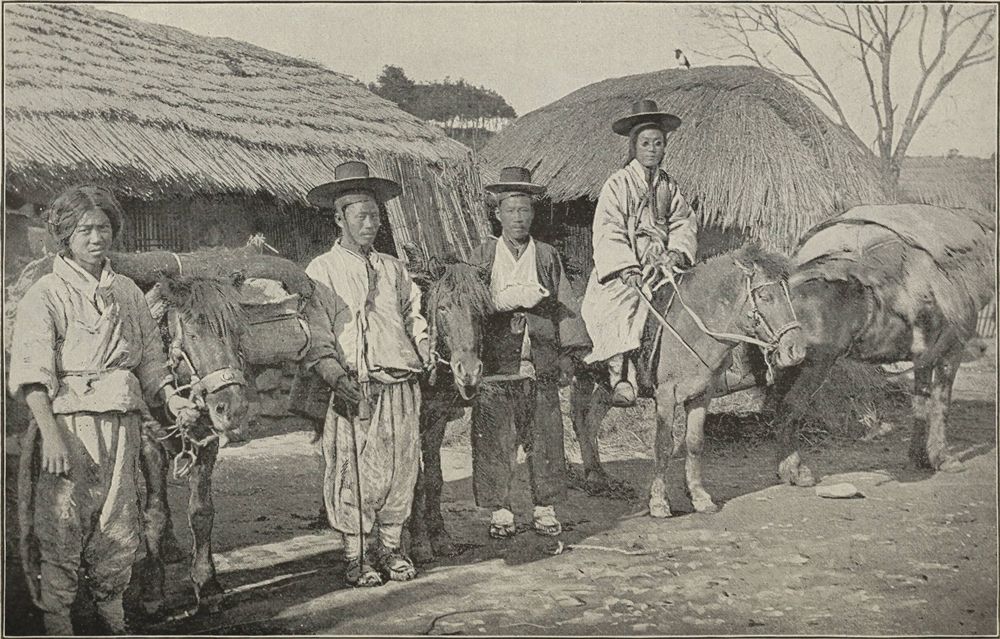
| Mrs. Bishop’s Traveling Party | Frontispiece |
| Harbor of Chemulpo | Facing 30 |
| Gate of Old Fusan | 34 |
| Japanese Military Cemetery, Chemulpo | Facing 38 |
| Turtle Stone | 48 |
| Gutter Shop, Seoul | Facing 60 |
| The Author’s Sampan, Han River | Facing 66 |
| Korean Peasants at Dinner | 81 |
| A Korean Lady | 120 |
| The Diamond Mountains | Facing 140 |
| Tombstones of Abbots, Yu-Chöm Sa | Facing 146 |
| Passenger Cart, Mukden | 198 |
| Temple of God of Literature, Mukden | Facing 200 |
| Gate of Victory, Mukden | Facing 208 |
| Chinese Soldiers | Facing 210 |
| Wladivostok | Facing 214 |
| Russian “Army,” Krasnoye Celo | Facing 232 |
| Korean Settler’s House | 238 |
| Korean Throne | Facing 248 |
| Summer Pavilion, or “Hall of Congratulations” | Facing 254 |
| Royal Library, Kyeng-Pok Palace | Facing 256[Pg 10] |
| Korean Gentleman in Court Dress | 260 |
| Place of the Queen’s Cremation | 268 |
| Chil-Sung Mon, Seven Star Gate | 300 |
| Altar at Tomb of Kit-ze | Facing 318 |
| Russian Settler’s House | Facing 320 |
| Upper Tai-Döng | Facing 324 |
| Russian Officers, Hun-Chun | Facing 330 |
| South Gate | Facing 412 |
| Seoul and Palace Enclosure | Facing 428 |
| The King of Korea | Facing 430 |
| Korean Cadet Corps and Russian Drill Instructors | 434 |
| A Street in Seoul | Facing 436 |
| Korean Policemen, Old and New | 444 |

The Edinburgh Geographical Institute John Bartholomew & Co.
Fleming H. Revell Company.

No comments:
Post a Comment