Kindle$16.90
Available instantly
Hardcover$51.18
Paperback$26.88

Follow the author

Nancy FraserNancy Fraser
Follow
Cannibal Capitalism: How our System is Devouring Democracy, Care, and the Planet – and What We Can Do About It Paperback – 30 April 2024
by Nancy Fraser (Author)
4.4 4.4 out of 5 stars (73)
Capital is currently cannibalizing every sphere of life-guzzling wealth from nature and racialized populations, sucking up our ability to care for each other, and gutting the practice of politics. In this tightly argued and urgent volume, leading Marxist feminist theorist Nancy Fraser charts the voracious appetite of capital, tracking it from crisis point to crisis point, from ecological devastation to the collapse of democracy, from racial violence to the devaluing of care work. These crisis points all come to a head in Covid-19, which Fraser argues can help us envision the resistance we need to end the feeding frenzy.
What we need, she argues, is a wide-ranging socialist movement that can recognize the rapaciousness of capital - and starve it to death.
R
208 pages
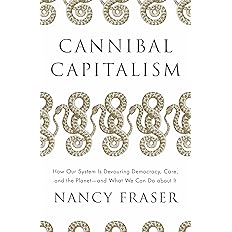
This item: Cannibal Capitalism: How our System is Devouring Democracy, Care, and the Planet – and What We Can Do About It
$26.88
+
Capitalism: A Conversation in Critical Theory
$36.95
+

The Old is Dying and the New Cannot Be Born: From Progressive Neoliberalism to Trump - and Beyond
$18.24
Total Price: $82.07
Add all 3 to Cart
Some of these items dispatch sooner than the others.
Show details
Customers who viewed this item also viewed

The Old is Dying and the New Cannot Be Born: From Progressive Neoliberalism to Trump - and Beyond
Nancy Fraser
4.4 out of 5 stars 103
Paperback
$18.24
Get it 25 Aug - Sep 2$3.00 shipping
Products related to this item
Sponsored
Page 1 of 15
Previous page of related Sponsored Products

37 Laws of Seduction: The Positive Art and Science of Getting ...
Drake White
8
Paperback
$21.99

Build Wealth With Common Stocks: Market-Beating Strategies for...
David J. Waldron
30
Paperback
$21.99

Shadow Work Journal & Workbook for Beginners: How To Integrate...
Abstract thoughts
303
Paperback
$24.78

CHILDREN BY CHOICE?: Double standards, population and the planet
BARBARA ROGERS
8
Paperback
$32.99

Communication Skills for Leaders (2 in 1): Communicate Effecti...
Albion Burns
2
Paperback
$32.99
Next page of related Sponsored Products
Product description
Review
"Nancy Fraser is a legendary radical philosopher grounded in the best of the Marxist and feminist traditions yet whose genuine embrace and profound understanding of Black, ecological, immigrant and sexual freedom movements make her a unique figure on the contemporary scene! Cannibal Capitalism is not only a singular gem - it is an instant classic for our bleak times!"
--Cornel West, author of Race Matters
"A brilliant synthesis of Fraser's many pathbreaking contributions to a Marxian theory of capitalism for the twenty-first century, beautifully written."
--Wolfgang Streeck, author of How Will Capitalism End?
"Cannibal Capitalism conjures up a monster that voraciously consumes the very land, labor and natural world upon which it thrives. With characteristically clear and inventive prose, Nancy Fraser unpacks capitalism's historically shifting, interlaced dynamics, revealing the interrelations between seemingly disparate crises and social violences. Throughout, we see the powerful potential of an anti-racist, eco-social reproduction critique. And we see why the future of the planet and humanity depend upon the socialist left building anti-capitalist struggles that reach across workplaces, streets, forests and oceans."
--Sue Ferguson, author of Women and Work
"Nancy Fraser has produced the most elegant theory yet of capitalism in our age - capitalism not in the narrow economic sense, but capitalism in the sense of a total omnivore, a system that cannot stop devouring everything around it, destroying the lives of people and nature. This is Marxist theory for our age of crisis - and, we shall hope, of reckoning."
--Andreas Malm, author of How to Blow Up a Pipeline
"Should serve to remind ... that capitalism remains a guzzler of care, and this is an unsustainable position"
--Rachel Andrews, White Review, Best Books 2022
"An explicit plea for a political project. The parallels between care and ecology are instructive."
--James Butler, London Review of Books
"Fraser captures how gender oppression, racial domination, and ecological destruction are not incidental to capitalism, but structurally embedded in it."
--Rhoda Feng, The Nation
"Succinct, thoughtful and eminently readable."
--Ronald Loewe, Marx & Philosophy
Book Description
A trenchant look at contemporary capitalism's insatiable appetite - and a rallying cry for everyone who wants to stop it from devouring our world
Read more
Product details
Publisher : Verso
Publication date : 30 April 2024
Language : English
Print length : 208 pages
ISBN-10 : 1804292583
ISBN-13 : 978-1804292587
Item weight : 1.05 kg
Dimensions : 12.85 x 1.35 x 19.79 cm
Best Sellers Rank: 53,136 in Books (See Top 100 in Books)22 in Socialism
53 in Communism
102 in Political Economy
Customer Reviews:
4.4 4.4 out of 5 stars (73)
About the author
Follow authors to get new release updates, plus improved recommendations.
Follow
Nancy Fraser
Discover more of the author’s books, see similar authors, read book recommendations and more.
Products related to this item
Sponsored
Page 1 of 13
Previous page of related Sponsored Products

An Indecent System: The Dominated Citizen
juan Ferrer
15
Kindle Edition
$7.52
CHILDREN BY CHOICE?: Double standards, population and the planet
BARBARA ROGERS
8
Paperback
$32.99
Communication Skills for Leaders (2 in 1): Communicate Effecti...
Albion Burns
2
Paperback
$32.99
Build Wealth With Common Stocks: Market-Beating Strategies for...
David J. Waldron
30
Paperback
$21.99
37 Laws of Seduction: The Positive Art and Science of Getting ...
Drake White
8
Paperback
$21.99
Next page of related Sponsored Products
How would you rate your experience shopping for books on Amazon today?
Very poor
Poor
Neutral
Good
Great
Submit
Looking for specific info?
Search
Customer reviews
4.4 out of 5 stars
4.4 out of 5
73 global ratings
5 star
68%
4 star
18%
3 star
7%
2 star
4%
1 star
3%
How are ratings calculated?
Review this product
Share your thoughts with other customers
Write a customer review
Sponsored
Top reviews from Australia
There are 0 reviews and 2 ratings from Australia
Top reviews from other countries
Translate all reviews to English
Sasha Johnson
5.0 out of 5 stars giftReviewed in the United States on 26 June 2025
Verified Purchase
Got as a gift - he was happy to receive it!
Report
Pinifiera
5.0 out of 5 stars LibroReviewed in Spain on 27 November 2024
Verified Purchase
Lo compre para mi hijo que me lo pidio para la escuela, le pregunté si es lo que buscaba y esta contento el chico, el libro tiene buenas tapas , buena letra que no es pequeña quiero decir
Report
Translate review to English
Talmadge Wright
5.0 out of 5 stars A critique and a vision of modern capitalismReviewed in the United States on 3 July 2023
Verified Purchase
Nancy Fraser's most recent work is an excellent analytical revealing of how modern capitalism has moved away from both its early manifestations of industrial capitalism, through the service capitalism represented by the expansion of business ideology and finance (neoliberalism), to a form of capitalism that depends on the cannibalization of its own productive power in order to keep the money circulating the profits intact for a few at the expense of the money. This is especially revealed by looking at the twin processes of exploitation and expropriation. The latter has grown much faster and with more brutal conditions imposed upon workers from the expanding gig economy to the decimation of labor rights. And important read for this time, this place.
Report
Desmond Thorpe
5.0 out of 5 stars Great ReadReviewed in the United States on 5 November 2022
Verified Purchase
Nancy's insightful way of diagnosing current global dysfunction. It can also be seen as a start of our cleansing process. Time to change course.
Report
Phaedra
2.0 out of 5 stars Nearly unreadableReviewed in the United States on 1 July 2024
Verified Purchase
I too bought this based on the author's interview on NPR. She was easy to understand in the interview and I wanted to hear what she had to say. Unfortunately, she was not interested in actually communicating her ideas to the public, but in impressing her college associates with her erudition. A typical excerpt:
"Contrary to bien-pensant common sense, it cannot be overcome by restoring civility, cultivating bipartisanship, opposing tribalism, or defending truth-oriented, fact-based discourse. Nor, contra recent democratic theory, ..."
The only way to read this book is on a computer or e-reader that has a dictionary lookup function. btw, "bien-pensant" just means "orthodox". "Contra"?
Report
See more reviews
====
Norman R. Aulabaugh
1.0 out of 5 stars Impossible to read and understand.
Reviewed in the United States on 14 November 2023
Verified Purchase
"Cannibal Capitalism" by Nancy Fraser. I listened to an interview with Nancy Fraser on Public Radio. The book sounded fascinating. I bought a copy.
I had to hold the book in one hand, and a dictionary in the other. I had to read and reread sentences, and even after multiple times, I still couldn’t figure out what was being said, e.g. ‘On the contrary, political projects that appeal to what they imagine to be capitalism’s “outside” usually end up recycling capitalist stereotypes, as they counterpose female nurturance to male aggression, spontaneous cooperation to economic calculation, nature’s holistic organicism to anthropocentric speciesism, subsistence communalism to occidental individualism.”
The story of the optimistic child who wanted a pony for Christmas but instead received a pile of horse dung comes to mind. The kid dove into the pile saying, “somewhere in this pile there must be a pony.” I gave up going through the horse dung after I had slogged through 37 pages.
I urge Nancy Fraser get a copy of “The Elements of Style” by William Strunk Jr. The book is a guide to writing well with practical advice for clear and effective communication.
14 people found this helpful
Report
Sean Dinces
2.0 out of 5 stars Promising but Undermined by Jargon
Reviewed in the United States on 30 March 2024
Verified Purchase
The chapter on capitalism and care-work is worth reading, if nothing else. However, the prose is atrocious in general. Passages like this litter the text: "The result is an evolving core/periphery geography, in which the boundary between those two co-constituted spaces shifts periodically, as does the boundary between economy and nature. The process that produces those shifts generates the distinctive spatiality of capitalist development" (p. 106). Torturous reading.
3 people found this helpful
Report
===
==
About the author
Profile Image for Nancy Fraser.
Nancy Fraser
136 books428 followers
Follow
Nancy Fraser is an American critical theorist, currently the Henry A. and Louise Loeb Professor of Political and Social Science and professor of philosophy at The New School in New York City. Fraser earned her PhD in philosophy from the CUNY Graduate Center and taught in the philosophy department at Northwestern University for many years before moving to the New School.
Librarian Note: There is more than one author with this name in the Goodreads database.
Readers also enjoyed
Syytös — Muuan akateeminen komitragedia
Hanna Kuusela
4.28
458
The Origin of Capitalism: A Longer View
Ellen Meiksins Wood
4.17
2,627
Caliban and the Witch: Women, the Body and Primitive Accumulation
Silvia Federici
4.56
12.7k
Climate Change as Class War: Building Socialism on a Warming Planet
Matthew T. Huber
3.97
405
Disaster Nationalism: The Downfall of Liberal Civilization
Richard Seymour
4.09
383
Slow Down: The Degrowth Manifesto
Kōhei Saitō
3.94
2,161
Crack-Up Capitalism: Market Radicals and the Dream of a World Without Democracy
Quinn Slobodian
4.13
960
Fully Automated Luxury Communism: A Manifesto
Aaron Bastani
3.69
2,548
Empire of Normality: Neurodiversity and Capitalism
Robert Chapman
4.33
780
Who’s Afraid of Gender?
Judith Butler
4.04
3,248
The Care Manifesto: The Politics of Interdependence
The Care Collective
3.79
1,596
The Wretched of the Earth
Frantz Fanon
4.34
30.7k
Abolish the Family: A Manifesto for Care and Liberation
Sophie Lewis
3.68
1,533
Hyperpolitik
Anton Jäger
3.9
454
Half-Earth Socialism: A Plan to Save the Future from Extinction, Climate Change and Pandemics
Troy Vettese
3.87
626
Technofeudalism: What Killed Capitalism
Yanis Varoufakis
4.03
6,405
Against Progress
Slavoj Žižek
3.85
266
In the Ruins of Neoliberalism: The Rise of Antidemocratic Politics in the West
Wendy Brown
4.09
422
The Late Marx's Revolutionary Roads: Colonialism, Gender, and Indigenous Communism
Kevin B. Anderson
4.45
11
Niñapájaroglaciar
Mariana Matija
4.58
825
All similar books
Ratings & Reviews
Profile Image for Sejin.
What do you think?
Rate this book
Write a Review
Friends & Following
No one you know has read this book. Recommend it to a friend!
Community Reviews
4.05
964 ratings142 reviews
5 stars
346 (35%)
4 stars
391 (40%)
3 stars
172 (17%)
2 stars
41 (4%)
1 star
14 (1%)
Search review text
Search review text
Filters
Displaying 1 - 10 of 142 reviews
Profile Image for Nathan Shuherk.
Nathan Shuherk
364 reviews
4,248 followers
Follow
October 31, 2024
loved this reframing of capitalism as a social model - it gives a wider context to the value and direction of surplus, instead of a metric for freedom for all, it’s solely a method of control and accumulation of power. Really shatters the myth of capitalism equaling freedom of choice.
55 likes
Like
Comment
Profile Image for Steffi.
Steffi
329 reviews
311 followers
Follow
October 19, 2022
I was really looking forward to (and pre-ordered) this new book ‘Cannibal Capitalism. How Our System Is Devouring Democracy, Care, and the Planet—and What We Can Do About It’ (it came out about 3 weeks ago) by Nancy Fraser - for me one of the most relevant contemporary (Marxist) theorists. In her previous books she also said everything there is to say about identity politics, can't thank her enough for this :-)
The book is great (and an amazing intro or 101 for those less familiar with the genesis and specific nature of 21st century financialized capitalism) but I guess there’s only so much one can say about capitalism and the, indeed cannibalizing, state of today’s capitalism. As such, the book walks the (already depressed, I guess) reader through kind of four areas devoured by capital: racial/imperial dynamics of capitalism’s expropriation/exploitation division which feed the glutton’s hunger for populations it can punish with impunity (chapter 2); the gendered dynamics of its reproduction/production couple, which stamp the system as a guzzler of care (chapter 3); the eco-predatory dynamics of its nature/humanity antithesis, which puts our planetary home in capital’s maw (chapter 4); and the drive to devour public power and butcher democracy, which is built into the system’s signature division between economy and the political.
For each of these four dimensions she provides a historic perspective, tracking the present from crisis point to crisis point throughout the various stages (regimes) of capitalism – 16-18th century mercantile capitalism; 19th century liberal-colonial regime, 20th century state managed capitalism and the current 21st madness of financialized capitalism (kind of providing two axes of race/gender/ecology/politics versus historic periods). Much of this is a culmination of earlier works or the standard VERSO bookshelf on the various evils of capitalism. Of course, these dimensions are linked, for instance “oil-fueled social democracy at home rested on militarily imposed oligarchy abroad”.
The bottom line is very, very simple: we are in a state of general crisis of financialized capitalism, we cannot ‘green deal’ our way out (I appreciated the book’s reckoning with the green-capitalist imaginary).What is needed is a “new common sense that must transcend the “merely environmental.” Addressing the full extent of our general crisis, it must connect its ecological diagnosis to other vital concerns, including livelihood insecurity and the denial of labor rights; public disinvestment from social reproduction and the chronic undervaluation of care work; ethno-racial-imperial oppression and gender and sex domination; dispossession, expulsion, and exclusion of migrants; and militarization, political authoritarianism, and police brutality.” In other words: it’s capitalism. There is no technological or otherwise fix within capitalism. It’s the logic of capitalism (as it is the logic of war which you cannot overcome within itself).
Sadly, at the present stage, I don’t have any hope whatsoever. And as the final chapters chart actions to build a ‘wide-ranging socialist movement that can recognize the rapaciousness of capital - and starve it to death’ I am like ‘you go, girl’ as I am going to read love novels or watch trash TV. I hope this is temporary and once hope comes back, this razor sharp analysis of how we go into this shit (including a new world war of sorts) and how we could get out will be very useful ☭ ❤
Show more
2022
31 likes
1 comment
Like
Comment
Profile Image for sologdin.
sologdin
1,834 reviews
833 followers
Follow
October 6, 2022
Eminently reasonable, this text seeks out further 'hidden abodes' of capitalism beyond the exploitation of wage labor, in the non-economic realms of gender-dominated carework, environmental extractivism, racial expropriation of those marked out as homo sacer, and the political processes of democratic governance--all of which are its conditions of possibility and each of which capitalism has a tendency to consume destructively. Many astute observations and useful historical schema. Ends with a useful reconception of socialism as well as a coda regarding the pandemic.
Verso sent this as the main selection for its September 2022 book club. Good on them.
Show more
leftwing-theory
17 likes
3 comments
Like
Comment
Profile Image for Morgan Blackledge.
Morgan Blackledge
799 reviews
2,597 followers
Follow
August 18, 2023
GREAT BOOK.
So….
Critical analysis of capitalism is back.
And….
Now it’s being integrated with green ecology, feminism, queer theory and anti-racism.
And…
We’re having a little moment with it.
It’s feeling VERY 90’s (in this regard).
The kids are digging theory and burning cop cars again.
Now if y’all can PLEASE MAKE SOME GOOD MUSIC.
Anyway.
Anticapitalism is a thing again.
And…
Here ya go!
THE CRISIS:
- ecological collapse
- financial boom and bust
- patriarchy
- racism
- LGBTQ-phobia
- addiction
- global pandemic
- for profit healthcare
- affordable housing crisis
- inflation
- unlivable wages in the gig economy
- student debt
THE GAME:
- get on top
- let wealth generate passive profit
- let China make all the stuff with essentially salve labor
- borrow all the money from China
- don’t pay it back
- buy all the oil from the Middle East
- save ours for later
- let BIPOC and LGBTQ have live action role play (LARP) with MAGA whites on CNN and FOX while the rich get richer.
- exploit cheap (care) labor.
- build a wall.
- let the rest of the world become a desert
- duke it out with Russia in the end of time
In other words, LATE CAPITALISM.
So what (precisely is) late capitalism.
POWER, PRIVILEGE AND POLLUTION:
According to my interpretation of Fraser’s argument, late capitalism is at essence a LAND, CARE and NATURE guzzling LEVIATHAN.
Essentially one big MLM PYRAMID SCAM, with a (Vegas odds) stacked deck, and WHITE, upper class heterosexual men as the house, and everyone else (BIPOC, women and LGBTQ gambling with their lives e.g. TIME, ENERGY CREATIVITY and CARE, hoping to hit a jackpot, or at least a livable wage, a home, and some security in old age. But probably (in the literal/statistical sense of the word) won’t.
In the meantime the ENTIRE GLOBE dries, warms and BURNS. As all of the earths resources (including HUMAN) are CONSUMED and CONVERTED to WEATLH of a FEW.
Hens the addition CANNIBAL to CAPITALISM and the image or the OUROBOROS, the oft recycled archetypal image of the SANKE EATING IT OWN TAIL.
Fraser asserts, quite convincingly, that there is no reforming capitalism into a GREEN, SOCIALLY JUST, RACIALLY EQUITABLE, QUEER AFFIRMATIVE RAINBOW.
If you remove ecological, and human exploitation from the mix.
Than capitalism disappears.
NEW WORLD ORDER:
Fraser RESISTS the notion that capitalism is simply an ECONOMIC model.
Fraser reconceives capitalism as an institutionalized SOCIAL ORDER that includes: COLONIALISM, RACISM, SEXISM, HOMOPHOBIA, EXPLOITATION OF NATURE, MASS INCARCERATION, BOOM AND BUST and BIG MONEY BAILOUTS as non-economic conditions for a capitalist economy to exist.
THE FOUR HORSEMEN:
Fraser lists the 4 “non-economic preconditions of capitalism as follows:
CONDITION 1: COLONIALISM & RACISM
Fraser states that the first non-economic precondition for capitalism “is a large fund of wealth expropriated from subjugated peoples, especially from racialized peoples, consisting above all in land, natural resources, and dependent unwaged or under-waged labor. Effectively stolen, this wealth serves as an ongoing stream of free or cheap productive inputs for which capital pays little or nothing.”
Capitalism converts stolen LAND and stolen (or underwater) PEOPLE into PROFITS.
In other words: capitalism needs stolen/colonized land, and subjugated/enslaved or otherwise disempowered people (BIPOC and poor whites) for free or cheep labor.
CONDITION 2: SUBJUGATION OF WOMEN
Fraser states that the second non-economic precondition for capitalism “a sizeable fund of unwaged and labor devoted to social reproduction, labor that is mostly performed by women. This carework, which “makes” human beings, is indispensable to what the system calls production, which makes things in order to make profits.”
Capitalism GUZZLES care.
In other words: capitalism also needs caretakers (mostly women) to make babies, raise children, and take care of men… for free or for cheep if you hire “help”.
CONDITION 3: EXPLOITATION OF NATURE
Fraser states that capitalism needs “a large fund of free or very cheap inputs from nonhuman nature. These supply the indispensable material substratum of capitalist production: the raw materials that labor transforms; the energy that powers machines; the foodstuffs that power bodies; and a host of general environmental prerequisites such as arable land, breathable air, potable water, and the carbon-carrying capacities of the earth’s atmosphere.”
Capitalism CONSUMES nature.
In other words: capitalism also needs natural resources to exploit and consume.
CONDITION 4: JAILS AND BAILOUTS
Fraser states that capitalism needs “a large body of public goods supplied by states and other public powers. include legal orders, repressive forces, infrastructures, money supplies, and mechanisms for managing systemic crises.”
In other words: capitalism needs police and prisons, a military industrial complex, big banks and fat bailouts for when they tank.
Capitalism imprisons BIPOC and poor people, TAXES the FUCK out of the middle class, and BAILS OUT rich the white men at the TOP when the BUBBLES POP and the BANKS TANK.
Fraser asserts that by identifying these background conditions for capitalism, we arrive at a definition of Capitalism that is not simply an economic model , but a type of social order, with colonialism, exploitation of nature, racism, and subjugation of women at its foundation.
As such, Fraser further asserts that there is no way to reform capitalism to be green, socially just, and racially equitable. That’s like trying to reform a house by eliminating the possibility of having a floor, walls, doors and a roof. You take all that away, and you’re left with nothing but a FAT MORTGAGE AND PROPERTY TAXES.
THE SOLUTION:
Fraser is the first to admit, that there probably isn’t one. But if there was. Then it would probably look an awful lot like SOCIALISM.
But not your grandma’s SOCIALISM.
And hopefully not Hitter, Stalin or Mao’s either.
What Fraser is envisioning is something like the following.
Trans-socialism: is an intersectional mode of socialist politics, economy, sexuality, and ecology.
Eco-socialism: is an egalitarian economic, political, and social structure that aims to harmonize human society with non-human ecology and meet human needs. Eco-socialists believe that eco-socialism is the only sufficient solution to the current ecological crisis.
Global trans-ecological-socialism: is a smash up of the two.
Put simply.
We need:
- a socially just
- queer affirmative
- feminist
- antiracist
- sustainable
- definancialized
- anticapitalist social order
- with growth in tech, goods and services
- without passive wealth accumulation
And it HAS to be GLOBAL.
Or we’re ALL (or most of us) GOING TO DIE.
If any of this seems interesting.
I URGE you to give this one a go.
It’s not an easy read.
It’s got a post modernist academic, Marxist (dis-mat) queer theory (Frankfort school) linguistic flare. But it’s TOTALLY doable.
And TOTALLY worth it.
Good fun.
5/5 stars ⭐️
Show more
13 likes
3 comments
Like
Comment
Profile Image for Charlotte.
Charlotte
14 reviews
Follow
January 15, 2025
Reading this has increased my awareness of all the shit that goes on in this world and how it's all connected. I'm happy to have learned so much, but also immensely distressed because of it
phd
10 likes
Like
Comment
Profile Image for Erik Graff.
Erik Graff
5,146 reviews
1,397 followers
Follow
February 14, 2024
This book was donated to Heirloom Books by David Schweickart, himself a political economist focused on matters of worker control socialism.
Deeply rooted in the Marxist traditions of social analysis, Fraser's 'Cannibal Capitalism' goes beyond Marx and Engels to consider the vital importance of non-economic factors in sustaining capitalism. These include such as the reproductive costs of labor, the environmental costs of treating nature as ownable and freely exploitable, and the expropriation of peoples at the margins of the capitalist core, in order words, colonialism and imperialism. Added to these considerations in her description of the historical evolution of capitalist social systems is the current centrality of debt and its extra-political, which is to say 'international', dimension.
While this book is very good in updating Marxist theory to include such contemporary concerns as race, gender and the environment, Fraser's writing style is rather dry and her points are repeated beyond necessity. Such a study could be fleshed out and made to seem more practicable in its prescriptions by the inclusion of some case studies of socialist alternatives.
political-social-science
9 likes
Like
Comment
Debbie Notkin
340 reviews
18 followers
Follow
February 13, 2023
Nancy Fraser's basic thesis is that thinking of capitalism as an economic system is true, but insufficient. This book is first an argument for broadening our understanding of capitalism to embrace not just worker/owner relations, but also systems of care (often called "social reproduction"), environmentalism and sustainability, and democracy as we know it. Once she sets out her framework, her thesis is that capitalism by its nature is destructive in all four domains, and cannot be otherwise -- and that to make real progress in any of these areas, we must see the problem whole, and address it as one problem.
She divides the history of capitalism into four periods, and in each of her domains, she lays out how and why capitalism is essentially bound to be a destructive force. She draws heavily on Marx and Engels, as well as more contemporary thinkers, and she has acerbically little patience with liberal or progressive band-aid solutions.
The book gave me a couple of real insights. I had a general understanding of her distinction between exploited workers, who can theoretically expect to be paid a living wage and receive some benefits from the system, and expropriated workers--everyone from care workers to colonialized people to prisoners--who are not even given cosmetic choices, and whose work and lives are the property of the owning class, but I didn't have such clear language. And I had never given thought to the invention of the steam engine as specifically a transfer of work from "animal muscle" (humans and farm/labor animals) to fossil power, and exactly how that changes not only what can be done, but who can be forced to do it.
I struggle with her inclusion of democracy in her four domains, because I want her to be wrong and I fear that she's right, that any true democracy cannot exist under capitalism because of the unequal distribution of power.
The book falls down at the end--the epilogue is too much of a recap of the book and has far too little analysis of what socialism could be if it were viewed through the same broad lens. And her brief addendum regarding COVID and the pandemic is the only part of the book that I thought was truly too one-sided and simplistic. Nonetheless, a really interesting way to think about the history and disastrous future of life under capitalism.
sdba-book-group
8 likes
Like
Comment
Profile Image for Laura.
Laura
759 reviews
414 followers
Follow
January 12, 2025
Kirja, joka kaikkien yhteiskunnassa toimivien (ja elävien) kannattaisi lukea. asap.
favorites
own
8 likes
Like
Comment
Profile Image for Ana Álvarez.
Ana Álvarez
254 reviews
24 followers
Follow
October 27, 2023
Sin duda lo mejor que he leído en el año y, sospecho, lo mejor que leeré en mucho tiempo. La autora conjunta varias visiones críticas del capitalismo para lograr una relectura de éste. La claridad y forma de argumentar es lo que más me tiene pasmada. En cierto sentido este libro es toda una clase de epistemología: observa el objeto de estudio, ve cómo lo han observado los demás, lo repiensa través de las críticas y formula algo nuevo en el sentido de que logra conjugar varios puntos que, si bien no se han pensado excluyentes, no se toman en consideración cuando se privilegia cierta perspectiva. Hermoso.
7 likes
Like
Comment
Profile Image for Iman.
Iman
25 reviews
Follow
March 19, 2025
4 stars for the strength of the argument made about the background conditions of capitalism, and the analytical clarity in linking this to the classical marxian account of exploitation in capitalism, and super nice to then link this to future social changes that a new world must encompass that reside outside “merely” doing away with exploitation as traditionally understood, located within the economic (social) relations between actors.
but she does repeat herself over and over so it ends up being a bit frustrating the more you read it.
phd
4 likes
Like
Comment
Displaying 1 - 10 of 142 reviews
More reviews and ratings
==
Profile Image for Andrew.
Andrew
Author
8 books
136 followers
Follow
October 30, 2022
The central premise of this excellent new book is that capitalism is not an economic system, but a social system that exists by devouring “non-economic” resources such as the free human care provided mostly by women, wealth expropriated from racialised others, our much-cherished democracies, and of course nature.
It’s a great way of connecting the dots between different struggles such as environmentalism, racial justice, feminism, and the fight to preserve democracy. By cannibalising all of these things it depends on, capitalism is like an ouroboros—a snake eating its own tail. It’s a thought-provoking analysis, and I’d strongly recommend it!
4 likes
Like
Comment
Profile Image for Greg.
Greg
789 reviews
55 followers
Follow
December 25, 2022
This is a hard-hitting, non-nonsense overview of how capitalism continues to ravage not only the lives of multiple millions of people, but also is a primary contributor to ecological plunder and global warming.
There is among many, Ms. Fraser says, “a growing awareness that the heterogeneous ills – financial, economic, ecological, political, social – that surround us can be traced to a common root; and that reforms that fail to engage with the deep structural underpinnings of these ills are doomed to fail.”
Her central thesis – captured in the title of this short book (only 165 pages) – is that unchecked or unregulated capitalism exploits everything. What I regard as the most important of her contributions is that capitalism is not “just an economic mechanism,” as it has become interwoven in every aspect of our lives: the way “the system” works – and it is a sprawling, complex system – is that it influences not just wages, benefits, and working conditions, but also family life, social interactions, and our political system. In keeping with her title image, it eats up everything in order to feed its bottomless insistence on expansion of wealth for the relative few. Like the classical cardinal sin of greed, its voraciousness knows no end.
In her book, she shows in detail both just how this system works and how it has evolved over time.
It is precisely because “the economy” has become so interwoven with all aspects of our lives – and, thereby, rendering its operations upon us effectively invisible – that we so often fail to “put the pieces together.”
Just to illustrate a few of the ways “the system” – and its various social and political enablers – act upon every aspect of our lives, consider:
Despite the huge increase in wealth disparity between the 1% and “the rest of us” – not just in the US but around the world – real wages for the majority have largely stalled for the past 30 years in terms of purchasing power
Since the “new economics” embraced by figures such as Reagan and Thatcher, government policies throughout most of the West have moved toward supporting the unrestricted operation of “the economy” while dropping the post-war focus on building and maintaining a solid and growing middle class
The power of those outside the executive suits and boardrooms has been greatly diminished, in large measure because of the decades-long war being waged against unions by corporations and their well-funded, non-neutral “think tanks”
All of this has disrupted family life as it has become much more difficult for one partner to earn enough to support a family, and this in turn has had important impacts on provisions for raising and educating children
Corporate balance sheets do not properly measure or quantify the true cost of inputs and outputs, disguising for the rest of us the real “cost of doing business”; think of how so many industries “use” natural resources as being “cost-free” to themselves, even though they diminish the existence and availability of these same resources for the larger community! Even with a more recent type of “environmental consciousness,” it is questionable how much of the cost (damage) they inflict is somehow repaid to the larger community.
o In our daily lives we drive right by examples everywhere, and yet do not notice: plants located along rivers, for example, using their waters for their processes, yet paying minimal prices for both water extraction and the fouled waters they pump back into the rivers when they have served their purposes.
o Factories consuming vast amounts of electricity or other fuel sources and then pumping their effluents into our air, including vast amounts of global warming causing emissions.
o Some of the most damaging consequences can be seen in states that were once colonies of the West where their once largely sustaining economic structures were transformed in order to serve the needs of the industrial West.
The cost of running for, and staying in, public office has allowed those with the greatest monetary resources the ability to control not just who runs for office in the first place, but also over the kinds of policies allowed to be considered after they are elected. This is why so many governments at all levels in the US have frustrated efforts to protect and improve their environmental systems, including the purity of land, water, and air.
Solutions?
In sum, a desperate need for a reawakened democratic policy that is designed to promote and protect all of us – including the only home we have in the universe. In one sense, this means regulated capitalism and not laissez-faire or hands-off “free market,” globalism fantasies. But the extent to which we must tackle “the system” in effect would bring about a significant transformation of our society in many ways.
In Ms. Fraser’s words:
“The struggle to resolve the present democratic crisis, like that crisis itself, cannot be limited to one sector of society, or one strand of the overall crisis. Far from concerning political institutions alone, it poses the most fundamental and general questions of social organization: Where will we draw the line delimiting economy from polity, society from nature, production from reproduction? How will we allocate our time among work and leisure, family life, politics, and civil society? How will we use the social surplus we collectively produce? And who exactly will decide these matters? Will the profit-makers manage to turn capitalism’s contradictions into new opportunities for the accumulation of private wealth? Will they co-opt important strands of rebellion, even as they reorganize social domination? Or will a mass revolt against capital finally be, as Walter Benjamin wrote, ‘the act by which the human race travelling in [this runaway] train applies the emergency brake’?”
3 likes
Like
Comment
Profile Image for c.
c
13 reviews
12 followers
Follow
August 18, 2024
Interesting in theory, but very repetitive. Especially as someone who has some prior knowledge of capitalism and sustainable economic theory, most of this was not exactly new to me. I do think it confirms and puts into logical arguments what most of us know without knowing how to articulate it: that the present’s capitalist system is “devouring” us.
Nonetheless, Fraser repeats the same arguments time and time again, and I find I could summarise the book in about 2 pages and contain most of what was important in those pages.
Lastly, I was disappointed by her call for ending capitalism, without clearly pointing to an alternative. Sure, she explored socialism in one of her latest chapters, and she rightly pointed out that her musings (and other musings) at this stage are preliminary and need to be fleshed out. But because of that, I found the structure and ideas of the book somewhat redundant. I’d hoped for something that characterises more clearly what socialism should be - in detail, not in broad strokes, and not just what it shouldn’t be based on the concept of what (cannibal) capitalism is.
3 likes
Like
Comment
Profile Image for Ville Verkkapuro.
Ville Verkkapuro
Author
2 books
193 followers
Follow
Read
February 13, 2025
Wow. Starting this, I wrote, ironically: "Who would've thought capitalism would be so evil?", which was of course very ironic as to me capitalism is the root of all evil.
In my bubble, there's three ways looking at capitalism: indifferent, positive and negative.
Those who are indifferent haven't educated themselves and do not understand that this world is a construction, they take things as they are. That category includes both winners and losers of capitalism, both my mom and my friends. My mom is a loser, working her ass off for the most of her life for dimes and nickles. My friends, young white men, are the winners. They spent most of their lives working, in a totalitarian system (according to Noam Chomsky), changing their freedom for money that gives them possibility to numb themselves with pleasures just enough to forget they are not free. The thing is, neither of them want to educate themselves about the issue. The indifferent losers are powerless, so knowing more just makes them more depressed. And the indifferent winners already have some anxiety and their small pleasures gives them just enough comfort. So they don't want to know because their ignorance works for their benefit.
The positive views of capitalism comes from my friends who know how things work, the winners. They have a bleak world view of humans being inherently lazy and everyone being in competition with each other. If you have a lot of money, you have deserved it – and vice versa. They comfort themselves in taxes: more money equals more taxes which is a good thing for all of us. There's great blind respect for the economy: they view the economy as a good thing that benefits all in big picture, though it must be healed all the time with "tough cuts" and they tend to overlook the systematic flaws and its tendency to crisis. They would like for the middle class to be as big as possible. There's no solidarity, because there's an illusion of meritocracy: a feeling that those who have a lot of money have deserved it. From that perspective I've heard, from my dearest friends, that "money is a symbol for a favour you've done to somebody else" and also, that money truly does exist.
Then there's the negative view, which comes usually from the losers of the system. Those who see how hard it is to do work that actually benefits others, those who know how all of our prosperity and our superabundance exploits our world.
I'm in between: capitalism works for me, kind of. I get a lot of money from doing basically nothing, I have access to a lot of pleasures and so on. I don't see all the horrors my way of life brings. But I'm not indifferent and I'm educated (by choice) so I understand that my way of living has a price. Like Mary Robinson reminds us in Climate Justice: the crisis is here, we exploit the poor and destroy their livelihood. Those who contribute the less to climate crisis are the ones who suffer the most. This is nothing new as this is how capitalism works.
This as a book was as good as all the other books that criticise capitalism, so in that sense nothing new. But a great one, focusing on how the system is built to destroy itself.
To me the biggest revelation in this is how capitalism refuses to pay the full price of things: it takes, but doesn't give back. It only works because of the exploitation. Capitalism would be just fine if it would pay enough, wouldn't be so racist and would give people their human rights. And, of course, it would make sure it recovers and revives the nature it exploits. There's finite resources, so that's the least we could do.
I love to turn things around and use the argument that is usually said about communism and say something about capitalism: "Capitalism is a beautiful idea, but doesn't work in practice", heheh. I think it's pretty naive: we have a system that works for a little while, using inherently racist systems that exploits half the world, destroys the environment without paying for its recovery and spirals itself to crisis all the time. All you capitalists, you silly people: socialism is the way. Ecofascism is the way.
We need systems and regulations that puts nature and equality first. Then we can see how much pleasures we can get. Because, this is also true: pleasures don't bring pleasure. Hard work, meaning, helping others, peace of mind – this is what brings true pleasure.
2 likes
Like
Comment
Profile Image for Don.
Don
653 reviews
84 followers
Follow
December 16, 2022
Fraser provides a helpful resume of Marx's 'core features' of capital which she presents as:
1/ Private property in the means of production;
2/ A market in free labour (ie not enslaved)
3/ A systemic thrust in the form of the compulsion to accumulate capital
4/ The distinctive role of markets in allocating the inputs into commodity producti0n and also in determining how the social surplus will be invested.
She views the latter as its 'most perverse characteristic' in that it hands over crucial decisions about the development of society to ther expansion of monetrised value. But in putting it in this way she also challenges the idea that markets in and of themselves lead towards the total commodification of society. What is central to her argument is her insistence on the tendency within capitalism to create 'semi-proletarianised' arrangements which preserve non-capitalist features, though always requiring them to function as adjuncts to capitalist accumulation. The most striking example here is the form of the private household, which utilises labour and allocates inputs into its reproduction in ways which are not analogous to profit-seeking.
She counters the idea that the fate of all and everything under capitalism is to be transformed into a commodity, each occupying a space as allocated by the market. Capitalism cannot do this without undermining an essential condition of its own existence – namely the capacity to plunder other systems of life which have been constituted by non-market means. Semi-proletarianisation is not a transitional phase to full-prolerianisation but rather a reversion to a mode in which workers are unable to sustain themselves on the basis of a wage and come to subsist on a variety of strategies which involves some waged work supplemented by petty trading and gift-giving exchanges. This trend has been under-scored by neoliberalism which has an accumulation strategy based on “expelling billions of people from the official economy into informal grey zones, from which capital syphons off wealth.” Her crucial point is that “marketised aspects of capitalist society coexist with non-marketised aspects.” In fact capitalism would not be able to live without the sustinance it draws from its parasitic dependence on the non-market world - a relationship which she likens to cannibalism, and hence the title of the book.
This framing of the story of capitalism brings the concept of expropriation into full focus, taking its place alongside exploitation as a driving force of capital accumulation. As considered in Marx’s Capital in volume one, expropriation mainly features as a force that operated back at the dawn of the capitalist period in during the time of ‘primitive accumulation’. The destruction of common land during the time of enclosure and the eviction of peasant farmers formed the basis of this period, with colonial expansion and the annihilation of non-capitalist modes of production in order to create space for markets forming another element. Fraser joins Harvey and others who have approach the subject through the lens of geography to insist that expropriation is not a largely spent historical force but an ongoing process of active eternal reconstitution of capitalist society. It shows up particularly acutely in the relationship between capitalism and the natural world, with the plunder of resources across the biosphere, minerals, energy and climate. Without the effectively free lunches that the natural world provides to capitalist society in the form of land, energy, water, animal power, they system would not be able to function.
This means that we have to think of capitalism as something more than just a type of economy: rather as a society in fact. In her argument this becomes important because the instance on its economic character leads to error Lukasc made in seeing commodification reified to the point where it becomes the consciousness of the entire people. Fraser’s instance on the maintenance of non-economic-capitalist zones within capitalist society mean that other forms of consciousness exist besides those sustained by market relations. The existence of public space tends to support democratic aspirations, for example. The scientific understanding of the human relationship with the natural world allows ecology and green politics to get a hearing on the political spectrum. Even the violence of expropriation, or rather resistance to it, sustains consciousness of the human need for re-integration and equality.
For Fraser capitalist society isn’t so different from feudalism, in that both are made up of structured segments with each being governed by its own set of values and norms, but which become coherent through the exercise of hegemonic power. The boundaries between the structural zones are not fixed permanently and continuously tense under the stress of specific historical conjunctures – mercantile capitalism, liberal-imperial capitalism, state monopoly capitalism and financialised capitalism becoming “four historically specific ways of demarcating the various realms that comprise capitalism. But this is not to imply that the non-economic segments are totally subordinate to capital accumulation. “Each of these ‘hidden abodes’ harbours distinctive ontologies of social practice and normative ideals…” which give rise to ‘boundary struggles’ which play a constitutive role in shaping the structure of capitalist society.
Boundary struggles also generate deeper problems which go beyond deciding what type of capitalism capitalist society might be at any particular time. Fraser sees them as expressing the contradiction which exists between capitalist accumulation and the background conditions for its existence – “between production and reproduction, society and nature, economy and polity, exploitation and expropriation.”
“Their effect … is to incite a broad range of social struggles, narrowly defined, at the point of production, political power and expropriation [and] boundary struggles over ecology, social reproduction, political power and expropriation.”
From this perspective social struggles in any of these areas might acquire an anti-capitalist character if they have the effect of sealing off a particular segment from the deprivations of capital accumulation. Trade union struggles to fully compensate workers for the effect of inflation on their living standards; of Black and ethnic minority people to liberate the socialisation of their children into a subordinate place in society; of a green new deal to effect a socially just transition to zero carbon would all demonstrate this tendency to move beyond capitalism. But, just as capitalism owes its continued existence to it success to date in containing anti-capitalist logics in each of these sub-structures, so the success of a post-capitalist politics will depend not just on success in any one area, but in significant advance across all segments.
The theoretical shape of Fraser’s argument is set out in the opening essay in this collection, each of which has appeared before in leftist and academic journals. Following chapters illustrate its key points by considering concrete case studies with regard to the role racism plays in capitalist society, the crisis of social reproduction under capitalism and its struggle for emancipation from the logic of capital accumulation, and similar with regard to green/environmental politics and democracy itself. A book I would place alongside Mike Davis’s ‘Old Gods, New Enigmas’ as a deeper dive into the contradictions of late capitalism which returns the reader to Marx in order to go quite a few paces beyond him.
modern-society
socialist-theory
2 likes
Like
Comment
Profile Image for Victoria.
Victoria
139 reviews
4 followers
Follow
January 6, 2024
Es un libro breve y directo. Hacia el final, quizás pierde un poco de la sustancia con la que explica las cosas al inicio, pero no me parece que sea importante para la comprensión del contenido.
El libro se resume en la analogía del uróboro: la identificación y el esfuerzo del capitalismo trascendiendo la categoría de sistema económico, reconociendo que alcanza y condiciona todas las esferas de la sociedad, la consume y, consecuentemente, termina poniendo en riesgo la propia existencia del capitalismo.
Al ser un libro reciente, se ven muchas actualizaciones respecto a las críticas al capitalismo (por ejemplo, la manera en la que se enfrentó la pandemia del COVID-19), y, sobre todo, sus alternativas. En todo el libro se asume la dificultad de la tarea de destronar al capitalismo, justamente por su alcance e implicancia en toda la vida, y desacelera bastante la nostalgia de un socialismo soviético, apuntando a nuevas soluciones para nuevos problemas. Aunque menciona puntos a tener en cuenta para un "socialismo del siglo 21", la aceptación de la complejidad de una alternativa, casi de la desesperanza, es muy refrescante.
2 likes
Like
Comment
Profile Image for Jeroen K.
Jeroen K
31 reviews
Follow
July 22, 2025
Fraser wants to expand the meaning of capitalism to include societal elements, and how it exploits and expropriates these. How it is racist, sexist, destroying the planet and democracy. These four views are each traced in four historical stages.
The best thing about this book is that it shows how capitalism relies on and exploits the non-economic like natural resources, human reproduction, systems of law and education, etc. It draws connections, finds 'hidden abodes', that's the reason to read this book.
But its overall thesis makes capitalism too generic: it's basically modern society and its history. And it lacks convincing examples (esp. non-US ones), which makes the historical traces seem formulaic. The proposed sketch at the end of its opposite, that should combat capitalism, (eco) socialism, is the weakest part of the book. Capitalism seems almost total here; how should socialism avoid the same issues and fight capitalism?
philosophy
2 likes
Like
Comment
Profile Image for David.
David
259 reviews
15 followers
Follow
March 21, 2023
"...the pandemic is the point where all of cannibal capitalism’s contradictions converge: where cannibalization of nature and carework, of political capacity and peripheralized populations, merge in a lethal binge. A veritable orgy of capitalist dysfunction, COVID-19 establishes beyond all doubt the need to abolish this social system once and for all."
Nancy Fraser
politics-sociology
2 likes
Like
Comment
Profile Image for Sebastià Caldentey.
Sebastià Caldentey
52 reviews
14 followers
Follow
June 12, 2024
No li recomanaria ni al meu pitjor enemic. Una idea repetida trenta vegades no és un llibre, és un pamflet. Dues estrelles perquè malgrat tot hi ha qualque cosa bona entre tanta palla.
2 likes
Like
Comment
Profile Image for Michela nonostante.
Michela nonostante
167 reviews
3 followers
Follow
August 7, 2024
Per niente banale, una critica minuziosa e attualissima al sistema capitalista, con tanto di criticità e alternative.
2 likes
Like
Comment
Profile Image for LaanSiBB.
LaanSiBB
305 reviews
18 followers
Follow
Read
September 23, 2022
Nothing new about back nuance stories of capital-social study, but using cannibalism as a metaphor is bit ahistorical to our ancestors who survived through eating each other (prion and gene), when the author is clearly living off exploitative mass agricultural system, that is excluded in the book but clearly is one of the underlying fundamentals on feminist, black, labour and migrant activism.
2 likes
1 comment
Like
Comment
Profile Image for Macho.
Macho
51 reviews
Follow
April 11, 2023
Yet another "ADJECTIVE Capitalism" book, but finally one unabashedly calling for the end of capitalism as a system, instead of just calling to rein in some perceived recent excess or "perversion". Fraser goes beyond the classical labour vs. capital socialist dichotomy to focus on four other pillars that she says the system couldn't maintain itself without: (1) expropriation, which is a huge category that more or less covers various types of theft, generally from people of colour, including theft of indigenous lands, slave-like labour in the periphery and in the context of mass incarceration, etc., (2) unremunerated social reproduction work, largely done by women, (3) free riding on the environment to the grave detriment of ecosystems and the climate, and (4) the hollowing out of the political state/power and of democracy. In Fraser's telling, capitalism's reliance on these "non-economic" pillars is done unsustainably so that the pillars are being eaten away in a "Marxist contradiction"-type of way, although she remains fairly cagey about whether that means the edifice will collapse on itself. She closes by calling for an expanded view of socialism to mirror her expanded one of capitalism, but as best I could tell she essentially says the socialist should not lose sight of the need to take down each of those four pillars because they're unjust. I personally am a fan of grand metanarratives so it was refreshing to read a book with the ambitious goal of describing not just capitalism as an economic system, but as an even broader social system, and there's a lot to like about the analysis provided, although the one drawback is that inevitably there's a lot of key stuff that's just completely glossed over (e.g. what exactly do you envision by "democracy"?, to name one of many).
Show more
2 likes
Like
Comment
Profile Image for Zita.
Zita
13 reviews
1 follower
Follow
November 27, 2023
Als ich das Buch gekauft habe, war ich voller Vorfreude, die leider zum größten Teil enttäuscht wurde.
Fraser verspricht, bisher übersehene Verhältnisse des Kapitalismus aufzudecken. Dass der Kapitalismus Natur, Sorgearbeit und den globalen Süden ausbeutet und enteignet, schien mir aber keine neue Erkenntnis. Spannend fand ich, wie sie das Verhältnis zwischen Kaptial und diesen 3 bereichen über die letzten 200 Jahre beschreint.
Insgesamt hätte ich mir mehr konkrete historische/empirische Beispiele gewünscht und dafür weniger Wiederholungen.
Für mich war das Buch leider nur okay.
4 likes
Like
Comment
Profile Image for Emily Bradshaw.
Emily Bradshaw
13 reviews
2 followers
Follow
Read
April 14, 2023
Honestly understood so little of this book I don’t even know if I’m allowed to say I read it x I like the central metaphor though
3 likes
Like
Comment
Profile Image for José Angel.
José Angel
95 reviews
4 followers
Follow
December 21, 2023
Fraser gives a great general perspective to understand how the current economic crisis that is occurring all over the world is not contingent but deeply embedded in the very essence of capitalism and is even sharper with its current form: financialized capitalism. Although long-time ignored and diagnosed only as a disease of "the corrupt third world," now, when the majority-ethnic middle-class citizens of richer countries are also feeling the mouth of this devouring beast getting closer and closer, everyone seems to be alarmed and are starting to look for answers... better late than never, I hope!
The book seeks to redefine what capitalism means in terms that are compatible with the 21st-century landscape. It claims that capitalism is kept very narrowly defined on purpose by its defenders in order to easily dodge criticism and avoid explaining why the theoretical model has such a mismatch with empirical evidence. Normally, capitalist advocates define it as an economic-only system that is part of a much bigger and dynamic macrosystem that includes politics, culture, social and geographical resources among others; hence, a liberal capitalist must only answer to the markets and navigate everything else, since other factors are only external.
According to Fraser, this view is not only flawed but perverse, since it encourages the privatization of all aspects of life (beyond the economic realm) while at the same time not being held accountable for the disorder and destruction that it creates in the "other realms". In these incomplete definitions, the resources that enable the self-perpetuating growth in which capital happen are taken for granted as if they came from an infinite supplier that cannot be disturbed. And here is where the cannibalization occurs: declaring ever expanding economic growth can only be achieved if one excludes all the losses that it also generates: expropriation of resources from underrepresented groups (at the national level) and less developed economies (at the international level), gender-biased division of labour where care and social reproduction are unpaid, militarized "law enforcement" and "anti-terrorism" to extort weaker political territories, racialised division of labour, treating nature as an unlimited supply of resources (before production starts) and a dumpster (after all possible wealth surplus was taken) without any responsibility for replenishment, and last but not least, the privatization of profit and socialization of debt and losses in times of crisis.
The text is direct, clear and (although sometimes overly repetitive) is an uncomplicated and transparent diagnostic of the current state of affairs. Sadly, as it usually happens with these classic left-wing theorists, the diagnosis is excellent but the recommended treatment is nothing but vague. Without entering a bigger and endless debate on politics, it is also not expected that someone can solve such a convoluted problem in less than 200 pages. This is a great book, and it delivers what the title announces: a diagnosis that pinpoints why capitalism is devouring itself and the whole planet and how a sharp change in worldview and ideology is mandatory to fix this mess. Proposing the usual patches within capitalism won't work. The solution calls for much bigger change, as capitalism by definition, provokes all these problems, far from just being a series of unfortunate and collateral coincidences, the problems are a structural result of our current global economical and political platform and they won't go away if there is no radical change that takes into account all these factors and especially all involved actors and stops focusing on the solutions that only work for the elites.
politics-economics
1 like
Like
Comment
Profile Image for Philipp Sorge.
Philipp Sorge
222 reviews
1 follower
Follow
Read
October 8, 2023
To recap: Kapitalismus wird nicht als Wirtschafts-, sondern als Gesellschaftssystem definiert und seine "nicht-ökonomischen" Säulen, ohne die er nicht funktionieren könnte, werden beleuchtet: Die Ausbeutung und/oder Enteignung von Menschen auf der ganzen Welt, denen Land, Ressourcen, unbezahlte und unterbezahlte Arbeit entrissen werden. Dann die unter-bis unbezahlte Care-Arbeit der sozialen Reproduktion, im Löwenanteil von Frauen geleistet, ohne die es keine "Arbeitskräfte" geben würde. Dann die kostenlosen oder sehr billigen Inputs aus der nicht-menschlichen Natur, die behandelt wird, als wäre sie der Junge mit den Goldhosen. Und dann natürlich die öffentlichen Güter wie Rechtsordnungen, Infrastrukturen etc., die von Staaten bereitgestellt werden.
Und nun ist das Problem, das alle diese Säulen des Kapitalismus von diesem abgesägt werden im Streben nach Kapitalakkumulation: die öffentliche Macht wird ausgehöhlt, um weniger Steuern und Löhne zahlen zu müssen, Care-Arbeit wird nicht vergütet und auf Privathaushalte abgewälzt, die Natur wird ausgebeutet genauso wie Bevölkerungen auf der ganzen Erde. Und so gelangen wir dorthin, wo wir uns heute befinden: die ökologische Krise des Klimawandels durch die Ausbeutung der Natur, eine demokratische Krise durch die Aushöhlung der politischen Macht, die in ihrer Unterwerfung unter das Kapital die Bedürfnisse der Menschen nicht erfüllen kann, eine Krise in der Reproduktion (Pflegenotstand, Lehrkräftemangel, Kitaplätze, schließende Krankenhäuser, ...) und irgendwann kann man den politisch wehrlosen Menschen in den "Entwicklungsländern" auch nicht noch mehr Reichtum stehlen.
Ergo: wir brauchen etwas neues, was nicht zur Selbstdestabilisierung neigt. Bzw. nicht "dazu neigt", sondern konstitutionell unweigerlich dorthin führt. Und hier finden sich ein paar interessante Gedanken dazu. Also nicht NUR super-deprimierend. Lediglich ziemlich.
Was den Planeten zu verbrennen droht, ist nämlich nicht "die Menschheit", sondern der Kapitalismus.
Interessant fand ich die Betrachtung dazu, wie undemokratisch eine kapitalistische Gesellschaftsordnung ist, wo wir uns doch immer die Demokratie auf die Fahnen schreiben:
Indem weite Bereiche des gesellschaftlichen Lebens der Herrschaft des "Marktes" (in Wirklichkeit der Großkonzerne) unterstellt werden, werden sie für demokratische Entscheidungsfindung, kollektives Handeln und öffentliche Kontrolle unzugänglich gemacht. Diese Regelung beraubt uns der Möglichkeit, gemeinsam zu entscheiden, was und wie viel wir auf welcher Energiebasis und im Rahmen welcher sozialen Beziehungen herstellen wollen. Sie beraubt uns auch der Fähigkeit zu entscheiden, wie wir den gesellschaftlichen Mehrwert, den wir kollektiv produzieren, verwenden wollen; wie wir uns zur Natur und zu zukünftigen Generationen verhalten wollen wie wir die Arbeit der sozialen Reproduktion und ihr Verhältnis zur Produktion organisieren wollen. Wegen der ihm eigenen Struktur ist der Kapitalismus also von Grund auf antidemokratisch. Selbst im besten Fall ist die Demokratie in einer kapitalistischen Gesellschaft zwangsläufig begrenzt und schwach.
Fazit: es ist alles sehr kompliziert und vielschichtig, Lösungen werden nicht einfach zu finden und durchzusetzen sein, aber möglich ist es. Das finde ich immer neben allen Krisen und Katastrophen mit am deprimierendsten: wie wenig wir in der Lage sind, uns ETWAS ANDERES vorzustellen. Das zeigt ja auch, wie sehr sich der Kapitalismus in unser Gehirn gefressen hat, dass er als unumgänglich betrachtet wird. Obwohl er uns alle zugrunde richtet. Ich werde mich umschauen nach Leuten, die eine bessere Vorstellungskraft haben
1 like
Like
Comment
Profile Image for Laura Walin.
Laura Walin
1,791 reviews
81 followers
Follow
July 20, 2025
Kannesta voisi päätellä, että Kannibaalikapitalismi olisi (talous)tieteen popularisointia, mutta en tätä siihen kategoriaan laittaisi - sen verran haastavaa Nancy Fraserin argumentin seuraaminen on. Fraser lähtee tässä pitkän uransa loppuvaiheen syntetisoimaan ajatuksiaan kapitalismin olemuksesta, kuten otsikkokin antaa ymmärtää.
Hänen pääargumenttinsa on, että kapitalismia ei pidä tarkastella vain talousjärjestelmänä, vaan oleellista on huomata sen olevan yhteiskuntajärjestelmäämme kokonaisvaltaisesti hallitseva systeemi, joka nojaa paitsi paljon ylistettyihin markkinoihin, joiden ajatellaan hoitavan kaikkien muiden mahdollisten systeemien sisäsyntyisen tehottomuuden ongelmat, myös talouden ulkopuolisiin välttämättömiin ehtoihin.
Nämä neljä ehtoa ovat työvoiman ei-vapaaehtoinen pakottaminen, hoivatyö, luonnonvarat sekä julkinen infrastruktuuri. Kapitalismin toiminta ei olisi ilman näitä mahdollista, mutta niiden arvoa ei lasketa osaksi sen toimintaa. Ilman hintalappua kapitalismi Fraserin mukaan kuluttaa näitä resursseja siksi huolettomasti niin, että se on ylikäytön myötä syömässä oman olemassaolonsa edellytykset. Tästä siis nimitys kannibaalikapitalismi.
Fraserin tapa kirjoittaa on koukeroinen, mutta lukijaa auttaa onneksi englantilaiseen kirjoitustyyliin kuuluvat metateksti kappaleiden lopussa. Kirjan lopussa on vielä suomalaistutkijoiden lyhyt katsaus Fraserin ajattelun kehittymiseen vuosikymmenten aikana, mutta sekin on akateemisen koukeroinen. Haastavaa, mutta mielenkiintoista luettavaa kaiken kaikkiaan, vaikkei mikään varsinainen lukunautinto ollutkaan.
philosophy
politics
talous
...more
1 like
Like
Comment
Profile Image for Álvaro Mercado.
Álvaro Mercado
17 reviews
Follow
April 2, 2024
Un ensayo muy iluminador sobre las condiciones de posibilidad no económicas del capitalismo, de las que este depende y que a la vez depreda, amenazando su propia existencia: la expropiación, los cuidados, la naturaleza y las instituciones políticas. Fraser proporciona una nueva visión al problema de las crisis más cercana a los planteamientos de la teoría de la escisión del valor de Kurz y ve en ellas la posibilidad de, en primer lugar pensar una crítica al capitalismo adaptada al siglo XXI para, en segundo lugar, proponer una reflexión sobre los lugares que tal vez proporcionen una escapatoria al uróboro que no deja de comerse la cola, para "matar de hambre a la bestia y poner fin de una vez y para siempre al capitalismo caníbal". Únicamente le criticaría un excesivo tono moral al deseo de lucro de una clase, creo que es más acertado incidir en los aspectos estructurales e irracionales que en el juicio de valor donde tendríamos la batalla perdida antes de comenzar.
Show more
1 like
Like
Comment
Profile Image for Heidi.
Heidi
100 reviews
1 follower
Follow
April 30, 2025
Taitava kokoava esitys tosi intuitiivisesti todesta asiasta eli siitä että kapitalismi syö kaiken: luonnon, hoivan, demokratian. Suurin ansio on musta just siinä, miten Fraser niputtaa tähän asti mietittyä yhteen ikään kuin saman kokoisiksi palasiksi joita voi sitten tökkiä ja mietiskellä. Tää antoikin jonkun konkreettisen uuden linssin jolla suhtautua esimerkiksi ikuisuuksia jatkuvaan pohdintaan siitä, että miksi äärioikeisto nousee ja kaikki menee perseelleen. Lukupiiritin tämän ja suosittelen tekemään niin jos mahdollista. Fraser lopulta jättää monta asiaa lukijalle kontekstoitavaksi ja oikeaan maailmaan sovellettavaksi, ja sitä oli kiva miettiä yhdessä muiden kanssa.
1 like
Like
Comment
Profile Image for Lydia Blanco Gil.
Lydia Blanco Gil
31 reviews
6 followers
Follow
February 3, 2025
diria que és un llibre ben escrit i interrelaciona molt bé els diferents pilars que constitueixen i fan possible el capitalisme. També m'agrada molt la idea del capitalisme com l'urobòr que s'autocanibalitza menjant-se la cua.
Tot i això diré que pq dinamitze el club de lectura i estava lleig no llegir-lo, però crec que sinó l'hagués abandonat, pq en moltes ocasions és repetitiu i el final deixa molt q desitjar.
1 like
Like
Comment
Profile Image for Igor Montenegro.
Igor Montenegro
75 reviews
3 followers
Follow
February 16, 2025
Melhor livro de política que leio desde Realismo Capitalista do Fisher. Com minúcia e perspicácia, Fraser analisa e demonstra como o capitalismo é muito mais insidioso atualmente do que já foi em décadas e séculos passados.
favoritos
humusidades
nonfiction
...more
1 like
Like
Comment
Profile Image for Ghofrane.
Ghofrane
42 reviews
26 followers
Follow
February 4, 2023
Brilliant! 👌🏼
1 like
Like
Comment
Profile Image for Jacob Wilson.
Jacob Wilson
214 reviews
6 followers
Follow
October 31, 2023
Spectacular, clear, analytically strident, and a necessary read for understanding contemporary capitalist society and the interrelated crises it produces. Fraser is enormously clearsighted in her analysis of the production and reproduction of tendencies toward crises immanent within the capitalist mode of production. A brilliant critique.
1 like
Like
Comment
Profile Image for The Coat.
The Coat
121 reviews
6 followers
Follow
January 3, 2024
Facile.
1 like
Like
Comment
Profile Image for Aura González.
Aura González
8 reviews
Follow
July 11, 2025
“Un sistema social que somete las cuestiones de vida y muerte a “la ley del valor”
1 like
Like
Comment
==

No comments:
Post a Comment