
Our American Israel: The Story of an Entangled Alliance Hardcover – 17 September 2018
by Amy Kaplan (Author)
4.5 4.5 out of 5 stars 18 ratings
An essential account of America's most controversial alliance that reveals how the United States came to see Israel as an extension of itself, and how that strong and divisive partnership plays out in our own time.
Our American Israel tells the story of how a Jewish state in the Middle East came to resonate profoundly with a broad range of Americans in the twentieth century. Beginning with debates about Zionism after World War II, Israel's identity has been entangled with America's belief in its own exceptional nature. Now, in the twenty-first century, Amy Kaplan challenges the associations underlying this special alliance.
Through popular narratives expressed in news media, fiction, and film, a shared sense of identity emerged from the two nations' histories as settler societies. Americans projected their own origin myths onto Israel: the biblical promised land, the open frontier, the refuge for immigrants, the revolt against colonialism. Israel assumed a mantle of moral authority, based on its image as an "invincible victim," a nation of intrepid warriors and concentration camp survivors. This paradox persisted long after the Six-Day War, when the United States rallied behind a story of the Israeli David subduing the Arab Goliath. The image of the underdog shattered when Israel invaded Lebanon and Palestinians rose up against the occupation. Israel's military was strongly censured around the world, including notes of dissent in the United States. Rather than a symbol of justice, Israel became a model of military strength and technological ingenuity.
In America today, Israel's political realities pose difficult challenges. Turning a critical eye on the turbulent history that bound the two nations together, Kaplan unearths the roots of present controversies that may well divide them in the future.
368 pages
Frequently bought together
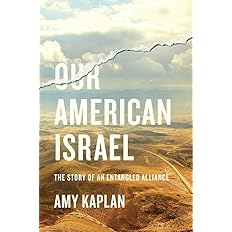
This item: Our American Israel: The Story of an Entangled Alliance
$51.95$51.95
+
Ten Myths About Israel
$19.99$19.99
+
The Hundred Years' War on Palestine: A History of Settler Colonialism and Resistance, 1917-2017
$20.17$20.17
Total Price:$92.11
Add all 3 to Cart
Some of these items dispatch sooner than the others.
Show details
Customers also viewed
The Hundred Years' War on Palestine: A History of Settler Colonialism and Resistance, 1917-2017
Rashid Khalidi
4.7 out of 5 stars 2,485
Paperback
#1 Best Seller in History of Syria
$20.17$20.17
FREE Delivery Wednesday, May 22
Ten Myths About Israel
Ilan Pappe
4.7 out of 5 stars 515
Paperback
$19.99$19.99
FREE Delivery Sunday, May 5
The Israel Lobby and U.S. Foreign Policy
John J Mearsheimer
4.7 out of 5 stars 666
Paperback
$32.27$32.27
FREE Delivery Wednesday, May 22

Gaza: An Inquest into Its Martyrdom
Norman Finkelstein
4.9 out of 5 stars 376
Paperback
$34.61$34.61
The Iron Cage: The Story of the Palestinian Struggle for Statehood
Rashid Khalidi
4.4 out of 5 stars 77
Paperback
$28.93$28.93
FREE Delivery Friday, May 17
Customers who bought this item also bought
Page 1 of 12Page 1 of 12
Previous page
The Hundred Years' War on Palestine: A History of Settler Colonialism and Resistance, 1917-2017
Rashid Khalidi
4.7 out of 5 stars 2,485
Paperback
#1 Best Seller in History of Syria
$20.17$20.17
FREE Delivery Wednesday, May 22
Ten Myths About Israel
Ilan Pappe
4.7 out of 5 stars 515
Paperback
$19.99$19.99
FREE Delivery Sunday, May 5

Orientalism
Edward W. Said
4.6 out of 5 stars 1,834
Paperback
$19.25$19.25
FREE Delivery Sunday, May 5
Gaza: An Inquest into Its Martyrdom
Norman Finkelstein
4.9 out of 5 stars 376
Paperback
$34.61$34.61
The Israel Lobby and U.S. Foreign Policy
John J Mearsheimer
4.7 out of 5 stars 666
Paperback
$32.27$32.27
FREE Delivery Wednesday, May 22
Next page
Product description
Review
Shows how the special relationship between Israel and the US (or even its Jewish population) was never preordained or inevitable. Rather, like any international relationship, it has been molded by a series of cultural and political mediations. In the tradition of critical scholarship Kaplan uncovers the constructedness of US approaches to the State of Israel and so contributes much to our understanding of it...Kaplan's study is of immense importance to anyone who wishes to study Israel in American culture in the past, present, or future.--David Hadar "American Literary History" (6/1/2022 12:00:00 AM)
Fascinating...could hardly be more timely.--Andrew Bacevich "The Spectator" (12/8/2018 12:00:00 AM)
Kaplan often confronts us with facts of history that are sometimes awkward and uncomfortable...But no American who loves and supports Israel can afford to ignore the arguments that she makes.-- "Jewish Journal" (9/13/2018 12:00:00 AM)
Kaplan's tour of literature and film shows how common understandings of Israel and the U.S. have been shaped--and distorted, as with the Trump administration's relocation of the American embassy to Jerusalem. A useful reading of history and politics in the light of mythmaking and media.-- "Kirkus Reviews" (8/1/2018 12:00:00 AM)
Keen analysis...Kaplan's approach is so fresh, her command of the sources so solid, and her prose so engaging that both casual readers and experts will find new insights in the book.--Walter Russell Mead "Foreign Affairs" (11/1/2018 12:00:00 AM)
Our American Israel is a tour de force, examining the profound ties that bind America and Israel together. No other book goes so deeply into American culture and intellectual life to explain the strength of the bond between the two countries. This book will be welcomed by those searching for a deeper and more intelligent analysis of the American-Israeli-Palestinian conundrum than is currently available.--Rashid Khalidi, author of Brokers of Deceit: How the U.S. Has Undermined Peace in the Middle East
Our American Israel is an incisive, urgently necessary excavation of the cultural meanings of the U.S.-Israeli relationship by one of the most perceptive cultural historians of the United States. It sheds powerful light on a troubled past and disturbing present, revealing the ways that narratives of similarity and connection were wielded against the demands of human rights and social justice.--Paul A. Kramer, author of The Blood of Government: Race, Empire, the United States, and the Philippines
About the Author
Amy Kaplan was Edward W. Kane Professor of English at the University of Pennsylvania. The author of Our American Israel, The Anarchy of Empire in the Making of U.S. Culture, and The Social Construction of American Realism, she was a past president of the American Studies Association and was awarded fellowships from the National Endowment for the Humanities and the Institute for Advanced Study at Princeton.
Product details
Publisher : *Harvard University Press; 1st edition (17 September 2018)
Language : English
Hardcover : 368 pages
ISBN-10 : 0674737628
ISBN-13 : 978-0674737624
Dimensions : 15.56 x 3.1 x 23.5 cmBest Sellers Rank: 593,269 in Books (See Top 100 in Books)528 in Regional Geography
573 in Jewish Social Studies
1,366 in History of Israel & PalestineCustomer Reviews:
4.5 4.5 out of 5 stars 18 ratings
Top reviews
Top reviews from Australia
There are 0 reviews and 0 ratings from Australia
Top reviews from other countries

Randolph Eck
5.0 out of 5 stars The American/Israeli Alliance
Reviewed in the United States on 28 July 2019
Verified Purchase
In 1945, it was not immediately obvious that a small state in the Middle East would come to identify with a country like the U.S. The author shows us how Zionism, which is a movement to establish a homeland for a particular ethnoreligious group, came to resonate “with citizens of a nation based on the foundation, or at least the aspiration, of civic equality amid ethnic diversity.” The book begins at the end of World War II, and it concludes “when the United States adopted a distinctively Israeli conception of homeland security.” The author shows how it is in the wider crucible of American culture that we find the meaning of the “special relationship” that has been forged between the nations. Throughout the book, we gain an understanding of the connotations of “our American Israel.” Quoting the author, “Israel can be seen through American eyes as a model of liberation from persecution, and imperial proxy doing the bidding of a superpower, a unifying object of affection, or the exclusive possession of a particular group.” In the book, we explore the creation of “common consent” over the last seventy years about the “apt and proper” ways to speak about Israel in the U.S.
It is good to be familiar with the history of the Palestinian region after WWII. You will come across mention of things such as, the Mandate for Palestine, the Anglo-American Committee for Inquiry, the UN Partition plan for Palestine, the Hagenah, the Irgun, the Stern Gang, and other such things relating to that period. A consultation with Wikipedia may help here.
A number of pages are devoted to the 1958 novel Exodus by Leon Uris, in which he wrote of Israel’s founding as “an epic in the history of man.” This was a pro-Israel book, described as propaganda in nature. It had a profound influence in Americanizing the Zionist narrative of Israel’s origins. This was followed by the film of the same name, which was responsible for its enormous influence in stimulating Zionism and support for Israel in the U.S. In the process, it seems that both “effaced the violent dispossession of Palestinians, with a glorified interpretation of Israel’s founding as an event ‘unparalleled in human history.’” The establishment of Israel is viewed as a universal good and “the embodiment of human aspiration and the fulfillment of the noblest impulses of mankind.”
In 1967, we have the six-day where Israel’s lightning victory and righteous cause appealed to a nation bogged down in Vietnam. Americans en masse fell in love with Israel. In 1973, we have the Yom Kippur War. In the aftermath of this war, President Nixon and Henry Kissinger committed the U.S. to maintaining Israel’s military edge dramatically increasing military, financial, and diplomatic support. Not all remained rosy for the American-Israel alliance. In 1982, Israel’s invasion of Lebanon caused criticism to ring out “from the center of American society, from mainstream media, politicians, intellectuals, and leaders of Jewish organizations.” The 1980s witnessed more polarization in America about Israel than ever before, yet the Reagan administration significantly increased financial aid and military cooperation calling Israel a “strategic asset” in a reheated Cold War. We see various organizations springing up to defend Israel from criticism and repair its reputation. We see this through mainstream Jewish American organizations (CAMERA, AIPAC, and the ADL) and expanded surveillance of Israel’s critics on college campuses. In the defense of Israel, two books – the “Haj” and “From Time Immemorial” were subsequently published. By the time of Jimmy Carter, we see increased emphasis on the Holocaust. There was this idea that Israel was vulnerable to a new Holocaust, and as Israeli military power grew, Holocaust analogies justified that increase. Also the “conflation of Palestinians with terrorism and Nazism contributed to the public perception of the illegitimacy of the PLO and the cause it represented,” the author notes.
The rise of the Christian Right in the late 1970s saw evangelical Christians become fervent supporters of Israel, some even looking to Israel as the setting of the Second Coming of Jesus Christ. A popular publication relating to these things was “The Late Great Planet Earth.” It was also felt by some that defending Israel would actually protect America from a descent into moral perdition. In 1983, Jerry Falwell announced that “the best friends Israel has in the world today are Evangelical and Fundamentalist Christians. Soon after, the prime minister of Israel began to cultivate the Christian Right as a political ally. We learn that this rise of the Christian Right dovetailed with the emergence of the neoconservative movement, and both groups crusaded to rebuild America’s military power and prestige around the world. After 2001, we see “Israel increasingly appealed to as a model to emulate in defending America at home and abroad from existential threats, both real and imagined,” the author notes. In 2004 the U.S. and Israel signed an agreement to fund research to develop new homeland security technologies. The author explains that Israel “marketed their weapons and systems of homeland security to Americans not only based on testing in the occupied territories, but also through a broader perception of Israel as an invincible victim.”
In 2009, Barack Obama spoke of the unbreakable bond between the United States and Israel. We can see that the “meaning and strength of that bond have fluctuated over the decades since Israel became a state in 1948, but it remains as powerful today.” It is also more contested that ever before.
Read less
13 people found this helpfulReport
Jane Wilson
5.0 out of 5 stars Unread but essential
Verified Purchase
In 1945, it was not immediately obvious that a small state in the Middle East would come to identify with a country like the U.S. The author shows us how Zionism, which is a movement to establish a homeland for a particular ethnoreligious group, came to resonate “with citizens of a nation based on the foundation, or at least the aspiration, of civic equality amid ethnic diversity.” The book begins at the end of World War II, and it concludes “when the United States adopted a distinctively Israeli conception of homeland security.” The author shows how it is in the wider crucible of American culture that we find the meaning of the “special relationship” that has been forged between the nations. Throughout the book, we gain an understanding of the connotations of “our American Israel.” Quoting the author, “Israel can be seen through American eyes as a model of liberation from persecution, and imperial proxy doing the bidding of a superpower, a unifying object of affection, or the exclusive possession of a particular group.” In the book, we explore the creation of “common consent” over the last seventy years about the “apt and proper” ways to speak about Israel in the U.S.
It is good to be familiar with the history of the Palestinian region after WWII. You will come across mention of things such as, the Mandate for Palestine, the Anglo-American Committee for Inquiry, the UN Partition plan for Palestine, the Hagenah, the Irgun, the Stern Gang, and other such things relating to that period. A consultation with Wikipedia may help here.
A number of pages are devoted to the 1958 novel Exodus by Leon Uris, in which he wrote of Israel’s founding as “an epic in the history of man.” This was a pro-Israel book, described as propaganda in nature. It had a profound influence in Americanizing the Zionist narrative of Israel’s origins. This was followed by the film of the same name, which was responsible for its enormous influence in stimulating Zionism and support for Israel in the U.S. In the process, it seems that both “effaced the violent dispossession of Palestinians, with a glorified interpretation of Israel’s founding as an event ‘unparalleled in human history.’” The establishment of Israel is viewed as a universal good and “the embodiment of human aspiration and the fulfillment of the noblest impulses of mankind.”
In 1967, we have the six-day where Israel’s lightning victory and righteous cause appealed to a nation bogged down in Vietnam. Americans en masse fell in love with Israel. In 1973, we have the Yom Kippur War. In the aftermath of this war, President Nixon and Henry Kissinger committed the U.S. to maintaining Israel’s military edge dramatically increasing military, financial, and diplomatic support. Not all remained rosy for the American-Israel alliance. In 1982, Israel’s invasion of Lebanon caused criticism to ring out “from the center of American society, from mainstream media, politicians, intellectuals, and leaders of Jewish organizations.” The 1980s witnessed more polarization in America about Israel than ever before, yet the Reagan administration significantly increased financial aid and military cooperation calling Israel a “strategic asset” in a reheated Cold War. We see various organizations springing up to defend Israel from criticism and repair its reputation. We see this through mainstream Jewish American organizations (CAMERA, AIPAC, and the ADL) and expanded surveillance of Israel’s critics on college campuses. In the defense of Israel, two books – the “Haj” and “From Time Immemorial” were subsequently published. By the time of Jimmy Carter, we see increased emphasis on the Holocaust. There was this idea that Israel was vulnerable to a new Holocaust, and as Israeli military power grew, Holocaust analogies justified that increase. Also the “conflation of Palestinians with terrorism and Nazism contributed to the public perception of the illegitimacy of the PLO and the cause it represented,” the author notes.
The rise of the Christian Right in the late 1970s saw evangelical Christians become fervent supporters of Israel, some even looking to Israel as the setting of the Second Coming of Jesus Christ. A popular publication relating to these things was “The Late Great Planet Earth.” It was also felt by some that defending Israel would actually protect America from a descent into moral perdition. In 1983, Jerry Falwell announced that “the best friends Israel has in the world today are Evangelical and Fundamentalist Christians. Soon after, the prime minister of Israel began to cultivate the Christian Right as a political ally. We learn that this rise of the Christian Right dovetailed with the emergence of the neoconservative movement, and both groups crusaded to rebuild America’s military power and prestige around the world. After 2001, we see “Israel increasingly appealed to as a model to emulate in defending America at home and abroad from existential threats, both real and imagined,” the author notes. In 2004 the U.S. and Israel signed an agreement to fund research to develop new homeland security technologies. The author explains that Israel “marketed their weapons and systems of homeland security to Americans not only based on testing in the occupied territories, but also through a broader perception of Israel as an invincible victim.”
In 2009, Barack Obama spoke of the unbreakable bond between the United States and Israel. We can see that the “meaning and strength of that bond have fluctuated over the decades since Israel became a state in 1948, but it remains as powerful today.” It is also more contested that ever before.
Read less
13 people found this helpfulReport
Jane Wilson
5.0 out of 5 stars Unread but essential
Reviewed in the United States on 25 March 2024
Verified Purchase
I’m sorry Harvard UP has done such a poor job of promoting this essential book, which is needed now more than ever after Oct 7. It should be a key part of the Israel/Palestine conversation, but remains in obscurity.
Report
E. Jahneke
5.0 out of 5 stars I learned a lot from this book...Reviewed in the United States on 10 June 2019
Verified Purchase
glad I read about it in The Nation. I didn't know much about Israel, and what I thought I knew was part of many years of image campaigns that Ms. Kaplan explains. Even though I wasn't very knowledgeable at the start, the book has an accessible style that I followed easily and wanted to read(it usually is a pleasure to read an expert on a theme that she has a passion for, as long as she doesn't treat it like a big secret!)
7 people found this helpfulReport
Professor X
5.0 out of 5 stars High qualityReviewed in the United States on 18 July 2021
Verified Purchase
Book arrived in excellent condition.
Report
See more reviews
Verified Purchase
I’m sorry Harvard UP has done such a poor job of promoting this essential book, which is needed now more than ever after Oct 7. It should be a key part of the Israel/Palestine conversation, but remains in obscurity.
Report
E. Jahneke
5.0 out of 5 stars I learned a lot from this book...Reviewed in the United States on 10 June 2019
Verified Purchase
glad I read about it in The Nation. I didn't know much about Israel, and what I thought I knew was part of many years of image campaigns that Ms. Kaplan explains. Even though I wasn't very knowledgeable at the start, the book has an accessible style that I followed easily and wanted to read(it usually is a pleasure to read an expert on a theme that she has a passion for, as long as she doesn't treat it like a big secret!)
7 people found this helpfulReport
Professor X
5.0 out of 5 stars High qualityReviewed in the United States on 18 July 2021
Verified Purchase
Book arrived in excellent condition.
Report
See more reviews
===

No comments:
Post a Comment