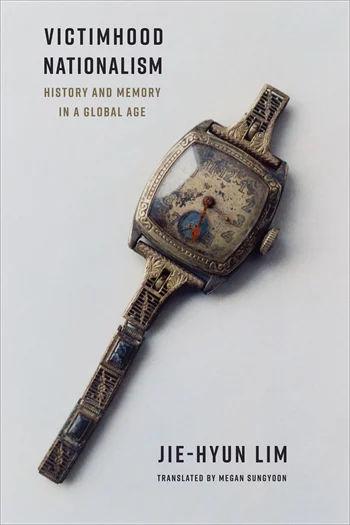
Victimhood Nationalism
History and Memory in a Global Age
Jie-Hyun Lim. Translated by Megan Sungyoon.
Columbia University Press
Reviews
Named one of the 10 best books of 2021 [Korean language edition]"
Hankook Ilbo
"Seventh place in the Kinokuniya People's Book Award 2023 [Japanese language edition]"
Kinokuniya
"This expansive study of what the author has astutely identified as "victimhood nationalism" ranges across the global landscape of contemporary memory practices from Eastern Europe to East Asia and places between. A landmark in the flourishing field of memory studies."
Carol Gluck, Columbia University
"A real tour de force, Victimhood Nationalism is the outcome of decades of research on what Lim calls "global memory formation." Tracking the dark side of collective remembrance across multiple languages, heterogeneous histories, and far-flung geographies, Lim offers a compelling account of how the memory of victimhood grounds exclusivist national identities even as it travels freely across national borders. The book is a must-read for all who are alarmed about contemporary abuses of memory and yet hold on to a fragile hope for mnemonic solidarity."
Michael Rothberg, author of The Implicated Subject: Beyond Victims and Perpetrators
"Now that the past plays a critical role in shaping both national identities and global politics, Victimhood Nationalism explores how historical suffering is turned into moral advantage. With a sharp focus on East Asia and Eastern Europe, this book brings clarity to the ways in which nations spin victimhood narratives to assert dominance in the transnational memory space. Drawing global implications from regional comparisons, Jie-Hyun Lim reshapes the conversation in memory studies and offers a new perspective within global history. Essential reading for anyone interested in the politics of memory and identity."
Joanna Wawrzyniak, University of Warsaw, and president of the Memory Studies Association
"Provides useful insights into how narratives of suffering and harm are mobilized for political and national purposes...for those interested in the global aspects of victimhood nationalism, this book offers a worthwhile perspective."
Jessie Barton Hronešová, University College London, International Affairs
"Victimhood Nationalism a profoundly necessary book for our time."
Lilie Chouliaraki, London School of Economics and Political Science, American Historical Review
Contents
reface
1. Mnemohistory
2. Genealogy
3. Sublimation
4. Globalization
5. Nationalization
6. Dehistoricization
7. Overhistoricization
8. Juxtaposition
9. Denial
10. Forgiveness
Coda: Beyond Mnemonic Eurocentrism
Notes
Bibliography
Index
Excerpt Links
Awards
Nationalism today depends on the perception of victimhood. The historical memory of past suffering endows nationalist movements with political legitimacy and a sense of moral superiority. Koreans recall Japanese colonial atrocities, while Japan commemorates the atomic bombings of Hiroshima and Nagasaki. Israel sanctifies the Holocaust and Poland trumpets the Nazi and Soviet occupations. Even Germany and Russia, perpetrators of historical crimes, today cast themselves as victims by pointing to national suffering.
In this theoretically sophisticated and empirically rich book, Jie-Hyun Lim offers a new way to understand nationalism and its political instrumentalization of suffering, developing the concept of “victimhood nationalism” and exploring it in a range of global settings. He examines relations among Poland, Germany, Israel, Korea, and Japan, focusing on how memories of colonialism, the Holocaust, and Stalinist terror have converged and intertwined in transnational spaces. With an emphasis on memory formation, Lim scrutinizes how perpetrators in Germany and Japan transformed themselves into victims, as well as how nationalists in Poland, Korea, and Israel portray themselves as hereditary victims in order to rebut external criticism. He considers the construction of nations as victims and perpetrators, tracing the interaction of history and memory. Ultimately, the book contends, challenging victimhood nationalism is necessary to overcome the endless competition over national suffering and instead promote reconciliation, mutual understanding, and transnational solidarity.
About the AuthorJie-Hyun Lim is the CIPSH Chairholder of Global Easts, Distinguished Professor, and founding director of the Critical Global Studies Institute at Sogang University. In 2025–2026, he is the Class of 1955 Visiting Professor in Global Studies at Williams College. His many books include Global Easts: Remembering, Imagining, Mobilizing (Columbia, 2022).
======
What underlies today’s genocidal conflicts, like the wars in Gaza and Ukraine? In my book, Victimhood Nationalism, I offer a global historian’s and memory scholar’s answer. I argue that these tragic clashes are preceded by “memory wars”—conflicts stemming from a troubled past of unresolved traumas and failed reconciliations. Memory diplomacy to achieve historical reconciliation has consistently failed when confronted with the power of an entrenched nationalist memory among the grassroots. I hope my book can help foster a global memory regime for mnemonic solidarity and historical reconciliation, by sacrificing victimhood nationalism.
I define “victimhood nationalism” as a narrative template that grants a nation moral superiority and political legitimacy based on a legacy of ancestral suffering. A nation of this hereditary victimhood is seen as having an inherent justification for its actions and a fundamental right to exist in the world. Its sense of “ontological security” is bolstered by the global human rights regime, which elevates that specific history of suffering into a universal cause for humanity. In this way, nationalism has survived and adapted to the age of globalization, replacing the worship of heroes with the veneration of victims.
Victimhood nationalism demonstrates that the globalization of memory, rather than guaranteeing transnational solidarity, often sharpens nations’ rivalries over their entangled past. Worse, this rivalry devolves into a distasteful competition over whose nation has suffered more. It regrettably reduces the complexities of human suffering to the vulgar politics of numbers. Thus, victimhood nationalism instrumentalizes, objectifies, and dehumanizes the very victims it claims to revere, turning them into mere historical assets and symbolic capital.
Victimhood nationalism instrumentalizes, objectifies, and dehumanizes the very victims it claims to revere.
Paradoxically, victimhood nationalism is fundamentally transnational. It thrives on entangled memories of the shared past, where a victim nation’s identity is inextricably linked to that of a perpetrator nation. The histories of Germany and Israel, Poland and Germany, and Japan and Korea are primary examples of this codependent dynamic, where each nation’s memory of suffering reinforces the other’s counter-memory in a vicious cycle.
This entanglement is not confined to bilateral relationships. Memories of the Holocaust, for example, have been appropriated by Japanese, Korean, and other victimhood nationalists. The result is a complex global memory space where victims of the Holocaust, the atomic bombings in Hiroshima and Nagasaki, colonial genocides in the Tricontinental, trans-Atlantic slave trade, and political genocides in the Stalinist regimes, as well as Japanese military “comfort women,” have become enmeshed.
This transnational memory framework provides the intellectual architecture for victimhood nationalism. At the heart of this architecture is a powerful engine, driven by two seemingly opposite yet mutually reinforcing processes: dehistoricization and overhistoricization. Dehistoricization is the process by which perpetrator nations cleanse their past, recasting their wartime traumas as indications of innocent suffering. Germany, for instance, leveraged memories of the Allied bombings and the expulsion of Volksdeutsche from Eastern Europe to portray its populace as victims. Similarly, Japan has often framed Hiroshima and Nagasaki as a unique human tragedy, a narrative that conveniently overshadows the war crimes committed by the Japanese Empire.
Conversely, overhistoricization is the weaponized memory of victim nations. This process establishes a fixed idea of “collective innocence”—a belief that a nation’s victim status is so absolute that its own members could never have been perpetrators. This logic is used to excuse, for instance, the Polish individuals who murdered their Jewish neighbors in Jedwabne in 1941. It is also applied to colonial Koreans who, serving in the Japanese military, committed B- and C-class war crimes; their actions are often obscured by Korea’s broader narrative of national victimhood. The mantle of “collective innocence” shields individual perpetrators, granting them a form of indulgence for being members of a victimized nation. Ultimately, victimhood nationalism create a zero-sum game of suffering by simplifying history into a nationalist binary of collective guilt and innocence.
Victimhood nationalism is not confined to the domain of memory; it is actively deployed as a weapon in contemporary conflicts.
Victimhood nationalism is not confined to the domain of memory; it is actively deployed as a weapon in contemporary conflicts. In the war in Gaza, for instance, the memory of the Holocaust is invoked to justify Israeli military actions, transforming the universal slogan of “never again” into a nationalized “never again for us.” Simultaneously, many Hamas supporters employ their own victim narrative, citing Franz Fanon to frame their attacks as an inevitable reaction to colonial oppression—an interpretation Fanon himself likely would have rejected. This weaponization of the past is also central to the invasion of Ukraine, which Vladimir Putin justifies through a narrative of Russian victimhood at the hands of the “collective West.”
For these reasons, victimhood nationalism cannot be tolerated in the global memory space. The Gaza War is a tragic reminder of the Holocaust’s most sinister lesson: not that such an atrocity can happen to us again, but that we, the innocent, are capable of perpetrating it. The fundamental danger of victimhood nationalism is that it blinds historical victims and their descendants to the possibility of being potential victimizers in a different historical setting. Nothing is more dangerous than moral self-righteousness without reflection.
The old Soviet joke goes, “The future is known, but the past is unpredictable because it is always changing.” This dark humor reveals a profound truth that also defines victimhood nationalism: the past is not a fixed record but a contested narrative, constantly reshaped to serve the present. The future we build depends entirely on the version of the past we choose to construct now. While we are not responsible for the events that occurred before our birth, we are fully accountable for how those events are remembered, because we are the architects of that memory.
==
==
What underlies today’s genocidal conflicts, like the wars in Gaza and Ukraine? In my book, Victimhood Nationalism, I offer a global historian’s and memory scholar’s answer. I argue that these tragic clashes are preceded by “memory wars”—conflicts stemming from a troubled past of unresolved traumas and failed reconciliations. Memory diplomacy to achieve historical reconciliation has consistently failed when confronted with the power of an entrenched nationalist memory among the grassroots. I hope my book can help foster a global memory regime for mnemonic solidarity and historical reconciliation, by sacrificing victimhood nationalism.
I define “victimhood nationalism” as a narrative template that grants a nation moral superiority and political legitimacy based on a legacy of ancestral suffering. A nation of this hereditary victimhood is seen as having an inherent justification for its actions and a fundamental right to exist in the world. Its sense of “ontological security” is bolstered by the global human rights regime, which elevates that specific history of suffering into a universal cause for humanity. In this way, nationalism has survived and adapted to the age of globalization, replacing the worship of heroes with the veneration of victims.
Victimhood nationalism demonstrates that the globalization of memory, rather than guaranteeing transnational solidarity, often sharpens nations’ rivalries over their entangled past. Worse, this rivalry devolves into a distasteful competition over whose nation has suffered more. It regrettably reduces the complexities of human suffering to the vulgar politics of numbers. Thus, victimhood nationalism instrumentalizes, objectifies, and dehumanizes the very victims it claims to revere, turning them into mere historical assets and symbolic capital.
Victimhood nationalism instrumentalizes, objectifies, and dehumanizes the very victims it claims to revere.
Paradoxically, victimhood nationalism is fundamentally transnational. It thrives on entangled memories of the shared past, where a victim nation’s identity is inextricably linked to that of a perpetrator nation. The histories of Germany and Israel, Poland and Germany, and Japan and Korea are primary examples of this codependent dynamic, where each nation’s memory of suffering reinforces the other’s counter-memory in a vicious cycle.
This entanglement is not confined to bilateral relationships. Memories of the Holocaust, for example, have been appropriated by Japanese, Korean, and other victimhood nationalists. The result is a complex global memory space where victims of the Holocaust, the atomic bombings in Hiroshima and Nagasaki, colonial genocides in the Tricontinental, trans-Atlantic slave trade, and political genocides in the Stalinist regimes, as well as Japanese military “comfort women,” have become enmeshed.
This transnational memory framework provides the intellectual architecture for victimhood nationalism. At the heart of this architecture is a powerful engine, driven by two seemingly opposite yet mutually reinforcing processes: dehistoricization and overhistoricization. Dehistoricization is the process by which perpetrator nations cleanse their past, recasting their wartime traumas as indications of innocent suffering. Germany, for instance, leveraged memories of the Allied bombings and the expulsion of Volksdeutsche from Eastern Europe to portray its populace as victims. Similarly, Japan has often framed Hiroshima and Nagasaki as a unique human tragedy, a narrative that conveniently overshadows the war crimes committed by the Japanese Empire.
Conversely, overhistoricization is the weaponized memory of victim nations. This process establishes a fixed idea of “collective innocence”—a belief that a nation’s victim status is so absolute that its own members could never have been perpetrators. This logic is used to excuse, for instance, the Polish individuals who murdered their Jewish neighbors in Jedwabne in 1941. It is also applied to colonial Koreans who, serving in the Japanese military, committed B- and C-class war crimes; their actions are often obscured by Korea’s broader narrative of national victimhood. The mantle of “collective innocence” shields individual perpetrators, granting them a form of indulgence for being members of a victimized nation. Ultimately, victimhood nationalism create a zero-sum game of suffering by simplifying history into a nationalist binary of collective guilt and innocence.
Victimhood nationalism is not confined to the domain of memory; it is actively deployed as a weapon in contemporary conflicts.
Victimhood nationalism is not confined to the domain of memory; it is actively deployed as a weapon in contemporary conflicts. In the war in Gaza, for instance, the memory of the Holocaust is invoked to justify Israeli military actions, transforming the universal slogan of “never again” into a nationalized “never again for us.” Simultaneously, many Hamas supporters employ their own victim narrative, citing Franz Fanon to frame their attacks as an inevitable reaction to colonial oppression—an interpretation Fanon himself likely would have rejected. This weaponization of the past is also central to the invasion of Ukraine, which Vladimir Putin justifies through a narrative of Russian victimhood at the hands of the “collective West.”
For these reasons, victimhood nationalism cannot be tolerated in the global memory space. The Gaza War is a tragic reminder of the Holocaust’s most sinister lesson: not that such an atrocity can happen to us again, but that we, the innocent, are capable of perpetrating it. The fundamental danger of victimhood nationalism is that it blinds historical victims and their descendants to the possibility of being potential victimizers in a different historical setting. Nothing is more dangerous than moral self-righteousness without reflection.
The old Soviet joke goes, “The future is known, but the past is unpredictable because it is always changing.” This dark humor reveals a profound truth that also defines victimhood nationalism: the past is not a fixed record but a contested narrative, constantly reshaped to serve the present. The future we build depends entirely on the version of the past we choose to construct now. While we are not responsible for the events that occurred before our birth, we are fully accountable for how those events are remembered, because we are the architects of that memory.
==
==
==
==

No comments:
Post a Comment