The Hong Kong protests explained in 100 and 500 words
 GETTY IMAGES
Anti-government protests have rocked Hong Kong for months and the situation shows no sign of dying down.
Here's all the background you need to know in 100 or 500 words - you can read each individually or in turn.

Hong Kong's protests started in June against plans to allow extradition to mainland China.
Critics feared this could undermine judicial independence and endanger dissidents.
Until 1997, Hong Kong was ruled by Britain as a colony but then returned to China. Under the "one country, two systems" arrangement, it has some autonomy, and its people more rights.
The bill was withdrawn in September but demonstrations continue and now demand full democracy and an inquiry into police actions.
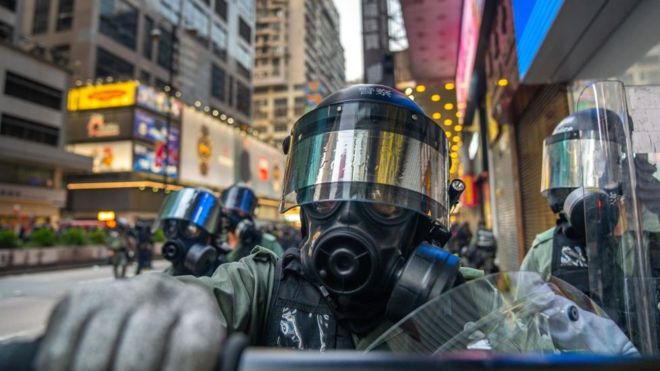
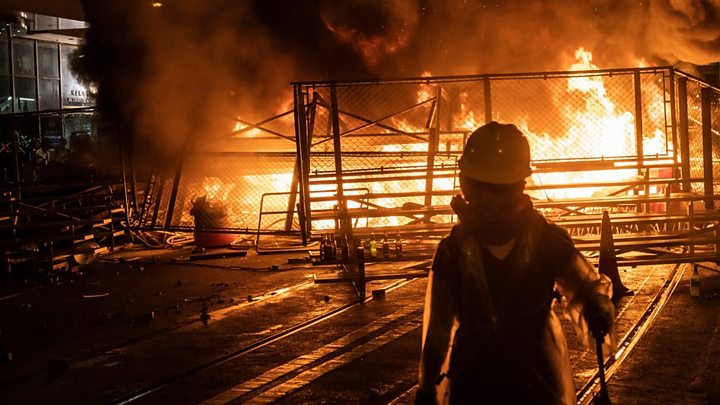
Clashes between police and activists have become increasingly violent, with police firing live bullets and protesters attacking officers and throwing petrol bombs.

The extradition bill which triggered the first protest was introduced in April. It would have allowed for criminal suspects to be extradited to mainland China under certain circumstances.
Opponents said this risked exposing Hongkongers to unfair trials and violent treatment. They also argued the bill would give China greater influence over Hong Kong and could be used to target activists and journalists.
Hundreds of thousands of people took to the streets. After weeks of protests, leader Carrie Lam eventually said the bill would be suspended indefinitely.
How did the protests escalate?
Protesters feared the bill could be revived, so demonstrations continued, calling for it to be withdrawn completely.
By then clashes between police and protesters had become more frequent and violent.
In September, the bill was finally withdrawn, but protesters said this was "too little, too late".
On 1 October, while China was celebrating 70 years of Communist Party rule, Hong Kong experienced one of its most "violent and chaotic days".
An 18-year-old was shot in the chest with a live bullet as protesters fought officers with poles, petrol bombs and other projectiles.
The government then banned protesters wearing face masks, and in early November a pro-Beijing lawmaker was stabbed in the street by a man pretending to be a supporter.
One week later, a policeman shot one protester at close range when activists were trying to set up a road block. Later that day another man was set on fire by anti-government protesters.
In November, a standoff between police and students barricaded on the campus of Hong Kong's Polytechnic University became another defining moment.
Later that month, the territory held local council elections that were seen as a barometer of public opinion.
The vote saw a landslide victory for the pro-democracy movement, with 17 of the 18 councils now controlled by pro-democracy councillors.
What do the protesters want?
Some protesters have adopted the motto: "Five demands, not one less!" These are:
- For the protests not to be characterised as a "riot"
- Amnesty for arrested protesters
- An independent inquiry into alleged police brutality
- Implementation of complete universal suffrage
The fifth demand, the withdrawal of the bill, has already been met.
Protests supporting the Hong Kong movement have spread across the globe, with rallies taking place in the UK, France, US, Canada and Australia.
In many cases, people supporting the demonstrators were confronted by pro-Beijing rallies.
Chinese president Xi Jinping has warned against separatism, saying any attempt to divide China would end in "bodies smashed and bones ground to powder".
What is Hong Kong's status?
Hong Kong is a former British colony handed back to China in 1997.
It has its own judiciary and a separate legal system from mainland China. Those rights include freedom of assembly and freedom of speech.
But those freedoms - the Basic Law - expire in 2047 and it is not clear what Hong Kong's status will then be.
Want to know more?
Read this:
- Hong Kong's young winners and the veterans they toppled
- What led to a single gunshot being fired?
- The background you need on the Hong Kong protests
- Why Starbucks? The brands attacked in Hong Kong
- Profile: Hong Kong leader Carrie Lam
- Seven ways China's media took on HK protests
- How badly has tourism been affected
And watch this:

China
Five flashpoints in Hong Kong's year of anger
- 31 August 2020
- China
LA-Hong Kong data cable dropped over China fears
- 31 August 2020
- Technology
Trump or Biden? China expects no favours either way
- 28 August 2020
- Business


 Chandra Wickramasinghe