Kindle $14.72
Audiobook
$14.95Available upon release
Hardcover
$37.26
Paperback
$26.25
Not now
Read sample
Follow the author

Peter BeinartPeter Beinart
Follow
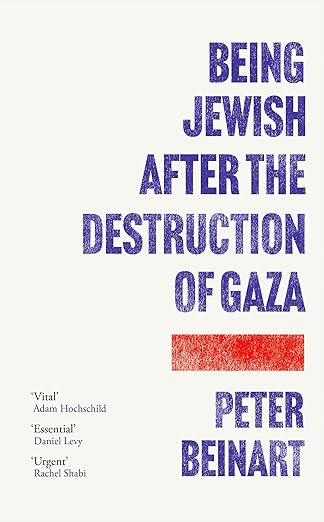
Being Jewish After the Destruction of Gaza Kindle Edition
by Peter Beinart (Author) Format: Kindle Edition
4.7 4.7 out of 5 stars 98 ratings
#1 Best Seller in Israeli History
***THE INSTANT NEW YORK TIMES BESTSELLER***
In Peter Beinart's view, one story dominates Jewish communal life: that of persecution and victimhood. It is a story that erases much of the nuance of Jewish religious tradition and warps our understanding of Israel and Palestine. After Gaza, where Jewish texts, history and language have been deployed to justify mass slaughter and starvation, Beinart argues, Jews must tell a new story. After this war, whose horror will echo for generations, they must do nothing less than offer a new answer to the question: What does it mean to be a Jew?
Beinart imagines an alternate narrative, which would draw on other nations' efforts at moral reconstruction and a different reading of Jewish tradition. A story in which Israeli Jews have the right to equality, not supremacy, and in which Jewish and Palestinian safety are not mutually exclusive but intertwined. One that recognizes the danger of venerating states at the expense of human life.
Being Jewish After the Destruction of Gaza is a provocative argument that will expand and inform one of the defining conversations of our time. It is a book that only Peter Beinart could write: a passionate yet measured work that brings together his personal experience, his commanding grasp of history, his keen understanding of political and moral dilemmas, and a clear vision for the future.
Read less
Print length
193 pages
Language

Kindle - Purpose built for reading
Read distraction-free. Highlight passages, look up definitions, translate words, and adjust text size—without ever leaving the page. Shop Now
Product description
About the Author
A frequent contributor to the New York Times and an MSNBC analyst, Peter Beinart is a professor of journalism and political science at the Craig Newmark Graduate School of Journalism at CUNY. He is also the editor at large of Jewish Currents and writes The Beinart Notebook, a weekly newsletter. He lives with his family in New York City. --This text refers to the paperback edition.
Review
This timely book constitutes a reckoning with the vast gulf between the Jewish tradition that Beinart cherishes and what has replaced it in the practice of the state of Israel, and of those who have come to worship that state. It is urgently needed. ― Rashid Khalidi, New York Times-bestselling author of The Hundred Years’ War on Palestine
'Beinart issues an impassioned critique of the American Jewish community's reaction to the war in Gaza. . . . Urgent and thought-provoking, this is sure to spark debate' ― Publishers Weekly --This text refers to an alternate kindle_edition edition.
Product details
ASIN : B0DKV992X5
Publisher : Atlantic Books (30 January 2025)
Language : English
File size : 1218 KB
Text-to-Speech : Enabled
Screen Reader : Supported
Enhanced typesetting : Enabled
X-Ray : Not Enabled
Word Wise : Enabled
Print length : 193 pages
Page numbers source ISBN : 0593803892Best Sellers Rank: 2,629 in Kindle Store (See Top 100 in Kindle Store)1 in History of Judaism
1 in Jewish History of Religion
1 in Israeli HistoryCustomer Reviews:
4.7 4.7 out of 5 stars 98 ratings
About the author
Follow authors to get new release updates, plus improved recommendations.
Follow
Peter Beinart
Contributing opinion writer, New York Times. Editor-at-Large, Jewish Currents. MSNBC Contributor. Professor of Journalism and Political Science, Newmark School of Journalism, CUNY. Fellow, Foundation for Middle East Peace.
Top reviews from Australia
There are 0 reviews and 3 ratings from Australia
Top reviews from other countries
Michael Nathanson
5.0 out of 5 stars A vital primer on the Israeli/Palestinian Conflict
Reviewed in the United States on 3 February 2025
Verified Purchase
I was born in Palestine before WW2 to immigrant European parents who fled their homelands as the ground under them began burning. I witnessed the uprising against the British Mandatory Government and lived through the War of Independence and its aftermath— the emptying of Arab villages and their demolition. I served in the IDF during the period of fighting Palestinian ‘infiltrators’ and the surrounding Arab States including the 1956 Sinai Campaign. The Kafr Quasim Massacre took place then. From 1957 to 1964 I was busy studying medicine in the divided Jerusalem. My attention to and involvement with the Israeli/Palestinian Conflict rekindled after the 1967 War when attention shifted back to the Palestinians who came under total Israeli control and had to contend with the swift establishment of Jewish settlement of the West Bank including East Jerusalem. This new, challenging, menacing, politically destructive
and humanly lethal situation has unleashed a spate of books that looked deeply and critically into the origins of the conflict, not least attempting to assign guilt to the opponents of their protagonist. Not many of the books written by Arab authors have been translated into English. But many in Western academia and Israeli ‘New Historians’ who examined released censured articles have concluded that early Jewish immigration to Palestine, and British support for building a Jewish National Home, a euphemism for a Jewish state, have bred among Arab Palestinians anti immigrant opposition bred by genuine fear of losing their land. History has vindicated the Palestinians. Peter Beinart’s new book, 121 pages short, succinctly and brilliantly summarized the antecedents of the conflict assigning the blame correctly on the Zionist movement that conveniently, and misleadingly, claimed its desire for the new Jewish immigrants to live peacefully side-by-side with the Arab Palestinians, adding Soto voce, but only as long as the Jews had 80% majority. I wish Mr. Beinart had spent more time analyzing Vladimir Zabotinsky’s pamphlet “the Iron Wall”. This Pamphlet reveals the mindset of the militant Zionist leaders, their plan of action and what motivates their disciples who now lead Israel, not that labor-led governments did not follow Zionism’s exclusionary geopolitics. Beinart’s primer on the Israeli-Palestinian Conflict is a vital addition to the burgeoning literature on this topic.
Read less
Report
slk
5.0 out of 5 stars Essential reading for Jews and non Jews alike.Reviewed in Germany on 16 February 2025
Verified Purchase
Really important and enlightening reading.
Report
jacob sznajdman
5.0 out of 5 stars If all jews read this, there will be peace
Verified Purchase
I was born in Palestine before WW2 to immigrant European parents who fled their homelands as the ground under them began burning. I witnessed the uprising against the British Mandatory Government and lived through the War of Independence and its aftermath— the emptying of Arab villages and their demolition. I served in the IDF during the period of fighting Palestinian ‘infiltrators’ and the surrounding Arab States including the 1956 Sinai Campaign. The Kafr Quasim Massacre took place then. From 1957 to 1964 I was busy studying medicine in the divided Jerusalem. My attention to and involvement with the Israeli/Palestinian Conflict rekindled after the 1967 War when attention shifted back to the Palestinians who came under total Israeli control and had to contend with the swift establishment of Jewish settlement of the West Bank including East Jerusalem. This new, challenging, menacing, politically destructive
and humanly lethal situation has unleashed a spate of books that looked deeply and critically into the origins of the conflict, not least attempting to assign guilt to the opponents of their protagonist. Not many of the books written by Arab authors have been translated into English. But many in Western academia and Israeli ‘New Historians’ who examined released censured articles have concluded that early Jewish immigration to Palestine, and British support for building a Jewish National Home, a euphemism for a Jewish state, have bred among Arab Palestinians anti immigrant opposition bred by genuine fear of losing their land. History has vindicated the Palestinians. Peter Beinart’s new book, 121 pages short, succinctly and brilliantly summarized the antecedents of the conflict assigning the blame correctly on the Zionist movement that conveniently, and misleadingly, claimed its desire for the new Jewish immigrants to live peacefully side-by-side with the Arab Palestinians, adding Soto voce, but only as long as the Jews had 80% majority. I wish Mr. Beinart had spent more time analyzing Vladimir Zabotinsky’s pamphlet “the Iron Wall”. This Pamphlet reveals the mindset of the militant Zionist leaders, their plan of action and what motivates their disciples who now lead Israel, not that labor-led governments did not follow Zionism’s exclusionary geopolitics. Beinart’s primer on the Israeli-Palestinian Conflict is a vital addition to the burgeoning literature on this topic.
Read less
Report
slk
5.0 out of 5 stars Essential reading for Jews and non Jews alike.Reviewed in Germany on 16 February 2025
Verified Purchase
Really important and enlightening reading.
Report
jacob sznajdman
5.0 out of 5 stars If all jews read this, there will be peace
Reviewed in Sweden on 4 February 2025
Verified Purchase
Clickbait admitted.
Beinart gives a tough-love talk aimed at fellow jews of different ( that is, wrong :) ) position about morality regarding Palestine-Israel state of affairs.
A succinct and wonderfully insightful essay on history, jewish tradition, psychology, and more. The arguments are backed by data from polls and various references that lend credibility to the thesis.
I have read a fair amount on the topic, and this is one of my absolute favorites and taught me new facts and perspectives I had not seen before.
Report
UserNameHidden
5.0 out of 5 stars Must read!
Verified Purchase
Clickbait admitted.
Beinart gives a tough-love talk aimed at fellow jews of different ( that is, wrong :) ) position about morality regarding Palestine-Israel state of affairs.
A succinct and wonderfully insightful essay on history, jewish tradition, psychology, and more. The arguments are backed by data from polls and various references that lend credibility to the thesis.
I have read a fair amount on the topic, and this is one of my absolute favorites and taught me new facts and perspectives I had not seen before.
Report
UserNameHidden
5.0 out of 5 stars Must read!
Reviewed in the United States on 29 January 2025
Verified Purchase
This book is a must read for Jews and non-Jews alike.
Peter Beinart’s book is a much needed cut against the grain of typical discourse on Israel. He humanizes the Palestinians while not detracting from the horrors of October 7th. As an observant Jew, he grapples with the meaning and purpose of Jewish chosenness while balancing the dangers that some interpretations of Jewish exceptionalism could lead to. Below are some quotes that summarize his perspective:
“More than sixty years ago, Hannah Ardent warned that Jewish nationalism contained this danger. ‘The greatness of this people was once that it believed in God,’ she wrote in 1963. ‘And now this people believes only in itself?’ That’s the real meaning of Netanyahu’s words. When he proudly declares that a Jewish state cannot be judged by any external standard, he is making that state—and the Jewish people for whom it speaks—an object of worship. And, as in the Bible, idolatry usually accompanies other sins. You ‘raise your eyes toward your fetishes, and you shed blood,’ the Prophet Ezekiel rebuked the Israelites in the sixth century BCE. ‘You have committed abominations.’ He could have been speaking about this war.”(P72-73).
“Many Jews treat a Jewish state the way the Bible feared Jewish monarchs would treat themselves: as a higher power, beholden to no external standard.” (P100).
“We have built an alter and thrown an entire society on the flames.” (p103).
“Remove Jewish statehood from Jewish identity and, for many Jews, it’s not clear what’s left.” (P107).
Read less
Report
Lobewiper
5.0 out of 5 stars A Great Book for Anyone--Not Only Jews
Verified Purchase
This book is a must read for Jews and non-Jews alike.
Peter Beinart’s book is a much needed cut against the grain of typical discourse on Israel. He humanizes the Palestinians while not detracting from the horrors of October 7th. As an observant Jew, he grapples with the meaning and purpose of Jewish chosenness while balancing the dangers that some interpretations of Jewish exceptionalism could lead to. Below are some quotes that summarize his perspective:
“More than sixty years ago, Hannah Ardent warned that Jewish nationalism contained this danger. ‘The greatness of this people was once that it believed in God,’ she wrote in 1963. ‘And now this people believes only in itself?’ That’s the real meaning of Netanyahu’s words. When he proudly declares that a Jewish state cannot be judged by any external standard, he is making that state—and the Jewish people for whom it speaks—an object of worship. And, as in the Bible, idolatry usually accompanies other sins. You ‘raise your eyes toward your fetishes, and you shed blood,’ the Prophet Ezekiel rebuked the Israelites in the sixth century BCE. ‘You have committed abominations.’ He could have been speaking about this war.”(P72-73).
“Many Jews treat a Jewish state the way the Bible feared Jewish monarchs would treat themselves: as a higher power, beholden to no external standard.” (P100).
“We have built an alter and thrown an entire society on the flames.” (p103).
“Remove Jewish statehood from Jewish identity and, for many Jews, it’s not clear what’s left.” (P107).
Read less
Report
Lobewiper
5.0 out of 5 stars A Great Book for Anyone--Not Only Jews
Reviewed in the United States on 31 January 2025
Verified Purchase
Mr. Beinart's little book (121 pages excluding notes) was for me a compelling read and highly informative. If I were to recommend only one book to someone interested in Israel-Palestine, this would be that book. Although its title suggests that it is aimed at Jewish readers, I found it a brilliant antidote to the propaganda ("hasbara") Israel and its allies have offered about its justifications for its decades-long apartheid treatment of Palestinians. Beinart is critical of both the Hamas Oct. 7 attack as well as Israel's conduct of the Gaza War. The book includes a detailed history of Israel's relationship with the Palestinians. Beinart shows how Jews and non-Jews have been conditioned to believe that Israel should be immune to criticism, regardless of its conduct toward others. Beinart argues that many Israelis, have justified their decades-long mistreatment of Palestinians by elevating the State of Israel above the Jewish faith, which of course commands its followers to treat others as one wishes oneself to be treated. Words cannot fully express my gratitude to Mr. Beinart for this courageous and extremely enlightening book. I wish all Americans would read it! (P.S.: Beinart is an editor of and regular contributor to JewishCurrents.com. I highly recommend it).
Report
See more reviews
Zionism rejected: Prominent US columnist Peter Beinart justifies Hamas - review
In his book, Beinart, a prominent left-wing American columnist, journalist, and political commentator, calls to reimagine Zionism.
Verified Purchase
Mr. Beinart's little book (121 pages excluding notes) was for me a compelling read and highly informative. If I were to recommend only one book to someone interested in Israel-Palestine, this would be that book. Although its title suggests that it is aimed at Jewish readers, I found it a brilliant antidote to the propaganda ("hasbara") Israel and its allies have offered about its justifications for its decades-long apartheid treatment of Palestinians. Beinart is critical of both the Hamas Oct. 7 attack as well as Israel's conduct of the Gaza War. The book includes a detailed history of Israel's relationship with the Palestinians. Beinart shows how Jews and non-Jews have been conditioned to believe that Israel should be immune to criticism, regardless of its conduct toward others. Beinart argues that many Israelis, have justified their decades-long mistreatment of Palestinians by elevating the State of Israel above the Jewish faith, which of course commands its followers to treat others as one wishes oneself to be treated. Words cannot fully express my gratitude to Mr. Beinart for this courageous and extremely enlightening book. I wish all Americans would read it! (P.S.: Beinart is an editor of and regular contributor to JewishCurrents.com. I highly recommend it).
Report
See more reviews
Joseph Psotka
5.0 out of 5 stars Thank you for this courageous analysis,
Reviewed in the United States on 9 February 2025
Verified Purchase
I cannot imagine the courage it took to write this exposition of deeply held views. It is thorough, detailed, explicit, and wonderful. I loved the use of Heschel to defend your views. It was terrifically insightful to reveal that :"the Arabic word for the Warsaw Ghetto uprising is 'intifada'.” What you say is so plainly right it has no need for the detailed evidence you painstakingly provide, but thank you very much for all the detail. Thank you, thank you. Good luck.
Beinart, Peter. Being Jewish After the Destruction of Gaza: A Reckoning (p. 84). Knopf Doubleday Publishing Group. Kindle Edition.
10 people found this helpful
Report
T. F. HUGHES
5.0 out of 5 stars Great read
Reviewed in the United States on 13 February 2025
Verified Purchase
For an Irishman striving to understand uncover the real history of the Palestine-Israel catastrophe, this proved to be a valuable resource. Not being a Jew, there are a few expressions and sacred text references that escaped me, but that did not really interfere with Beinart's message which is clearly stated and compelling. I read it in a day and I'll read it again; each time with a heavy heart.
4 people found this helpful
Report
tirzah firestone
5.0 out of 5 stars A brave and clear-headed essay on the tragedy we are living through
Reviewed in the United States on 16 February 2025
Verified Purchase
This is a brave and clear-headed essay on the tragedy we are living through: a seismic
departure from Jewish values that allows for the abuse of Jewish power on the world stage.
A most important read for anyone who has an open-mind and is ready for critical thinking!
One person found this helpful
Report
Howard B. Lenow
5.0 out of 5 stars Brilliant, Compelling and Eminently Readable
Reviewed in the United States on 7 February 2025
Verified Purchase
Another brilliant contribution by Peter Beinart on the complexity of the conflict in Israel Palestine. This book gives the most complete and complex history of the conflict in an amazingly brief and readable form. Peter explores the contradiction of Israel defining itself as a “Jewish AND Democratic” state and why Jews worldwide should not feel compelled to support Israel’s oppression of Palestinians and why Jews should stand up against all violations of human rights.
7 people found this helpful
Report
Ghassan
5.0 out of 5 stars One of the Best Books written on this subject with Captivating style
Reviewed in the United States on 31 January 2025
Verified Purchase
One of the best books written to date on this subject. I do not say this lightly. Peter's style is captivating and offers in depth understanding of what the issues really are . He also offers pathways to peace that only come from dismantling structures of superiority of one over another. He brings it from a true believer in the Jewish faith that you can feel in his passion and deep knowledge of true Judaism. The companion Audible version is an outstanding addition, narrated by Peter himself, like no one else can narrate on this subject. It brings true life and deeper understanding of the discussion
30 people found this helpful
Report
- Dale O. WoleryReviewed in the United States on 14 February 2025
inspiring! insightful! Worthy!
As an Evangelical Pastor for half a century I found this book full of lessons, packed with inspiration and powerful. Beinart brings his A Game injecting our shattered world with compassion and hope.One person found this helpful - Leonard PorcheReviewed in the United States on 2 February 2025
Effective use of history - ancient and modern - to reach the reader
I found the book's argument to be analytical and sincere and to present a point of view that I had not considered before. I hope that readers can approach this book with an open heart and mind.19 people found this helpful - DReviewed in the United States on 8 February 2025
A timely and helpful view of our world today.
I found this to be a very thoughtful review of historical events and a rational and practical approach to today’s problems.10 people found this helpful - DonnaReviewed in the United States on 7 February 2025
The Truth
Finally, someone is telling the truth.8 people found this helpful - seekerReviewed in the United States on 6 February 2025
The courage of the author is legendary!
Love the book! Buy it!8 people found this helpful

===
www.jpost.com › israel-news › article-839779
www.jpost.com › israel-news › article-839779
Zionism rejected: Prominent US columnist Peter Beinart justifies Hamas - review
In his book, Beinart, a prominent left-wing American columnist, journalist, and political commentator, calls to reimagine Zionism.
JANUARY 29, 2025 13:13Updated: JANUARY 29, 2025 13:17
 Palestinians at the site of an Israeli air strike in Rafah, in the southern Gaza Strip, on December 17, 2023.(photo credit: ABED RAHIM KHATIB/FLASH90)
Peter Beinart’s purpose in writing Being Jewish After the Destruction of Gaza: A Reckoning is encapsulated in its title.
In a foreword, he explains to someone he describes as a “former friend” (former, because they have diverged so sharply in their views) why he rejected the idea of calling his book "Being Jewish after October 7". It was not, he writes, because he minimizes the horror of that day. He chose his title, he explains, “because I worry you don’t grapple sufficiently with the terror of the days that followed, and preceded it as well.” In short, he believes mainstream Israeli opinion is unbalanced as regards the rights and wrongs of the Gaza conflict, and his aim is to redress the perspective he sees as mistaken.
Beinart is a prominent left-wing American columnist, journalist, and political commentator. Born and raised in an Orthodox Jewish family, Beinart began as an ardent liberal Zionist but slowly moved toward an increasingly extreme left-wing position. Finally, in July 2020, in an article in The New York Times, he renounced Zionism entirely and declared himself in favor of a unitary Arab-Jewish state in place of Israel.
In this new book, he writes, “When I enter a synagogue I am no longer sure who will extend their hand and who will look away.” He sounds genuinely mystified, if perhaps somewhat disingenuous when he writes: “How does someone like me, who still considers himself a Jewish loyalist, end up being cursed on the street?”
THE ANSWER lies partly in the pages of his new book, where one of his most contentious claims is a call to reimagine Zionism. He believes the movement is at odds with democratic principles and Jewish ethics. He suggests that it perpetuates injustice by prioritizing Jewish self-determination over Palestinian rights.
===
Being Jewish after the Destruction of Gaza by Peter Beinart — Open Letters Review
Being Jewish after the Destruction of Gaza by Peter BeinartJanuary 25, 2025 Steve Donoghue

Being Jewish After the Destruction of Gaza: A Reckoning
By Peter Beinart
Knopf 2025
A book featuring the titanically overused “reckoning” in its title, particularly if that book is 100 pages long, can be legitimately suspected of being lazy palavering, which would be not only unfortunate but almost blasphemous when the subject is Israel’s ongoing assault on Gaza and the West Bank. So Being Jewish After the Destruction of Gaza: A Reckoning, a slim little thing from City University of New York journalism professor Peter Beinart, might cause a crease of worry even before its first page is turned.
After all, what can the book’s very title actually mean? Half the world’s Jews don’t live in Israel, and of the ones who do, presumably very few are in decision-making roles within the Netanyahu government that’s doing the bombing and killing. Being a Jew after the destruction of Gaza will entail all the same things that being a Jew entailed before it. Surely what Beinart is asking here is: how should a Jew feel about the bombing and killing?
But although polling on such a question is inevitably hazy, it’s fairly clear that most of the world’s Jews disapprove of the staggering bloodshed the Netanyahu government has unleashed in the last 15 months, as indeed most of the world’s other humans do. At least 50,000 Palestinians have been killed by Israeli forces since October 7; well over 12,000 of those casualties have been under the age of 18; in a damnation of the Netanyahu government for the rest of time, thousands have been infants. These are figures from some kind of blood-soaked alternate dimension; no terrorist attack, no hostage rescue could conceivably even begin to justify them. Literally the only people who disagree with this are themselves monsters.
Given such givens, Beinart’s book would have to be extraordinary simply in order not to disappoint, and it’s not extraordinary. Beinart views himself as part of the old familiar metaphor of the world’s Jews as a family, but he insists that family has been corrupted. “Jewish leaders have turned our commitment to one another into a moral sedative,” he writes. “They have traded on our solidarity to justify starvation and slaughter. They have told us that the way to show we care about Israelis taken hostage by Hamas is to support a war that kills and starves those very hostages, and that the way to honor the memory of the Israelis Hamas murdered is to support a war that will create tens of thousands more scarred, desperate young Palestinians eager to avenge their loved ones by taking Israeli lives.”
Even readers appreciating such bolt-clear prose (Beinart is a very forceful writer) will wonder what the point of it is. The Netanyahu government has cynically made these kinds of claims, yes, but most people have not believed them, even then the lies were fresh. So why bang away like this, on hollow posturing that’s always been manipulative deceit? Is motive likewise a benign kind of deceit, designed to backhand-underscore that idea of the worldwide Jewish family? How much of any of this is supposed to be a genuine reflection of either what Beinart thinks or what anybody else thinks?
“From Putin to Modi to Xi to Trump, thugs dominate the globe, inciting tribal violence while they steal their nations blind,” he writes. “In its unchecked cruelty and unbearable pain, the destruction of Gaza is a symbol of our age.” Jews are not “history’s permanent virtuous victims,” he writes. “We are not hardwired to forever endure evil but never commit it.”
Is anyone doubting any of this? None of it stalls to the point of banality, but this is about as far from being a “reckoning” as a grade school dodge-ball match. In fact, for most of its bantam length, the book is the very last thing any book about Gaza should be: easy. Given Beinart’s obvious erudition and eloquence, the temptation here is to avoid blaming the book by instead blaming the subject. Considering the fact that thousands of bodies are still buried in the rubble of Gaza, maybe it’s too soon for any kind of reckoning.
Steve Donoghue is a founding editor of Open Letters Monthly. His book criticism has appeared in The Washington Post, The American Conservative, The Spectator, The Wall Street Journal, The National, and the Daily Star. He has written regularly for The Boston Globe, the Vineyard Gazette, and the Christian Science Monitor and is the Books editor of Georgia’s Big Canoe News
===
===
===
===
Palestinians at the site of an Israeli air strike in Rafah, in the southern Gaza Strip, on December 17, 2023.(photo credit: ABED RAHIM KHATIB/FLASH90)Peter Beinart’s purpose in writing Being Jewish After the Destruction of Gaza: A Reckoning is encapsulated in its title.
In a foreword, he explains to someone he describes as a “former friend” (former, because they have diverged so sharply in their views) why he rejected the idea of calling his book "Being Jewish after October 7". It was not, he writes, because he minimizes the horror of that day. He chose his title, he explains, “because I worry you don’t grapple sufficiently with the terror of the days that followed, and preceded it as well.” In short, he believes mainstream Israeli opinion is unbalanced as regards the rights and wrongs of the Gaza conflict, and his aim is to redress the perspective he sees as mistaken.
Beinart is a prominent left-wing American columnist, journalist, and political commentator. Born and raised in an Orthodox Jewish family, Beinart began as an ardent liberal Zionist but slowly moved toward an increasingly extreme left-wing position. Finally, in July 2020, in an article in The New York Times, he renounced Zionism entirely and declared himself in favor of a unitary Arab-Jewish state in place of Israel.
In this new book, he writes, “When I enter a synagogue I am no longer sure who will extend their hand and who will look away.” He sounds genuinely mystified, if perhaps somewhat disingenuous when he writes: “How does someone like me, who still considers himself a Jewish loyalist, end up being cursed on the street?”
THE ANSWER lies partly in the pages of his new book, where one of his most contentious claims is a call to reimagine Zionism. He believes the movement is at odds with democratic principles and Jewish ethics. He suggests that it perpetuates injustice by prioritizing Jewish self-determination over Palestinian rights.
===
Being Jewish after the Destruction of Gaza by Peter Beinart — Open Letters Review
Being Jewish after the Destruction of Gaza by Peter BeinartJanuary 25, 2025 Steve Donoghue
Being Jewish After the Destruction of Gaza: A Reckoning
By Peter Beinart
Knopf 2025
A book featuring the titanically overused “reckoning” in its title, particularly if that book is 100 pages long, can be legitimately suspected of being lazy palavering, which would be not only unfortunate but almost blasphemous when the subject is Israel’s ongoing assault on Gaza and the West Bank. So Being Jewish After the Destruction of Gaza: A Reckoning, a slim little thing from City University of New York journalism professor Peter Beinart, might cause a crease of worry even before its first page is turned.
After all, what can the book’s very title actually mean? Half the world’s Jews don’t live in Israel, and of the ones who do, presumably very few are in decision-making roles within the Netanyahu government that’s doing the bombing and killing. Being a Jew after the destruction of Gaza will entail all the same things that being a Jew entailed before it. Surely what Beinart is asking here is: how should a Jew feel about the bombing and killing?
But although polling on such a question is inevitably hazy, it’s fairly clear that most of the world’s Jews disapprove of the staggering bloodshed the Netanyahu government has unleashed in the last 15 months, as indeed most of the world’s other humans do. At least 50,000 Palestinians have been killed by Israeli forces since October 7; well over 12,000 of those casualties have been under the age of 18; in a damnation of the Netanyahu government for the rest of time, thousands have been infants. These are figures from some kind of blood-soaked alternate dimension; no terrorist attack, no hostage rescue could conceivably even begin to justify them. Literally the only people who disagree with this are themselves monsters.
Given such givens, Beinart’s book would have to be extraordinary simply in order not to disappoint, and it’s not extraordinary. Beinart views himself as part of the old familiar metaphor of the world’s Jews as a family, but he insists that family has been corrupted. “Jewish leaders have turned our commitment to one another into a moral sedative,” he writes. “They have traded on our solidarity to justify starvation and slaughter. They have told us that the way to show we care about Israelis taken hostage by Hamas is to support a war that kills and starves those very hostages, and that the way to honor the memory of the Israelis Hamas murdered is to support a war that will create tens of thousands more scarred, desperate young Palestinians eager to avenge their loved ones by taking Israeli lives.”
Even readers appreciating such bolt-clear prose (Beinart is a very forceful writer) will wonder what the point of it is. The Netanyahu government has cynically made these kinds of claims, yes, but most people have not believed them, even then the lies were fresh. So why bang away like this, on hollow posturing that’s always been manipulative deceit? Is motive likewise a benign kind of deceit, designed to backhand-underscore that idea of the worldwide Jewish family? How much of any of this is supposed to be a genuine reflection of either what Beinart thinks or what anybody else thinks?
“From Putin to Modi to Xi to Trump, thugs dominate the globe, inciting tribal violence while they steal their nations blind,” he writes. “In its unchecked cruelty and unbearable pain, the destruction of Gaza is a symbol of our age.” Jews are not “history’s permanent virtuous victims,” he writes. “We are not hardwired to forever endure evil but never commit it.”
Is anyone doubting any of this? None of it stalls to the point of banality, but this is about as far from being a “reckoning” as a grade school dodge-ball match. In fact, for most of its bantam length, the book is the very last thing any book about Gaza should be: easy. Given Beinart’s obvious erudition and eloquence, the temptation here is to avoid blaming the book by instead blaming the subject. Considering the fact that thousands of bodies are still buried in the rubble of Gaza, maybe it’s too soon for any kind of reckoning.
Steve Donoghue is a founding editor of Open Letters Monthly. His book criticism has appeared in The Washington Post, The American Conservative, The Spectator, The Wall Street Journal, The National, and the Daily Star. He has written regularly for The Boston Globe, the Vineyard Gazette, and the Christian Science Monitor and is the Books editor of Georgia’s Big Canoe News
===
===
===
===

No comments:
Post a Comment