Bandi
+ Follow
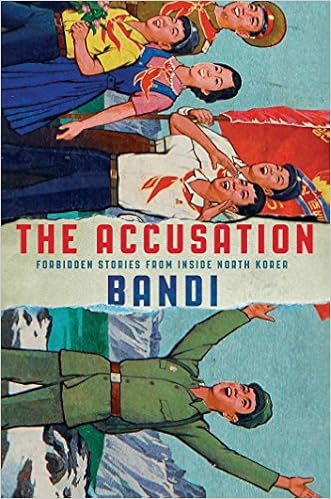
Accusation: Forbidden Stories from Inside North Korea Hardcover – 23 March 2017
by Bandi (Author)
4.4 out of 5 stars 198 ratings
Kindle
$11.22Read with Our Free Ap
Publisher : Grove Press (23 March 2017)
Language : English
Hardcover : 288 pages
Product description
Review
Praise for The Accusation
Winner of a PEN Translates Award
A World Literature Today Notable Translation of 2017
The Globe and Mail Best Books of the Year 2017
Longlisted for the Aspen Words Literary Prize
"The stories describe life under a locked-down totalitarian dictatorship in which everything is controlled by the central government, including writing and reading; in which society is riddled with spies who report on the most trivial of aberrations; and in which the non-elites are starved and overworked and lied to about the real state of affairs. This book emphasizes the value of an open society in which many voices can be heard--not just one authoritarian voice."--Margaret Atwood, Literary Hub
"[A] remarkable collection . . . [the stories'] power is in the plain-spoken, almost artless way they convey daily life under an ever-watchful, whimsically cruel regime . . . This courageous book offers an important reminder that not all dystopias are invented."--Sam Sacks, Wall Street Journal
"Searing fiction by an anonymous dissident . . . A fierce indictment of life in the totalitarian North."--New York Times
"[The Accusation] might be the most dangerous book on the planet right now . . . An historic milestone . . . A powerful denunciation . . . Its very existence is still a hopeful symbol that change is inevitable, if not imminent."--Vice
"They say fact is stranger than fiction. One book smuggled out of North Korea encapsulates both . . . A reflection of life under North Korean rule . . . This is the first known writer of a book, critical of North Korea, who is still inside the country."--Paula Hancocks, CNN
"The Accusation shines a light on the dark half of the Korean peninsula with stories that are as readable as they are important . . . If these stories are an exorcism for the author, they are a revelation for us; The Accusation is fiction, but it is fiction that screams truth. Like its great literary predecessor One Day in the Life of Ivan Denisovich, The Accusation is a powerful work that seems destined to serve as the go-to example, and indictment, of life in the Democratic People's Republic of Korea."--National Post
"Deborah Smith . . . vividly brings to English the taut, searing stories . . . Each turn of the page, each moment of anger and sadness a reader feels for Bandi's characters comes with a deeper ache. The reader knows, horribly, that all of these things are still happening."--Minneapolis Star Tribune
"Seven short stories, each pointing an accusing finger at the ruling regime, shine a light on North Korea's 'truly fathomless darkness' . . . In the midst of dashed hopes and broken dreams, the flame of hope barely flickers. These are indeed, as the book's subtitle says, Forbidden Stories from Inside North Korea."--"The Best Books on North Korea," The Guardian
"The seven stories paint an eye-opening portrait of life under the brutal regime . . . The Accusation is a testament to the resilience of the North Korean people and a proof that goodness still exists even in the most hostile environments."--Electric Literature
"Miraculous . . . Raises the question of what it means to be an artist of any kind in Bandi's country or in any other totalitarian state . . . Bandi's work speaks to our irrepressible need for self-expression and drive to create art. His writing and characters prove magnetic; they are anything but the one-dimensional characters of North Korean propaganda."--Zyzzyva
"Revelatory . . . Bandi, whoever he may be, has made history. He's illuminated the daily life of North Koreans, presenting them as human beings living in--and in spite of--extraordinary circumstances. The Accusation, which is a triumph simply for existing, places Bandi in the canon of dissenting literature. Now we can only hope to read more of his work."--Paste
"The seven stories . . . aptly convey the hardships and constant trauma that people face in a country cut off from the rest of the world . . . Written with deep emotion and elegance."--Business Standard
"All we can do is to read these 'accusations.' Only that will save the writer who wrote and sent them out into the world at the risk of his own life."--Kyung-Sook Shin, New York Times bestselling author of Please Look After Mom
"The Accusation is a stark and often despair-inducing collection, but one we should read with great urgency at this moment, both as a document of what is and what could be and as a way to continue gaining better understanding of the complexities of North Korean society, which remains elusive to the West . . . The Accusation represents a milestone for those living outside the DPRK, but also in a sense for those living within its borders . . . Bandi refuses simplicity for his characters. Instead he gifts them forceful and vivid voices."--Words Without Borders
"A startling collection of short stories revealing the brutal reality of life inside the isolated regime . . . A remarkable feat of dissident literature . . . The seven short stories and one poem presented in The Accusation are based on harrowing true events, which only heightens their import and impact . . . A clarion call for justice, The Accusation is an unforgettable testament to indomitable human spirit, written with an unbending commitment to the truth, at times difficult to bear, but also spiked with a sharp satirical spear . . . Immeasurably vital."--New Daily
"This is an extraordinary tale of ordinary people in North Korea . . . A highly readable, nuanced, credible picture of a country where ordinary people go about their lives treading around the regime, and sometimes bumping into it."--BBC World Service
"A collection of courageous and confounding short stories . . . expertly translated by Deborah Smith . . . Shows similarities of both quality and content to stories by authors as various as Gorky, Solzhenitsyn and Chen Ruoxi, or even Chinese contemporaries such as Yan Lianke . . . Vivid and uncompromising storytelling."--New Statesman (UK)
"These short works offer powerful insights into a world behind walls . . . In its scope and courage, The Accusation is an act of great love."--Guardian
"Unflinching tales from North Korea . . . Enlightening . . . A compelling collection."--Observer (UK)
"Billed as the first work of fiction by someone still living in North Korea (under a pen-name meaning 'firefly'), Bandi's collection set during the Arduous March of the early 1990s is understated, detail-rich, full of pathos and incredibly brave."--The Globe and Mail
"The Accusation takes us across a deep cultural and political border . . . The stories, written between 1989 and 1995, constitute a passionate J'accuse . . . Shines a necessary light on what remains one of the darkest places on Earth."--Hamilton Spectator
"A rare piece of fiction from one of the world's most repressive regimes . . . A dramatic page-turner."--Quartz
"For readers interested in a candid look at life in North Korea, The Accusation . . . will immerse you via the stories of common folk."--Millions
"A concise and clearly written and translated work . . . The stories document the poverty, mutual spying and damaged family relations, the desire for openness and dream of defection that imbue everyday life."--The Hudson Review
"Bandi has been likened to Aleksandr Solzhenitsyn. This is a specious analogy . . . Bandi cannot be fitted into familiar traditions because he is unprecedented. North Korea is unlike anything that exists or has existed . . . Bandi's existence proves that fear and mass hypnosis haven't yet succeeded in annihilating the imaginations of North Koreans. If the stories in The Accusation are sourced from the actual experiences of actual people, then there can be no doubt that there are multiple Bandis in the country--men and women like the characters in The Accusation who are striving to preserve their souls from the assaults of the Kim dynasty."--The National
"The Accusation continues to make international history as the first literary work smuggled out of repressive North Korea . . . Illuminating stories that reveal desperate lives enduring terrifying day-to-day challenges . . . British translator Smith . . . expertly delivers Bandi's subversive prose with nuanced grace . . . As Bandi's characters both fear and sling accusations, the title takes on piercing gravitas for readers."--Booklist (starred review)
"With these uncompromising stories, the pseudonymous Bandi gives a rare glimpse of life in the "truly fathomless darkness" of North Korea . . . An endnote about how Bandi's collection was smuggled out of the country reveals just how miraculous it is that it exists at all."--Publishers Weekly
"Fugitive fiction--literally--from inside North Korea, devastatingly critical of the Kim dynasty and its workers' paradise . . . There is a streak of satire in these stories, but mostly they are grimly realistic . . . Certainly the author has access to the broad sweep of North Korean society, from industrial workers and farmers to midlevel political functionaries . . . An important document of witness."--Kirkus Reviews
"No fiction beyond a trickle of agitprop has passed beyond North Korea's borders, and of course dissident voices are suppressed altogether. When it was smuggled out, this story collection became an international publishing sensation."--Library Journal
"Well-crafted stories . . . The Accusation is a haunting, disturbing collection . . . worthwhile."--Complete Review
"[An] insightful and harrowing collection of stories written about life in North Korea . . . The overarching aspects of everyday life in a terrorist regime are on full display . . . [Bandi's] stories are delivered in a simple style, but neither time nor translation lessen their impact."--US Review of Books
"[A] slim, powerful volume."--Week
"Bandi's writing style is markedly different from that of Western fiction . . . The rather bare-bones, bracing style fits the stories told. Their content has so much implicit drama and heartache, there's no need to elaborate . . . The Accusation is a quick read . . . Worthy of attention."--Crime Fiction Lover
"The stories are understated but the dissent is scorching. The only way to adequately honour writing that puts the author's life in danger is to read it."--Globe and Mail
"Dissident tales from pseudonymous author Bandi, still living in the country . . . very rare fiction to emerge from the secretive dictatorship . . . on its way to becoming an international literary sensation."--Alison Flood, Guardian
"[A] remarkable collection of stories . . . Revealing the terrible truth of living in a country where any any freedoms are curtailed, where famine and brutality are rife, but where human belief and hope can survive any odds, this is a defining read for 2017."--Emerald Street (UK)
"Compelling, at times heartbreaking . . . [There] are echoes of great dissident writers such as Alexander Solzhenitsyn and leading Western chroniclers of 20th-century totalitarianism such as George Orwell . . . There is a rawness about the prose that is as startling as it is unsettling . . . In common with Fyodor Dostoevsky, Bandi has the deepest sympathy for the unassuageable anguish of his or her characters . . . [A] truly remarkable book . . . [The Accusation] may well be the most important work of fiction published this year."--Australian
"The Accusation courageously speaks for millions of people who collectively long for a life of peace."--Culture Trip
"Plunges us into the daily life of families in North Korea. These stories are the cry of a man suffocated by totalitarianism. These are also the cry of an entire people who have been broken under the yoke of North Korean communism . . . The author makes use of storytelling, poetry, humor, and even the burlesque to aid his condemnation of these unbearable injustices. The writing is simple, humble, which gives it its beauty. The seven novellas shine with humanity and tenderness."--Aleteia
"This collection of novellas that the author managed to extract from his country is of incredible value . . . The classic construction reminds us of Gogol and Chekhov, and for their taste for absurdist satire, Ionesco and Bulgakov."--Books Magazine
"Describes in very impressionistic, subtle, almost veiled tones, if I may, the daily life of a dictatorship . . . The book gives a human face, gives stories and images, to the sufferings of North Koreans . . . I was almost groggy by the time I finished reading, reminding myself of just how lucky I am to live in a democracy . . . I thought of Orwell and Kafka but realized that the country described here really exists and that there are people who are living there, perhaps not even knowing that a different kind of life is possible."--L'express
"Bandi, a pseudonym that means "firefly", has achieved the unthinkable - offering a testimony on the dictatorial regime of North Korea while remaining in situ . . . In the same way as the works of Solzhenitsyn in their time, Bandi's writing reminds us of the perennial necessity of battling censorship, whatever the cost."--L'amour des livres
"This author is completely unknown and would like to stay that way. He continues to live in a country that is held fast by an iron fist, putting his life at risk by writing. He describes, not without humor, the ordinary life of this dictatorship, the extreme misery there, and the surveillance networks that have been put in place by the regime, which make everyone into a potential spy or informant."--Mag Dimanche
"Even if one did not know anything about the writer or the way the manuscript was smuggled out of the country, it would not diminish the fact that the force of this collection of novellas evokes the classics of world literature about totalitarianism."--L'ours
"A message in a bottle that is so precious that we should all reach out to grab it and better understand the tragedy of the last Marxist regime in the world."--Le Revenu
"Stories of simple people that are humiliated and beaten down for absurd reasons, watched over by grotesque henchmen and toadying neighbors, arrested and punished by a dictatorship that has held the country under its heel for six decades. A book to burst the silence."--La Vie
"This rare collection offers seven moving novellas, snapshots of a country where nothing normal ever leaks out . . . A far cry from the grandiloquent, ridiculous images that are thrown out by the Kim Jong-Un regime, The Accusation offers the opportunity to discover a moving portrait of a secret country, a forgotten land where humanity only asks to try to triumph."--Lire
"No one could imagine that it could be at all comical to live in a dictatorship, but in describing the limitless absurdity of the system, Bandi sometimes makes the reader give out a nervous laugh . . . A fragile hint of light in a country that confuses democracy with obscurantism."--L'Alsace
"Each of these stories shows a different aspect of the remorseless dictatorship . . . With a fierce sense of irony and a deeply dark humor, Bandi denounces totalitarianism, the divisions in North Korean society, and the absurdity and corruption of the one party system."--La Grande Parade
"Stories written with a great humanity, the work of a true writer."--Lecturama.fr
"The appearance of this collection of seven novellas is a true publishing event."--Livres Hebdo
"This is a work of unassailable tragedy. There are points you can't bring yourself to read anymore, it's a full blown, collision course that cannot be avoided. You want to scream out--how can life be this cruel? But you don't, for as you learn in The Accusation, that will do no good . . . Bandi has looked into the soul of the Workers' Party, its machinations, and discovered its dark, demonic heart."--Arsalan Isa, The News on Sunday (Pakistan)
"Heart-wrenching . . . a powerful and unflinching portrait of life under the rule of Kim Il-sung and Kim Jong-il."--NDTV (New Delhi)
About the Author
Bandi, a name derived from the Korean for "firefly," is a pseudonym for a writer who is still living in his homeland of North Korea. The Accusation is his only published book to date.
Deborah Smith is the Man Booker International Prize-winning translator of The Vegetarian by Han Kang and other books.
=======
Customer reviews
4.4 out of 5 stars
Top review from Australia

Charlotte
5.0 out of 5 stars An excellent collection of interesting short stories documenting civilian life in ...Reviewed in Australia on 15 April 2018
Verified Purchase
An excellent collection of interesting short stories documenting civilian life in North Korea. Recommended for anyone who wants to a glimpse of what it's like to live there.
Top reviews from other countries

Georgiana89
5.0 out of 5 stars Utterly fascinating whoever wrote itReviewed in the United Kingdom on 18 February 2018
Verified Purchase
This is supposed to be a collection of stories written by someone in North Korea and smuggled out. I have no idea whether that's true or not. If it is, then this is a truly fascinating insight into that society. If it's not true, while that's a shame, it still seems to have been written by someone who knows what they are talking about.
Most of the stories are quite compelling on their own terms, as little slices of life and looks into the human mind. Whatever else he is, the author is certainly a talented writer. But clearly, the real fascination is with what the stories show about life in North Korea. We've all heard about famines and prison camps, and there's some of that here. But I felt the stories that were most powerful weren't those that dealt with absolute horror and suffering, but with the smaller inconveniences, stresses and emotional effort of living in a true police state and with people just getting on with their lives and having their own personal family and work dramas under these conditions. I also learnt so much about the political structures that are in place.
I'd heavily recommend this for educational purposes, as an enjoyable but heart-wrenching read, and ultimately, almost to bear witness to what's going on.
3 people found this helpfulReport abuse

Catherine Rotte-Murray
4.0 out of 5 stars Lifting the lid on life in the North Korean regime.Reviewed in the United Kingdom on 16 November 2017
Verified Purchase
This unique book of short accounts of life under the brutal totalitarianism of the North Korean Kim dynasty gives a fascinating insight into the micro management of a dictatorship on its people.
People get destroyed for not opening the curtains on the day of the celebrations March for the birthday of the Great Lead. They get blamed and humiliated and indeed punished by public trial for the failure of the bean crop so there's a shortage of bean paste.
The fear and the horror of sick children and parents dying from hunger and preventable diseases permeates every page. That the writer was able to smuggle out the manuscript shows courage as he is the only writer still living in the North and not a defector living in the safety of Seoul, as are all the other well known writers on North Korea.
A fascinating read. Don't expect a literary style as it's more journalistic than anything else.
2 people found this helpfulReport abuse

Jesse Taylor-Billington
2.0 out of 5 stars Not as insightful as other titles on North Korea.Reviewed in the United Kingdom on 15 October 2018
Verified Purchase
I've read quite a few books on North Korea and was quite intrigued by this as it was said to have been written by someone still residing there. I bought it under the impression that it was a collection of accounts from people that had elected to leave the country and had been able to tell the author of their stories before they left. However, having read it, it reads far more like a collection of the kind of short stories that they'd use in children's books in the West to educate them on the way of life in North Korea, than the kind of harrowing accounts of life there that are written elsewhere. It does give you a good idea of the claustrophobia that's said to be prevalent there, but it feels a bit Disney-esque compared to other titles.
One person found this helpfulReport abuse
Hsmi
5.0 out of 5 stars Don't ever fall for propaganda.Reviewed in the United Kingdom on 23 March 2017
Verified Purchase
These tales seem too dreadful to believe and too well written to disbelieve. Bandi is an excellent writer, you feel yourself being dragged into a N.Korean life and it's terrifying.
3 people found this helpfulReport abuse
MISS SAMANTHA MURRAY
5.0 out of 5 stars Loved itReviewed in the United Kingdom on 1 July 2020
Verified Purchase
I’ve read a few books on North Korea but none like this one.
Fantastic stories, beautifully written.
The author gives you a real sense of the craziness of life in NK as well as the daily humdrum of life for its citizens.
Report abuse
jette wang wahnon
5.0 out of 5 stars Bandi,a real-life hero
Reviewed in the United Kingdom on 6 July 2017
Verified Purchase
Fantastic book,a must read.My heart goes out to the author who has managed to keep his compassion and humanity intact in a surreal world of suffering and mental cruelty.I hope he never is caught, and that some day he and his family will be safe so he can sit down and write more of his wonderful stories and get the recognition he deserves.
Report abuse
AAA
3.0 out of 5 stars Three Stars
Reviewed in the United Kingdom on 3 June 2017
Verified Purchase
It is not so much the writing but the familiar tales of the horrific circumstances that command attention.
One person found this helpful
Report abuse
Michael David Stringer
4.0 out of 5 stars Sad insight into life in North Korea
Reviewed in the United Kingdom on 5 April 2017
Verified Purchase
I rate this book as four star because of the fascinating, though very sad, insights it gives to life in North Korea, on the assumption that it is an accurate reflection of the current situation. The style is largely very readable, but in some stories there are strange dreams attached to characters that seemed just a bit strange to me.
One person found this helpful
Report abuse
rom other countries
Pat45
5.0 out of 5 stars The Accusation.
Reviewed in the United Kingdom on 13 March 2017
Verified Purchase
An excellent if heart-breaking book. So much cruelty in North Korea which permeates down from the top to individual village party members. The question is if I were born into such a society how would I behave? Can oppression & the lack of truth cause us to become inhuman? For some it does, anything to stay alive....?
Report abuse
linda woolley
3.0 out of 5 stars Life in North Korea
Reviewed in the United Kingdom on 9 May 2017
Verified Purchase
Interesting. Written in an unusual format. Different to many books about North Korea. Gives a frightening insight into another world
One person found this helpful
Report abuse
sue Turner
4.0 out of 5 stars Harsh stories
Reviewed in the United Kingdom on 12 September 2019
Verified Purchase
Hard work but good to know
Report abuse
David Young
4.0 out of 5 stars AN EYE OPENER FROM A HIDDEN LAND
Reviewed in the United Kingdom on 17 June 2017
Verified Purchase
These stories from North Korea give a real insight into life there - the reality behind the showmanship with is constantly being displayed on TV. We do not always get the reality of what ordinary people wihin dictatorships are expeirencing. It makes one want to do more, but what? It is a bit of a dilemma!
Report abuse
Amelia Fitzgibbon
5.0 out of 5 stars Beautiful and important work
Reviewed in the United Kingdom on 19 October 2017
Verified Purchase
Beautiful, important book. Best I've read all year.
Report abuse
DC
5.0 out of 5 stars Interesting insight
Reviewed in the United Kingdom on 2 April 2019
Verified Purchase
Interesting insight
Report abuse
Amazon Customer
5.0 out of 5 stars Presebt
Reviewed in the United Kingdom on 30 October 2018
Verified Purchase
Present- very swift delivery - thank you
Report abuse
Vanina
5.0 out of 5 stars Five Stars
Reviewed in the United Kingdom on 25 April 2018
Verified Purchase
fab
Report abuse
Mt
5.0 out of 5 stars Unique
Reviewed in the United Kingdom on 10 September 2017
Verified Purchase
Essential reading for anyone who wants to try and fathom how North Korean society operates.
As these stories were written inside of the country and smuggled out, at present the collection is one-of-a-kind.
Report abuse
SB
5.0 out of 5 stars Heartbreaking. Powerful stories from a North Korean writer who ...
Reviewed in the United Kingdom on 13 June 2017
Verified Purchase
Heartbreaking. Powerful stories from a North Korean writer who has chosen to stay inside North Korea while protesting the regime with his pen.
Report abuse
==============
Do you think that Bandi should win the Nobel Prize for Literature?
4 Likes · Like 3 Years Ago See All 2 Answers
Lysa Yes, it shows stories from a modern emprisoned world, we all need to know what is going on. Thumbs up for getting it accross the border and published.…more
flag
Does anyone know if/how the author is being paid for this book, since it was smuggled out? Does this author even know how many people are reading the book? I have so many questions and so much admiration.
Like 3 Years Ago Add Your Answer
Marian I am not sure if he is paid any royalties, but according to this interview with Hee-Yun Do, Bandi knows the book has been published internationally: h…more
====
Bill Kerwin
Mar 29, 2017Bill Kerwin rated it it was amazing
Shelves: north-korea, short-stories
In Why Orwell Matters (2005), Christopher Hitchens made the following prediction about North Korea: “...there will turn out to have been individual Koreans who always kept a scrap of culture alive.” The fulfillment of that prediction is this book, first published in 2017.
An afterward tells the story of how the manuscript escaped from the North, how it was smuggled out—due to the efforts of a female relative—sandwiched between the pages of The Selected Works of Kim il-Sung. Its author, Bandi (a pseudonym, meaning “firefly”) remains in North Korea. Although he chooses not to defect (he has a wife and children) the stories of this “firefly” illuminate the bleak lives of the men and women of his homeland, and I for one feel privileged to share in his light.
Bandi once was—perhaps still is—a member of North Korea’s official writer’s group, contributing articles to government magazines. But in his private moments, during the latter days of Kim il-Sung and the first few years of Kim Jong-il (1989 to 1997), he wrote these stories of the everyday struggles of the North Korean people against the relentless mechanisms of its totalitarian state.
Bandi is an artist, and, although the reader feels, roiling beneath the surface, the great wells of rage and compassion which generate these stories, the artist is careful to keep his canvas small, to find—in typical, common frustrations—sufficient evidence to condemn an entire system of government.
The people of The Accusation are all regular people with ordinary problems: in “Reason for a Defection” a man’s life is blighted because his father once failed—years ago—to care properly for a new type of seed; in “City of Specters” a privileged couple is alarmed because their toddler screams in terror at a poster of Karl Marx, putting the whole family in peril; in “Life of the Swift Steed,” an old hero of the revolution earns the ire of government forces by defending his precious “revolutionary” elm tree; in “So Near, Yet so Far,” a simple miner defies a travel ban to see his dying mother; in “Pandemonium” a family is caught in a railway station panic precipitated by a visit of “The Great Leader”; in “On Stage” a thoughtful young man’s improvisation during an acting class enrages his conservative father; and, finally, in “The Red Mushroom,” we see how an out-of-favor bean-paste factory manager is blamed by the bureaucracy—and eventually destroyed—because of an unnecessary task they have assigned him.
The stories are grim, but not entirely without humor: my favorites--”City of Specters,” “Pandemonium” (featuring an appearance by “The Great Leader” himself), and “On Stage” each have a touch of humor. Above all, though, they are tributes to a writer, who, under the worst of conditions, has maintained a sense of balance and a touch of poetry, and produced, not only a testimony against totalitarianism, but a tribute to humanity itself. (less)
flag162 likes · Like · 3 comments · see review
Taryn
Feb 24, 2017Taryn rated it really liked it
Shelves: received-from-publisher, netgalley, short-stories
4.5 Stars. The Accusation is a collection of seven short stories about life in North Korea. The manuscript was smuggled out of the country. It's the first time a book critical of the North Korean government written by someone who still lives there has been published.
Bandi, Korean for firefly, is the pseudonym the author uses; he states that he's "fated to shine only in a world of darkness." The translation is by Deborah Smith, translator for Han Kang's Human Acts and The Vegetarian. Bandi wrote the stories between 1989 and 1995. They take place during the rule of Kim Il-sung, grandfather of North Korea's current leader Kim Jong-un. The stories are fictional but based on real-life accounts. Every story is great! They had all of the features I appreciate most: completeness, rich symbolism, thoughtful characters with strong family relationships, and haunting endings. It was even more impressive that these stories were written in such a closed environment. I was reminded of all the dystopian fiction I've read and it's jarring to think that it's unlikely Bandi ever experienced any of that work--though he is living it firsthand.
There's a classic quality to the stories, perhaps due to the lack of technology or the author's restricted sphere of inspiration. The presentation of the stories is reminiscent of Kazuo Ishiguro's work, because Bandi tends to introduce an event and fill in the gaps later. Many of the relevant details are revealed through an intimate conversation ("Life of a Swift Steed," "So Near Yet So Far") or via a document ("Record of Defection"). It features both the privileged and those who are marked by an ancestor's "crimes" against the state. Status is never guaranteed and a perceived misstep can alter the course of a life. There's a constant fear that the actions of a relative will become a lifelong burden. Fear and obedience are necessary tools for survival. All negative emotions must be suppressed. Anyone could be watching, waiting to find someone committing even the most minor offense. In each of these stories, characters find themselves in an absurd situation that makes them see the contradictions of their homeland. Sometimes realizing the disconnect between long-held beliefs and the reality of their situation has tragic consequences.
The first five stories were my favorites, but each story has staying power:
Record of a Defection - A man discovers that his wife has been taking birth control in secret. Her other strange behavior makes him assume the worst, but there's another explanation. The sacrifices we make for those we love and the cruelty of multi-generational punishments.
People write books and sing songs claiming that love is this or that. But to me, love was indistinguishable from sympathy. That intolerable fretfulness at your inability to take any of the suffering on yourself, that irrepressible impulse to offer up your own flesh as a sacrifice, anything to bring some measure of relief.
City of Specters - A two-year-old boy cries every time he sees the giant portrait of Karl Marx across from his apartment, causing huge problems for his parents. This story shows the extreme paranoia of the state and the power of fear.
Life of a Swift Steed - Decorated war veteran Seol Young-su refuses to let the military police cut a branch off of his treasured elm tree. When Jeon Yeong-il is questioned by the military police's chief on the matter, he his mystified by his "uncle's" insubordination. This story is about a man "torn apart by contradictions" when he realizes his entire life has been dedicated to a lie. He experiences the rage, sorrow, and shame of an illusion being shattered.
So Near, Yet So Far - Yeong-sam risks his life to visit his dying mother after the government refuses to issue him a travel permit to his home village. Rigid obsession with regulations and how even the smallest symbols can evoke fear.
“They must have trained you well in that village of yours, eh? Properly broken you in. In this society, I tell you, people are like sheep!”
“Are you any different?” Yeong-sam countered. “If you hadn’t been ‘broken in,’ as you put it, would you have managed to live so long?”
Pandemonium - A woman accidentally becomes part of a propaganda video. The government's report of "happy laughter" is a stark contrast to the chaos that occurred near the filming location. I loved the use of fairy tales in this one.
Hahaha and hohoho, all year round—because of the laughing magic which the old demon used on his slaves. “Why did he use such magic on them? To conceal his evil mistreatment of them, of course, and also to create a deception, saying, ‘This is how happy the people in our garden are.’ And that’s also why he put the fences up, so that the people in other gardens couldn’t see over or come in.
On Stage - The country is still grieving three months after the death of Kim Il-sung. Outlandish displays of emotion are expected at the hundreds of altars scattered around the city. Comrade Inspector Yeong-pyo's son is in trouble for a second time, this time for being disrespectful during a time of mourning. In a dramatic confrontation, his son compares living in North Korea to a lifetime at drama school. Everyone is forced to live a lie and put on a false front in order to survive. This story also shows why authoritarian regimes are so quick to ban art and quash dissent. Once an idea is planted, it's impossible to eradicate.
“A sincere, genuine life is only possible for those who have freedom. Where emotions are suppressed and actions monitored, acting only becomes ubiquitous, and so convincing that we even trick ourselves."
The Red Mushroom - A man implores a journalist to help clear his uncle's name. A good man who sacrificed his entire life in service to the state has become a scapegoat. In this story, we see how bizarre accusations can be and the futility of fighting the party officials. It was my least favorite, but I still really liked it. (It's me, not the author! I have a negative Pavlovian response to farming stories thanks to Anna Karenina.)
"In all of creation, the rule is that the more toxic something is, the more pretty and friendly it’s made to look.”
"Afterword: How The Accusation Came Out of North Korea" and "A Note from Do Hee-Yun" give background on the author and reveal how the manuscript was snuck out of North Korea. Some of the biographical details were changed to protect Bandi's identity. The supplementary material is fascinating! I'm tempted to round up to five stars because I'm so blown away by the story behind the book! Bandi's stories gave me a more well-rounded view of what it's like to live day-to-day in North Korea, replacing the caricature that previously existed in my mind. Many of the stories end with a quiet resignation, but the "lightbulb" moments for the characters and the fact this book exists at all gave me hope. A government can restrict people from the outside world, scare them into submission, and suppress dissent, but they can't crush all imagination and independent thought.
Risking one's life to resist a system of oppression can be interpreted as having a premonition of that system's end. In this sense, the writing produced by resistance writers who live within North Korea, exposing the face of the nation to the world, is in itself the beginning of an epoch-making upheaval, showing that cracks are now appearing in the hereditary dictatorship, which has seemed until now an impregnable fortress. - Kim Seong-dong
Further reading:
Do North and South Korea speak the same language? Yes, but not quite by Deborah Smith - A glimpse into Smith's translation process. It's interesting that the original manuscript includes 200 words that the average South Korean would be unfamiliar with.
Goodreads review by Gustavo - Interesting analysis of The Accusation's authenticity.
I received this book for free from Netgalley and Grove Atlantic/Grove Press. This does not affect my opinion of the book or the content of my review. The publication date is March 7, 2017. (less)
flag92 likes · Like · see review
Diane S ☔
Mar 13, 2017Diane S ☔ rated it really liked it
Shelves: lor
North Korea, a closed society, books and news have been filtering out in the last several years. In these seven stories, based on experiences and thoughts of the people as told to the author, we learn some of the harsh realities of living under this type of dictatorship, cut off from the rest of the world. They are as enlightening and harsh as one could imagine. The way the book made it out of North Korea, or that it even did, is amazing as is the way these stories are told. This information and more, some of the author's background is chronicled in the afterword.
All of these stories serve to highlight the huge disconnect between outward emotion, thoughts, actions and internal feelings. Of being constantly watched for loyalty and love to the great leader, any independent action suspect, even those with valid reasons. Family reputation everything, of not being looked on favorably if a family member had done something, no matter how small, considered against the regime, never being able to rise above this status, for any family member, not ever. Of praising the regime for its generosity while not having enough to eat, fuel to stay warm nor even to gain permission to stay home with a sick child, visit a dying mother. Banishment to the far outreaches, internment in a work camp and even death the penalties. Horrifically unbelievable, yet it happens again and again, happens still and not just in North Korea.
ARC from Netgalley.
Hannah
Mar 09, 2017Hannah rated it really liked it
Shelves: arc, short-stories
I beg you to read my words. - Bandi
This is an important book, one that needs to be read and it was highly enlightening for me. Bandi is the pseudonym of a writer living in North Korea and this collection of short stories was smuggled out of the country and has been published in South Korea. As such it is unusual - normally the stories we can read about North Korea are written by people who have fled the country - and not by somebody who is still very much a part of it. While reading it, I first thought that the stories reminded me of dystopian books I have read - and that scared me because Bandi's stories while fictional still are true, they show the authentic lives that people are living, every day - but more than that they remind me of the literature written in and about Nazi Germany. The regime in North Korea is scary in scope and Bandi really succeeds in showing what that does to the people living in it.
But even beyond the political importance of this book, the stories are very well written. Short stories are difficult to pull off, but these worked brilliantly for me. The characters felt honest and real and flawed and just believable - even if their situation in life is hard to grasp for me. While the stories follow similar themes - the difficulty of living in a dictatorship, the realization that the world the protagonists inhabit is unreal, and the danger that comes with having the 'wrong' thoughts - they all still work on their own as well. At the core of this work is not the political message but the human relationships depicted. Bandi shows that even in times of hardship, relationships are what makes people people. I loved the different types of relationships depicted and I loved how this is what I ultimately can take from this. Even though the collection is relentlessly bleak there is this kernel of optimism: this idea that individual people are better than the country they live in and that human connection cannot be regulated.
___
I received an arc of this book curtesy of NetGalley and Grove Atlantic in exchange for an honest review. Thanks for that! (less)
flag51 likes · Like · 10 comments · see review
David
Mar 13, 2017David rated it liked it
The first work of fiction to come out of North Korea - smuggled and written under the pseudonym Bandi which means firefly in Korean. It's translated by the Korean translator du jour Deborah Smith, she of The Vegetarian and Human Acts.
This is a collection of grim short stories and while it flies under the banner of fiction and certainly reads like some absurdist dystopia, you get the sense it is more lightly fictionalized reportage than imaginary fiction. It's a bleak portrayal of North Korea that shows how it breaks the strong, the proud and loyal. How it tears at families and sets citizens against each other while insisting on keeping up appearances at all costs.
There isn't a lot of nuance to these stories - they're more blunt instruments bludgeoning their points home. But maybe nuance is a luxury that has no place for the people living in North Korea. (less)
flag42 likes · Like · comment · see review
Idarah
Jun 01, 2017Idarah rated it really liked it
Shelves: short-stories
photo IMG_0286_zpstuklqt79.jpg
"A sincere, genuine life is possible only for those who have freedom. Where emotions are suppressed and actions monitored, acting only becomes ubiquitous, and so convincing that we even trick ourselves. Look at all these people sobbing over a death that happened three months ago, starving because they haven't been able to draw their rations all the while. What about the mother of the child bitten by a snake while he was out gathering flowers forKim Il-sung's altar? Perhaps she finds her private grief useful for shedding public tears. Isn't it frightening, this society which teaches us all to be great actors, able to turn on the waterworks at the drop of a hat?"
What a powerful book! The only one of its kind written by someone currently living in North Korea since the peninsula was divided, some sixty-eight years ago. In these profound, unsettling stories, "Bandi" manages to shed light on what life is like in North Korea, and not just for those in good graces with the Communist party. It's acerbically satirical, but beautifully rendered. Set during the dictatorships of Kim Il-sung and Kim Jong-il, the brutal and nonsensical administration is painted as a pariah amidst worldly governments. Something that one can only laugh at to keep from crying. Definitely a must read! (less)
flag35 likes · Like · see review
Helene Jeppesen
Mar 19, 2018Helene Jeppesen rated it really liked it
This book was impressive! “The Accusation” is a collection of short stories written by an anonymous person from North Korea who risked his life publishing this book in order to make the world aware of the brutal conditions of his country. In other words, Bandi is a pseudonym, but the stories - even though they are fiction - are real!
Basically, these short stories depict a North Korea whose dictatorship is built on fear and hereditary hierarchy. No one is allowed to speak against the dictators; everyone has to act and appear supportive of their Great Leaders.
Needless to say, this book is an eye-opener because it speaks the truth and allows for us to get a unique insight into what it’s like to live in North Korea. So who am I to judge this book and rate it according to my liking?
There’s no doubt that based on its importance and relevance alone, this book deserves 5 stars. But I can’t help but also judge based on my enjoyment of the fiction and the way it gets its points across, and on that note the stories are heavy with symbolism that is explicitly told for every single story (and I wasn’t a huge fan of that). I would have preferred for the symbolism to have been a bit more covert and for the characters to tell their story and let us understand it in our own way.
The first stories were a bit messy, but gradually I got familiar with Bandi’s style and grew to really appreciate some of the later stories. So all in all, this is an important piece of work that you must read - especially because a man endangered his and his family’s life in order to let us know the truth! (less)
flag34 likes · Like · 2 comments · see review
Kavita
May 06, 2017Kavita rated it it was ok
Shelves: whiny-protagonist, north-korea, short-stories
I have read a number of memoirs and non-fiction books written by North Koreans, especially those who escaped. The thing that is intriguing about The Accusation: Forbidden Stories from Inside North Korea is that the author is still living in North Korea, and that it is fiction. So this is genuine North Korean fiction, of the style that we don't really get to see in the bookshelves often. I think this is the reason most people have given it a high rating.
As for the book itself, I found it slightly below average. There are seven short stories, each one talking about the harsh life in North Korea. The setting is in the late 80es and through the 90es. Even Kim Sung Il makes an appearance in one of the stories. There is a lot of interest to be found in these stories, especially if you do not know much about the local culture. The plots of the stories were mildly interesting.
But the negative aspects far outweighed the positives. There was nothing subtle about this book. There was no sense of lives being depicted from all aspects. The only purpose of the stories was to depict the Kim dynasty regime as horrible, which indeed it has been for decades. But it makes for poor fiction. Another negative of the stories was the constant chest beating and weeping. It just made for melodrama and I was constantly feeling like I was watching some old regressive Bollywood film, where the poor people are always crying because the rich feudal lord is harassing them. Yeah, that story can be told without the melodrama.
I would say this is worth a read merely because it is an unique kind of work. You just have to disregard the quality. (less)
flag21 likes · Like · 4 comments · see review
shakespeareandspice
Mar 05, 2017shakespeareandspice rated it really liked it · review of another edition
Shelves: minibingo17, translated, collections
Where in the world might you find such a garden, such a den of evil magic, where cries of pain and sadness where wrenched from the mouths of its people and distorted into laughter?
The Accusation is a collection of stories smuggled out of North Korea, the most repressive nation in the world, and published under the pseudonym of Bandi. Bandi shares with us a very diverse collection of voices; we get stories from husbands and wives, daughters and sons, families and friends, each exposing a bleak cultural landscape of North Korea.
The stories are as follows:
‣ Record of a Defection - a husband finds contraceptives his wife hides but fails to grasp the reality behind the situation
‣ City of Specters - a woman attempts to comfort her sick child, with dire consequences
‣ Life of a Swift Steed - the war hero who is ‘deeply disillusioned’ and questions his life achievements
‣ So Near, Yet So Far - a son tries to get permit to see his dying mother but having been denied multiple times, resorts to desperate means
‣ Pandemonium - an elderly grandmother stumbles into the Supreme Leader’s spotlight
‣ On Stage - father and son struggle to understand each other’s ideas of freedom and liberty
‣ The Red Mushroom - a man torn away from his family does everything he can to protect them from afar
While reading though these stories, I had to remark at the similarities between the North Korean regime today and the Communist regime under which Eastern European countries fell post-WWII. The comparisons are not shocking, but the absolute hopelessness in North Korean citizens is a stark contrast to the accounts I read from people who lived under Communism in Eastern Europe. Though Eastern European accounts still showed an understanding of what true democracy is, North Koreans seem to have withdrawn their dreams of liberty. Given that they’ve lived like this for generations, I can understand why freedom is a faraway dream at this point.
The idea that the author has to hide away these stories devastates me but for all the struggles this manuscript faced to see the light of day, I am glad to have been able to read Bandi’s stories from across the world. I knew this book was going to be historically important, but I was very pleased to discover that it holds a lot of literary merit as well. Bandi has a fantastic ability to pen stories that make you care even when you know it’s hopeless to do so. None of the stories felt repetitive or read dully (keeping in mind the collection has a similar theme overall); each offers a uniquely chilling example of shattered humanity. This collection is well-written, poignant, and utterly heartbreaking.
The Accusation was by far one of the best books I’ve had the pleasure of reading this year, and possibly one of the most remarkable books I might read in my lifetime. I would highly recommend this to everyone, and would also request the you read through the acknowledgements and the story behind the manuscript as well.
Disclaimer: I received this e-book from NetGalley in exchange for a review. All opinions stated are my own and not influenced by the exchange.
[Video review available later.] (less)

No comments:
Post a Comment