Carl Stephenson (historian)
Carl Stephenson (1886–1954) at the time of his death was regarded as one of America's foremost medieval scholars.[1] He was a student of Charles Gross and Charles Homer Haskins at Harvard University (graduated 1914[2]), later studied with Henri Pirenne at the University of Ghent (1924–25[2]) and had close scholarly ties with other well-known medievalists of the first half of the 20th century. He taught mainly at the University of Wisconsin–Madison and Cornell University Department of History (1931–1941).
Primarily focused on documentary evidence, he was opposed to easy theorizing and glib generalizations.[1] Carl Stephenson did his best work on those institutions found in medieval Europe between the Loire and the Rhine.[1] Since he was writing far removed from western Europe and its acrimonious academic feuding, he dispassionately demolished much of the prejudiced nationalistic writing devoted to praising or damning Germanic or Latin institutions.[1] His greatest joy came from demonstrating that a tax, a commune, or seignorialism and feudalism were not peculiar to one area but were common to all western Europe.
For fifteen years Carl Stephenson regularly published articles in the leading historical journals of America, England, Belgium, and France and established himself as an authority on taxation, representative assemblies, and the origin of urban institutions. His most mature work,[1] Borough and Town, appeared in 1933; here he combined his research with scholarly methods developed on the Continent to show that the English borough was not an insular peculiarity but that it was like its continental counterpart in origin and constitution. He then turned his attention to seignorial and feudal institutions, work resulting in further articles including his 1942 classic essay Mediaeval Feudalism which has remained in print into the 21st century. His book, Medieval History: Europe from the Fourth to the Sixteenth Century, was for decades one of the most widely used textbooks in the field.[2] He co-edited Sources of English Constitutional History with his Cornell colleague Frederick Marcham;[3] the work is still considered a monumental achievement.
Notes
[edit]- ^ a b c d e Carl Stephenson, Mediaeval Feudalism (1942). See "Introduction" by Bryce D. Lyon in the Great Seal Books edition first published in 1956 by Cornell University Press
- ^ a b c "Medievalists at Cornell" Archived 2007-07-15 at the Wayback Machine
- ^ Stephenson, Carl and Frederick G. Marcham, eds: Sources of English Constitutional History (2nd ed. 1990)
External links
[edit]- Carl Stephenson, Mediavel Feudalism, Cornell University Press, 1942.
- Works by Carl Stephenson at Google Books.
https://archive.org/details/in.ernet.dli.2015.59885/page/n7/mode/2up
===
Kindle
from $5.99
 Audiobook
$0.00with membership trial
Paperback
$6.81
Other Used and New from $2.19
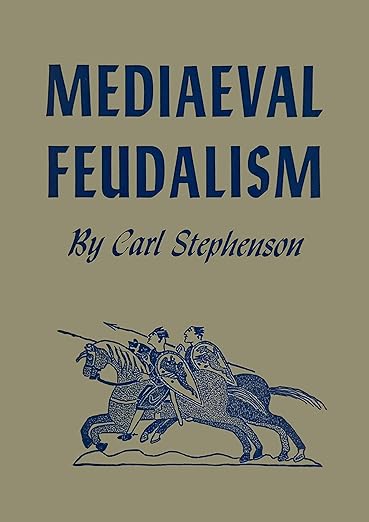
Mediaeval Feudalism Kindle Edition
by Carl Stephenson (Author) Format: Kindle Edition
4.6 4.6 out of 5 stars (16)
3.8 on Goodreads
143 ratings
This is the reprint of the first single-volume work in English to treat of the principles of feudalism. It gives a clear and concise account of the origin, growth, and decay of the feudal system. Special attention is paid to the principles of feudal tenure, chivalry, the military life of the nobility, and the workings of feudal government, as illustrated by actual cases.
The book has enjoyed a distinguished career and has been received enthusiastically by historians...
"Really a little masterpiece."—Carl Becker
"Such a book as this has long been needed."—Richard A. Newhall
"I believe it to be the best treatment of the subject, within a limited scope, that is in existence."—James F. Baldwin
This digital edition of "Mediaeval Feudalism" was meticulously scanned and thoroughly proofread by the expert team at Babel Books and has been specifically formatted and skillfully edited to ensure optimal readability on various digital devices.
Read less
From the Back Cover
This book gives a clear and concise account of the origin, growth, and decay of the feudal system.
About the Author
Carl Stephenson, regarded as one of America's foremost medievalists at the time of his death in 1954, had a long and significant scholarly career. A student of Charles Gross and Charles Homer Haskins at Harvard, he later studied with the renowned Henri Pirenne of Belgium. Most of his teaching was done at the University of Wisconsin and Cornell University. His other books include Borough and Town (1933) and Medieval History: Europe from the Fourth to the Sixteenth Century (1935).
TopAbout this itemQuestionsReviewsSimilar
Product details
ASIN : B0CGXVHY7H
Publication date : August 29, 2023
L
Print length : 82 pages
#2,099 in Radical Political Thought
Customer Reviews:
4.6 4.6 out of 5 stars (16)
Amazon Customer
2.0 out of 5 stars Two StarsReviewed in the United States on July 23, 2017
Verified Purchase
Stephen Balbach
4.0 out of 5 stars Mediavel FeudalismReviewed in the United States on November 17, 2007
Carl Stephenson (1886-1954) was an early to mid-20th century American Medievalist, a student of Charles Homer Haskins (America's "first medievalist"). This little gem was written in 1942 before the more fashionable works on Feudalism by Bloch, Ganshof, Reynolds and Brown. It is a solid and easily digested foundation written in a delightfully simple down to earth style. Even if some of the perspectives have been questioned or expanded by later works, this still provides a necessary and accessible foundation. As the opening paragraph of the 1956 edition says:
[START QUOTE]
SINCE its first printing in 1942 the late Carl Stephenson's 'Mediaeval Feudalism' has enjoyed a distinguished career. Eminent historians of America and Europe have reviewed it with high praise in the most respected historical journals. To the college freshman it has been a "vade mecum" in the awesome task of mastering such complicated feudal principles as subinfeudation and liege homage. The omniscient graduate student has at first reading whisked through it with disdain, casting it aside for the imaginative hypotheses of a Marc Bloch or for the impressive tomes of German historians, only to come meekly back to it to obtain his bearings and a sense of proportion. Seasoned scholars and teachers have read the book with discrimination, realizing that behind each page stood years of research and thought devoted to the study of feudalism in mediaeval Europe; they in turn have recommended it to their students.
[END QUOTE]
Another book by Stephenson, Medieval History: Europe from the Fourth to the Sixteenth Century, was for decades one of the most widely used textbooks in the field. He is probably best known for Borough and Town: A Study of Urban Origins in England (1933). Stephenson was working in an age rife with prejudiced nationalism among European scholars; as an outsider he helped show the commonality of medieval institutions and move the discussion beyond 19th and early 20th century nationalistic concerns.
Read less
10 people found this helpful
HelpfulReport

No comments:
Post a Comment