
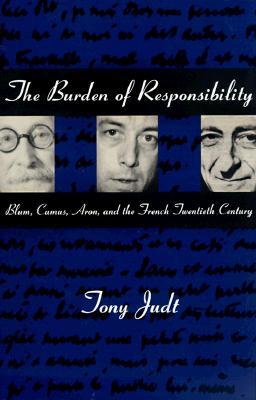
The Burden of Responsibility: Blum, Camus, Aron, and the French Twentieth Century Kindle Edition
by Tony Judt (Author) Format: Kindle Edition
=====
4.8 out of 5 stars 21 ratings
See all formats and editions
Hardcover$68.47
3 New from $68.47
Paperback$41.21
14 New from $41.21
Length: 205 pages
Using the lives of the three outstanding French intellectuals of the twentieth century, renowned historian Tony Judt offers a unique look at how intellectuals can ignore political pressures and demonstrate a heroic commitment to personal integrity and moral responsibility unfettered by the difficult political exigencies of their time.
Through the prism of the lives of Leon Blum, Albert Camus, and Raymond Aron, Judt examines pivotal issues in the history of contemporary French society—antisemitism and the dilemma of Jewish identity, political and moral idealism in public life, the Marxist moment in French thought, the traumas of decolonization, the disaffection of the intelligentsia, and the insidious quarrels rending Right and Left. Judt focuses particularly on Blum's leadership of the Popular Front and his stern defiance of the Vichy governments, on Camus's part in the Resistance and Algerian War, and on Aron's cultural commentary and opposition to the facile acceptance by many French intellectuals of communism's utopian promise. Severely maligned by powerful critics and rivals, each of these exemplary figures stood fast in their principles and eventually won some measure of personal and public redemption.
Judt constructs a compelling portrait of modern French intellectual life and politics. He challenges the conventional account of the role of intellectuals precisely because they mattered in France, because they could shape public opinion and influence policy. In Blum, Camus, and Aron, Judt finds three very different men who did not simply play the role, but evinced a courage and a responsibility in public life that far outshone their contemporaries.
"An eloquent and instructive study of intellectual courage in the face of what the author persuasively describes as intellectual irresponsibility."—Richard Bernstein, New York Times
Product description
About the Author
Tony Judt is the University Professor of European History at New York University and the author of several books, most recently, Postwar: A History of Europe Since 1945. --This text refers to the paperback edition.
Product details
Publisher : University of Chicago Press (15 November 2008)
Language : English
File size : 537 KB
Text-to-Speech : Enabled
Screen Reader : Supported
Enhanced typesetting : Enabled
X-Ray : Not Enabled
Word Wise : Enabled
Print length : 205 pages
Customer Reviews: 4.8 out of 5 stars 21 ratings
====
Top reviews from other countries
Jake Goldsmith
5.0 out of 5 stars A wonderful read
Reviewed in the United Kingdom on 3 January 2018
Verified Purchase
I have an indebtedness to the late Tony Judt, who helped arouse in me this engrossed appreciation for a recent history of ideas.
As something specific, beyond a broader philosophical investigation, I became enamoured with these acclaimed outsiders of the last century and sensed a nervous proximity to them, an accordance, in part with tinted-glasses as I could romanticise an era yet too with finding a type of studied devotion that was applicable, pragmatic, and tangible to my life and actions unlike so many theorists I was bent towards otherwise.
A wonderful book for anyone interested in intellectual history, Camus, or Raymond Aron.
One person found this helpful
---
Franz Bieberkopf
5.0 out of 5 stars The anti-Stalinist left in france
Reviewed in the United Kingdom on 9 November 2010
Verified Purchase
Tony Judt(RIP)based these three essays on a series of lectures he gave at,I think,Chicago University.
All three are wonderfully well-written and perceptive,but for me the best was that on Leon Blum.Blum has became almost the forgotten man of 20th century European history,but he was one of the most able and brave of those who struggled against dictatorship of either the left or right during the catastrophe of the 1935-45 era.His view that socialism is impossible without democracy was a striking contrast to the Stalin-worshippers of the French left,but somehow he has drifted out of public conciousness.Judt restores the balance here.
The essays on Aaron and Camus are just as good.
it's a bit pricey here,but try and get it secoond-hand or out of a library.
6 people found this helpful
===
Dr. R. Brandon
5.0 out of 5 stars A Demanding But Highly Rewarding Read
Reviewed in the United Kingdom on 20 July 2014
Verified Purchase
This is a highly intelligent and, at times, quite difficult book to read as it demands a lot from the reader in terms of concentration and understanding. Tony Judt employs his immense erudition to exam three fascinating cases of intellectual courage in modern France; the politician and leader of the 1936 Patriotic Front government in France, Leon Blum, the writer Albert Camus and the philosopher Raymond Aron. Far be it for me to be able to do justice to the closely argued theses put forward by Judt. Briefly, he examines the role Blum was to play in keeping the Socialist Party in France out of the hands of the popular Communist party of the day. Judt looks at the courage of Blum in recommending caution and defending Vichy against the howling mob in their headlong rush to exterminate those supposed to be collaborators with Hitler’s Germany.
Perhaps the least satisfactory part of the book is the section on Camus which is possibly too long for the content. Judt provides a defence of the disagreement Camus had with the fellow travellers of the Soviet Union, Sartre and de Beauvoir, and their hypercritical and vitriolic outpourings against Western values. The author also considers the ‘moralist’ stance adopted by Camus with regard to the 1954 to 1962 war in Algeria and the terrorist actions by both sides, for each of which he held some sympathy. Finally Judt looks at the magnificently gifted philosopher and columnist Raymond Aron. Aron went out of favour after his critical articles on the somewhat ‘vacuous’ French student riots of 1968. He also failed to support or agree with the predominantly left of centre philosopher community of 1960s and 70s Paris. Hindsight and a better understanding of the true nature of the Soviet Union has lead to a recent reappraisal of Aron’s work and he certainly finds favour with Tony Judt.
This is an invaluable work for those who want a much better understanding of these three important French figures without necessarily tackling full scale biographies, not all of which are available in English. It is a great pleasure simply to immerse yourself in this book and experience the great intellect and range of knowledge displayed by Judt in these three beautifully crafted essays. Judt is that rarity, a completely objective left of centre writer who is not afraid to state inconvenient truths associated with socialist movements. The loss of Judt to the academic community and his readership in 2010 was a tragedy.
Read less
3 people found this helpful
===
Femerepi
5.0 out of 5 stars Five Stars
Reviewed in Canada on 29 July 2015
Verified Purchase
Highly recommended.
===
Jose G.
5.0 out of 5 stars It is a must
Reviewed in the United Kingdom on 11 August 2013
Verified Purchase
I will recomend this book anytime for it is above all the honest, uncompromising and informed overview of our very recent past.
Report abuse
See all reviews
=====
The Burden of Responsibility: Blum, Camus, Aron, and the French Twentieth Century by Tony Judt | Goodreads
Want to Read
Rate this book
1 of 5 stars2 of 5 stars3 of 5 stars4 of 5 stars5 of 5 stars
The Burden of Responsibility: Blum, Camus, Aron, and the French Twentieth Century
by
Tony Judt
4.18 · Rating details · 215 ratings · 17 reviews
Using the lives of the three outstanding French intellectuals of the twentieth century, renowned historian Tony Judt offers a unique look at how intellectuals can ignore political pressures and demonstrate a heroic commitment to personal integrity and moral responsibility unfettered by the difficult political exigencies of their time.
Through the prism of the lives of Leon Blum, Albert Camus, and Raymond Aron, Judt examines pivotal issues in the history of contemporary French society—antisemitism and the dilemma of Jewish identity, political and moral idealism in public life, the Marxist moment in French thought, the traumas of decolonization, the disaffection of the intelligentsia, and the insidious quarrels rending Right and Left. Judt focuses particularly on Blum's leadership of the Popular Front and his stern defiance of the Vichy governments, on Camus's part in the Resistance and Algerian War, and on Aron's cultural commentary and opposition to the facile acceptance by many French intellectuals of communism's utopian promise. Severely maligned by powerful critics and rivals, each of these exemplary figures stood fast in their principles and eventually won some measure of personal and public redemption.
Judt constructs a compelling portrait of modern French intellectual life and politics. He challenges the conventional account of the role of intellectuals precisely because they mattered in France, because they could shape public opinion and influence policy. In Blum, Camus, and Aron, Judt finds three very different men who did not simply play the role, but evinced a courage and a responsibility in public life that far outshone their contemporaries.
"An eloquent and instructive study of intellectual courage in the face of what the author persuasively describes as intellectual irresponsibility."—Richard Bernstein, New York Times (less)
==
COMMUNITY REVIEWS
Showing 1-57
Average rating4.18 ·

Aug 10, 2010Jim Coughenour rated it it was amazing
Shelves: europeanhistory, biography
Like hundreds of other grateful readers, I mourn the loss this week of Tony Judt. I first read his Past Imperfect in the early 90s, a scathing analysis of Sartre & Co.'s support of Stalinism. This book could be considered a companion piece, offering three examples of intellectual integrity. Judt's study of Camus is inspiring but hardly hagiographic, and belongs in the high company of Ronald Aronson's book. But it was Judt's chapter on Raymond Aron that most impressed me – and encouraged me to purchase Aron's The Dawn of Universal History: Selected Essays from a Witness of the Twentieth Century, for which Judt provided the introduction.
I've only dipped into Judt's collection, Reappraisals, and his monumental history of postwar Europe – but sooner or later I'll read them through. As his essays for the New York Review of Books have proved over the years, Judt was himself a public intellectual with a keen sense of responsibility and remarkable courage, even through the darkest days of his illness. He will be missed.
(less)
flag12 likes · Like · comment · see review

Sep 04, 2010AC rated it really liked it · review of another edition
Shelves: 20th-21st-century, fascism, france
This is an excellent book, and is recommended. Judt reviews the moral and intellectual careers of three men of tangential centrality to European Modernity: Léon Blum, Albert Camus, and Raymond Aron.
Judt attempts to show that each, while starting from the anti-fascist Left, had to come to grips with the totalitarian instincts that emerged in the postwar Left -- in the form of Stalinism, and tiers-mondisme (notably in Algeria, in the Cultural Revolution, Pol Pot...) -- and that each showed himself, in accepting this challenge that shirked by most of their contemporaries in the French Intelligensia (think Sartre...) as men of great moral courage and moral individuality.
They were men, you might say, of the radical center -- men of political responsibility -- setting themselves consciously in revolt against cruelty, brutality, and extremism -- *wherever* it was found. What Judt understands by this term "political responsibility" is shown by the following passage:
"Conceding to Necessity, aligning one's choices with those of History, in the sense used by Carl Schmitt (or by Hegel as interpreted by Alexandre Kojève) was a reactionary not a radical solution, and made no more appealing by the invocation of reason. In an early postwar essay Camus was to remark that what distinguished an ancien regime reactionary from a modern one (of Right and Left alike) was that the former claimed that reason determined nothing, whereas the latter thought that reason determined everything. In place of reason Camus invoked responsibility. Indeed, his writings bear witness to an ethic of responsibility deliberately set against the ethic of conviction..."
Throughout, Judt seems to be expressing views to which he was himself committed.
The writing is a bit sententious at times (for my taste) - hence the ranking -- but the book reads quickly and is of interest. (less)
flag7 likes · Like · 2 comments · see review

Sep 05, 2016Ярослава rated it really liked it
Shelves: history
У Джадта є дві книжки про французьких інтелектуалів - одна про мудаків (себто тих, хто виставляв своїй стороні й опонентам різні стандарти з низки принципових етичних питань штибу концтаборів чи використання тортур), друга про немудаків (тих, хто такого не робив). "Тягар відповідальності" - це як раз про немудаків у складі Леона Блюма, Альбера Камю й Реймона Арона. Як завжди, з чудовими джадтівськими формулюваннями штибу "The loyalty of French writers, thinkers, and professors to their ideas was only matched by their utter indifference to reality" (я хочу писати, як Джадт, коли виросту. Ви теж хочете писати, як Джадт, коли виростете). Як завжди, з типовим джадтівським песимізмом (послідовність у етичних стандартах до своєї сторони й іншої виявляють, по факту, найчастіше ті, хто з якихось причин не почувається повністю належним до жодної зі сторін). (less)
flag5 likes · Like · comment · see review

Jul 04, 2013Manuel J. rated it it was amazing · review of another edition
I found this book very moving. The choice of persons Judt made is debatable, but each one is a person of interest, a real person, with good and bad points. The idea of perusing History through some of its actors' personal history is always interesting, even taking into account that it makes the book less an History book and more a book to read more like a novel. The advantage it is that the normal reader gets much more involved and, in a sense, learns more this way.
There are points specially relevant to the world today: the capacity these three men to stand by themselves against the society, searching for what they thought right, even at a personal cost. We all should learn from them. (less)
flag2 likes · Like · comment · see review

Jul 12, 2008Jeffrey is currently reading it
Unlike some of France's post WW2 intellectuals who left ideology make them look like fools (Sartre....) these three giant intellectuels publiques in France kept their integrity by remaining honest thinkers who kept to moral principles.
Have to be really into France to like this book. (less)
flag2 likes · Like · comment · see review

Jun 30, 2016James Spencer rated it really liked it · review of another edition
Before Tony Judt switched his focus to Eastern Europe, his original doctoral work and interest was in 20th century French political and intellectual history. This little book comes from that earlier interest. It consists of three essays on three French thinkers, writers and (at least in Blum's case) politicians who Judt clearly admired even though all three took more than their share of criticism from the intellectual left (think Sartre) who dominated 20th century French thinking. These three along with Judt himself all leaned significantly left but that did not prevent them from recognizing the truth, in particular about Stalinism.
Judt and his subjects believed that intellectuals, journalists, politicians etc. had an obligation, a responsibility to face truths and not to somehow justify unacceptable or irresponsible actions simply because one's emotions and desires would lead to a different conclusion. The prime example for Judt is Sartre, de Beauvoir, and most of the rest of the French left's insistence that Stalin's mass murders, show trials, etc. were acceptable because Marxism or Communism or whatever demanded it. To the bulk of French left wing intellectuals, the end justified the means even when the ends were nowhere in sight.
While some 20 years old now, the relevance to today is as great as ever. As we listen to some Sanders supporters insist that they cannot support Hillary even though they must know that if she loses Donald Trump becomes president and even though their agenda is not practical or achievable is exactly the same as the issues that Blum, Camus, Aron, and Judt addressed throughout the 20th Century in France. I recommend this highly for those who are willing to do some serious thinking. (less)
flag1 like · Like · comment · see review

May 02, 2008Ross rated it really liked it · review of another edition
Judt is a very attentive reader and a perceptive critic who clearly shows the difficulty of what each of these three tried to do: cut some kind of path between the Communist left and the liberal center. He also clearly describes the price they paid for much of their lives, almost in solitude, as he tells it, making enemies on all sides.
This collection could have used more centrifugal force, or a little more clarity behind the notion of 'responsibility,' which seems straightforward but is actually a little elusive. The introductory essay comes closest when it criticizes the tendency of (other) 20th cent. French intellectuals to "merely reflect back into the public sphere the country's own long-standing political divisions." And: "Ideological warfare substituted for attention to local realities, so that everything was politicized while few paid serious attention to politics." This almost suggests a connection between 'responsibility' and a non-ideological pragmatism, but that doesn't square with the principled social-democratic stances that Judt wants to show the three taking (and suffering for).
So, flawed but rewarding. (less)
flag1 like · Like · comment · see review

Mar 24, 2013David rated it liked it
Interesting angle - brief profiles of three prominent left-leaning 20th Century European anti-communists, one an academic, one a politiican, and one a popular writer. As flawed as they all were, their work holds up better than their opponents who seemingly triumphed at the time, which is more a result of the three's human qualities than personal brilliance. Could be a little tighter, but then these were originally written as speeches rather than as a single comparative essay. (less)
flag1 like · Like · comment · see review
Jan 12, 2020Dylan Groves rated it liked it
Shelves: history, paris
raymond aron really gets the star treatment.
critical take: https://newleftreview.org/issues/II71...
...more
flagLike · see review

Jun 06, 2020Dr Carolyn rated it it was amazing · review of another edition
This book is very philosophical. It examines the lives of 3 20 century Frenchman and discusses their perspectives of intellectual life and politics
flagLike · comment · see review

Jul 07, 2018Jim rated it really liked it
What
flagLike · comment · see review

Apr 12, 2021Daniel1974nlgmail.com rated it really liked it · review of another edition
Very good sections on Camus and Aron.
flagLike · comment · see review

Jul 07, 2018Tomé Andrade rated it really liked it · review of another edition
Muito boa introdução à obra e acção dos 3 monumentos do sec. XX francês. A não perder.
flagLike · comment · see review

Jun 27, 2018Lazarus-II rated it liked it · review of another edition
3.5/5 or 7/10
flagLike · comment · see review

May 12, 2016Marcio Silva rated it it was amazing · review of another edition
Judt merecia uma traduçãozinha melhor, hein? Que coisa terrível a desse livro.
Want to Read
Rate this book
1 of 5 stars2 of 5 stars3 of 5 stars4 of 5 stars5 of 5 stars
The Burden of Responsibility: Blum, Camus, Aron, and the French Twentieth Century
by
Tony Judt
4.18 · Rating details · 215 ratings · 17 reviews
Using the lives of the three outstanding French intellectuals of the twentieth century, renowned historian Tony Judt offers a unique look at how intellectuals can ignore political pressures and demonstrate a heroic commitment to personal integrity and moral responsibility unfettered by the difficult political exigencies of their time.
Through the prism of the lives of Leon Blum, Albert Camus, and Raymond Aron, Judt examines pivotal issues in the history of contemporary French society—antisemitism and the dilemma of Jewish identity, political and moral idealism in public life, the Marxist moment in French thought, the traumas of decolonization, the disaffection of the intelligentsia, and the insidious quarrels rending Right and Left. Judt focuses particularly on Blum's leadership of the Popular Front and his stern defiance of the Vichy governments, on Camus's part in the Resistance and Algerian War, and on Aron's cultural commentary and opposition to the facile acceptance by many French intellectuals of communism's utopian promise. Severely maligned by powerful critics and rivals, each of these exemplary figures stood fast in their principles and eventually won some measure of personal and public redemption.
Judt constructs a compelling portrait of modern French intellectual life and politics. He challenges the conventional account of the role of intellectuals precisely because they mattered in France, because they could shape public opinion and influence policy. In Blum, Camus, and Aron, Judt finds three very different men who did not simply play the role, but evinced a courage and a responsibility in public life that far outshone their contemporaries.
"An eloquent and instructive study of intellectual courage in the face of what the author persuasively describes as intellectual irresponsibility."—Richard Bernstein, New York Times (less)
==
COMMUNITY REVIEWS
Showing 1-57
Average rating4.18 ·
Aug 10, 2010Jim Coughenour rated it it was amazing
Shelves: europeanhistory, biography
Like hundreds of other grateful readers, I mourn the loss this week of Tony Judt. I first read his Past Imperfect in the early 90s, a scathing analysis of Sartre & Co.'s support of Stalinism. This book could be considered a companion piece, offering three examples of intellectual integrity. Judt's study of Camus is inspiring but hardly hagiographic, and belongs in the high company of Ronald Aronson's book. But it was Judt's chapter on Raymond Aron that most impressed me – and encouraged me to purchase Aron's The Dawn of Universal History: Selected Essays from a Witness of the Twentieth Century, for which Judt provided the introduction.
I've only dipped into Judt's collection, Reappraisals, and his monumental history of postwar Europe – but sooner or later I'll read them through. As his essays for the New York Review of Books have proved over the years, Judt was himself a public intellectual with a keen sense of responsibility and remarkable courage, even through the darkest days of his illness. He will be missed.
(less)
flag12 likes · Like · comment · see review
Sep 04, 2010AC rated it really liked it · review of another edition
Shelves: 20th-21st-century, fascism, france
This is an excellent book, and is recommended. Judt reviews the moral and intellectual careers of three men of tangential centrality to European Modernity: Léon Blum, Albert Camus, and Raymond Aron.
Judt attempts to show that each, while starting from the anti-fascist Left, had to come to grips with the totalitarian instincts that emerged in the postwar Left -- in the form of Stalinism, and tiers-mondisme (notably in Algeria, in the Cultural Revolution, Pol Pot...) -- and that each showed himself, in accepting this challenge that shirked by most of their contemporaries in the French Intelligensia (think Sartre...) as men of great moral courage and moral individuality.
They were men, you might say, of the radical center -- men of political responsibility -- setting themselves consciously in revolt against cruelty, brutality, and extremism -- *wherever* it was found. What Judt understands by this term "political responsibility" is shown by the following passage:
"Conceding to Necessity, aligning one's choices with those of History, in the sense used by Carl Schmitt (or by Hegel as interpreted by Alexandre Kojève) was a reactionary not a radical solution, and made no more appealing by the invocation of reason. In an early postwar essay Camus was to remark that what distinguished an ancien regime reactionary from a modern one (of Right and Left alike) was that the former claimed that reason determined nothing, whereas the latter thought that reason determined everything. In place of reason Camus invoked responsibility. Indeed, his writings bear witness to an ethic of responsibility deliberately set against the ethic of conviction..."
Throughout, Judt seems to be expressing views to which he was himself committed.
The writing is a bit sententious at times (for my taste) - hence the ranking -- but the book reads quickly and is of interest. (less)
flag7 likes · Like · 2 comments · see review
Sep 05, 2016Ярослава rated it really liked it
Shelves: history
У Джадта є дві книжки про французьких інтелектуалів - одна про мудаків (себто тих, хто виставляв своїй стороні й опонентам різні стандарти з низки принципових етичних питань штибу концтаборів чи використання тортур), друга про немудаків (тих, хто такого не робив). "Тягар відповідальності" - це як раз про немудаків у складі Леона Блюма, Альбера Камю й Реймона Арона. Як завжди, з чудовими джадтівськими формулюваннями штибу "The loyalty of French writers, thinkers, and professors to their ideas was only matched by their utter indifference to reality" (я хочу писати, як Джадт, коли виросту. Ви теж хочете писати, як Джадт, коли виростете). Як завжди, з типовим джадтівським песимізмом (послідовність у етичних стандартах до своєї сторони й іншої виявляють, по факту, найчастіше ті, хто з якихось причин не почувається повністю належним до жодної зі сторін). (less)
flag5 likes · Like · comment · see review
Jul 04, 2013Manuel J. rated it it was amazing · review of another edition
I found this book very moving. The choice of persons Judt made is debatable, but each one is a person of interest, a real person, with good and bad points. The idea of perusing History through some of its actors' personal history is always interesting, even taking into account that it makes the book less an History book and more a book to read more like a novel. The advantage it is that the normal reader gets much more involved and, in a sense, learns more this way.
There are points specially relevant to the world today: the capacity these three men to stand by themselves against the society, searching for what they thought right, even at a personal cost. We all should learn from them. (less)
flag2 likes · Like · comment · see review
Jul 12, 2008Jeffrey is currently reading it
Unlike some of France's post WW2 intellectuals who left ideology make them look like fools (Sartre....) these three giant intellectuels publiques in France kept their integrity by remaining honest thinkers who kept to moral principles.
Have to be really into France to like this book. (less)
flag2 likes · Like · comment · see review
Jun 30, 2016James Spencer rated it really liked it · review of another edition
Before Tony Judt switched his focus to Eastern Europe, his original doctoral work and interest was in 20th century French political and intellectual history. This little book comes from that earlier interest. It consists of three essays on three French thinkers, writers and (at least in Blum's case) politicians who Judt clearly admired even though all three took more than their share of criticism from the intellectual left (think Sartre) who dominated 20th century French thinking. These three along with Judt himself all leaned significantly left but that did not prevent them from recognizing the truth, in particular about Stalinism.
Judt and his subjects believed that intellectuals, journalists, politicians etc. had an obligation, a responsibility to face truths and not to somehow justify unacceptable or irresponsible actions simply because one's emotions and desires would lead to a different conclusion. The prime example for Judt is Sartre, de Beauvoir, and most of the rest of the French left's insistence that Stalin's mass murders, show trials, etc. were acceptable because Marxism or Communism or whatever demanded it. To the bulk of French left wing intellectuals, the end justified the means even when the ends were nowhere in sight.
While some 20 years old now, the relevance to today is as great as ever. As we listen to some Sanders supporters insist that they cannot support Hillary even though they must know that if she loses Donald Trump becomes president and even though their agenda is not practical or achievable is exactly the same as the issues that Blum, Camus, Aron, and Judt addressed throughout the 20th Century in France. I recommend this highly for those who are willing to do some serious thinking. (less)
flag1 like · Like · comment · see review
May 02, 2008Ross rated it really liked it · review of another edition
Judt is a very attentive reader and a perceptive critic who clearly shows the difficulty of what each of these three tried to do: cut some kind of path between the Communist left and the liberal center. He also clearly describes the price they paid for much of their lives, almost in solitude, as he tells it, making enemies on all sides.
This collection could have used more centrifugal force, or a little more clarity behind the notion of 'responsibility,' which seems straightforward but is actually a little elusive. The introductory essay comes closest when it criticizes the tendency of (other) 20th cent. French intellectuals to "merely reflect back into the public sphere the country's own long-standing political divisions." And: "Ideological warfare substituted for attention to local realities, so that everything was politicized while few paid serious attention to politics." This almost suggests a connection between 'responsibility' and a non-ideological pragmatism, but that doesn't square with the principled social-democratic stances that Judt wants to show the three taking (and suffering for).
So, flawed but rewarding. (less)
flag1 like · Like · comment · see review
Mar 24, 2013David rated it liked it
Interesting angle - brief profiles of three prominent left-leaning 20th Century European anti-communists, one an academic, one a politiican, and one a popular writer. As flawed as they all were, their work holds up better than their opponents who seemingly triumphed at the time, which is more a result of the three's human qualities than personal brilliance. Could be a little tighter, but then these were originally written as speeches rather than as a single comparative essay. (less)
flag1 like · Like · comment · see review
Jan 12, 2020Dylan Groves rated it liked it
Shelves: history, paris
raymond aron really gets the star treatment.
critical take: https://newleftreview.org/issues/II71...
...more
flagLike · see review
Jun 06, 2020Dr Carolyn rated it it was amazing · review of another edition
This book is very philosophical. It examines the lives of 3 20 century Frenchman and discusses their perspectives of intellectual life and politics
flagLike · comment · see review
Jul 07, 2018Jim rated it really liked it
What
flagLike · comment · see review
Apr 12, 2021Daniel1974nlgmail.com rated it really liked it · review of another edition
Very good sections on Camus and Aron.
flagLike · comment · see review
Jul 07, 2018Tomé Andrade rated it really liked it · review of another edition
Muito boa introdução à obra e acção dos 3 monumentos do sec. XX francês. A não perder.
flagLike · comment · see review
Jun 27, 2018Lazarus-II rated it liked it · review of another edition
3.5/5 or 7/10
flagLike · comment · see review
May 12, 2016Marcio Silva rated it it was amazing · review of another edition
Judt merecia uma traduçãozinha melhor, hein? Que coisa terrível a desse livro.

No comments:
Post a Comment