[[ Comfort Woman by Nora Okja Keller (review)
Seiwoong Oh
Western American Literature
The Western Literature Association
Volume 34, Number 1, Spring 1999
pp. 102-103
10.1353/wal.1999.0051
Review
Comfort Woman. By Nora Okja Keller. New York: Viking, 1997. 215 pages, $21.95.
Reviewed by Seiwoong Oh Rider University, Lawrenceville, New Jersey
Inspired by a 1993 talk in Honolulu by a seventy-year-old Korean woman who lived as a “comfort woman” for Japanese soldiers during World War II, Nora Okja Keller wrote a short story, “Mother Tongue,” which won the 1995 Pushcart Prize.
In her debut novel, Comfort Woman, which grew out of “Mother Tongue,” Keller portrays the psychological complexity of a Korean woman and her relationship with her American-born daughter. As Akiko, the mother, and her daughter, an obituary writer for a local paper, take turns narating the story, we hear both sides of the mother-daughter relationship. We also travel between Honolulu and Korea to piece together Akiko’s bizane life as a twelve-year-old sex slave raped by dozens of soldiers every day, wife to a hypocritical American missionary who brings her to America, and widow who makes her living as a spirit medium in Honolulu.
The strong graphic images of death and violence make the story an “uncomfortable” read, but that very discomfort seems indeed essential in coming anywhere close to understanding the life of a former comfort woman.
Moreover, Keller achieves a few other things that have rarely been done, if at all: she investigates a war crime with a focus on its impact on generations of women, offers a sharp insight into the cross-cultural motherdaughter relationship, and helps us look inside the current political debate between Japan and Asian countries over Japan’s lack of apology and com pensations to the tens of thousands of women who served as sex slaves during World War II.
The story of comfort women had to be told, and Keller proves to be the right writer to brave that unchartered territory.
===
[[COMFORT WOMAN
BY NORA OKJA KELLER ‧
[[COMFORT WOMAN
BY NORA OKJA KELLER ‧
RELEASE DATE: APRIL 1, 1997
https://www.kirkusreviews.com/book-reviews/nora-okja-keller/comfort-woman/
First-novelist Keller, a Korean-American living in Hawaii, offers a shocking and unusual version of the mother-daughter relationship tale, in which a Korean woman whose experience as a ``comfort woman'' servicing Japanese troops during WW II profoundly distorts her own life and that of her Korean-American daughter.
https://www.kirkusreviews.com/book-reviews/nora-okja-keller/comfort-woman/
First-novelist Keller, a Korean-American living in Hawaii, offers a shocking and unusual version of the mother-daughter relationship tale, in which a Korean woman whose experience as a ``comfort woman'' servicing Japanese troops during WW II profoundly distorts her own life and that of her Korean-American daughter.
Poor, orphaned Kim Soon Hyo was only 12 when her oldest sister raised the money for her own dowry by selling Soon Hyo to the occupying Japanese.
One of hundreds of girls kept like animals in stalls and forced to service long lines of soldiers, Soon Hyo was assigned the name Akiko—the name each girl inhabiting that stall had been given—then raped, beaten, humiliated, and adored on a daily basis, according to each soldier's whim.
Profoundly traumatized, Soon Hyo struggled to survive by imagining herself emptied of her soul.
As the war ends, Soon Hyo escapes to Pyongyang, where she marries an American missionary who knows her only by her hated Japanese name, returns with him to the US, and eventually gives birth to a daughter.
When her husband dies, ``Akiko'' finds herself stranded in Hawaii with no money, a five- year-old child to care for, and a tenuous hold on her sanity.
Rebeccah Bradley, Akiko's daughter, grows up in the shadow of her mother's periodic bouts of psychosis, periods that a number of locals view as true visitations from the spirit world and pay to witness, thus providing a modicum of financial support for the two females.
Rebeccah, ignorant of her mother's traumatic childhood, struggles mightily to free herself from the terror and embarrassment of Akiko's fits, eccentricities, and neglect. It is only after Akiko's death, when Rebeccah herself is almost 30, that she learns the terrible secrets buried in her mother's past. Not at all a pretty story, but a memorable one, powerfully told. Keller brings her Korean characters to vivid, passionate life. (Author tour)
Pub Date: April 1, 1997
ISBN: 0-670-87269-5
Page Count: 256
Publisher: Viking
Review Posted Online: May 20, 2010
Kirkus Reviews Issue: Feb. 1, 1997
Categories: GENERAL FICTION
Pub Date: April 1, 1997
ISBN: 0-670-87269-5
Page Count: 256
Publisher: Viking
Review Posted Online: May 20, 2010
Kirkus Reviews Issue: Feb. 1, 1997
Categories: GENERAL FICTION
===
[[Reading Matters
‘Comfort Woman’ by Nora Okja Keller
May 6, 2007
https://readingmattersblog.com/2007/05/06/comfort_woman_by_nora_okja_keller/
kimbofo
ComfortWoman
Fiction – paperback; Penguin; 240 pages; 1998.
During the Second World War the Japanese military introduced a programme to provide sexual services for its troops. Young, often ethnic, women were kept prisoner in special camps where they were employed as “comfort women”, a euphemism for being systematically raped and beaten.
American-Korean writer Nora Okja Keller explores this abhorrent practise in her astonishing debut novel Comfort Woman, which, upon its release in 1997, attracted critical acclaim from far and wide.
Through twin narratives, which jump backward and forward in time, we learn the secrets and private struggles of two women: Akiko, a Korean refugee living in Hawaii, who has the unnerving ability to channel spirits; and Beccah, Akiko’s daughter by an American missionary, who loves her mother deeply but is unable to fully accept her cultural and ethnic heritage.
What Beccah does not know is that her mother was once a comfort woman. This deeply hidden secret manifests itself in Akiko’s often insane — and embarrassing — behaviour that plagues Beccah for much of her childhood. When most teenage girls are having fun, Beccah is haunted by her mother’s absurd kowtowing to the spirits of the dead.
It is only when the secret is revealed that Beccah comes to some kind of understanding of her mother’s strange ways…
While this is a confidently written and eloquent tale about the horrors of war and its far-reaching impact on its survivors and their children, it’s also a testament to the strength of the mother-daughter relationship even when it is dominated by unexplained pain and fear of both the real and imaginary kind.
I very much enjoyed reading this book, although the dual narratives in which Akiko and Beccah take it in turns to tell their story grated slightly and hindered the overall flow of the book.
The emphasis on the spirit world was also slightly overdone, so that it came to suffocate the rest of the story. I wanted to know more about Akiko’s traumatic past — the hub of the novel — and less about her traumatic present.
Finally, the discovery of Akiko’s secret came too close to the end, so that there was very little exploration of how this bombshell impacted on the rest of Beccah’s life.
Despite these flaws Comfort Woman is a disturbing yet moving story, and one that resonates long after the book draws to a close.
==
Comfort Woman Summary
by Nora Okja Keller
https://www.gradesaver.com/comfort-woman/study-guide/summary
Comfort Woman Summary
by Nora Okja Keller
https://www.gradesaver.com/comfort-woman/study-guide/summary
Featured study guides
Loaded: 100.00%
Remaining Time-0:17Picture-in-PictureFullscreen
Comfort Woman Summary
These notes were contributed by members of the GradeSaver community. We are thankful for their contributions and encourage you to make your own.
Written by people who wish to remain anonymous
Beccah Bradley has grown up resentful of her mother, Akiko. When her mother takes ill, she reveals to Beccah that she is responsible for her husband's death. She wished death upon for years until finally she ensured he would succumb. Beccah becomes afraid, worrying she has done the same to her mother since she's often wished her death. Growing up in Hawaii, Becca remembers her mother working for a cafe owner named Auntie Reno who employed her as a psychic. Akiko was an erratic person who often passed into trances, obscene dances, and communication with the spirits. She took great care of Beccah but was largely emotionally unavailable. After her dad died, much to Beccah's relief, she moved with her mother to the Big Island although they had plans which never came to fruition to return to Korea. Beccah grows up wishing her mom were normal but sensing her maternal love.
On her deathbed, Akiko tells her daughter a huge secret about her past. From Akiko's point of view, readers learn that she was a child in Korea during WWII. when her parents died, she was sold to the Japanese by her sister who needed the money for a dowry. Akiko is sent to work in a Japanese recreation camp for the duration of the war. The women are brought to this camp to serve as prostitutes for the soldiers. At the beginning she works cleaning up the stalls in which the other women -- the sex slaves -- work and live. These poor women are robbed of all identity and autonomy, named after the stalls in which they work. When one of the women rebels, she is brutally executed to be an example to the others to cooperate. Akiko takes her place. She goes from being Soon Hyo -- her birth name -- to Akiko 41, the name which she's born ever since.
She and her fellow slaves are called "Comfort Women," a sort of sick joke to make light of their position. Never allowed to leave her stall, Akiko services thousands of soldiers over the years. They all line up and wait their turn with her. Some of them love her. Some of them beat her. All of them abuse her to the point of reducing her to an animal. As time progresses, she grows weaker and sicker and increasingly depressed. She has forgotten all sense of purpose, feeling like her soul has died to leave only her body to be used by these men. At one point she get's pregnant and is forced into a painful abortion which compromises her health forever.
By some miracle, Akiko manages to escape from the camp one day. She seeks refuge with some Christian Missionaries who plan to help her be adopted. As a Korean, Akiko knows that Japanese families often treat Japanese children whom they adopt no better than slaves. She's eager to avoid another situation in which she's considered property, although she has long ago abandoned any feelings of independence or value. She keeps quiet. Faced with her silence, the minister who is taking care of her decides to offer her another option: marriage to a man named Bradley who wants to take a wife back to American with him. Although she's not thrilled about the idea, Akiko continues to keep silent which Bradley interprets as submission. He takes her to Hawaii where she soon discovers that she's pregnant from the her time at the camp.
Beccah is astonished to hear her mother's story. She is the product of a brutal rape while her mother was imprisoned as a sex slave in a different country. It's a shocking blow. As she processes the news, Beccah realizes that her mother's odd behavior is just a natural result of all the trauma she's experienced. In order to survive, Akiko had convinced herself that she has a connection with another world -- the spirit world. Beccah is left wondering what she should do with this new information. She forgives her mom and makes peace with her.
Update this section!
You can help us out by revising, improving and updating this section.Update this section
After you claim a section you’ll have 24 hours to send in a draft. An editor will review the submission and either publish your submission or provide feedback.Next SectionCharacter ListPrevious SectionAbout Comfort WomanCite this page
STUDY GUIDE NAVIGATION
About Comfort Woman
Comfort Woman Summary
Character List
Glossary
Themes
Quotes
Analysis
Symbols, Allegory and Motifs
Metaphors and Similes
Irony
Imagery
Literary Elements
Essay Questions
RELATED CONTENT
Study Guide
Essays
Q & A
Nora Okja Keller Biography
Comfort Woman Questions and Answers
The Question and Answer section for Comfort Woman is a great resource to ask questions, find answers, and discuss the novel.Ask Your Own Question
Study Guide for Comfort Woman
Comfort Woman study guide contains a biography of Nora Okja Keller, literature essays, quiz questions, major themes, characters, and a full summary and analysis.
About Comfort Woman
Comfort Woman Summary
Character List
Glossary
ThemesREAD THE STUDY GUIDE FOR COMFORT WOMAN…
Essays for Comfort Woman
Comfort Woman essays are academic essays for citation. These papers were written primarily by students and provide critical analysis of Comfort Woman by Nora Okja Keller.
Akiko and Post-traumatic Stress Disorder
=====
https://www.nytimes.com/1997/03/25/books/repairing-lives-torn-by-the-past.html
===
COMFORT WOMAN.
By Nora Okja Keller
Viking: 213 pp., $21.95
BY MERLE RUBIN
MARCH 23, 1997
https://www.latimes.com/archives/la-xpm-1997-03-23-bk-41070-story.html
The ugly story of the women and girls forced to serve as “comfort women” in the “recreation camps” designed to accommodate the sexual needs of Japanese soldiers during World War II took a long time to come to light. Women who had been victimized in this way were devalued not only in the eyes of their communities but often in their own eyes. This bitterly ironic paradigm is not limited to traditional sexist cultures. Almost everywhere, it seems, far too many victims struggle with feelings of shame and despair, while too few victimizers are troubled by guilt.
This powerful first novel by a young writer born in Korea and raised in Hawaii tells the intertwined stories of a Korean-born woman sold into the sexual slavery of the Japanese camps and of the woman’s American-born daughter, who discovers the secret of her mother’s harrowing past after her death.
Rebeccah Bradley, known as Beccah, grows up in Hawaii, where she enjoys a relatively normal life--or, at any rate, a life blessedly free from the shocking dislocations and acute suffering experienced by her mother, Akiko. But in some respects, Beccah’s childhood is abnormal. Her mother is given to strange fits, falling into trances, dancing on tabletops and communing with invisible spirits. Beccah’s father, an American Protestant missionary, died when she was 5. Five years later, while dutifully commemorating the anniversary of his demise by preparing a sacrificial offering of his favorite food (shrimp), Akiko tells her daughter that she killed him.
Beccah, however, has learned to take many of her mother’s pronouncements with a grain of salt. She knows that in the eyes of her classmates at school, Akiko is the “crazy lady,” and there are times when she feels powerfully alienated by her mother’s outlandishness. Yet in other ways, Beccah’s perceptions and emotions have been deeply colored by Akiko’s confused yet potent mixture of folklore, superstitions and passionately held beliefs.
ADVERTISEMENT
Akiko warns the little girl about Saja the Death Messenger. When the child awakens in the middle of the night screaming that Saja is after her, the mother grabs a butchered chicken, tears off her daughter’s nightgown, wraps it around the chicken and throws the bloody bundle out of doors to “fool” the hungry demon.
As Beccah grows older, her mother’s strange beliefs seem deluded, yet oddly plausible. There seem to be any number of bizarre unseen powers capable of threatening happiness and well-being. “Red Disaster, the way my mother explained it, was like the bacteria we learned about in health class: invisible and everywhere in the air around us; honyaek was contagious and sometimes deadly. Burning the red items from our apartment was my mother’s version of washing my hands.”
Akiko’s weird behavior is not without redeeming financial value. The proprietress of a local eatery, having given the poor widow a job, recognizes her employee’s oracular potential. She sets her up as a spiritual advisor and clients flock from miles around.
As a mother, Akiko can be fiercely protective but at other times neglectful and withdrawn. Beccah’s account of growing up in this eccentric household is interwoven with chapters in which Akiko relates the appalling story of her wartime experiences as a comfort woman. As we find out what she has endured, her apparent “craziness” begins to look mild in comparison.
The youngest daughter of a poor Korean family, Akiko was born with the name Soon Hyo. Barely into her adolescence, she was orphaned and sold to raise money for her oldest sister’s dowry: It was known that the Japanese were looking for pretty girls. On arriving at the recreation camp, she was still so young that they assigned her to work as a maid to the other women, cleaning their rooms and emptying their chamber pots. Before long, however, she is made to take over for one of the previous comfort women, who spoke out one night and was killed for it. The memory has been branded into her brain:
“To this day, I do not think Induk--the woman who was the Akiko before me--cracked. Most of the other women thought she did because she would not shut up. One night she talked loud and nonstop. In Korean and Japanese, she denounced the soldiers, yelling at them to stop their invasion of her country and her body. Even as they mounted her, she shouted: I am Korea, I am a woman, I am alive. I am seventeen, I had a family just like you do, I am a daughter, I am a sister. . . . Just before daybreak, they took her out of her stall and into the woods, where we couldn’t hear her anymore. They brought her back skewered . . . like a pig ready for roasting. A lesson, they told the rest of us, warning us into silence. That night, it was as if a thousand frogs encircled the camp. They opened their throats for us, swallowed our tears, and cried for us. All night, it seemed, they called, Induk, Induk, Induk, so we would never forget.”
Even after her eventual escape from the camp, Akiko feels unable to assume her former name or identity. She is rescued from her war-torn country by an American missionary. Their marriage is based on a kind of love and furtive lust on his side, resignation and silent hatred on hers and a mutual lack of understanding. Yet despite the damage inflicted on her by a crude abortion in the camp, Akiko manages to conceive and bear Beccah. She loves her daughter with a passionate intensity that transcends the enormous gap between their universes. She hates her husband so much she feels responsible for his death.
Writing from Beccah’s perspective, Keller effectively conveys the daughter’s ambivalence, the mixture of embarrassment and protectiveness she feels toward her mother. Gradually, the slight touch of irony in her tone gives way to a deeper understanding and a wholehearted attempt to identify with her mother’s sufferings and struggles. In the chapters given over to Akiko’s recounting of her painful history, Keller’s achievement is still more remarkable. By the time Beccah--and the reader--have learned Akiko’s story, it is clear why this daughter cannot turn her back on her mother, for all that she lost, endured and hoped to pass on to her child.
Strongly imagined, well-paced and written with an eloquently restrained lyricism that conveys the subtleties of feelings as well as the harshness of facts, “Comfort Woman” is a poignant and impressive debut.
===
Princess Pari in Nora Okja Keller's Comfort Woman
September 2004
positions east asia cultures critique 12(2):431-456
Kun Jong Lee
Research Interest
Abstract
positions: east asia cultures critique 12.2 (2004) 431-456
When she attended a human rights symposium in 1993, Nora Okja Keller listened to the testimony of Keum Ju Hwang and learned the truth of Japanese military sex slavery in World War II. Keller was so haunted by the graphic images of the former military comfort woman's horrible experience that her dreams were filled with "images of war and women, of blood and birth." She found that the only way to "exorcise these images was through writing." Keller's reminiscence of her peculiar experience is shamanistic in its images and implications: she seems to have been possessed by the spirits of comfort women, who urged her to bear witness to their military sex slavery in writing. In an interview with the novelist, Martha Cinader astutely asked Keller whether she had seen herself "as a shaman" while writing Comfort Woman. Keller's answer was quite interesting: "I really felt that sometimes I entered a type of trance, that I was really connected to something higher [than] myself . . . . I was almost like a medium." No wonder Keller transforms a former comfort woman, Soon Hyo, into a shaman in her fiction and, as Kathleen Brogan observes, "the authorial haunting finds reflection in the novel's double story of haunting." Heinz Insu Fenkl regards Soon Hyo's "shamanic transformation" as "unexpected" in his review of Comfort Woman. But Keller's transformation of her protagonist is not so arbitrary and incongruous as it seems. It is commonly believed that "spirits in search of human victims to possess are particularly attracted by those whose souls have been ‘fractured' . . . by personal tragedies or exploitations others have caused them to suffer." A former comfort woman whose life was brutally shattered by her horrendous experience and trauma might have easily attracted the attention of spirits looking for their victims. In fact, shamanism is one of the two "self-curative professions" that some Korean survivors of military sexual slavery have taken up in order to deal with their psychological scars. Dai Sil Kim-Gibson reported three cases of former comfort women who had become shamans after their return to Korea, and one former military sex slave, Jok Gan Bae, clearly ascribed her shamanhood to her experience as a comfort woman. What is really unique in Keller's Comfort Woman is less the transformation of a former military sex slave into a shaman than the portrayal of a former comfort woman as Princess Pari. Princess Pari is the prominent female deity in the fundamentally women-centered Korean shamanism. The Princess is the ur-shaman who leads the spirit of the dead to the other world in a shamanistic rite. In her literary requiem for the spirits of comfort women, Keller appropriately represents Soon Hyo and her daughter, Beccah, as Princess Pari in order to remember the victims of Japanese military sex slavery and to guide the spirits of comfort women to the next world. Keller not only portrays her protagonists as Princess Pari but also manipulates Pari Kongju (Princess Pari), the shamanistic narrative about Princess Pari, with an interventionist and revisionist agenda to critique Korean patriarchy, agnation, androcentrism, and misogyny as well as Japanese patriarchy, militarism, colonialism, ethnocentrism, and the emperor system. At the same time, the Korean American novelist appropriates the Korean shamanistic myth ultimately to endow her main characters, a Korean immigrant woman and her biracial daughter, with a psychological anchor and cultural agency in their struggles against American patriarchy, sexism, homophobia, and xenophobia. Thus Princess Pari is one of the most significant motifs in Keller's shamanistic reconfiguration of comfort women. But Keller scholars have not addressed the significance of the shamanistic deity properly in their studies of Comfort Woman. If Princess Pari is mentioned at all in Keller criticism, the scholars have not developed the motif of Princess Pari adequately. Some critics even discuss the myth of Princess Pari out of its shamanistic context or regard Keller's adaptation—and Laurel Kendall's modification in Shamans, Housewives, and Other Restless Spirits—as the original version of the shamanistic narrative. To correct the critical neglect and mistakes in Keller criticism, this essay...
https://draft.blogger.com/blog/post/edit/3434169572044140250/8002508714275527456
===
Symbolism in “Comfort Woman” by Nora Okja Keller
Essay
Exclusively available on IvyPanda
Updated: Oct 13th, 2021
Symbolism is a style in the literature that enables an author to enrich the content of his or her work. They do this by bringing into the literary creation an issue that the readers can easily identify with and at the same time must look deeply to unravel the hidden meaning. These meanings are embodied in common features within one’s society. In the book “Comfort woman”, the author Keller has incorporated several symbols and motifs that symbolize various meanings and symbols.
We will write a custom Essay on Symbolism in “Comfort Woman” by Nora Okja Keller specifically for you
for only $16.05 $11/page
806 certified writers online
In this essay, the importance or significance of the River or water has been discussed as a symbolic feature. Water or the river can be used for some reasons. First, it can be perceived as a cleaning agent; for washing the dirtiest of linens, as a source of livelihood, a sign of peace and tranquility. The physical side can also be taken to provide peace and security for people especially soldiers in war as was the case in Korea. The course of a river and its characteristics in various stages of development can also find symbolic meaning from the novel. During the useful stage of the formation of a river, it flows violently sweeping everything in its wake. It also creates new routes where there are barriers. In the middle stage, it deposits much of what it had collected while in the old stage it loses its speed and strength and gains depth as it enters a lake, a new life.
This book is set in the post-war period in Asia. It is the story of the life of Akiko, a former comfort girl for the Korean Soldiers, and her teenage daughter Beccah. It highlights the traumas the mother Akiko goes through as a mother teenage and her teenage girl. The hardships that Beccah too goes through are also explored in-depth and her feelings are near an “abnormal” mother. It is her journey to understand her where she also creates herself and finds more about her mother’s lifestyle and job. Ironically in a painfully realistic way she finds that she has so much from her mother than she would have ever thought possible.
The symbol of the river and/or water can be applied to these issues. The physical setting does not come out in great detail, but it crosses one as authentic. We can therefore safely assume that it has wonderful sceneries with rivers and other physical features. These are relevant in the sense that during the war the landscape and its rivers aided the soldiers in the fighting. They could use it to hide from enemies and to diminish their trials.
The lives of the Mother and daughter can be interpreted in terms of a river that has fully developed from the formation to the old stage. From the trappings of being a sex slave to the soldiers to the birth of her daughter, Akiko’s life has gone full circle. The book is interposed with her life in Korea, how she left Korea, married the daughter’s father, and her subsequent life in the US. She discovers the high cost of human degradation, rape, and the brutal loss of self. Beccah comes to learn so much about the mother and like a river that has met a barrier, she develops a sense of self-awareness and direction. She tries and even works as an obituary writer.
The mother’s spirit is dead after uncountable rapes by the Japanese soldiers’ attempts to protect her half-American half Korean daughter from harm. She also fights hard the truths from her Korean Background. The daughter is confused since the mother does not reveal what makes her despair. The father though not prominent in the pages his character is also savagely drawn. We can say that she tries to wash off her evil and brutal past from her daughter. Readers learn of the pain that Akiko underwent as a comfort girl for the soldiers.
Her daughter, Beccah, feels somewhat overwhelmed and overburdened by the hierarchies in society and her mother’s spiritual attachment to the spirit world. Coupled with a mystical and schizophrenic mother who uses broken English, Beccah is embarrassed. The plot moves through the widely held memories, historical occurrences, and the relationship between an outsider’s and an insider’s view of the mainstream culture. On a more personal note, it examines the lives of a mother and daughter drugged into the extensive world of prostitution and sex.
Get your 100% original paper on any topic done
in as little as 3 hours
Water has been used for many days to clean dirt. It has also been used to dissolve dangerous chemicals and as a place for disposing of wastes. The course of a river as it flows is a journey wrought with many experiences; it picks stuff as it leaves some along the way. In her quest for a better life, Akiko has met with exploitative soldiers and unfaithful men, like the father to Beccah. These people have left her with a soiled spirit and scare he soul. The memories are so bitter she does not even disclose them to the daughter easily. They have been left in a world seemingly in the depth of poverty vice and despair. They are segregated by society and abandoned by the people they thought would help them.
In the end, Beccah can make peace with her mother and her ethnic heritage as she gains in-depth self-awareness. She grows to trust the relationship with her mother and also follows her heart. It follows through a life of survival over unimaginable brutality. The water as a cleaning agent has cleaned them and brought newness to them. When clean and enriched with oxygen it becomes medicine for the future. The oxygen in this case is the new lifestyle mother and daughters try to forge in America. Like a river that has found a new course, we expect their lives to change.
Works Cited
Keller, Nora Okja. Comfort woman, New York: Viking, (1997).
This essay on Symbolism in “Comfort Woman” by Nora Okja Keller was written and submitted by your fellow student. You are free to use it for research and reference purposes in order to write your own paper; however, you must cite it accordingly.
https://ivypanda.com/essays/symbolism-in-comfort-woman-by-nora-okja-keller/
===
Nora Okja Keller and the silenced woman: an interview
Citation metadata
Author: Young-Oak Lee
Date: Winter 2003
From: MELUS(Vol. 28, Issue 4)
Publisher: Oxford University Press
Document Type: Interview
Length: 6,640 words
https://go.gale.com/ps/i.do?id=GALE%7CA113523869&sid=googleScholar&v=2.1&it=r&linkaccess=abs&issn=0163755X&p=LitRC&sw=w&userGroupName=anon%7E503deeec
Article Preview :
Nora Okja Keller (1965-) is a writer based in Hawaii. She was born in Seoul and her family moved to the United States when she was three. After studying English and Psychology at the University of Hawaii, she earned her master's degree in American literature at the University of California, Santa Cruz.
Her first book, Comfort Woman (1997), is inspired by the testimony of Keum-ja Hwang, who had the courage to break the silence of half a century and talk about what the colonizer did to her and to her country during World War II. In 1941, Hwang, at the age of twenty, was tricked into the Japanese military scheme of mobilizing Korean young girls, as many as 200,000, as sex objects for soldiers. Keller's novel evoked a sensational response from readers in many countries and served as a catalyst for addressing issues of colonialism, patriarchy, sexuality, and gender.
Keller's second novel Fox Girl, was published in April 2002 by Viking and shows Keller's continued interest in the silenced status of women. Using the Korean legend of the fox girl Keller directs our attention to women who struggle to survive at the lowest rung of the social ladder as prostitutes.
This interview is an integration of an email interview with an in-person interview, when Keller came to Berkeley to give a reading of Fox Girl on April 30, 2002. I have merged these parts into a continuous flow of conversation.
Lee: You say that being raised by your Korean mother involved a lot of absorption of Korean sensibilities and culture. Could you be more specific about this? For instance, do you mean that she helped shape the world of your imagination by telling you stories or folktales?
Keller: Not so much my mother, but my older brother and older sister, told me very many folktales and stories before so I grew up with those types of stories in my mind. Of course, there's always food. There's always customs....
Lee: And the way you make a judgment on things, the way you shape up your opinions?
Keller: Perhaps, but that's hard to say if that comes from my mother's Korean upbringing. That's hard to say, because I'm a mixture of very many things, so I cannot say, "Oh, this part is Korean, this part is American, this part is from Hawaii." It's all woven together, so I couldn't pick it apart.
Lee: Where would you call your home?
Keller: Hawaii. Even though I was born in Korea, I left there when I was three, so I started elementary school in Hawaii and grew up there.
Lee: Was it a mixed place when you were growing up?
Keller: One of the best things about Hawaii is that the majority of people are mixed race in some way or another, so I grew up where that was the norm. And I think I would have had a very different experience if I had grown up in either Korea or in the Midwest, say,...
===
Comfort Woman by Nora Okja Keller - Paperback - 1998 - from Infinity Books Japan (SKU: RWARE0000054375)
By Keller, Nora Okja
USEDVERY GOODPAPERBACK
Condition
Very Good
ISBN 10
0140263357
ISBN 13
9780140263350
Seller
Infinity Books Japan
Seller rating:This seller has earned a 1 of 5 Stars rating from Biblio customers.
Tokyo, Japan
https://www.biblio.com/book/comfort-woman-keller-nora-okja/d/1399591736
Synopsis
Reviews
Penguin Books, 1998. Paperback.
Very Good. A copy that has been read, but is in excellent condition. Pages are intact and not marred by notes or highlighting. The spine remains undamaged. Possessing a wisdom and maturity rarely found in a first novelist, Korean-A merican writer Nora Okja Keller tells a heartwrenching and enthralling tale in this, her literary debut.
Comfort Woman is the story of Akiko, a Korean refugee of World War II, and Beccah, her daughter by an American missionar y. The two women are living on the edge of society--and sanity--in Honolulu , plagued by Akiko's periodic encounters with the spirits of the dead, and by Beccah's struggles to reclaim her mother from her past. Slowly and painf ully Akiko reveals her tragic story and the horrifying years she was forced to serve as a "comfort woman" to Japanese soldiers. As Beccah uncovers the se truths, she discovers her own strength and the secret of the powers she herself possessed--the precious gifts her mother has given her. A San Francisco Chronicle bestseller In 1995, Nora Okja Keller received the Pushcart Prize for "Mother Tongue", a piece that is part of Comfort Woman.
Details
Terms of Sale
Store Description
Bookseller
Infinity Books Japan JP (JP)
===
Five. Shamanism and the Subject(s) of History in Nora Okja Keller’s Comfort Woman
From the book Double Agency
Tina Chen
https://doi.org/10.1515/9781503625310-007
https://www.degruyter.com/document/doi/10.1515/9781503625310-007/html
You currently have no access to view or download this content. Please log in with your institutional or personal account if you should have access to this content through either of these. Showing a limited preview of this publication:
fiveShamanism and the Subject(s) of History in Nora Okja Keller’s Comfort WomanIn treating his patient, the shaman also offers his audience a performance.What is this performance? . . . we shall say that it always involves theshaman’s enactment of the “call,” of the initial crisis which brought him therevelation of his condition. But we must not be deceived by the word perfor-mance.The shaman does not limit himself to reproducing or miming cer-tain events. He actually relives them in all their vividness, originality, andviolence.Structural Anthropology, Claude Lévi-Strauss[Shamans] derive their power from listeningto the others and absorbingdaily realities. While they cure, they take into them their patients’ posses-sions and obsessions and let the latter’s illnesses become theirs.Woman, Native, Other, Trinh T. Minh-haShamanism provides the [Korean] people with a profound symbolic lan-guage. Most of all, it gives people the “spirit” of resistance. They can“invoke” their own significant spirits and thus transform them into thebearers of their political message. They invoke the spirits of students, factoryworkers, and nameless masses killed by abnormal causes and translate theminto political rhetoric: the resurrection of nation, restoration of history,return of subaltern people, and reconstruction of popular space. All this hasbeen rejected or lost through colonialism, capitalism, foreign domination,and modernization. As spirit possession is a cultural construct for a dialecticplay of identity formation . . . shamanistic ritual process attempts to replacea reality imagined by the state with the people’s own imagined reality.“Rituals of Resistance,” Kwang-Ok Kim
===
Writing Rape, Trauma, and Transnationality onto the Female Body: Matrilineal Em-Body-Ment in Nora Okja Keller's Comfort Woman
저자
Silvia Schultermandl
학술지정보
Meridians: feminism, race, transnationalism
2007
7권, 2호
view options71p ~ 100p ISSN 1536-6936
발행정보
Indiana University Press 2007년
---
도서관 링크
경인교육대학교 동덕여자대학교 서울대학교 설정
주제분야
사회과학 > 사회학 , 사회과학 > 여성학
초록
참고문헌
초록
In Nora Okja Keller's Comfort Woman (1997), the Korean American protagonist reconciles with her Korean heritage through the act of spreading her mother's ashes. This essay looks at Keller's use of a "language of the body" that protests against rape and other forms of oppression of the female body. This language of the body does not rely on essentialist parameters of "race" or of women's "nature." On the contrary, by depicting rape as universal, non-culture-specific issue, Keller's novel sketches a mother-daughter relationship where the daughter finds a way to identify with the mother despite the fact that the mother remains, at times, the cultural "Other." It is a shared experience of rape and trauma that facilitates a means of understanding between mother and daughter and serves as a point of contact for the building of transnational feminist solidarity between women of different cultures.
참고문헌 60
1.
. 1993. Articulate Silences: Hisaye Yamamoto, Maxine Hong Kingston, Joy Kogawa. Ithaca, NY: Cornell University Press.
2.
Trauma and Multiplicity in Nieh's "Mulberry and Peach"
(2003) MONICA CHIU MOSAIC-A JOURNAL FOR THE INTERDISCIPLINARY STUDY OF LITERATURE
3회 피인용
3.
Chodorow, Nancy. 1978. The Reproduction of Mothering: Psychoanalysis and the Sociology of Gender. Berkeley: University of California Press.
4.
Chow, Rey. 1991. Woman and Chinese Modernity: The Politics of Reading between West and East. Minneapolis: University of Minnesota Press.
5.
Chu, Patricia P. 2004. "`To Hide Her True Self': Sentimentality and the Search for an Intersubjective Self in Nora Okja Keller's Comfort Woman." In Beyond the Hyphen: Asian North American Identities, edited by Eleanor Ty and Donald C. Goellnicht. 61- 83. Bloomington: Indiana University Press.
6.
. 2000. Assimilating Asians: Gendered Strategies of Authorship in Asian America. Durham, NC: Duke University Press.
7.
Discomforting Knowledge: Or, Korean "Comfort Women" and Asian Americanist Critical Practice
(2003) Kandice, Chuh
15회 피인용
8.
Conboy, Katie, Nadia Medina, and Sarah Stanbury. 1997. Writing on the Body: Female Embodiment and Feminist Theory. New York: Columbia University Press.
9.
Cowie, Elizabeth. 2000. "Traumatic Memories of Remembering and Forgetting." In Between the Psyche and the Polis: Refiguring History in Literature and Theory, edited by M. Rossington and A. Whitehead. Aldershot, UK: Ashgate.
10.
Dinnerstein, Dorothy. 1976. The Mermaid and the Minotaur: Sexual Arrangements and the Human Malaise. New York: Harper and Row.
===
https://vimeo.com/210188268
Beyond “Sex and the Family”: Revisionist Historiography in Nora Okja Keller’s Comfort Woman
5 years agoMore

IAFORBUSINESSFollow
Until the early nineties and due to various reasons, the experiences of (Korean) comfort women were edited out of Korean and Japanese historical narratives, highlighting how power dynamics and different agendas lead to the sanitization and censoring of historical records. In her novel Comfort Woman (1997), Nora Okja Keller positions Akiko, a survivor of Japanese sexual slavery, and her daughter Beccah as revisionist historiographers who capture these untold and forgotten histories for future generations.
Forced to remain silent, Akiko produces innovative counter-narratives which she manages to document for her daughter and future generations by leaving a box full of clippings of both an official and a personal nature. By combining the two, Akiko introduces a more comprehensive view of history which includes private as well as national sacrifices, particularly those of women. Beccah, too, with her work as an obituarist performs a new brand of revisionist historiography. Obituaries serve as a sort of personal history, and faced with her mother’s death, Beccah realizes that a formulaic “official” obituary is noncomprehensive. Throughout the narrative, particularly by posing as revisionist historiographers, the women in Keller’s novel challenge traditional views to history and record the forgotten and neglected experiences of women.
Dina ElDakhakhny, Yonsei University, South Korea
https://vimeo.com/210188268
Beyond “Sex and the Family”: Revisionist Historiography in Nora Okja Keller’s Comfort Woman
5 years agoMore
IAFORBUSINESSFollow
Until the early nineties and due to various reasons, the experiences of (Korean) comfort women were edited out of Korean and Japanese historical narratives, highlighting how power dynamics and different agendas lead to the sanitization and censoring of historical records. In her novel Comfort Woman (1997), Nora Okja Keller positions Akiko, a survivor of Japanese sexual slavery, and her daughter Beccah as revisionist historiographers who capture these untold and forgotten histories for future generations.
Forced to remain silent, Akiko produces innovative counter-narratives which she manages to document for her daughter and future generations by leaving a box full of clippings of both an official and a personal nature. By combining the two, Akiko introduces a more comprehensive view of history which includes private as well as national sacrifices, particularly those of women. Beccah, too, with her work as an obituarist performs a new brand of revisionist historiography. Obituaries serve as a sort of personal history, and faced with her mother’s death, Beccah realizes that a formulaic “official” obituary is noncomprehensive. Throughout the narrative, particularly by posing as revisionist historiographers, the women in Keller’s novel challenge traditional views to history and record the forgotten and neglected experiences of women.
Dina ElDakhakhny, Yonsei University, South Korea
===
https://www.yalestatueofpeace.org/resources
Resources Related to the Ramseyer Controversy
COMFORT WOMAN (1998) — NORA OKJA KELLER
keller.jpg
This work of historical fiction by Korean-American author Nora Okja Keller, which tells the story of the Korean-American daughter of a former “comfort woman”, is well-suited for the high school classroom.
A guide to the literature of Japan's "comfort women": Comfort station survivors tell their stories
As Japan & South Korea reach an agreement on the painful subject, some books to help the reader untangle the past
By DANIELLE HARMS
PUBLISHED JANUARY 17, 2016 1:00PM (EST)
https://www.salon.com/2016/01/17/a_guide_to_the_literature_of_japans_comfort_women_comfort_station_survivors_tell_their_stories/
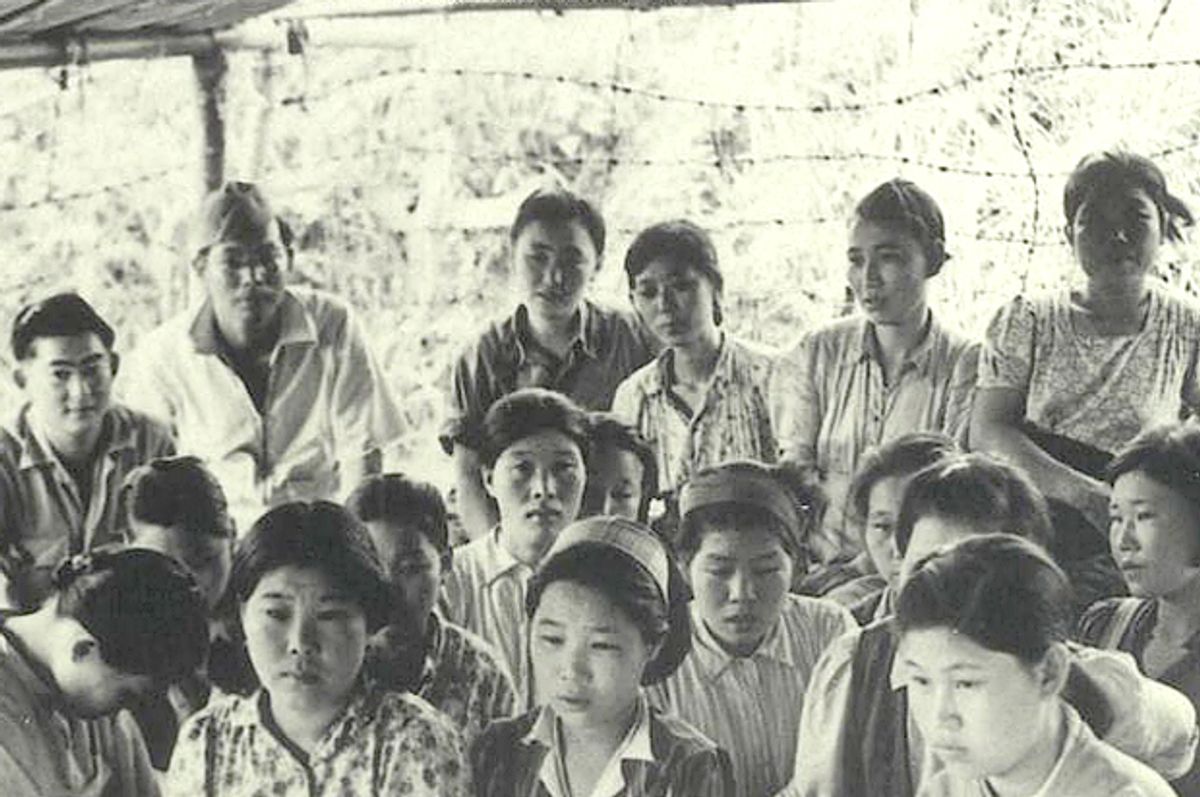 (Columbia University Press)
If you’ve followed any of the headlines emerging about the “comfort women” in the past weeks—or months, or years, or decades—you probably have some questions. Did the Japanese government really coerce thousands of women into military brothels while its empire colonized Asia? Were the so-called “comfort women” sexual slaves or indentured servants, consenting prostitutes, or none of the above? Was the Japanese government’s recent apology to South Korea, along with the pledge to pay $8.3 million to Korean survivors, a resolution, an insult or one step in a long process of reconciliation? Does the U.S. bear any responsibility? And why is a statue of a teenage girl still making so many people so mad?
The answer to each is, “It’s complicated.” Like most matters of history, especially those entwined with violent colonialism, there are heaps of good questions, but few simple ones. Still, the story of the comfort women and the issue’s legacy today is worth your interest. There are plenty of books to help readers untangle the thorny topic. From the researched to the riveting, here’s a glimpse into the long overlooked literature of the comfort women.
Advertisement:
"Comfort Woman, A Novel," by Nora Okja Keller.
If you’re going to pick up just one book about the comfort women, this should be the one. It is hands down the best piece of fiction on the topic written in English.
There’s an old concept in Korean culture called han. It has no English translation, but is often imagined as a knot growing in a person’s chest until it’s too big to remove. Han describes bitter sorrow laced with hope for things to improve, and the simultaneous recognition that they will not. This beautiful book is full of han.
Okja Keller’s book interweaves two stories. The first is the life of a Korean girl who ends up in a comfort station, where she is given a new name, and reduced to an amenity for Japanese troops. She survives, thanks to the unsettling help of a zealous U.S. missionary, and immigrates to Hawaii. The book alternates between her and the perspective of her adult daughter. Both struggle to understand each other.
The mother’s plot is partly based on the real-life testimony of comfort station survivor Jok Gan Bae and includes the story of Princess Pari, the legendary character of Korean folklore who escaped from hell to become the first female shaman.
Advertisement:

Hollywood doubted Eddie Huang's "Boogie": "You can't get this made"
Progress Bar
01:52 / 04:02Volume Bar
I taught this book to a class of undergraduates in a required literature class at a Virginia university. Worried I was only assigning it out of personal interest, I thought they’d dislike it. I was wrong. Despite endless stories about coddled college students who refuse exposure to the unpleasant, my students craved this book’s honest portrayal of the troubling and the heartening. One of my students grew up in Thailand and had never finished a book. She finished this one. Others were first generation Korean students who had only heard bits and pieces about the comfort stations. Many were wealthy white males with conservative dispositions. It didn’t matter. None could abide the horrible acts of too many people in the book, and all of them wanted to read more.
For most of my students this book was the most revelatory thing they read all semester. And I shouldn’t have been surprised. Lyrically written, with memorable characters who are both heartening and disturbing, its themes are the same our current culture is wrapped up in: first generation immigrant experiences, hypocritical religious zealotry, gender identity, the politics of our bodies, and the many elements that converge so we keep secrets about what happens to them.
Advertisement:
"Comfort Woman: A Filipina’s Story of Prostitution and Slavery Under the Japanese Military," by Maria Rosa Henson.
This is one of the few autobiographies written by comfort station survivors. In it, Maria Rosa Henson tells the story of her life in the Philippines and her internment as a comfort woman. It’s a slim book, sprinkled with family photos and Henson’s drawings, so it’s an easy, one-bath read. But sometimes watching her life unfold is so overwhelming, that I took my time reading. At the age of 15 Henson was forced to become a sexual slave to the Japanese soldiers who occupied her Filipino town. The same soldiers visit her every day, becoming characters in this book. One shows her kindness, and they have a relationship of sorts, but all the while he too exploits her. Henson is an amateur writer, but her frankness in relaying the events of her life is staggering, and she has a knack for including specific details that stick with you. In one passage Henson is confronting memories she couldn’t share. “Whenever I felt the need to talk, I would write instead on small sheets of paper, ‘Japanese soldiers raped me. They fell in line to rape me.’ Then I would crumple the paper and throw it away.” Henson has since died, but written across the pages of this book is her refusal to be discarded.
Advertisement:
"True Stories of the Korean Comfort Women," edited by Keith Howard, compiled by the Korean Council for Women Drafted for Military Sexual Slavery.
Perhaps the only reason the “comfort women” are discussed today is the work of a few key activists who grew from South Korea’s burgeoning women’s movement in the '80s. They were part of a larger push to include the experiences of women in public memory. One of those awareness-raising groups, the Korean Council for the Women Drafted into Military Sexual Slavery by Japan (not the most efficient name, but direct), set about recording the oral testimony of comfort station survivors from Korea. They conducted extensive interviews. The women were elderly and most had rarely discussed what they survived. The result is this collection of 20 interviews. Sometimes the women’s memories seem foggy; others come across with painful clarity; but overall they make it clear why this is an issue worth investigating.
"Comfort Women," by Yoshimi Yoshiaki, translated by Suzanne O’Brien.
I’ll be the first to admit that book is not the most dazzling literary journey you’ll ever travel. It’s the work of a scholar, and feels like it. But if you are the kind of reader who can nerd out on impressive research, then this deep-dive will speak to you. As a young man in Japan, Yoshimi Yoshiaki joined a group of professors who argued that investigating the past, good and bad, was crucial for the nation’s health. One day while rooting through Japanese military archives he came across evidence that the government had supervised a vast system of military brothels for its troops, and was well aware many of the women in them were coerced. This was big news, and set off a chain of events that uncovered stacks more evidence. Yoshimi doesn’t rely much on the testimony of survivors. He’s more interested in troop diaries and government records. He also addresses how the Allied forces, including the U.S., were aware of the exploitation in the comfort stations, and even used the system after winning the war.
Advertisement:
"The Comfort Women: Sexual Violence and Postcolonial Memory in Korea and Japan," by C. Sarah Soh.
Here’s the thing with books about the comfort women: Their titles don’t vary much, so this one has the same name as all the rest. But it has a unique perspective. Activists sometimes present a monolithic story of the comfort women, implying each was kidnapped, imprisoned and forced to provides sexual services without pay. It’s a response to neoconservatives who have denied the comfort stations existed at all, or that anything criminal happened in them. As a result, the diverse spectrum of individual experiences, and the personality of the people behind them, can feel lost. Soh counters that monolithic version in this book, which discusses the range of conditions women encountered, and tackles head-on whether people who collaborated with the Japanese contributed to the suffering of their own countries. This month another Korean author was accused of being a “pro-Japanese traitor” and found guilty of defamation for similar claims. It’s the sort of honesty that makes people uncomfortable, but it’s brave too.
DANIELLE HARMS
Danielle Harms writes about her research into the comfort women at 1,000Wednesdays.org and blogs at Danielle.HarmsBoone.org. Follow @danielleharms on Twitter.MORE FROM DANIELLE HARMS
https://www.thefreelibrary.com/Nora+Okja+Keller%3a+telling+trauma+in+the+transnational+military-...-a0168090922
===
Nora Okja Keller's Comfort Woman and the Ethics of Literary Trauma
Author
Madsen, Deborah Lea
Published in Concentric. 2007, vol. 33, no. 2, p. 81-97
Abstract Nora Okja Keller's 1997 novel Comfort Woman has come to prominence recently as one of the key texts of Asian American literature, representing in literary form a silenced historical trauma: the enforced sexual servitude of Korean women and girls under the Japanese military occupation. In contrast to the numerous volumes of testimony and autobiography that have been published since the mid-1990s, Keller’s text is a novel, a work of fiction written by someone with no personal experience of this historical trauma. The text therefore raises questions related to the ethics of using trauma as a literary subject, questions concerning the purpose of the fiction, the role of the author, and the status of the traumatized fictional protagonist. The difficulty and pain involved in the speaking of traumatic memory is described by many former comfort women who in the course of their testimony confess that the recollection of their ordeal makes them physically ill. As each of these women testify, to be known as a trauma victim places a woman in a specific subject position that ensures her further trauma through its representation. Why then relive such trauma? Why is the testimony of survivors important? Trauma narratives seek both validation and catharsis for the survivor; they are motivated by the desire to make the traumatic experience real both to the survivor and to the witness by uniting fragments of traumatic memory and by taking control of the meaning of the experience through the retelling. The difficulty of such testimony lies, however, not so much in the telling but in the appropriation of survivor discourses by dominant gender paradigms and ideologies that re-script such discourse. In Comfort Woman, Akiko’s experience of rape and torture is rescripted by the American missionary who becomes her husband. His interest in her past is motivated by a sexual desire that is described in terms of paedophilia by Akiko and the only terms in which he can conceptualize and articulate her experience is as prostitution. But the question remains whether the novel offers the opportunity for validation and catharsis (and, if so, on whose behalf Keller offers such strategies of “working through” the historical trauma) or whether the fiction offers primarily entertainment with a measure of education.
Keywords Nora Okja Keller — Korean Comfort Women — Trauma — Trauma narrative — Testimony — Survivor discourse — Literary ethics — Korean-American Literature
Note Concentric, special issue: "Ethics and Ethnicity"
Full text Article (Accepted version) (131 Kb) - public document Free access
Structures
Faculté des lettres / Département de langue et de littérature anglaises
Citation
(ISO format) MADSEN, Deborah Lea. Nora Okja Keller's Comfort Woman and the Ethics of Literary Trauma. In: Concentric, 2007, vol. 33, n° 2, p. 81-97. https://archive-ouverte.unige.ch/unige:87862
Article
Nora Okja Keller's Comfort Woman and the Ethics of Literary Trauma
MADSEN, Deborah Lea
Abstract
Nora Okja Keller's 1997 novel Comfort Woman has come to prominence recently as one of the key texts of Asian American literature, representing in literary form a silenced historical trauma: the enforced sexual servitude of Korean women and girls under the Japanese military occupation. In contrast to the numerous volumes of testimony and autobiography that have been published since the mid-1990s, Keller’s text is a novel, a work of fiction written by someone with no personal experience of this historical trauma. The text therefore raises questions related to the ethics of using trauma as a literary subject, questions concerning the purpose of the fiction, the role of the author, and the status of the traumatized fictional protagonist. The difficulty and pain involved in the speaking of traumatic memory is described by many former comfort women who in the course of their testimony confess that the recollection of their ordeal makes them physically ill. As each of these women testify, to be known as a trauma victim places a woman in a specific subject position that ensures her further trauma through its representation. Why [...]
Reference
MADSEN, Deborah Lea. Nora Okja Keller's Comfort Woman and the Ethics of Literary Trauma.
Concentric, 2007, vol. 33, no. 2, 33.2, p. 81-97
Published in Concentric, special issue: Ethics and Ethnicity, ed. Shirley Lim, 33. 2 (September 2007), pp. 81-97.
Nora Okja Keller's Comfort Woman and the Ethics of Literary Trauma
Deborah L. Madsen
Nora Okja Keller's 1997 novel Comfort Woman has come to prominence recently as one of the key texts of Asian American literature, representing in literary form a silenced historical trauma: the enforced sexual servitude of Korean women and girls under the Japanese military occupation. In contrast to the numerous volumes of testimony and autobiography that have been published since the mid-1990s, Keller’s text is a novel, a work of fiction written by someone with no personal experience of this historical trauma. The text therefore raises questions related to the ethics of using trauma as a literary subject, questions concerning the purpose of the fiction, the role of the author, and the status of the traumatized fictional protagonist.
The difficulty and pain involved in the speaking of traumatic memory is described by many former comfort women who in the course of their testimony confess that the recollection of their ordeal makes them physically ill: for example, Kim Sook-Duk tells how “I still have nightmares. I then scream to wake myself up. Nowadays, people often come here to interview me about my life as a 'comfort woman'. I cannot see them as often as I used to. My nightmares become worse after remembering the past at these interviews” (40); Pak Du-ri admits, “Occasionally I meet visitors who want to hear about my ordeal. After these meetings I frequently suffer from severe headaches. Sometimes they become so bad I have to be hospitalized” (71); Yi Young-sook explains, “Occasionally people come to hear my story of a former 'comfort woman'. I am reluctant to talk about it because it is my shameful, terrible past. Recollecting such a past is so emotionally draining” (101). As each of these women testify, to be known as a trauma victim places a woman in a specific subject position that ensures her further trauma through its representation.
Why then relive such trauma? Why is the testimony of survivors important? Trauma narratives seek both validation and catharsis for the survivor; they are motivated by the desire to make the traumatic experience real both to the survivor and to the witness by uniting fragments of traumatic memory and by taking control of the meaning of the experience through the retelling. Wendy S. Hesford in her essay “Reading Rape Stories: Material Rhetoric and the Trauma of Representation” acknowledges the risks of equating autobiographical testimony with authentic truth but she nuances this view by observing that
Survivor narratives do expose oppressive material conditions, violence, and trauma; give voice to heretofore silent histories; help shape public consciousness about violence against women; and thus alter history's narrative. Moreover, there is strong evidence that the process of telling one's story and writing about personal trauma can be essential elements of recovery ...”(195).
The difficulty of such testimony lies, however, not so much in the telling but in the appropriation of survivor discourses by dominant gender paradigms and ideologies that re-script such discourse. So the story becomes evidence of female hysteria or of feminine weakness or of the irresistible sexuality of Asian women, for example. In Comfort Woman, Akiko’s experience of rape and torture is rescripted by the American missionary who becomes her husband. His interest in her past is motivated by a sexual desire that is described in terms of paedophilia by Akiko and the only terms in which he can conceptualize and articulate her experience is as prostitution. But the question remains whether the novel offers the opportunity for validation and catharsis (and, if so, on whose behalf Keller offers such strategies of “working through” the historical trauma) or whether the fiction offers primarily entertainment with a measure of education.
In a 2002 interview with Asianweek Nora Okja Keller explained how she came to write Comfort Woman after hearing the testimony of Keum Ja Hwang, a survivor of the wartime Japanese comfort stations, at a University of Hawaii symposium on Human Rights in 1993. The friend who accompanied Keller told her, in Keller's words, “You should write about this, you're Korean”. Keller continued, “But the topic was too big, I couldn't even find the words to express how horrified I was, much less find the vocabulary to talk about the pain in this woman's life. But her story took hold of me. I felt so haunted, I began dreaming about images of blood and war, and waking with a start. Finally, I realized that the only way to exorcise these dreams and the story from my mind was to write them down. So I got up one night and began to write bits and pieces of my dreams and the comfort woman's words.” (Keller, 2002, n.p.).
What Keller describes is reminiscent of Toni Morrison’s notion of “emotional memory” (described in her 1987 essay “The Site of Memory”). Morrison argues that in autobiographical texts, such as slave narratives of the eighteenth and nineteenth centuries, a “veil” (her metaphor) is drawn over the physically traumatic aspects of American slavery in narratives that strive to be as factual as possible. She describes her writerly mission to “rip” this veil so as to reveal interior lives: “I’m looking to find and expose a truth about the interior life of people who didn’t write it (which doesn’t mean they didn’t have it)” (113). Later in the same essay she describes her route into these interior lives as emotional memory, “what the nerves and the skin remember as well as how it appeared” (119). The testimony of former comfort women shares a common set of characteristics. These texts strive to be as objective as possible, recounting the literal facts of coercion by the Japanese military, the nature of their ordeal as sexual slavery, and the extreme brutality with which they were treated.
These autobiographical texts seek to provide evidence in support of the survivors’ claim for the acknowledgement of the violation of their human rights and for compensation from the Japanese government. What the survivor narratives do not describe is the nature of the emotional and psychological damage these women have suffered, damage that could possibly undermine their credibility as witnesses. They describe the destruction of their lives: lives destroyed because of the physical trauma they suffered as a result of beatings, punishments, drug therapies to induce abortions and to treat sexually transmitted diseases and because they could not return to intensely patriarchal communities in a condition where they were unfit for marriage. Like the slave narratives discussed by Morrison, these testimonies draw a veil over the inner lives of those who have been the subjects of historical trauma. And this invites Keller to rip the veil, to expose the interior operations of trauma upon these victims, witnessing “what the nerves and the skin remember.”
In its assumption that the writer of fiction can articulate circumstances of extreme historical trauma, Comfort Woman raises questions about traumatic memory and its relation to cultural memory through the role of the witness within the context of a fiction. Questions such as: how is the role of the witness incorporated into the fiction? Who is the witness -- the reader, the author, or the fictional protagonist? And how does testimony, upon which the psychoanalytical analysis of trauma is based, enter a fictional text? Can the text itself occupy the status of testimony even if it is fictional? What is the significance for the representation of trauma of the transformation of history from event into language?
In his book The Ethics of Memory (2002), philosopher Avishai Margalit argues that memory is knowledge about the past, not knowledge from the past; that memory is about belief rather than truth and so the agent who takes responsibility for shaping our belief in what has been the case must be a special agent of historical belief. He describes how: “[c]onveying the sensibility of events from the past that should be landmarks in our collective moral consciousness calls for a special agent of collective memory. Such an agent needs to be invested with special moral authority akin to that of the religious witness or martyr” – this agent he calls “the moral witness” (14). The moral witness is a particularly significant figure in the memorialization of trauma which is described by Jeffrey Olick and others as the disruption of “the legitimating narrative[s] that we as individuals produce for us as a collectivity” (345): in other words, the ongoing nature of trauma lies in historical events that cannot be integrated into the constitutive narratives of communities of memory. The moral status of the witness precludes mere survivors of such traumatic events as, say, natural disasters, where no morally evil force is involved. Margalit argues that “[b]eing a moral witness involves witnessing actual suffering, not just intended suffering. A moral witness has knowledge-by-acquaintance of suffering” (149). And he goes on to ask the question especially pertinent here: “[D]oes acquaintance mean experiencing the suffering first-hand – as a victim – or can one know it as a sympathetic bystander, observing the suffering without being a victim oneself?” (149). While Margalit concedes that it is possible to be a moral witness without being a victim, a moral witness must at the very least be at personal risk, and at risk as a consequence of acting as a moral witness. For a moral witness must testify to the existence of evil in the hope that in the future there will exist a moral community that will listen to and credit their testimony.
The witnessing of testimony is enacted in Comfort Woman through the daughter’s reception of her mother’s testimony. Akiko functions as a moral witness, testifying to the evil of the Japanese imperial regime. And she risks all by witnessing the nature of her traumatic experience and escaping to tell her story. This telling, in the nature of trauma itself, is belated. Akiko’s first-person narratives (which are juxtaposed with her daughter’s) place in question the idea of lived time and her traumatic experience in relation to her life before and after the recreation camp. There are two moments in the chronology of trauma: the original event and its belated emergence as a symptom. Ruth Leys explains:
The idea is that, owing to the emotions of terror and surprise caused by certain events, the mind is split or dissociated: it is unable to register the wound to the psyche because the ordinary mechanisms of awareness and cognition are destroyed. As a result, the victim is unable to recollect and integrate the hurtful experience in normal consciousness; instead, she is haunted or possessed by intrusive traumatic memories.
The experience of the trauma, fixed or frozen in time, refuses to be represented as past, but is perpetually reexperienced in a painful, dissociated, traumatic present” (2).
Trauma is defined by this belated temporality; trauma resides in the repetition of an earlier event that is forgotten or repressed and so is neither recalled nor known as traumatic. But these repetitions are not identical and because each repetition is not self-identical there opens the potential for analysis. After her escape from the military camp where she has been imprisoned, Akiko suffers a period of hysterical muteness and, although she is able to articulate her memories in the narratives to which we as readers have access, for her daughter she prepares a cassette recording to be heard after her death (the text does not make clear whether Akiko’s narratives are identical with this recording). It is the novel itself that returns obsessively in Akiko’s sections to the repetition of trauma. Akiko functions as a moral witness but in a way that Nora Keller cannot. What then is the ethical status of the author who cannot be but can create a moral witness?
Historical trauma that is constitutive of a specific community of memory can be represented by what Dominick LaCapra calls the “secondary witness”. This secondary witness empathizes with a trauma that has not been experienced personally, as LaCapra explains: “Historical trauma is specific and not everyone is subject to it or entitled to the subject-position associated with it. It is dubious to identify with the victim to the point of making oneself a surrogate victim who has a right to the victim’s voice or subject-position” (722). This empathy, which LaCapra likens to a “virtual experience,” acknowledges the difference separating the victim from the witness and is seen by him as a desirable affective complement to empirical research and analysis. Specifically, this empathy or “empathetic unsettlement” can disrupt the temptation to false harmonizing or recuperation of the past through “uplifting messages and self-serving scenarios” (723). The working of “emotional memory” or empathy with the victim of historical trauma empowers Keller both as a secondary witness and as the creator of a moral witness within her fiction.
The distancing of the text from the circumstances of the historical trauma that it purports to represent is troubling. Keller is a Korean American, born in South Korea and brought by her parents to the US at the age of three. She is separated generationally, culturally, and experientially from the victims of Japanese military sexual slavery about whom she had never heard until the University of Hawaii symposium on Human Rights in 1993. In these terms, Comfort Woman risks the commodification of trauma against which Patricia Yeager warns in her essay, “Consuming Trauma: or, The Pleasures of Merely Circlating.” Yaeger describes the dangers of coopting and commodifying stories of trauma (turning pain to aesthetic pleasure), by sensationalising stories of suffering and violence and re-traumatizing victims. She warns specifically that academics are “busy consuming trauma ... obsessed with stories that must be passed on, that must not be passed over ... but are drawn to these stories from within an elite culture driven by its own economies” (228). Keller has anticipated such a charge through the creation of the character of Reno who commodifies the repetition of the traumatic event by Akiko. It is Reno who transforms Akiko into a famous psychic and spiritual medium. Where Beccah fears her mother’s periods of insanity, Reno uses these opportunities to call up a crowd of seekers who pay handsomely to hear about what Beccah calls “the death and unfulfilled desire in their lives” (10). The conflict between Beccah, who experiences these trances only as the loss of her mother, and Reno, who grows rich as the facilitator of these meetings reaches a pitch after Akiko’s death and over arrangements for her funeral. They argue literally over Akiko’s dead body as Beccah accuses Reno of pure self-interest in her concern for Akiko, of using her to make money. Reno defends herself by describing Akiko as a shrewd woman who also made money out of her role as a psychic: “Your maddah was one survivah. Das how come she can read other people. Das how come she can see their wishes and fears. Das how come she can travel out of dis world into hell, cause she already been there and back and know the way” (203). In her description of Akiko’s traumatic repetitions Reno articulates a hybrid discourse constituted of survivor narratives, popular mysticism and narratives of the American Dream, which repeat in miniature the rhetorical mix of the novel as a whole. Reno’s defence of her use of Akiko’s trauma can be seen to parallel Keller’s use of the trauma experienced by surviving comfort women, a parallel that incorporates into the fiction potential criticisms like those outlined by Yaeger. Beccah’s eventual reconciliation with Reno and the compromise that they should conduct two separate funerals for Akiko, one a commodified event for the clients from which Reno will take a profit, the other a private ritual cremation, rehearses the expectation of the reader’s acceptance of Keller’s commodification of historical trauma that can be integrated into a variety of distinct cultural narratives.
The conflict between Reno and Beccah underlines the difficulty of recuperating traumatic stories and the dangers of such recuperation as
“normalization.” By normalization I mean the scripting of trauma and its assimilation to cultural narratives of normality. Kalí Tal refers to the “mythologization” of trauma that “works by reducing a traumatic event to a set of standardized narratives … turning it from a frightening and uncontrollable event into a contained and predictable narrative. … Once codified, the traumatic experience becomes a weapon in another battle, the struggle for political power” (6) – such that survivor discourses become revised or censored narratives of traumatic experiences. The untranslatability of trauma makes survivor discourse especially reliant upon cultural scripting for the conditions of its own meaning, even when it may resist these cultural ideologies. The ineffable nature of trauma creates a relationship of dependency with discourse to bring it into a “condition of significance” (Shoshana Felman’s term). Consequently, literature is a privileged site for the representation of trauma. The figurative nature of literary language together with the representational nature of literature functions for the articulation of a trauma that does not need to be apprehended in order to be present in the text (Ramadanovic, n.p., para 2). In other words, literature can preserve the authenticity of trauma as an experience that takes place in a liminal space outside the normal contexts of experience and meaning. The significance of trauma as unspeakable horror is, in the view of theorists like Cathy Caruth and Walter Benn Michaels, articulated as pure horror when the referential function of language is pressed beyond its limits. Then, in the words of Benn Michaels, we have access to “not the normalizing knowledge of the horror but the horror itself” (8). In a literary context, trauma can be witnessed without being fully comprehended because “language is capable of bearing witness only by a failure of witnessing or representation” (Leys, 268). The peculiar epistemology of trauma resides in the special authority attributed to the survivor who, alone, is qualified to articulate the trauma they have experienced. But, as a consequence, the significance of the traumatic experience is contested.
Keller’s recreation of the survivor’s story is enmeshed in a number of contemporary North American cultural scripts which seek to control the significance of this historical trauma: the recovery movement which is dominant in US popular psychology and contemporary feminist analyses of patriarchal power structures. Keller’s novel can be seen to derive validation from these discourses and, in turn, to confirm these discourses as powerful cultural narratives. This should not be so surprising: historical trauma can be destructive of some cultural narratives but can also function to affirm others (for example, the genocide of Native Americans can confirm narratives of the Vanishing American and of Manifest Destiny). Keller’s adaptation of the comfort woman narrative confirms the feminist analysis of patriarchy in general and, in particular, the sexualization of Asian femininity through such practices as government-supported sex tourism and military prostitution around the US bases in South Korea.
Comfort Woman identifies a profound connection between Japanese military sexual slavery and the Japanese colonial occupation of Korea. Akiko describes how, when girls are forcibly taken to the comfort stations, they are required to adopt Japanese names and to speak only Japanese when they speak at all. They must surrender their Korean identities and submit to their complete domination by Japanese colonial masters. Japanese imperialism works together with the forces of patriarchy to disempower all Koreans but Korean women are doubly disempowered, by reason of their race and their gender. Akiko tells how she was not taken by force by the military but was sold by her eldest sister in order to provide a dowry without which marriage – a woman’s only conceivable destiny – would be impossible. And upon her escape Akiko knows that because she is no longer a virgin, because she is unmarriageable, she is not able to return to her village and her family. The oppressive patriarchy that makes of Akiko a victim even before she enters her life of rape and torture as a comfort woman is generalized from Asia to encompass the US when Akiko migrates with her missionary husband. She finds little difference between the husband who rapes her and the Japanese soldiers who raped her. She finds in America that she occupies a subject-position that differs very little from Korea.
This emphasis upon a universalized patriarchal oppression is congruent with the very origins of the comfort woman movement, which was organized by the efforts of feminists in Korea and Japan to draw attention not to the isolated incidence of military sexual slavery during the war in the Pacific but to focus the attention of the world upon the sexual exploitation of Asian women generally and Korean women specifically in the global sex trade and in particular in the trans-national sex trade between Korea and Japan. The economic exploitation of Korean women’s sexuality is seen as an expression of powerful patriarchal narratives that dominate both cultures. So where the survivor narratives of former comfort women may shatter cultural narratives of human rights, for example, these narratives also affirm the continued power of narratives of Asian feminine sexuality and patriarchal dominance. That the intersection of discourses of patriarchy and orientalism is also powerful in American culture is evidenced by Keller’s equation of Akiko’s suffering as a comfort woman with her suffering as the oriental wife of an American man, and this interest is of course explored further in Keller’s second novel, Fox Girl, which addresses directly the experience of contemporary Korean women who provide sexual services to the US military personnel still stationed in South Korea.
The Americanness of Keller’s novel, then, lies in part in this connection between imperialism, patriarchy and the sexualization of Asian femininity but I would like to suggest that it also resides in the nature of Keller’s rhetoric of trauma. Keller uses the potentially cathartic role of literary language in the process of healing, where the special characteristics of poetic language can act as a mechanism by which the full horror of the traumatic event can be recreated or recovered. I use the term “recovered” advisedly to evoke the “recovery movement” in contemporary popular American psychology, which is founded on the principle that through therapy (involving a combination of self-help, support groups, addiction therapy, and the like) memories of childhood trauma can be pieced together as part of the process of healing. The shift in terminology to describe the nature of traumatic memory is significant, as Marita Sturken observes: “the slippage from repressed to recovered implies that remembrance is an activity that will help one recover” (104). In Freudian terms repression is an active process of keeping dangerous knowledge from consciousness but in recovery psychology the active process is the recovery of memory. In the concluding sections of Comfort Woman Keller uses this principle of self-help through the recovery of collective traumatic memory. It is not, however, the former comfort woman Akiko who is the subject of this healing but her American-born daughter.
In fact, trauma as depicted in the novel is not restricted to Akiko’s traumatic experience of the comfort camps and her subsequent bouts of insanity and attempts to commit suicide: her daughter Beccah also suffers the symptoms of trauma, though these are muted in the narrative. She embraces her mother’s rituals and the spirit world they conjure, and as a consequence she becomes anorexic, eating only that which the spirits eat: the steam that arises from the offerings presented to them. She admits, “I continued to devour the steam of rice, waiting until I would be tiny enough to slip completely into the world my mother lived in” (86). Beccah is the victim of the trauma visited upon her mother, the trauma that has characterized her childhood as one of neglect and deprivation. That Beccah’s dysfunctionality is a consequence of her mother’s, and is in some way identical with it, is articulated in the text by the shared imagery of their unconscious and their dreams.
The motif of frogs or toads, linked to the figure of a “heavenly messenger,” unites the experience of both Akiko and Beccah. When Akiko recalls the killing of Induk, her predecessor in the camp, she imagines she can hear a chorus of frogs lamenting this death; the murdered Induk is ambiguously related to the spirit Induk, the Birth Grandmother, throughout the narrative and at times they are identified as one, as when Akiko imagines that she sees Induk in the form of her mother standing by the edge of the river where Akiko is lying unconscious having just escaped the camp. When Induk addresses her, Akiko describes her voice “creaking like a hundred thousand frogs” (36). Later, Beccah reports a dream in which she sees a woman standing by a river who appears to be her mother and who identifies herself as Induk but Beccah knows is actually herself. In addition to dreams, the stories passed from Akiko to Beccah – like the story of the heavenly frog who rewards those who believe him by taking them to heaven or that of the little frog who obeys his mother for the only time by following her literal directions for her burial when she had expected that he would act as he always had and do the opposite of what she asked – provide a symbolic commentary upon the characters’ unexpressed emotional lives. The frog jewellery and ornaments given to Akiko by her clientele represent her status as a spirit messenger like the Heavenly Frog, though her clients cannot know the significance of the figure of the messenger for Akiko who carried secret coded messages among the comfort women who were bound by a rule of silence in the camp.
These symbolic images then trace back to Akiko’s originary trauma, the trauma she cannot articulate in the terms of ordinary language to her daughter. Indeed, the healing of Beccah’s traumatized psyche is represented through dream imagery, imagery that arises from the story of Princess Pari who tricked her way into hell so that she could find her parents and drag them free by the strips of cloth she ties around her waist (49). Later, Beccah dreams that she is held underwater by a shark that transforms into the figure of her mother, holding her legs Beccah says, “as though I could save her. Instead I feel myself sinking” (141). Beccah feels herself punished by her inability to conform to the ideal established by Princess Pari until she discovers her mother’s true identity and learns of her mother’s traumatic history. Then she is able to shake off the suspicion that she is modelled upon the little frog who was incapable of correctly burying his mother. Then Beccah is able to conduct the ritual preparation of her mother’s body, though with the difference that she binds the body with cloth strips torn from the bedsheet upon which she has transcribed Akiko’s testimony. Beccah does this in the belief that when her mother’s body is cremated, the flames will carry her words away and free Akiko’s spirit from her body and her history also. The cloth with which Princess Pari saved her parents becomes the cloth shroud Beccah uses to liberate her mother. In the process, Beccah liberates herself. In the final dream that she reports, Beccah dreams that she gives birth to herself, a new and “whole” self. She dreams again of being immersed but rather than drowning now she swims through the sky, as she describes, “higher and higher, until, dizzy with the freedom of light and air, I looked down to see a thin blue river of light spiralling down to earth, where I lay sleeping in bed, coiled tight around a small seed planted by my mother, waiting to be born” (213). This image draws together several rhetorical strands of the narrative. It recalls the advice given to Akiko that in order to find something lost she must free her mind and allow her unconscious to spiral in towards the lost object; this is in itself recalls Akiko explaining to Beccah that her trances are her mind’s attempt to find something that she has lost – her past, her history, lost to the devastating power of trauma. The river represents throughout the narrative a gateway to the spiritual realm, be that hell or home. Beccah scatters her mother’s ashes in the river by their home, the river that Akiko has ritually united with her daughter through a bond of blood that is extended to herself as Beccah touches her mother’s wet ashes to her lips, “ ‘Your body in mine,’ I told my mother, ‘so you will always be with me, even when your spirit finds its way home’ ” (212). The conclusion of the narrative, then, enacts the recovery of traumatic memory and its reintegration into the narratives recalled by Beccah. As a consequence, daughter is united with mother, the unity of the generations is preserved, and ritual is united with history as body is united with spirit.
I mentioned earlier that survivor narratives seek two things: validation and catharsis and I posed the question: on whose behalf does Keller offer strategies of “working through” historical trauma? Nora Keller achieves in her novel validation of the suffering of surviving comfort women but catharsis is reserved for the generations who are damaged as a result of the originary historical trauma. As these generations witness the historical testimony of survivors, Keller suggests, the possibility for selfhealing opens through the cathartic power of language. This is not the language of everyday life: Akiko is unable to articulate her traumatic experience except through the ritual mourning of the women who did not survive the comfort camps. She does not speak her trauma but sings it and the secondary witness to this testimony, Nora Keller, represents it in highly poetic terms, through dreams, visions, and inherited stories. These discourses, which exceed in their representational power the limits of normal mimesis, demonstrate the ability of poetic language to transform history from event into a discourse that approaches the horror of the traumatic event. Once remembered and recreated, the trauma can then be purged. The status of Comfort Woman as an Asian American text raises more questions about the status of the text’s language than the text can resolve (for instance, why only Reno’s Hawaiian accent is transliterated when other characters, most notably Akiko, must speak not only an inflected English but indeed Korean in sections of the text that are not marked by any such linguistic switching). Keller uses a style of rhetoric that appears to owe its motivation to the recovery movement in contemporary popular psychology and a style of discourse normalization that owes much to feminist analyses of patriarchal cultural formations. She creates a fiction based on history and written in the style of personal confession. But she appears to be ignorant of the dangers of cultural narratives that rescript the story of historical trauma and mythologize its significance. In these ways, this text continues to raise disturbing questions about ethics and the literary cooptation of traumatic memory.
Works Cited
Walter Benn Michaels, “You who never was there? Slavery and the New Historicism,
Deconstruction and the Holocaust” Narrative 4 (1996), pp. 1-16, rpt. in Hilene Flanzbaum (ed.), The Americanization of the Holocaust (Baltimore, MD: The Johns Hopkins University Press, 1999), pp. 181-97.
Shoshana Felman, “Education and Crisis,” Psychoanalysis, Culture and Trauma, ed. Cathy Caruth, special issue of American Imago, 48. 1 (Spring 1991).
Nora Okja Keller, Asianweek,
<http://www.asianweek.com/2002_04_05/arts_keller.html>.
Dominick LaCapra, “Trauma, Absence, Loss,” Critical Inquiry, 25 (Summer, 1999), 696-727.
Ruth Leys, Trauma: A Genealogy (Chicago & London: University of Chicago Press, 2000).
Avishai Margalit, The Ethics of Memory (Harvard University Press, 2002).
Toni Morrison, “The Site of Memory” in Inventing the Truth: The Art and Craft of Memoir ed. William Zinsser (Boston: Houghton Mifflin, 1987), 103-124.
Jeffrey K. Olick, “Collective Memory: The Two Cultures”, Sociological Theory, 17. 3 (Nov 1999), 333-348.
Peter Ramadanovic, “Introduction: Trauma and Crisis”, Postmodern Culture, 101 (2001), n.p. www.iath.virginia.edu/pmc/text-only/issue101/11.2introduction.txt
Sangmie Choi Schellstede, ed., Comfort Women Speak: Testimony by Sex Slaves of the Japanese Military, (New York & London: Holmes & Meier, 2000).
Marita Sturken, “The Remembering of Forgetting: Recovered Memory and the Question of Experience”, Social Text, 57 (Winter 1998), 103-25.
Kali Tal, Worlds of Hurt: Reading the Literatures of Trauma (Cambridge: Cambridge University Press, 1996).
===
[Interview] One Korean-American author tells the story of comfort women
Posted on : May.28,2017
[Interview] One Korean-American author tells the story of comfort women
Posted on : May.28,2017
In her writings, Nora Okja Keller explores “mixed blood” and Korean identity
Nora Okja Keller, a Korean-American author who received the American Book Award in 1998 for “Comfort Women,” during an interview with the Hankyoreh. (by Kim Tae-hyeong, staff photographer)
Nora Okja Keller is a Korean-American author who received the American Book Award in 1998 for “Comfort Women,” a novel dealing with the women forced to provide sexual services for the Japanese imperial army. Born to a Korean woman and a German-American man and raised in Hawaii, Keller published a second novel, “Fox Girl,” in 2012, which focuses on biracial children and women working at “camp towns” near US military bases in South Korea. “For my third novel, I’m planning to write the back story to ‘Fox Girl,” which will be set in Hawaii in the 1980s,” Keller told the Hankyoreh in an interview on May 25. She is currently in Seoul to participate the Seoul International Forum for Literature, which is being organized by the Daesan Foundation.
---
Keller first learned about the comfort women during a human rights symposium held at the University of Hawaii in 1993. The testimony of Hwang Geum-ja, a former comfort woman, came as a huge shock to her. When she suggested writing an article about the comfort women to a reporter she knew, her friend responded that she should write it, since she was Korean. And thus her novel “Comfort Women” was born.
“I met the former comfort women when I was invited to visit Seoul for Women’s World 2005. I attended the protest in front of the Japanese embassy, and after the protest, I talked to the women. When I gave them my novel and told them that it was their courageous testimony that had enabled me to write it, one of them caressed my cheek and told me I had done a good job. That just make me cry even more,” Keller said.
The comfort women agreement reached by the governments of South Korea and Japan at the end of 2015 was “disappointing and disconcerting,” Keller said. “Even though decades have passed since the war, the Japanese government continues to deny its involvement in the recruitment of the comfort women and its responsibility for that. What the former comfort women really want isn’t money – it’s for the Japanese government to acknowledge what it did and to ask for forgiveness,” she said.
For quite a long time after “Fox Girl,” Keller wasn’t able to write another book because of her other responsibilities: teaching composition and raising her two daughters. But Keller said she didn’t regret this situation, despite the obstacles it presented to her career as a writer. “My second daughter is graduating this Saturday, and I think I might dedicate more time to writing now while teaching part-time instead of full-time,” she said.
Keller gave her daughters the Korean names “Tae” and “Sunhi.” While Keller’s own Korean name “Okja” is her middle name, she had her daughters put their Korean names first and put their American names in the middle. “Since half of my blood is Korean, you can tell I’m biracial just from my appearance, but my daughters are one-quarter Korean and three-quarters Caucasian by blood. So I wanted to emphasize their Korean identity even more, even if through their names. ‘Tae’ came from my mother’s name,” she said.
During the Seoul International Forum for Literature, Keller made a presentation titled “Thoughts about Being Hapa [a Hawaiian word meaning “mixed blood”]: Living on the Margins Both as ‘Self’ and ‘Other’” during a session called “Perceiving ‘Us’ and ‘Them.’” “Even if my full-grown daughter has a child that has just one-eighth Korean blood, that child is also fully Korean. The very distinction between the self and other is a false dichotomy,” she said during her presentation.
“The presentation that Korean writer Kim Soom made during the same session of the Seoul International Forum for Literature was really impressive. It felt incredibly poetic even while being about something that could feel very uncomfortable, and I also thought her writing resonated with my work. I actually found myself thinking, wow, I really like this woman, from the moment she started speaking,” Keller said.
Surprisingly enough, Keller made this remark without having heard about Kim Soom’s 2016 novel “One Person,” which is also about the comfort women. “That makes me more interested in her. I’ve got to read that book,” Keller said when told about the novel.
Finally, Keller was asked about the political situation in South Korea, in which the candlelight rallies led to the impeachment former President Park Geun-hye and the election of new President Moon Jae-in, and about the possibility of US President Donald Trump being impeached.
“Koreans have showed that they’re able to bring about positive change peacefully by making their voices heard. The first thing I thought when I heard about the impeachment was that it would be great if the same thing happened soon in the US. I think Trump could be impeached, too. But since I’m not an expert, that might be wishful thinking,” Keller said with a laugh.
By Choi Jae-bong, literature correspondent
https://english.hani.co.kr/arti/english_edition/e_international/796488.html
---
Keller first learned about the comfort women during a human rights symposium held at the University of Hawaii in 1993. The testimony of Hwang Geum-ja, a former comfort woman, came as a huge shock to her. When she suggested writing an article about the comfort women to a reporter she knew, her friend responded that she should write it, since she was Korean. And thus her novel “Comfort Women” was born.
“I met the former comfort women when I was invited to visit Seoul for Women’s World 2005. I attended the protest in front of the Japanese embassy, and after the protest, I talked to the women. When I gave them my novel and told them that it was their courageous testimony that had enabled me to write it, one of them caressed my cheek and told me I had done a good job. That just make me cry even more,” Keller said.
The comfort women agreement reached by the governments of South Korea and Japan at the end of 2015 was “disappointing and disconcerting,” Keller said. “Even though decades have passed since the war, the Japanese government continues to deny its involvement in the recruitment of the comfort women and its responsibility for that. What the former comfort women really want isn’t money – it’s for the Japanese government to acknowledge what it did and to ask for forgiveness,” she said.
For quite a long time after “Fox Girl,” Keller wasn’t able to write another book because of her other responsibilities: teaching composition and raising her two daughters. But Keller said she didn’t regret this situation, despite the obstacles it presented to her career as a writer. “My second daughter is graduating this Saturday, and I think I might dedicate more time to writing now while teaching part-time instead of full-time,” she said.
Keller gave her daughters the Korean names “Tae” and “Sunhi.” While Keller’s own Korean name “Okja” is her middle name, she had her daughters put their Korean names first and put their American names in the middle. “Since half of my blood is Korean, you can tell I’m biracial just from my appearance, but my daughters are one-quarter Korean and three-quarters Caucasian by blood. So I wanted to emphasize their Korean identity even more, even if through their names. ‘Tae’ came from my mother’s name,” she said.
During the Seoul International Forum for Literature, Keller made a presentation titled “Thoughts about Being Hapa [a Hawaiian word meaning “mixed blood”]: Living on the Margins Both as ‘Self’ and ‘Other’” during a session called “Perceiving ‘Us’ and ‘Them.’” “Even if my full-grown daughter has a child that has just one-eighth Korean blood, that child is also fully Korean. The very distinction between the self and other is a false dichotomy,” she said during her presentation.
“The presentation that Korean writer Kim Soom made during the same session of the Seoul International Forum for Literature was really impressive. It felt incredibly poetic even while being about something that could feel very uncomfortable, and I also thought her writing resonated with my work. I actually found myself thinking, wow, I really like this woman, from the moment she started speaking,” Keller said.
Surprisingly enough, Keller made this remark without having heard about Kim Soom’s 2016 novel “One Person,” which is also about the comfort women. “That makes me more interested in her. I’ve got to read that book,” Keller said when told about the novel.
Finally, Keller was asked about the political situation in South Korea, in which the candlelight rallies led to the impeachment former President Park Geun-hye and the election of new President Moon Jae-in, and about the possibility of US President Donald Trump being impeached.
“Koreans have showed that they’re able to bring about positive change peacefully by making their voices heard. The first thing I thought when I heard about the impeachment was that it would be great if the same thing happened soon in the US. I think Trump could be impeached, too. But since I’m not an expert, that might be wishful thinking,” Keller said with a laugh.
By Choi Jae-bong, literature correspondent
https://english.hani.co.kr/arti/english_edition/e_international/796488.html
===
Concentric: Literary and Cultural Studies 45.2
September 2019: 3-26
The Stories That Have Not Been Told:
Comfort Women, Nora Okja Keller’s Novels and the
Subaltern’s Performance of History
Tae Yun Lim
Department of English Language and Literature
Hongik University, Republic of Korea
Shin Haeng Lee
Division of International Studies Sejong University, Republic of Korea
Abstract
In Nora Okja Keller’s Comfort Woman (1998), the young heroine of the novel, Beccah, gets to know the life of her Korean mother, Akiko, a former Japanese sex slave (“comfort woman”), and her other female ancestors, whose spirits often haunt Akiko’s body.
This paper analyzes the subalternity of the former Korean comfort women under Japanese imperialism and explores the (im)possibility of their enunciation from various postcolonial theoretical perspectives.
The first part of this paper problematizes the oppressive ideological mechanisms that frustrated victimized women’s attempts to speak out, such as Japanese imperialism and patriarchal and anti-colonial nationalist discourses in Korea.
The second part of this paper explores how Beccah’s use of Korean and her metonymic understanding of Akiko’s unedited testimony is an on-going practice, constantly reweaving different layers of meaning and historical memories, and eventually rewriting the colonizer’s versions of the victimized women’s lives, beyond a strict sense of national and cultural boundaries.
Keywords
comfort woman, Japanese imperialism, gendered subaltern, Body/Text, historical trauma, post-colonialism
I feel you, knowing you wait by my side until the time comes for me to join you across the river. I offer you this one small gesture each year, worth more than the guilt money the Japanese now offer to silence me: a bit of rice burned in your memories, and your names called over and over again, a feast of crumbs for the starving.
—Nora Okja Keller Comfort Woman
Therefore if you insist upon fighting to protect me, or “our” country, let it be understood, soberly and rationally between us, that you are fighting to gratify a sex instinct which I cannot share; to procure benefits which I have not shared and probably will not share; but not to gratify my instincts, or to protect myself or my country. For . . . in fact, as a woman, I have no country. As a woman I want no country. As a woman my country is the whole world. —Virginia Woolf
Three Guineas
Introduction
Nora Okja Keller’s novel Comfort Woman (1998, hereafter CW) sets out how the heroine, Beccah, a Korean-American girl growing up in Hawaiʻi, comes to know the past of her Korean mother, Akiko, as well as the lives of other female ancestors whose spirits often haunt Akiko’s body. Akiko is one of the former “comfort women”—a translation of the Korean wianbu (위안부) and Japanese ianfu (慰安婦)—who were forced by the Japanese imperial military to work as sex slaves during World War II. Given the horrendous lives that female sex slaves in Asia endured during WWII, the term “comfort woman”—intended to evoke warm and motherly feelings for poor, tired Japanese soldiers—is a disreputable euphemism. Akiko’s Korean name was Soon Hyo; but after the former Akiko 40, whose Korean name was Induk, was brought back to the military camp as a corpse “skewered from her vagina to her mouth like a pig,” the young Soon Hyo became Akiko 41 and took Induk’s place in the camp. Akiko was among the common Japanese names assigned to Korean sex slaves in the military camps. When one Akiko dies, another quickly takes her place (CW 21). Although Beccah is ignorant about the past of her mother, whom she knows only as Akiko, later in the novel she attempts to piece together and reimagine the life of Akiko as well as other victimized women’s genealogy. Keller was motivated to write CW by her desire to help all comfort women come out from the world of silence, and her hope to shed new light on these women from their own perspectives (Lee 155).
The contentious issues regarding the former sex slaves during WWII and the comfort women for American GIs during the Korean War have become known to the public outside Korea only since the publication of Katharine H. S. Moon’s Sex among the Allies (1997) and Sangmie Choi Schellstede and Soon Mi Yu’s Comfort Women Speak (2000). According to the respected Korea JoongAng Daily, an estimated 80,000-200,000 girls and women—mostly Koreans and Filipinos—were abducted and forced into sexual slavery by the Japanese Army during WWII (“‘Comfort Women’ Relieve Their Horror” n. pag.). Schellstede and Yu also explain that this, the most methodical mass rape of women in recorded history, was authorized by Japan’s wartime government but little is known about the true scope of this crime against humanity. Now there remain only a few survivors, most of whom suffer from severe physical and emotional trauma. To make matters worse, the WWII issue is either slowly disappearing from center stage because of the Japanese government’s concealment of wartime atrocities from the international community or else an enforced reticence on the issue still seems to hold the tongues of the victimized.
A tacit silence about the former comfort women is still observed in domestic circles, too. What caused their silence at home is the traditional patriarchal system in South Korea. The post-occupational South Korea was obsessed with controlling female sexuality, and strengthened the national ideology of chastity for women to reclaim the emasculated Korean male subjectivity lost during the war. The former
“comfort women” were often called hwanhyang nyo (“homecoming women”: 還鄕女 in Chinese), and the name was used as “nomenclature that constructs Korean men as the victims of the emasculation of the Korean nation” even after the liberation from Japan (Choi 13). So, the homecoming women’s “shameful” past had to be erased in “the most fervent anti-colonial nationalist narrative in Korea, until 1991” (Choi 13). The women were also implicitly or explicitly pressured not to talk about their past by their family members, under threat of being driven out of their homes and villages for having disgraced the family name. In The History of Sexuality, Michel Foucault explains that disciplinary power (or “biopower”) is exercised both on and within the institution of the family. According to him, the family unit contributes to normalizing society by dividing people’s lives into the “normal” and the “dangerous.” Anyone who resists being part of such a family not only becomes abnormal but also poses a threat to the society, against which it has the right to defend itself. In other words, family members participate in the practice of normalization of sexuality, always monitored by disciplinary agencies such as social services and the institution of medicine.
Moreover, as Moon and Schellstede/Yu point out, the Korean government contributed to the silence insofar as the continued US military presence was accommodated with tacit approval of sex slaves for American GIs in military camps until the late 1970s. Until recently, the South Korean government tried to smooth over the comfort women issue, regardless of the victims’ will, by using many euphemisms. Among the euphemisms used synonymously with “comfort woman” was Chongshindae (挺身隊 or Jungshindae in Korean). Chongshindae became the title of the victimized women’s organization, but it originally referred to army units devoted to Imperial Japan, and particularly to the women who were mobilized to supplement the labor force in Japanese munitions factories. Why, then, was Chongshindae the term for comfort women? It is deliberately obfuscating language that treated them as manual laborers, and this naming discrepancy reflects the Korean government’s uneasiness in letting the victims speak for themselves. The term was subject to the government’s ideological maneuvering and sometimes euphemistic rhetoric toward the former sex slaves from when the issue started to be discussed publicly in the 1980s.
In this context, the first half of this paper investigates how comfort women were rendered silent. The first section problematizes the oppressive ideological mechanisms that often frustrate victimized women’s attempts to speak out, such as Japanese imperialism and patriarchal/anti-colonial nationalist discourses in Korea, as illustrated in the lives of Induk (the former Akiko 40 in the Japanese military camp as well as Akiko’s ghost lover) and Akiko 41 (her original Korean name is Soon Hyo). Besides those rare moments when Akiko’s body is possessed by ghost spirits, her voice is barely heard or located in the public realm. Among the dominant cultural, historical, and national discourses—consisting of intricately intertwined networks of multiple races, genders, cultures, and classes—Akiko’s voice is effectively drowned out to create an utterly singular “subaltern” position. Citing Gayatri Spivak, Chandra T. Mohanty, Moon, and Jungmoo Choi, we explore how the oppressive ideological mechanisms surrounding Akiko—such as Japanese imperialism, Christian religious doctrine, postcolonial American society, and patriarchal discourse in the Korean peninsula—eventually silenced and invalidated the voices of the Akikos.
Keller, however, does not entirely rule out a discursive space for the enunciation of subaltern subjects or that readers may embrace the haunting voices of Akiko and Beccah through their fragmented language. Keller’s ambiguous use of Korean, as in Akiko’s and Beccah’s Blue River Song, help the characters achieve more dynamic linguistic agency and force their way through a strict binary superstructure in postcolonial discourse set up against them. Akiko’s erotic communion with Induk also gives them an impetus to break through the imperial process of “othering” in the dominant social discourses that legitimize the superiority of a certain gendered and racial group and consequently construct Akiko’s identity as unrecognizable. In the second half of this paper, we thus argue that Keller raises the possibility that the victimized women can articulate their suffering and traumas through the multicultural and supranational chain of female solidarity: Akiko-Soon Hyo-Induk-Beccah. This intersubjective consciousness transferred from mother to daughter constantly “transcend[s] the dichotomies of subject/object, mother/daughter, past/present” and creates new historical networks wherein different subjects in relation to gender, race, sexuality, and culture meet, communicate, and unite to give voice against the global biopolitical system (Chu, Do Metaphors 207).
What Silences the Comfort Women?
In CW, terms derived from Korean traditional shamanism abound: Princess Pari—the first female mudang (무당, a Korean word for “shaman”), apotheosized as a goddess in the underworld; Gut—a practice of exorcism performed by Korean shamans; Yong-mae—a spiritual medium who delivers messages from the dead to the living;2 Yongsun—a wandering spirit who has no connection to a “host” body in the living world; and Sajashin—a devouring male god.
subaltern issues and has advised that they pay much more attention to the ways in which those subaltern groups have been constructed in the representative realm. She disapproves of both Gramsci’s assertion of the autonomy of the subaltern groups and Guha’s Subaltern Studies, given that in her perspective, no methodology or idea of “autonomy” can avoid a sort of essentialism in its attempt to define who or what may constitute the subaltern group (Louai 7).
2 In Korean shamanism, Yong-mae or Princess Pari usually refers to a female who performs
These shamanistic motifs help Akiko pay respect to and mourn the fallen spirits, bereft and traumatized. More importantly, however, they help Keller’s heroines explore the possibility that they possess a much stronger and newer sense of linguistic agency to speak, resist, and transform. Not only Keller but many Korean American female writers have struggled to craft a strong sense of agency in their language through the shamanistic motifs, so that their marginalized characters impose different meanings and political visions on their original text and find a new sense of “home.” Ironically, however, the possibility of Akiko’s enunciation as a subaltern woman is rarely dealt with in the novel, although she and her daughter, Beccah, as the first-person narrator, alternately deliver their stories to readers. Their narratives in the first person recapture their past and provide readers with more direct and immediate access to it. Nevertheless, Akiko’s life as a former sex slave for Japanese soldiers was not fully shared nor understood even by her closest family and friends during her lifetime. Even her only flesh and blood, Beccah, did not know her mother’s real name, age, or history. Beccah’s job is to write people’s obituaries in the newspaper, but she could not write a single line about her mother when she died, or even comprehend what Akiko and her friends went through under Japanese imperialism.
I have recorded so many deaths that the formula is templated in my brain: Name, age, date of death, survivors, services. And yet, when it came time for me to write my own mother’s obituary, as I held a copy of her death certificate in my hand, I found that I did not have the facts for even the most basic, skeletal obituary. And I found I did not know how to start imagining her life. (26)
As seen in the novel, Akiko has many close links with the ghosts of Induk,
Samshin, Seven Stars, and other females who died with han,3 which is Korean for
religious and magical functions by turning her consciousness into a state of transition so that the supernatural possesses her body, letting it speak for the spirits. There are different versions of Princess Pari in Korea, but the common story plot is about her traversal of the worlds of the living and the dead. Pari’s parents forsake her because she is born a girl. But an old couple rescues her and raises her as their foster daughter. Later, when she overhears that her birth father is gravely ill and that only life-giving water can save him, she sets out to obtain it. After roaming the underworld,
she, marries the King of Hades and bears him three sons to save her father’s life (Lim 186).
3 Han is a concept of an emotion, representing a feeling of resentment and helplessness in reaction to historical injustice against Korean nation and its people. According to Seo-Young Chu, Han is a subtle, persistent and strangely vital emotion that is often transferred from Korean mother
“regret,” for many different reasons. But Akiko’s body as a Yong-mae did not really speak for her even once in her lifetime or put her voice in the dominant historical realm. It is not until the end of the novel that a thin beam of hope emerges and Akiko’s possibility of enunciation is dealt with through the voice of Beccah, who has a white American father and American citizenship by birth. But it is yet unknown whether Beccah will eventually speak for her mother and testify in public about her
“horrific bodily and psychological injury as a comfort woman” (Chu, “Science” 112). Keller also seems to be more concerned about how the myriad ideological constraints around the gendered/racialized subalterns—such as cultural nationalism in postliberated Korea, patriarchal religious doctrines and racialism in America—eventually silence the Akikos’ voices.
In “Can the Subaltern Speak?”, Spivak also maintains a cautious and pessimistic stance toward the possibility of subaltern enunciation. She explains that their “possibility of collectivity itself is persistently foreclosed through the manipulation of female agency” in the representative realm (283). In “Three Women’s Texts and Circumfession,” she also makes herself clear that in the postcolonial situation, telling the gendered subaltern’s story cannot be narrativized through the agency because of its structural impossibility (11). Because there exists no representative space where subaltern women can make themselves heard, Spivak is concerned that their act of articulation cannot eventually reach the receiver because of the lack of a linguistic medium to represent themselves: the disempowered indigenous women’s identities are therefore always represented through the historically determined system of language, the logic of which rests on binary oppositions such as man/woman, self/other, white/black, good/evil, and superior/inferior, in which the subaltern women are always the latter.4 Moreover, when a certain notion of linguistic agency is prescribed and imposed by First-World feminist discourse, it puts the female subject in Western societies in an asymmetrical relationship with the poorest subaltern women in the eastern/southern hemispheres, since global feminist discourse also operates within a binaristic closure. As for restoring the subaltern’s voice, Spivak thus highlights the importance of recognizing the heterogeneity of networks of power/desire/interests in the dominant social to Korean American daughters in a lot of Korean American literature, such as in the works of Theresa Hak Kyung Cha, Jane Jeong Trenka, and Keller (“Science” 111).
4 But, to Spivak, irresponsibly responding to or manipulating the voices of the gendered subaltern from the side of First-World translators is an even more despicable act: it is “a failure of responsibility in the address,” of which she has herself also been guilty (“Three Women’s” 9).
discourse and the necessity for gendered subalterns to develop a new sign system to speak for themselves (A Critique 105).
In CW, we also see how the former Korean sex slaves give up the attempt to speak for themselves against the globalized system of racial, religious and class discrimination. It seems that the only way they could speak out is to choose their own death, as in the case of Induk. The scene that resonates the most in the novel will be probably that of Induk’s death. To Akiko, Induk (the former Akiko) is very special because she chose her own death by denouncing Japanese soldiers with banned Korean words (206). For similar reasons, Akiko has always been envious of another comfort woman who is of noble birth—one who is from Yangban class in Korea. Since the girl carries a traditional Korean silver knife, Eunjangdo, symbolizing women’s right to death over sexual dishonor in the Choseon dynasty, the rest “were envious [of her], not of the valuable things she had, not of her aristocracy, but of her right to kill herself” (CW 144). To the comfort women in Japanese military camps, choosing their own death was the most valuable thing. Keller thus describes that they feared dying under Japanese soldiers’ bodies: “[t]hough we were not afraid of death, were afraid only of dying under them, like dogs. . . . That is what, in the end, made
Induk so special: she chose her own death” (143-44).
After the night Induk shouts and denounces Japanese soldiers and their imperialism, she is found dead and desecrated on a deserted path of a nearby forest (20-21). The girls in the camp, however, cannot express a word of sorrow over Induk’s body or properly bury her because of the soldiers’ orders.
One night she talked loud and nonstop. In Korean and in Japanese, she denounced the soldiers, yelling at them to stop their invasion of her country and her body. Even as they mounted her, she shouted: I am Korean, I am a woman, I am alive. I am seventeen, I have a family just like you do, I am a daughter, I am a sister. . . . Just before daybreak, they took her out of her stall and into the woods, where we couldn’t hear her anymore. They brought her back skewered from her vagina to her mouth, like a pig ready for roasting. A lesson, they told the rest of us, warning us into silence. (20-21)
This episode is reminiscent of the anecdote relating to Bhuvaneswari Bhaduri’s death in Spivak’s “Can the Subaltern Speak?” She was a middle-class female activist involved in the Indian Independence movement who could not accomplish her political mission. The village people whispered that she was having an affair and had become pregnant; to make clear that her suicide was not because of an illegitimate pregnancy, Bhaduri waited until she was menstruating to kill herself. Spivak commented that until the end, Bhaduri attempted to communicate with the only thing she had left, her body, by taking her own life: “an unemphatic, ad hoc, subaltern rewriting of the social text of sati-suicide as much as the hegemonic account of blazing, fighting, and familiar Durga.” Spivak explains that Bhaduri attempted to “‘speak’ by turning her body into a text of woman/writing” (“Can the Subaltern” 308).
But nevertheless, Spivak’s case of Bhaduri was an obvious example of “the (im)possible re-presentation (Darstellung) of a foreclosure” of subaltern women (Mascat 779), and her theoretical stance toward their right to obtain a linguistic agency in “Can the Subaltern Speak?” is still dark and pessimistic. So theorists such as Jamila M. H. Mascat point out that Spivak in her earlier writings, by emphasizing the foreclosed condition of gendered subalterns, does not raise serious political issues such as linguistic agency and collectivity, and therefore her notion of subalternity is in danger of falling into a “conceptual deadlock endowed with theoretical pessimism and political immobilism” (775).
Like Spivak’s earlier approaches to gendered subalterns, Keller in CW is concerned about how social institutions conspired together not to restore any agential role to the former Korean sex slaves during WWII. Even after Korea’s liberation from Japan, Akiko’s voice was still silenced because of the multiple layers of hierarchy and domination existing both in Korea and America. Akiko’s life as a silent woman is well represented through the image of oversized garments that do not fit her body. Even at her own funeral, she had to be dressed in junky spangled clothes that Aunt Reno had once owned, which was not Akiko’s style at all. Having lived as a Young-mae her whole lifetime, Akiko had to lend her body to other spirits and wear different clothes to speak for them but not for herself (162).
Moreover, when she was staying in the missionary house in Pyongyang named “Heaven and Earth Mentholatum and Matches,” unlike other orphan girls who naively anticipated the future romantically tinged with pink, she foresees that the current suppression under Japanese imperialism would continue in other social contexts to silence her: “[b]ecause they were still babies, really, I did not tell them what I know was true: The war would never end, because the Japanese, like all that was evil, would wait in the shadows, shape-shifting and patient, hoping for a chance to swallow you whole” (67). She knew that all those repressive ideologies, not only Japanese colonialism but also postcolonial Korean society, are complicit in covering up her voice. Among this ideological matrix consisting of complex intersections of nationality, gender, race, and class, Akiko’s voice and being are effectively foreclosed.
Neither Akiko’s marriage to Robert nor her newly formed family in the US can transform her subaltern status to something better. In America, Akiko is no longer known as a Chungshindea, and has lost some of the social stigma attached to this dishonorable name. But her subaltern status in gender, race and language has not changed; nor has the anonymity she earns in America helped her erase her past sufferings and losses. Robert’s merciful and sympathetic attempt to save Akiko from Third World ignorance and poverty also fails to represent her being. His effort only reflects what Spivak calls “white men saving brown women from brown men,” as in abolition of the Hindu rite of Sati in India (“Can the Subaltern” 297). The more Robert, a First-World white male pastor, attempts to save Akiko, the more his language undermines her existence, leaving absence or non-being:
May I call you Akiko? Rick and Akiko, our names somehow match. I felt as if he had slapped me with the name the soldiers had assigned to me. I wanted to shout, No! That is not my name! but I said nothing, knowing that after what had happened to me, I had no right to use the name I was born with. That girl was dead. (CW 93)
As Spivak mentions, a female subaltern such as Akiko is always caught between patriarchy and imperialism, cannot speak, and thus cannot help but position herself
“even more deeply in shadow” than her male counterparts (Mascat 778). She thus claims that understanding subaltern women’s rights within the family unit cannot solve the fundamental problem regarding the subaltern’s impossibility of enunciation.
Moreover, patriarchal Christian doctrine is deeply rooted in the predominance of patrilineage and operates within the same imperial process of “othering”—which legitimizes male superiority and norms. The only positions allowed to Akiko in biblical discourse for the pastor’s wife as well as the orphan girl who receives help from the missionaries are as submissive and chaste wife and daughter. But her dishonorable past always stigmatizes her as “a fallen woman” or “devil girl” (CW 66). Moreover, female sexuality and desire, alluded to through Akiko’s erotic relationship with Induk, cannot adequately take place within Christian discourse; and Roberts sees her sexuality as “shameful lust,” calling her “Succubus” (46).
Besides Robert’s misrepresentation of Akiko as “a fallen woman,” the attempts of First-World females to represent her are also distorted in the novel, as is shown through the image of a missionary lady’s clothes hanging too loosely on Akiko’s stick-like body. Or, when Akiko is on a missionary road trip with Robert in America, a white woman she meets in a restaurant does not recognize Akiko’s ethnicity, calling her quaint and a “poor little orphan Jap” (109). The more time she spends in the US, the more Akiko feels that she has “no face and no place in this country” (110), even more so when the story setting changes from Japanese imperialism to racial American society. Akiko encounters a group of elderly people in Robert’s late mother’s house who mistake her for a Chinese woman: “You related to Mrs. Bradley? Never knew she had a son. Never knew he was married to a Chinee. All them people are so small, see? How adorable! You speakee English?” (111). We see that so many intra-racial, national, and cultural differences among Asian women are misrepresented here as the exotic and unrepresentable “Otherness” in America.
Mohanty thus explains that the category of “the Third World woman” as monolithic and homogeneous is a necessary element for the Western ideological and political project that aims at legitimating the Western man’s centrality (352-54). According to her, Western humanistic discourse is constituted on the binary logic of humanistic values; and in its process of colonizing, the second terms such as “woman/women” and “the East” need to be defined as Others and peripheral so that a first majority term such as Western “Man/Humanism can represent him/itself as the center” (352). The same logic is used in Western metropolitan feminism, in which the superiority of the West is reinforced by undeveloped images of Third World women: “the veiled woman, the powerful mother, the chaste virgin, the obedient wife, etc.” (352). Western feminists’ attempts to appropriate the pluralities of locations, cultures and classes of different groups of women as a monolith prevent them from “ris[ing] above their generality and their ‘object’ status” (Mohanty 351). In other words, metropolitan feminism’s simple assumption of Third World women as “the oppressed” and a “homogeneous” group results in defining them only as a subject outside of social relations.
Although she does not directly address it in the novel, Keller also implies that the cultural nationalism in post-liberated Korea does not contribute to restoring the voice of the gendered subaltern. The Pacific War ended in victory for the US, and Japan signed the Instrument of Surrender on September 2, 1945. Because of the fall of the Japanese empire, WWII officially ended and Korea was freed from colonialism. However, the United States Army Military Government took power in the southern half of the Korean Peninsula from 1945 and the Rhee Syngman administration came under US control. The Korean nationalism that the anti-colonial intellectuals adopted was another repressive ideology of the dominance vs. subordination or abuse vs. deprivation structure, in which women’s voices were not heard. Not only Japanese colonialism but postcolonial and postliberation Korean society were complicit in covering up women’s and other subalterns’ voices. Choi therefore asserted that the Korean government had failed to “rescue itself from the universalizing forces of imperialism and remain[ed] subordinated” to it even after liberation (18).
For example, under the fervent anti-colonial nationalist policies, the comfort women issue was ignored until the 1990s in South Korea. Under the continued deployment of US forces, Korean male subjects were obsessed with controlling female sexuality to erase their emasculated wartime state, and this strict sexual ideology emphasizing Korean women’s chastity further silenced the voices of comfort women in domestic circles. The government disciplined and regulated Korean women’s bodies and chastity, which were the very “metaphors for [Korean men’s] uncontaminated, uninterrupted homonational (or homosocial) identity” (Choi 13): “This very ideology has silenced hundreds of thousands of former and present ‘comfort women’ who fear that they might be stigmatized as the emblem of promiscuity: hwanhyang nyo” (13).
Moreover, the government’s confirmation of the US military presence in Korean peninsula and their tacit approval of the existence of comfort women for American GIs further contributed to the women’s silence. The service industry targeting American GIs contributed greatly to the Korean economy in the 1960s–70s; the government tried to reabsorb the salaries of the US troops by exploiting the Yanggongjoo’s bodies, licensing and even training them to work as prostitutes for American GIs and foreign men (Moon 43). In 1962, the government even created 104 special quarters for prostitution “as a way to increase foreign exchange earnings for the Korean government,” although an anti-prostitution law had already existed from 1961 (42-43).
The Yanggongjoo thus served as “personal ambassadors” under the auspices of the Korean government; consequently, USFK, the Korean government and local camp town power-holders promoted their interests at the expense of the women’s bodies (Moon 118-20). But, what happened to the “Western princesses” in the 1980s and beyond? The Korean government, concerned that GIs were obtaining an erroneous impression of Korea by their interactions with the Yanggongjoo, decided to launch “the Camp town Clean-Up Campaign” (119). Koreans after the 1970s “felt highly sensitive about the image that American GIs were getting” through the comfort women in military camp towns (Choi 13). To create an improved and more honorable impression of South Korea after the war, reticence on the comfort women issue had to continue in both public and private sectors even after the 1980s. In other words, comfort women were used, then thrown away like disposable paper cups for economic and diplomatic reasons. These women were treated “as trash, ‘the lowest of the low’” in the 1970s and ’80s in South Korea (Moon 3). Keller’s second novel, Fox Girl (2002), is similarly set in an American camp town, kijich’on, where the former comfort woman Duk Hee has settled down and become a Yanggongjoo after the Korean war. She has a daughter named Sookie from an African American soldier, and Keller depicts the lives of two mixed-race teenage girls living in the American camp town, Sookie and Hyun Jin, as being totally alienated from and abandoned by Korean society as well as the American soldiers.
Akiko’s Affective Body as a Yong-mae
Despite all their hardships, Keller does not rule out the possibility that the victimized women can articulate their sufferings through a multicultural and supranational chain of female solidarity or that the second-generation Korean American Beccah can be part of this matrilineage as a Princess Pari who will “lead the parade of the dead . . . [and] bathe [them] with [her] song” (CW 197). For this, Keller deploys a narrative with a flowing economy of exchange among different female ghosts, so that Akiko’s body and language act as a haunting space of intervention and activism for the deserted souls. Akiko as a Korean female shaman, Young-mae, and her turning to the supernatural, for instance, play an important role of “resistance against [the former comfort women’s] oppressed positions” and their struggle to negotiate with it (Ng 155). In particular, her erotic communion with Induk gives an impetus to break through the imperial process of “Othering,” which legitimizes the superiority of only a certain gendered and racial group and consequently constructs Akiko as an unrecognizable being. Whenever Akiko communes with Induk or other female ghosts such as Samhin or Seven Stars, all of her bodily senses are alerted and her voice is intermingled with theirs so that they can overcome the repressive gender and racial barriers surrounding them, although only momentarily. Even before she became a Yong-mae in Hawai‘i, Akiko was a messenger among comfort women trapped inside small stalls. In the Japanese recreation camp, she helped the comfort women communicate each other by pretending to empty the chamber pots and singing a song, and they knew how to take Akiko’s hummed unsung words for their message: “In this way, [they] could keep up with each other, find who was sick, who was new, who had the most men the night before, who was going to crack” (CW 20).
When the first Akiko (Induk) died and was brought back to the camp, Soon Hyo realizes that the corpse is no other than herself: “It was Akiko 41; it was me” (21). From the moment that she died a spiritual death, the boundary between old Akiko (Induk) and new Akiko (Soon Hyo), as their same name implies, becomes blurred and difficult to distinguish. In other words, Akiko 41—at this point, Soon Hyo—comes to see herself in and as the Other, that which is not really herself after having witnessed Induk’s death. It is, however, noticeable that this Akiko-Induk double provides a liminal yet embryonic state of collectivity, so that she overcomes the impasse originating from her utterly singular subaltern position and brings the possibility that the voice of the colonized can also be “incorporated into the very economy of dwelling . . . and to sustain and protect . . . identity” (Ng 168).
In other words, Akiko’s body as a conjurer and her affective relationship with other female ghosts, far from erasing their collective voice, oftentimes serves as an inchoate form of agency or medium to regain the composure and voice. For example, it was Induk who infuses into Akiko’s bleeding body—which just underwent a dangerous abortion at the hands of a Japanese doctor—and drags her to Samshin to save her. Besides, Induk protected Akiko from Mrs. Bradley’s ghost by compressing it into a speck of dust. After that, Induk’s ghost brings it to Akiko’s mouth and invites her “to suck, to taste, to make this—the apartment, the city, the state, and America— home [your] own” (113). Moreover, Induk saves Beccah’s life from honyaek (measles in Korean) so that she can fight against the masculine Sajashin, Red Death, who often snatches female souls away from their living host (76).
Their amoeba-like relationship is often depicted as that of lovers having rapturous sex (145). Whenever Akiko is haunted by Induk, she feels that strong affective senses are merged to form a mysterious force inside, which gives her the impetus to speak out against the world. Even when having sex with Robert, Akiko secretly falls into a trance and enjoys sexual excitement with Induk’s spirit. Akiko believes, however, that Robert—who always admonishes her that “Sungyok un chae ok-ida” (“sexual desire is a sin” in Korean)—would never understand their relationship and sneers at him (146). To Akiko, other female ghosts such as Samshin, Seven Stars, or even her mother, do not therefore signify a threat but “prove powerful helpmeets for fractured individuals to regain their composure” (Ng 157).
Taking the example of the Birmingham feminist movement, Homi K. Bhabha, argues that the true power that contributes to subaltern women’s practice of enunciation in the position of absence comes from their affective power. It not only helps those socially marginalized groups distance themselves from essentializing their racial issues but also helps them regain agency. In other words, the achievement of the Birmingham feminist movement lies in the “becoming process” in which the women acknowledged the women’s traumatic affect and took up the enunciative position from the lack/absence within the field of knowledge (Bhabha 1-30). This affective power shakes the solidarity of cultural nationalism and its geographical frame in the identity politics and makes possible the immediate displacement of one’s identity, which had been violently interpolated from different social positions. In this context, Akiko’s possession can be regarded as important “strategies for [the gendered subalterns’] survival to confront marginalization, impermanence and even effacement” in the historical realm (Ng 158). Gillian Beer similarly assesses Keller’s ghost story and its motif of spiritual medium or possession as being closely related to the “insurrection, not with resurrection, of the dead” (qtd. in Ng 155): “I grabbed her hand and my fingers slipped into [Induk’s] bloated flesh. I kissed it and offered her my own hands, my eyes, my skin. She offered me salvation” (CW 96).
Beccah’s Singing a Blue River Song
We have so far investigated how Akiko’s haunting experiences occur not through historical facts but through the physical and affective dimensions. In this section, I suggest that Akiko’s and Beccah’s vulnerable language, a hybrid English often mixed with Korean patois and jargon, also functions as a haunting space of intervention and creation of newer senses of “home,” “matrilineage,” and “history.” Instead of imagining the historically fixed memories of the country where her mother was born and suffered, and thus reproducing the same helplessness that her mother might have felt as a victim, the second-generation Korean American daughter Beccah’s Blue River Song and her understanding of post-memory han becomes an ongoing process: it constantly reweaves different layers of meanings and historical memories, eventually rewriting the colonizer’s (or anti-colonial nationalist) versions of the victimized women’s lives. In other words, the fixed metaphors and historical contexts of Akiko’s song slowly resolve into her daughter’s metonymic logic of contiguity and transformation.
Akiko’s Blue River Song is written as the words are pronounced in Korean; and when Beccah sings along with her mother’s song, imbued with the “suppressed historical and personal sorrow of the Korean people,” called han, its Korean lyric produces estranging effects, since she does not fully understand the language (Chu, “Science” 102). Akiko’s song has been passed down from mother to daughter in an oral tradition, but its meaning remains untranslated to Beccah and English-speaking readers.
Nodle Kang-byon pururun mul
Kang Muldo mot miduriroda Su manun saramdul-i jugugat-na
. . .
E he yo! Pururun mul, kang muldo Na rul mit-go nado kang mul-dul miduriroda
. . .
Moot saram-ui seulpumdo diwana bol-ga
Moot saram-ui seulpumdo hulro hulro sa ganora. (71-72)
The lyric originated in the Korean folk song “Riverside of Nodle” (노들강변에서 in Korean) composed in 1930, and it describes the speaker’s bitter mind in setting Korean people’s han adrift in the river. But when Beccah sings along with the song, it fails to deliver any objective sense of historical content or independent accounts of the victimized women’s lives. The more the song is repeated, the more its textual materiality thickens and the objective sense of history exceeds itself. This is because she understands her mother’s song more as a metonym “in which the transference of qualities is based not on direct analogy but on the mental association between two things that are contiguous” (Chu, Do Metaphors 196). Here, the song resists being understood as a fixed metaphor and creates a liminal space in which culturally more diverse and concrete versions of the communal past and memories can be sensed. Beccah’s poetic understanding of Akiko’s Blue River Song therefore evokes a more metonymic relationship of the ghostly past of her mother and Beccah’s present life, placing her as a spiritual guardian of the Akiko-Beccah-Induk matrilineage between the Ala-Wai canal in Hawai‘i and Akiko’s Yalu river in Korea.
Joseph Jonghyun Jeon thus argues that the Asian American subject’s alternative identities and memories are often precipitated by “the emerging materiality of the text itself” (31). Timothy Yu also points out that in contemporary Asian American literature, the boundary between the personal and the historical often becomes ambiguous, since the “personal and historical relationships become . . . linguistic ones [and] persons become understood as positions within language” (106). Because of the intimacy and intertwining of the narrator’s body, language, and meaning of national history, the genealogy of the victimized women and their han, the meanings of which Beccah always searches for, cannot be “recuperated, decrypted from the past . . . in pristine form from the vaults” (Punter 130).
Moreover, when encountering her mother’s traumatic past for the first time from an old cassette tape, Beccah refuses to assimilate her unedited testimony into the First-World hegemony of language. Instead, she writes Akiko’s testimonies, often mixed with affective sobs, pauses, and cries, on the bedsheet in her own hand, just as Akiko did for young Beccah when she caught the measles, honyaek. Beccah’s act of writing down Akiko’s body/text here can be seen as an active process of “forgetting” and “re-membering” Akiko’s past. Moreover, her illegible Korean handwriting on a bedsheet constantly brings the unaccountable temporal/spatial gap to the present and disorients our rigid understanding of the historical context, creating a liminal space “where subjects do not belong easily” (Ng 31).
Beccah seems to understand that Akiko’s oral testimony about Japan’s wartime atrocities, the meanings of which constantly transgress the norms and limits of grammar and syntax in the First-World language, is not a mere composition of sound bites. They were the “traces of events that resist naming and knowing,” a symptom of events that happened but were not really registered in the dominant historical discourse (Rostan 150). So, as a witness of the witness of trauma, Beccah, for the first time in her life, participates in the liminal process where historical knowledge is not just a factual given but an advent. Leaving all those hectic old days behind, she entirely submits herself to the rhetoric of her mother’s original text and listens more carefully to its immediate contingency, subversion, and silence. Moreover, in this process of displacement, Akiko—the subject who experienced the tragedy—and
Beccah—the witness of her mother’s trauma—lose themselves in each other and confront the exterior facts that resist being understood easily.
Comfort Woman is thus a story about Beccah’s slow journey to understanding her mother from the perspective of the First-World narrator and translator. Born of a Korean mother and American father living in Hawai‘i, Beccah with some difficulty partakes in the Korean oral tradition and practice of storytelling. Since she has various cultural, geographical, and generational backgrounds, unlike the single one of Akiko’s Korean female predecessors, she could not have presumed a real unity between herself and her Korean mothers. In school, she was also called nicknames such as “invisible” (128) and “misfit” for her multicultural background. The embodied way her name is said by Akiko also demonstrates Beccah’s multicultural and in-between state, erasing the boundaries among different Asian nationalities/cultures. Akiko calls her “Beccah-chan” or “Bek-Hap,” not a proper abbreviation of Rebeccah in English. Bek-Hap means White Lily in Korean, and
Chan is often added to children’s given names in Japan to convey intimacy. It also sounds similar to one of the most common Chinese surnames, Chen (Chan in Cantonese), or even the Korean surname Chang. The way Keller uses Korean therefore not only recreates a different version of the communal past and collective history but also helps the unrecognizable Others get back their living bodies from which as gendered subalterns they have long been away.
But more importantly, her paying respect to the many Akikos through her fragmented mother tongue and her refusal to exercise her editorial control over her mother’s testimony, offer an alternative to or extension of history. Just like Persephone or the Korean mythic figure Princess Pari, who is abducted into the world of death and transforms her experience into a new life, Beccah is being presented with the same opportunity through her death-like experience and the act of remembering and re-claiming her mother’s past. This whole process reflects what Spivak emphasizes as a task of the First-World translators. When such translators approach a non-European woman’s text, she says, their journey to understanding it should begin with the act of “hold[ing] the agency of the translator and the demands of her imagined or actual audience at bay” (“The Politics” 181). To Spivak, the act of translation is thus not a practice of situating a self within a community but rather “a striation [of] the self . . . with the trace of the ‘other’” (Kim 55). For this, she says, the First-World translators should be able to attend to the rhetoricity of the original text and retain the other’s untranslatability and otherness. The term “rhetoricity” here refers to the potential to disrupt the translator’s clear sense of logic, especially in the matter of the production of an agent in the representative realm (“The Politics” 187). Moving into the denouement of the story, Beccah is now about to enunciate
Akiko’s life beyond the homogeneous form of national/cultural/racial subordination. Beccah’s last Korean song for the dead—which takes on the commemorative function of washing, shrouding, and burying Akiko’s dead body—allows her to pay appropriate condolences to the many former Akikos’ lives, who have disappeared into the mist of history. While singing, cleaning, and dressing her mother’s body for Korean traditional burial kok and yeom, she finally and for the first time speaks her mother’s name (CW 295): “I remember. I remember. . . . This is for your name, Omoni, so you can speak it true: Soon Hyo. Soon Hyo. Soon Hyo” (208-09). Here, she appoints herself as a Princess Pari, the last spiritual guardian of the AkikoBeccah-Induk matrilineal community, who will “lead the parade of the dead . . . clear the air with the ringing of bell, [and] bathe [them] with song” (197).
“I remember,” I sang without knowing the words, “Omoni, I remember the care. Of the living and the dead.” . . . Untangling vines of honeysuckle from the bouquets of ginger and ’uki ’uki flowers, I curled them whole into the water bowl. “A rope of scent, Omoni, purity and light. Hold tight and I will guide you past Saja in Kasi Mun,” I sang out. “And if you fall, if he lures you into hell, wrap the vines around you, and I will be your Princess Pari, pulling you through. Pururun mul, Kang-muldo mot miduriroda . . . Moot saram-ui seulpumdo hulro hulro sa ganora.” (208)
Singing along with Blue River Song for her dead mother, Beccah realizes that she has “always been waiting for [her] mother, wasting time in the hallway of her life, waiting for an invitation to step over the threshold and into her home” (173). Beccah’s playing the role of Pari here resembles that of the female speakers in
Theresa Hak Kyung Cha’s DICTEE, in which Pari—also identified with a diseuse (a female fortuneteller or conjurer)—summons spirits from the underworld and lets the invisible rise up and speak through her body. Cha and Keller’s languages both resonate on personal and public levels, shaking off the implication of national/cultural/gender subordination and providing the historically invisible others with new discursive tropes.
Fig. 1. A memorial commemorating the tens of thousands of “comfort women” in the world who were victimized by Japanese soldiers during World War II, photograph from Christine Hauser, “‘It Is Not Coming Down’: San Francisco Defends ‘Comfort Women’ Statue as Japan Protests,” The New York Times (The New York Times, 4 Oct. 2018; web; 25 Oct. 2018). Copyright © Justin Sullivan/Getty Images.
In other words, Akiko’s and Beccah’s vulnerable uses of Korean serve to rewrite the colonizer/anti-colonial nationalist’s version of the victimized women’s lives, giving them a more open and powerful meaning. For Beccah, for example,
Akiko’s term Chongshindae is not something to be ashamed of under the eyes of Japanese imperialists or Korean nationalists. The term rather becomes the entrance through which the fixed meanings of Akiko’s sign system are re-formatted in a newer and stronger sense. This way, Beccah connects the more personal/affective realm to the political/public, so she can “[flout a] subtle form of subordination with its sheer disparity and divergence” and reweave different layers of power relationship in the political discourse (Ng 37). The meaning of “discourse” that Beccah, Akiko, and Induk reweave here is thus not a “recuperative discourse, a discourse about putting back together what has been broken” (Punter 133). The process by which the secondgeneration Korean American daughter searches for her lost female genealogy and makes their tragic history part of her own constitutes a new discourse “about haunting and the echo; it is about false memories of dim pasts . . . the unreality of the hope” (Punter 133-34). Beccah’s Blue River Song thus represents so many Akiko’s collective voices, unheard in the dominant history: it is at once the voices of Beccah, Akiko-Soon Hyo, Induk, the Seven Stars, her grandmother, and her great grandmother. Beccah’s voice not only uncovers their traumatized history but also
“re-member[s]”/“re-claim[s]” their voices, not as the “victimized” or “colonialized.”
Conclusion: Making a History of Multiplicity
In December 2015, the South Korean and Japanese governments announced that they had reached a deal on the longstanding comfort women issue: Japan agreed to pay US$8.3 million to allocate funds for surviving former comfort women on the condition that Korea refrain from any future claims on this issue and remove a statue symbolizing the comfort women and their suffering during WWII from in front of the Japanese Embassy. This announcement upset many Korean victims, who had no voice in the decision-making process by which their own government and foreign ministers came to a “final and irrevocable resolution” about them (Soble and Choe n. pag.). It is only a small example to show how their voices are still not being heard in the nation-state-dominant narrative. According to The Guardian, Lee Ok-sun, aged 88 and Kang Il-chul, 87, two of the eight Korean comfort women survivors, vented their anger and resentment about this “final and irrevocable” agreement, saying that it was made without consulting them and the Korean government had made them “look like fools” (McCurry n. pag.).
Keller, however, constantly lets the victimized reweave culturally and ethnically more concrete and diversified versions of reality and historical memories (Ng 37). She also examines the possibility that Beccah’s metonymic use of her Korean mother tongue further leads into a more special kind of linguistic abstraction, abstraction with imagination, so that different political interests among the asymmetrical subaltern groups can be connected together (Mascat 782).
Whether the victims’ haunting voices will be eventually heard in the dominant social realm is still a toss-up. But Keller’s ghosts continuously “affect” the living and help Beccah’s family avoid the trap of essentialized categories of gender, race, and class. The female genealogy and new history of the lost that Beccah now seeks is not something that can be dug up in pristine form from the past and put into a neatly recognizable order. Neither does her notion of history rely upon taking any notion of culture as a common and essential base. Keller, however, through many Akiko’s vulnerable voices—which keep haunting us from nowhere—asks us that they should be re-membered and re-claimed apart from the imposition of the conqueror’s culture and oppressive history. If we continue to imagine their voices only within the same political representative framework of “empty declamation or melancholy defeat” that sees them only as radical Other (Punter 137), their historically, culturally, and geographically more concrete experiences and memories would be drowned again.
Keller’s narratives, however, provide us with this mobile middle ground between “singularity and generality, locality and planetarity, concreteness and abstraction,” allowing more positive shifts and reconfigurations of the power relationship in the dominant society and delivering more of a sense of continuity and extension of history (Mascat 790).
So many of Akiko’s Blue River Songs are still passed down to the daughter’s generation, bearing the mark of untranslatability. Beccah, however, never stops trying to build a new matrilineage beyond fixed national, historical, and cultural boundaries. Through Beccah’s song and its expansion of meanings, voices of former Akikos, Hanakos, Miyokos, and Kimikos are constantly re-membered and reconstituted as impossible yet inchoate gestures toward a new sense of “home,”
“memories,” and female “genealogy” (Trinh 121).
Works Cited
- Bhabha, Homi K. “‘The Beginning of Their Real Enunciation’: Stuart Hall and the Work of Culture.” Critical Inquiry, vol. 42, no. 1, 2015, pp. 1-30. Cha, Theresa Hak Kyung. DICTEE. Third Woman P, 1995.
- Choi, Chungmoo. “Nationalism and the Construction of Gender in Korea.” Dangerous Women: Gender and Korean Nationalism, edited by Elaine H. Kim and Chungmoo Choi, Routledge, 1998, pp. 9-31.
- Chu, Seo-Young. Do Metaphors Dream of Literal Sleep? A Science-Fictional Theory of Representation. Harvard UP, 2011.
- —. “Science Fiction and Postmemory Han in Contemporary Korean American Literature.” MELUS, vol. 33, no. 4, Winter 2008, pp. 97-121.
- “‘Comfort Women’ Relieve Their Horror as Sex Slaves.” Korea JoongAng Daily, Joins.com, Inc., 18 Aug. 2015, koreajoongangdaily.joins.com/news/article/artic le.aspx?aid=3008039. Accessed 4 May 2018.
- Foucault, Michel. The History of Sexuality, Vol. 1: An Introduction. 1976. Translated by Robert Hurley, Vintage Books, 1990.
- Hauser, Christine. “‘It Is Not Coming Down’: San Francisco Defends ‘Comfort Women’ Statue as Japan Protests.” The New York Times, The New York Times, 4 Oct. 2018, https://www.nytimes.com/2018/10/04/us/osaka-sf-comfortwomen-statue.html. Accessed 25 Oct. 2018.
- Jeon, Joseph Jonghyun. Racial Things, Racial Forms: Objecthood in Avant-Garde Asian American Poetry. U of Iowa P, 2012.
- Keller, Nora Okja. Comfort Woman. Penguin Books, 1998.
- Kim, John Namjun. “Politics as Translation: Naoki Sakai and the Critique of Hermeneutics.” The Politics of Culture: Around the Work of Naoki Sakai, edited by Richard F. Calichman and John Namjun Kim, Routledge, 2010, pp. 52-71.
- Lee, Young-Oak. “Nora Okja Keller and the Silenced Woman: An Interview.” MELUS, vol. 28, no. 4, Winter 2003, pp. 145-65.
- Lim, Tae Yun. Female Exiles in Language. U of Washington, 2016, PhD dissertation.
- Louai, El Habib. “Retracing the Concept of the Subaltern from Gramsci to Spivak: Historical Developments and New Applications.” African Journal of History and Culture, vol. 4, no. 1, 2012, pp. 4-8.
- Mascat, Jamila M. H. “Subalternity Reloaded: Singularity, Collectivity and the Politics of Abstraction.” Cultural Studies, vol. 30, no. 5, 2016, pp. 774-92.
- McCurry, Justin. “Former Sex Slaves Reject Japan and South Korea’s ‘Comfort Women’ Accord.” The Guardian, Guardian News & Media Limited, 26 Jan. 2016, www.theguardian.com/world/2016/jan/26/former-sex-slaves-reject-japa n-south-koreas-comfort-women-accord. Accessed 4 July 2018.
- Mohanty, Chandra T. “Under Western Eyes: Feminist Scholarship and Colonial Discourses.” Boundary 2, vol. 12, no. 3, 1984, pp. 333-58.
- Moon, Katharine H. S. Sex among Allies: Military Prostitution in US-Korea Relations. Columbia UP, 1997.
- Ng, Andrew Hock Soon. Interrogating Interstices: Gothic Aesthetics in Postcolonial Asian and Asian American Literature. Peter Lang, 2007.
- Punter, David. Postcolonial Imaginings: Fictions of a New World Order. Rowman & Littlefield, 2000.
- Rostan, Kim. “The Ethics of Infidelity in Country of My Skull.” Current Writing, vol. 19, no. 2, 2007, pp. 144-62.
- Schellstede, Sangmie Choi, and Soon Mi Yu. Comfort Women Speak: Testimony by Sex Slaves of the Japanese Military. Holmes & Meier, 2000.
- Soble, Jonathan, and Choe Sang-Hun. “South Korean and Japanese Leaders Feel Backlash from ‘Comfort Women’ Deal.” The New York Times, The New York Times, 29 Dec. 2015, www.nytimes.com/2015/12/30/world/asia/south-koreajapan-comfort-women.html?searchResultPosition=1. Accessed 23 July 2018.
- Spivak, Gayatri C. “Can the Subaltern Speak?” Marxism and the Interpretation of Culture, edited by Cary Nelson and Lawrence Grossberg, U of Illinois P, 1988, pp. 271-310.
- —. A Critique of Postcolonial Reason. Harvard UP, 1999.
- —. “The Politics of Translation.” Outside in the Teaching Machine. Routledge, 1993, pp. 179-200.
- —. “Three Women’s Texts and Circumfession.” Postcolonialism and Autobiography, edited by Alfred Hornung and Ernstpeter Ruhe, Rodopi, 1998, pp. 7-22.
- Trinh T., Minh-Ha. Woman, Native, Other: Writing Postcoloniality and Feminism. Indiana UP, 1989.
- Yu, Timothy. Race and the Avant-Garde: Experimental and Asian American Poetry since 1965. Stanford UP, 2009.
About the Authors
Tae Yun Lim earned her MA in English Literature from Seoul National University in 2009 and her PhD from the University of Washington in 2016. She is currently working as an assistant professor in the Department of English at Hongik University in Seoul, South Korea. Her main fields of interest include gender/feminist theory, postcolonial theory, early twentieth-century American and British modernism, women’s experimental poetry, and contemporary women’s writing. Her research has been published in peer-reviewed journals including Ariel, Arizona Quarterly, Modern Fiction in English, and Feminist Studies in English Literature.
Shin Haeng Lee is an assistant professor in the Division of International Studies at Sejong University, South Korea. His research examines unconventional forms of political participation and its relationship with digital media use in East Asia. He earned his PhD in communication at the University of Washington. His recent research has been published in peer-reviewed journals including Journal of East Asian Studies, International Journal of Communication, Journal of Asiatic Studies, Journal of International and Area Studies, and The Korea Journal of International Studies.
[Received 29 July 2018; accepted 14 June 2019]
===
An Analysis of the Book, Comfort Women by Nora Keller
https://www.kibin.com/essay-examples/an-analysis-of-the-book-comfort-women-by-nora-keller-4NeKnAz8
PAGES
2WORDS
811 About this essay
Not sure what I'd do without @Kibin
- Alfredo Alvarez, student @ Miami University
Exactly what I needed.
- Jenna Kraig, student @ UCLA
Wow. Most helpful essay resource ever!
- Chris Stochs, student @ UC Berkeley
===
Dear Dr. Arthur
I read Comfort Women by Nora Keller the book your company is contemplating weather or not to publish. Here are some of my thoughts and inputs regarding this piece of work, which I think is very eligible for publishing.
The book targets all types of audiences. It is very compelling and I think that all age groups can interpret and incorporate events that take place into their own lives. For example the younger ones can relate to Beccah her life as a kid, especially the school field trip permission that she forged her moms name on to.
For the middle age group, we can look at the book from the middle perspective, where we can see the big picture. The mothers can relate to Akiko and her protective attitude towards Beccah.
Nora Okja Keller is of Korean descent, and there fore there is a lot of Korean culture incorporated into this book. I think that her primary point was to let the readers know about the history and culture of Korea, using the comfort women as an example of the tragic torture her culture went through. The story turned personal, which also made clear the after effects of that time period.
The picture painted of Akiko's enforced prostitution for the Japanese army is unflinching and terrible, while its results years later are just as blunt.Akiko went crazy, some might say. I think that Nora is trying to communicate another point across; to look beyond a persons actions and try to figure out what made them that way. If all of us went through the torture and hard times of being a comfort woman as Akiko did, who knows how we would have wound up.
I think the majority of the audience will enjoy this book. It has something in it for everyone. Immigrants can relate to it because they had to start from the beginning just like Akiko did. Also their kids can relate to it,
===
https://www.google.com.au/books/edition/The_Comfort_Women/ddfkDwAAQBAJ?hl=en&gbpv=1&dq=Comfort+Woman:+Keller,+Nora+Okja+Review&pg=PA52&printsec=frontcover
The Comfort Women
Sexual Violence and Postcolonial Memory in Korea and Japan
By C. Sarah Soh · 2020
https://www.scribd.com/book/461694429/The-Comfort-Women-Sexual-Violence-and-Postcolonial-Memory-in-Korea-and-Japan?utm_source=google&utm_medium=organic&utm_campaign=knowledge_graph
===
JOURNAL ARTICLE
Nora Okja Keller and the Silenced Woman: An Interview
Young-Oak Lee and Nora Okja Keller
MELUS
Vol. 28, No. 4, Speech and Silence: Ethnic Women Writers (Winter, 2003), pp. 145-165 (21 pages)
Published By: Oxford University Press
MELUS
https://doi.org/10.2307/3595304
https://www.jstor.org/stable/3595304
===

No comments:
Post a Comment