“미국 독자들에게 ‘위안부’ 역사 알리고 싶어요” Emily Jungmin Yoon
등록 :2020-08-14
최재봉 기자 사진
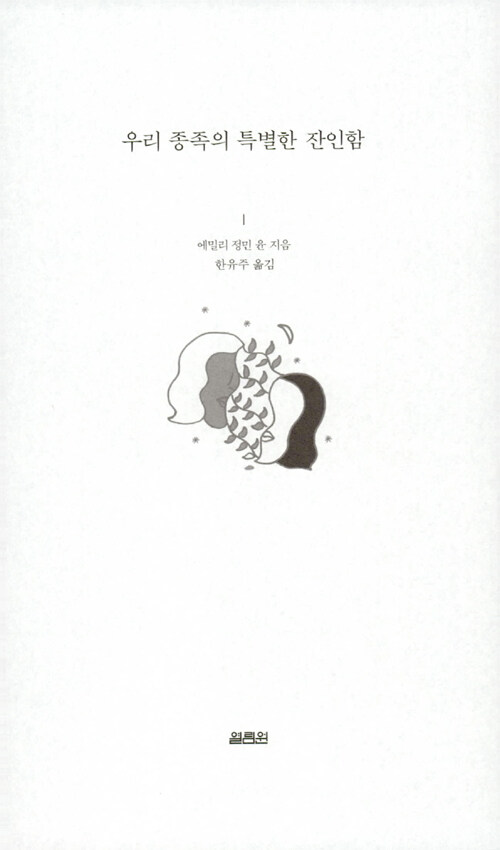
우리 종족의 특별한 잔인함
에밀리 정민 윤 지음, 한유주 옮김/열림원·1만2000원


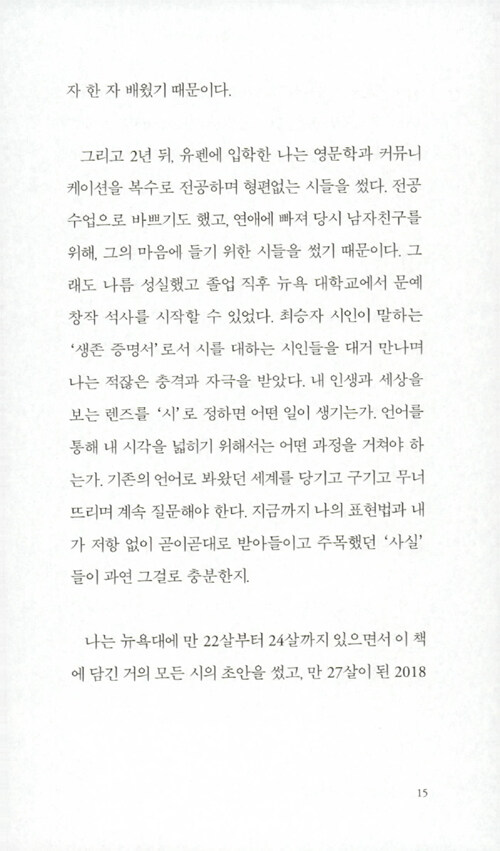
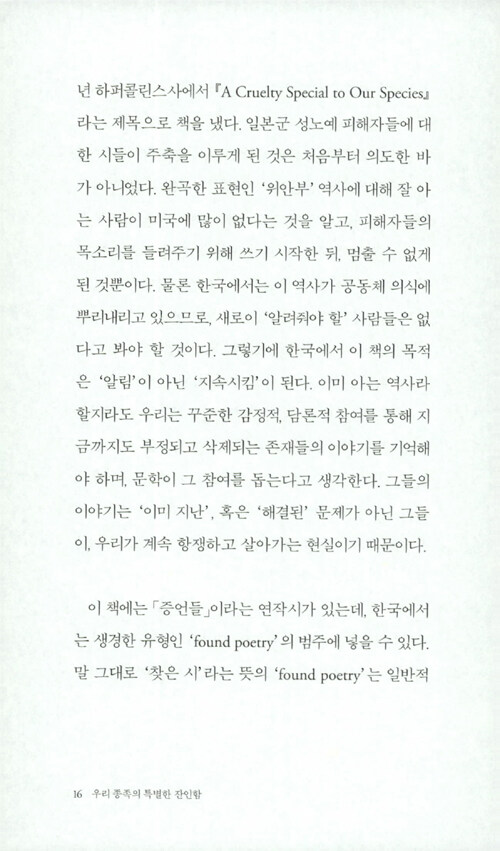
에밀리 정민 윤(사진)은 1991년 한국에서 태어나 2002년 캐나다로 이민을 갔으며 2009년 미국의 대학으로 진학한 뒤 지금까지 미국에서 살고 있다. 그가 2018년에 낸 책 <우리 종족의 특별한 잔인함>은 일본군 ‘위안부’들의 증언을 토대로 한 작품을 중심으로 여성 억압의 역사와 현실을 다룬 시집이다. 시인 자신에 따르면 “‘위안부’ 역사에 대해 잘 아는 사람이 미국에 많이 없다는 것을 알고, 피해자들의 목소리를 들려주기 위해 쓰기 시작한” 시들이다.
“소녀들이 도착했고 아팠고 임신했고 수많은 주사약을/ 맞았고 이름 없는 짐승들이/ 우리를 깔아뭉갠 채 폭발했고/ 해방의 날 갑자기/ 말 울음소리가 들리지 않았고 부엌에선/ 최후의 군인이 네 나라는 해방되었는데/ 내 나라는 불타고 있구나.”(‘증언들: 황금주’ 부분)
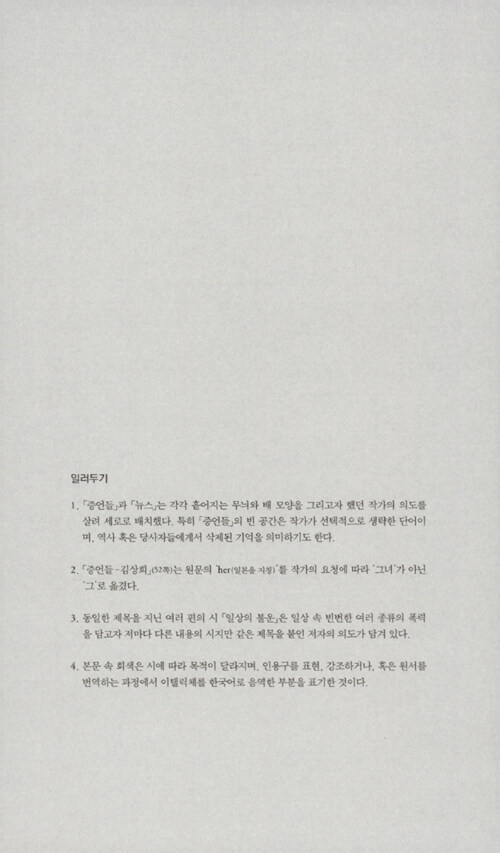
전체 4부로 이루어진 이 시집의 제2부 ‘증언’은 그가 책에서 접한 ‘위안부’ 피해자 일곱 사람의 증언을 재구성한 장시 ‘증언들’로 되어 있다. 원서에서도 그렇고 번역 시집에서도 이 2부는, 세월호를 다룬 시 ‘뉴스’와 함께, 책을 오른쪽으로 90도 돌려서 읽도록 편집되었다. 증언자의 침묵 속에 생략된 무수한 언어들을 상징하는 빈 칸들은 말로 형용할 수 없는 고통의 크기를 보여준다.
한국에서 자랄 때 어린 나이에도 글쓰기를 좋아했고 특히 소설을 많이 썼다는 시인은 영어라는 낯선 언어의 땅에서 적응하느라 의도치 않게 과묵한 사람으로 살았지만, 시를 쓰면서 자유로워졌노라고 밝혔다. 이 시집을 한국어로 옮긴 소설가 한유주와 나눈 질의응답에서 그는 “시에서는 문법, 문장 구조, 단어 선택 등이 자유로운 것이 매력적으로 다가왔다”며 “영어로 글을 쓰면서 (…) 한국어와 더 친밀해지는 느낌을 받는다”고 밝히기도 했다. 실제로 시집에는 한국어 ‘차다’ ‘세월’ ‘갈치’(칼치) 등이 발음대로 표기되기도 하고, ‘쉽게 씌어진 시’라는 작품은 같은 제목을 지닌 윤동주의 시를 패러디한 것이기도 하다.
지난 1일 입국해 자가격리 중인 시인은 13일 낮 영상으로 진행된 기자간담회에서 “‘위안부’ 피해자 분들의 증언을 토대로 시를 쓰는 일은 콜라주라는 미술 기법과 비슷하다고 할 수 있다”며 “시 속의 빈 칸들은 증언자의 떨림과 말 더듬기 그리고 그 증언을 바탕으로 시를 쓴 나의 떨림과 불편함을 나타내려는 장치”라고 설명했다.
최재봉 선임기자 bong@hani.co.kr, 사진 열림원 제공
====
[eBook] 우리 종족의 특별한 잔인함

에밀리 정민 윤 (지은이),한유주 (옮긴이)열림원2021-11-25

원제 : A Cruelty Special to Our Species: Poems












 전자책 미리 읽기
전자책정가
8,400원
판매가
8,400원
쿠폰할인가
7,560원
10% 할인쿠폰 받기
마일리지
420원(5%) + 멤버십(3~1%)
+ 5만원이상 구매시 2,000원
Sales Point : 40
 9.8 100자평(15)리뷰(13)
이 책 어때요?
종이책
10,800원 (+600원)
출판사 제공 북트레일러
출판사 제공 카드리뷰


기본정보
제공 파일 : ePub(21.35 MB)
TTS 여부 : 지원
종이책 페이지수 248쪽, 약 4.2만자, 약 1만 단어
책소개
미국 문단에서 주목받으며 데뷔한 에밀리 정민 윤은 다른 시대, 다른 국가에서 삶을 일궈 왔지만 누구보다도 일본군 '위안부' 피해라는 어두운 역사의 단면에 깊게 파고든 시인이다. 대학 시절 논문을 작성하다 일본군 '위안부'의 역사를 접하게 된 그는 전쟁 범죄의 그늘에서 침묵을 깨기까지 오랜 기간 가시밭길을 걸었던 피해자들의 고통에 깊게 공감하고 그들의 사건을 자신에게 투영시키며 현대 여성들의 아픔 또한 헤아리기에 이르렀다.
그에게 주어진 유전적 트라우마는 그 자신을, 나아가 모든 여성을 돌아보게 만들었다. 일본군 '위안부' 문제에 대해 알리고자 각성한 그는 미국 문단에서 자신에게 상속된 아픔을 공유하는 장을 용기 있게 열었다.
<우리 종족의 특별한 잔인함>은 총 4개의 챕터, 35편의 시로 구성된 시집이다. 미국 문학계에서 주목받고 있는 시인 에밀리 정민 윤이 일본군 '위안부' 문제를 넘어 전 세계 여성들이 마주하고 있는 억압의 일상을 들여다보았다. 책임, 증언, 고백, 그 이후라는 제목과 함께 구성된 총 네 개의 챕터는 과거에 일어난 일련의 일본군 '위안부' 피해 사건들부터 시작해 현대에 벌어지고 있는 성차별, 성폭력에 관한 여성들의 이야기로 이어진다.
그는 일본군 '위안부'에 대한 어두운 과거를 그로테스크한 시적 표현을 더해 그려내기도 하고, 전쟁 중에 일어난 말도 안 되는 집단적인 광기를 거부한 일본군 남자의 시선으로 바라보며 관점의 전환을 주기도 한다. 나아가 북한과 남한의 관계에 대해 무지하거나, 2차 세계대전을 미국의 입장에서 바라보는 이들에게 이민자 여성으로서 새로운 관점을 제시해준다.
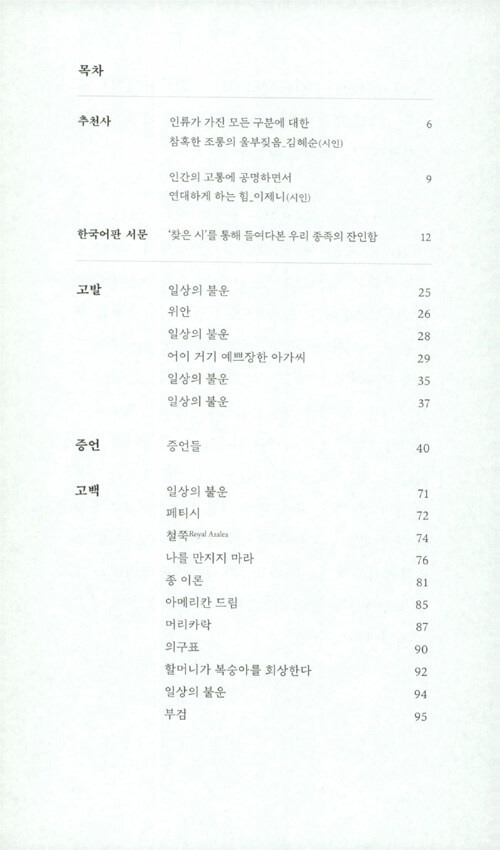
목차
추천사
인류가 가진 모든 구분에 대한 참혹한 조롱의 울부짖음
- 김혜순(시인)
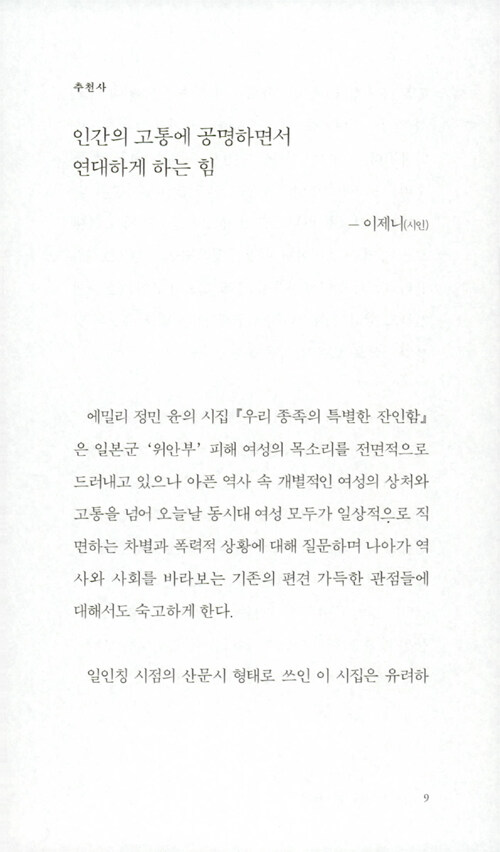
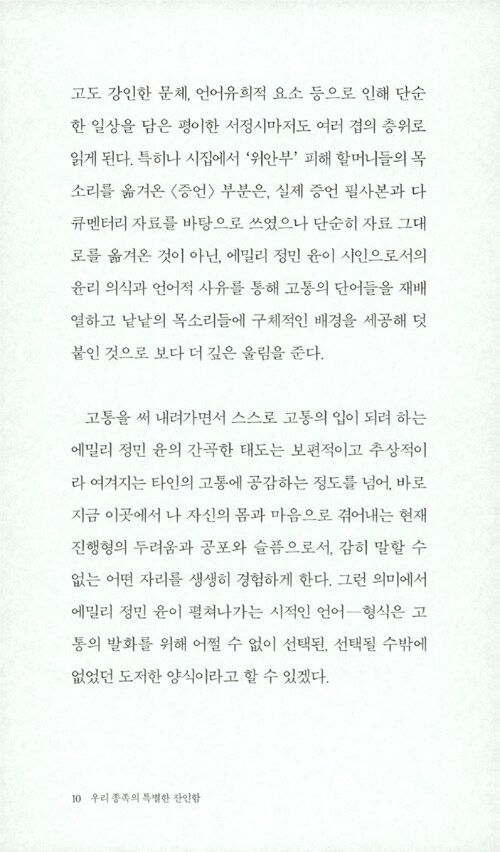
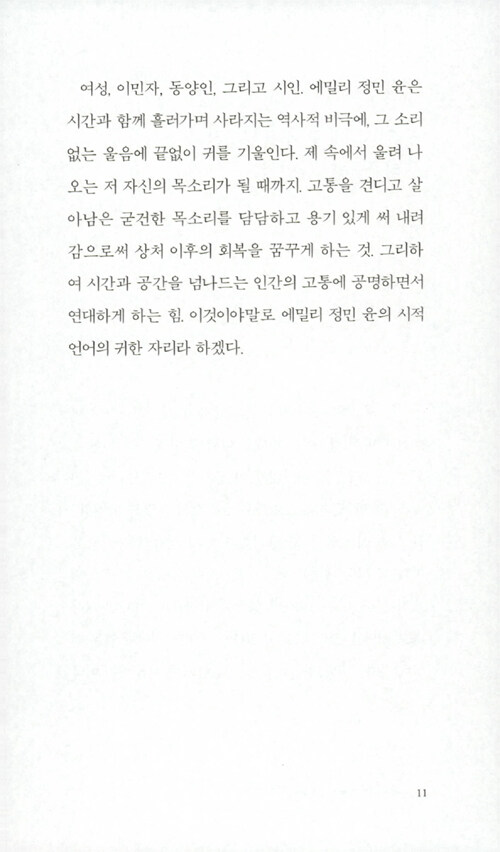
인간의 고통에 공명하면서 연대하게 하는 힘
- 이제니(시인)
한국어판 서문
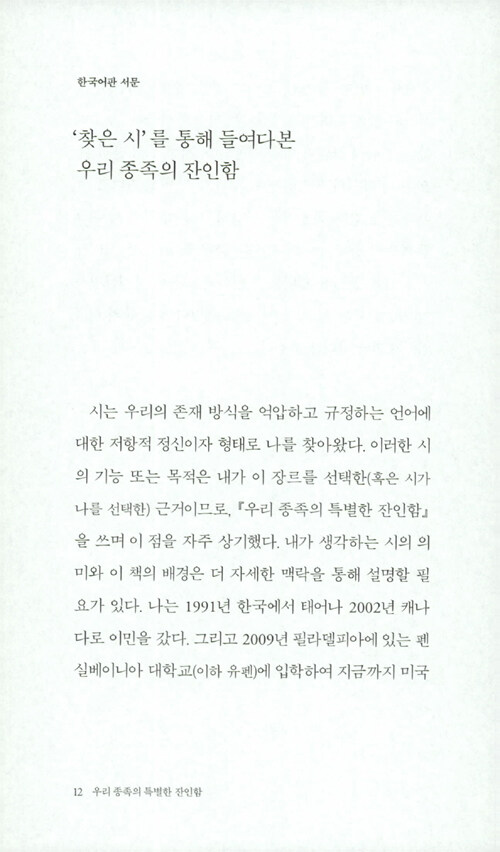
‘찾은 시’를 통해 들여다본 우리 종족의 잔인함
고발
일상의 불운
위안
일상의 불운
어이 거기 예쁘장한 아가씨
일상의 불운
일상의 불운
증언
증언들
고백
일상의 불운
페티시
철쭉
나를 만지지 마라
종 이론
아메리칸 드림
머리카락
의구표
할머니가 복숭아를 회상한다
보통의 불운
부검
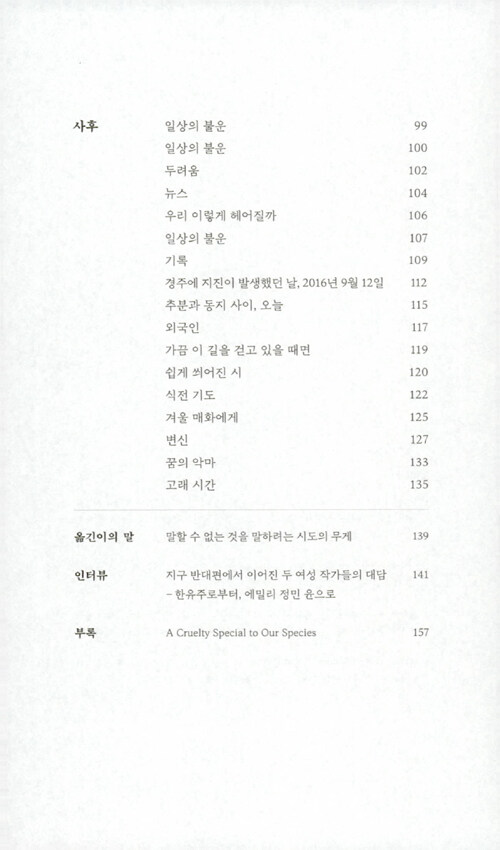
사후
일상의 불운
일상의 불운
두려움
뉴스
우리 이렇게 헤어질까
일상의 불운
기록
경주에 지진이 발생했던 날, 2016년 9월 12일
추분과 동지 사이, 오늘
가끔 이 길을 걷고 있을 때면
외국인
쉽게 씌어진 시
식전 기도
겨울 매화에게
변신
꿈의 악마
고래 시간
인터뷰
지구 반대편에서 이어진 두 여성 작가들의 대담
- 한유주로부터, 에밀리 정민 윤으로
접기
책속에서
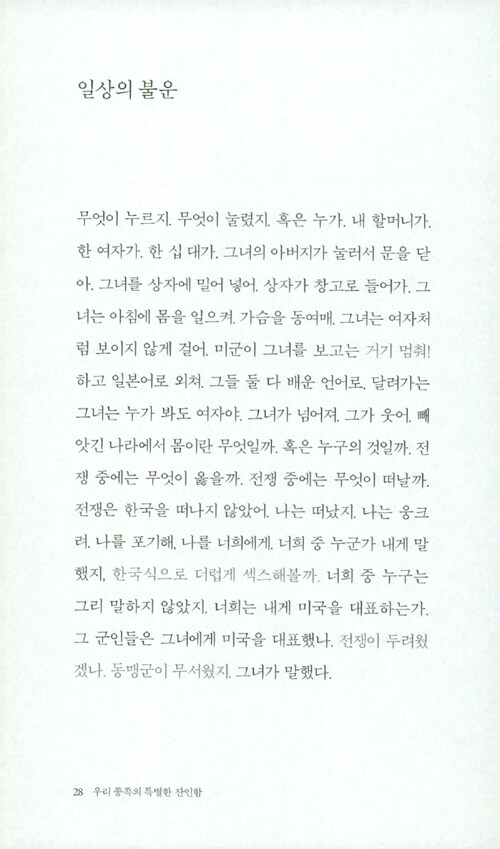
빼앗긴 나라에서 몸이란 무엇일까. 혹은 누구의 것일까. 전쟁 중에는 무엇이 옳을까. 전쟁 중에는 무엇이 떠날까. 전쟁은 한국을 떠나지 않았어. 나는 떠났지. 나는 웅크려. 나를 포기해, 나를 너희에게. 너희 중 누군가 내게 말했지, 한국식으로 더럽게 섹스해볼까. 너희 중 누구는 그리 말하지 않았지. 너희는 내게 미국을 대표하는가.... 더보기
나는 열네 살에서 열아홉 살이 될 때까지 위안부였고
나는 열이 났고 나는 불임이 되었고
나는 내 죽은 남편의 아이들을 기억한다
나는 괜찮았던 끼니를 기억한다 나는 혼자다
나는 합천 집에서 이방인처럼 보였다 살갗이 거무스름해져 있었지
내 어머니는 당신이 꿈꾸고 있다고 생각하셨지
<... 더보기
하얼빈의 개울가에서
산 채로 매장된
아팠던 소녀의 손을 보았다.
내 꿈속에서 그 애는 아직도
더 넓은 물을 향해 나아가고 있어.
- 「증언들」 부분
내 남편은 어디선가 연인들을 찾았지. 나는 어디선가 내 딸들을 찾았어. 나는 아무도 점거하지 않은 집을 갈망하며 그들을 사랑해. 그들은 가끔 갈라진 벽 틈에 손을 집어넣고 말하지, 왜 그래? 왜 그래요? 문이란 문은 죄다 닫혔다. 칠십 년 그리고 아무도 모른다. 아무도 내 과거가 살아 있다는 걸 몰라. 위안소의 소녀들, 그때 우리... 더보기
당신과 나의, 사냥과
짐승 되기의 역사가 있습니다. 그렇지 않다면,
우리는 여기서 무엇을 하고 있나요, 내 죽은 몸을
가늠하며, 민들레를 뽑자마자
죽을 것이라는 걸 알아버린 아이 같은
바보처럼 스스로의
두 손을 들여다보는 당신과
나의 죽은 몸은.
- 「부검」 부분 접기
더보기
저자 및 역자소개
에밀리 정민 윤 (Emily Jungmin Yoon) (지은이)
저자파일
신간알리미 신청

미국 거주 한국계 이민자이자 여성 시인. 펜실베이니아 대학교에서 영문학과 커뮤니케이션을 전공했고, 뉴욕 대학교에서 문예창작 석사 학위를 취득했다. 대표작으로 2017년 ‘뜨락 정원 소책자 시문학상(Sunken Garden Chapbook Poetry Prize)’을 수상한 「일상의 불운(Ordinary Misfortunes)」이 있다. 전 세계 여성들의 아픔을 헤아린 깊이 있는 작품들로 미국 문단의 호평을 받으며 역사에 희생된 자들의 고백에 생기를 불어다 주고 저항과 회복의 몸짓이 지닌 강렬한 힘에 관해 이야기한다.
최근작 : <에픽 #04>,<우리 종족의 특별한 잔인함> … 총 9종 (모두보기)
SNS : //twitter.com/emilyyoon
한유주 (옮긴이)
저자파일
신간알리미 신청

1982년 서울에서 태어나, 2003년 『문학과사회』를 통해 등단했다. 소설집 『달로』 『얼음의 책』 『나의 왼손은 왕, 오른손은 왕의 필경사』 『연대기』와 장편소설 『불가능한 동화』를 펴냈으며, 한국일보문학상과 김현문학패 등을 수상했다.
한유주 작가가 펴낸 책들
소설집 『달로』, 문학과지성사, 2006.
『얼음의 책』, 문학과지성사, 2009.
『나의 왼손은 왕, 오른손은 왕의 필경사』, 문학과지성사, 2011.
『연대기』, 문학과지성사, 2019.
『숨』
장편 『불가능한 동화』, 문학과지성사, 2013.
단편선 『끓인 콩의 도시에서』, 미메시스, 2018.
접기
최근작 : <[큰글자도서] 엄마에 대하여>,<우리가 세계에 기입될 때>,<엄마에 대하여> … 총 78종 (모두보기)
출판사 제공 책소개
김혜순 시인, 이제니 시인 추천! 한유주 소설가 번역!
이민자 여성 시인, 에밀리 정민 윤이 마주한
과거의 아픔과 일상의 불행
나는 여태까지도 우리의 복잡하고 잔인한 인간성과 세상 속에서
사랑을 하고 그것을 시를 통해 노래한다
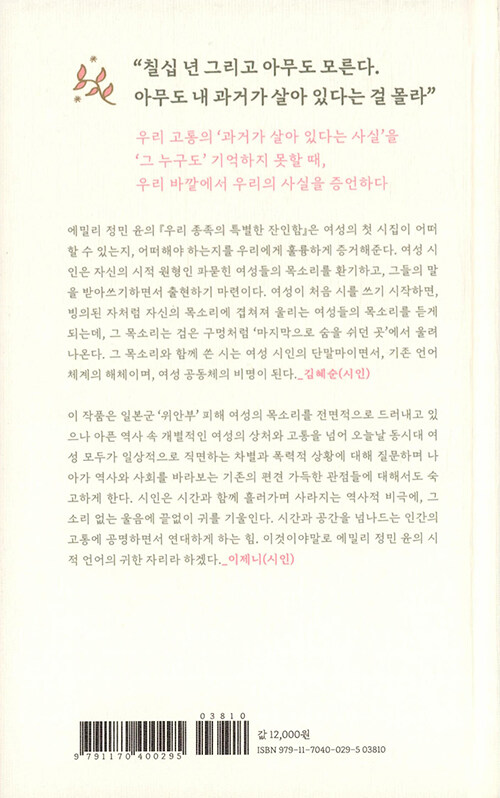
‘그 누구도’ 우리 고통의 ‘과거가 살아 있다는 사실’을 기억하지 못할 때,
오히려 우리의 바깥에서 우리에게 그 시간이 살아 있음을 증언하는 것이
이 시집에는 존재한다._김혜순(시인)
에밀리 정민 윤은 한국인, 이민자, 여성 그리고 시인이다. 그는 다른 시대, 다른 국가에서 삶을 일구었지만, 누구보다도 일본군 ‘위안부’ 피해라는 어두운 역사의 단면에 깊게 파고든 시인이다. 피해자들의 고통에 깊게 공감한 그는 그들의 사건을 자신에게 투영시키며 현대 여성들의 아픔 또한 헤아리기에 이르렀다. 『우리 종족의 특별한 잔인함』은 총 4개의 챕터, 35편의 시로 구성된 시집이다. ‘고발, 증언, 고백, 사후’라는 제목으로 나누어진 총 네 개의 챕터는 과거 일본군 ‘위안부’ 피해 사건부터 시작해 현대 여성들이 겪는 일상적 폭력에 관한 이야기로까지 이어진다.
과거로부터 울려 퍼져
현재를 관통하는 목소리들의 집합
“고통의 단어들로 재배열된 낱낱의 목소리”
일인칭 시점의 산문시들은 언어유희 같은 실험성을 가미하며 형식을 자유롭게 확장해나가는 개성을 보인다. 시집 후반에는 무거운 주제에서 벗어나 평범한 형식의 서정시를 싣기도 했지만, 그 속에서도 독특한 시어들이 보여주는 사유가 마냥 예사롭지는 않다. 특히나 ‘증언’ 챕터는 독자로 하여 피해자들의 고통을 절감하게 만드는 대목이다.
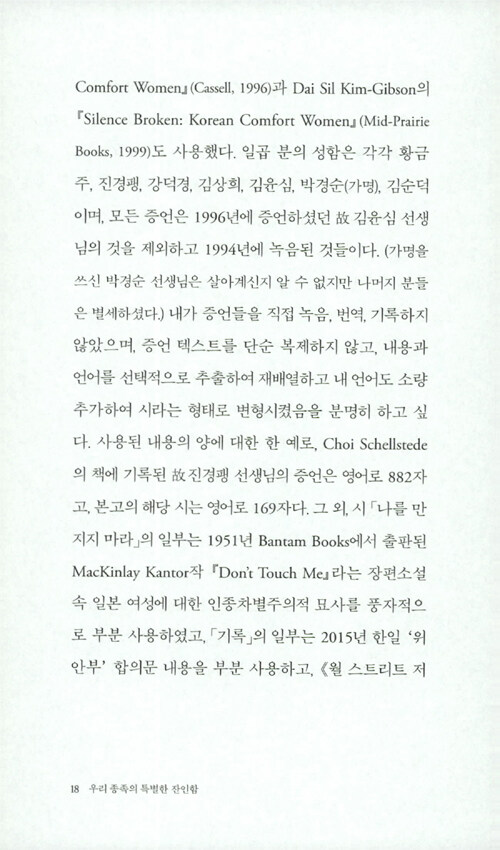
증언 시는 일본군 ‘위안부’ 피해자 할머니들의 실제 증언 필사본과 다큐멘터리 자료를 바탕으로 쓰였지만, 이것이 자료 그대로를 시에 옮겨놓았다는 뜻은 아니다. 에밀리 정민 윤은 시인으로서의 책임감과 윤리의식을 발휘하여 피해자들의 이야기를 더욱 사실적으로 전달하고자 했다. 시인의 치밀한 의도 아래 재배열된 단어들은 계산된 여백이나 꾸밈새 없이 담담한 형식을 취하면서 동시에 그들의 목소리에 입체감을 부여한다. 그 결과, 독자들은 나와 타인의 경계를 넘어 피해 당사자들의 고통을 받아들이게 되고 비로소 타인이 경험한 역사적 사건을 나의 현재로까지 호출해내기에 이른다.
과거지만 과거만은 아닌, 현재지만 현재만은 아닌
우리에게는 이런 이야기들이 필요하다
에밀리 정민 윤은 단순히 일본군 ‘위안부’ 피해 사건을 조명하는 것에서 나아가 역사에서 비롯된 상흔들을 토대로 현대 사회의 내면에 숨겨져 있는 차별 그리고 편견까지 추적해나간다. 시인의 대표작 「일상의 불운」을 포함한 여러 작품은 매일의 폭력으로부터 살아남은 현대 여성들의 초상을 사실적으로 그려내고 있다.
폭력의 잔재는 한국전쟁 이후의 삶을 살아온 사람들의 입에서도, 바에서 만난 외국인 남성의 시선에서도, 성관계를 일방적으로 요구하는 상대방의 표정에서도 온전히 드러난다. 시인은 이민자 여성으로서의 개인적 경험까지 작품 속에 드러냄으로써 여성들이 저마다의 아픔을 기꺼이 공유할 수 있는 소통의 장을 열어 보이고자 하였다. 여성의 삶을 잠식시켜온 길고 긴 폭력의 굴레가 그 민낯을 드러낼 때 우리는 아직 어딘가 파묻혀 있을 여성들의 목소리를 떠올리며 우리 사회에 대해 깊이 묵상하게 된다.
시인은 이번 시집을 통해 독자들이 역사 속 목소리를 대면하고 이해할 수 있기를 바랐다. 실제로 겪은 적 없는 고통을 실제처럼 마주하는 일, 피해자들의 고통에 공감하고 연대하는 일, 자신 안에 부당한 억압을 벗어날 수 있는 또 다른 힘을 만들어나가는 일 등을 해나가길 바랐다. 그것이야말로 여성들이 지닐 수 있는 가장 강력한 힘이자 연대라고 생각한 것이다. “모든 시가 해결책이라기보다는 질문이라고 믿는다”는 작가의 말처럼 우리는 끝없이 화두를 던지고 질문하고 대화해야 한다. 명백한 폭력의 역사가 흐지부지 달아나지 않도록. 지금 우리에게는 이런 이야기들이 필요하다. 접기
북플 bookple
이 책의 마니아가 남긴 글
친구가 남긴 글
내가 남긴 글
친구가 남긴 글이 아직 없습니다.
마니아
읽고 싶어요 (14)
읽고 있어요 (5)
읽었어요 (31)
이 책 어때요?
평점
분포

9.8


88.5%

11.5%
0%
0%
0%
100자평

등록
카테고리
 스포일러 포함
글 작성 유의사항
구매자 (14)
전체 (15)
공감순
의미 있는 책이 펀딩을 통해 세상에 나오게 되어 기쁩니다.

jude 2020-08-13 공감 (4) 댓글 (0)
Thanks to
공감
가장 작은 동심원은 일본군 성노예로 피해를 입은 할머니들의 증언을 인용한 시다.(‘증언들‘). 시인은 할머니들의 증언을 자신만의 방식으로 인용, 재가공했다는 점에서 ‘증언들의 증언‘이라 하겠다. 이 동심원 바깥에는 ‘일상의 불운‘이라는 제목을 단 여러 편의 시가 그 자리를 차지한다.
사춘기의배꼽 2020-08-28 공감 (2) 댓글 (0)
Thanks to
공감
이 펀딩에 참여하게 되어 영광입니다. 늘 여성문제에 관심 갖고 있는 제게 특별히 의미 있는 “투자”였습니다. 잘 읽겠습니다.
허풍쟁이앤 2020-08-17 공감 (2) 댓글 (0)
Thanks to
공감
그동안 너무 아플까봐 들여다보지 못했었는데 위안부 증언을 시끄럽지 않은 투로 아름답게 쓴 이 시집이 너무소중해졌어요. 제가 아는 모든 이들에게 선물하고 싶습니다.
dayeong23 2020-08-20 공감 (2) 댓글 (0)
Thanks to
공감
솔직하고 여과없는, 때때로 묵묵한 목소리가 더해져 묵직하고 아픈 시가 완성됐네요. 떨리는 손을 부여잡고 한 자 한 자 고이 삼키고 있습니다. 멋진 시집 출간해주셔서 감사합니다.
독서의 흔적 2020-08-21 공감 (1) 댓글 (0)
Thanks to
공감
더보기
마이리뷰
구매자 (3)
전체 (13)
리뷰쓰기
공감순
[마이리뷰] 우리 종족의 특별한 잔인함
또 한분의 위안부 피해자 할머니께서 상처를 고스란히 안고 돌아가셨다. 뉴스를 접하고 시집의 목차가 다시 눈에 띄었다. 고발, 증언, 고백, 사후...... 역사를 잊은 이들에게 미래는 없다는 말처럼 힘들어도 작가님의 말처럼 ‘지속시킴‘이어야하는 역사가 있다. 나 또한 마주하기 힘든이야기 하지만 마주해야하는 과거가 아닌 현실이다. 에밀리 정민 윤 작가의 ‘우리 종족의 특별한 잔인함‘에서는 위안부, 세월호, 죽어가는 고래 이야기가 나온다. ‘해결된 문제가 아닌 우리가 계속 항쟁하고 살아가는 현실‘이야기들이다. 그래서 이 책은 꼭 누구든... + 더보기
dadokdadok 2020-08-31 공감(8) 댓글(0)
Thanks to
공감
우리 종족의 특별한 잔인함
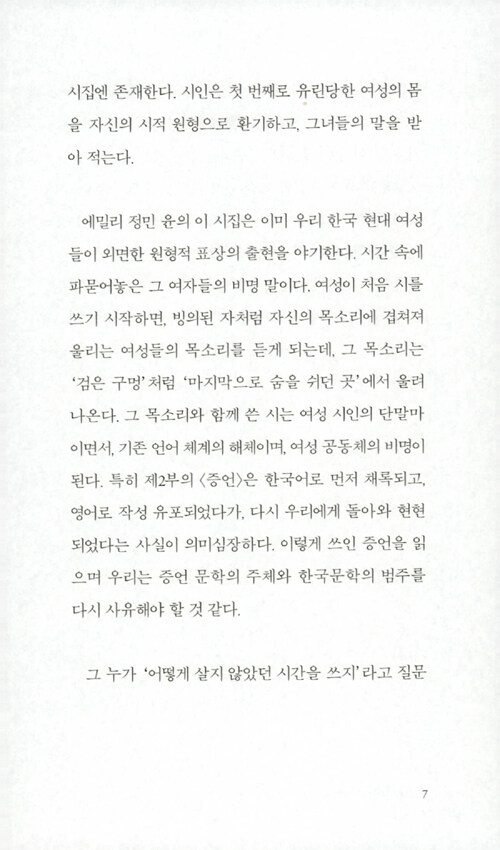
여성이 처음 시를 쓰기 시작하면, 빙의된 자처럼 자신의 목소리에 겹쳐져 울리는 여성들의 목소리를 듣게 되는데,그 목소리는 '검은 구멍'처럼 '마지막으로 숨을 쉬던 곳'에서 울려 나온다.그 목소리와 함께 쓴 시는 여성 시인의 단말마이면서,기존 언어 체계의 해체이며, 여성 공동체의 비명이 된다. (-7-)
일상의 불움ㄴ.그녀는 자갈.그녀가 잡혔다.그녀가 자갈 한 줌처럼 잡혔다.물에 갈린 자갈.그녀의 마을은 온통 자갈밭이다. 1950년이다.그녀는 소녀, 그녀가 잡혔다.나의 할머니도 소녀이지만, 잡힌 그녀가 할머니는 아니다. 할머니의 아버지가 뭄능 닫는다.미군들에 맞서지만, 그들이 돌담들을 뛰어넘는다.내 할머니가 아닌 소녀를 향해.그 소녀는 잡힌 자갈이다.그녀의 언어는 아무것도 의미하지 않기에 자갈이다.소녀 한 줌,땅이 자갈 투성이다. 한국은 자갈이고 무덤이다.소녀는 소녀이고 할머니가 되는 일은 없을 것이다.그녀는 소녀일 것이다.소녀는 자갈이고 역사는 물 위로 던져진 돌멩이처럼 그녀를 건너뛸 것이다. 오 소녀여.오 영광이여,소녀여. (-37-)
두려움
내게서 두려움을 도려내고..
역사의 절벽들로 측면을 두른
피오르드가 되고 싶었다.어떻게 해야
내가 살지 않은
시간들을 쓸 수 있을까.나는 두려움이
비워지고 삶으로 충만한
장소를 원했어.
맥스 데스퍼의
흑백사진들처럼
나는 어떤 감정을 느껴야 할 지 모르겠어
그의 한국전쟁 사진들 앞에서
그에게 퓰리처상을 안겨준 사진에는
파괴된 다리를 기어오르는 난민들이 있어
한데 나를 멈추게 한 사진은-
안 쌍의 손
눈을 뚫고 손은 거무스름한 손가락들
그 앞에 구멍이 있었고
내 뒤의 화면에서 데스퍼가 말하길,
남자의 손은 묶여 있었고.그는 저 검은 구멍으로
마지막 숨을 쉬었습니다.
저 검은 구멍, 손가락들의
저 구체, 저 대양의 팔, 나의
저 피오르드.내가 텅 비었다고
믿어왔던 것을 쥐고,목소리,두려운 해류.그 밑에,
물의,
빛의 몸들.(-103-)
시대적인 통찰을 시적으로 아우르고 있었다.이 시집은 이민자의 신분으로 20대에 쓰여진 시로서,위안부 여성들의 아픔을 시적으로 표현하고 있었다.원하지 않았지만, 강요되어야 하는 시대적인 표상을 뛰어넘어서서, 좌절감과 굴욕감 속에서 생존을 위해 몸을 바쳐야 했던 그 순간들 속에서 자신의 자좀감은 반드시 무너지고야 말았다.스스로 살아있는 생명체인것이 부끄러웠다.차라리 자갈이었으면, 움켜지더라도 수치심은 느끼지 않았을 것이다. 깍이더라도,깍아내리더라도, 슬퍼하지 않았을 것이다.살아가기 위해서 모든 것을 다 내려 놓아야 했던 그 지난날들이 그에게는 그것이 아픔이었다.목소리가 들리지 않았고, 후각조차 내비칠 수 없었던 그 밀폐된 공간안에서 두려움과 공포감 속에서 극환의 시간에 침전하게 된다.살아간다는 것,생과 사의 절벽에서 ,한 걸음만 내디디면 죽음으로 인어지게 된다.분명히 죽을 수 있다는 것을 알면서도 기어올라야 했던 그 순간들,누군가는 그 순간들을 사진으로 남겨 놓게 되었고,후대의 사람들은 그 사진 으로 그시대의 사회적인 맥락과 심경, 악에 바친 삼켜야 했던 목소리를 감지하게 된다.눈은 많은 것을 담아내고 있었다.어디를 보느냐에 따라서, 누군가를 보느냐에 따라서, 많은 의미와 가치들을 들추고 있었다.그것을 저자는 시적인 감각과 시대적인 배경을 씨줄과 날줄처럼 엮어내고 있었으며, 위안부 소녀의 마음에 자신의 마음을 빙의하게 된다.자신의 목소리를 통해서 처젏함을 드러내었고, 시적인 감각 속에서 ,자신이 겪지 못했던 것들을 꺼내고 또 꺼내어야 했다.살아간다는 것, 누추한 삶이 반복되었어도,살아있다는 것이 너무나 감사 하다는 것을 한편의 시를 읽으면서,시인의 마음을 읽어나가게 되었다.
- 접기
깐도리 2020-08-27 공감(7) 댓글(0)
Thanks to
공감
[마이리뷰] 우리 종족의 특별한 잔인함
나는 열이 났고 나는 불임이 되었고 나는 내 죽은 남편의아이들을 기억한다. p47 읽는내내 아프고 시렸다. 이 분들을 위해 할 수 있는 건 기도밖에 없었다.여기서의 기도는 종교를 떠나서 드리는 간절한 기도,동족을 위한,여성을 위한,전쟁 피해자를 위한 영적이고 욕망이 배제된 기도다. OM shanti🙏🏻🙏🏻🙏🏻
글월마야 2020-09-27 공감(7) 댓글(0)
Thanks to
공감
증언들의 무한한 파문(에밀리 정민 윤 시집, 우리 종족의 특별한 잔인함, 열림원)
○ 에밀리 정민 윤 시집, 우리 종족의 특별한 잔인함, 열림원, 2020
이 시집의 맨 안쪽 동심원은 일본군 성노예로 피해를 입은 할머니들의 증언을 인용한 시다(‘증언들’). 시인은 할머니들의 피해 증언을 자신만의 시각으로 인용, 재가공해서 ‘증언들의 증언’을 한다. 이 동심원의 바깥에는 ‘일상의 불운’이라는 제목을 단 여러 편의 시가 있다. 일상적인 폭력과 불안에 대한 저항과 불안이 짙게 배인 또다른 증언들. 그리고 ‘우리 종족의 특별한 잔인함’이라는 시구는 이 문구가 포함된 시 보다는 이 시집의 맨 마지막에 자리 잡은 ‘고래 시간’에 더 잘 어울린다는 생각을 했다. 미래의 인류에 대한 묵시론적 경고 같은 ‘오래된 증언’. 증언의 말들은 쏟아지는 비처럼 호수에 내리고, 그 파문은 무한히 확장되고 있다.
- 위안 26-27쪽
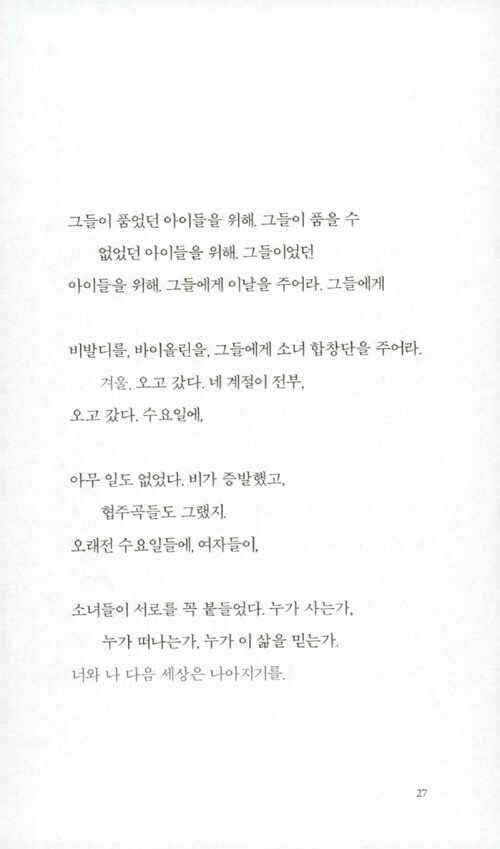
수요일에, 나는 플레인 요거트를 먹었다. / 공책을 펼쳤다. 빨래를 개는 동안/ 비발디.// 그의 생일이었다. 수요일에,/ 비가 내렸다. 다육식물들 위로,/ 살아남은 여자들 위로.// 속거나 납치당해서, 일본군에게 끌려갔다./ 콘돔에 적혀 있는 건, 돌격 1번./ 헹궈서 재사용. 수요일마다,// (···)// 그들이 품었던 아이들을 위해. 그들이 품을 수/ 없었던 아이들을 위해./ 그들이었던/ 아이들을 위해. 그들에게 이날을 주어라. 그들에게// (···)
- 종 이론
오래전, 1923년 일본에서는, 주고엔 고짓센이라는 말이 한국인들을/ 구별하는 데 사용되었다. 15엔 50센 발음해봐. 관동 대지진의 혼란을 틈타 식민지 사람들이 물에 독을 풀고 불을 질렀다고: 우리 종족의 특별한/ 잔인함/ 84쪽
- 접기
사춘기의배꼽 2020-08-28 공감(4) 댓글(0)
Thanks to
공감
한국 여성으로 태어났다
시인은 젊다. 10살 때 캐나다로 이민갔고 학교는 유펜을 졸업했다.
영어가 모국어가 아니어서 언어에 대해 더 민감하다. 그리고 시를 알게 되면서 해방감을 느꼈다고 한다.
시는 언어를 파괴하고 창의적으로 언어를 변형해도 괜찮기 때문이다.
시인은 아시아 여성으로 유해한 남성성, 군국주의, 제국주의, 전쟁, 인종차별, 언어에 의한 고통을 주제로 다루고 있다. (19쪽)
물론 이 책은 일본군 성노예 피해자들의 이야기가 핵심이다. 하지만 세월호 사건, 경주 지진 등도 담고 있다.
영어와 한국어 번역 둘 다 수록되어 있어서 비교가 가능해서 좋았다.
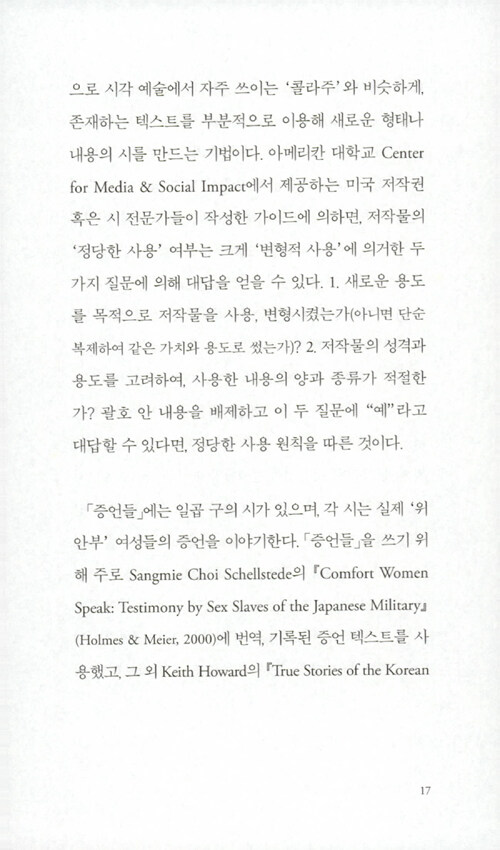
'증언들'이라는 연작시가 있는데 한국에서는 조금 생소한 'found poetry'다. 시각 예술에서 자주 쓰이는 '콜라주'와 비슷하다. 그래서 시 자체가 한 폭의 그림 같다. 여백도 시에서 매우 중요하다. 그래서 번역도 여백의 미를 살렸다고 한다.
위안부 할머니들의 증언을 할머니들의 언어로 재구성한 점이 새롭다. 그래서 더 울림이 크다.
황금주, 진경팽, 강덕경, 김상희, 김윤심, 박경순(가명), 김순덕 7명의 증언이다. 모두 1994년에 녹음되었다. (한 명 빼고)
시를 읽으면서 더 끔찍하고 가슴이 아팠다.
위안부 문제를 여전히 부정하는 아베 정권과 제국주의 세력들이 한심할 따름이다.
이렇게 영어로 위안부 문제를 다루는 시가 나와서 정말 감사하다.

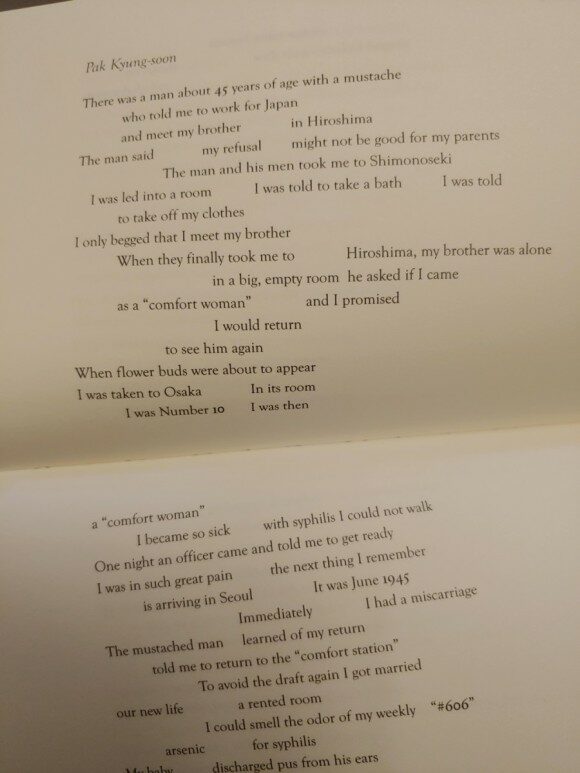
많은 사람들이 이 시를 읽고 공감하길 바란다.
======
전자책 미리 읽기전자책정가
8,400원
판매가
8,400원
쿠폰할인가
7,560원
10% 할인쿠폰 받기
마일리지
420원(5%) + 멤버십(3~1%)
+ 5만원이상 구매시 2,000원
Sales Point : 40
9.8 100자평(15)리뷰(13)이 책 어때요?
종이책
10,800원 (+600원)
출판사 제공 북트레일러
출판사 제공 카드리뷰
기본정보
제공 파일 : ePub(21.35 MB)
TTS 여부 : 지원
종이책 페이지수 248쪽, 약 4.2만자, 약 1만 단어
책소개
미국 문단에서 주목받으며 데뷔한 에밀리 정민 윤은 다른 시대, 다른 국가에서 삶을 일궈 왔지만 누구보다도 일본군 '위안부' 피해라는 어두운 역사의 단면에 깊게 파고든 시인이다. 대학 시절 논문을 작성하다 일본군 '위안부'의 역사를 접하게 된 그는 전쟁 범죄의 그늘에서 침묵을 깨기까지 오랜 기간 가시밭길을 걸었던 피해자들의 고통에 깊게 공감하고 그들의 사건을 자신에게 투영시키며 현대 여성들의 아픔 또한 헤아리기에 이르렀다.
그에게 주어진 유전적 트라우마는 그 자신을, 나아가 모든 여성을 돌아보게 만들었다. 일본군 '위안부' 문제에 대해 알리고자 각성한 그는 미국 문단에서 자신에게 상속된 아픔을 공유하는 장을 용기 있게 열었다.
<우리 종족의 특별한 잔인함>은 총 4개의 챕터, 35편의 시로 구성된 시집이다. 미국 문학계에서 주목받고 있는 시인 에밀리 정민 윤이 일본군 '위안부' 문제를 넘어 전 세계 여성들이 마주하고 있는 억압의 일상을 들여다보았다. 책임, 증언, 고백, 그 이후라는 제목과 함께 구성된 총 네 개의 챕터는 과거에 일어난 일련의 일본군 '위안부' 피해 사건들부터 시작해 현대에 벌어지고 있는 성차별, 성폭력에 관한 여성들의 이야기로 이어진다.
그는 일본군 '위안부'에 대한 어두운 과거를 그로테스크한 시적 표현을 더해 그려내기도 하고, 전쟁 중에 일어난 말도 안 되는 집단적인 광기를 거부한 일본군 남자의 시선으로 바라보며 관점의 전환을 주기도 한다. 나아가 북한과 남한의 관계에 대해 무지하거나, 2차 세계대전을 미국의 입장에서 바라보는 이들에게 이민자 여성으로서 새로운 관점을 제시해준다.
목차
추천사
인류가 가진 모든 구분에 대한 참혹한 조롱의 울부짖음
- 김혜순(시인)
인간의 고통에 공명하면서 연대하게 하는 힘
- 이제니(시인)
한국어판 서문
‘찾은 시’를 통해 들여다본 우리 종족의 잔인함
고발
일상의 불운
위안
일상의 불운
어이 거기 예쁘장한 아가씨
일상의 불운
일상의 불운
증언
증언들
고백
일상의 불운
페티시
철쭉
나를 만지지 마라
종 이론
아메리칸 드림
머리카락
의구표
할머니가 복숭아를 회상한다
보통의 불운
부검
사후
일상의 불운
일상의 불운
두려움
뉴스
우리 이렇게 헤어질까
일상의 불운
기록
경주에 지진이 발생했던 날, 2016년 9월 12일
추분과 동지 사이, 오늘
가끔 이 길을 걷고 있을 때면
외국인
쉽게 씌어진 시
식전 기도
겨울 매화에게
변신
꿈의 악마
고래 시간
인터뷰
지구 반대편에서 이어진 두 여성 작가들의 대담
- 한유주로부터, 에밀리 정민 윤으로
접기
책속에서
빼앗긴 나라에서 몸이란 무엇일까. 혹은 누구의 것일까. 전쟁 중에는 무엇이 옳을까. 전쟁 중에는 무엇이 떠날까. 전쟁은 한국을 떠나지 않았어. 나는 떠났지. 나는 웅크려. 나를 포기해, 나를 너희에게. 너희 중 누군가 내게 말했지, 한국식으로 더럽게 섹스해볼까. 너희 중 누구는 그리 말하지 않았지. 너희는 내게 미국을 대표하는가.... 더보기
나는 열네 살에서 열아홉 살이 될 때까지 위안부였고
나는 열이 났고 나는 불임이 되었고
나는 내 죽은 남편의 아이들을 기억한다
나는 괜찮았던 끼니를 기억한다 나는 혼자다
나는 합천 집에서 이방인처럼 보였다 살갗이 거무스름해져 있었지
내 어머니는 당신이 꿈꾸고 있다고 생각하셨지
<... 더보기
하얼빈의 개울가에서
산 채로 매장된
아팠던 소녀의 손을 보았다.
내 꿈속에서 그 애는 아직도
더 넓은 물을 향해 나아가고 있어.
- 「증언들」 부분
내 남편은 어디선가 연인들을 찾았지. 나는 어디선가 내 딸들을 찾았어. 나는 아무도 점거하지 않은 집을 갈망하며 그들을 사랑해. 그들은 가끔 갈라진 벽 틈에 손을 집어넣고 말하지, 왜 그래? 왜 그래요? 문이란 문은 죄다 닫혔다. 칠십 년 그리고 아무도 모른다. 아무도 내 과거가 살아 있다는 걸 몰라. 위안소의 소녀들, 그때 우리... 더보기
당신과 나의, 사냥과
짐승 되기의 역사가 있습니다. 그렇지 않다면,
우리는 여기서 무엇을 하고 있나요, 내 죽은 몸을
가늠하며, 민들레를 뽑자마자
죽을 것이라는 걸 알아버린 아이 같은
바보처럼 스스로의
두 손을 들여다보는 당신과
나의 죽은 몸은.
- 「부검」 부분 접기
더보기
저자 및 역자소개
에밀리 정민 윤 (Emily Jungmin Yoon) (지은이)
저자파일
신간알리미 신청
미국 거주 한국계 이민자이자 여성 시인. 펜실베이니아 대학교에서 영문학과 커뮤니케이션을 전공했고, 뉴욕 대학교에서 문예창작 석사 학위를 취득했다. 대표작으로 2017년 ‘뜨락 정원 소책자 시문학상(Sunken Garden Chapbook Poetry Prize)’을 수상한 「일상의 불운(Ordinary Misfortunes)」이 있다. 전 세계 여성들의 아픔을 헤아린 깊이 있는 작품들로 미국 문단의 호평을 받으며 역사에 희생된 자들의 고백에 생기를 불어다 주고 저항과 회복의 몸짓이 지닌 강렬한 힘에 관해 이야기한다.
최근작 : <에픽 #04>,<우리 종족의 특별한 잔인함> … 총 9종 (모두보기)
SNS : //twitter.com/emilyyoon
한유주 (옮긴이)
저자파일
신간알리미 신청
1982년 서울에서 태어나, 2003년 『문학과사회』를 통해 등단했다. 소설집 『달로』 『얼음의 책』 『나의 왼손은 왕, 오른손은 왕의 필경사』 『연대기』와 장편소설 『불가능한 동화』를 펴냈으며, 한국일보문학상과 김현문학패 등을 수상했다.
한유주 작가가 펴낸 책들
소설집 『달로』, 문학과지성사, 2006.
『얼음의 책』, 문학과지성사, 2009.
『나의 왼손은 왕, 오른손은 왕의 필경사』, 문학과지성사, 2011.
『연대기』, 문학과지성사, 2019.
『숨』
장편 『불가능한 동화』, 문학과지성사, 2013.
단편선 『끓인 콩의 도시에서』, 미메시스, 2018.
접기
최근작 : <[큰글자도서] 엄마에 대하여>,<우리가 세계에 기입될 때>,<엄마에 대하여> … 총 78종 (모두보기)
출판사 제공 책소개
김혜순 시인, 이제니 시인 추천! 한유주 소설가 번역!
이민자 여성 시인, 에밀리 정민 윤이 마주한
과거의 아픔과 일상의 불행
나는 여태까지도 우리의 복잡하고 잔인한 인간성과 세상 속에서
사랑을 하고 그것을 시를 통해 노래한다
‘그 누구도’ 우리 고통의 ‘과거가 살아 있다는 사실’을 기억하지 못할 때,
오히려 우리의 바깥에서 우리에게 그 시간이 살아 있음을 증언하는 것이
이 시집에는 존재한다._김혜순(시인)
에밀리 정민 윤은 한국인, 이민자, 여성 그리고 시인이다. 그는 다른 시대, 다른 국가에서 삶을 일구었지만, 누구보다도 일본군 ‘위안부’ 피해라는 어두운 역사의 단면에 깊게 파고든 시인이다. 피해자들의 고통에 깊게 공감한 그는 그들의 사건을 자신에게 투영시키며 현대 여성들의 아픔 또한 헤아리기에 이르렀다. 『우리 종족의 특별한 잔인함』은 총 4개의 챕터, 35편의 시로 구성된 시집이다. ‘고발, 증언, 고백, 사후’라는 제목으로 나누어진 총 네 개의 챕터는 과거 일본군 ‘위안부’ 피해 사건부터 시작해 현대 여성들이 겪는 일상적 폭력에 관한 이야기로까지 이어진다.
과거로부터 울려 퍼져
현재를 관통하는 목소리들의 집합
“고통의 단어들로 재배열된 낱낱의 목소리”
일인칭 시점의 산문시들은 언어유희 같은 실험성을 가미하며 형식을 자유롭게 확장해나가는 개성을 보인다. 시집 후반에는 무거운 주제에서 벗어나 평범한 형식의 서정시를 싣기도 했지만, 그 속에서도 독특한 시어들이 보여주는 사유가 마냥 예사롭지는 않다. 특히나 ‘증언’ 챕터는 독자로 하여 피해자들의 고통을 절감하게 만드는 대목이다.
증언 시는 일본군 ‘위안부’ 피해자 할머니들의 실제 증언 필사본과 다큐멘터리 자료를 바탕으로 쓰였지만, 이것이 자료 그대로를 시에 옮겨놓았다는 뜻은 아니다. 에밀리 정민 윤은 시인으로서의 책임감과 윤리의식을 발휘하여 피해자들의 이야기를 더욱 사실적으로 전달하고자 했다. 시인의 치밀한 의도 아래 재배열된 단어들은 계산된 여백이나 꾸밈새 없이 담담한 형식을 취하면서 동시에 그들의 목소리에 입체감을 부여한다. 그 결과, 독자들은 나와 타인의 경계를 넘어 피해 당사자들의 고통을 받아들이게 되고 비로소 타인이 경험한 역사적 사건을 나의 현재로까지 호출해내기에 이른다.
과거지만 과거만은 아닌, 현재지만 현재만은 아닌
우리에게는 이런 이야기들이 필요하다
에밀리 정민 윤은 단순히 일본군 ‘위안부’ 피해 사건을 조명하는 것에서 나아가 역사에서 비롯된 상흔들을 토대로 현대 사회의 내면에 숨겨져 있는 차별 그리고 편견까지 추적해나간다. 시인의 대표작 「일상의 불운」을 포함한 여러 작품은 매일의 폭력으로부터 살아남은 현대 여성들의 초상을 사실적으로 그려내고 있다.
폭력의 잔재는 한국전쟁 이후의 삶을 살아온 사람들의 입에서도, 바에서 만난 외국인 남성의 시선에서도, 성관계를 일방적으로 요구하는 상대방의 표정에서도 온전히 드러난다. 시인은 이민자 여성으로서의 개인적 경험까지 작품 속에 드러냄으로써 여성들이 저마다의 아픔을 기꺼이 공유할 수 있는 소통의 장을 열어 보이고자 하였다. 여성의 삶을 잠식시켜온 길고 긴 폭력의 굴레가 그 민낯을 드러낼 때 우리는 아직 어딘가 파묻혀 있을 여성들의 목소리를 떠올리며 우리 사회에 대해 깊이 묵상하게 된다.
시인은 이번 시집을 통해 독자들이 역사 속 목소리를 대면하고 이해할 수 있기를 바랐다. 실제로 겪은 적 없는 고통을 실제처럼 마주하는 일, 피해자들의 고통에 공감하고 연대하는 일, 자신 안에 부당한 억압을 벗어날 수 있는 또 다른 힘을 만들어나가는 일 등을 해나가길 바랐다. 그것이야말로 여성들이 지닐 수 있는 가장 강력한 힘이자 연대라고 생각한 것이다. “모든 시가 해결책이라기보다는 질문이라고 믿는다”는 작가의 말처럼 우리는 끝없이 화두를 던지고 질문하고 대화해야 한다. 명백한 폭력의 역사가 흐지부지 달아나지 않도록. 지금 우리에게는 이런 이야기들이 필요하다. 접기
북플 bookple
이 책의 마니아가 남긴 글
친구가 남긴 글
내가 남긴 글
친구가 남긴 글이 아직 없습니다.
마니아
읽고 싶어요 (14)
읽고 있어요 (5)
읽었어요 (31)
이 책 어때요?
평점
분포
9.8
88.5%
11.5%
0%
0%
0%
100자평
등록
카테고리
스포일러 포함 글 작성 유의사항
구매자 (14)
전체 (15)
공감순
의미 있는 책이 펀딩을 통해 세상에 나오게 되어 기쁩니다.
jude 2020-08-13 공감 (4) 댓글 (0)
Thanks to
공감
가장 작은 동심원은 일본군 성노예로 피해를 입은 할머니들의 증언을 인용한 시다.(‘증언들‘). 시인은 할머니들의 증언을 자신만의 방식으로 인용, 재가공했다는 점에서 ‘증언들의 증언‘이라 하겠다. 이 동심원 바깥에는 ‘일상의 불운‘이라는 제목을 단 여러 편의 시가 그 자리를 차지한다.
사춘기의배꼽 2020-08-28 공감 (2) 댓글 (0)
Thanks to
공감
이 펀딩에 참여하게 되어 영광입니다. 늘 여성문제에 관심 갖고 있는 제게 특별히 의미 있는 “투자”였습니다. 잘 읽겠습니다.
허풍쟁이앤 2020-08-17 공감 (2) 댓글 (0)
Thanks to
공감
그동안 너무 아플까봐 들여다보지 못했었는데 위안부 증언을 시끄럽지 않은 투로 아름답게 쓴 이 시집이 너무소중해졌어요. 제가 아는 모든 이들에게 선물하고 싶습니다.
dayeong23 2020-08-20 공감 (2) 댓글 (0)
Thanks to
공감
솔직하고 여과없는, 때때로 묵묵한 목소리가 더해져 묵직하고 아픈 시가 완성됐네요. 떨리는 손을 부여잡고 한 자 한 자 고이 삼키고 있습니다. 멋진 시집 출간해주셔서 감사합니다.
독서의 흔적 2020-08-21 공감 (1) 댓글 (0)
Thanks to
공감
더보기
마이리뷰
구매자 (3)
전체 (13)
리뷰쓰기
공감순
[마이리뷰] 우리 종족의 특별한 잔인함
또 한분의 위안부 피해자 할머니께서 상처를 고스란히 안고 돌아가셨다. 뉴스를 접하고 시집의 목차가 다시 눈에 띄었다. 고발, 증언, 고백, 사후...... 역사를 잊은 이들에게 미래는 없다는 말처럼 힘들어도 작가님의 말처럼 ‘지속시킴‘이어야하는 역사가 있다. 나 또한 마주하기 힘든이야기 하지만 마주해야하는 과거가 아닌 현실이다. 에밀리 정민 윤 작가의 ‘우리 종족의 특별한 잔인함‘에서는 위안부, 세월호, 죽어가는 고래 이야기가 나온다. ‘해결된 문제가 아닌 우리가 계속 항쟁하고 살아가는 현실‘이야기들이다. 그래서 이 책은 꼭 누구든... + 더보기
dadokdadok 2020-08-31 공감(8) 댓글(0)
Thanks to
공감
우리 종족의 특별한 잔인함
여성이 처음 시를 쓰기 시작하면, 빙의된 자처럼 자신의 목소리에 겹쳐져 울리는 여성들의 목소리를 듣게 되는데,그 목소리는 '검은 구멍'처럼 '마지막으로 숨을 쉬던 곳'에서 울려 나온다.그 목소리와 함께 쓴 시는 여성 시인의 단말마이면서,기존 언어 체계의 해체이며, 여성 공동체의 비명이 된다. (-7-)
일상의 불움ㄴ.그녀는 자갈.그녀가 잡혔다.그녀가 자갈 한 줌처럼 잡혔다.물에 갈린 자갈.그녀의 마을은 온통 자갈밭이다. 1950년이다.그녀는 소녀, 그녀가 잡혔다.나의 할머니도 소녀이지만, 잡힌 그녀가 할머니는 아니다. 할머니의 아버지가 뭄능 닫는다.미군들에 맞서지만, 그들이 돌담들을 뛰어넘는다.내 할머니가 아닌 소녀를 향해.그 소녀는 잡힌 자갈이다.그녀의 언어는 아무것도 의미하지 않기에 자갈이다.소녀 한 줌,땅이 자갈 투성이다. 한국은 자갈이고 무덤이다.소녀는 소녀이고 할머니가 되는 일은 없을 것이다.그녀는 소녀일 것이다.소녀는 자갈이고 역사는 물 위로 던져진 돌멩이처럼 그녀를 건너뛸 것이다. 오 소녀여.오 영광이여,소녀여. (-37-)
두려움
내게서 두려움을 도려내고..
역사의 절벽들로 측면을 두른
피오르드가 되고 싶었다.어떻게 해야
내가 살지 않은
시간들을 쓸 수 있을까.나는 두려움이
비워지고 삶으로 충만한
장소를 원했어.
맥스 데스퍼의
흑백사진들처럼
나는 어떤 감정을 느껴야 할 지 모르겠어
그의 한국전쟁 사진들 앞에서
그에게 퓰리처상을 안겨준 사진에는
파괴된 다리를 기어오르는 난민들이 있어
한데 나를 멈추게 한 사진은-
안 쌍의 손
눈을 뚫고 손은 거무스름한 손가락들
그 앞에 구멍이 있었고
내 뒤의 화면에서 데스퍼가 말하길,
남자의 손은 묶여 있었고.그는 저 검은 구멍으로
마지막 숨을 쉬었습니다.
저 검은 구멍, 손가락들의
저 구체, 저 대양의 팔, 나의
저 피오르드.내가 텅 비었다고
믿어왔던 것을 쥐고,목소리,두려운 해류.그 밑에,
물의,
빛의 몸들.(-103-)
시대적인 통찰을 시적으로 아우르고 있었다.이 시집은 이민자의 신분으로 20대에 쓰여진 시로서,위안부 여성들의 아픔을 시적으로 표현하고 있었다.원하지 않았지만, 강요되어야 하는 시대적인 표상을 뛰어넘어서서, 좌절감과 굴욕감 속에서 생존을 위해 몸을 바쳐야 했던 그 순간들 속에서 자신의 자좀감은 반드시 무너지고야 말았다.스스로 살아있는 생명체인것이 부끄러웠다.차라리 자갈이었으면, 움켜지더라도 수치심은 느끼지 않았을 것이다. 깍이더라도,깍아내리더라도, 슬퍼하지 않았을 것이다.살아가기 위해서 모든 것을 다 내려 놓아야 했던 그 지난날들이 그에게는 그것이 아픔이었다.목소리가 들리지 않았고, 후각조차 내비칠 수 없었던 그 밀폐된 공간안에서 두려움과 공포감 속에서 극환의 시간에 침전하게 된다.살아간다는 것,생과 사의 절벽에서 ,한 걸음만 내디디면 죽음으로 인어지게 된다.분명히 죽을 수 있다는 것을 알면서도 기어올라야 했던 그 순간들,누군가는 그 순간들을 사진으로 남겨 놓게 되었고,후대의 사람들은 그 사진 으로 그시대의 사회적인 맥락과 심경, 악에 바친 삼켜야 했던 목소리를 감지하게 된다.눈은 많은 것을 담아내고 있었다.어디를 보느냐에 따라서, 누군가를 보느냐에 따라서, 많은 의미와 가치들을 들추고 있었다.그것을 저자는 시적인 감각과 시대적인 배경을 씨줄과 날줄처럼 엮어내고 있었으며, 위안부 소녀의 마음에 자신의 마음을 빙의하게 된다.자신의 목소리를 통해서 처젏함을 드러내었고, 시적인 감각 속에서 ,자신이 겪지 못했던 것들을 꺼내고 또 꺼내어야 했다.살아간다는 것, 누추한 삶이 반복되었어도,살아있다는 것이 너무나 감사 하다는 것을 한편의 시를 읽으면서,시인의 마음을 읽어나가게 되었다.
- 접기
깐도리 2020-08-27 공감(7) 댓글(0)
Thanks to
공감
[마이리뷰] 우리 종족의 특별한 잔인함
나는 열이 났고 나는 불임이 되었고 나는 내 죽은 남편의아이들을 기억한다. p47 읽는내내 아프고 시렸다. 이 분들을 위해 할 수 있는 건 기도밖에 없었다.여기서의 기도는 종교를 떠나서 드리는 간절한 기도,동족을 위한,여성을 위한,전쟁 피해자를 위한 영적이고 욕망이 배제된 기도다. OM shanti🙏🏻🙏🏻🙏🏻
글월마야 2020-09-27 공감(7) 댓글(0)
Thanks to
공감
증언들의 무한한 파문(에밀리 정민 윤 시집, 우리 종족의 특별한 잔인함, 열림원)
○ 에밀리 정민 윤 시집, 우리 종족의 특별한 잔인함, 열림원, 2020
이 시집의 맨 안쪽 동심원은 일본군 성노예로 피해를 입은 할머니들의 증언을 인용한 시다(‘증언들’). 시인은 할머니들의 피해 증언을 자신만의 시각으로 인용, 재가공해서 ‘증언들의 증언’을 한다. 이 동심원의 바깥에는 ‘일상의 불운’이라는 제목을 단 여러 편의 시가 있다. 일상적인 폭력과 불안에 대한 저항과 불안이 짙게 배인 또다른 증언들. 그리고 ‘우리 종족의 특별한 잔인함’이라는 시구는 이 문구가 포함된 시 보다는 이 시집의 맨 마지막에 자리 잡은 ‘고래 시간’에 더 잘 어울린다는 생각을 했다. 미래의 인류에 대한 묵시론적 경고 같은 ‘오래된 증언’. 증언의 말들은 쏟아지는 비처럼 호수에 내리고, 그 파문은 무한히 확장되고 있다.
- 위안 26-27쪽
수요일에, 나는 플레인 요거트를 먹었다. / 공책을 펼쳤다. 빨래를 개는 동안/ 비발디.// 그의 생일이었다. 수요일에,/ 비가 내렸다. 다육식물들 위로,/ 살아남은 여자들 위로.// 속거나 납치당해서, 일본군에게 끌려갔다./ 콘돔에 적혀 있는 건, 돌격 1번./ 헹궈서 재사용. 수요일마다,// (···)// 그들이 품었던 아이들을 위해. 그들이 품을 수/ 없었던 아이들을 위해./ 그들이었던/ 아이들을 위해. 그들에게 이날을 주어라. 그들에게// (···)
- 종 이론
오래전, 1923년 일본에서는, 주고엔 고짓센이라는 말이 한국인들을/ 구별하는 데 사용되었다. 15엔 50센 발음해봐. 관동 대지진의 혼란을 틈타 식민지 사람들이 물에 독을 풀고 불을 질렀다고: 우리 종족의 특별한/ 잔인함/ 84쪽
- 접기
사춘기의배꼽 2020-08-28 공감(4) 댓글(0)
Thanks to
공감
한국 여성으로 태어났다
시인은 젊다. 10살 때 캐나다로 이민갔고 학교는 유펜을 졸업했다.
영어가 모국어가 아니어서 언어에 대해 더 민감하다. 그리고 시를 알게 되면서 해방감을 느꼈다고 한다.
시는 언어를 파괴하고 창의적으로 언어를 변형해도 괜찮기 때문이다.
시인은 아시아 여성으로 유해한 남성성, 군국주의, 제국주의, 전쟁, 인종차별, 언어에 의한 고통을 주제로 다루고 있다. (19쪽)
물론 이 책은 일본군 성노예 피해자들의 이야기가 핵심이다. 하지만 세월호 사건, 경주 지진 등도 담고 있다.
영어와 한국어 번역 둘 다 수록되어 있어서 비교가 가능해서 좋았다.
'증언들'이라는 연작시가 있는데 한국에서는 조금 생소한 'found poetry'다. 시각 예술에서 자주 쓰이는 '콜라주'와 비슷하다. 그래서 시 자체가 한 폭의 그림 같다. 여백도 시에서 매우 중요하다. 그래서 번역도 여백의 미를 살렸다고 한다.
위안부 할머니들의 증언을 할머니들의 언어로 재구성한 점이 새롭다. 그래서 더 울림이 크다.
황금주, 진경팽, 강덕경, 김상희, 김윤심, 박경순(가명), 김순덕 7명의 증언이다. 모두 1994년에 녹음되었다. (한 명 빼고)
시를 읽으면서 더 끔찍하고 가슴이 아팠다.
위안부 문제를 여전히 부정하는 아베 정권과 제국주의 세력들이 한심할 따름이다.
이렇게 영어로 위안부 문제를 다루는 시가 나와서 정말 감사하다.
많은 사람들이 이 시를 읽고 공감하길 바란다.
======

A Cruelty Special to Our Species: Poems Hardcover – September 18, 2018
by Emily Jungmin Yoon (Author)
5.0 out of 5 stars 34 ratings
See all formats and editions
Hardcover
AUD 37.11
23 Used from AUD 2.43
8 New from AUD 23.56
1 Collectible from AUD 28.71
Paperback
AUD 29.05
30 Used from AUD 2.64
19 New from AUD 15.72
A piercing debut collection of poems exploring gender, race, and violence from a sensational new talent
In her arresting collection, urgently relevant for our times, poet Emily Jungmin Yoon confronts the histories of sexual violence against women, focusing in particular on Korean so-called “comfort women,” women who were forced into sexual labor in Japanese-occupied territories during World War II.
In wrenching language, A Cruelty Special to Our Species unforgettably describes the brutalities of war and the fear and sorrow of those whose lives and bodies were swept up by a colonizing power, bringing powerful voice to an oppressed group of people whose histories have often been erased and overlooked. “What is a body in a stolen country,” Yoon asks. “What is right in war.”
Moving readers through time, space, and different cultures, and bringing vivid life to the testimonies and confessions of the victims,Yoon takes possession of a painful and shameful history even while unearthing moments of rare beauty in acts of resistance and resilience, and in the instinct to survive and bear witness.
Read less
Report incorrect product information.
Print length
80 pages
Language
English
Next page
Customers who viewed this item also viewed
The Beekeeper of Aleppo: A Novel
The Beekeeper of Aleppo: A Novel
Christy Lefteri
4.4 out of 5 stars 20,680
Paperback
82 offers from AUD 6.49
Ordinary Beast: Poems
Ordinary Beast: Poems
Nicole Sealey
4.7 out of 5 stars 55
Paperback
AUD24.32
Get it as soon as Thursday, Mar 3
AUD 16.68 shipping
Only 1 left in stock - order soon.
Customers who bought this item also boughtPage 1 of 3Page 1 of 3
Previous page
The City in Which I Love You (American Poets Continuum)
The City in Which I Love You (American Poets Continuum)
Li-Young Lee
4.6 out of 5 stars 50
Paperback
83 offers from AUD 3.67
The Country Between Us
The Country Between Us
Carolyn Forche
4.5 out of 5 stars 67
Paperback
AUD17.14
Only 4 left in stock - order soon.
Human Dark with Sugar
Human Dark with Sugar
Brenda Shaughnessy
4.6 out of 5 stars 7
Paperback
AUD21.53
AUD 25.00 shipping
Only 1 left in stock (more on the way).
Thrown in the Throat (National Poetry Series)
Thrown in the Throat (National Poetry Series)
Benjamin Garcia
4.7 out of 5 stars 22
Paperback
28 offers from AUD 15.76
I Can't Talk About the Trees Without the Blood (Pitt Poetry Series)
I Can't Talk About the Trees Without the Blood (Pitt Poetry Series)
Tiana Clark
4.9 out of 5 stars 75
Paperback
53 offers from AUD 11.04
Next page
Editorial Reviews
Review
“With searing witness and quietly prodigious song here is a volume that speaks sharp truths to those who would wish the forgetting of one of the darkest hours of humanity. A lovely, moving, and ultimately devastating book.” -- Chang-rae Lee
“Emily Jungmin Yoon finds language to convey its horror and violence—painfully and unsparingly, but somehow also with a delicacy, precision, and attention that does not impose the true (literal) brutality on the reader, which makes these poems all the more shocking and unforgettable.” -- Amy Tan
“Emily Jungmin Yoon’s...un-erring lyrical sense, evident in all her poems, including these meditations on slavery and rape, allow her to transcend the limits of language itself. From her refusal of dismissive epiphany to the profound linguistic insights that underscore these rare searching poems, beauty occurs.” -- Carol Muske-Dukes
“[A] deeply reverent debut collection. . . [Yoon] writes these poems in her second language, an English in which she takes mindful, absorbing residence while her ‘native tongue is a code’ that orchestrates with brimming precision what can be imagined, mourned, remembered, invented and haunted.” -- Eleanor Chai
“The poems...are miracles of clarity and precision that are all the more miraculous because their strength, piercing lyricism, and transparent humanity never quaver or falter or step back for a second.” -- Vijay Seshadri
“A heart-wrenching debut...Yoon’s work is compelling in part because it shows the importance of understanding history and its enduring impact.” -- Washington Post
From the Back Cover
A piercing debut collection of poems from a sensational new talent exploring gender, race, and violence
In her arresting collection, urgently relevant for our times, poet Emily Jungmin Yoon confronts the histories of sexual violence against women, focusing in particular on so-called comfort women, Korean women who worked in Japanese-occupied territories during World War II.
In wrenching language, A Cruelty Special to Our Species unforgettably describes the brutalities of war and the fear and sorrow of those whose lives and bodies were swept up by a colonizing power, amplifying the voices of an oppressed group of people whose histories have often been erased and overlooked. “What is a body in a stolen country?” Yoon asks. “What is right in war?”
Moving readers through time, space, and different cultures, and bringing vivid life to the testimonies and confessions of the victims, Yoon takes possession of a painful and shameful history even while unearthing moments of rare beauty in acts of resistance and resilience, and in the instinct to survive and bear witness.
About the Author
Emily Jungmin Yoon is the author of Ordinary Misfortunes, the 2017 winner of the Sunken Garden Chapbook Prize by Tupelo Press. Yoon was born in Busan, Republic of Korea and received her BA at the University of Pennsylvania and MFA in Creative Writing at New York University. She has been the recipient of awards and fellowships from Ploughshares’ Emerging Writer’s Contest, AWP’s WC&C Scholarship Competition, and the Poetry Foundation, among others. Her poems and translations have appeared in publications including The New Yorker, POETRY, The New York Times Magazine, and Korean Literature Now. She currently serves as the Poetry Editor for The Margins, the literary magazine of the Asian American Writers’ Workshop, and is a PhD student studying Korean literature in the Department of East Asian Languages and Civilizations at the University of Chicago.
Read less
Product details
Publisher : Ecco (September 18, 2018)
Language : English
Hardcover : 80 pages
ISBN-10 : 0062843680
ISBN-13 : 978-0062843685
Item Weight : 9.6 ounces
Dimensions : 6 x 0.47 x 9 inches
Best Sellers Rank: #903,896 in Books (See Top 100 in Books)
#204 in Asian American Poetry
#661 in Asian Poetry (Books)
#2,274 in Poetry by Women
Customer Reviews: 5.0 out of 5 stars 34 ratings
Videos
Help others learn more about this product by uploading a video!
Upload video
How would you rate your experience shopping for books on Amazon today?
Very poor Neutral Great
Customer reviews
5.0 out of 5 stars
5 out of 5
34 global ratings
5 star
95%
4 star
5%
3 star 0% (0%)
0%
2 star 0% (0%)
0%
1 star 0% (0%)
0%
How are ratings calculated?
Review this product
Share your thoughts with other customers
Write a customer review
Sponsored
Top reviews
Top reviews
Top reviews from the United States
Lizzibella
5.0 out of 5 stars Great poems that deserve recognition!
Reviewed in the United States on December 25, 2018
Verified Purchase
The incredible way the author plays with words across several languages in this text is incredible. Mostly written in English, there are sections of the work that have even more depth with some understanding of Korean. The poem, "Bell Theory" is one of the most brilliant works I've read in a long time. Each time I reread these works I find something I didn't notice before.
One person found this helpful
Helpful
Report abuse
Julia
5.0 out of 5 stars An Important Collection
Reviewed in the United States on January 20, 2019
Verified Purchase
Yoon's poetry is fresh and powerful. She gives a ripe voice to the oppressed with such fluid language. Her writing radiates pain, honesty, and strength amidst all-encompassing darkness. This is a potent collection, one I will surely return to many times.
One person found this helpful
Helpful
Report abuse
Audhild Tjugen
5.0 out of 5 stars Chilling but Necessary
Reviewed in the United States on January 22, 2019
Verified Purchase
It chills you to the bone and makes your blood boil. This is hard-hitting poetry, to say the least and I loved how much it made me feel.
One person found this helpful
Helpful
Report abuse
MS
5.0 out of 5 stars Best poetry book this year
Reviewed in the United States on October 22, 2018
Verified Purchase
Simply the best
One person found this helpful
Helpful
Report abuse
Jackson
5.0 out of 5 stars perfect
Reviewed in the United States on December 25, 2018
Verified Purchase
After having a plastic one for years, this new spoon is perfect for grabbing and serving spaghetti. Durable, easy to clean and looks good.
2 people found this helpful
Helpful
Report abuse
Cooper K
5.0 out of 5 stars A Stunning Poetry Debut!
Reviewed in the United States on October 22, 2018
I have been a fan of Emily for a while. As a Korean American, I was moved by the way she talks about being Korean in Canada and the United States, about learning English and learning to embrace the beauty of language in poetry. As the title implies, Emily also deals with a lot of dark history, particularly the experiences of the comfort women during WWII. These poems can be difficult to read, but I loved the way she moves seamlessly from the past into the present, sometimes within the space of a single line. I learned a lot from this book and was inspired to look up many issues and incidents that are mentioned in its pages. I would recommend it to everyone.
4 people found this helpful
Helpful
Report abuse
==
A Cruelty Special to Our Species: Poems
Want to Read
Rate this book
1 of 5 stars2 of 5 stars3 of 5 stars4 of 5 stars5 of 5 stars
A Cruelty Special to Our Species: Poems
by Emily Jungmin Yoon (Goodreads Author)
4.29 · Rating details · 851 ratings · 126 reviews
A piercing debut collection of poems exploring gender, race, and violence from a sensational new talent
In her arresting collection, urgently relevant for our times, poet Emily Jungmin Yoon confronts the histories of sexual violence against women, focusing in particular on Korean so-called “comfort women,” women who were forced into sexual labor in Japanese-occupied territories during World War II.
In wrenching language, A Cruelty Special to Our Species unforgettably describes the brutalities of war and the fear and sorrow of those whose lives and bodies were swept up by a colonizing power, bringing powerful voice to an oppressed group of people whose histories have often been erased and overlooked. “What is a body in a stolen country,” Yoon asks. “What is right in war.”
Moving readers through time, space, and different cultures, and bringing vivid life to the testimonies and confessions of the victims,Yoon takes possession of a painful and shameful history even while unearthing moments of rare beauty in acts of resistance and resilience, and in the instinct to survive and bear witness. (less)
GET A COPY
KoboOnline Stores ▾Book Links ▾
ebook, 80 pages
Published September 18th 2018 by Ecco
ISBN0062843699 (ISBN13: 9780062843692)
Edition LanguageEnglish
Other Editions (8)
A Cruelty Special to Our Species
A Cruelty Special to Our Species: Poems
A Cruelty Special to Our Species: Poems
A Cruelty Special to Our Species
A Cruelty Special to Our Species
All Editions | Add a New Edition | Combine
...Less DetailEdit Details
FRIEND REVIEWS
Recommend This Book None of your friends have reviewed this book yet.
READER Q&A
Ask the Goodreads community a question about A Cruelty Special to Our Species
54355902. uy100 cr1,0,100,100
Ask anything about the book
Be the first to ask a question about A Cruelty Special to Our Species
LISTS WITH THIS BOOK
Specials by Scott WesterfeldThe House of Special Purpose by John BoyneGoin' Someplace Special by Patricia C. McKissackLovey by Mary MacCrackenEmpress Alexandra by Melanie Clegg
Special Titles
184 books — 15 voters
Anxiety by Danny WinterBright Dead Things by Ada LimonNight Sky with Exit Wounds by Ocean VuongCalling a Wolf a Wolf by Kaveh AkbarThere Are More Beautiful Things Than Beyoncé by Morgan Parker
Poetry Published in Decade: 2010s
306 books — 29 voters
More lists with this book...
COMMUNITY REVIEWS
Showing 1-30
Average rating4.29 · Rating details · 851 ratings · 126 reviews
Search review text
English (121)
More filters | Sort order
Sejin,
Sejin, start your review of A Cruelty Special to Our Species: Poems
Write a review
Jenna
Oct 22, 2018Jenna added it
Shelves: poetry-in-english, as-am-or-asian-british-writers
I've long known Yoon's work via the poetry salons of New York City as well as via her role as poetry editor for the Asian American Writers Workshop's literary magazine The Margins, so I was eager to finally read this.
I've read countless debut poetry collections over the past decade or so with a more-or-less critical eye, and this is one of the strongest debut collections I can remember -- consistently readable, clear, and compelling. You don't have to be steeped in the world of contemporary verse to be able to understand and appreciate this poetry, but if you are thus steeped, you won't find these poems lacking, either. All the poems between these covers feel like finished works, written from a vantage point of authoritative maturity and insight; each poem in the collection is sufficient unto itself, and yet, simultaneously, almost every poem in the collection feels necessary to the whole. The collection is ambitious, tackling a huge, still timely and resonant historical topic: Korean history of the 20th century, with an especial focus on the narratives of the hundreds of thousands of Korean "comfort women" forced to be sex slaves to the Japanese military during World War II. With this topic as her central hub, Yoon branches out in many directions, exploring how this history reverberates across the years, with echoes still audible in the incidents of casual racism and gendered harassment experienced by Asian female immigrants such as Yoon herself today. Yoon's interconnected vision encompasses such wide-ranging topics as: colonialism and the associated erasure of non-western religious and spiritual practices; western portrayals of Korea in media ranging from lurid mid-century pulp novels to the 2014 Hollywood comedy film The Interview; wartime rapes during the Korean War; peer pressure on girls to "put out" in teenage dating relationships; street harassment; schoolyard bullying; the unique brand of body image issues faced by Asian American girls; and the challenges inherent in transnational/interracial relationships in a dating scene shadowed by race-based fetishization. The last section of the book pushes Yoon's exploration of violence in all its forms still further, darkly limning how current tensions between Koreans and Filipinos might embody the tendency of violence to beget violence, the tendency of yesterday's victims to become today's victimizers; nodding to racialized police killings in the U.S.; and positing a connection between the previously discussed forms of human-on-human violence and the ongoing environmental destruction that threatens all our futures today (Yoon accomplishes the latter through the motif of woman-metamorphosed-into-whale, magically handled in the two poems "The Transformation" and "Time, in Whales"). Titles of some other poems that stood out to me: "On the Day of the Gyeongju Earthquake, September 12, 2016," "Say Grace," "Hair," and "American Dream" (a poem that subverts the title phrase with more wry irony than I have seen almost anywhere). Also the poem "Autopsy," which first appeared in the New York Times, a searing indictment of the human tendency to fail to recognize its own complicity, to be forever protesting its innocence: https://www.nytimes.com/2018/03/01/ma... (less)
flag14 likes · Like · 2 comments · see review
clem
Oct 26, 2018clem rated it liked it
Rating:⭐️⭐️⭐️
I’m disappointed. The beginning is good because I wasn’t used to the format or the theme but all the poems say the same thing: Korean women have been through hell.
The poems are shocking and horrible but well written although sometimes I got lost in one but it’s redondant.
flag13 likes · Like · see review
saïd
Nov 05, 2021saïd rated it liked it · review of another edition
Shelves: poésie, hangeul, 2_nonfiction
Jenny Holzer's 1993 neo-conceptual art series Lustmord, German for "sexual murder," was created specifically as a response to the Bosnian War, specifically the methodical rape and murder of Bosniak women during and after the war. Holzer's work centres around three poems, a sort of parodic Rashômon, each showing a different perspective of the crime: that of the perpetrator, the victim, and an observer (possibly the woman's daughter). Although the three poems were originally in the written word, Holzer's work has taken many different forms in various media, including a series of different human bones laid out on a wooden table, pinned to the table with metal bands upon which the text was engraved. The mass rape of Bosniak women during the war was an organised and systematic assault on not only the individual Bosniak women but also their entire community, destroying families and even entire villages. The majority of perpetrators have never been charged or sentenced.
While reading Emily Jungmin Yoon's poetry-prose collection, I was reminded of Holzer's Lustmord and its disturbing language portraying rape. Yoon's writing focuses primarily on the Korean women forced into sexual slavery in Japanese-occupied Korean territories during World War II, known as "comfort women" (慰安婦). Estimates of how many women total were raped by Japanese soldiers are still approximate, ranging between 50 thousand and 200 thousand. The very first prose-poem in the book, part of a recurring series entitled "An Ordinary Misfortune," is as follows:
Mine is the jam-packed train. The too-weak cocktail. This statement by an American man at the bar: Your life in Korea would have been a whole lot different without the US. Meaning: be thankful. This question by a Canadian girl, a friend: Why don’t you guys just get along? The guys: Japan and Korea. Meaning: move on. How do I answer that? Move on, move on, girls on the train. Destination: comfort stations. Things a soldier can do: mount you before another soldier is done. Say, Drink this soup made of human blood. Say, The Korean race should be erased from this earth. Tops down. Bottoms up. Things erased: your name, your child, your history. Your new name: Fumiko, Hanako, Yoshiko. Name of the condom: Charge Number One. Name of the needle: Compound 606. Salvarsan means, an arsenic to save. Ratio 291: 29 soldiers per girl. Actual count: lost. Lost: all. Shot, shot, shot, everybody. Give thanks.
This is very reminiscent of Holzer's work, except lengthier. The "erased [...] child" is a reference to forced abortions inflicted on these rape victims.
The entries alternate between poetry and prose, primarily focused on the topic of the rape of Korean women, but also addressing Yoon's own life, her connection with her heritage and family, and her experiences as a Korean-American woman. One of my favourite lines from the entire book, "What is a body in a stolen country," is applicable to all of those topics.
An etymology lesson from the "An Ordinary Misfortune" series:
The trouble with trees is that their bodies and limbs are too capable, capable of burning, of living, capable of leaves, of leaving, charcoal, ash, and we think we have power. Capable, 1561, from Late Latin capabilis “receptive,” Unit 731 of the Japanese Empire injects us with monkey blood, our limbs are not receptive, Capable, used by theologians, from Latin capax “able to hold much,” our living bodies and extracted children, not holding, not Capable, capere “to take, grasp, lay hold, catch, undertake, be large enough for, comprehend,” how to take, how to grasp, comprehend, our limbs catch fire, taken, our bodies not large enough, Capable, Sanskrit kapati “two handfuls,” two handfuls of intestines, are they Capable, Greek kaptein “to swallow, gulp down,” pills, gas, what more, Capable, Lettish kampiu “seize,” our limber bodies, carve our bodies, our eyes unseized by their sockets, Capable, limbs, capable of burning, of ash, charcoal, Capable, Old Irish cacht “servant girl,” her fallopian tube, cut, living, not Capable, of living, leaving, Welsh caeth “captive, slave,” Capable, our names, maruta, from Japanese, “logs.”
Another very powerful section of the book is the "Testimonies" section, a series of poems, each titled after a woman's name, describing their experiences during the war.
Girls at the comfort stations, we were all children then.
(less)
flag11 likes · Like · see review
Emily
Sep 02, 2018Emily rated it it was amazing
It's been years since I was consistently reading poetry, but I am trying to get back into it. I was a little bit hesitant about accepting A Cruelty Special to Our Species for review, but I am so glad that I did. Emily Jungmin Yoon's collection is heartbreaking and thought-provoking. She pours her heart into these poems, and I loved the honesty.
A lot of these poems cover Korean history, and many of them are about "comfort women", who were trafficked for sex work during WWII. So, trigger warning ...more
flag9 likes · Like · comment · see review
Nhi
Oct 27, 2018Nhi rated it it was amazing
Shelves: books-that-fucked-me-up
there were several times i wanted to just...close this book, put it out of my mind, forget i ever read it, because it was just too much. the sorrow, the unresolved grief. speaking of grief here are some lines from one of my favorites:
Colonial-era Japanese historians were sure
the white pottery and clothes of Korea show perpetual
sorrow. Poverty of color, incapacity for pleasure--countless foreign invasions turned the people blank
and hollow, cursed to eternal mourning.
i'm convinced that poetry is maybe, the closest thing that can put such lasting, searing pain to words. (less)
flag9 likes · Like · comment · see review
aqilahreads
Mar 02, 2021aqilahreads rated it really liked it
Shelves: poetry, four-star-reads, underrated-so-need-to-rec-more, omg-my-heart
emily jungmin confronts the histories of sexual violence against women, focusing in particular on so-called comfort women - women who were forced into sexual labour in japanese-occupied territories during WW2.
this is such a difficult read and definitely not for readers who will not be able to take in such a heavy topic. however, it is necessary to talk about and i would still highly recommend. i really love how emily navigates these women's stories with grace, tenderness, and care. i cannot imagine how much emily has gone through in order to write these poems out, it really do seem like a very thorough research was done. there were a few sections in this book and my favourite one would be "the testimonies". its also my first time hearing about emily jungmin - already cant wait to read more of her works! (less)
flag5 likes · Like · comment · see review
Kathleen
Jun 04, 2018Kathleen rated it it was amazing
Our Q&A for the Poetry Foundation: https://www.poetryfoundation.org/arti...
The poet Emily Jungmin Yoon believes that art reminds us that “dissent can manifest itself in beautiful and complex forms.” Born in Busan, the second-largest city in South Korea, Yoon recently published her debut collection, A Cruelty Special to Our Species (2018). The book focuses on the history of so-called comfort women from Korea and elsewhere in Southeast Asia whom Japanese soldiers detained and forced into sexual slavery before and during World War II. This summer, I corresponded via email with Yoon, who is now earning her PhD in Korean literature at the University of Chicago. We talked about activism, translation, the best place for a US audience to dive into K-pop, and how a poem “is always an opening, a question, and never an answer.” The following exchange was condensed and edited.
Your poetry weaves together so many social issues from race to gender and violence to history, and you’ve participated in such events as Poets for Puerto Rico to raise awareness and funds in the aftermath of Hurricane Maria. How do you view the relationship between the arts and political activism?
Art allows the expression of resistance and subversion that circumvents or confronts censorship and control. Artists invent and expand on modes of defiance to amplify their voices and create solidarity. In literature, writers use narratological and stylistic tactics to challenge the mores of their societies—each choice made in the structure, punctuation, perspective, and vocabulary can be a powerfully charged vehicle to convey meaning and intention beyond what the narrative communicates. Readers can discover revolutionary potential in all details of a work of art, which I think can have a mobilizing effect—some may be moved to think about their own ways of expressing or joining in on the resistance, whether they be in the arts, on the streets, or elsewhere. Art not only makes concrete the notion that dissent is possible in times of darkness but also reminds viewers that dissent can manifest itself in beautiful and complex forms. Art is a strategy for political activism.
You’ve remarked that “A lot of people say poetry is dying, but I think that it’s because people think that poetry is out of their reach or irrelevant … especially when times are hard, poetry is most necessary.” Why do you believe that, and what role does poetry play in contemporary life?
To continue from the previous response, I do think art is a productive way of expressing dissent. To be even broader, such political potential for art is activated because art is always struggling against or transcending the limitations of society, the body, or even the imagination to find meaning and joy beyond physical experience and knowledge. That struggle does not have to materialize in the form of an “obvious” language of political dissent. Circumlocution, deconstructed language, and unfinished narratives are all welcomed in poetry, and that permits every poem to be a question—every poem is an invitation to a heightened perception of our own existence. People might turn to poems to articulate why and how the world pains them and know that they are not alone in that pain. They might read joyful poems to intentionally deny the world, for a moment, and that’s OK.
You point out in your book that in 1991, the year of your birth, Kim Hak-sun became the first former comfort woman to deliver testimony of her life as a sex slave, and the section titled “The Testimonies” draws upon documentary materials from numerous women who endured that experience. What got you interested in this project, and how did you decide to make it the centerpiece of the collection?
I have always been interested in the comfort woman history, but poetry provided another medium through which to talk about it and add to the existing discourse—not really to provide new evidence or facts but to make another way to keep the history alive in our memory. That is the work of reproduction and reflection that art does.
I actually didn’t start my manuscript thinking “this is a project about the comfort women,” but I ended up writing a lot about them, which also fed into a lot of other poems. So, the poems about the comfort women are literally and symbolically central to my collection, not only because of the historical significance but also because of the fact that they led to meditations that inspired other poems.
Discussion and acknowledgement of the plight of the comfort women is often met with protest and outrage. Last fall, for instance, the mayor of Osaka, Japan, cut ties with San Francisco after that city allowed a statue commemorating such history to go up. Why is this subject still so contested today, and how do you see your poetry responding to such controversy?
I think the protest and outrage exist because of the postwar narratives that portrayed Japan as the victim. Many scholars on Cold War Japanese cultures would agree that a process of “forgetting” the past took place in Japan to paint the United States as rescuing and converting Japan into a model democratic nation in Asia as part of the greater goal of combating communism and asserting control over the continent. Narrative discourse that challenged this “foundational narrative” was suppressed by both Japan and the US, though of course not without creative dissent and subversion from the people. See Yoshikuni Igarashi’s Bodies of Memory (2000) for more on this.
Anyway, I think this rhetoric of “forgetting” the past and rebuilding Japan as a symbol of progress, democracy, and liberation still makes some people refuse to acknowledge the wartime atrocities and colonial traumas that Japan caused in Asia. My poetry aims to reject this denial and reconstruction of comfort women’s histories by engaging with, and becoming mouthpieces for, their stories—to add my voice to the conviction that war memories and responsibilities must continue to be articulated and addressed in artistic, scholarly, and community forums and forms.
In your author’s note, you make the distinction between “speaking from within, not for, a community” in regard to the testimonies of comfort women, and you assert that “an experience that is not mine is still part of the society and world that I occupy. It is crucial to know, listen, tell, and retell various stories so we may better theorize and understand our existence.” Why choose poetry as the genre in which to examine and present these women’s histories?
A poem, to me, is always an opening, a question, and never an answer. It does not force an absolute conviction. When I read Mai Der Vang’s Afterland (2017), for instance, I feel like a gentle hand reaches toward me to experience a history I did not firsthand live. The lyrical conveyance of historical and emotional information helps me connect the history to mine—to think about the Cold War, immigration, language. ... Even if the book talks about a specific history, it opens my eyes to my own experiences too, and I hope my poems can achieve that effect. I revel in the fact that poetic language, even when uttering a particular experience, even without explicitly aiming to educate, is able to be inclusive and expansive. It’s also liberating that poems have no limits in the visual forms that they can take, which have their own representational meanings.
You organize the collection into four sections—“The Charge,” “The Testimonies,” “The Confessions,” and “The After”—and intersperse these with prose poems all titled “An Ordinary Misfortune.” How did you settle on this structure? And why did you give all the prose poems the same title, particularly when so many of the misfortunes seem extraordinarily harsh?
I wanted the book to begin with and maintain a strong contextual framing that addresses the history of the comfort women. I also wanted that to be situated alongside other stories of violence and alienation to suggest the continuities of various human cruelties. “The After” hopefully gestures toward more tenderness and futurity in a way that suggests a path that the next book might take but still maintains an emotional and thematic tie to the rest of the book.
I saw the phrase “an ordinary misfortune” quoted in the book The Comfort Women: Sexual Violence and Postcolonial Memory in Korea and Japan (2008), by C. Sarah Soh—the trafficking of female Koreans to become “comfort women” (itself a euphemistic term) for the Japanese Imperial Army was so widespread that it was an “ordinary misfortune.” That striking understatement, in that specific context, really pierced me. My first poem writing about that phrase and the comfort woman history started my whole book, as that poem led to more poems about the history and soon linked itself to other histories of sexual violence. I wanted readers to look at the title again after reading the poem and think critically about how one’s society enables or normalizes those violences.
In the poem “Bell Theory,” the speaker recalls “being laughed at for my clumsy English” and also utters the title phrase, “a cruelty special to our species,” twice. What kindnesses, if any, do you think are “special to our species?”
I think that the human species is capable of intelligently and deftly performing kindness, but I’m not sure if we have kindness that is special to just us. There are other animals with behaviors that humans might identify as “kindness.” That said, I do try to find and appreciate human kindness, even if it’s not special to our species. People fighting to undo or prevent various kinds of harms done by other people give me hope, though again, that’s less a result of a “special” kindness and more of a level of awareness.
You’re the poetry editor of the Margins, the literary magazine of the Asian American Writers’ Workshop (AAWW), whose mission statement explains that “in an age when Asian Americans are relegated to sidekicks, whether in sitcoms or the corridors of power, we believe it’s time to bring Asian Americans into the conversations that matter.” How does your work as an editor impact your work as a poet?
In the US, many people see the term Asian American and envision an East Asian face. East Asian privilege in the discourse of Asian American literature and culture is very real and can be deleterious to fostering pan-Asian solidarity. Institutions that claim an Asian American identity should actively create space to uplift the voices and visions of all Asian Americans, and I believe the folks at AAWW strive for that.
Editing helps me as a poet because, for one, the work really makes me feel like a part of the poetry community even when I’m not writing or attending many literary events. That sense of participation is important to me because it is tough to “feel like a poet” in a non-creative-writing graduate program. Second, perhaps even more significantly, reading also inspires me to write. Sometimes I am driven to abandon academic obligations and just write a poem, and that impulse usually comes when I’m reading. Even jotting down one line while reading gives me a lot of peace and joy.
In your poem “Between Autumn Equinox and Winter Solstice, Today,” you write, “I read a Korean poem / with the line ‘Today you are the youngest / you will ever be.’” You’ve also published some translations. What contemporary or historical Korean poets do you recommend, and are there any you’d like to translate yourself?
I recommend Kim Hyesoon’s books, translated by Don Mee Choi and published by Action Books. The world of Hyesoon is vigorous, intestinal, and irresistible. The Colors of Dawn: Twentieth-Century Korean Poetry (2016), a collection translated by Brother Anthony of Taizé and Chung Eun-Gwi and published by the University of Hawai‘i Press, is also a good introduction to modern and contemporary poetry. I think it would be cool to translate poetry by women poets from the colonial era to trace the history of feminism (by the modern definition) in Korea.
Can you say a bit more about feminism by the modern definition in Korea? What does feminism look like there, and how does it resemble or differ from feminism elsewhere in the world?
In the modern period, often periodized as being the same as the colonial era, 1910–1945, there was a lively discussion of women's rights and liberation, starting roughly around the 1920s with the discourse on "free love," marriage, and sexuality. It was also a decade in which many prominent writers, not only women writers, were committed to proletarianism and class revolution. The second boom in feminist discourse, literature, and research is thought to have occurred in the 1990s. Both the modern and contemporary investment in feminism can be said to owe somewhat to Western texts and theories, which I imagine one might say about feminisms in other parts of the world, but there are conscious efforts to avoid uncritically taking and applying them to Korean social contexts. People are doing the labor of excavating forgotten or silenced authors and their works to reshape/expand the canon (e.g., Lee Sang-kyung), studying the roots of family ideology (Kwon Myong-A), examining how women poets used poetry to call for gender equality and feminist collectivity (Ku Myŏng-suk), etc. Unfortunately, most of these works are not available in English. I presume feminists in other countries are doing the same for their specific societal and cultural realities. I can't say I know much about feminism elsewhere, though, especially because geopolitical disparity functions in a way that makes the production and reception of Western feminism more visible than others.
Now that this book is done, what do you plan to publish next?
I’m actually working on a couple of translation projects! I don't have all the details set yet, but they will be feminist women's writing from Korea. I’d also like to write more poems. I want to work out a schedule to find time to devote to poetry.
When you’re not writing poetry or working on your PhD studies, how best do you like to spend your time?
Eat, go shopping, and Netflix and Chill™—all the better if with loved ones! I also like long baths. My current go-to shows are Terrace House and Queer Eye.
Is there anything I haven’t asked you about that would be your dream question to answer?
I’m not sure if this is my dream question, but I do want to talk about the international popularity of K-pop. What are the implications and consequences of that popularity, say, in America? What does it tell about the relationship between language and sense of belonging? How does it reflect or change expectations about performance of gender? I don’t have clear-cut answers, but I want to talk about transnational phenomena such as this without facing the racist accusation that these interests are frivolous or inane.
If you could recommend one K-pop song to an American audience looking to get into the genre, what would it be?
“Fake Love,” by BTS, not only because it did immensely well in the US and cracked the Top 10 in the Billboard Hot 100 very recently, but also because their choreographies, fashion, and music videos are really interesting. I think boy groups such as BTS can offer a glimpse into how expectations on gender performance and masculinity differ across cultures. (less)
flag5 likes · Like · comment · see review
Francesca Calarco
Oct 13, 2019Francesca Calarco rated it really liked it
Short and impactful, A Cruelty Special to Our Species: Poems opens a window into the lives of Korean women who have survived sexual assault, including the stories of those who were forced to be comfort women for the Japanese during World War II. Some poems shine a light on a specific time and place, though the entirety of this collection unveils more universal elements of culturally sanctioned dehumanization that is as heartbreaking as it is vile and pernicious. This book will not be for the faint of heart, but I would still definitely recommend it as Emily Jungmin Yoon allows for these women’s stories to be truly seen in a way that is respectful to their humanity. (less)
flag4 likes · Like · comment · see review
Noah
Feb 08, 2019Noah rated it it was amazing · review of another edition
Shelves: favorites
"The trouble with trees is that their bodies and limbs are too capable, capable of burning, of living, capable of leaves, of leaving, charcoal ash, and we think we have power."
This is a short, devastating collection. Covering difficult subjects from the sex slavery of Korean comfort women during World War Two, to the fetishization of Asian women in western culture, to the tragic beaching of whales, Yoon does so with grace and with great, great effective eloquence. Her language is jolting, and though painful, very rewarding. (less)
flag5 likes · Like · comment · see review
Samantha
Sep 20, 2018Samantha rated it really liked it · review of another edition
Shelves: race, poc-poets, poetry
An arresting and moving collection about Korean "comfort women" during WWII that is so well-thought-out and put together, in terms of taking hold of a narrative that hasn't been widely shared (and the importance of that, given the surviving comfort women are in their 90s). And beautifully written, of course. (less)
flag3 likes · Like · comment · see review
Eunice Moral
Apr 11, 2021Eunice Moral rated it really liked it
Shelves: poetry
Eloquent, beautiful and painful.
A Cruelty Special to Our Species centered on the sex slavery of Korean comfort women during World War II. Emily Jungmin Yoon mentioned in her author’s note that her poetry is not meant to answer but rather to continue asking questions - and that’s what I admire in this book, it presented itself without reservations, never holding back. It is as if the readers were reliving the same horrifying events with a wider perspective than they had before. Emily Jungmin Yoon’s poetry was meant to continue bringing relevance to the sufferings of Korean women and how it is still connected in the present times.
A Cruelty Special to Our Species though short definitely packed a punch. It was brimming with eloquence and beauty but also pain. There are poems that are hard to get through, the vivid imagery of the unspeakable things done to the comfort women made my heart ache. The experiences of these comfort women is not far from what the Filipino comfort women have experienced during the Japanese Occupation. Reading A Cruelty Special to Our Species, dare I say, is a shared experience. Emily Jungmin Yoon is a poet I will definitely watch out for.
CW: Sexual assault, abuse, rape, sex slavery (less)
flag2 likes · Like · comment · see review
Shivanee Ramlochan
Sep 02, 2021Shivanee Ramlochan rated it really liked it
These poems don’t shout. They don’t need to. Emily Jungmin Yoon channels the voices of women forced into sexual servitude, ‘comfort women’ of the Japanese territories of World War II. The power of this work is that it will both break your heart, and you will be thankful for it: that you’re alive to read each poem, pressing the hurts hot and insistent to your gaze, resisting silence, demanding your attention with quiet, vehement urgency.
“You did, you did, you did, and you, and you, and you,
you did this to me in my home, you did this while crying.
I cannot make a sound as though my mouth is full
of honey. Of a colony of bees. Honey, honey.
You lift my skin. Inside it lives your dream of forests
where snow grows old and you are young,
cold and white and lonely
without my suffering”
27/31
#TheSealeyChallenge (less)
flag2 likes · Like · comment · see review
Alex Johnson
Oct 09, 2019Alex Johnson rated it really liked it
Fascinating exploration of the history of Korean "comfort women" who were raped repeatedly for the enjoyment of Japanese men in WWII. Yoon also speaks on womenhood and living in the liminal space between cultures. I particularly enjoyed her series of "An Ordinary Misfortune" poems and how she used Korean words to build imagery in her poems. That being said, I wasn't very taken with the whole collection; however, I'm excited to read more by Emily Jungmin Yoon. (less)
flag2 likes · Like · comment · see review
Peycho Kanev
Feb 17, 2019Peycho Kanev rated it really liked it
Shelves: poetry
Fear
I wanted to carve it out of me—
become a fjord flanked
by historic cliffs. How else
could I write the years
I did not live. I wanted the space
for fear emptied, teem with lives
like the black-and-white photos
of Max Desfor’s.
I don’t know what I expected to feel
in front of his Korean War photograph.
The image that won him the Pulitzer
held refugees crawling a wrecked bridge,
but this wasn’t it—
it was a pair of hands,
blackened fingers sprouting out of snow
with a hole above them.
Desfor says, in a screen behind me,
“The man’s hands were bound and that black hole
was where he breathed his last.”
That black hole, that sphere
of fingers. That oceanic arm, that fjord
of mine. Holding what I had believed
to be void. Voice,
a fearful current. Underneath,
bodies of light,
of water.
Between Autumn Equinox and Winter Solstice, Today
I read a Korean poem
with the line “Today you are the youngest
you will ever be.” Today I am the oldest
I have been. Today we drink
buckwheat tea. Today I have heat
in my apartment. Today I think
about the word chada in Korean.
It means cold. It means to be filled with.
It means to kick. To wear. Today we’re worn.
Today you wear the cold. Your chilled skin.
My heart kicks on my skin. Someone said
winter has broken his windows. The heat inside
and the cold outside sent lightning across glass.
Today my heart wears you like curtains. Today
it fills with you. The window in my room
is full of leaves ready to fall. Chada, you say. It’s tea.
We drink. It is cold outside. (less)
flag2 likes · Like · comment · see review
Dorie
Apr 15, 2019Dorie rated it it was amazing
Shelves: poetry, fantabulous
A Cruelty Special To Our Species:Poems
by Emily Jungmin Yoon
2018
Harper Collins
4.5 / 5.0
This packs so much emotion, fear, and heartbreak, it is hard to grasp. The poems here share the brutality and sexual violence against women. Specifically, Korean ¨comfort women¨, women captured and forced to have sex with soldiers in Japanese occupied territories during WWII. Many of the soldiers were American. Let that sink in.....
The forced violence, and deaths pissed me off. It was difficult to read and devastating to think about or invision.....it moves you and terrifies you at the same time.
This is Jungmin Yoons debut. Her vitality, energy, and strength are amazing. I will look forward to more from her.
This is what poetry is all about. (less)
flag2 likes · Like · see review
Ljubomir
Dec 08, 2019Ljubomir rated it really liked it
Shelves: poetry, contemporary, asia
"A Cruelty Special to Out Species" is a collection of narrative and prose poems, most of which tell the stories of "comfort women" (or sex slaves) from countries that were occupied by the Imperial Japanese Army. Some also tell of the chauvinistic and threatening attitude of the US soldiers during the Korean war, and some deal with sexualisation and fetishisation of Asian women, and the author's experience as a young Asian girl in the US.
These important and disturbing stories are sometimes told in a simple manner, sometimes with striking imagery, sometimes more poetically, but always fittingly. At times the poems can feel repetitive, and yet they are all necessary. (less)
flag2 likes · Like · comment · see review
Kei
Jan 18, 2019Kei rated it really liked it
This was POWERFUL. I felt my anxiety creeping while I read this because of unsettling and horrible some of things these "comfort women" experienced. I was left in physical pain... but there are realities we need to write and read about. (less)
flag2 likes · Like · comment · see review
Melissa Croce
Oct 17, 2019Melissa Croce rated it it was amazing
Shelves: poetry
tragic and necessary. bears witness to an especially horrific period in korean history. i usually try and consume poetry books slowly, but i couldn’t bear to put it down or look away.
flag2 likes · Like · see review
carolyn !!
Jun 05, 2021carolyn !! rated it really liked it
Shelves: poetry, asian-lit
“in my country our shamans were women and our gods multiple until white people brought / an ecstasy of rosaries and our cities today glow with crosses like graveyards.”
“if a word for religion they don’t believe in is magic, / so be it, let us have magic. let us have / our own mothers and scarves, our spirits, our shamans and our sacred books. let us keep / our stars to ourselves and we shall pray / to no one. let us eat / what makes us holy.”
ah, this is good poetry. it is hard-hitting and temporal and personal. and nothing else has ever perfectly articulated my feelings on christianity like these two quotes above. and just to note: yoon writes these lines as someone who admits “it’s not that i don’t believe in god.”
this tension between a religion that quite literally shapes the national consciousness of south korea and the country’s indigenous culture before the arrival of missionaries is a corporeal kind of pain. because the west is associated with economic progress, the modern woman, etc., after 1945 i suppose it posed itself as a shining beacon of light when faced with a destitute, war-torn korea. and yet, american soldiers set up their own comfort stations during the korean war. is this progress, i ask?
my favorite poems were “obeli,” “say grace,” and “my grandmother reminisces with peaches.” i also enjoyed “bell theory,” “autopsy,” “news,” “between autumn equinox and winter solstice,” and the untitled poem about the japanese military condoms. i look up to yoon—as a poet, emerging scholar, woman—and am so happy i finally got to read her book. (less)
flag1 like · Like · see review
pugs
Jun 23, 2021pugs rated it it was amazing
i'm aware of the horrors u.s. military have and continue to perpetrate against women and girls abroad, creating and contributing to sex slavery, soldiers giving and spreading massive amounts of stds during wwii, destabilizing country after country and leaving women and girls the most vulnerable to danger, soldiers' superiors purposely looking in the other direction, sweeping the sex crimes of their men under the rug and rewarding them with medals back home. but i'm rather ignorant towards the history of other countries committing the same atrocities. yoon brings attention to the stories of korean women and girls enslaved by the japanese military. the language is brilliant as it is tragic and infuriating, it's difficult to both praise the quality of writing and acknowledge the severity of subject at the same time, but yoon creates poems that evoke a visceral reaction while eviscerating emotions. the collection is titled for that exact reason. (less)
flag1 like · Like · comment · see review
Danielle
Feb 18, 2019Danielle rated it liked it
Collection of poems showing the mental and physical anguish of comfort women, how it feels like to be a “foreigner”, and the sheer power of the Korean language in its multiple forms/definitions.
flag1 like · Like · comment · see review

No comments:
Post a Comment