CONTENTS
Translator's Note
Prologue
The Backstory 5
I. FIGHTING ANTI-SEMITISM 1919-1929 27
2. YEARS OF CRISIS 1929-1939 62
3. THE WAR YEARS 1939-1945 135
4. STRUGGLE OVER THE STATE 1945-1948 14.8
5. THE FINAL YEARS 1948-1955 191
Epilogue: Making a Myth 225
Final Note 233
Appendix: Texts Attributed to Einstein 235
Einstein's Correspondents 253
Bibliography 269
Sources for Einstein's Articles, Letters, and Interviews 285
Notes 297
Acknowledgments 315
Index 319
Click on the image to open expanded view
Follow the authors

Albert EinsteinAlbert Einstein
Follow
Fred JeromeFred Jerome
Follow
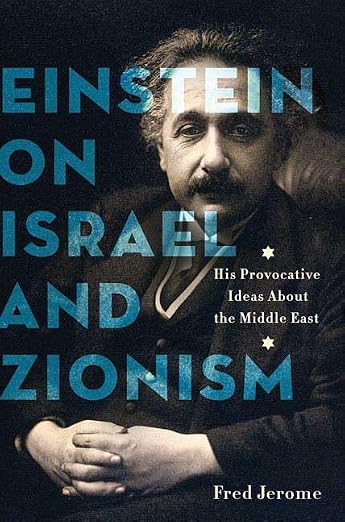
Einstein on Israel and Zionism: His Provocative Ideas About the Middle East Hardcover – 26 May 2009
by Fred Jerome (Author)
3.9 3.9 out of 5 stars 16 ratings
Albert Einstein thought and wrote extensively not just on the most difficult problems in physics, but also in politics. For the first time, this book collects his essays, interviews, and letters on the Middle East, Zionism, and Arab-Jewish relations. Many of these have never been published in English, and all of them contradict the popular image of Einstein as pro-Zionist. He was offered and refused the Presidency of Israel, but had he taken it, he may have said things the Zionists didn't want to hear; he favoured a non-religious state that would welcome Jew and Palestinian alike.One person's letters, even Einstein's, cannot resolve the crisis in the Middle East. However, decades later when horrors 'of the conflict in the Middle East are familiar to everyone, the reflections of one of the twentieth century's greatest thinkers are a signpost, showing his commitment to social justice and understanding and friendship between Jew and Arab.
===
288 pages
St Martin's Press
26 May 2009
Top reviews
Top reviews from other countries
Translate all reviews to English

J. Marsden
5.0 out of 5 stars
Einstein an embarrassment to present day Zionists – go Einstein go.
Reviewed in the United Kingdom on 4 September 2014
Verified Purchase
Fantastic – it really is very informative and reinforces that you should go to the source for information and not rely on politicians and the media. I heavily recommended this book.
2 people found this helpfulReport
FB
5.0 out of 5 stars Was Einstein a Zionist?
Verified Purchase
Fantastic – it really is very informative and reinforces that you should go to the source for information and not rely on politicians and the media. I heavily recommended this book.
2 people found this helpfulReport
FB
5.0 out of 5 stars Was Einstein a Zionist?
Reviewed in the United States on 9 November 2009
Verified Purchase
The conflict between Jews and Arabs in Palestine, which in Einstein's own lifetime was bitter and which has only grown sharper since, was not inevitable. So thought Albert Einstein at least. In "Einstein on Israel and Zionism", Fred Jerome has compiled a selection of Einstein's writings and speeches concerning the enterprise to create a Jewish state in Palestine. Zionism was controversial from the start, since it was clear that Palestine already had a number of inhabitants -- non-Jewish -- who could not reasonably be expected to welcome any effort naturally designed to dispossess them. Therefore, in their outward show the early Zionists very quickly ceased speaking of building a *state*, and instead spoke of creating a *homeland* for the Jews.
From his earliest contact with Zionism in 1914 at the age of thirty-five, Einstein was supportive of the Jewish homeland concept. He did so for two major reasons. First, he felt that a Jewish homeland in Palestine would raise the self-esteem of Jews in the diaspora; and, second, he believed firmly that because of anti-Semitism Jews needed a place of refuge as a last resort against persecution. His primary concern is with Jews in the diaspora; at no time does he suppose that life in the diaspora is invalid or impossible. In 1927 he stated: "For me the importance of the Zionist work lies precisely in the effect it will have on those Jews who will not themselves live in Palestine" (p. 60) But what about the Arabs who were already living in Palestine, what effect will Zionism have on them?
Einstein's view can be described as "cultural Zionism", the belief that in Palestine Jews could create an entity, a spiritual and intellectual center which would serve to foster Judaism as a culture, and Hebrew as a language, to unite Jews worldwide. In 1929: "It was a great achievement of Herzl to have realized and proclaimed...the establishment of a national home or, more accurately, a center in Palestine..." In this sense there is no question but that "Zionist" is a term that can justly be applied to Einstein.
However, Einstein never favored the existence of Israel as a political state. In fact, his writings attest that he firmly and consistently throughout his life opposed political Zionism. But wasn't that what the movement begun by Herzl was all about? One gets the impression that at the beginning Einstein, it could almost be said, deceived himself about the actual Zionist goals; but as time wore on, the scales fell from his eyes. He came to see that Weizmann and the rest of the Zionists represented a Jewish chauvinism whose realization would render impossible any just rapprochement with the Arab inhabitants of Palestine -- and which in the end would fail. To Weizmann, 1929: "If we are not able to find a way to honest cooperation and honest pacts with the Arabs, then we have learned nothing in our two thousand years of suffering, and deserve the fate which will befall us" (p. 78). In this sense, Einstein was anti-Zionist -- much to the chagrin of Weizmann and the mainstream Zionist movement.
One asks, what then is the right way to honest cooperation and honest pacts with the Arabs? In today's world there is a widely accepted view that the only way to solve the Israel-Palestine conflict is to allow a Palestinian state to be created on the land that Israel has illegally occupied since 1967 and from which it must now withdraw. This is the vaunted "two-state solution". As demonstrated in this collection of his writings, Einstein was adamantly opposed to any two-state solution. To him it was very clear that Jews needed to share all the land of Palestine on an equal basis with Arabs. In 1947 the United Nations voted to partition Israel by creating separate states for Arabs and Jews -- this was the original two-state solution. Einstein opposed it, favoring instead a single bi-national state in which Jews and Arabs were represented on an equal basis: "What we can and should ask is a secured bi-national status in Palestine....if we ask more we are damaging our own cause" (1946, p. 176). He clearly felt that a *Jewish state* was incompatible with the need to maintain just relations with the non-Jewish inhabitants of Palestine. The conflict was resolvable, but if only the Zionists renounced chauvinism and agreed to share the land equally. This has never happened, of course. Since Einstein's death in 1955, the situation for the Palestinians has grown starkly worse, and Jewish chauvinism has starkly increased.
28 people found this helpful
Nicolas Plagne
5.0 out of 5 stars to escape from memory manipulations
Verified Purchase
The conflict between Jews and Arabs in Palestine, which in Einstein's own lifetime was bitter and which has only grown sharper since, was not inevitable. So thought Albert Einstein at least. In "Einstein on Israel and Zionism", Fred Jerome has compiled a selection of Einstein's writings and speeches concerning the enterprise to create a Jewish state in Palestine. Zionism was controversial from the start, since it was clear that Palestine already had a number of inhabitants -- non-Jewish -- who could not reasonably be expected to welcome any effort naturally designed to dispossess them. Therefore, in their outward show the early Zionists very quickly ceased speaking of building a *state*, and instead spoke of creating a *homeland* for the Jews.
From his earliest contact with Zionism in 1914 at the age of thirty-five, Einstein was supportive of the Jewish homeland concept. He did so for two major reasons. First, he felt that a Jewish homeland in Palestine would raise the self-esteem of Jews in the diaspora; and, second, he believed firmly that because of anti-Semitism Jews needed a place of refuge as a last resort against persecution. His primary concern is with Jews in the diaspora; at no time does he suppose that life in the diaspora is invalid or impossible. In 1927 he stated: "For me the importance of the Zionist work lies precisely in the effect it will have on those Jews who will not themselves live in Palestine" (p. 60) But what about the Arabs who were already living in Palestine, what effect will Zionism have on them?
Einstein's view can be described as "cultural Zionism", the belief that in Palestine Jews could create an entity, a spiritual and intellectual center which would serve to foster Judaism as a culture, and Hebrew as a language, to unite Jews worldwide. In 1929: "It was a great achievement of Herzl to have realized and proclaimed...the establishment of a national home or, more accurately, a center in Palestine..." In this sense there is no question but that "Zionist" is a term that can justly be applied to Einstein.
However, Einstein never favored the existence of Israel as a political state. In fact, his writings attest that he firmly and consistently throughout his life opposed political Zionism. But wasn't that what the movement begun by Herzl was all about? One gets the impression that at the beginning Einstein, it could almost be said, deceived himself about the actual Zionist goals; but as time wore on, the scales fell from his eyes. He came to see that Weizmann and the rest of the Zionists represented a Jewish chauvinism whose realization would render impossible any just rapprochement with the Arab inhabitants of Palestine -- and which in the end would fail. To Weizmann, 1929: "If we are not able to find a way to honest cooperation and honest pacts with the Arabs, then we have learned nothing in our two thousand years of suffering, and deserve the fate which will befall us" (p. 78). In this sense, Einstein was anti-Zionist -- much to the chagrin of Weizmann and the mainstream Zionist movement.
One asks, what then is the right way to honest cooperation and honest pacts with the Arabs? In today's world there is a widely accepted view that the only way to solve the Israel-Palestine conflict is to allow a Palestinian state to be created on the land that Israel has illegally occupied since 1967 and from which it must now withdraw. This is the vaunted "two-state solution". As demonstrated in this collection of his writings, Einstein was adamantly opposed to any two-state solution. To him it was very clear that Jews needed to share all the land of Palestine on an equal basis with Arabs. In 1947 the United Nations voted to partition Israel by creating separate states for Arabs and Jews -- this was the original two-state solution. Einstein opposed it, favoring instead a single bi-national state in which Jews and Arabs were represented on an equal basis: "What we can and should ask is a secured bi-national status in Palestine....if we ask more we are damaging our own cause" (1946, p. 176). He clearly felt that a *Jewish state* was incompatible with the need to maintain just relations with the non-Jewish inhabitants of Palestine. The conflict was resolvable, but if only the Zionists renounced chauvinism and agreed to share the land equally. This has never happened, of course. Since Einstein's death in 1955, the situation for the Palestinians has grown starkly worse, and Jewish chauvinism has starkly increased.
28 people found this helpful
Nicolas Plagne
5.0 out of 5 stars to escape from memory manipulations
Reviewed in France on 10 December 2009
Verified Purchase
very informative book on Einstein's real ideas on these sensitive issues: Einstein was very reserved on the founding of a Jewish state in Palestine and very hostile to the anti-Arab terrorist policy of the armed Jewish groups Stern and Irgun... His ideal was peaceful and constructive cohabitation between Arabs and a community of Jews who had returned to Palestine with the agreement of the local population; the Jews were not to seize Arab lands or claim political control of the region, but to be accepted and reassure the Arabs and Muslims of their good intentions and their assistance in the construction of a democratic and modern bi-national state . We have been far from counting since 1948.
Verified Purchase
very informative book on Einstein's real ideas on these sensitive issues: Einstein was very reserved on the founding of a Jewish state in Palestine and very hostile to the anti-Arab terrorist policy of the armed Jewish groups Stern and Irgun... His ideal was peaceful and constructive cohabitation between Arabs and a community of Jews who had returned to Palestine with the agreement of the local population; the Jews were not to seize Arab lands or claim political control of the region, but to be accepted and reassure the Arabs and Muslims of their good intentions and their assistance in the construction of a democratic and modern bi-national state . We have been far from counting since 1948.
Einstein also accused Great Britain of having pitted Arabs and Jews (authorized to emigrate) against each other to reign in their so-called "mandate" protectorate of Palestine and of having fostered fears and developed hatred through a cynical or incoherent and in any case catastrophic policy...
After 48, Einstein tried to play the role of mediator for reconciliation with the Arabs (between Ben Hourion and Nasser in particular). But he refuses the presidency of Israel. Einstein: the example of the secular Jew of German-European culture and cosmopolitan spirit who is not tempted by emigration to Palestine; understanding in certain respects for Zionism, but also anti-nationalist and anti-fascist, he is very cautious about its politico-military consequences and hostile to Jewish colonialism, which would be a form of anti-Arab racism.
One person found this helpfulReport
Translate review to English

Alpha Male 1
4.0 out of 5 stars Four StarsReviewed in the United States on 31 October 2014
Verified Purchase
Very interesting book and it gave me an political perpsective of Mr. Einstein I never knew existed!
2 people found this helpfulReport
the karsten hald nielsen
4.0 out of 5 stars Correcting thingsReviewed in the United Kingdom on 6 April 2014
Verified Purchase
Often it is said that Einstein supported the creation of the Jewish state. But in fact he was very critical. He supported the creation of a Jewish Homeland in the meaning of a place where Jews could live in peace, but he was absolutely against the creation of a Jewish state (In fact he found nationalism a very bad thing). And the way it happened was for him a crime. He, together with other prominent Jews, condemned the massacre at Deir Yassin and called the zionist leader Menachim Begin for a fascist.
4 people found this helpfulReport
One person found this helpfulReport
Translate review to English
Alpha Male 1
4.0 out of 5 stars Four StarsReviewed in the United States on 31 October 2014
Verified Purchase
Very interesting book and it gave me an political perpsective of Mr. Einstein I never knew existed!
2 people found this helpfulReport
the karsten hald nielsen
4.0 out of 5 stars Correcting thingsReviewed in the United Kingdom on 6 April 2014
Verified Purchase
Often it is said that Einstein supported the creation of the Jewish state. But in fact he was very critical. He supported the creation of a Jewish Homeland in the meaning of a place where Jews could live in peace, but he was absolutely against the creation of a Jewish state (In fact he found nationalism a very bad thing). And the way it happened was for him a crime. He, together with other prominent Jews, condemned the massacre at Deir Yassin and called the zionist leader Menachim Begin for a fascist.
4 people found this helpfulReport
====
Displaying 1 - 6 of 6 reviews
Profile Image for Wale.
Wale
106 reviews
18 followers
Follow
December 7, 2010
I enjoyed reading Einstein's independent thoughts on the plight and experience of his fellow brothers.
However I resented the author's attempt of trying to colour Einstein's opinions with his own views of what he thinks Einstein meant by such and such- a conceit that so much pervades journalism and the media today.
3 likes
Like
Comment
Connie
80 reviews
5 followers
Follow
April 2, 2011
My neighbor found this book and loaned it to me to read first! WOW!I sure wish a few power brokers would have listened to Einstein back in the 20s and 30s and perhaps the Israel-Palestine situation would never have degraded into what it has been throughout my 58 yrs.
Jerome is an Einstein scholar, and for this book had dozens of articles of correspondence translated, researched transcriptions of dozens of speeches, and the book is a fascinating and informative view back in time!
He recognized Great Britain and later the US for the evil for which they were (and are) responsible.
Highly recommended!!!!
2 likes
1 comment
Like
Comment
Profile Image for Chelsea.
Chelsea
122 reviews
24 followers
Follow
August 15, 2014
Great insight into one of the most brilliant and compassionate minds of the 20th century. A must read for any students of the conflict in Palestine.
1 like
Like
Comment
Profile Image for Eurydice Montpelier F. Waltz.
Eurydice Montpelier F. Waltz
13 reviews
Follow
December 3, 2023
As someone very interested in physics and is constantly surrounded by Einstein's equations and his long-lasting influences on modern science, this piqued my interest. This book lays out very concisely exactly how Einstein's views on Israel and Zionism changed over the years. Even if we were not dealing with one of the most pivotal figures in history who completely reformed the scientific paradigm of the twentieth century, it would simply be fascinating to see how people - especially Jews - reacted to Israel in its formative years. I do think, however, that the author could have been considerably more critical of Einstein's early statements on Zionism and Israel. Instead, Jerome tends to overlook painfully ignorant statements Einstein made in some of his letters - his ideas on how Israel should be established - in favor of reassuring the reader that *later on* Einstein gets it right. It would have been vastly more informative if Jerome had taken the time to deconstruct each of Einstein's oversights in those earlier letters, point out the flaws in his "logic" surrounding colonization, and illustrate exactly where Einstein got it wrong, and why he had no choice but to change his views.
The book, however, opens with a commentary on the recent tragedies that had taken place in Palestine at the time the book was written, 2008, which remains excruciatingly relevant today. I hope it doesn't take Einstein's opinions to change any modern readers' view of the occupation, but it is a fascinating read, regardless.
Like
Comment
Profile Image for William.
William
9 reviews
Follow
January 23, 2013
I picked up this book because of the subject matter. The scientific stuff kind goes right over my head but this is an easy read. It is well documented and it offers up a behind the scenes look at the history of Israel and Zionism, alongside a genius observing it unfold. Though he was a great thinker, Einstein was also very thoughtful and just a legit dude--very classy. All in all, Einstein = Good dude with a lot on his mind.
Poor out some liquor for Albert.
Like
Comment
Profile Image for Bruce.
Bruce
17 reviews
1 follower
Follow
August 8, 2009
I actually didn't finish this one, stopped half way through.
It's a great read, and there's a lot of great info on history
of palestine and europe especially. It references a lot of
einstein's letters and also some books he wrote on the subject of
israel. I might just look those up when I get ready to read up on the
subject again.
history-current-events
nonfiction
Like
Comment
====

No comments:
Post a Comment