Ebook183 pages4 hours
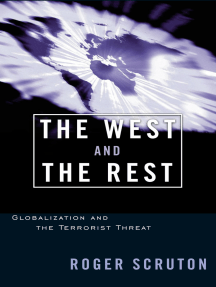
The West and the Rest: Globalization and the Terrorist Threat
By Roger Scruton
Rating: 4 out of 5 stars
4/5
(8 ratings)
About this ebook
Scruton shows how the different religious and philosophical roots of Western and Islamic societies have resulted in those societies’ profoundly divergent beliefs about the nature of political order. For one thing, the idea of the social contract, crucial to the self-conception of Western nations, is entirely absent in Islamic societies. Similarly, Scruton explains why the notions of territorial jurisdiction, citizenship, and the independent legitimacy of secular authority and law are both specifically Western and fundamentally antipathetic to Islamic thought.
And yet, says Scruton, for its adherents Islam provides amply for one of the most fundamental of human needs: the need for membership. In contrast, the decay of the West’s own political vision, and its concomitant preoccupation with individual choice, has finally led to a “culture of repudiation” in which that need goes increasingly unfulfilled, principally because the sources of its fulfillment—patriotism, religious belief, traditional ways of life—are routinely mocked.
Globalization has made these facts an explosive mixture. Migration, modern communications, and the media have inexorably brought the formerly remote inhabitants of Islamic nations into constant contact with the images, products, and peoples of secular, liberal democracies. Scruton warns that in light of this new reality, certain Western assumptions—about consumption and prosperity, about borders and travel, about free trade and multinational corporations, and about multiculturalism—need to be thoroughly re-evaluated.
The West and the Rest is a major contribution to the West’s public discourse about terrorism, civil society, and liberal democracy.
Read now
Saved
Download to app
Share title
=====
West And The Rest Hardcover – 30 July 2002
by Roger Scruton (Author)
4.7 4.7 out of 5 stars 47 ratings
See all formats and editions
In The West and the Rest, Scruton argues that to comprehend Islamist terrorism, one must understand what is unique - and what is potentially dangerous - about Western institutions, ideas, and technology.
Scruton shows how the different religious and philosophical roots of Western and Islamic societies have resulted in those societies' profoundly divergent beliefs about the nature of political order. For one thing, the idea of the social contract, crucial to the self-conception of Western nations, is entirely absent in Islamic societies. Similarly, Scruton explains why the notions of territorial jurisdiction, citizenship, and the independent legitimacy of secular authority and law are both specifically Western and fundamentally antipathetic to Islamic thought.
===
West And The Rest Hardcover – 30 July 2002
by Roger Scruton (Author)
4.7 4.7 out of 5 stars 47 ratings
See all formats and editions
In The West and the Rest, Scruton argues that to comprehend Islamist terrorism, one must understand what is unique - and what is potentially dangerous - about Western institutions, ideas, and technology.
Scruton shows how the different religious and philosophical roots of Western and Islamic societies have resulted in those societies' profoundly divergent beliefs about the nature of political order. For one thing, the idea of the social contract, crucial to the self-conception of Western nations, is entirely absent in Islamic societies. Similarly, Scruton explains why the notions of territorial jurisdiction, citizenship, and the independent legitimacy of secular authority and law are both specifically Western and fundamentally antipathetic to Islamic thought.
===
===
Displaying 1 - 10 of 25 reviews

Marc
3,199 reviews1,522 followers
Follow
January 29, 2019
This book was written shortly after Nine-Eleven and it definitely bears the traces of it. The title "The West and the Rest" expresses the overall tenor of this work, but Scruton mainly focuses on Islam, and therefore the title in the Dutch translation that I read (The West and the Islam) covers the load of this book much better. This is the first book I read from Scruton. Of course, I already knew him indirectly through what I had read about him in newspapers and seen or heard in the audio-visual media. His straightforwardly conservative view of the world is resumed in a nutshell in this book, but he specifically focuses on the danger that lies in the Islamic point of view.
Scruton is a clever and erudite man, that is clear. His analysis of what the West stands for cannot simply be swept aside. In the first chapters he gauges the uniqueness of the Western institutions, in a very condensed style that is sometimes difficult to read. Essential to him are the concepts of 'territorial jurisdiction' (that is the sovereignty of the nation state, limited to a specific geographical area) on the one hand, and the 'loyalty of the citizen' of that nation state on the other, by Scruton also called 'membership', the feeling to belong to that particular nation state. Demarcated jurisdiction and loyalty are two interrelated aspects of the same phenomenon in the Western nation state, and they are the fruit of the Enlightenment.
This is an interesting view, because it rightly states that the specificity of the West is not limited to something as instrumental as elections, but rather that cultural-institutional aspects are decisive. The problem is that Scruton boldly states that these phenomena simply do not exist outside the West (roughly Europe and North America). On the contrary, regimes on other continents, even if they are sovereign and even though they have a certain democratic appearance, are usually the mere instrument of potentates and have no legal personality with which their inhabitants identify themselves. Even if that is true for a lot of states, with this polarizing thesis Scruton just sweeps Latin America, Africa, the Middle East and especially Asia in one heap, and that is at least questionable (besides, also the predicate 'the West' as a generalization does not live up to reality).
As said before, Scruton mainly focuses on Islam: not five pages pass or the attitude or view of Islam is contrasted with the Western 'values', and in an extensive third chapter he explicitly zooms in on the danger of Islam as a whole. Again, Scruton obviously touches ground, and he exposes issues that cannot simply be ignored; in traditional Islam there are certainly elements that differ from the Western way of feeling and doing and that is at least a more or less neutral conclusion. But here too the problem is that Scruton generalises everything into the absolute and ignores the enormous diversity in thinking and doing in the Muslim communities; it is typical that he limits the Islamic world to the Middle East and to the radical cores in the West, that he leaves Asia completely out of the picture and limits his analysis of Islam to what the basic texts and traditions say.
Scruton links that threat of Islam (in general) with the loss of the core values of Western society itself. Under the title "denial" he argues how Western society undermines itself and contributes to its own destruction. It’s the ultra-conservative in him that surfaces here. Scruton states that relativism in the West has taken over in the form of politically correct thinking, multiculturalism (of which he gives a very narrow and very coloured definition), radical feminism, deconstructive philosophy, modernist architecture and the "sex and drug lifestyle of the modern teenager" (sic). Scruton dissolves all his devils here and his most poisonous arrows he focuses on global institutions such as the UN and the EU that systematically undermine the principle of territorial jurisdiction of Western nation states.
Again: his criticism to a certain extant can be justified, but at the same time his extreme conservatism makes him an implicit ally of other radicalisms, such as extremist Islamism, that fight against Western civilization. For example, there’s his praise for the Islamic madrassas (the schools where Islamic education is given, now often seen as hotbeds of radicalization) because they provide much better moral education than Western schools; and members of Al Quaeda, through their Western technical and scientific education, have also seen how empty that civilization has become, which is what Scruton himself endorses!
In general, I tend to react to people who are fanatical or extremely polemicizing at first by looking carefully at what they say and weighing whether there is some ground in their views or not. But at the same time, I also have the reflex to ask myself the question of what is going on in the personal lives of these people, in their deepest psychology that makes them so extremist. While reading this book, especially the second half of it, I also had this reaction. Of course, I don’t know Scruton as a person and I absolutely want to respect him, but the question is really relevant. This thinker offers interesting opinions that are to be valued, but his thinking is clearly 'contaminated' by experiences that have clouded his reasonable insight and sent him on the extreme way. You can of course say: sometimes it is necessary that the hard contours of the truth are said, and I can get that, but in this case there is clearly more going on. And it’s a pity that in my view this undermines the great intellectual that Scruton certainly is.
conservatism islam terrorism
...more
11 likes
Like
Comment

Jujin Deliu
207 reviews19 followers
Follow
October 2, 2018
Current although originally published more than a decade ago, it is a solid compendium that relates the evolution of Western society to Islamic society, from their origins to the present day. The main differences on issues such as law, citizenship and value systems are highlighted, then analyzing the inevitable and painful collisions (September 11th is certainly the most remembered) and finally proposing some radical solutions which, although not "politically correct" , are anything but populist or based on stereotypes, especially those that concern identity and globalization.
essay politics religion
...more
3 likes
Like
Comment

Samuel
228 reviews24 followers
Follow
April 9, 2020
Scruton, from what I have heard, is a great pioneer of the legacy of Western Civilization as well as one who calls attention to its decline. This book was published in the time after the terrorist attacks of 9/11, and in addition to comparing the West with the rest of the world (which in this case is mainly the Muslim world), it did not avoid pointing out the decline of the West. I myself am aware of this phenomenon, but every time it jumps out at me from somewhere, I ironically ask myself from what height the West must be falling, because it has been falling for a very long time. In any case, Scruton made the decline of the West one of his arguments for why the Western world will face a greater threat of terrorism in the coming years, with Europe in particular at risk. In this respect, his argument proved to be prophetic, although it would certainly be a great simplification to leave it only at this level. Because basically everything can be argued about the decline of Western civilization, but there will be something to it.
Anyway, this little book is divided into four parts. The first deals with the Social Contract and talks about the fact that the West stands by such a contract, while it is mainly about the fact that it bases its legitimacy on the freedom of choice and decision - that is, that people agree on legislation. According to Scruton, the Muslim world does not know this and bases everything on submission to Allah. The West knows the Christian "give to Caesar what is Caesar's and to God what is God's." The rest of the world does not know this principle. At the same time, the social contract creates local legislation that binds the nation or citizens and thus creates "membership". In the Muslim world, let's call it belonging, it binds only to Allah.
The second part, called Enlightenment, Citizenship and Loyalty, was a little more difficult for me to understand, but basically it just expanded the essence of the social contract and talks about the emergence of national identity and loyalty to the nation in the Western world, which arose from the removal of religion from public life. In this chapter, he formulates his argument, which says that the decline of Western civilization, the resistance to everything national or Western, has caused a weakening and can lead to the destruction of everything that was being built.
In the chapter on the Holy Law, Scruton outlined a short and concise history of Islamic extremism (I hope no one stones me for this phrase, I mean extremism that draws on Islam, but is not part of the religion as such). He describes Wahhabism, the Muslim Brotherhood to Al-Qaeda, while talking about the problem that arises from the fact that terrorists do not belong to any state (hence the name "base", they are everywhere and nowhere).
In conclusion, he blames globalization, which has only accelerated all this and created the idea that multinational corporations and institutions want to attack and the sovereignty of smaller states and nations, which is a fertile ground for terrorism, which abuses the advantages that globalization offers.
Definitely worth a read. It didn't excite me that much, but that's mainly because skepticism and pessimism run through the whole book. There is a lack of hope, which Christopher Dawson talked about, for example, who also talked about the decline of Western Civilization.
Show morenon-fiction
2 likes
Like
Comment

Yohanes Saputra
62 reviews9 followers
Follow
January 20, 2023
To really understand why the terrorists in the Middle East conflicts with the West is not an easy task. One has to reflect on what makes the Western civilization so hate-inducing to these people, and when we reflect that, then it comes to no suprise that the West has it better. But how can it come to this?
Roger Scruton believes that the West has two fundamental concepts pertinent for the foundation of their states, territorial jurisdiction and national loyalty. As Scruton argues, to really bind a society a state needs a territory, a law and a loyalty.
The Arab states on the other hand have no foundations of the same value as these (Arab nationalism failed, as an example Scruton offers). Because they are not attached to their territory and their nationalism had failed, there is one loyalty that they share, and that is the religion of Islam.
Just by bringing to light this difference, we can see how the West sees itself and the Arabs see themselves. That's why in the West their nation-states are successful and why the Middle East filled with failed states. Terrorism, as Scruton argues, is the uninteded by-product of this very envy of nation-states, so a certain group needs to rid off it.
That, I think, is the reason terrorism have existed: their unconscious desire to destroy what they even lack back in home.
Show moreglobalisation politics world-affairs
2 likes
Like
Comment

Tim Pendry
1,046 reviews398 followers
Follow
October 1, 2022
Two decades old in 2002 and written in the aftermath of 9/11, the conservative philosopher Roger Scruton's polemical 'The West and the Rest' appears more sensible now than ever, not on the detail (where he was a trifle too alarmist) but on the general trajectory of globalisation.
Terrorism proved not to be the downfall of Western civilisation. American power and the Islamists' own weak reach and existential exhaustion (probably based on generational factors) failed to do more than cause pain and misery to relatively small and localised populations.
The book's great value in this context, if we ignore the paranoia and neurosis of the 2000s, is to point up a far deeper issue - the essential incompatibilities in the way Islam and the West see social and political reality.
The book contains a superb and succinct account of Islamic cultural norms and how they differ from Western norms (incidentally permitting us to see exactly what Western habits consist of), emphasising difference rather than simplistic and excitable American good/evil judgments.
Where Scruton scores is in pointing out the intrinsic conflict that must emerge between the globalisation process that drives the extension of Western values into every corner of the world and the traditional cultures that this process has been disrupting.
Looked at two decades on, Islamism and its associated terrorism was just an early symptom of a much greater disease which has seen a growing resistance to the extension of Western values that now encompasses Chinese neo-confucianism, Russian orthodoxy, Hindu nationalism and so on.
What we see in Scruton's book is a preliminary sketch for a world, partially predicted by Huntington and unseen by Fukuyama, in which the Kremlin can, quite reasonably by its own lights, present itself as the centre of a global resistance to Western hubris and arrogance.
What Scruton did not see and we can now see is that the 'extension of Western values' not merely created its own forms of violent resistance elsewhere in the world but started to redefine Western values at home and so created its own internal populist resistance.
The world of 2002 was one of absolute Western hegemony fairly united around the assumed benefits of globalisation and dealing with what appeared to be a single primitive traditionalist revolt that was nihilistic and which 'justified' extreme security and cultural measures.
The world of 2022 is the fruit of the 'West' (actually interlocking political elites centred on Washington) failing to realise that the unjust behaviour of Islamist militants hid an underlying just resentment that the 'West' thought could be railroaded and bludgeoned into compliance.
The underlying just resentment was at being ordered around and told to believe what one part of the world which had inherited its vast wealth had decided was appropriate. With backs to the wall, the resentment turned violent and this required brutal methods to crush the consequent revolt.
Now the West faces a far more serious revolt from a nuclear power with the resources of a modern if flawed state machinery behind it. The doubling down on 'all means necessary' to put down this far more important revolt risks a world-destroying nuclear conflagration.
Even were this challenge to the West to be crushed, the resentment would not go away. China and India are aware of their own need to survive as civilisations. Russia's resistance has created a new awareness of the colonial legacy in Africa and much of the rest of the world.
Meanwhile, the West's elites attempt to create cover for its post-imperial hegemony by promoting ESG, social capitalism and global liberal values in ways that have not only alienated these external communities but significant elements within its own voting electorates.
Scruton was pushed aside in 2002 as just a dissident 'Tory' voice. He got it wrong on the level of threat from Islamism, effectively buying into hysteria that was manufactured often for enhanced internal security powers and militarist operations, but he got it right where it really mattered,
Radical Islamism had become vicious. There was rightly no compromise with it. The 'West' (aka US) acted reasonably if clumsily to contain it. However, this was just a sticking plaster on a far bigger and festering problem that required new thinking not the 'doubling down' we see today.
Capitalism itself was shaken in 2008 to such an extent that it becomes now a strategic possibility for Russia to exploit the massive debt burden in the West through its disruptions. 2016 saw warning shots to liberal elites that were ignored in yet another round of doubling down on 'values'.
Now, in 2022, all that has happened because of the failure of the West to moderate and manage its values imperialism is a raising of the stakes - the splitting of the world into camps driven not by ideology but by warring 'values', a lack of mutual respect and economic competition.
Core Western values as described by Scruton in the book are also at threat in the West's heartlands - since the West may be regarded as a distinct civilisation in its own right but with important variations - through federalisms, the manufacturing of consent and flawed democratic procedures.
A Prime Minister elected by 0.2% of her population almost triggered the meltdown of the financial system in her country through incompetence yet there is no way of either bringing her into line or removing her that is not in the hands of a very few men and women in Parliament.
It was supposed to be the Marxists who brought down capitalism yet it would seem that ideological liberals, in the ultimate internal contradiction, are in danger of doing so through a combination of moral absolutism, economic sanctions, disorganisation and defiance of popular sentiment.
The world system is no longer the United Nations created in 1945 on a victory by two ideologies over a third but has become a more fluid and competitive structure based on 'civilisations' that are modernising in different ways whilst trying to preserve their essential characters.
If one of those civilisations, based on its historic hegemony, attempts to impose its essential character beyond a certain point then it will face violent resistance because, while it may suborn elites, elites can be overuled by their own civilisational histories.
While there are now substantial 'liberal' minorities in all traditional civilisations, the majority remain passively traditional and remain passive only to the extent that they are both fed (economic) and not insulted as to their core values (cultural).
Similarly hungry and/or culturally neglected minorities within the West are likely to become resistors in turn - generally in the form of populism - especially as it is becoming clear that the middle classes are getting poorer and working classes treated with contempt.
Put all this together and we have a volatile and dangerous situation both internationally and domestically. Frightened elites, no longer able to control the situation they find themselves in, constantly 'double down' making the situation worse as they reach their points of no return.
We see this most obviously with the Ukraine situation but there are similar issues arising with China while India and the Gulf States are no longer to be taken for granted. We can expect a similar 'doubling down' on domestic populations resentful of the cost of living and migration
The book is thus worth reading for two reasons - as a remarkably cogent account of the state of affairs that should have predicted our current malaise and as a case study in the contrast between two civilisational systems (the 'West' and Islam)
If only more people in the West had read Scruton's book at the time and then gone on to think about the implications of what he was saying. In the meantime, read it for the excellent material on Islam and as a baseline for a rethink - that may now be too late.
middle-eastern political-philosophy politics
...more
6 likes
Like
Comment

Stephen Heiner
Author 3 books75 followers
Follow
May 17, 2019
Sir Roger Scruton, normally at home speaking about culture and architecture, doesn't put together a convincing enough case for the problem of jihad and Islam, or what people these days call "Islamism." Written in 2002, it has proven to be the mildest of responses to 9/11 and all that has come since. Because Scruton accepts the principles of the so-called Enlightenment, he is half defeated before he even picks up his pen on this issue.
As a quick survey of the development of law and government in Christian states as opposed to Islamic ones, it is useful.
"It is, in my view, impossible to understand the French Revolution if one does not see it as primarily a religious phenomenon. The inner compulsion was to dethrone the gods of the monarchical order, and to erect a new community in its place - but a community demanding sacrifice, devotion, and slaughter, establishing a right to obedience through the spilling of blood. The leading revolutionary St-Just could say, in 1794, that a republic 'is constituted by the total destruction of that which is opposed to it,' so abolishing at a stroke the century of political thinking that had finally come to fruition in revolutionary France. Membership, as St-Just's remark makes clear, means the establishment of a "we," and the easiest way to invent this "we" is through a fight to the death with "them." The French Revolution was prodigal of opponents - some of them real, as in the Vendee uprising, some of them imaginary, like the quasi-supernatural emigres, crystallizing now in this person or club or gathering, now in that, and everywhere the object of the most violent suspicion and enmity. There is no need to dwell on the parallels with subsequent revolutionary movements and their demons: the emigres were simply the first in a long line of victims - kulaks, Jews, the bourgeoisie - prepared as sacrificial offerings on behalf of a new form of social membership. It is from a deficit of membership that the urge to revolution arises, and when people are hungry for membership, collective violence issues as a matter of course.
The French Revolution sought to replace one religion with another: hence its fanaticism and exterminatory zeal. But the new religion of the nation was demonic, fraught with contradiction and self-hatred, with no power to survive. It quickly gave way to the Napoleonic project of empire, through which violence was externalized and a rule of law re-established at home." (p. 44-45)
nonfiction
1 like
Like
Comment

Josh Friedlander
755 reviews111 followers
Follow
August 12, 2015
Scruton's prose is felicitous, and his grasp of Islamic political philosophy seemingly comprehensive. He advances a number of conclusions in this book, written in response to the 9/11 attacks - some more compelling than others.
His first thesis is that Western political thought is inherently suited to develop disestablishmentarian ideas. Its influences, after the Greeks, are from Christianity - a religion which developed in the shadow of the Roman empire, a pre-existing law system, and contains the idea of an independent church (a non-human legal person, like a firm or a state) separate from a secular state. "Render unto Caesar..."
Islam, by contrast, is inherently both a theological and a political movement. Jesus was a victim, Agnus Dei, turning the other cheek to his executioners. Mohammed was a warrior, who combined military stratagems with his poetic suras. Globalisation has brought these two forces into contrast, but it is impossible to resolve them.
Scruton positions himself as a sort of radical centre, mixing in criticisms of postmodernism, the excesses of pluralism and political correctness, and the Western world's value crisis - his familiar bêtes noires - with a traditionally leftist disparagement of cultural and economic globalisation, and the excesses of the IMF and WTO. Your mileage may vary; I found the critique wanting, in its presumption of a prelapsarian status quo to which all developing countries would wish to return. While the debate on globalisation of a few years ago has mostly died down, issues such as migration in Europe and home-grown terror cells are still very much in the public eye. This slim book is a cogent and authoritative contribution to our public debate.
Show moremiddle-east modern-history theology
1 like
Like
Comment

Patrick McCoy
1,061 reviews79 followers
Follow
February 6, 2015
The West and The Rest by Roger Scrunton (a philosopher) is a short, but well-written and informative look at the ideas that led to attacks on 9/11. I thought that he was especially lucid about the fundamental differences that underlie the Christian and Muslim religions, mainly in that Christianity is concerned with conciliation to break the cycle of violence. Furthermore, he points out that Islamic societies are unable to break out of the paradigm of families and members of their religion, whereas the western countries are bound by citizenship that binds a society of strangers together for a common purpose. He also points out the three major effects of the Khomeini’s revolution in Iranian 1981: 1) He showed that a Islamic government is a viable option in the modern world 2) He made the exportation of the Islamic Revolution the cornerstone of his foreign policy by support Hezbollah in Lebanon 3) He endowed the Islamic revolution with a Shiite physiognomy, which made martyrdom a central part of the strategy.
current-affairs history non-fiction
1 like
Like
Comment

Salih Yasun
3 reviews
Follow
November 19, 2017
Scruton’s book provides a forthcoming account the paths of development between the West as defined as the Judeo-Christian and the rest defined as the Islamic world, with an aim at understanding what led to 9/11 attacks. While the author makes some convincing arguments about the innate differences between the historical background of Islam and Christianity, yet the book lacks from a comprehensive methodological approach on the subject. In describing Christianity, the author places more emphasis on the historical development of the religion, while in describing Islam the emphasis is overwhelmingly placed on the canonical texts of the religion. While the author argues that the approach that he employed is justified based on the innate differences of the two religions, the methodological divergence allows for exogenous factors (such as the rise of nation-states) to influence the outcomes of cases. The author attempts to solve the endogeneity issue by arguing that the nation-states are a by-product of Christianity, or at least, Christianity provides space for nation-states that Islam does not afford to provide. Yet, the argument remains insufficient and unable to fit either within the localities of the analysis of established texts or historical backgrounds, including a total ignorance of both territorial and de facto power of the Catholic Church that sprang from the Christian theology itself. The hostility towards other groups arising from Christian doctrines, such as anti-semitism, hostility against gays and minority rights.
Another weakness of the book is that its assumptions of the unaltered relationship of the pious Muslims to the holy scriptures. While the author finds the authority to make claims about “true” Muslims following the orders of the God, he ignores the numerous heterodox orders that have existed across the Islamic world, and which, instead of focusing on the laws derived by God, focused on spiritual experiences. The number of these heterodox orders dwindled not because of the globalization, but as a result of the imperial dictates that attempted to put these groups under control through the official state doctrines of Sunni or Shi’a Islam. In addition,The approach of Muslims to the holy texts change with globalization and changing societal orders. For instance a majority of Muslims do not advocate for cutting the hands of the thieves, whereas Qur’an stipulates that the hand of thieves shall be cut down ( http://www.pewforum.org/2013/04/30/th...). While it can be argued that Muslims on average are harder to acquire the changing norms and moral values due to the innate nature of the scripture, the embedded nature of the Islamic law over secular governance that the author argues for does not have a strong base.
Similarly, the author treats the case of secularization and modernization in the Ottoman Empire and modern Turkey as a “deviation” form normal and “an imperial power”, he ignores that Ottoman Empire experienced a constitutional monarchy with more participatory democratic forms than many European countries in the late 19th century. As such, the retreat of Ulama was not as much a result of a “forced change” from above but rather as a natural product of modernization and scientific development. The composition of Mecelle, (مجلة (, the relatively egalitarian Civic Code written in the late 19th century in the Ottoman Empire, is a good example of this process. Thus, Islamic societies can change and adjust to a secular order, albeit potentially at a smaller pace than the west. Similarly, emphasizing the status of the scripture and God in Islam, the author argues that it is inherently hard in Islamic societies to be governed by the constitutional regimes. Yet, the regime change often occurs through the break-up among the elites in the process of power-sharing. Thus, democratization is a mass process as much as it is an elite process, with the utilities of elites being determined by their ability to reach power, as was the case in the Ottoman Empire. In addition, the current experiences of Tunisia, a Muslim-majority and on average pious society, discredits the author’s claims regarding Islam and a constitutional and democratic order.
In order to strengthen his argument on the “deviated” nature of the modern Turkey, the author makes another claim that secularism in Turkey was accomplished due to rapid changes that occurred during the Ataturk’s time on Turkish customs and language. As such, the “traditional literature of the country (Turkey) became unreadable.” The Ottoman language was the language of the palace, spoken among the selected elite. Thus, the transformation to the Latin Alphabet did not exert a huge toll on the traditional literature, which had remained oral in its form due to the striking low rates of illiteracy. The ignorance of such critical points enables the author to explain the cases that do not fit his framework as deviations, whereas their examination naturally requires a lot more attention than the author affords.
The author makes selection biases by explaining the experiences of Western Muslims through the paradigms of terrorists or radicals such as المهاجرين (Al muhaciryn) in Britain, whereas the aggregate evidence in surveys such as PEW indicate that Muslims in the West, particularly in America, have developed a certain understanding of theology that is quite accommodating, and indeed more accommodating than some Judeo-Christian views.
Finally, the author treats Enlightenment as an idea that enabled humanity to establish a common concept of citizenship and togetherness irrespective of different religious of individuals that are part of the communities. Yet, this limited approach to Enlightenment, while enabling the author to criticize the changing gender and family dynamics, misses a crucial point, that is increasing irrelevance of religious dogmas and religious authority that the Enlightenment has afforded.
Like
Comment

Stephen Coates
305 reviews9 followers
Follow
June 7, 2021
The book is a defence of Western civilisation and the liberal democratic system of government that has evolved within and become the de rigueur system of government in the West. It begins with an explanation of the social contract by which the populace accepts being governed in exchange for the benefits of membership of the governing polity and that this requires freedom of conscience which, in turn, requires secular government. He explains that the question of what makes secular government legitimate is itself a core question within Western philosophical debate.
He then explains that civilisations are composed of communities which can be held together by political processes, language, religion, ethnicities or territory, but only those defined by territory with the law of the land and only of the land (i.e. the nation-state) can a community comprising multiple languages, religions and/or ethnicities peacefully co-exist, the nation-state being the best defence of Enlightenment values. Western civilisation is based on nation-states. He stressed the importance of citizenship binding strangers together as citizens of the nation-state independent of religion, ethnicity and/or language in contrast to communities where persons are bound only by familial and creedal relationships. He contrasted the principles of citizenship and territorial respect of Western civilizations with Islamic communities which respect only the laws derived from the Koran and not secular law and, by implication, the authority of the nation-state, noting that shari’a law does not well define the status of non-Moslems living in Moslem communities, the absence or recognition of corporations, organisations and the government itself as legal persons and that shari’a law applies only to domestic matters and does not address the public sphere.
Scruton then takes a detour into architecture noting a resentment of how modernist architecture with its skyscrapers, wide streets and public spaces was a marked contrast to traditional architecture in Islamic communities and which it was progressively replacing. Beyond physical architecture, he noted that Islam today was characterised by nostalgia for an idyllic past and a sense of having been uprooted not just by modernity but each person from that person’s natural place. He observes that Islamic insurgents have used Western laws and agreements such as the UN Refugee Convention to gain access to Western territories and used the Internet and other technologies to facilitate the distribution of their messaging much faster and further than was possible in the pre-internet age. But he adds that globalisation also involves the succession of powers by nation states to such international bodies as the EU and the UN arguing that this loss of sovereignty reduces each nation state’s capacity to fight terrorism.
I see the strength of the book in its articulation of the attributes and merits of Western civilisation. The primary weakness is that, although the title promised a comparison with the rest, it only compared Western civilisation with Islam and primarily Islam as a civilisational force instead of the countries that are predominantly Islamic and it made no mention of other civilisation including South America, Eastern (Orthodox) Europe, China, Japan, India and sub-Saharan Africa. A minor weakness is that he hinted although didn’t state that a strengthened belief in Christianity in the West would help defend itself against the challenge posed by increasingly militant Islamic countries and Islamic minorities. Finally, he also claimed that the Swiss architect Le Corbusier, the leading early 20th century proponent of modernism was able to convince the colonial French government to flatten much of Algiers and replace it with buildings of design whereas it would appear that as much as he wanted to do so, he was prevented from doing any such thing.
Like
Comment
Displaying 1 - 10 of 25 reviews

No comments:
Post a Comment