World Hunger (12 Myths) - Kindle edition by Joseph Collins. Politics & Social Sciences Kindle eBooks @ Amazon.com.
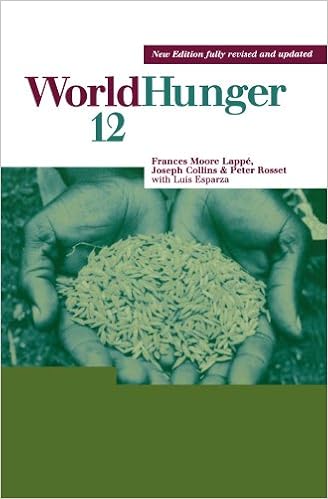
World Hunger (12 Myths) 2nd Edition, Kindle Edition
by Joseph Collins (Author)
4.5 out of 5 stars 24 ratings

ISBN-13: 978-1853834936
ISBN-10: 1853834939Why is ISBN important?
The revised edition of this text includes substantial new material on hunger in the aftermath of the Cold War; global food productioin versus population growth; changing demographics and falling birth rates around the world; the shifting focus of foreign assistance in the new world order; structural adjustment and other budget-slashing policies; trade liberalization and free trade agreements; famine and humanitarian interventions; and the thrid worldization of developed nations.
Kindle

from $24.42
Hardcover
from $49.89
Paperback
from $1.36
Editorial Reviews
From the Back Cover
The Revised and Updated Edition of the Classic on World Hunger from the Internationally Recognized Institute for Food and Development Policy/Food First.The completely revised Second Edition includes:
o Substantial new material on hunger in the aftermath of the Cold War
o Global food production vs. population growth
o Changing demographics and falling birth rates around the world
o The shifting focus of foreign assistance in the new world order
o Structural adjustment and other budget-slashing policies
o Trade liberalization and free trade agreements
o Famine and humanitarian interventions
o The Third Worldization of First World nations
In this completely revised and updated edition of the most authoritative book on world hunger, three of our foremost experts on food and agriculture expose and explode the myths that prevent us from effectively addressing the problem. Drawing on and distilling the extensive research of the Institute for Food and Development Policy (Food First), Lapp, Collins, and Rosset examine head-on the policies and politics that have kept hungry people from feeding themselves around the world, in both Third and First World countries, as well as the misconceptions that have obscured our own national, social, and humanitarian interests. Written in a straightforward, easy-to-read style, World Hunger: Twelve Myths shakes many tenaciously held beliefs; but most important, it convinces readers that by standing together with the hungry we can advance not only humanitarian interests, but our own well-being.
"World Hunger addresses problems of enormous human significance with valuable and often surprising information, much insight, sound common sense, and fundamental decency. It should become not only a book for study, but a guide to action."-Noam Chomsky, MIT
"A marvelously lucid message: the most important cause of death and disease is hunger; the remedy is food; the remedy exists. Their message swiftly demolishes the myths and powerfully arms us for the political task of ending hunger, here and throughout the world."-Dr. Barry Commoner
Frances Moore Lapp is the author of twelve books including the international bestseller, Diet for a Small Planet, and co-director of the Center for Living Democracy in Brattleboro, Vermont. In 1975, she and Joseph Collins founded the Oakland-based Institute for Food and Development Policy. Dr. Collins' many books include Food First: Beyond the Myth of Scarcity, and Aid as Obstacle: Twenty Questions About Our Foreign Aid and the Hungry (both with Lapp, as well as No Free Lunch: Food and Revolution in Cuba, and Chile's Free Market Miracle: A Second Look. An author, lecturer and consultant on international development issues, Collins makes his home in Santa Cruz, California. Peter Rosset is the Executive Director of the Institute for Food and Development Policy. Dr. Rosset's many books include A Cautionary Tale: Failed U.S. Development Policy in Central America, The Greening of the Revolution: Cuba's Experiment with Organic Agriculture, and Agroecology. Dr. Luis Esparza is a Geographer from the National Autonomous University of Mexico (UNAM).
o Substantial new material on hunger in the aftermath of the Cold War
o Global food production vs. population growth
o Changing demographics and falling birth rates around the world
o The shifting focus of foreign assistance in the new world order
o Structural adjustment and other budget-slashing policies
o Trade liberalization and free trade agreements
o Famine and humanitarian interventions
o The Third Worldization of First World nations
In this completely revised and updated edition of the most authoritative book on world hunger, three of our foremost experts on food and agriculture expose and explode the myths that prevent us from effectively addressing the problem. Drawing on and distilling the extensive research of the Institute for Food and Development Policy (Food First), Lapp, Collins, and Rosset examine head-on the policies and politics that have kept hungry people from feeding themselves around the world, in both Third and First World countries, as well as the misconceptions that have obscured our own national, social, and humanitarian interests. Written in a straightforward, easy-to-read style, World Hunger: Twelve Myths shakes many tenaciously held beliefs; but most important, it convinces readers that by standing together with the hungry we can advance not only humanitarian interests, but our own well-being.
"World Hunger addresses problems of enormous human significance with valuable and often surprising information, much insight, sound common sense, and fundamental decency. It should become not only a book for study, but a guide to action."-Noam Chomsky, MIT
"A marvelously lucid message: the most important cause of death and disease is hunger; the remedy is food; the remedy exists. Their message swiftly demolishes the myths and powerfully arms us for the political task of ending hunger, here and throughout the world."-Dr. Barry Commoner
Frances Moore Lapp is the author of twelve books including the international bestseller, Diet for a Small Planet, and co-director of the Center for Living Democracy in Brattleboro, Vermont. In 1975, she and Joseph Collins founded the Oakland-based Institute for Food and Development Policy. Dr. Collins' many books include Food First: Beyond the Myth of Scarcity, and Aid as Obstacle: Twenty Questions About Our Foreign Aid and the Hungry (both with Lapp, as well as No Free Lunch: Food and Revolution in Cuba, and Chile's Free Market Miracle: A Second Look. An author, lecturer and consultant on international development issues, Collins makes his home in Santa Cruz, California. Peter Rosset is the Executive Director of the Institute for Food and Development Policy. Dr. Rosset's many books include A Cautionary Tale: Failed U.S. Development Policy in Central America, The Greening of the Revolution: Cuba's Experiment with Organic Agriculture, and Agroecology. Dr. Luis Esparza is a Geographer from the National Autonomous University of Mexico (UNAM).
About the Author
Frances Moore Lappe' is the author of Diet for a Small Planet, which has sold over three million copies, and seventeen other books. She is a recipient of the Rightlivelihood Award, the "Alternative Nobel."
Rosset is executive director of Food First/The Institute for Food and Development Policy. He has a Ph.D. from the University of Michigan and teaches at Stanford University.
Joseph Collins has been researching and writing about international food and development issues for five decades. He is a consultant to the Unites Nations and international charities.
Rosset is executive director of Food First/The Institute for Food and Development Policy. He has a Ph.D. from the University of Michigan and teaches at Stanford University.
Joseph Collins has been researching and writing about international food and development issues for five decades. He is a consultant to the Unites Nations and international charities.
The Global Food Economy: The Battle for the Future of Farming
Tony Weis
3.4 out of 5 stars 2
Kindle Edition
AUD 31.79
Key Thinkers on Development (Routledge Key Guides)
David Simon
Kindle Edition
AUD 28.68
Farm Anatomy: The Curious Parts and Pieces of Country Life
Julia Rothman
4.8 out of 5 stars 233
Kindle Edition
AUD 16.22
Seeing Like a State: How Certain Schemes to Improve the Human…
James C. Scott
4.4 out of 5 stars 77
Kindle Edition
AUD 16.12
Profit Over People: Neoliberalism and Global Order
Noam Chomsky
4.3 out of 5 stars 166
Kindle Edition
AUD 15.83
Product details
File Size: 1388 KB
Print Length: 284 pages
Simultaneous Device Usage: Up to 4 simultaneous devices, per publisher limits
Publisher: Routledge; 2 edition (February 4, 2014)
Publication Date: February 4, 2014
More about the authorsDiscover books, learn about writers, read author blogs, and more.

Frances Moore Lappe
Customer reviews
4.5 out of 5 stars
4.5 out of 5
24 customer ratings
5 star 69%
4 star 23%
3 star 4%
2 star 0% (0%)
0%
1 star 4%
Review this product
Share your thoughts with other customers
Write a customer review
Top Reviews

M. A. Krul
5.0 out of 5 stars Essential introductory primer on global food issuesReviewed in the United States on November 7, 2008
Format: PaperbackVerified Purchase
Lappé et al.'s "World Hunger: Twelve Myths", a production of the Institute for Food and Development Policy, does exactly what it promises: it mentions and then subsequently refutes twelve often held false beliefs about global food issues and worldwide hunger.
Although most of the material in this book will be familiar to anyone who has made some study of development issues, economic theory, and Third World politics, it is nonetheless an excellent primer for those who do not. The accessible and simple writing style, the useful examples, the systematic approach to all the relevant issues in food policy, and the historical awareness in the book all combine to make it the best introduction to the world problematic of agriculture that one could give to family, friends and so forth.
The twelve myths addressed are familiar:
that the world is overpopulated,
that hunger is caused by absolute lack of food,
that food production cannot be both efficient and good for the environment,
that biotechnology will solve the problem for us (or has),
that free trade or free markets will solve the food issue,
that foreign aid is the best way to address it, and so forth.
Though the authors of the book shy away from any too radical conclusions in their refutations of the above, and they are sometimes quite naive in their appeal to people's interests (particularly in the part where they argue that the American working class has broadly the same interests as the Third World poor), nonetheless their facts and arguments are correct and to the point, and the conclusions the authors do not wish to draw are no less obvious for that. Lappé et al. can even help refute misconceptions about food widely held among the left, such as a distaste for organic production as inefficient or elitist, or the idea that as long as you eat vegetarian, you're not contributing to food or environmental problems.
In summary, although one should not take all the conclusions the authors draw at face value, this book is an excellent primer and introduction to global agriculture issues when it comes to the facts.
3 people found this helpful
HelpfulComment Report abuse

Sandy Penny
5.0 out of 5 stars The Politics of FoodReviewed in the United States on February 27, 2014
Format: PaperbackVerified Purchase
Frances Moore Lappe is a political and social visionary. The author of Diet for a Small Planet, in World Hunger, she points out how food is wrongly being used as a political tool. She gives us hope and guidance for making it better, in a voice that anyone can understand. She has dedicated her life to making sure that people get fed, that food is grown safely, and that we make cautious decisions about how we handle our food supply. I highly respect her opinions and recommend her books to anyone interested in the politics of food and how it affects our future.
HelpfulComment Report abuse

David May
4.0 out of 5 stars You should read this bookReviewed in the United States on February 15, 2010
Format: PaperbackVerified Purchase
This one really makes you rethink your ideas about humger. The authors take each of the presumed causes and presumed cures for hunger and show why they are not accurate and will not work. Each chapter in well documented, making it a little harder to read, but easier to believe. Toward the end, it begins to feel like a science fiction novel in the vein of 1984. A little scary in that respect.
They assert that the free trade legislation, agricultural trade laws, and even hunger relief efforts go to support the acquisition of more land by the big international corporations, reducing the land owned by individual families. Even when a smaller country is exporting huge amounts of food products, local people are still starving, because it is the international corporations that are doing the exporting, and sending the money out of the country.
The only solutiions, they say, are rather dramatic. They call for land redistribution, and greater sharing by the big international agricultural giants. They call for a balance between the free market and government regulation, in the interest of everyone having a way to produce enough to eat.
I recommend this one for everyone
A Call to Arms! Out of the Pews and Into the Streets
One person found this helpful
HelpfulComment Report abuse

Rafter
5.0 out of 5 stars Good overviewReviewed in the United States on December 6, 2013
Format: PaperbackVerified Purchase
Great overview of issues relating to chronic poverty. There are plenty of endnotes to support what the authors are saying and provide avenues for further investigation. I read a lot of development literature and books. Easy to read, great intro type book.
HelpfulComment Report abuse

No comments:
Post a Comment