
IDF Spokesperson, Brigadier General Effie Defrin, December 12, 2025. (IDF Spokesperson's Unit Facebook page; used in accordance with Clause 27a of the Copyright Law)
Inside the Israeli army’s propaganda wing
Psy-op campaigns, selective leaks, exclusive reporter access: Soldiers and journalists reveal how the IDF Spokesperson's Unit controls public discourse and promotes Israel's narrative abroad.
By Illy Pe’ery April 8, 2026
In partnership with

In October 2023, Gili was called up for reserve duty in the IDF Spokesperson’s Unit and assigned to the Northern Command. In the days following Hamas’ attacks, while public attention in Israel was fixed on the devastation in the south, Hezbollah began launching rockets and anti-tank missiles toward northern Israel.
“We were working 12-hour shifts in an underground operations room, while soldiers in outposts were terrified, but we couldn’t convey that the north was on fire,” she recalled. “We downplayed the northern front to avoid causing public panic, even though there were constant launches. People weren’t dying like in the south, but I remember feeling we were creating an inaccurate picture: We showed far more strength than vulnerability.”
The experience left Gili, who requested to use a pseudonym, questioning the very system she had served for years. “It was always easy to repeat that ‘The IDF is prepared for any scenario,’” she continued. “Who were we to question it? But in reality, it was bullshit.
Subscribe to The Landline
+972's weekly newsletter
Sign up
“You can see it now with Iran, too: The focus is almost entirely on the army’s overwhelming power, and not much beyond that,” she explained. “It doesn’t reassure me when I’m told how hard the IDF is striking or about air superiority over Tehran. At the end of the day, ballistic missiles are still being fired at us, and there’s no normal routine. There are air defense systems, but for every 10 successful interceptions, there are also direct hits.”
Asked whom she believes today, Gili answered without hesitation: “No one. Not what the IDF Spokesperson says, and not the military correspondents either. They’re mouthpieces.”

Anti-missile system fires interceptors at Iranian missiles, as seen over central Israel, February 28, 2026. (Yossi Aloni/Flash90)
Speaking to the Israeli investigative outlet The Hottest Place in Hell, soldiers in the IDF Spokesperson’s Unit and military correspondents for Israeli publications pointed to a systematic pattern: an obsessive drive to control the public discourse, preferential treatment for “convenient” journalists while sidelining and punishing critical ones, and, above all, an organizational culture of deception.
During the first 14 months of Israel’s war in Gaza, the IDF Spokesperson’s Unit also ran a covert psychological operations campaign aimed at shaping public opinion in Israel and abroad, as The Hottest Place in Hell recently revealed. In parallel to these influence efforts, the unit was tasked with processing and distributing footage from Hamas’ October 7 attack on Israeli communities near Gaza.
According to testimonies, soldiers collected large volumes of visual material — including footage filmed by Hamas militants — and reformatted it for rapid circulation on social media platforms.
This process culminated in “Bearing Witness to the October 7 Massacre,” or what became known in Israel as the “atrocities video”: a 47-minute compilation of raw footage produced under the supervision of Major (res.) Yuval Horowitz, head of the campaigns division.
“It was like the Wild West — there was no censorship,” said a soldier who served in the unit and worked on the film. “We were flooded with material and saw everything. I was in shock, but at the same time, there was pressure to distribute as much as possible — it was like in a social media [advertising campaign]: What works? What doesn’t? What gets attention?”
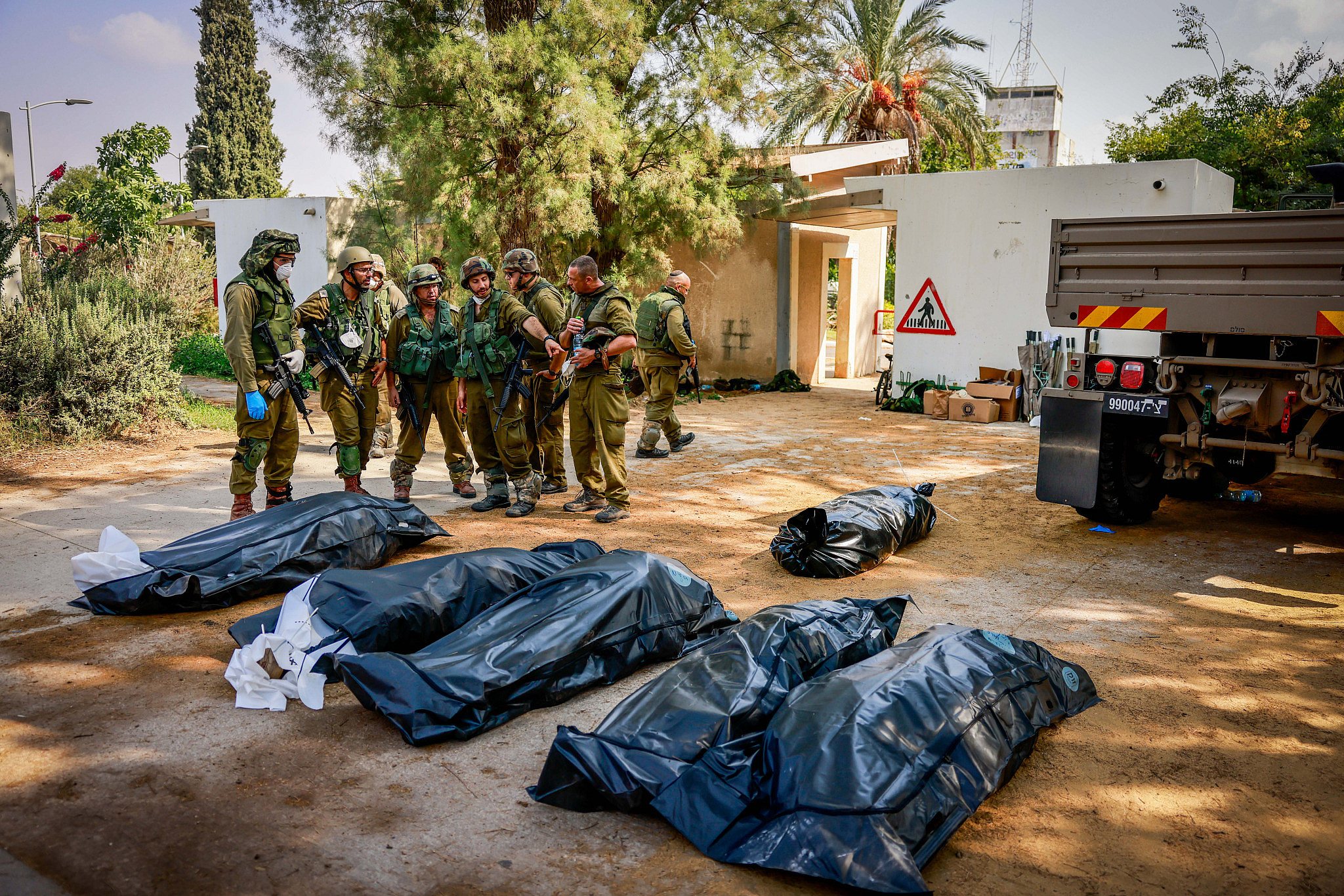
Israeli soldiers remove bodies of Israeli civilians in Kibbutz Kfar Aza, near the Israeli-Gaza fence, in southern Israel, October 10, 2023. (Chaim Goldberg/Flash90)
“The IDF Spokesperson lies,” one senior military correspondent told The Hottest Place in Hell. “Sometimes it’s about manipulating data, but ultimately the public is the one caught off guard.
“At the beginning of ‘Operation Roaring Lion,’” he continued, referring to the current war with Iran, “the IDF claimed it had destroyed 70 percent of Iran’s missile launchers. We checked and quickly realized it wasn’t accurate — sometimes they hit tunnel entrances, not the launchers themselves, or the launchers kept firing despite being ‘destroyed.’ In major outlets, no one questions it. But when the war ends and rockets are still being fired, the public won’t understand how.”
After nearly two and a half years of continuous war, the Israeli public’s trust in the army’s narrative appears to be eroding. Between sirens, more and more Israelis are asking: Are we really achieving what we’re told we are? And if so, why are we still running to shelters?
The making of a hidden influence operation
On Oct. 29, 2023, a group titled “Fact Check – Daily Content” appeared on WhatsApp. Its English-language description presented the initiative as a neutral educational effort: “a non-profit organization working to provide students with information and facts regarding the ongoing war between Israel and the terrorist organization Hamas.”
Two weeks later, on Nov. 12, a YouTube channel called “Fact Check” was created using a U.S.-based account, again presenting itself as a “non-profit news organization.” An Instagram account under the same branding followed the next day.
In reality, as the Hottest Place in Hell recently uncovered, it was the IDF Spokesperson’s Unit that had launched and operated these channels. This propaganda campaign ran from October 2023 to December 2024 under the guise of an independent, non-profit media initiative branded as a “fact-checking” outlet. During that time, it produced and disseminated dozens of videos advancing Israeli military narratives without disclosing their origin.

A screenshot of the fake Instagram account “factcheck_daily” set up by the IDF Spokesperson’s Unit and which operated between October 2023 and December 2024.
None of the channels managed to attract a large subscriber base. However, the operation recruited dozens of Israeli and pro-Israeli international influencers to amplify messaging coordinated by the military, including Noa Tishby and Sarai Givaty, alongside other figures from Jewish communities abroad. Content was distributed across WhatsApp, YouTube, and Instagram, reaching millions of viewers.
The videos advanced a range of arguments closely aligned with official Israeli messaging. These included claims that Jews cannot be considered colonizers in Palestine due to their historical ties to the biblical Kingdom of Judah, while “Arabs” are the true “colonizers of the land”; assertions that Israel’s actions in Gaza do not amount to genocide; and defenses against war crimes allegations against Israel at the International Court of Justice.
“The channels [on YouTube, WhatsApp, and Instagram] targeted foreign audiences and presented themselves as objective and unaffiliated with Israel,” one soldier involved in producing the videos told The Hottest Place in Hell in an interview. “But everything was created within our unit and clearly promoted the Israeli narrative.
“The campaigns division is the most morally gray area within the IDF Spokesperson’s Unit,” the soldier continued. “At first, it felt urgent to show the world what we had gone through. But very quickly, that shifted. Gaza was being flattened, and the narrative that may have held in the early weeks began to unravel. By the time I was discharged, I felt a deep sense of revulsion at having been part of it.”
The investigation suggests that this was not an isolated initiative, but part of a broader pattern of psychological operations conducted by the IDF Spokesperson’s Unit.
In May 2021, during what the Israeli military dubbed “Operation Guardian of the Walls,” the unit’s campaigns division launched a social media initiative under the hashtag #GazaRegrets, aimed at boosting support for the military’s actions in Gaza among the Israeli public. As part of the project, soldiers operated fake accounts that shared images of Israeli airstrikes in Gaza alongside the hashtag, while interacting with social media accounts belonging to supporters of Prime Minister Benjamin Netanyahu and other right-wing politicians — all without disclosing their affiliation with the military.

From left to right, Maj. (res.) Yuval Horowitz, commander of the campaigns unit in the IDF Spokesperson’s Division, and Former IDF Spokesperson Daniel Hagari. Under Horowitz’s supervision, psychological operations were conducted. (IDF Spokesperson Unit Facebook page; used in accordance with Clause 27a of the Copyright Law)
Following a Haaretz investigation that exposed the campaign, the army acknowledged its involvement and described it as a “mistake.” However, The Hottest Place in Hell’s findings indicate that similar methods continued to be employed in the years that followed.
The army’s ‘carrot and stick approach’
The IDF Spokesperson’s Unit serves as the public’s primary gateway to the military, mediated through the press. To obtain information, verify details, or interview military officials, journalists must go through the unit — imbuing it with a power that, according to journalists and soldiers who spoke to The Hottest Place in Hell, is often abused to distort media coverage, and by extension, the Israeli public’s perception of the army.
Roni enlisted in the Israeli army in 2019 and served in this unit. Like many others, she was called back as a reservist after October 7, rotating through roles that included responding to journalists’ inquiries and distributing messaging briefs. “It was almost addictive,” she recalled. “The scale of responsibility made me deeply invested. I was available 24/7 — [receiving] constant phone calls. I felt like I was doing something huge.”
The unit is divided into multiple branches across army divisions and departments. Field spokespersons — officers typically holding the rank of captain or major — are embedded in commands and brigades and are responsible for responding to media inquiries.
For example, if a journalist requests information about an incident in the West Bank, headquarters will refer the request to the Central Command’s spokesperson team, which gathers details from the relevant units and formulates an official response. Field spokespersons are also tasked with identifying “stories” within units that can be pitched to media outlets, essentially functioning as a public relations arm.

A reporter for Israeli Army Radio, November 11, 2019. (Moshe Shai/Flash90)
The unit’s more familiar role, however, is its media-facing function, with specialized departments handling television, print, digital, and radio. When journalists seek a response to their story, they typically contact the department aligned with their platform — except for a select group of 16 Israeli reporters who belong to the so-called “correspondents’ cell.”
“Members of the cell receive exclusive briefings, conferences, hotlines, and special events,” Roni explained. “There were reporters and outlets that weren’t admitted for years, and others were reassigned to less prestigious departments — say, from the national InterRadio desk to the one for local outlets — because they were critical of the IDF. I wasn’t at the level where those decisions were made, but often it came down to a reporter’s attitude toward us — it’s a system of give and take.”
One journalist told The Hottest Place in Hell that his reporting sometimes came at a professional cost. “I was very critical of the IDF, and they didn’t like it. People inside the military told me my criticism was excessive, even people within the Spokesperson’s Unit,” he said. He was boycotted by the unit for years, until his publication applied pressure and forced the army to admit him to the cell.
“When I joined the correspondents’ cell, I realized that wasn’t the end of it — there are ‘castes’ within the group, [with] clear prioritization of less critical reporters,” he continued. “Television correspondents are favored, especially those seen as aligned with the IDF narrative. You can see the hierarchy: For example, during Zoom briefings, some prominent reporters don’t even attend but they still publish the information, meaning they received it in advance.”
“The IDF Spokesperson operates using a carrot-and-stick approach,” another senior military correspondent said, speaking anonymously. “If you criticize them, you get punished.”
Yaniv Kubovich, military correspondent for Haaretz, has been behind several major wartime exposés. Speaking to The Hottest Place in Hell, he said that when he sought responses from the IDF Spokesperson, the unit’s primary goal was to block publication — not to provide accurate information.
“I approached them with everything I had, but they were focused solely on getting me to drop the story and avoiding a response,” he said. “After October 7, with all the trauma it experienced, the IDF is doing everything it can to suppress reporting that exposes failures, ethical issues, or command shortcomings, instead of examining what actually happened. In that sense, it has reverted to the same arrogance as before: the belief that no one can criticize it through the press.”

Former IDF Spokesperson Daniel Hagari attends a Defense and Foreign Affairs Committee meeting at the Knesset, the Israeli parliament in Jerusalem on December 24, 2024. (Chaim Goldberg/Flash90)
Kubovich, a longtime member of the correspondents’ cell, described it primarily as a tool of control. “The relationship between the IDF Spokesperson and the correspondents’ cell is absurd. The dependency is absolute,” he said. “It allows them to decide when we speak and with whom.
“We’ve been at war for so long, and we’ve met the chief of staff maybe twice. Since [Chief of Staff Eyal] Zamir took office, we haven’t met the Southern Command chief even once — despite it being the most critical front. He won’t meet critical reporters because it might hurt morale.”
Selective leaks and exclusive access
During her service, Roni helped decide whether and how to respond to journalists. “When we chose not to respond, it was often to very problematic reports, but also to journalists we preferred not to engage with,” she said. Another practice involved selective leaks — or, as Roni put it, ensuring that “certain materials were published by one outlet and not another.”
This was the case in December 2024, when, for two weeks, the IDF Spokesperson’s Unit refused to explain how activists from Uri Tsafon — an Israeli group that promotes settlement of southern Lebanon — crossed into Lebanese territory unhindered. After initially denying that any civilians had breached the border, the unit reversed course and leaked the information to Doron Kadosh, the military correspondent for Israeli Army Radio. Kadosh then promoted the army’s framing of the incident as a “serious incident that was being investigated,” adding that “several operations were carried out to block passages in the fence.”
“Military reporters who don’t eat from the IDF Spokesperson’s hand starve,” Roni said. “It takes a lot of effort to find sources outside the system, and that gave us a lot of leverage.” This dynamic extends beyond access to briefings or official responses. As Roni noted, these “give-and-take” relationships translate into power, prestige, and financial incentives.
Most read on +972
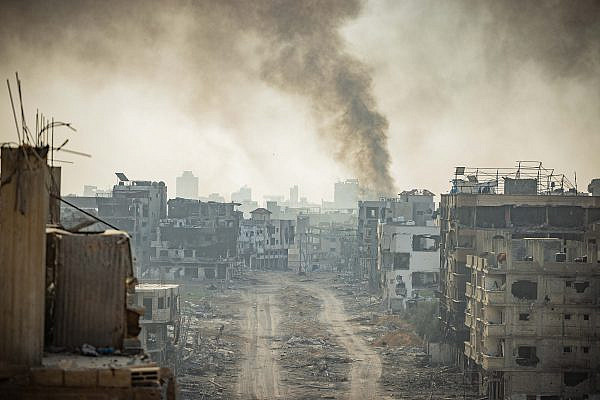
‘Lavender’: The AI machine directing Israel’s bombing spree in Gaza

PHOTOS: How hypermilitarism pervades everyday life in Israel

What Israelis can learn from the nightmares of an Iranian hangman
“At the end of the day, we work for ratings,” one journalist said, speaking anonymously to The Hottest Place in Hell. “When something happens, the correspondents’ cell is briefed first — they’re the first to publish. If you’re not part of that group and aren’t sharp enough as a journalist and publish 10 minutes behind the others, you’re irrelevant.”
In effect, the Spokesperson’s Unit uses the public trust placed in it not only to manage information, but to influence the commercial competition between media outlets. “The unit gives a certain story to Channel 12 because they have ratings, but because they also gave them the previous stories, they create interference in the competition,” the journalist noted.
“It pulls the entire system into a loop,” another journalist said. “We had internal debates about whether it was worth confronting the unit. But ultimately, owners see competitors getting the stories and want the same. It all comes down to controlling journalists and suppressing criticism.”
The IDF Spokesperson declined to comment.
Versions of this article were first published in Hebrew on The Hottest Place in Hell. Read them here and here.
IDF spokesperson's unit
2026 U.S.-Israeli war with Iran
October 7 war
Israeli propaganda
Israeli army
Media
Illy Pe’ery is an investigative reporter and associate editor at the independent Israeli online magazine The Hottest Place in Hell.

No comments:
Post a Comment