Robert David Putnam[a] (born January 9, 1941) is an American political scientist specializing in comparative politics. He is the Peter and Isabel Malkin Professor of Public Policy at the Harvard University John F. Kennedy School of Government. Putnam developed the influential two-level game theory that assumes international agreements will only be successfully brokered if they also result in domestic benefits. His most famous work, Bowling Alone, argues that the United States has undergone an unprecedented collapse in civic, social, associational, and political life (social capital) since the 1960s, with serious negative consequences.[5] In March 2015, he published a book called Our Kids: The American Dream in Crisis that looked at issues of inequality of opportunity in the United States.[6] According to the Open Syllabus Project, Putnam is the fourth most frequently cited author on college syllabi for political science courses.[7]
Life and career[edit]
Robert David Putnam was born on January 9, 1941, in Rochester, New York,[8] and grew up in Port Clinton, Ohio,[9] where he participated in a competitive bowling league as a teenager.[10] Putnam graduated from Swarthmore College in 1963 where he was a member of Phi Sigma Kappa fraternity. He won a Fulbright Fellowship to study at Balliol College, Oxford, and went on to earn a master's degree and doctorate from Yale University, the latter in 1970. He taught at the University of Michigan until joining the faculty at Harvard in 1979, where he has held a variety of positions, including Dean of the Kennedy School, and is currently the Malkin Professor of Public Policy. Putnam was raised as a religiously observant Methodist. In 1963, Putnam married his wife Rosemary, a special education teacher and French horn player.[10] Around the time of his marriage, he converted to Judaism, his wife's religion.[11]
Making Democracy Work[edit]
His first work in the area of social capital was Making Democracy Work: Civic Traditions in Modern Italy. published in 1993. It is a comparative study of regional governments in Italy that drew great scholarly attention for its argument that the success of democracies depends in large part on the horizontal bonds that make up social capital.[12] Putnam writes that northern Italy's history of community, guilds, clubs, and choral societies led to greater civic involvement and greater economic prosperity.[13] Meanwhile, the agrarian society of Southern Italy is less prosperous economically and democratically because of less social capital. Social capital, which Putnam defines as "networks and norms of civic engagement", allows members of a community to trust one another.[13] When community members trust one another, trade, money-lending, and democracy flourish.[citation needed]
Putnam's finding that social capital has pro-democracy effects has been rebutted by a sizable literature which finds that civic associations have been associated with the rise of anti-democratic movements.[14][15][16]
Bowling Alone[edit]
In 1995, he published "Bowling Alone: America's Declining Social Capital" in the Journal of Democracy. The article was widely read and garnered much attention for Putnam, including an invitation to meet with then-President Bill Clinton and a spot in the pages of People.
In 2000, he published Bowling Alone: The Collapse and Revival of American Community, a book-length expansion of the original argument, adding new evidence and answering many of his critics. Though he measured the decline of social capital with data of many varieties, his most striking point was that many traditional civic, social and fraternal organizations – typified by bowling leagues – had undergone a massive decline in membership while the number of people bowling had increased dramatically.
Putnam distinguishes two kinds of social capital: bonding capital and bridging capital. Bonding occurs among similar people (same age, same race, same religion, etc.), while bridging involves the same activities among dissimilar people. He argues that peaceful multi-ethnic societies require both types.[17] Putnam argues that those two kinds of social capital, bonding and bridging, do strengthen each other. Consequently, with the decline of the bonding capital mentioned above inevitably comes the decline of the bridging capital leading to greater ethnic tensions.
In 2016, Putnam explained his inspiration for the book, by saying,
We've [Americans] been able to run a different kind of society. A less statist society, a more free-market society, because we had real strength in the area of social capital and we had relatively high levels of social trust. We sort of did trust one another, not perfectly, of course, but we did. Not compared to other countries. And all that is declining, and I began to worry, "Well, gee, isn't that going to be a problem, if our system is built for one kind of people and one kind of community, and now we've got a different one. Maybe it's not going to work so well."[18]
Critics such as the sociologist Claude Fischer argue that (a) Putnam concentrates on organizational forms of social capital, and pays much less attention to networks of interpersonal social capital; (b) Putnam neglects the emergence of new forms of supportive organizations on and off the Internet; and (c) the 1960s are a misleading baseline because the era had an unusually high number of traditional organizations.[citation needed]
Since the publication of Bowling Alone, Putnam has worked on efforts to revive American social capital, notably through the Saguaro Seminar, a series of meetings among academics, civil society leaders, commentators, and politicians to discuss strategies to re-connect Americans with their communities. These resulted in the publication of the book and website, Better Together, which provides case studies of vibrant and new forms of social capital building in the United States.
Social capital[edit]
Putnam theorizes a relation in the negatives trends in society. He envisions a uniting factor named social capital; originally coined (no evidence provided) by social theorist Alexis de Tocqueville as a strength within America allowing democracy to thrive due to the closeness of society, "trends in civic engagement of a wider sort".[19] Putnam observes a declining trend in social capital since the 1960s. The decreasing in social capital is blamed for rising rates in unhappiness as well as political apathy. Low social capital, a feeling of alienation within society is associated with additional consequences such as:
- Lower confidence in local government, local leaders and the local news media.
- Lower political efficacy – that is, confidence in one's own influence.
- Lower frequency of registering to vote, but more interest and knowledge about politics and more participation in protest marches and social reform groups.
- Higher political advocacy, but lower expectations that it will bring about a desirable result.
- Less expectation that others will cooperate to solve dilemmas of collective action (e.g., voluntary conservation to ease a water or energy shortage).
- Less likelihood of working on a community project.
- Less likelihood of giving to charity or volunteering.
- Fewer close friends and confidants.
- Less happiness and lower perceived quality of life.
- More time spent watching television and more agreement that "television is my most important form of entertainment".
Diversity and trust within communities[edit]
In recent years, Putnam has been engaged in a comprehensive study of the relationship between trust within communities and their ethnic diversity. His conclusion based on over 40 cases and 30,000 people within the United States is that in the short term, other things being equal, more diversity in a community is associated with less trust both among and within ethnic groups. Putnam describes people of all races, sex, socioeconomic statuses, and ages as "hunkering down", avoiding engagement with their local community as diversity increases. Although limited to American data, his findings run counter to contact hypothesis, which proposes that distrust declines as members of different ethnic groups interact, and conflict theory, which suggests that while distrust among ethnic groups rises with diversity, distrust within ethnic groups should decrease. Putnam found that even when controlling for income inequality and crime rates, two factors which conflict theory states should be prime causal factors in declining inter-ethnic group trust, more diversity is still associated with less communal trust. Further, he found that low communal trust is associated with the same consequences as low social capital. Putnam says, however, that "in the long run immigration and diversity are likely to have important cultural, economic, fiscal, and developmental benefits."[20]
Putnam published his data set from this study in 2001[22] and subsequently published the full paper in 2007.[20]
Putnam has been criticized for the lag between his initial study and his publication of his article. In 2006, Putnam was quoted in the Financial Times as saying he had delayed publishing the article until he could "develop proposals to compensate for the negative effects of diversity" (quote from John Lloyd of Financial Times).[23] In 2007, writing in City Journal, John Leo questioned whether this suppression of publication was ethical behavior for a scholar, noting that "Academics aren't supposed to withhold negative data until they can suggest antidotes to their findings."[24] On the other hand, Putnam did release the data in 2001 and publicized this fact.[25]
Putnam denied allegations he was arguing against diversity in society and contended that his paper had been "twisted" to make a case against race-based admissions to universities. He asserted that his "extensive research and experience confirm the substantial benefits of diversity, including racial and ethnic diversity, to our society."[26]
Recognition[edit]
Memberships and fellowships[edit]
He has been a member of Phi Beta Kappa since 1963, the International Institute of Strategic Studies since 1986, the American Philosophical Society since 2005[27] and the National Academy of Sciences since 2001. He has been a Fellow of the American Academy of Arts and Sciences from 1980 and a Corresponding Fellow of the British Academy from 2001 and was a Fellow of the National Academy of Public Administration, 1989–2006 and Center for Advanced Study in the Behavioral Sciences, 1974–1975 and 1988–1989. Other fellowships included the Guggenheim 1988–1989; the Woodrow Wilson International Center for Scholars 1977 and 1979; Fulbright 1964–1965 and 1977; SSRC-ACLS 1966–1968; Ford Foundation, 1970; German Marshall Fund, 1979; SSRC-Fulbright, 1982; SSRC-Foreign Policy Studies, 1988–1989 and was made a Harold Lasswell Fellow by the American Academy of Political and Social Science. Robert Putnam was a fellow of the Council on Foreign Relations 1977–1978 and a member since 1981. He was a member of the Trilateral Commission from 1990 to 1998.[28]: 2 He was the President of the American Political Science Association (2001–2002).[29] He had been Vice-President 1997–1998.[28]: 3
In 2004 the President of the Italian Republic made him a Commander of the Order of the Star of Italian Solidarity. He was awarded the Johan Skytte Prize in Political Science in 2006 and a Wilbur Lucius Cross Medal by the Yale Graduate School of Arts and Sciences in 2003, he was a Marshall Lecturer at the University of Cambridge in 1999 and was honored with the Ithiel de Sola Pool Award and Lectureship of the American Political Science Association.[28]
He has received honorary degrees from Stockholm University (in 1993), Ohio State University (2000), University of Antwerp (also 2000), University of Edinburgh (2003), Libera Università Internazionale degli Studi Sociali Guido Carli (2011), University of Oxford (2018), and University College London (2019).[30][28]: 1 [31]
In 2013, he was awarded the National Humanities Medal by President Barack Obama for "deepening our understanding of community in America."[32]
In 2015, he was awarded the University of Bologna, ISA Medal for Science for research activities characterized by excellence and scientific value.
Published works[edit]
| External videos |
|---|
 Presentation by Putnam on Bowling Alone, June 7, 2000, C-SPAN |
| Booknotes interview with Putnam on Bowling Alone, December 24, 2000, C-SPAN |
| Presentation by Putnam and Lewis Feldstein on Better Together, September 18, 2003, C-SPAN |
| Presentation by Putnam on Our Kids, March 31, 2015, C-SPAN |
- The Beliefs of Politicians: Ideology, Conflict, and Democracy in Britain and Italy New Haven: Yale University Press, (1973)
- "The Italian Communist Politician" in Communism in Italy and France eds. Donald Blackmer and Sidney Tarrow, Princeton: Princeton University Press
- The Comparative Study of Political Elites Englewood Cliffs, New Jersey: Prentice-Hall, (1976)
- Bureaucrats and Politicians in Western Democracies (with Joel D. Aberbach and Bert A. Rockman, 1981)
- Hanging Together: Cooperation and Conflict in the Seven-Power Summits (with Nicholas Bayne, 1984; revised 1987)
- "Diplomacy and Domestic Politics: The Logic of Two-Level Games". International Organization. 42 (Summer 1988): 427–460.
- Making Democracy Work: Civic Traditions in Modern Italy (with Robert Leonardi and Raffaella Nanetti, 1993)
- Bowling Alone: The Collapse and Revival of American Community (2000) ISBN 978-0-7432-0304-3
- Democracies in Flux: The Evolution of Social Capital in Contemporary Society (Edited by Robert D. Putnam), Oxford University Press, (2002)
- Better Together: Restoring the American Community (with Lewis M. Feldstein, 2003) ISBN 978-1-4391-0688-4
- Robert D. Putnam (June 2007). "E Pluribus Unum: Diversity and Community in the Twenty-first Century The 2006 Johan Skytte Prize Lecture". Scandinavian Political Studies. Johan Skytte Prize in Political Science. 30 (2): 137–174. doi:10.1111/J.1467-9477.2007.00176.X. ISSN 0080-6757. Wikidata Q55880625.
- Clark, Tom; Putnam, Robert D.; Fieldhouse, Edward (2010). The Age of Obama: The Changing Place of Minorities in British and American Society (Illustrated ed.). Manchester, England: Manchester University Press. ISBN 978-0719082788.
- Putnam, Robert D.; Campbell, David E. (2012). American Grace: How Religion Divides and Unites Us. New York: Simon & Schuster. ISBN 978-1416566731.
- Putnam, Robert D. (2015). Our Kids: The American Dream in Crisis (Hardcover ed.). New York: Simon & Schuster. ISBN 978-1476769899.
- Putnam, Robert D.; Bridgeland, John (October 19, 2017). "America needs big ideas to heal our divides. Here are three". PBS NewsHour. WETA. Retrieved December 7, 2022.
- Putnam, Robert D.; Garrett, Shaylyn Romney (October 13, 2020). The Upswing: How America came together a century ago and how we can do it again (Hardcover) (1st ed.). New York: Simon & Schuster. ISBN 978-1-9821-2914-9. OCLC 1142896590.
- Putnam, Robert D.; Babcock-Lumish, Terry (September 28, 2022). "The White House bowling alley is a symbol of what's wrong with US politics". The Boston Globe. Retrieved September 28, 2022.
Interviews[edit]
- Putnam, Robert D. (May 31, 2000). "Going Bowling". All Things Considered (Interview). Interviewed by Robert Siegel. NPR. Retrieved December 7, 2022.
- Putnam, Robert D. (August 15, 2007). "Political Scientist: Does Diversity Really Work?". Tell Me More (Interview). Interviewed by Michel Martin. NPR. Retrieved December 7, 2022.
- Putnam, Robert D. (October 11, 2010). "Religious Diversity and the Building Blocks of 'American Grace'". PBS NewsHour (Interview). Interviewed by Paul Solman. WETA. Retrieved December 7, 2022.
- Putnam, Robert D. (March 7, 2015). "'Bowling Alone' Author Tackles The American Dream". Weekend Edition (Interview). Interviewed by Scott Simon. NPR. Retrieved December 7, 2022.
- Putnam, Robert D. (March 19, 2015). "What's splitting a new generation of haves and have-nots". PBS NewsHour (Interview). Interviewed by Paul Solman. WETA. Retrieved December 7, 2022.
- Putnam, Robert D. (March 19, 2015). "Why you should care about other people's kids". PBS NewsHour (Interview). Interviewed by Paul Solman. WETA. Retrieved December 7, 2022.
- Putnam, Robert D. (April 19, 2015). "Robert Putnam on Our Kids: The American Dream in Crisis" (Interview). Interviewed by Rich Fahle. PBS. Retrieved December 7, 2022.
- Putnam, Robert D. (November 10, 2020). "How U.S. history could provide a path out of polarization". PBS NewsHour (Interview). Interviewed by Paul Solman. WETA. Retrieved December 7, 2022.
- Putnam, Robert D. (March 15, 2022). "Politics And America's Loneliness Epidemic" (Interview). Interviewed by Danielle Kurtzleben. NPR. Retrieved December 7, 2022.
See also[edit]
References[edit]
- ^ Putnam, Robert David (1970). Politicians and Politics: Themes in British and Italian Elite Political Culture (PhD thesis). New Haven, Connecticut: Yale University Press. OCLC 83494112.
- ^ Campbell, David E. "Curriculum Vitae" (PDF). Notre Dame, Illinois: University of Notre Dame. Archived from the original (PDF) on July 31, 2019. Retrieved October 27, 2018.
- ^ Rayside, David. "Biography: Introduction". David Rayside. Retrieved October 27, 2018.
- ^ Fabbrini, Sergio (2011). "Robert D. Putnam Between Italy and the United States" (PDF). Bulletin of Italian Politics. 3 (2): 391–399. ISSN 1759-3077. Archived from the original (PDF) on August 3, 2018.
- ^ Marc Parry, "Can Robert Putnam Save the American Dream" Chronicle of Higher Education, March 12, 2015 Chronicle Review
- ^ "Press release on book release". robertdputnam.com. Retrieved April 1, 2015.
- ^ "Open Syllabus: Explorer".
- ^ "Robert D. Putnam Curriculum Vitae" (PDF). The Finnish Children and Youth Foundation. March 2006. Archived from the original (PDF) on October 19, 2016. Retrieved August 22, 2012.
- ^ "Robert D. Putnam on Conversations with Bill Kristol".
- ^ Jump up to:a b Louis Uchitelle (May 6, 2000). "Lonely Bowlers, Unite: Mend the Social Fabric; A Political Scientist Renews His Alarm At the Erosion of Community Ties" (Book review). The New York Times. Retrieved August 22, 2012.
- ^ The Forward, Robert Putnam Assays Religious Tolerance From a Unique Angle, Retrieved November 26, 2010
- ^ Putnam, Robert D. (1994). Making Democracy Work: Civic Traditions in Modern Italy. Princeton University Press. ISBN 978-0-691-03738-7.[page needed]
- ^ Jump up to:a b Putnam, Robert D. (1993). "What Makes Democracy Work?". National Civic Review. 82 (2): 101–107. doi:10.1002/ncr.4100820204.
- ^ Berman, Sheri (1997). "Civil Society and the Collapse of the Weimar Republic". World Politics. 49 (3): 401–429. doi:10.1353/wp.1997.0008. ISSN 0043-8871. JSTOR 25054008. S2CID 145285276.
- ^ Riley, Dylan (2005). "Civic Associations and Authoritarian Regimes in Interwar Europe: Italy and Spain in Comparative Perspective". American Sociological Review. 70 (2): 288–310. doi:10.1177/000312240507000205. ISSN 0003-1224. S2CID 2338744.
- ^ Satyanath, Shanker; Voigtländer, Nico; Voth, Hans-Joachim (2017). "Bowling for Fascism: Social Capital and the Rise of the Nazi Party". Journal of Political Economy. 125 (2): 478–526. doi:10.1086/690949. ISSN 0022-3808. S2CID 3827369.
- ^ Putnam, Robert D. (2001). Bowling Alone: The Collapse and Revival of American Community. New York: Touchstone. pp. 22–23. ISBN 978-0-7432-0304-3.
- ^ "Robert D. Putnam on Conversations with Bill Kristol".
- ^ Putnam, Robert D. (1995). "Bowling Alone: America's Declining Social Capital". Journal of Democracy. 6: 65–78. doi:10.1353/jod.1995.0002. S2CID 154350113.
- ^ Jump up to:a b Putnam, Robert D. (June 2007). "E Pluribus Unum: Diversity and community in the twenty-first century". Scandinavian Political Studies. 30 (2): 137–174. doi:10.1111/j.1467-9477.2007.00176.x. S2CID 14234366. The 2006 Johan Skytte Prize Lecture.
- ^ Hendrix, Anastasia (March 1, 2001). "Fewer In S.F. Attend Church / Survey says South Bay people busiest working". The San Francisco Chronicle. Hearst Corporation. Archived from the original on September 16, 2011.
- ^ Lloyd, John (October 8, 2006). "Study paints bleak picture of ethnic diversity". The Financial Times. London. Retrieved August 22, 2012.
- ^ Leo, John (June 25, 2007). "Bowling with our own". City Journal. Manhattan Institute for Policy Research.
- ^ "The Social Capital Community Benchmark Survey". www.ksg.harvard.edu. June 2023.
- ^ Berlett, Tom (August 15, 2012). "Harvard Sociologist Says His Research Was 'Twisted'". The Chronicle of Higher Education.
- ^ "APS Member History". search.amphilsoc.org. Retrieved June 8, 2021.
- ^ Jump up to:a b c d "ROBERT D. PUTNAM Curriculum Vitae March 2006" (PDF). Archived from the original (PDF) on October 19, 2016. Retrieved July 22, 2010.
- ^ "American Political Science Association > ABOUT > Governance > APSA Presidents and Presidential Addresses: 1903 to Present". www.apsanet.org.
- ^ .[1] Archived June 26, 2013, at archive.today
- ^ UCL (September 10, 2019). "UCL welcomes over 15,000 new graduates to the alumni community". UCL Campaign. Retrieved October 13, 2019.
- ^ President Obama to Award 2012 National Medal of Arts and National Humanities Medal Whitehouse.gov, retrieved June 30, 2013
Further reading[edit]
- Utter, Glenn H. and Charles Lockhart, eds. American Political Scientists: A Dictionary (2nd ed. 2002) pp 328–31, online.
External links[edit]


'/%3E%3Cpath d='M16.0001 7.9996c0 4.418-3.5815 7.9996-7.9995 7.9996S.001 12.4176.001 7.9996 3.5825 0 8.0006 0C12.4186 0 16 3.5815 16 7.9996Z' fill='url(%23paint1_radial_15251_63610)'/%3E%3Cpath d='M16.0001 7.9996c0 4.418-3.5815 7.9996-7.9995 7.9996S.001 12.4176.001 7.9996 3.5825 0 8.0006 0C12.4186 0 16 3.5815 16 7.9996Z' fill='url(%23paint2_radial_15251_63610)' fill-opacity='.5'/%3E%3Cpath d='M7.3014 3.8662a.6974.6974 0 0 1 .6974-.6977c.6742 0 1.2207.5465 1.2207 1.2206v1.7464a.101.101 0 0 0 .101.101h1.7953c.992 0 1.7232.9273 1.4917 1.892l-.4572 1.9047a2.301 2.301 0 0 1-2.2374 1.764H6.9185a.5752.5752 0 0 1-.5752-.5752V7.7384c0-.4168.097-.8278.2834-1.2005l.2856-.5712a3.6878 3.6878 0 0 0 .3893-1.6509l-.0002-.4496ZM4.367 7a.767.767 0 0 0-.7669.767v3.2598a.767.767 0 0 0 .767.767h.767a.3835.3835 0 0 0 .3835-.3835V7.3835A.3835.3835 0 0 0 5.134 7h-.767Z' fill='%23fff'/%3E%3Cdefs%3E%3CradialGradient id='paint1_radial_15251_63610' cx='0' cy='0' r='1' gradientUnits='userSpaceOnUse' gradientTransform='rotate(90 .0005 8) scale(7.99958)'%3E%3Cstop offset='.5618' stop-color='%230866FF' stop-opacity='0'/%3E%3Cstop offset='1' stop-color='%230866FF' stop-opacity='.1'/%3E%3C/radialGradient%3E%3CradialGradient id='paint2_radial_15251_63610' cx='0' cy='0' r='1' gradientUnits='userSpaceOnUse' gradientTransform='rotate(45 -4.5257 10.9237) scale(10.1818)'%3E%3Cstop offset='.3143' stop-color='%2302ADFC'/%3E%3Cstop offset='1' stop-color='%2302ADFC' stop-opacity='0'/%3E%3C/radialGradient%3E%3ClinearGradient id='paint0_linear_15251_63610' x1='2.3989' y1='2.3999' x2='13.5983' y2='13.5993' gradientUnits='userSpaceOnUse'%3E%3Cstop stop-color='%2302ADFC'/%3E%3Cstop offset='.5' stop-color='%230866FF'/%3E%3Cstop offset='1' stop-color='%232B7EFF'/%3E%3C/linearGradient%3E%3C/defs%3E%3C/svg%3E)
'%3E%3Cpath d='M15.9953 7.9996c0 4.418-3.5816 7.9996-7.9996 7.9996S-.004 12.4176-.004 7.9996 3.5776 0 7.9957 0c4.418 0 7.9996 3.5815 7.9996 7.9996Z' fill='url(%23paint0_linear_15251_63610)'/%3E%3Cpath d='M15.9973 7.9992c0 4.4178-3.5811 7.9992-7.9987 7.9992C3.5811 15.9984 0 12.417 0 7.9992S3.5811 0 7.9986 0c4.4176 0 7.9987 3.5814 7.9987 7.9992Z' fill='url(%23paint1_radial_15251_63610)'/%3E%3Cpath d='M15.9953 7.9996c0 4.418-3.5816 7.9996-7.9996 7.9996S-.004 12.4176-.004 7.9996 3.5776 0 7.9957 0c4.418 0 7.9996 3.5815 7.9996 7.9996Z' fill='url(%23paint2_radial_15251_63610)' fill-opacity='.8'/%3E%3Cpath d='M12.5278 8.1957c.4057.1104.6772.4854.623.9024-.3379 2.6001-2.5167 4.9012-5.1542 4.9012s-4.8163-2.3011-5.1542-4.9012c-.0542-.417.2173-.792.623-.9024.8708-.237 2.5215-.596 4.5312-.596 2.0098 0 3.6605.359 4.5312.596Z' fill='%234B280E'/%3E%3Cpath d='M11.5809 12.3764c-.9328.9843-2.1948 1.6228-3.5841 1.6228-1.3892 0-2.6512-.6383-3.5839-1.6225a1.5425 1.5425 0 0 0-.016-.0174c.4475-1.0137 2.2-1.3599 3.5999-1.3599 1.4 0 3.1514.3468 3.5998 1.3599l-.0157.0171Z' fill='url(%23paint3_linear_15251_63610)'/%3E%3Cpath fill-rule='evenodd' clip-rule='evenodd' d='M13.3049 5.8793c.1614-1.1485-.6387-2.2103-1.7872-2.3717l-.0979-.0138c-1.1484-.1614-2.2103.6388-2.3717 1.7872l-.0163.1164a.5.5 0 0 0 .9902.1392l.0163-.1164c.0846-.6016.6408-1.0207 1.2424-.9362l.0978.0138c.6016.0845 1.0207.6407.9362 1.2423l-.0164.1164a.5.5 0 0 0 .9903.1392l.0163-.1164ZM2.6902 5.8793c-.1614-1.1485.6387-2.2103 1.7872-2.3717l.0979-.0138c1.1484-.1614 2.2103.6388 2.3717 1.7872l.0164.1164a.5.5 0 1 1-.9903.1392l-.0163-.1164c-.0846-.6016-.6408-1.0207-1.2423-.9362l-.098.0138c-.6015.0845-1.0206.6407-.936 1.2423l.0163.1164a.5.5 0 0 1-.9902.1392l-.0164-.1164Z' fill='%231C1C1D'/%3E%3C/g%3E%3Cdefs%3E%3CradialGradient id='paint1_radial_15251_63610' cx='0' cy='0' r='1' gradientUnits='userSpaceOnUse' gradientTransform='matrix(0 7.9992 -7.99863 0 7.9986 7.9992)'%3E%3Cstop offset='.5637' stop-color='%23FF5758' stop-opacity='0'/%3E%3Cstop offset='1' stop-color='%23FF5758' stop-opacity='.1'/%3E%3C/radialGradient%3E%3CradialGradient id='paint2_radial_15251_63610' cx='0' cy='0' r='1' gradientUnits='userSpaceOnUse' gradientTransform='rotate(45 -4.5272 10.9202) scale(10.1818)'%3E%3Cstop stop-color='%23FFF287'/%3E%3Cstop offset='1' stop-color='%23FFF287' stop-opacity='0'/%3E%3C/radialGradient%3E%3ClinearGradient id='paint0_linear_15251_63610' x1='2.396' y1='2.3999' x2='13.5954' y2='13.5993' gradientUnits='userSpaceOnUse'%3E%3Cstop stop-color='%23FFF287'/%3E%3Cstop offset='1' stop-color='%23F68628'/%3E%3C/linearGradient%3E%3ClinearGradient id='paint3_linear_15251_63610' x1='5.1979' y1='10.7996' x2='5.245' y2='14.2452' gradientUnits='userSpaceOnUse'%3E%3Cstop stop-color='%23FF60A4'/%3E%3Cstop offset='.2417' stop-color='%23FA2E3E'/%3E%3Cstop offset='1' stop-color='%23BC0A26'/%3E%3C/linearGradient%3E%3CclipPath id='clip0_15251_63610'%3E%3Cpath fill='%23fff' d='M-.002 0h16v15.9992h-16z'/%3E%3C/clipPath%3E%3C/defs%3E%3C/svg%3E)
 민경우씨는 “586 정권 실세들은 돈 때문에 발생하는 고통을 경험 못 한 집단”이라고 말했다.
 2005년 출소 직후 환영받는 장면.
 Iranian Karrar drones are displayed at an inauguration ceremony on 10 December in Tehran next to a banner that reads ‘Death to Israel’. Iran has also been providing shells, drones and missiles to Russia. Photograph: Iranian army office/AFP/Getty Images
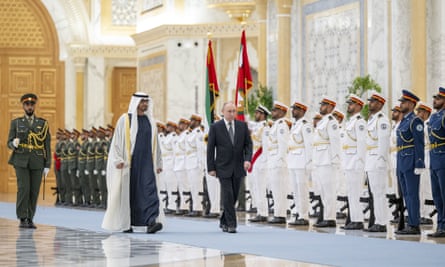 Vladimir Putin, seen here in Abu Dhabi with the president of the UAE, Mohamed bin Zayed Al Nahyan, was welcomed on his visit to the emirates and Saudi Arabia earlier in December. Photograph: UAE presidential court/Anadolu/Getty Images
 A crowd of people stormed on to the airfield and shouted antisemitic slogans at the airport in Makhachkala, Dagestan, on 30 October, protesting against the arrival of a plane from Tel Aviv. Photograph: AP

 (왼쪽부터) 윤석열 대통령, 전여옥 전 국회의원, 한동훈 국민의힘 비상대책위원장. <디지털타임스 박동욱 기자, 디지털타임스 DB, 대통령실 제공>
 한동훈 국민의힘 비상대책위원장이 지난 27일 여의도 국회 사무실로 출근하며 기자들의 질문을 받고 있다. <연합뉴스>


