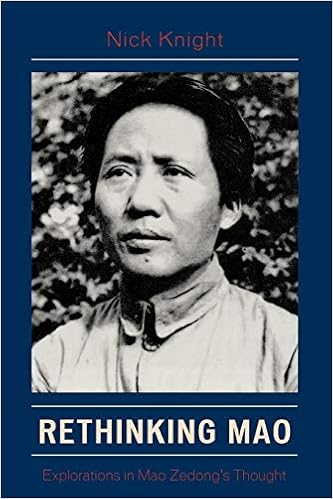
Rethinking Mao offers an innovative perspective on the thought of Mao Zedong, the major architect of the Chinese Revolution and leader of the People's Republic of China until his death in 1976. Utilizing a number of recently discovered documents written by Mao, Nick Knight 'rethinks' Mao by subjecting a number of controversial themes to fresh scrutiny. This book provides a sophisticated analysis of Mao's views on the role of the peasants and working class in the Chinese revolution, his theoretical attempt to make Marxism appropriate to Chinese conditions, and his understanding of the Chinese road to socialism. Knight includes a discussion of the theoretical difficulties in interpreting Mao's thought. Rethinking Mao represents a challenge to many of the conventional accounts of Mao and his thoughts. This book will appeal to scholars and students of Chinese history and politics, as well as the history of Marxism in China.
Rethinking Mao: Explorations in Mao Zedong's Thought Paperback – 17 April 2007
by Nick Knight (Author)
5.0 out of 5 stars 1 rating
See all formats and editions
Kindle
$58.61Read with Our Free App
Hardcover
$198.79
1 Used from $389.0011 New from $198.79
Paperback
$78.04
1 Used from $146.0011 New from $78.04
Product description
Review
Rethinking Mao not only offers something new, it does so with a critical depth that others eschew.... Rethinking Mao not only offers a sophisticated analysis of Mao's historicism, it is itself an excellent example of historicist scholarship.--Journal of Chinese Political Science
Distinguished China scholar Nick Knight has been researching Mao Zedong's thought for nearly four decades. Departing from recent conventional research, which tends to demonize and/or scoff at Mao, Knight takes Mao very seriously, both as a socialist leader and as a Marxist. In this important and aptly titled book, Knight reaches many innovative, balanced, and perceptive conclusions that will surely impact greatly on the future study of a man who, whatever his failings, was undoubtedly among the towering figures of the twentieth century.--Colin Mackerras, professor emeritus, Department of International Business and Asian Studies, Griffith University
Nick Knight has distinguished himself over the years as one of the most astute readers and interpreters of Mao's thought. Rethinking Mao brings together a lifetime of scholarship, revisited and revised with the benefit of contemporary hindsight. The volume is a serious reminder of the historical and theoretical significance of Mao's thought at a time when most writing on Mao, riding the wave of anti-socialism, has degenerated into little more than malicious gossip. It also coincides with a reevaluation of Mao's policies in the PRC as possible inspiration in confronting the problems created by three decades of reform that turned its back on his revolutionary legacy.--Arif Dirlik, author of Marxism in the Chinese Revolution
About the Author
Nick Knight is professor of Asian studies at Griffith University in Australia.
==
maoist rated it liked it
Shelves: base-superstructure
Decent book riddled with contradictions.
This is a book from a liberal who thinks he has a very firm grasp of Marxism, and indeed, it has to be admitted, his understanding is ahead of the many economistic revisionists still running around (in fact if social media were a genuine medium to measure such things, you'd think they are getting more numerous). The author defends Mao as a genuine Marxist who stayed true to Marxism until the end and instead of becoming more utopian (as is often claimed, based on a misunderstanding of the Great Proletarian Cultural Revolution (GPCR) as some attempt to quickly get to communism) he actually became more realistic, expecting the transitional period of socialism to communism to last a whole historical epoch, lasting perhaps hundreds or even 1000 years. He also has an insightful analysis of Mao's developing conceptualization and refinement of the dialectics between base and superstructure and how the superstructure can become more important than the base at certain historical times. Even his lengthy discussion of the different interpretations and their polemics is not uninteresting, though likely too much for most non-specialist readers.
The contradictions come into play when the author refers to anti-communist arguments by Popper, for example, in between two sections where he disproves these very arguments, seemingly unaware of this. Another example is his use of the concept of economism, which has a specific meaning in Marxism, and which he uses in this very meaning, while also using it to refer disparagingly to Marxism in general. Yet another contradiction is the author referring to a whole barrage of books on the economic development of Maoist China all proving the it was a roaring success throughout (excluding the period of the Great Leap where natural disasters lead to great setbacks, but which also laid the basis for such natural disasters never threatening China again by constructing enormous irrigation projects all over the country and establishing the communes), and then talking about the GPCR as if it set the economy back by decades (when in reality it started industrialization for good and laid the basis for the later development, when the capitalist counter-revolution won and claimed these successes while spreading the lie of the disaster that supposedly was the GPCR).
Despite its shortcomings, this is still an insightful book, probably more so to liberal and reactionary readers than Marxists. But revolutionary Marxists, too, can gain from it. (less)
flagLike · comment · see review

No comments:
Post a Comment