The Nature of the Beasts: Empire and Exhibition at the Tokyo Imperial Zoo
 |
HOME / PEOPLE /
Ian J. Miller
Professor of History
Faculty Dean of Cabot House

On Leave Academic Year 2023-2024
Academic office hours (Thurs 2:00-4:00 pm):
https://calendly.com/ian_miller/officehours
Cabot House office hours (Fri 3:00-4:00 PM):
https://calendly.com/ian_miller/cabot-house-office-hours
I am a historian of Japan and its modern empire whose research is primarily focused on the cultural dimensions of scientific, technological, and environmental change.
I began my career as a cultural historian because I discovered, early in my graduate training at Columbia University, that my interest lay in connecting commonplace beliefs and behaviors with larger issues, often in surprising ways or through unexpected materials.
I have remained dedicated to these methods because I have come to realize that histories of this sort—narratives that demonstrate meaningful connections between abstract or alienating processes and individual experience—answer an important need in an age defined by vast and rapid change.
To comprehend macro-level issues such as climate change or the development of global capitalism we have to learn to see them in human-scale terms. Japan, as the world’s first non-Western industrial and imperial power, is an ideal site for this work.
My first book, The Nature of the Beasts: Empire and Exhibition at the Tokyo Imperial Zoo, pursues these goals by taking readers into East Asia’s first modern zoological garden, Tokyo’s Ueno Zoo. The zoo was a showcase for new ideas about nature; it was also a cultural machine designed to manufacture “civilized” people at a time when the distinction between humans and other animals was often synonymous with that between colonizer and colonized.
Research and training for this project were supported by the Japan Foundation, the National Endowment for the Humanities, the United States Department of Education (Fulbright-Hays), and the Whiting Foundation.
I am working on a new book, Tokyo Electric: Japan in the Age of Global Energy, which recasts the history of the world’s largest city—Tokyo—as a history of energy.
I am working on a new book, Tokyo Electric: Japan in the Age of Global Energy, which recasts the history of the world’s largest city—Tokyo—as a history of energy.
Based on materials found in the previously closed archives of the Tokyo Electric Power Company (TEPCO), Japan’s first electric company and owner of the vexed Fukushima Daiichi Nuclear Power Plant, this research has been supported by the American Council of Learned Societies, the Center for Global Research, and the Social Science Research Council (via the Abe Fellowship Program). It was also the starting point for a Mellon Foundation New Directions Fellowship (2016-2019). That course of study, framed around the question of “Carbon and its Discontents,” has led me deeper into a “material turn” focused on the creation of modern infrastructure and its political implications.
I enjoy collaborative work. My first foray resulted in Japan at Nature’s Edge: The Environmental Context of a Global Power, co-edited with Julia Adeney Thomas and Brett L. Walker.
I enjoy collaborative work. My first foray resulted in Japan at Nature’s Edge: The Environmental Context of a Global Power, co-edited with Julia Adeney Thomas and Brett L. Walker.
My second in a co-edited Forum in the journal Environmental History on energy transitions, with Paul Warde. My current collaborative work is focused on oceanic history. Oceanic Japan, co-edited with Nadin Heé, Stefan Hübner, and Bill Tsutsui, will be published by University of Hawai’i Press in 2021.
I also co-convene the Environment Forum at the Mahindra Humanities Center with Robin Kelsey.
Other teaching and research interests include urban history, history of science and technology, comparative imperialisms, and philosophies of action and agency. I am affiliate faculty in the Department of History of Science and in Department of East Asian Languages and Civilizations. I urge potential graduate students interested in working with me to apply to both the Department of History and to History & East Asian Languages. I regularly offer PhD general exam fields in “Modern Japanese History” and “Global Environmental History” and “Energy History," among other areas.
CONTACT INFORMATION
Center for Government and International Studies-South Building
Room S421
1730 Cambridge Street
Cambridge, MA 02138
ian_miller@harvard.edu
p:617-495-7921
Faculty Assistant
Jenni Ting
wting@fas.harvard.edu
617-496-3184
WEBSITES
Personal Website
Imperial History
TIME PERIOD
19th Century
20th Century
THEME AND METHODOLOGY
Cultural History
Digital History
Environmental History
Imperial History
Science & Technology
Urban History
====
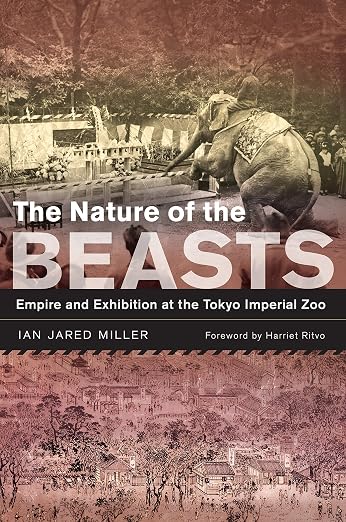
The Nature of the Beasts: Empire and Exhibition at the Tokyo Imperial Zoo (Asia: Local Studies / Global Themes Book 27) 1st Edition, Kindle Edition
by Ian Jared Miller (Author), Harriet Ritvo (Foreword) Format: Kindle Edition
4.6 out of 5 stars 3
Book 18 of 23: Asia: Local Studies/Global Themes
It is widely known that such Western institutions as the museum, the university, and the penitentiary shaped Japan’s emergence as a modern nation-state. Less commonly recognized is the role played by the distinctly hybrid institution—at once museum, laboratory, and prison—of the zoological garden. In this eye-opening study of Japan’s first modern zoo, Tokyo’s Ueno Imperial Zoological Gardens, opened in 1882, Ian Jared Miller offers a refreshingly unconventional narrative of Japan’s rapid modernization and changing relationship with the natural world. As the first zoological garden in the world not built under the sway of a Western imperial regime, the Ueno Zoo served not only as a staple attraction in the nation’s capital—an institutional marker of national accomplishment—but also as a site for the propagation of a new "natural" order that was scientifically verifiable and evolutionarily foreordained. As the Japanese empire grew, Ueno became one of the primary sites of imperialist spectacle, a microcosm of the empire that could be traveled in the course of a single day. The meaning of the zoo would change over the course of Imperial Japan’s unraveling and subsequent Allied occupation. Today it remains one of Japan’s most frequently visited places. But instead of empire in its classic political sense, it now bespeaks the ambivalent dominion of the human species over the natural environment, harkening back to its imperial roots even as it asks us to question our exploitation of the planet’s resources.
Read less
====
Review
Other teaching and research interests include urban history, history of science and technology, comparative imperialisms, and philosophies of action and agency. I am affiliate faculty in the Department of History of Science and in Department of East Asian Languages and Civilizations. I urge potential graduate students interested in working with me to apply to both the Department of History and to History & East Asian Languages. I regularly offer PhD general exam fields in “Modern Japanese History” and “Global Environmental History” and “Energy History," among other areas.
CONTACT INFORMATION
Center for Government and International Studies-South Building
Room S421
1730 Cambridge Street
Cambridge, MA 02138
ian_miller@harvard.edu
p:617-495-7921
Faculty Assistant
Jenni Ting
wting@fas.harvard.edu
617-496-3184
WEBSITES
Personal Website
Imperial History
TIME PERIOD
19th Century
20th Century
THEME AND METHODOLOGY
Cultural History
Digital History
Environmental History
Imperial History
Science & Technology
Urban History
====
The Nature of the Beasts: Empire and Exhibition at the Tokyo Imperial Zoo (Asia: Local Studies / Global Themes Book 27) 1st Edition, Kindle Edition
by Ian Jared Miller (Author), Harriet Ritvo (Foreword) Format: Kindle Edition
4.6 out of 5 stars 3
Book 18 of 23: Asia: Local Studies/Global Themes
It is widely known that such Western institutions as the museum, the university, and the penitentiary shaped Japan’s emergence as a modern nation-state. Less commonly recognized is the role played by the distinctly hybrid institution—at once museum, laboratory, and prison—of the zoological garden. In this eye-opening study of Japan’s first modern zoo, Tokyo’s Ueno Imperial Zoological Gardens, opened in 1882, Ian Jared Miller offers a refreshingly unconventional narrative of Japan’s rapid modernization and changing relationship with the natural world. As the first zoological garden in the world not built under the sway of a Western imperial regime, the Ueno Zoo served not only as a staple attraction in the nation’s capital—an institutional marker of national accomplishment—but also as a site for the propagation of a new "natural" order that was scientifically verifiable and evolutionarily foreordained. As the Japanese empire grew, Ueno became one of the primary sites of imperialist spectacle, a microcosm of the empire that could be traveled in the course of a single day. The meaning of the zoo would change over the course of Imperial Japan’s unraveling and subsequent Allied occupation. Today it remains one of Japan’s most frequently visited places. But instead of empire in its classic political sense, it now bespeaks the ambivalent dominion of the human species over the natural environment, harkening back to its imperial roots even as it asks us to question our exploitation of the planet’s resources.
Read less
====
Review
====
"A triumph. . . .archival richness. . . .analytic dexterity and elegant writing."-- "Times Literary Supplement"
"The Nature of Beasts is a critical intervention in global zoo, environmental and Japanese histories. It stands on its own as a fascinating and thoughtful history, but also provides opportunities for future scholarly exploration into patterns of human dominion over nature across the East Asian world."-- "Pacific Affairs"
"It is difficult to find fault with Miller's carefully researched, elegantly written, and convincingly argued monograph."-- "East Asian Science, Technology, and Medicine"
"The Nature of the Beasts is a model of interdisciplinary environmental history and a must-read for anyone interested in the politics of the modern zoo."-- "Enviromental History"
"The book provides a rich canvas for a variety of cross-cultural comparisons."-- "Monumenta Nipponica"
"Makes an important contribution to our understanding of how governments outside of the United States and Europe have used zoo animals to further political goals."-- "American Historical Review"
"A rich political and cultural history of modern Japan."-- "Cross-Currents"
"This is a path-breaking contribution to the history of science, environmental history, and Japanese history."-- "Journal of Japanese Studies"
====
From the Back Cover
"Brilliantly researched and refreshingly original, this study of the Ueno Zoo shows how the human world has been constituted in large part by its engagements with nature and animals--and, conversely, how the zoo reflects larger questions of modernity, desire, violence, and history. Nationalism, empire and colonialism, total war, consumerism, and the culture of capitalism, bio-power and necropolitics, race--readers will be challenged to think about these and other "human" concerns through the supposed garden of nature and animals." --Takashi Fujitani, Dr. David Chu Professor and Director in Asia Pacific Studies, University of Toronto
"In a tumultuous history of the Tokyo Zoo as it has been intertwined with the history of the Japanese nation, Ian Miller reveals the zoo as a site for disciplining subjects and citizens, naturalizing empire, glorifying sacrifice during war, playing out geopolitical rivalries, and spurring mass consumerism. Theoretically sophisticated but accessible and thoroughly engaging, The Nature of the Beasts is an important contribution to our understandings of Japan's modernization, imperialism, and relationship with the animal world."--William M. Tsutsui, author of Japanese Popular Culture and Globalization
"Miller offers a unique vantage point onto Japan's modern experience. The Nature of the Beasts is deftly and poignantly written. The book is a real gem."--Brett L. Walker, Regents Professor, Montana State University, Bozeman
"The Nature of the Beasts is at once critical, compassionate and profound. The Ueno zoo becomes a stage on which animals, people and nations act out the changing ecological drama of modernity. It is a drama in which we all play a part. We are touched with sorrow by the ritualized sacrifice of majestic animals played out in the culture of total war. This book is a deep reflection on the rise, fall, and transformation of an imperial power and its consequences for the lives of humans and nonhumans alike."--Gregg Mitman, author of Reel Nature: America's Romance with Wildlife on Film
"Ian Miller's compelling book on Japan's foremost zoo makes clear that the cages constructed for nonhuman animals ultimately circumscribe their human captors as well. Japan's modern history, its rise and fall as an imperial power and its postwar place in a world threatened by climate change, are all encapsulated in dramatic events at the Ueno zoological garden."--Julia Adeney Thomas, author of Reconfiguring Modernity: Concepts of Nature in Japanese Political Ideology
About the Author
Ian Jared Miller teaches Japanese history at Harvard University.
Read less
===
Top reviews from other countries
Marshall
5.0 out of 5 stars contrast with parallels and timeless epic themes placing the work among the best. I laughed
Reviewed in the United States on 21 October 2014
Verified Purchase
Before mentioning the content of The Nature of the Beasts, let me pause and relish the prose style. The exquisite phrasing and robust documentation are above reproach and there are narrative techniques such as foreshadowing, repetition with variation, contrast with parallels and timeless epic themes placing the work among the best. I laughed. I cried. It was not until nearly the end that I realized how heroically inclusive the title is. And the graphics are wonderful. How I longed to see each on a full page spread.
Who could have guessed so much of profound general interest could be found in the archives of a zoo?
Early on there are two liminal issues onto which I fastened: the border between natural and human, and the border between traditional and urban (including modern) societies.
The first is dealt with elegantly and with great insight, tracing the perception of nature as invincible into nature as a remnant requiring the utmost in care and nurturing and probing the parallels and contrasts between the life occupying the cages and the life peering in.
The second approaches an issue that is my own obsession: call it urban infertility. No city has ever been able to survive without recruitment. The birth rate is never sufficient for survival. This has been attributed to pollution or choice in the ancient world. It has been attributed to street violence or dueling in the more recent past. It has been attributed to élan vital, more recently. That myth was demolished by Pasteur, so the blame was laid at the feet of infectious disease, which is under control so we are back with pollution or choice, where we started a couple thousand years ago. Yet urban infertility persists unabated.
I have long said, with temerity while documentation was lacking, that the city must recruit. The village generally produces plenty of children. So I have attributed the wonders of civilization – absurd architecture, pointless pageantry, deafening music, zoos and books (well there had to be some good in it) to the need of the city to proclaim that its life was somehow superior to village life. And this book points out how this recruitment campaign was documented at the great Ueno Zoo in Tokyo. Of course once the critical step from village to town has been taken, there is no logical barrier to bringing people along into empire and globalization, which is laid out swiftly and clearly from a zoological garden coign of vantage.
A wonderful read.
Read less
2 people found this helpful
Report
The second approaches an issue that is my own obsession: call it urban infertility. No city has ever been able to survive without recruitment. The birth rate is never sufficient for survival. This has been attributed to pollution or choice in the ancient world. It has been attributed to street violence or dueling in the more recent past. It has been attributed to élan vital, more recently. That myth was demolished by Pasteur, so the blame was laid at the feet of infectious disease, which is under control so we are back with pollution or choice, where we started a couple thousand years ago. Yet urban infertility persists unabated.
I have long said, with temerity while documentation was lacking, that the city must recruit. The village generally produces plenty of children. So I have attributed the wonders of civilization – absurd architecture, pointless pageantry, deafening music, zoos and books (well there had to be some good in it) to the need of the city to proclaim that its life was somehow superior to village life. And this book points out how this recruitment campaign was documented at the great Ueno Zoo in Tokyo. Of course once the critical step from village to town has been taken, there is no logical barrier to bringing people along into empire and globalization, which is laid out swiftly and clearly from a zoological garden coign of vantage.
A wonderful read.
Read less
2 people found this helpful
Report
===

No comments:
Post a Comment