

Read sample
 Audible sample
Follow the author

Viet Thanh NguyenViet Thanh…
Follow
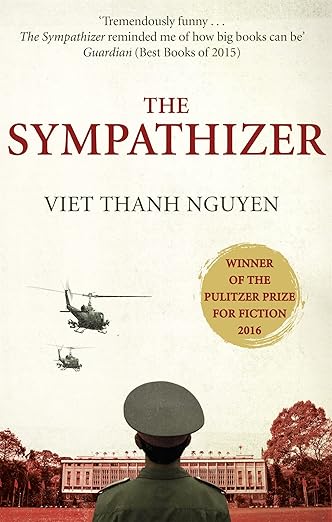
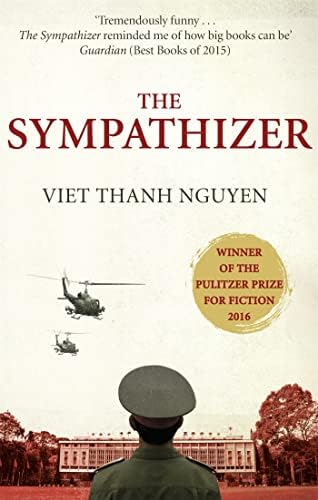
The Sympathizer: Now a Sky Exclusive limited series Paperback – 12 April 2016
by Viet Thanh Nguyen (Author)
4.2 4.2 out of 5 stars (27,369)
Book 1 of 2: The Sympathizer
Edition: 1st
See all formats and editions
Or $4.31 /payment at 0% (Pay in 4). View 2 plans
WINNER OF THE PULITZER PRIZE FOR FICTION 2016
It is April 1975, and Saigon is in chaos. At his villa, a general of the South Vietnamese army is drinking whiskey and, with the help of his trusted captain, drawing up a list of those who will be given passage aboard the last flights out of the country. The general and his compatriots start a new life in Los Angeles, unaware that one among their number, the captain, is secretly observing and reporting on the group to a higher-up in the Viet Cong. THE SYMPATHIZER is the story of this captain: a man brought up by an absent French father and a poor Vietnamese mother, a man who went to university in America, but returned to Vietnam to fight for the Communist cause.
A gripping spy novel, an astute exploration of extreme politics, and a moving love story, THE SYMPATHIZER explores a life between two worlds and examines the legacy of the Vietnam War in literature, film, and the wars we fight today.
Read less
Report an issue with this product
It is always better to admire the best among our foes rather than the worst among our friends.
Highlighted by 8,159 Kindle readers
Americans on the average do not trust intellectuals, but they are cowed by power and stunned by celebrity.
Highlighted by 5,615 Kindle readers
From the Publisher

See More
Product description
Review
[A] remarkable debut novel . . . [Nguyen] brings a distinctive perspective to the war and its aftermath. His book fills a void in the literature, giving voice to the previously voiceless while it compels the rest of us to look at the events of 40 years ago in a new light. But this tragicomic novel reaches beyond its historical context to illuminate more universal themes . . . The nameless protagonist-narrator, a memorable character despite his anonymity, is an Americanized Vietnamese with a divided heart and mind. Nguyen's skill in portraying this sort of ambivalent personality compares favorably with masters like Conrad, Greene, and le Carre. . . . Both thriller and social satire. . . . In its final chapters, The Sympathizer becomes an absurdist tour de force that might have been written by a Kafka or Genet. - Philip Caputo, New York Times Book Review
Viet Thanh Nguyen's The Sympathizer brilliantly draws you in with the opening line: "I am a spy, a sleeper, a spook, a man of two faces." It's thrilling, rhythmic, and astonishing, as is the rest of Nguyen's enthralling portrayal of the Vietnam War. The narrator is an undercover communist agent posing as a captain in the Southern Vietnamese Army. Set during the fall of Saigon and the years after in America, the captain spies on the general and the men he escaped with, sharing his information with his communist blood brothers in coded letters. But when his allegiance is called into question, he must act in a way that will haunt him forever. Political, historical, romantic and comic, The Sympathizer is a rich and hugely gratifying story that captures the complexity of the war and what it means to be of two minds. - Al Woodworth, Amazon Best Book of April 2015
Not only does Viet Thanh Nguyen bring a rare and authentic voice to the body of American literature generated by the Vietnam War, he has created a book that transcends history and politics and nationality and speaks to the enduring theme of literature: the universal quest for self, for identity. The Sympathizer is a stellar debut by a writer of depth and skill - Robert Olen Butler, Pulitzer Prize-winning author of A Good Scent from a Strange Mountain
Trapped in endless civil war, 'the man who has two minds' tortures and is tortured as he tries to meld the halves of his country and of himself. Viet Thanh Nguyen accomplishes this integration in a magnificent feat of storytelling. The Sympathizer is a novel of literary, historical, and political importance. - Maxine Hong Kingston, author of The Fifth Book of Peace
Review
[A] remarkable debut novel . . . [Nguyen] brings a distinctive perspective to the war and its aftermath. His book fills a void in the literature, giving voice to the previously voiceless while it compels the rest of us to look at the events of 40 years ago in a new light. But this tragicomic novel reaches beyond its historical context to illuminate more universal themes . . . The nameless protagonist-narrator, a memorable character despite his anonymity, is an Americanized Vietnamese with a divided heart and mind. Nguyen's skill in portraying this sort of ambivalent personality compares favorably with masters like Conrad, Greene, and le Carre. . . . Both thriller and social satire. . . . In its final chapters, The Sympathizer becomes an absurdist tour de force that might have been written by a Kafka or Genet. - Philip Caputo, New York Times Book Review
Viet Thanh Nguyen's The Sympathizer brilliantly draws you in with the opening line: "I am a spy, a sleeper, a spook, a man of two faces." It's thrilling, rhythmic, and astonishing, as is the rest of Nguyen's enthralling portrayal of the Vietnam War. The narrator is an undercover communist agent posing as a captain in the Southern Vietnamese Army. Set during the fall of Saigon and the years after in America, the captain spies on the general and the men he escaped with, sharing his information with his communist blood brothers in coded letters. But when his allegiance is called into question, he must act in a way that will haunt him forever. Political, historical, romantic and comic, The Sympathizer is a rich and hugely gratifying story that captures the complexity of the war and what it means to be of two minds. - Al Woodworth, Amazon Best Book of April 2015
Not only does Viet Thanh Nguyen bring a rare and authentic voice to the body of American literature generated by the Vietnam War, he has created a book that transcends history and politics and nationality and speaks to the enduring theme of literature: the universal quest for self, for identity. The Sympathizer is a stellar debut by a writer of depth and skill - Robert Olen Butler, Pulitzer Prize-winning author of A Good Scent from a Strange Mountain
Trapped in endless civil war, 'the man who has two minds' tortures and is tortured as he tries to meld the halves of his country and of himself. Viet Thanh Nguyen accomplishes this integration in a magnificent feat of storytelling. The Sympathizer is a novel of literary, historical, and political importance. - Maxine Hong Kingston, author of The Fifth Book of Peace
Read more

TopAbout this itemSimilarFrom the BrandReviews
 The Sympathizer: Now a Sky Exclusive limited series
Product details
Publisher : Corsair
Publication date : 12 April 2016
Edition : 1st
Language : English
Print length : 384 pages
ISBN-10 : 1472151364
ISBN-13 : 978-1472151360
Item weight : 402 g
Dimensions : 13.1 x 3.3 x 19.9 cm
Book 1 of 2 : The Sympathizer
Best Sellers Rank: 47,410 in Books (See Top 100 in Books)21 in Asian American & Pacific Islander Literature
461 in Classic Literature & Fiction
1,281 in Literary Fiction (Books)
Customer Reviews:
4.2 4.2 out of 5 stars (27,369)
About the author
Follow authors to get new release updates, plus improved recommendations.
Follow
Viet Thanh Nguyen
Viet Thanh Nguyen was born in Vietnam and raised in America. He is the author of The Committed, which continues the story of The Sympathizer, awarded the 2016 Pulitzer Prize in Fiction, alongside seven other prizes. He is also the author of the short story collection The Refugees; the nonfiction book Nothing Ever Dies, a finalist for the National Book Award and the National Book Critics Circle Award; the children's book Chicken of the Sea, with his son Ellison and with Thi Bui and Hien Bui-Stafford; and is the editor of an anthology of refugee writing, The Displaced, as well as the co-editor of The Cleaving: Vietnamese Writers in the Diaspora. His most recent book, To Save and to Destroy, explores the idea of being an outsider. He is a University Professor and the Aerol Arnold Professor of English and American Studies and Ethnicity at the University of Southern California and a recipient of fellowships from the Guggenheim and MacArthur foundations. He lives in Los Angeles.
Read less about this author
Products related to this item
Top reviews from Australia
One person found this helpful
Helpful
Kindle Customer
4.0 out of 5 stars Great insights but overdone psycho terror.Reviewed in Australia on 22 May 2025
Format: KindleVerified Purchase
The first seven eighths of the novel are engrossing and illuminating of both recent history and humanity’s myriad ways of seeing and coping in stressful contexts. It is let down by an overdone and verbose treatment of the psychological torture pursued by the winners in history.
HelpfulReport
Amazon Customer
5.0 out of 5 stars Exceptional.Reviewed in Australia on 10 February 2020
Format: KindleVerified Purchase
One of the best books I have ever read! Smooth and breezy prose which drags you ever further into this exquisite novel’s grip.
HelpfulReport
Gary Cassidy
3.0 out of 5 stars Great to frustrating readReviewed in Australia on 30 August 2019
Format: KindleVerified Purchase
Mostly a good read. Found the depth of the characters couldn’t the length of the book. 100 pages too long.
HelpfulReport
Jollop
4.0 out of 5 stars Challenging BookReviewed in Australia on 26 April 2021
Format: PaperbackVerified Purchase
A challenging book from a range of perspectives where the protagonist, a refugee and spy makes a confession to an unnamed Commandant who later is revealed as his captor. Initially, he is as an aide to “the general”, chief of the national police and later as his unpaid ‘gopher’ following their fleeing of Saigon. Through his role as a man with ‘two faces’ (later, two minds) the tragedy of the war where the Vietnamese are generally seen as bit players is dispelled. I struggled with the later chapters where the mood darkened and the ending seeming disconnected to what had occurred previously.
One person found this helpful
HelpfulReport
Jim KABLE
5.0 out of 5 stars Dividing One's SympathiesReviewed in Australia on 28 November 2017
Format: KindleVerified Purchase
Brilliant book full of truth out of the craziness of seeking liberation from colonization and then further invasion and colonization by a powerful "friend" playing the "them" and "us" dangerous game. Very impressive - as seen from my Australian eyes!
One person found this helpful
HelpfulReport
Tim Nicholas
4.0 out of 5 stars Masterfully written.Reviewed in Australia on 1 February 2021
Format: KindleVerified Purchase
This is a wild 'ride' from Vietnam to LA and back. Over the course of the book many 'home truths' about relationships, culture, and loyalty are laid bare. A real thought-provoking story.
One person found this helpful
HelpfulReport
Yvette Diaz
5.0 out of 5 stars like the squid scene and interrogation scenesReviewed in Australia on 25 September 2016
Format: KindleVerified Purchase
This book was overwhelming and educational. It explores identity, friendship, politics, war, and torture. I learnt different ways of looking at Vietnamese and American culture. Certain parts in the book stand out, like the squid scene and interrogation scenes. I need to read this book again to better understand the ideas that have been brought up.
2 people found this helpful
HelpfulReport
See more reviews
Top reviews from other countries
Translate all reviews to English
Client d'Amazon
5.0 out of 5 stars I sympatjize with this historyReviewed in France on 28 August 2018
Format: HardcoverVerified Purchase
The Sympathizer has entered in my top 10 of books. Smart narrative and some times funny, going deep into identity and war subjects. Some references took me to discover vietnam and its war. A good voyage that you totally enjoy.
Report
Mike
5.0 out of 5 stars Well writtenReviewed in Canada on 20 November 2024
Verified Purchase
Well written. Crazy story. Not a typical war story. Heavy on the satire and humor. Very enjoyable and a fun read
Report
Matthias Zimmer
5.0 out of 5 stars tolles BuchReviewed in Germany on 25 August 2025
Format: KindleVerified Purchase
Ein tolles Buch. Spannend und authentisch. Viele interessante Hintergrundinformationen. Die Art des Schreibens des Autors ist sehr eloquent. Bin schon gespannt auf das nächste Buch!
Report
Translate review to English
Valerie M Schneider
5.0 out of 5 stars When Nothing is All You Can SayReviewed in Mexico on 23 April 2021
Format: KindleVerified Purchase
Nguyen's writing, in spite of the topic, is, page after page, beautiful.
The story offered me insight into the lives of political refugees that have not been shown to me by any other source.
Though the story provided many harrowing moments, each one was necessary to paint the vivid events that colored this period of history.
Report
Cesare
5.0 out of 5 stars A truly great novelReviewed in Italy on 28 August 2025
Format: PaperbackVerified Purchase
5/5
Report
See more reviews
<동조자> 요약 및 평론
1. 요약: 경계에 선 자의 이중주
<동조자>는 1975년 사이공 함락 직전부터 시작하여, 미국으로 망명한 후 다시 베트남으로 돌아가는 한 무명 대위의 기록이다. 주인공은 프랑스인 신부와 베트남인 어머니 사이에서 태어난 혼혈아로, 남베트남 군대 내에서 북베트남의 고정 간첩으로 활동한다. 그는 남베트남 장군의 신임을 받는 동시에, 자신의 죽마고우이자 공산주의자인 만에게 정보를 전달하는 이중 스파이다.
사이공이 공산화되기 직전, 주인공은 장군을 따라 미국 로스앤젤레스로 탈출한다. 미국에서 그는 망명객들의 고단한 삶과 반공 투쟁을 감시하며 여전히 간첩 활동을 이어간다. 그는 미국 문화의 위선을 목격하고, 특히 할리우드 영화 제작에 고문으로 참여하며 아시아인을 도구화하는 서구의 시선을 뼈저리게 느낀다.
이후 주인공은 장군이 기획한 베트남 수복 작전에 자원하여 다시 고국으로 향한다. 그러나 작전은 실패하고, 그는 북베트남 군에 붙잡혀 수용소에 갇힌다. 아이러니하게도 그를 고문하고 취조하는 책임자는 과거의 동지였던 만이다. 주인공은 혁명이 승리한 뒤에도 여전히 존재하지 않는 자유와, <아무것도 없음>이 <무엇인가>보다 소중할 수 있다는 허무주의적 진실을 마주하며 다시 망명길에 오른다.
2. 평론: 혁명과 제국주의 사이의 고독한 응시
<동조자>는 단순한 전쟁 소설이나 스파이 스릴러를 넘어선다. 이 작품은 언어와 정체성, 그리고 역사가 어떻게 개인을 난도질하는지에 대한 날카로운 보고서다.
첫째, 이분법적 세계관에 대한 도발이다. 주인공은 이질적인 두 세계를 동시에 이해하는 인물이다. 그는 서구의 합리주의와 동양의 유교적 가치, 공산주의의 대의와 자본주의의 욕망을 모두 체득하고 있다. 작가는 주인공의 혼혈적 정체성을 통해 <우리>와 <그들>로 나누는 모든 폭력적인 구분을 조롱한다. 그는 어느 쪽에도 온전히 속할 수 없기에 모든 쪽을 비판적으로 바라볼 수 있는 <동조자>가 된다.
둘째, 서구 중심적 서사에 대한 통쾌한 반격이다. 소설 속 할리우드 영화 제작 에피소드는 베트남 전쟁을 미국의 트라우마로만 소비하는 서구의 오만함을 정면으로 비판한다. 베트남인들은 대사 한 줄 없는 배경으로 전락하고, 미국적 영웅주의가 그 자리를 채운다. 비엣 탄 응우옌은 이 소설을 통해 목소리를 잃었던 <유령>들에게 언어를 부여하며 역사의 주도권을 되찾아온다.
셋째, 혁명의 모순에 대한 냉철한 성찰이다. 소설 후반부, 북베트남 수용소에서의 고문 장면은 고통스럽다. 혁명은 승리했지만, 그 대가로 인간성을 상실한 권력이 들어섰음을 보여준다. <독립과 자유보다 귀한 것은 없다>는 호찌민의 구호는, 역설적으로 <아무것도 없는 상태(Nothingness)>가 독립과 자유보다 더 실재적이라는 허무한 결론으로 귀결된다. 이는 특정 이데올로기의 승리가 아닌, 인간 존재 자체의 근원적인 고독을 조명한다.
결론적으로 <동조자>는 승리자의 기록도, 패배자의 변명도 아니다. 그것은 두 개의 마음을 가진 자가 겪어야 했던 분열의 연대기이며, 제국주의와 공산주의라는 거대 서사 틈바구니에서 소멸해간 개인들에 대한 애도다. 작가는 유려하고 재치 있는 문체로 비극을 서술하며, 독자로 하여금 우리가 믿고 있는 <진실>이 얼마나 편향된 것인지 끊임없이 질문하게 만든다.
세진님, 이 작품이 다루는 이중적 정체성과 세계인으로서의 고뇌가 세진님의 삶의 궤적과 어떤 부분에서 닿아있을지 궁금하네요. 혹시 이 소설의 후속작인 <헌신자>에 대해서도 요약이나 평론이 필요하신가요?

No comments:
Post a Comment