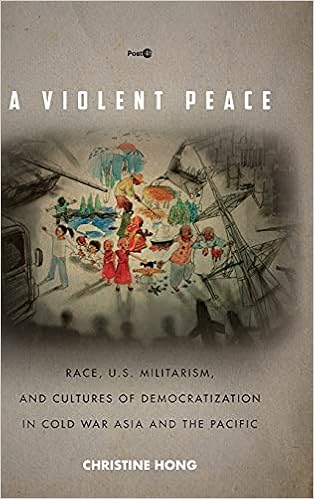
A Violent Peace: Race, U.S. Militarism, and Cultures of Democratization in Cold War Asia and the Pacific (Post*45) 1st Edition
by Christine Hong (Author)
5.0 out of 5 stars 3 ratings
ISBN-13: 978-1503603134
ISBN-10: 150360313XWhy is ISBN important?
Hardcover
AUD 121.22
Paperback
from AUD 52.71
A Violent Peace offers a radical account of the United States' transformation into a total-war state. As the Cold War turned hot in the Pacific, antifascist critique disclosed a continuity between U.S. police actions in Asia and a rising police state at home. Writers including James Baldwin, Ralph Ellison, and W.E.B. Du Bois discerned in domestic strategies to quell racial protests the same counterintelligence logic structuring America's devastating wars in Asia.
Examining U.S. militarism's centrality to the Cold War cultural imagination, Christine Hong assembles a transpacific archive―
- placing war writings,
- visual renderings of the American concentration camp,
- Japanese accounts of the atomic bombing of Hiroshima,
- black radical human rights petitions,
- Korean War–era G.I. photographs,
- Filipino novels on guerrilla resistance, and
- Marshallese critiques of U.S. human radiation experiments alongside government documents.
Editorial Reviews
Review
"A Violent Peace is a tour de force, a brilliant rebuttal to the myth of America as defender of human rights abroad and racial justice at home. Christine Hong demonstrates how radical black and Asian intellectuals' penetrating critiques represent the real democratizing project. Beautifully written and persuasively argued, this book is a seismic shift in Cold War cultural history and our geopolitical imagination." -- Robin D. G. Kelley ― University of California, Los Angeles
"Bursting with brilliance, clarity, and insight, this stunningly original and expansive work excavates the cross-racial, transnational origins of today's militarized modernity. Christine Hong unearths the hidden linkages between race, capital, and occupation in making our postwar global order and points us to alternative conceptions of community and solidarity that defy the borders of modern sovereignty. This book is a game-changer." -- Chandan Reddy ― University of Washington
About the Author
Christine Hong is Associate Professor of Literature and Critical Race and Ethnic Studies at the University of California, Santa Cruz. Her political commentary has appeared in The Nation and on Democracy Now! and Al Jazeera.

Controlling the Pacific
A Violent Peace ~ By Christine Hong
(Stanford University Press, Redwood City (CA), 2020, ISBN #978-1-5036-1291-1)
Review by Gregory Elich (Fall 2020 issue)
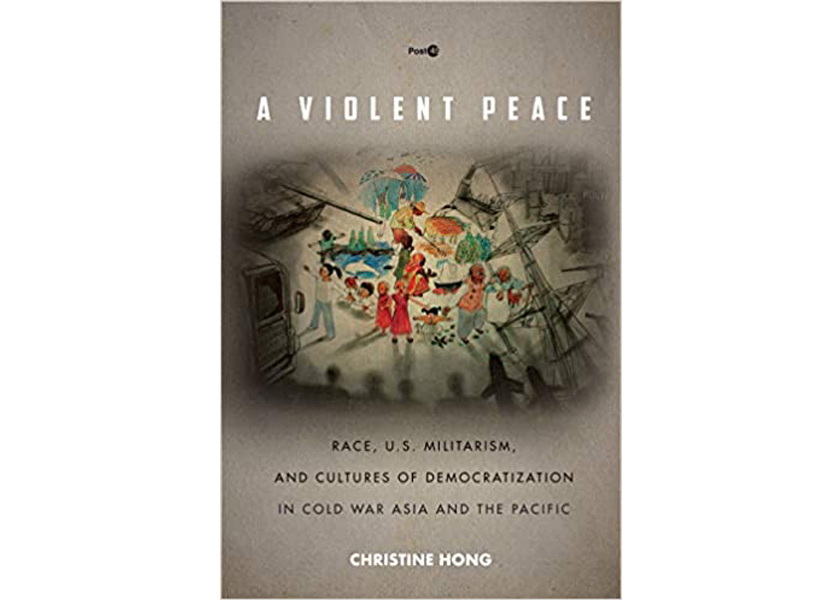
Christine Hong’s A Violent Peace: Race, U.S. Militarism, and Cultures of Democratization in Cold War Asia and the Pacific, arrives at a time when Washington’s Indo Pacific Strategy is driving U.S. political, economic, and military confrontation in the Asia-Pacific, as the culmination of a long process that began in the immediate aftermath of the Second World War.
A Violent Peace examines how the U.S. sought to encompass the Asia-Pacific “within the securitized contours of U.S. military empire,” and the responses to that policy by “a range of people’s struggles —- black freedom, Asian liberation, and Pacific Islander decolonization.”
Hong focuses her political analysis through the the literary and artistic lens of relevant works by black authors Ralph Ellison and James Baldwin, Japanese writer Kenzaburo Oe, Japanese American artist Miné Okubo, and Philippine American novelist Carlos Bulosan.
Following World War II, the U.S. swiftly expanded its military presence in the region and established and supported reactionary client states. It aimed to roll back socialism and pursue economic, political, and military domination throughout the region. Those goals remain unchanged to this day. As Hong writes:
Understanding the role of U.S. police and war power within the political economy of postwar U.S. ‘democracy’ entails critically revisiting World War II’s structural legacies. How we explain postwar U.S. militarism —- its reliance on superior force to achieve political ends in foreign and domestic arenas —- depends on our grappling with the transformation of the United States during World War II, a time of Jim Crow, into a boundary-blurring, total-war state, permanently mobilized not only for war abroad but also for war at its very core.
The U.S. imposed regional postwar democratization and development based on how it defined those terms. This was a political project that was “realized at the barrel of a gun,” subsuming Asian and Pacific nations into American military and police power projection that encircled China and the Soviet Union.
The U.S. introduced a democratization model that established postwar Japan as an important client state and anchor for the projection of U.S. war power throughout the region. Rehabilitating capitalism and providing opportunities for Western investors were prioritized as goals over meeting the people’s needs, despite the fact that many Japanese urban areas lay in ruins, and the population faced food shortages and mass unemployment.
For U.S. capitalism, a more pressing task than improving peoples’ quality of life was to solidify a system that would serve U.S. power, and the U.S. Army Counter Intelligence Corps “enlisted the Japanese police in routing out labor organizers with alleged Communist Party ties.” This policy planted “the ideological seeds of anti-communist U.S. police actions to come,” including the wars in Korea and Vietnam. “In the dawning Cold War order, wartime allies thereby morphed into peacetime targets whereas former rightist foes in Japan and the region were rehabilitated as linchpins of anticommunism.”
The Marshall Islands served as a sacrificial offering to U.S. nuclear weapons development. The disregard shown by U.S. officials toward islanders is stunning in its inhumanity. Residents of three islands that were downwind from the Castle Bravo hydrogen bomb test on March 1, 1954 were not evacuated until three days later, by which time their “hair began falling out in clumps” and “their skin displayed burn patterns.”
In the view of American officials, U.S. administrative control over the islands trumped the territorial rights of the inhabitants, giving the U.S. “the right to close areas for security reasons,” as it “anticipated closing them for atomic tests.”
Returning the Rongelapese to their contaminated homes was regarded by American researchers as an opportunity that would “afford most valuable ecological radiation data on human beings.” What better test subjects could there be? As Merril Eisenbud, director of the Atomic Energy Commission’s Health and Safety Laboratory, observed in an internal 1956 memorandum, “While it is true that these people do not live… the way Westerners do, civilized people, it is nevertheless true that these people are more like us than mice.” One may question just who is civilized and who is uncivilized in designating Marshallese people as “model organisms for biomedical study.”
As Marshallese politician Tony deBrum noted, “Some of our people were injected with or coerced to drink fluids laced with radiation. Other experimentation involved the purposeful and premature resettlement on islands highly contaminated by weapons tests to study how human beings absorb radiation from their foods and environment.” Hong observes that in this context, “no Marshallese could sustain the illusion that near-likeness meant an assurance of their humanity.”
Although the Marshallese were routinely denied medical care, U.S. researchers diligently conducted examinations and blood tests to gather data. Noting islander resentment, researcher Robert Conrad suggested that “next trip we should consider giving them more treatment or even placebos.” In a scathing public letter to Conrad in 1975, Rongelap magistrate Nelson Anjain wrote: “There is no question about your technical competence, but we often wonder about your humanity.”
U.S. policy in the postwar Philippines followed a familiar pattern, prioritizing opportunities for Western investors to exploit the land, labor, and natural resources. The U.S. “installed, most flagrantly in the office of the president, Filipino collaborators with the Japanese” and “secured military basing rights, transforming the Philippines into a launching pad for its anticommunist insurgencies in the region.” Inevitably, leftist guerrillas who had fought against Imperial Japanese occupation discovered that with the advent of peace, they were transformed into “targets of brutal U.S.-backed counterinsurgency campaigns.”
Postwar decolonization in the Asia-Pacific generally failed to free the region’s nations from domination, transferring that relationship from Imperial Japan to the U.S. “Having returned in the garb of antifascist liberator,” Hong observes, “the United States erected a formidable extraterritorial garrison state, unleashing catastrophic violence throughout the region and placing the Asian communist opponents of Japanese fascism in its war machine’s crosshairs.”
In contrast to the punishment meted out to erstwhile wartime allies, the U.S. installed in power many of those who had collaborated with Japanese occupiers, valuing their experience in fighting against liberation movements. Hong points out, “In rehabilitating the empire it succeeded, the Pax Americana, as a military-imperial regime in its own right, strategically gave new life to subfascist figures who had served under the Japanese, thus thwarting the process of decolonization.”
U.S. power abroad is interrelated to issues of class and race at home. As was often the case when American soldiers encountered the local citizenry in Vietnam, there was and is a mirrored pattern at home. In both environments, “racial profiling presumes guilt not just by association but by location, sweepingly conflating racialized humanity with areas where ‘mere presence in a certain place’ is tantamount to a crime.” In that context, people are erased as individuals and incorporated into the category of “perceived threat.”
In the postwar era, the persistence of Black exclusion from U.S. society contrasted with the image of inclusion provided through the U.S. military’s desegregation. This “liberal cover of integration, coalition, multiculturalism, and democratization” masked what was mainly “un-visible” to the U.S. domestic population —- the “U.S. national security apparatus, military-industrial complex, empire of bases, and permanent war economy.”
The military offered a politically equivocal personal emancipatory model that was essentially “extractive and destructive.” The “harnessing of race to the war machine required that racial labor risk its own obliteration” in performing its role in a “lethal agenda geared toward the devastation of distant lifeworlds.” The image of the military’s inclusivity “belied the U.S. war machine’s brute geopolitics and anti-humanism.”
Black radical appeals to the United Nations General Assembly, such as W.E.B. Du Bois’s 1947 petition and William Patterson’s 1951 indictment “We Charge Genocide,” outlined a structural relationship between U.S. domestic and foreign policy, “construing racism within the U.S. to be the domestic expression of a global pattern of U.S. imperialism.” These appeals fell victim to intensifying Cold War pressures and the unequal power relationship between imperialism and Third World nations.
Patterson approached several UN delegations, only to be informed that while they were in sympathy with the appeal, “championing such a petition, no matter how valid, would not be diplomatically prudent.” The United Nation’s human rights program was, and remains so today, inextricably bound with U.S. power. “Any account of black radical human rights as an oppositional politics,” Hong explains, “thus must theorize U.S. dominance in the Cold War system, the very institutional basis for human rights that emerged out of World War II’s ashes.”
U.S. domestic repression against oppositional voices during the Vietnam War, including COINTELPRO, the CIA’s Operation CHAOS, and other repressive mechanisms, blurred the distinction between the home front and war front, unleashing a “national security juggernaut” against “Americans perceived to be enemies.” The methods deployed against activists and organizers “uneasily mirrored, though by no means on the same scale, U.S. strategies of pacification and neutralization in Vietnam.”
Racial counterintelligence aimed to neutralize enemies both at home and abroad. “Predictably,” Hong notes, “each author of Black radical human rights petitions to the UN —- Du Bois, Patterson, Newton, and Seale —- as well as key affiliates like Robeson, would be subjected to counterintelligence investigation.” Hundreds of thousands of American citizens were the targets of investigation and surveillance, while COINTELPRO engaged in burglaries, disinformation programs, and efforts to create discord and conflict within oppositional groups. “The vast military-industrial complex and intelligence apparatus that emerged from World War II paved the way” for police militarization and human rights violations throughout the “U.S. military empire, including at its imperial core.”
In the space of a short review, it is only possible to touch on a few of the book’s themes. A Violent Peace covers a much broader spectrum of topics, from which even the most knowledgeable reader will find much to learn. Christine Hong has written a profound and multilayered analysis of the U.S. military’s role in the postwar Asia-Pacific, and its relationship to militarized repression at home. Enriched by a deeply sympathetic understanding of Black and Asian oppositional voices, Hong’s book exposes the reality behind comforting myths about the American democratization mission.
With great eloquence, she draws insightful connections between race, class, and power, while vividly demonstrating how the expansion of U.S. power into the Asia-Pacific in the postwar era has led to the world we live in today. Deeply considered and thought-provoking, A Violent Peace is essential to understanding our current predicament. Feminists resonate with quiet novel of desperation

No comments:
Post a Comment