2026-02-13

이상주의자: 제프리 삭스와 빈곤 퇴치를 향한 여정 2013

The Idealist: Jeffrey Sachs and the Quest to End Poverty eBook : Munk, Nina: Amazon.com.au: Kindle Store

Kindle
$9.99


The Idealist: Jeffrey Sachs and the Quest to End Poverty Kindle Edition
by Nina Munk (Author) Format: Kindle Edition


4.4 4.4 out of 5 stars (294)

NAMED ONE OF THE BEST BOOKS OF THE YEAR BY
Bloomberg • Forbes • The Spectator

Recipient of Foreign Policy's 2013 Albie Award


A powerful portrayal of Jeffrey Sachs's ambitious quest to end global poverty

"The poor you will always have with you," to cite the Gospel of Matthew 26:11. Jeffrey Sachs—celebrated economist, special advisor to the Secretary General of the United Nations, and author of the influential bestseller The End of Poverty—disagrees. In his view, poverty is a problem that can be solved. With single-minded determination he has attempted to put into practice his theories about ending extreme poverty, to prove that the world's most destitute people can be lifted onto "the ladder of development."

In 2006, Sachs launched the Millennium Villages Project, a daring five-year experiment designed to test his theories in Africa. The first Millennium village was in Sauri, a remote cluster of farming communities in western Kenya. The initial results were encouraging. With his first taste of success, and backed by one hundred twenty million dollars from George Soros and other likeminded donors, Sachs rolled out a dozen model villages in ten sub-Saharan countries. Once his approach was validated it would be scaled up across the entire continent. At least that was the idea.

For the past six years, Nina Munk has reported deeply on the Millennium Villages Project, accompanying Sachs on his official trips to Africa and listening in on conversations with heads-of-state, humanitarian organizations, rival economists, and development experts. She has immersed herself in the lives of people in two Millennium villages: Ruhiira, in southwest Uganda, and Dertu, in the arid borderland between Kenya and Somalia. Accepting the hospitality of camel herders and small-hold farmers, and witnessing their struggle to survive, Munk came to understand the real-life issues that challenge Sachs's formula for ending global poverty.

THE IDEALIST is the profound and moving story of what happens when the abstract theories of a brilliant, driven man meet the reality of human life.
Read less

Review
Recipient of Foreign Policy's 2013 Albie Award
Bloomberg "Best Books of 2013"
Forbes "Best Books of 2013"
The Spectator "Best Books of 2013"
Canada's National Business Book Award Finalist
ISI's Henry and Anne Paolucci Book Award Nominee


"Munk draws a nuanced portrait of Sachs and his Millennium Villages Project . . . worth taking the time to read it. It's a valuable--and, at times, heartbreaking--cautionary tale." --Bill Gates

"A sharply rendered and deeply disillusioned account of [Jeffrey Sachs'] personal quest to end poverty. . . . With impressive persistence, unflagging empathy and journalistic derring-do, Ms. Munk returns over a five-year period to Dertu and one other village to document the project's progress. . . . Heartbreaking." --The Wall Street Journal

"One of the most readable and evocative accounts of foreign aid ever written, The Idealist shows that virtually nothing about such aid is ever easy. . . . A masterful tale of good intentions gone wrong." --William Easterly, Barron's

"A stark reminder that the war against poverty is not yet won. A must-read." --Dambisa Moyo, author of Dead Aid

"Writing accessibly about development economics is a high-wire act, but Munk accomplishes it brilliantly. She shadows Sachs as he cajoles world leaders to fund his Millennium projects, and also visits those places to tell the whole story. The final chapter, in which Munk interviews a chastened Sachs (usually an oxymoron), is particularly devastating." --Foreign Policy

"A fascinating portrait of an innovative thinker as well as a fair-minded examination of his methods. It's also a testament to the enduring value of old-fashioned, shoe-leather reporting--it should be read not just in policy circles but also at J-schools." --Vanity Fair

"Magnificent. . . . An absolute must-read for anyone who is interested in doing good for those in need." --The Christian Science Monitor

"Munk tracks a messianic economist's quixotic attempts to show that he can end African poverty. In one village his team gets farmers to grow maize instead of traditional matoke; there are no buyers for the bumper crop, and rats end up eating much of it. Munk describes a growing gulf between good intentions and hard reality with nuance and sensitivity." --Forbes

"An engaging, eye-opening read." --The Guardian

"A highly readable examination of Jeffrey Sachs's Millennium Villages Project in Africa"
--Financial Times

"The Idealist tracks the messianic economist Jeffrey Sachs's doomed attempt to solve African poverty by establishing a network of model villages where his pet theories could be tested before being escalated. The author, Nina Munk, who spent six years interviewing Sachs and visiting the Millenium Villages, is a delicate, careful writer. She not only reminds us that there are good, solid reasons why certain areas of the world remain desperately poor, she raises troubling questions about the credibility of an economist embraced by rock singers and film stars." --The Spectator

"A fine writer with a gift for deploying spare, vivid detail, Munk overcomes the burden of what could be duller-than-dirt subject matter--the politics of foreign aid; the ins and outs of Uganda's matoke market; NGO infighting over anti-malaria efforts--into a lively and at times, quite funny book." --Fortune

"A deep and important book. . . . The Idealist tells the stories behind the numbers and its evidence is as compelling and as important as anything in the data." --The Lancet

"Munk is a sly, relentless reporter with a gift for wedding her observations to a fluent, even graceful, writing style" --The Globe & Mail

"This book is stark proof that approach just does not work. . . . The world needs to pay attention to these lessons and stop wasting resources." --Bloomberg

"Nina Munk's brilliant book on [Jeffrey] Sachs' anti-poverty efforts, chronicles how his dream fell far short of reality" --Reason

"Written over six years, with exhaustive on-the-ground reporting from two African communities that are part of MVP village clusters, [Nina] Munk's book is a readable and fast-paced chronicle of the real-world consequences of elite intellectual arrogance....Munk's authoritative telling of Sach's story is most valuable as an exhortation to intellectual humility, and a compulsively readable portrait of a man without any." --Commentary

"A fascinating and essential exploration of what goes wrong when unchecked audacity and clinical precision encounter the frailties, ambiguities, and unpredictabilities of human beings, societies and histories." --The Cleveland Plain Dealer

"Not only an important book, but a truly enjoyable read. She does not boast, but the reader cannot avoid the impression that her intrepid years in Sachsland have demanded all the inner steel of the most hardened explorer or war correspondent." --The Weekly Standard

"Students of economic policy and altruistic do-gooders alike will find Munk's work to be a measured, immersive study of a remarkable but all-too-human man who let his vision get the best of him." --Publishers Weekly

"Trenchant and thought-provoking." --Kirkus Reviews

"A fine contrarian polemic full to brimming with excellent reporting." --The Globe & Mail

"Heart-rending. . . . The catalogue of bright ideas that go awry would be funny if it weren't so tragic." --National Post

"A testament to the enduring value of old-fashioned, shoe-leather reporting--it should be read not just in policy circles but also at J-schools." --Vanity Fair Daily

"A devastating portrait of hubris and its consequences." --Pacific Standard

"A fascinating and essential exploration of what goes wrong when unchecked audacity and clinical precision encounter the frailties, ambiguities, and unpredictabilities of human beings, societies and histories." --The Cleveland Plain Dealer

"Nina Munk has written a fascinating book about a fascinating man--and even more important, about a set of ideas that are intriguing and important." --Fareed Zakaria, editor-at-large of Time magazine and author of New York Times Bestseller The Post-American World

"Jeffrey Sachs is a global phenomenon: no one thinks as big, makes a more passionate case for foreign aid, and works as hard to make the dream of ending global poverty a reality. This terrific book gives you a ringside seat on Sachs's tireless global quest to get donors, governments, international agencies, private firms, and poor farmers to buy into his vision of economic development. Nina Munk's portrayal goes beyond the man and his dream; it is a clear-headed depiction of the challenges the world's poorest face as they struggle to improve their lives." --Dani Rodrik, Professor of International Political Economy at Harvard University and author of The Globalization Paradox

"A riveting narrative that must be read to understand why the over $700 billion pumped into Africa by the West since 1960 has achieved so little. This powerful book will shake up the foreign aid development community." --George Ayittey, President of the Free Africa Foundation, and author of Africa Unchained

"A powerful exposé of hubris run amok, drawing on touching accounts of real-life heroes fighting poverty on the front line." --Robert Calderisi, author of The Trouble with Africa

"The Idealist confirms that in the quest to end extreme poverty in Africa, the truly wise and resonant voices are those of the Africans themselves." --Roger Thurow, author of The Last Hunger Season

"Nina Munk's incisive, moving and elegantly written report takes us to Africa to see first-hand that the poor don't need one more central planner with the prescription for prosperity. What the poor need is what really made the rich rich - the legal devices to join their continent's vast, dispersed naturalandhuman resources into valuable combinations through their own collective action." --Hernando de Soto, President of the Institute for Liberty and Democracy, and author of The Mystery of Capital
About the Author
NINA MUNK, a contributing editor at Vanity Fair, is a journalist and the author of Fools Rush In- Steve Case, Jerry Levin, and the Unmaking of AOL Time Warner. She was previously a senior writer at Fortune, and before that a senior editor at Forbes. Her work has appeared in Vanity Fair, the New York Times Magazine, the New Yorker, Fortune, and the New York Times. She lives in New York.


Publication date ‏ : ‎ 10 September 2013

Customer Reviews:
4.4 4.4 out of 5 stars (294)

About the author
Follow authors to get new release updates, plus improved recommendations.

Follow

Nina Munk


Nina Munk is a prize-winning journalist and author whose articles have appeared in The Atlantic, Vanity Fair, The New York Times Magazine, and The New Yorker, among other publications. A Contributing Editor at Vanity Fair since 2001, Nina was previously a Senior Writer at Fortune and a Senior Editor at Forbes. She is the author of several books, most recently The Idealist: Jeffrey Sachs and the Quest to End Poverty (Doubleday). She is also the editor of How It Happened: Documenting the Tragedy of Hungarian Jewry (McGill-Queen’s University Press).

==

From other countries

Leon Cardoso
5.0 out of 5 stars excelled
Reviewed in Brazil on 2 January 2019
Format: PaperbackVerified Purchase
In 2005 Jeffrey Sachs published “The End of Poverty: How to End Poverty in 20 Years”, in which the author proposes an integrated approach of actions that, if taken together, would be sufficient to remove a given region from extreme poverty at a low cost to donors and place it on a path of sustained growth. It would be a social “Big Push”. Given the gigantism of the proposal (ending extreme poverty in 20 years means making 1 billion people have an income greater than US$1/day), Sachs intends to implement the project on a small scale as a way of proving the viability of his ideas, for this purpose, with US$120 million donated by individuals (mainly George Soros), the author launches the Millennium Villages Project (MVP), in which 12 villages in African countries would be submitted for 5 years to the development strategy developed by him. This is where the author of the book “The Idealist”, Nina Munk, enters.
The author follows the development of two of the villages in the MVP throughout this period and “follows” Jeffrey Sachs through meetings, events, lectures...
Munk's story is delightful, she manages to convey how the local excitement with the MVP gradually turns into disappointment. As Sachs (the central figure in the book) is forced to remake her plans and discourse as a way of covering up the failure of her project, and especially the author is able to portray the human aspect of those living in extreme poverty and of those who work on such humanitarian projects.
Reading this book is an extremely pleasant experience, the language is light (the level of “English” required is at best intermediate), the narrative is very fluid, the individuals portrayed are very interesting, and it is undoubtedly a book that deserves to be read.
Report
Translated from Portuguese by Amazon
See original ·Report translation

Stefan Siewert
5.0 out of 5 stars Impressive: why the search for quick solutions to overcome poverty had to fail
Reviewed in Germany on 10 April 2014
Format: HardcoverVerified Purchase
Nina Munk writes an excellently researched and brilliantly written work about Jeffrey Sachs and his global initiative to end poverty in one fell swoop. It was the idea of a major leap from absolute poverty to modernity through technical upgrading of so-called millennium villages. Nina Munk describes the focal points of the event in an entertaining way and with a lot of detailed knowledge, including the concrete developments in two villages, how the enthusiasm for emergence led to the desperation of inevitable failure and the situation is not always better afterwards, despite millions of investments.

Jephrey Sachs is a revolutionary. It had a great idea that could not be more correct: because of the wealth of the modern world, extreme poverty is an unprecedented scandal. Only every revolution still eats their children. Nina Munk drastically shows how experts predicted from the beginning that the cause of the Millennium Villages is doomed to failure. Development is a complex phenomenon. Abbreviations did not exist and do not exist, be it technology, fertilizer, project management or a participatory approach to development aid. Additional input increases prosperity, but does not interact with the environment, national and global markets, then it remains like an additional rain, a better harvest or a godsend. Exchange with the markets is necessary in order to turn more prosperity into economic development. New structures and mentalities must emerge. This is challenging and has its own dynamics, requirements and limits, ultimately it is about trade prefences and global power relations.

In the long term, there is no way around global balance and global social standards. The Millennium Goals and the sustainability targets under discussion point in this direction. The island solution Millenium Villages a la Sachs is one of the many dead ends in this complex and decades-long learning process.

Jephrey Sachs didn't want to see this, he didn't see it, and he doesn't want to see this. The Millennium Villages reiterate in
some ways the experience of the shock terapy he initiated in Russia, which also ended in scandals by corrupt American advisers. There is also a certain tragedy in this.

Nina Munk does not aspire to reflect on theoretical debates, even if she refers to important facts and approaches. It illustrated impressively and with many concrete examples, the intrinsic logic and rationality of the individual actors, whose best intentions and hard work could not lead to the desired results. The book is a recommendation for a quiet afternoon.
One person found this helpful
Report
Translated from German by Amazon
See original ·Report translation

Ahmad
5.0 out of 5 stars An Insightful Book
Reviewed in Canada on 22 December 2017
Verified Purchase
Local Ownership is the key to Success and Sustainability. Exogenous factors often hinder the efforts being made to support economic development. A must read for any one interested in the field.
One person found this helpful
Report

Hill Country Bob
5.0 out of 5 stars Does anyone know how to provide effective air to Africa?
Reviewed in the United States on 23 December 2013
Format: KindleVerified Purchase
Does anyone know how to cure poverty in Africa? Jeffrey Sachs is a very talented economist at Columbia University. This book is about his commitment to raise money and use it to change in three years three different areas in sub Sahara Africa. He is a visionary, and certainly seems driven to help people change their lives and thus become better for the future for themselves and their families and neighbors and friends and relatives. I consider that this was the modern equivalent of what the Bible talks about in teaching a man to fish and thus he can feed himself for a lifetime, vice just feeding hem for the day, which really does not solve his problem in his life. He set up and got funded an expensive and elaborate program to help a small part of Africa as a demonstration for three years. The thought was to integrate it into the area so that it became stand alone for the people and country.

The author tracked the program for the three years, and saw the start of many good events that improved peoples lives. However, the programs seemed to create a new set of expectations, and transitioning out of the program when the money stopped was a real issue. In some cases the men were used to being herdsmen, but that way of life could not support them ,and so they needed to change. However the men did not want to change and seemed to consider the new jobs that were available to be beneath their dignity. In other cases, the aid team had a pickup truck to use for their errands. However, some of the people that they were trying to help regarded the pickup truck as something between a taxicab and an ambulance. When a toilet was built, and required periodic maintenance, the maintenance was not done by any of the natives. This was a simple task that the aid team could not get transitioned, and was typical of the issues. Overall, it seemed to me that the assistance was dependent to an overwhelming extent to the members of the aid team.

Getting the people to be able to do for themselves was not something that Jeffrey Sachs and his team understood how to accomplish which is really unfortunate. Unfortunately, the basic message that I got is that in general, we in the west to not know how to effectively help the poor people of Africa so that they can help themselves improve their lives. It may not be possible for the good willed people of the west to provide constructive help to the people of Africa. History is full of many efforts with the worlds best intentions, but lousy results. In many cases the money is stolen and used to buy fancy cars like Mercedes or sent out of the country to some officials foreign bank account.

A well done but depressing book. Well worth the read if you want to understand aid at a practical level.
9 people found this helpful
Report

Amazon Customer
5.0 out of 5 stars A salutary tale, exquisitely well-written.
Reviewed in the United Kingdom on 23 December 2013
Format: HardcoverVerified Purchase
Jeffrey Sachs is fearsomely smart, driven and idealistic. The word hubris could also have been invented for him. His is an example of how the deceptively compelling simplicity of the Western rationalist / mechanistic approach can lead us so far up the garden path. The apparently 'obvious' solutions to this top economist with a (somewhat questionable) track record in turning round second world economies, solutions so self-evident only a moron could fail to see them, turn out not to be quite so self-evident after all. This book does an excellent job of chronicling the many creative ways in which the messy realities of life, and especially life in the 'developing world', acted together to stymie his best efforts in ways which he could not have predicted. What he could have predicted, however, was that perverse forces of some kind would inevitably act against what he was trying to do. He did not do that and went into the whole Millennium Village Project with a wide-eyed innocence which any gap year student who had spent a bare six months volunteering on a third world development project would have found laughable. You can't help feeling that if he'd done some time as a young man in the Peace Corps this whole debacle would never have happened.

What is as remarkable as the story itself, though, is that Nina Munk has crafted a compelling, page-turning story out of what most people would think was rather a dry topic. She is a gifted wordsmith and I would recommend this book to anyone with an interest in development or simply the pitfalls of believing the Western rationalist-centric view of the world can deliver the answers the world needs on its own.
8 people found this helpful
Report

Erik Bloom
4.0 out of 5 stars Optimism meets naivete in Africa
Reviewed in the United States on 4 March 2014
Format: HardcoverVerified Purchase
Nina Munk's "The Idealist" provides is a good example of serious investigative journalism and qualitative critique of the Millennium Village Project and on Jeffery Sach's approach to ending poverty. In a word, Munk finds that the Project did not meet its lofty goals. The book is based on Munk’s visits to two project sites as well as extensive interviews. Nina Munk knows how to write—the book is a quick read, at times more like a novel than a book about development.

A brilliant economist, Sachs started getting interested in development in the 1990s. His book, the End of Poverty, is his manifesto on how to reduce poverty. Basically he sees the poor as being caught in a “poverty trap” and requiring a nudge to escape. The nudge that Sachs has in mind is a package of investments and interventions, to improve health and education as well as ensuring that people have opportunities. Sachs sees this as requiring a quick and targeted public investment. With the investment, the target village will see rapid growth and a decline in poverty. This will essentially make the package self-sustaining as the village takes over the responsibility for the project.

The Millennium Village Project is Sachs’ attempt to put his ideas into practice. With contributions from a number of large donors and enthusiastic staff, he sets off to prove that his theory can work in practice. This is where Nina Munk’s book comes in. I believe that she starts out being quite optimistic about the model, sharing Sachs’ optimism and excitement. With time, this changes.

The book catalogs a series of missteps and naiveté, leading to a series of unintended consequences. Did the Millennium Village Project raise the living standards of its intended population? Quite likely, yes. However, with the same amount of money, they probably could have done a lot more. In short, the money was largely wasted. Munk catalogs these unintended consequences as well as some of Sachs’ other forays into politics.

This book will be of interest to anybody in the development field. It both identifies the development impact of the project and tells a good story about the political economy of development. It is a good example of the use of qualitative data to tell a story. By design, the Millennium Village Project should have been evaluable by any number of evaluation techniques. Since Sachs did not play ball, this is the best that we have. And it is pretty good.
4 people found this helpful
Report

KatieB
5.0 out of 5 stars The Idealist
Reviewed in Canada on 29 March 2015
Verified Purchase
A brilliant book. Behind the scenes, on the ground, sharing the facts omitted in press release headlines, Munk's The Idealist reports on the Millennium's initial impact in ending extreme poverty. A must read for donors supporting international aid.
One person found this helpful
Report

Oliver Schmidt
5.0 out of 5 stars Great book about the labours of development cooperation
Reviewed in Germany on 15 July 2014
Format: KindleVerified Purchase
I am a practitioner of development cooperation and I thought this is one of the books that talks balanced and knowledgably, yet engaging and thought-provoking, about the work my colleagues and I do (and maybe sometimes don't do). The angle is a sort of biography of Jeffrey Sachs, a celebrity-economist who was at the forefront of the millennium development goals' concept and tried single-handedly to turn them into reality. That millennium village project gets a very differentiated reflection in this book, with a lot of information that may not have been available so far. Moreover, the interaction between organisations, individuals and some wider context (which we are still, after 40 years of development cooperation, trying to grasp) makes the book a pleasurable and greatly informative read.
One person found this helpful
Report

vilh.finsen@medisin.ntnu.no
4.0 out of 5 stars An easy read about a difficult subject
Reviewed in the United Kingdom on 24 June 2014
Format: HardcoverVerified Purchase
More about Sachs than about helping the third world, really, but I suppose that is what it says in the title. Interesting picture of a gifted man who seems to loose interest when things don't go as expected.
Report

Coloreader
5.0 out of 5 stars A sad story well told
Reviewed in the United States on 31 December 2014
Format: KindleVerified Purchase
The Idealist is a well-written account of Jeffrey Sachs's attempt to end poverty in Africa. At the beginning, Munk portrays Sachs as the brilliant economist who has figured out how to end poverty. It is strange that Sachs is surprised that development professionals, who have been at this for decades, are skeptical about his approach. He tells them that they should do it his way, and is stunned when they don't always agree with him. Half way through the book, I expected the Millenium Villages Project to show amazing results. In the second half, however, it becomes clear that Jeffrey Sachs doesn't have a magic wand, and that just spending a lot of money into selected villages is not going to end poverty. So we go back to the USAID slog, working with people a little bit at a time, hoping they can lift themselves out of poverty.
It is a sad ending, but I commend Munk for telling the story with all of its warts. Those of us that are not as smart as Sachs will just keep plugging, and hope some of our efforts work.
One person found this helpful
Report

==
From other countries

Cherie
5.0 out of 5 stars Story well told
Reviewed in Germany on 20 February 2019
Format: PaperbackVerified Purchase
The book came in good order. Some parts of the book were required reading in our programme, but enjoyed it very much that I had to have my own copy. It is an easy read. Nina Munk narrated the stories vividly that I can picture the characters, themselves. It made me reflect on my role in the field of development.
Report

Molly
5.0 out of 5 stars A must read.
Reviewed in the United Kingdom on 26 March 2014
Format: KindleVerified Purchase
As someone who works in development (PhD) I have had concerns over the MVP and Sachs general attitude to the complexities of development since before the publication of "The End of Poverty" (2005). His astounding lack of interest in the voices of the people and his complete inability to grasp complexities within development (to ensure the best outcomes for people actually living In poverty) had been disturbing. Especially, since, as mentioned within this book, academics like Robert Chambers have been writing about the need for community involvement, perhaps especially, within rural development initiatives since the early 80s. The fact that Sachs has been fêted and fawned upon by celebrities and people hoping for easy answers and quick fixes the last 10 years has meant that real debate and dialogue have been pushed aside and made invisible. Nina Munk has done a great service with her book in highlighting to people not within development that superficial bandaid solutions are not worthy of anyone, let alone those people who need help the most.
3 people found this helpful
Report

Maria
4.0 out of 5 stars Nice book!
Reviewed in the United Kingdom on 14 October 2014
Format: HardcoverVerified Purchase
Very interesting book, written in a very simple style. Gives the reader to understand the complicated problems that Millenium Villages Project Managers were faced with. Very illustrative examples are used.
Report

T. Graczewski
4.0 out of 5 stars Sachs's Folly?
Reviewed in the United States on 19 October 2014
Format: PaperbackVerified Purchase
The paperback edition of “The Idealist: Jeffrey Sachs and the Quest to End Poverty” was eagerly anticipated. Well, by me, at least. I have spent the past year reading broadly on the topic of economic development. Sachs’s 2005 bestseller, “The End of Poverty,” is by far the most optimistic and prescriptive of the lot. He declared triumphantly in that book: "The wealth of the rich world, the power of today's vast storehouses of knowledge, and the declining fraction of the world that needs help to escape poverty all make the end of poverty a realistic possibility by the year 2025." After serving a year on the ground as an economic development officer in Kandahar, Afghanistan in 2010, I’m skeptical of such sweeping and confident assertions concerning development. Nevertheless, I admired Sachs for the courage of his convictions.

According to her own account, author Nina Munk came to this project with an objective, open mind; if anything, she genuinely wanted to believe in the feasibility of Sachs’s grand and noble vision of eradicating poverty in sub-Saharan Africa and beyond. After six years researching this book, however, Munk is no fan of Jeffrey Sachs. In fact, I’m fairly confident she grew to loathe the man. By the end of the book, she dismissively refers to his many op-ed pieces in prominent publications as “jeremiads,” his rapid-fire Twitter feed as embarrassing “screeds,” the man once tenured as a Harvard economics professor at the ridiculously tender age of 28 as a “sawed-off shotgun, scattering ammunition in all directions.”

Sachs is a controversial a character; his own book makes that clear. There are only two types of people in the world, according to “The End of Povery”: smart, noble people who agree with and unquestioningly offer their enthusiastic support to Jeffrey Sachs, and ignorant, unprofessional, and painfully misguided buffoons who do not. One of the main themes in “The Idealist” is that Sachs simply does not tolerate dissent, no matter how honestly and innocently voiced. “In effect,” Munk writes, Sachs demands that you “trust him, to accept without question his approach to ending poverty, to participate in a kind of collective magical thinking.” Any criticism or questioning of his vision or approach is reliably met with “…his usual impatience and blind faith,” often ending in cruelly directed scorn and humiliating name-calling, Or, as Munk describes it in one of her rare charitable moments toward the subject of her book: “It’s never easy to disagree with Jeffrey Sachs.”

One of the things I like and respect about Sachs is that he brings an entrepreneur’s vision and passion for the cause of poverty alleviation. I’ve lived and worked in Silicon Valley for 15 years and have observed that many legendary tech entrepreneurs (Gates, Jobs, Bezos, Musk, etc.) are famously prickly and impatient with those who fail to see the future that is so clearly visible to them. For these forward thinkers, arguably the genuine geniuses amongst us, “all seems impossible until it becomes inevitable.” They live a different world where “no idea is too far fetched,” which is how Munk describes Sachs.

Not too surprisingly, Sachs’s strident criticism of economic-development-business-as-usual has been met with hostility from those who work in that system. Julie McLaughlin, the World Bank’s lead health specialist for Africa, echoes a common sentiment about Sachs, as quoted by Munk in “The Idealist”: “Jeff’s a televangelist, which seems to go over with some people, but I don’t find him all that articulate or charming. I don’t want to be lectured to.” Ah, yes, the lecturing. That’s how most development professionals unfavorably view Sachs’s approach to debate according to the author. “I don’t want to argue with you, Jeff, because I don’t want to be called ignorant or unprofessional,” one development professional is quoted as saying to Sachs in a crowded room after he delivered one of his predictably condescending, didactic, and undiplomatic public speeches on all that is wrong with development work in Africa. “I have worked in Africa for thirty years. My colleagues combined have worked in the field for one hundred plus years. We don’t like your tone. We don’t like you preaching to us. We are not your students. We do not work for you.” The bitterness and (I dare say) hate drip off every sentence. These people – the professionals at USAID, The World Bank, DFID, etc. – have developed a visceral hatred for Jeffrey Sachs. It’s a bug that Nina Munk evidently contracted during her six years on the job.

But what really “Hath Sachs Wrought?” He boldly defined a plan to eradicate poverty in the most depressed regions of the world. His ambitious goal: to help get these god-forsaken communities at least onto the first rung of the economic development ladder. His tireless evangelism funded the first phase of his vision to the tune of $120M, most of it from liberal philanthropist George Soros. Sachs’s narrative ensured that outside economic support was only temporary. Once the combined basics of clean water, healthcare, malaria-preventing bed nets, transportation networks and so on were provided for, the local population would pull themselves up by their bootstraps and carry themselves out of poverty and into the twenty-first century as self-sufficient and innovative market capitalists. For many experienced sub-Saharan Africa development practitioners, it all sounded hopelessly naïve, almost farcical. But, again, my view is (and was): why not give it a try? In 2008, I was director of corporate development at Intuit when we paid $170M for Mint.com, an online personal financial management solution that was barely earning $1M a year. The price tag of $120M to test Sachs’s ambitious proposal to eradicate poverty felt shamefully modest.

And that’s where this book left me wanting, perhaps because it’s still too early to tell. The author focuses on only two of Sachs’s model “Millennium Development Villages,” one in the badlands of northeastern Kenya, on the parched and lawless border with Somalia, and the other deep in the heart of rural Uganda. Both have experienced mixed results. On the one hand, the self-sufficiency that Sachs predicted was not irrefutably taking hold. On the other hand, pumping millions of dollars into these remote and miserably poor communities obviously had a positive impact: malaria rates were down dramatically; as was infant mortality; more people than ever had corrugated tin roofs over their homes, the African equivalent of a television in every house and two cars in the driveway. But how much of this superficial success is sustainable? Once Sachs and his dollar-rich foundation move on, will these villages be any better off ten or twenty years down the road?

The author’s mind is evidently made up. She dismisses even the early success of the project as illusionary. “By 2010 the Millennium Villages Project had become a cumbersome bureaucracy with hundreds of dependent employees,” she writes. “One hundred twenty million dollars and Sachs’s reputation were riding on the outcome of this social experiment in Africa. Was anyone prepared to smash the glass and pull the emergency cord?” But is it really necessary to pull the emergency cord just now, especially given the price tag for Phase 2? When you consider that top hedge fund managers earn over $1 billion (yes, billion) annually, is asking for another $100M that absurd? I realize that Sachs is a polarizing figure. In fact, I’m not particularly predisposed to like him; I’d rather kick him in the shins if I could, to tell the truth. But I’m not convinced that Sachs’s pie-in-the-sky vision has been fully discredited, at least not after reading “The Idealist,” which most certainly sought to discredit the man and his vision. Munk declares unequivocally that Sachs “…misjudged the complex, shifting realities in the villages. Africa is not a laboratory; Africa is chaotic and messy and unpredictable.” I’m 70% confident that she’s correct, although she didn’t make her case nearly as airtight as she evidently thinks she did. The most damning evidence of Sachs’s ill will presented by Munk is that he dismissed the assistance of celebrated MIT economist Esther Duflo to rigorously test the effects of intervention in the MVPs. Sachs evidently rejected such help because it treated global poverty alleviation like “testing pills.” It’s a shame that Sachs isn’t more open to a rigorous and scientific approach to testing his results.

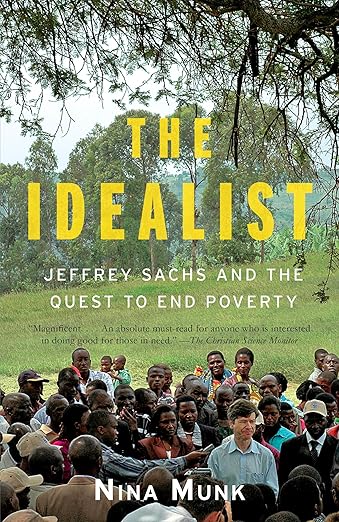
I put this book down feeling even more depressed about the fate of sub-Saharan Africa than when I started, which was pretty depressed. The cover photo in the paperback edition shows Sachs surrounded by African villagers. It's a photo well selected by Munk and her editors as it captures perfectly the mix of Sachs's arrogance and ridiculousness that Munk conveys in this book. I just sincerely hope that she isn't nearly as accurate as believes that she is.
47 people found this helpful
Report

Piano
5.0 out of 5 stars Jeff Sachs under scrutiny
Reviewed in Germany on 25 June 2014
Format: KindleVerified Purchase
Nina Munk started off as a sympathiser of Jeff Sachs and ended by brilliantly debunking the intellectual poverty of the ideas of a pretentious "star" economist.
Report

Occasional Thinker
5.0 out of 5 stars A bright buffoon is still a buffoon
Reviewed in the United Kingdom on 27 October 2013
Format: HardcoverVerified Purchase
A cautionary tale of a smart-alec who was so smart he could sort out Africa, and lots of other places too like Russia and Poland. Or so he thought. He has left a trail of damage, waste, and sanctimonious simple-minded but clever sounding twaddle wherever he has been. You do not want this chap arriving in your village with his wads of dollars and pushy style. Send him away. This book deserves to be widely read in the developing world, and elsewhere too.
7 people found this helpful
Report

Floridian
5.0 out of 5 stars Reads Like An Engrossing Novel
Reviewed in the United States on 19 October 2013
Format: KindleVerified Purchase
I didn't expect this book to be hard to put down. But it is. I enjoyed reading it very much.

I decided to read it because I currently have a daughter at Columbia. I like to read things related to Columbia. It's a wonderful place.

Other reviews here provide all the details you need to know. I just want to share some words that describe Jeffrey Sachs and speculate on his motivations based on this book. I will stipulate that Jeffrey Sachs wants to end poverty. But he seems to be self-promoting, self-aggrandizing, somewhat delusional and surprisingly naive.

In my opinion, as Sachs was approaching 50, it occurred to him that he needed to end his career with a big bang. Why not claim to have a way to end poverty in Africa and find others to pay for an attempt? At the same time he would rub shoulders with the likes of Bono and Angelina Jolie. He simply bit off more than he could chew. His hubris makes him pretend that he has been succeeding in his Quixotic quest.

It seems obvious to me that Sachs would really like to be a rock star. And that would have been much easier than taking on a challenge that's not likely to ever be achieved.
2 people found this helpful
Report

RRW
3.0 out of 5 stars engaging story...but very biased.
Reviewed in the United States on 4 April 2014
Format: KindleVerified Purchase
I know most of the people and places Munk describes as I was there. Certainly there is much truth, but also much bias as well. Some of the Millennium Villages have worked out better than others, but all were chosen for the extreme challenges they presented. Unlike many development projects, the MVP was designed to also be a science project such that the process and changes were carefully documented. Some of what Munk describes as the heavy hand of New York was really the demand for data on what was happening.
10 people found this helpful
Report

Lookfar
3.0 out of 5 stars definetely worth a read
Reviewed in the United Kingdom on 5 February 2015
Format: KindleVerified Purchase
This is an interesting insight into the Millenium Villages project. The journalist has taken her time in collecting evidence by interviewing the people who are actually on the field. However, when adressing something of this importance (millions of dollars are being poured into the project). I would expect something more than a journalistic cronicle. The book lacks data, not just reviews from the news but solid data that can guide the reader towards an unbiased conclusion. We may not like the way things are done, we may even not like the characters that are doing the things, but that does not mean they may not have done something of value.
To be read critically, and in conjuction with other books on the same topic.
2 people found this helpful
Report

Radish
5.0 out of 5 stars Great insight
Reviewed in the United Kingdom on 10 April 2014
Format: KindleVerified Purchase
I heard an interview with Nina Munk and felt compelled to buy this book, which was brilliant. This is great for anyone working in development or even those who just have an interest. Nina is not a development expert, but her insight and analysis of people and situations is excellent. I would highly recommend this book.
Report

==
From other countries

Anna E.
5.0 out of 5 stars Blame Intro to Global Economics class with a Canadian professor.
Reviewed in the United States on 16 November 2014
Format: KindleVerified Purchase
This book was AMAZING. I found myself attached to it during every break I had at work, down time at school, and days off.

This book was assigned to read and to write a critical book review for my global economics class at the University of Washington.

So many great points were brought up that meant a great deal to me throughout this book. It has given me a whole new outlook on poverty, not just in Africa, but anywhere. Poverty, even to the extreme, is EVERYWHERE.

I definitely recommend anyone who has a charitable heart to really give this book a go. I'm not much of a reader but this book was SO well written, easy to understand, and shows a whole new perspective on things.
One person found this helpful
Report

lea
4.0 out of 5 stars Well written but too pessimistic
Reviewed in the United States on 15 December 2024
Format: PaperbackVerified Purchase
This book was a great read, the author is a talented writer. She does demonstrate that the problem of extreme poverty was not nearly as simple as Sachs originally thought and involves many complex larger environmental, cultural and political problems. That said, I actually found the book to be too harsh with Sachs, since it seems that the program was helpful it's just that Sachs overpromised. But on the other hand, Sachs needed to raise funds so it makes sense that he overpromised. Furthermore, one can argue that Sach's approach is more correct than what the author gives credit for, but much more funds per capita were needed. I didn't come away with a clear idea of what Munk is suggesting as the alternative to the problem of extreme poverty.
Report

Charlie
3.0 out of 5 stars Easy read.
Reviewed in the United Kingdom on 17 March 2017
Format: KindleVerified Purchase
Good to get a bit of perspective and a critical view of Sachs but this book is nonetheless pretty harsh and comes across as biased for the sake of journalism. That said it's important to be aware of the naivety of presuming that the West and Western ways hold all the answers.
Report

Stephen Franks
4.0 out of 5 stars What does Nina Recommend?
Reviewed in the United States on 3 April 2014
Format: HardcoverVerified Purchase
Munk brilliantly skewers the clerical economist. Her deceptively simple description of the gaps between rhetoric and reality do it all. Her charitable balance spotlights his vilification of people who disagree with him. Though his failure is tragic, feeling for those he lifted with hope then failed, release us from sympathy for the man who sacrificed intellectual integrity to his poster child left-academic vision.
But I can't give this book five stars. This sick joke doesn't have a punch-line. One starts waiting for it from half-way through, from the initial darkening of the bright pictures of hope. Waiting starts as a niggling hope that her perspicacity will identify elements worth preserving from Sach's arrogant analysis and prescriptions. But she leaves a lot hanging. She describes Sachs' torpedoing of generations of development agency work to create in Tanzania a self-sustaining domestic market in insecticide mosquito nets, when his vituperation badgered the world into a big bang distribution of free nets to everyone. We hear that they get used for fishing, and fencing goats, but we do not learn whether there was a dramatic reduction in malaria. Nor do we learn the fate of those who will be needed to replace the nets when the free ones wear out after five years.
But we do see enough for it to be clear that Sachs simply dressed up 'non-judgmental' charity in overwhelming optimism to disguise the usual left hatred of our Western forebears' Christian capitalist virtues (thrift, diligence, honesty, rationality, freedom). Without a critical mass of those virtues our forebears could not have lifted us from the normal Malthusian cycles of famine, disease and tyranny.
Munk leaves Sachs with the dignity of some learning from the experience. After summarizing his decline into Occupy fulmination against the world and humans as they are she quotes him qualifying his previous conviction that he knew exactly what should be done and that everyone who opposed him were stupid or venal. "I believe in the contingency of life. This isn't one grand roll of the dice. The world is complicated, hard and messy".
But I really want to know what she would prescribe.
5 people found this helpful
Report

Rev. David Kashangaki
4.0 out of 5 stars A Perfect Title.
Reviewed in the United States on 7 November 2013
Format: HardcoverVerified Purchase
I found that the story told through the eyes of local actors was very compelling, and the struggles they went through to attempt to implement Jeffrey Sachs "big" ideas added to the credibility of the point that Nina Munk was making: that money thrown at problems is not enough to solve them, no matter how much is raised. Munk also brought home the point that it is impossible to foresee all the complications that arise when trying to solve such a broad issue as poverty with a one solution fits all locations, just because there seems to be a common problem. Solutions to poverty in different geographical areas are going to require more than money and dedicated administrators to overcome. Munk clearly shows that poverty is more nuanced, and as a practical answer to the question of poverty, she proves beyond reasonable doubt that up scaling Sachs plan to spend billions of dollars tackling every single obstacle that arises in implementing the Millennium Village Project is definitely not the route to take to ending poverty. There are just too many!
One person found this helpful
Report

Bookman
5.0 out of 5 stars Applying romantic visions to primitive environments hurts more people than it helps.
Reviewed in the United States on 17 October 2013
Format: KindleVerified Purchase
Not being willing to admit and understand the millennial realities of many 3rd-world countries before trying to "help" just leads to more conflict, disease, and death.

It is fine to want to help, and to help, but unless the impetus to change the inherent problems of societies whose culture has been the same for thousands of years comes from the actual leaders of those societies, far more suffering will result than if they were just left alone.

Unrealistic "hopes" by the perpetrators of "we will do away with poverty right away" schemes simply attracts many thousands of those poor people to a landscape which lacks the structure to support them. When the schemes are abandoned, the poor folk just die, or are in worse poverty than they were before.

...not to mention the inevitable attraction of the crooks, the politicians, and the clerics, who want their share of the pie, even if it leaves their own people to starve.

As Paul Simon put it so well:
"I have squandered my resistance
For a pocket full of mumbles,
such are promises
All lies and jests
Still a man hears what he wants to hear
And disregards the rest...
Lie la lie..."

"and a little bitty tear let me down..."-Burl Ives...
One person found this helpful
Report

Richard Martin
4.0 out of 5 stars A very fair and fascinating account
Reviewed in the United States on 24 February 2014
Format: KindleVerified Purchase
This is a good book. Nina Munk is an admirer of Jeffrey Sachs and her account starts from a position of admiration for his ideas and trust in his abilities. But as she watches his ambitious project develop, the flaws in the whole scheme become increasingly clear. The book uses the perspective of the local staff to document the problems faced by them from both local and international factors. The top-down nature of the management of the Millennium Village Project is depicted vividly as well as the arrogance with which Sachs and his team prescribe solutions. The tragedy of the story is that the generosity of Sachs and his financiers creates a grant-dependency in the beneficiary villages, the opposite effect that he sought. The vicious cycle created by an increasingly desperate search for additional financiers illustrates the limitations of his solutions that make such good sense in principle, but are so difficult to put into practice.
One person found this helpful
Report

Stu Daultrey
4.0 out of 5 stars I liked the detailed discussion of two Millennium Village projects
Reviewed in the United States on 4 November 2014
Format: KindleVerified Purchase
There's a lot in this book that could serve as a critique of the "hands on" and "can do" approach to lack of development in Africa that Jeffrey Sachs takes. I liked the detailed discussion of two Millennium Village projects, but when, towards the end of the book, the two projects fell apart, the discussion stopped. What went wrong? Personal differences appeared to contribute in one case, environmental extremes in the other, but both projects were always struggling to cope. Is there a fundamental flaw in the Sachs approach? Is any other approach achieving better results?

Perhaps Ms Munk just reached the limits of her time to give to following up on these two projects, and/or perhaps she just reached the limits of her competence to discuss the whole issue. It's half the book it could have been, but I enjoyed what there was, and learned a lot.
One person found this helpful
Report

Antonia Roberts
4.0 out of 5 stars Biting
Reviewed in the United States on 13 September 2021
Format: KindleVerified Purchase
She highlights many flaws of the Millennium Villages projects. Towards the end I start to get an idea of what she thinks could’ve been done better, although that is never her explicit claim. The whole time when she takes little jabs at Jeffrey Sachs, I want to give him the benefit of the doubt. But it’s when she softens up on him at the end that I feel the most disappointed in the Millennium Village Projects. Definitely lots of food for thought.
Report

DRM
5.0 out of 5 stars Old-fashioned journalism that makes you think
Reviewed in the United States on 13 September 2013
Format: HardcoverVerified Purchase
Nina Munk compellingly captures the tension between abstract concepts and human lives in this immersive examination of the thinking behind and the experiences within Jeffrey Sachs Millennium Villages Project. What is the real impact, in personal, human terms, when $120 million is poured into rural, sustenance-level communities? Munk juxtaposes the stories of Sach's insistent conviction that poverty is a scale problem that can only be solved with scale solutions with the struggles that confront the project villages in Africa that benefit from his largesse.

This is old-fashioned reporting in the absolute best-way: Munk lets us see, assess and judge for ourselves. And she helps us along the way with assured writing that captures the moment, the people and the place in the best way: vivid and crisp.

This book lets you feel a little smarter about something important, brings you close to lives of courage and folly, and makes you wonder about how to solve one of the most pressing problems of our age. Absolutely recommend it.
28 people found this helpful
Report
==

<이상주의자: 제프리 삭스와 빈곤 퇴치를 향한 여정> 요약 및 평론

1. 서론: 오만과 열정의 경계

니나 뭉크의 <이상주의자>는 세계적인 경제학자 제프리 삭스가 주도했던 밀레니엄 빌리지 프로젝트(MVP)의 궤적을 쫓는 기록이다. 이 책은 한 천재 경제학자의 선의가 아프리카의 복잡한 현실과 충돌하며 어떻게 마찰음을 내는지, 그리고 데이터와 이론이 살아있는 인간의 삶을 규정하려 할 때 발생하는 비극적 괴리를 가감 없이 보여준다.

2. 요약: 밀레니엄 빌리지의 야심찬 실험

제프리 삭스는 2000년대 초반, 적절한 투자와 기술적 개입만 있다면 한 세대 안에 극심한 빈곤을 종식할 수 있다고 주장했다. 그는 사하라 이남 아프리카의 10개국, 15개 지역을 선정하여 보건, 교육, 농업, 인프라를 동시에 개선하는 밀레니엄 빌리지 프로젝트를 시작한다.

뭉크는 6년이라는 시간 동안 삭스를 추적하며 에티오피아의 더워(Dertu)와 우간다의 루히라(Ruhiira) 등지에서 벌어지는 실험을 관찰한다. 초기에는 가시적인 성과가 나타나는 듯했다. 말라리아 모기장이 배포되고, 비료가 지원되면서 옥수수 수확량이 비약적으로 늘어났다. 삭스는 이를 빈곤의 덫(Poverty Trap)을 탈출하는 증거로 선전하며 더 많은 국제적 지원을 호소했다.

그러나 시간이 흐르며 균열이 발생한다. 과잉 생산된 옥수수는 저장 시설 부족과 시장 접근성 부재로 썩어갔고, 외부에서 지원된 수중 펌프는 관리 주체가 없어 고장 난 채 방치되었다. 삭스는 현장의 세세한 문제들—부족 간의 갈등, 유목민의 문화적 특성, 시장 경제의 역학—보다는 거시적인 지표와 통계에 집착했다. 결국 프로젝트는 당초 약속했던 자립적인 경제 모델 구축에 실패하고, 외부 원조 없이는 유지될 수 없는 의존성만을 확인하며 막을 내린다.

3. 평론: '계획가'의 환상과 '탐색가'의 부재

이 책은 단순한 실패의 기록이 아니라, 근대 서구 지성주의가 지닌 고질적인 오만(Hubris)에 대한 통렬한 비판이다.

첫째, <하향식 설계의 한계>다. 삭스는 빈곤을 단순히 투입(Input)이 부족해서 발생하는 공학적 문제로 치부했다. 그는 아프리카를 거대한 실험실로, 가난한 이들을 실험 대상으로 여겼다. 뭉크는 삭스가 현지인들의 목소리를 듣기보다 자신의 이론을 증명하기 위해 현장을 끼워 맞추는 모습을 포착한다. 이는 윌리엄 이스털리가 지적한 계획가(Planner)의 전형적인 오류이며, 현장의 맥락을 읽어내는 탐색가(Searcher)의 관점이 결여된 결과다.

둘째, <현실 부정과 확증 편향>이다. 책에서 가장 인상적인 부분은 명백한 실패 징후 앞에서도 자신의 오류를 인정하지 않는 삭스의 태도다. 그는 데이터가 부정적으로 나오면 통계적 오류를 탓하거나 실무자들을 질책했다. 지적 오만함은 그를 눈멀게 했고, 결국 구호 기금은 효율적으로 집행되지 못했다.

셋째, <서사적 진실의 힘>이다. 니나 뭉크는 경제학적 수치 뒤에 숨겨진 인간의 얼굴을 드러낸다. 삭스가 뉴욕의 연회장에서 헐리우드 스타들과 빈곤 퇴치를 논할 때, 에티오피아의 유목민들은 자신들의 삶의 방식이 파괴되는 것을 지켜봐야 했다. 뭉크의 문체는 냉정하면서도 연민을 담고 있어, 독자로 하여금 거대 담론이 놓치는 구체적인 고통이 무엇인지 직시하게 한다.

4. 결론: 선의만으로는 충분하지 않다

<이상주의자>는 세상을 바꾸겠다는 뜨거운 심장이 차가운 이성과 결합하지 못했을 때 어떤 부작용이 발생하는지 경고한다. 제프리 삭스는 분명 진심으로 빈곤을 증오했다. 하지만 그 진심이 타자의 삶을 제단 위에 올릴 권리를 부여하지는 않는다.

이 책은 국제 개발 원조의 패러다임을 바꾼 고전으로 남을 만하다. 빈곤 퇴치는 단기적인 프로젝트나 화려한 프레젠테이션으로 해결될 수 있는 과제가 아니라, 현지의 문화와 시장, 그리고 인간의 자율성을 존중하는 긴 호흡의 여정이어야 함을 뼈아프게 증명한다.


세진님, 위 내용이 원하시는 수준의 요약과 평론이 되었을까요? 혹시 특정 부분(예를 들어 에티오피아 사례나 삭스의 경제 이론 비판 등)을 더 심도 있게 다루길 원하신다면 말씀해 주세요. 다음 단계로 무엇을 도와드릴까요?

==

==

『이상주의자: 제프리 삭스와 빈곤 종식을 향한 탐구』

<The Idealist: Jeffrey Sachs and the Quest to End Poverty> – Nina Munk

1. 책의 기본 문제의식

<니나 멍크(Nina Munk)>의 『이상주의자』는 개발경제학자 <제프리 삭스(Jeffrey Sachs)>가 주도한 “빈곤의 종식” 프로젝트를 밀착 취재한 르포르타주이다. 삭스는 『The End of Poverty』에서 극빈은 “정책 의지와 자원의 집중 투입”으로 해결 가능하다고 주장했다. 이 책은 그 주장을 실험한 대표적 사례인 <밀레니엄 빌리지 프로젝트(Millennium Villages Project)>를 현장에서 추적한다.

문제는 단순하다.
“막대한 자금과 최고의 의지, 국제적 명성까지 동원했는데, 왜 빈곤은 그렇게 쉽게 사라지지 않는가?”

멍크는 찬양도, 적대도 아닌 방식으로 이 질문을 밀어붙인다.


2. 밀레니엄 빌리지 프로젝트의 구상

삭스는 아프리카 일부 마을에 집중적으로 자원을 투입하면 ‘빈곤의 덫’을 끊을 수 있다고 보았다.

핵심 전략은 다음과 같다.

  • 비료와 종자 지원 → 농업 생산성 증가

  • 보건소 설립 → 말라리아·기생충 퇴치

  • 학교 급식 및 교육 강화

  • 도로·우물 등 인프라 구축

  • 기술·시장 접근 지원

대표 사례로 케냐 북동부의 데르투(Dertu) 같은 지역이 등장한다.

이 프로젝트는 단순 원조가 아니라 “통합적 패키지 투자”였다.
삭스는 극빈의 원인을 개인의 무능이 아니라 구조적 결핍으로 보았고, 일정 수준의 임계점만 넘으면 자립적 성장 경로로 진입한다고 믿었다.

이 점에서 그는 낙관적 구조주의자였다.


3. 현장의 균열

멍크는 삭스를 이상주의적 영웅으로 시작하지만, 곧 균열을 보여준다.

1) 통계와 현실의 간극

프로젝트 보고서에서는 생산량 증가, 학교 출석률 상승 같은 성과가 제시된다.
그러나 현장에서는 다음과 같은 문제가 발생한다.

  • 비료 공급이 중단되자 수확량 급감

  • 보건소 운영비 부족

  • 외부 자금 의존 구조 고착

  • 시장 접근 부족으로 농산물 가격 하락

단기 성과는 있었지만, 장기 자립은 불확실했다.

2) 정치·제도 환경의 문제

삭스 모델은 기술적·재정적 접근에 강했지만, 다음 요소를 과소평가했다.

  • 지방정부의 부패

  • 중앙정부의 정책 불안정

  • 지역 권력 구조

  • 토지 소유 문제

빈곤은 단순한 자원 부족이 아니라 정치경제적 권력 구조 속에 놓여 있었다.

3) 기대와 환멸

마을 주민들은 처음엔 기대를 품었다.
그러나 외부 프로젝트가 끝날 무렵, 남은 것은 애매한 구조였다.

  • 지원은 줄어들었고

  • 새로운 자립 모델은 불완전했으며

  • 의존성은 남았다

멍크는 삭스의 선의를 의심하지 않지만, 그의 확신이 현실을 단순화했다고 지적한다.


4. 제프리 삭스라는 인물

이 책의 진짜 주인공은 정책이 아니라 삭스라는 인간이다.

그는:

  • 젊은 시절 볼리비아·폴란드 경제개혁에 참여

  • “쇼크 요법”으로 논쟁의 중심에 섰고

  • 이후 빈곤 퇴치로 관심을 이동

그는 에너지 넘치고 도덕적 확신이 강하다.
유엔, 세계은행, 정부 수반과 직접 연결되는 네트워크를 갖고 있다.

그러나 멍크가 그리는 삭스는 때로 다음과 같다.

  • 비판에 방어적

  • 현장 문제를 세부적으로 관리하지 않음

  • 메시지 중심적

  • 낙관적 가정에 집착

그는 “거대한 서사”를 믿는다.
그러나 현장은 작은 문제들로 이루어져 있다.


5. 이상주의의 구조적 한계

이 책은 단순히 “삭스가 실패했다”는 이야기가 아니다.
보다 근본적인 질문을 던진다.

1) 빈곤은 기술적 문제인가, 정치적 문제인가?

삭스 모델은 다음 가정을 깐다.

빈곤은 자원 부족 → 자원 투입 → 성장 → 자립

하지만 멍크는 보여준다.

  • 권력 구조

  • 부패

  • 토지 문제

  • 무력 갈등

  • 글로벌 시장 구조

이것이 얽혀 있다.

2) 외부 개입의 한계

외부 자금이 투입될 때 나타나는 효과:

  • 단기적 개선

  • 기대 상승

  • 의존 구조 형성

이것이 반복되면, 내부 역량 축적보다 외부 기대가 커진다.

3) “증명되지 않은 성공”

밀레니엄 빌리지 프로젝트는 실험군·통제군 비교 연구가 충분히 이루어지지 않았다.
성과는 홍보되었지만, 독립적 평가가 제한적이었다.

이는 개발 담론에서 “서사”와 “데이터”의 긴장을 보여준다.


6. 세진님 관심 맥락과 연결

세진님은 자주 다음을 질문해 왔다.

  • 구조적 정의와 실천의 간극

  • 국제주의와 민족주의의 긴장

  • 도덕적 확신이 현실을 단순화하는 문제

이 책은 바로 그 문제를 개발경제학 영역에서 드러낸다.

삭스는 도덕적 열정을 가진 국제주의자다.
그러나 멍크는 보여준다.

도덕적 확신이 강할수록
복잡한 정치경제 구조를 과소평가하기 쉽다.

이 점은 동아시아 평화 담론, 한반도 중립화론, 팔레스타인 문제 분석에서도 반복되는 구조와 닮아 있다.


7. 평론: 이 책의 의의와 한계

장점

  1. 인물 중심 서사와 구조 분석을 결합

  2. 개발 담론의 낙관주의를 균형 있게 비판

  3. 현장 밀착 취재의 생생함

  4. 선의와 결과의 간극을 냉정하게 드러냄

한계

  1. 대안 모델에 대한 구체적 제시는 부족

  2. 구조 비판은 강하지만, 체계적 비교 연구는 제한적

  3. 삭스 개인 서사에 초점이 맞춰져 정책적 일반화는 제한적


8. 더 깊은 질문

이 책을 덮고 남는 질문은 이것이다.

  • 빈곤은 끝낼 수 있는가?

  • 아니면 관리할 수 있을 뿐인가?

  • 국제적 원조는 구조를 바꾸는가, 연장하는가?

  • 이상주의는 현실정치와 어떻게 조화되는가?

삭스는 여전히 “끝낼 수 있다”고 말한다.
멍크는 “그렇게 단순하지 않다”고 말한다.


9. 결론

『이상주의자』는 이상주의에 대한 조롱이 아니다.
그러나 낙관적 단순화에 대한 경고다.

이 책이 주는 가장 중요한 교훈은 이것이다.

선의는 충분하지 않다.
자금도 충분하지 않다.
구조를 읽는 힘이 필요하다.

그리고 아마 더 냉혹한 진실은 이것일지도 모른다.

빈곤은 단지 결핍의 문제가 아니라
권력의 문제다.

이 점을 직시하지 않으면,
아무리 거대한 프로젝트라도
결국은 실험으로 남을 가능성이 크다.


원하신다면 다음 단계로,

  • 삭스 모델 vs 에스터 뒤플로·랜던식 무작위실험 접근 비교

  • 삭스 vs 구조주의·의존이론 비교

  • 동아시아 개발독재 모델과의 비교

중 어디로 확장해 볼까요?

==

No comments: