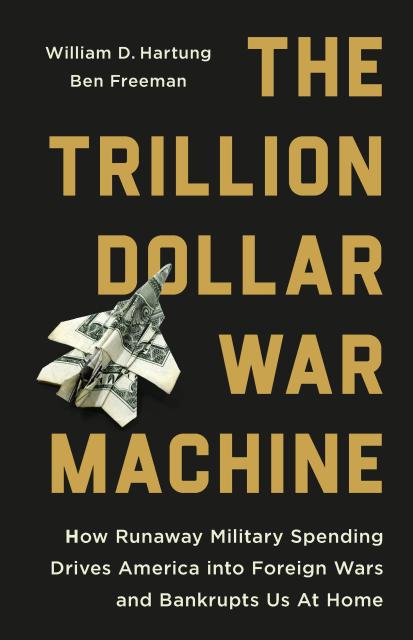
The Trillion Dollar War Machine
How Runaway Military Spending Drives America into Foreign Wars and Bankrupts Us at Home
 Open the full-size image
Contributors
By William D Hartung
By Ben Freeman
Formats and Prices
On SaleNov 11, 2025
Page Count336 pages
PublisherBold Type Books
ISBN-139781645030638
Price$30.00
Format:Hardcover$30.00
ebook$18.99
Add to Cart
Buy from Other Retailers:Amazon
Barnes & Noble
Books-A-Million
Bookshop
Target
Walmart
Description
A hard-hitting investigation into how the Pentagon’s runaway spending embroils America in foreign wars, squanders its wealth, and enriches a privileged elite
“A damning indictment of the conflicts of interest running rampant in the defense establishment.”―Publishers Weekly
America spends nearly a trillion dollars a year on its military. This extraordinary spending not only detracts from our ability to address pressing social problems but compels us into foreign wars to justify our vast arsenal. Sold to us in the name of “security,” our military industrial complex actually makes us far less safe.
Top policy experts William D. Hartung and Ben Freeman follow the profits of militarism from traditional Pentagon contractors, which receive more than half of the Pentagon’s budget, to the upstart high-tech firms that shamelessly promote unproven and destabilizing technologies. They unmask the enablers of the war machine—politicians, lobbyists, the media, Hollywood, think tanks, and so many more—whose work enriches a wealthy elite at the expense of everybody else, spreading conflict around the world and embroiling America in endless wars.
A damning tour de force, The Trillion Dollar War Machine shows who is pulling the strings and pushing for war, and offers a blueprint for how we can shut down the war machine and restore American security and prosperity.
See LessRequest Desk/Exam Copy
Genre:Nonfiction
History
Military
United States
About the Author
Praise

William D Hartung
About the Author
William D. Hartung is a senior fellow at the Quincy Institute, focusing on the arms industry and military spending. He is the author of Prophets of War and resides in New York City.
Ben Freeman, director of democratizing foreign policy at the Quincy Institute, holds a PhD from Texas A&M. He focuses on investigating money in politics, military spending, and foreign influence. He lives in central Florida.
Learn more about this author

Ben Freeman
About the Author
Ben Freeman, director of democratizing foreign policy at the Quincy Institute, holds a PhD from Texas A&M. He focuses on investigating money in politics, military spending, and foreign influence. He lives in central Florida.
Learn more about this author
From the United States
3 people found this helpful
Helpful

Lee De Cola
4.0 out of 5 stars words, words, words...Reviewed in the United States on February 7, 2026
Format: HardcoverVerified Purchase
i've studied the US military-industrial complex statistically and hoped that this book would give me not only verbal accounts of how the juggernaut continues to gobble up treasure but also maps, datagraphics, timelines, etc that would make the story come alive visually. unfortunately the book is just word piled upon word.
the Quincy Institute no doubt has the talent to enrich this story, so why not use it?
(i'll admit that my impatience with this prosaic format prevented me from reading beyond the first few pages...)
One person found this helpful
HelpfulReport

ezeques
5.0 out of 5 stars A Clear-Eyed Look at America’s Permanent War Economy — and Why It Matters Now More Than EverReviewed in the United States on November 13, 2025
Format: Hardcover
The Trillion Dollar War Machine is one of the most important, sobering, and fact-driven books I’ve read in years about U.S. foreign policy and the forces that quietly shape it. William Hartung has spent decades tracking the defense industry, and here he lays out—with clarity, data, and historical memory—the uncomfortable truth: America’s foreign policy is not primarily driven by security, diplomacy, or national interest, but by a sprawling military-industrial racket that profits from endless conflict.
Hartung shows how, decade after decade, the U.S. has poured staggering sums into weapons systems we don’t need, cannot use, or that often make the world less stable. He traces how political influence, lobbying, and contractor money create a self-reinforcing cycle where every problem appears solvable only with more bases, more bombs, and more military “solutions.”
What I found especially powerful is the contrast Hartung implicitly draws with how other major powers project influence. While China is engaging in economic statecraft—building roads, railways, ports, power plants, and long-term commercial ties—the U.S. too often relies on a toolbox dominated by bombing campaigns, regime-change adventures, covert operations, and permanent military deployments abroad that seldom turn out to benefit the American taxpayer.
17 people found this helpful
HelpfulReport

S. Nasiri
5.0 out of 5 stars Excellent Reading on Cost War and MICReviewed in the United States on December 9, 2025
I really enjoyed reading this book and learned quite a bit about the military-industrial complex and it's politics. There were many eye opening facts and figures that was hard to belive and explained clearly how and why we have got to such a huge 35 trillion dollar debt in USA.
8 people found this helpful
HelpfulReport
Vicky
5.0 out of 5 stars $1,000,000,000,000 for less safetyReviewed in the United States on November 20, 2025
Format: Hardcover
Excellent book that exposes the web of Pentagon spending, the corporations it enriches, Hollywood, and lobbyists that keep us mired in endless wars. I particularly appreciated their research into the new tech companies that are beginning to compete with the Lockheed Martins of the world for weapons contracts, and the argument that all of this spending and corruption is actually hurting military readiness. It's hard to read a book like this and not be angry, and I hope that it becomes a "Silent Spring" for those of us who want to see birds, not drones, in our skies.
9 people found this helpful
HelpfulReport
Michael Hardiman
2.0 out of 5 stars Informative on the Mil.-Indus. Complex, but too much out of scope kooky leftwing jibber jabberReviewed in the United States on February 11, 2026
Format: Hardcover
Stiglitz and Bilmes in their book The Three Trillion Dollar War were thorough, unrelenting and on-point in their criticism of the Iraq invasion. I wish that was the case with this examination of the massive machine behind the Pentagon's nearly trillion dollar annual budget. The authors propose stripping funds from the Military Industrial Complex (MIC), only to add to the Welfare Industrial Complex (WIC) and the Global Warming/Climate Industrial Complex (GWIC). Both the WIC and GWIC use many of the same tactics as the MIC to ensure that their taxpayer financed gravy train keeps rolling.
The book presents to the reader ideas almost never discussed, the most interesting of which is eliminating the land-based ICBMs from the nuclear arsenal. They argue that a two pronged (submarines and aircraft) nuclear capability is more than adequate, much safer and much less expensive than the nuclear triad in place since the 1950s.
It describes at length how the financial tentacles of the MIC reach into Hollywood, universities, research think tanks, the news media, gaming and endless lobbying of Congress by both government personnel and military contractors. The MIC prevents opposing viewpoints through exercising financial and access pressure points. The MIC also pollutes discourse by recipients of its largesse failing to disclose their conflicts of interest. For example, a retired general or admiral will spout off on television in a very authoritative manner, without disclosing that he or the research foundation which employs him are financed by the manufacturer of the weapon he is promoting.
Unfortunately, the authors rather extreme leftwing politics frequently limit the solutions they propose. The Poor People's Campaign largely socialist proposals are recommended, but the libertarian Cato Institute is nowhere to be seen. Moving money from defense to social programs is proposed, but not reducing spending to slow growth of the $38 trillion national debt. And green energy is frequently hyped, without acknowleding that windmills and solar panels do not supply persistent power and require oil and gas backup.
Alleged systemic racism, water in Flint Michigan, wages in West Virginia, Martin Luther King, inequality, lbxyz rights, charging House Speaker Mike Johnson with claims of racism, all take a star turn in a book that is promoted to be about the Pentagon's budget and how to bring it under control. The books authors and editors should have pruned about 50 pages of kooky leftwing jibber jabber and ad hominem attacks and stuck to the subject matter.
HelpfulReport
==
==
미국의 전쟁을 움직이는 손은 누구인가
송고2026-02-22 08:11
송고 2026년02월22일 08시11분

김정은기자
군산복합체 해부한 신간 '미국은 왜 전쟁을 멈추지 못하는가'
이미지 확대
 연합뉴스 사진
[부키 제공. 재판매 및 DB 금지]
(서울=연합뉴스) 김정은 기자 = 베트남, 이라크, 아프가니스탄, 시리아, 리비아, 베네수엘라 등에서 수많은 분쟁과 무력 개입을 벌여온 나라. 전 세계 무기 시장의 43% 이상을 차지하고, 107개국에 무기를 공급하는 나라. 냉전 시대 때보다 국방 예산에 더 많은 돈을 쓰고 있지만 실제로는 점점 덜 안전해지고 있는 나라.
신간 '미국은 왜 전쟁을 멈추지 못하는가'(부키)에서 두 저자 윌리엄 D. 하텅과 벤 프리먼이 바라본 미국의 현주소다.
미국 싱크탱크 퀸시책임국정연구소에서 국방 예산과 군수산업 등을 연구하는 두 사람은 이 같은 상황의 배경으로 미국을 움직이는 '전쟁 기계', 군산복합체를 지목한다.
돈과 권력이 얽힌 거대한 이익 집단인 군산복합체가 미국 사회에서 정치권력을 장악하고 막강한 영향력을 행사하면서 이 나라를 끝없는 전쟁으로 몰아넣는다는 것이다.
저자는 1조 달러에 육박하는 미국 국방부 예산의 절반 이상은 군대 인건비가 아니라 민간 기업으로 흘러간다고 지적한다.
2001년 9·11 테러 이후 20년 동안 미국 국방부가 지출한 14조 달러 중 절반이 민간 군수기업으로 들어갔다. 이 기간 '빅5' 방산업체인 록히드 마틴, 레이시온(현 RTX), 보잉, 제너럴 다이내믹스, 노스럽 그러먼은 국방부 계약으로 2조1천억 달러를 챙겼다
책은 만약 이 돈을 주택과 학교 건설, 의료와 교육 지원 등 국가적으로 필요한 다른 곳에 썼다면 미국 사회는 크게 변했을 것이라고 말한다.
그러나 워싱턴에서는 이를 문제 삼는 사람이 거의 없다. 방산업체는 의원 1명당 로비스트를 거의 2명 붙이고 막대한 로비 자금을 투입한다.
군산복합체의 로비와 영향력은 의회와 행정부에 그치지 않는다. 할리우드, 게임산업, 스포츠, 각급 학교와 대학, 주류 언론, 싱크탱크 등 사회 전반에 광범위하게 영향을 미친다.
TV와 할리우드 영화에서는 군대와 무기가 호의적으로 묘사되도록 만든다. 첨단 전쟁은 원격으로 수행된다는 점에서 게이머들을 겨냥해 게임 산업에 투자하고 이들의 입대를 장려한다.
책은 팔란티어, 스페이스X 등 신흥 기술기업들이 인공지능(AI)과 무인으로 대표되는 자동화 전쟁 시대의 도래를 주창하며 막대한 이권을 놓고 기존 빅5 방산업체와 벌이는 대결도 다룬다.
'국가 안보'라는 명목으로 이뤄지는 미국 대외정책의 이면을 엿볼 수 있다.
백우진 옮김. 452쪽.
kje@yna.co.kr
==
미국의 전쟁을 움직이는 손은 누구인가
군산복합체 해부한 신간 '미국은 왜 전쟁을 멈추지 못하는가'
(서울=연합뉴스) 김정은 기자 = 베트남, 이라크, 아프가니스탄, 시리아, 리비아, 베네수엘라 등에서 수많은 분쟁과 무력 개입을 벌여온 나라. 전 세계 무기 시장의 43% 이상을 차지하고, 107개국에 무기를 공급하는 나라. 냉전 시대 때보다 국방 예산에 더 많은 돈을 쓰고 있지만 실제로는 점점 덜 안전해지고 있는 나라.
신간 '미국은 왜 전쟁을 멈추지 못하는가'(부키)에서 두 저자 윌리엄 D. 하텅과 벤 프리먼이 바라본 미국의 현주소다.
미국 싱크탱크 퀸시책임국정연구소에서 국방 예산과 군수산업 등을 연구하는 두 사람은 이 같은 상황의 배경으로 미국을 움직이는 '전쟁 기계', 군산복합체를 지목한다.
돈과 권력이 얽힌 거대한 이익 집단인 군산복합체가 미국 사회에서 정치권력을 장악하고 막강한 영향력을 행사하면서 이 나라를 끝없는 전쟁으로 몰아넣는다는 것이다.
저자는 1조 달러에 육박하는 미국 국방부 예산의 절반 이상은 군대 인건비가 아니라 민간 기업으로 흘러간다고 지적한다.
2001년 9·11 테러 이후 20년 동안 미국 국방부가 지출한 14조 달러 중 절반이 민간 군수기업으로 들어갔다. 이 기간 '빅5' 방산업체인 록히드 마틴, 레이시온(현 RTX), 보잉, 제너럴 다이내믹스, 노스럽 그러먼은 국방부 계약으로 2조1천억 달러를 챙겼다.
책은 만약 이 돈을 주택과 학교 건설, 의료와 교육 지원 등 국가적으로 필요한 다른 곳에 썼다면 미국 사회는 크게 변했을 것이라고 말한다.
그러나 워싱턴에서는 이를 문제 삼는 사람이 거의 없다. 방산업체는 의원 1명당 로비스트를 거의 2명 붙이고 막대한 로비 자금을 투입한다.
군산복합체의 로비와 영향력은 의회와 행정부에 그치지 않는다. 할리우드, 게임산업, 스포츠, 각급 학교와 대학, 주류 언론, 싱크탱크 등 사회 전반에 광범위하게 영향을 미친다.
TV와 할리우드 영화에서는 군대와 무기가 호의적으로 묘사되도록 만든다. 첨단 전쟁은 원격으로 수행된다는 점에서 게이머들을 겨냥해 게임 산업에 투자하고 이들의 입대를 장려한다.
책은 팔란티어, 스페이스X 등 신흥 기술기업들이 인공지능(AI)과 무인으로 대표되는 자동화 전쟁 시대의 도래를 주창하며 막대한 이권을 놓고 기존 빅5 방산업체와 벌이는 대결도 다룬다.
'국가 안보'라는 명목으로 이뤄지는 미국 대외정책의 이면을 엿볼 수 있다.
백우진 옮김. 452쪽.
kje@yna.co.kr
==“The Trillion Dollar War Machine”: William Hartung on How U.S. Military Spending Fuels Wars
 Watch Full Show
Democracy Now! speaks to William Hartung about his new book, The Trillion Dollar War Machine, and who profits from the United States’ runaway military spending that fuels foreign wars. Hartung says that U.S. policy is “based on profit,” and calls for a rethinking of our foreign entanglements. “We haven’t won a war in this century. We’ve caused immense harm. We’ve spent $8 trillion,” he says.
Transcript
AMY GOODMAN: This is Democracy Now!, democracynow.org. I’m Amy Goodman, with Juan González.
As the U.S. expands its military presence in Latin America, Defense Secretary Pete Hegseth declared earlier this week the Pentagon is now on a war footing. In a major speech, Hegseth called for weapons companies executives to speed up production of weapons for the military.
DEFENSE SECRETARY PETE HEGSETH: Every dollar squandered on redundancy, bureaucracy and waste is a dollar that could be used to outfit and supply the warfighter. We must wage an all-out campaign to streamline the Pentagon’s process to unshackle our people from unproductive work and to shift our resources from the bureaucracy to the battlefield.
Our objective is simple: transform the entire acquisition system to operate on a wartime footing, to rapidly accelerate the fielding of capabilities and focus on results. Our objective is to build, rebuild the arsenal of freedom.
AMY GOODMAN: We’re joined now by William Hartung, co-author of the new book, The Trillion Dollar War Machine: How Runaway Military Spending Drives America into Foreign Wars and Bankrupts Us at Home. Bill Hartung is senior research fellow at the Quincy Institute for Responsible Statecraft.
Bill, welcome back to Democracy Now! How unprecedented is the Pentagon budget at this point and what the military is doing? I mean, for example, even President Trump, in his executive order, renaming the Department of Defense the Department of War, although only actually Congress can officially do that.
WILLIAM HARTUNG: Well, the Pentagon budget has never hit a trillion dollars before. Even its most ardent supporters kind of didn’t believe we would ever hit this mark. But now that they’re there, all bets are off.
And speeches like that by Pete Hegseth are basically saying, “Not only are we going to spend a trillion, there’s not going to be rules. You know, we’re not going to have independent testing of these weapons. We’re not going to vet them for human rights when we export them.” It was basically a gift to the arms industry. And, you know, they talk about speeding it up. When it comes to weapons, speed kills.
AMY GOODMAN: So — go ahead, Juan.
JUAN GONZÁLEZ: Yeah, Bill, I wanted to ask you about the increasing shift in the military machine of the United States from actually troops to machines, this shift of this new defense industry that has arisen from Silicon Valley that, I guess, dreams of being able to fight wars without losing any human beings and just depending on remote-control killing abilities, robots, AI. Could you talk about to what degree this has moved forward?
WILLIAM HARTUNG: Well, it’s definitely moving. I mean, in Washington, the two ways to make money are mention China, mention AI, or if you mention both, even better. And it’s part of a long myth that technology can win wars, which didn’t happen in Vietnam, didn’t happen in Iraq, didn’t happen with Reagan’s alleged leak-proof missile defense. So, they’re selling kind of a bill of goods that’s kind of stale. It’s old ideology with new software.
And they’re much more aggressive than the head of, like, Lockheed Martin, who might say to his shareholders, “Oh, you know, this turbulence is going to create business for us.” You know, Palmer Luckey is saying, “We’re going to have war with China in two years. We’re going to bury them. We’re going to have more ammunition.” They’re sort of acting like they’re in charge of our foreign policy, and they view themselves as almost the new technological messiahs. So, I think their ideology and their political influence is almost as dangerous as the weapons they want us to use.
JUAN GONZÁLEZ: And in your book, you have an extensive discussion of the war on Gaza and how U.S. companies have — how the Gaza war became big business for U.S. companies. Could you talk about that?
WILLIAM HARTUNG: Yeah, well, there’s this mythology in the Pentagon that sending arms is better than sending troops because our troops aren’t at risk, and the countries will, quote, “defend themselves.” But, of course, Israel committed genocide in Gaza. It was not defense under any terms. And when you’re sending weapons, all the money goes to the companies. You’re not doing troops. You’re not doing logistics. It’s almost pure revenue.
And when you say it’s military aid to Israel, it’s really military aid to Lockheed Martin and Palantir, because the money rests in Israel, comes right back to them. Palantir even had its board meeting in Israel during the Gaza war and tried to get other companies profiting from the war to be more vocal in their support of Israel. And, of course, they also gave them software to accelerate the bombing.
So, it’s one of the more shameful episodes in the history of an industry that, of course, is not based on morality, it’s based on profit. And I think, unfortunately, a lot of people who are kind of, you know, into tech are like, “Oh, these are amazing people. You know, they put rockets in space. It’ll be cheaper,” and so forth. But we’ll pay a big price if we put our trust in these companies.
And, of course, they’re very much into the Trump administration, including JD Vance, who was groomed in Silicon Valley and is a creature of Silicon Valley and owes Peter Thiel, essentially, his career. When he was appointed VP, the champagne corks went off in Silicon Valley, and huge amounts of money came in behind Trump.
So, they’re trying to basically displace these huge companies like Lockheed Martin. And what the government is going to do is pay off both of them. I mean, Golden Dome is going to have hardware by Lockheed Martin, software by Anduril and other companies. So, that just means that trillion dollars is going to be in the rearview mirror in a few years if we don’t fight back and fight back hard, which means not accepting the myth of technological superiority.
AMY GOODMAN: You have two fascinating chapters in this book, “The Militarization of American Science: Buying the Ivory Tower” and “Capturing the Media: How Propaganda Powers the War Machine.” Talk about both.
WILLIAM HARTUNG: Well, you know, this move towards AI and advanced tech means they need the university folks more, because Lockheed Martin doesn’t have those kind of people. They’re prized now. And so, they’re doing much more recruiting, sending much more money. Johns Hopkins gets a billion dollars a year to work on things like ballistic missiles. But the average student there wouldn’t know it. The lab is 40 miles away. They’re occupied with other things. Berkeley helps run a nuclear weapons lab. If you walked into a student on the quad, likewise, they would not know that. So, they’re accelerating that, and also the pipeline from engineering students into the weapons industry.
And the media, well, between vetting Hollywood scripts, spokespersons from think tanks funded by the weapons industry, just the framing — you know, very few outlets now really do deep critiques of the military. And then, on top of that, they’re not covering it. Some papers don’t even have a Pentagon reporter anymore, so they just print up the Pentagon press release. And then, paragraph 32, somebody like Bill Hartung makes a little quote so they can, you know, say they’re being balanced. But the whole framing is pro-military.
And there’s this notion that if something happens in the world, if we don’t respond with the military, we’re, quote-unquote, “not doing anything.” Of course, whenever we do it, it’s disastrous. I mean, you have members saying, “Oh, peace through strength.” Well, we haven’t won a war in this century. We’ve caused immense harm, and we’ve spent $8 trillion. We’ve got troops with PTSD in the hundreds of thousands, who we’re not taking care of. And yet, that myth persists. So, I think there’s a kind of a cultural educational task that has to happen, as well as pulling back the amount of money we’re throwing at these companies.
JUAN GONZÁLEZ: And, Bill, you begin your book by citing Trump’s 2024 campaign speech in Wisconsin, where he pledged to end endless wars. But, ultimately, as you point out, Trump wasn’t very different from Biden on many of these metrics. They both turned out to be staunch supporters of the U.S. war machine. Could you elaborate?
WILLIAM HARTUNG: Yeah, well, Trump uses that tool when needed, like when he beat Jeb Bush and Hillary Clinton over the head about Iraq, which, of course, he did not oppose when it was happening. And I think this stuff about war profiteering is a message to those parts of his base who are sick of corporate welfare, sick of war. Some may have even voted for him because they believed this idea that he was going to be less interventionist.
But here we are, blowing innocent people out of the water off of Venezuela, continuing to arm a genocide in Gaza, giving away the store to these companies. “We’ll give you money. We won’t regulate you. You’ll get to do pretty much what you want.” In his first term, he did a similar thing, until he cozied up to Saudi Arabia to sell them record amounts of arms and then claimed they were job creators in the United States.
So, he really views the arms industry as a political ally, and he’s not going to go after them in any big way. But every once in a while, he’ll lapse into that, or he says we have too many nuclear weapons. But there’s no evidence in his policy. In fact, they’re increasing spending on nuclear weapons. So, he’s erratic, but there is a political purpose, which is just to keep that part of his base that’s skeptical of war feeling like, you know, he maybe will do something about it.
AMY GOODMAN: Before we end, I wanted to ask you about Axios yesterday reporting Israel is seeking a new 20-year security agreement with the United States, while the past agreement promised Israel around $4 billion per year in military aid, and Israel is likely to seek at least that much going forward.
WILLIAM HARTUNG: Well, yeah, they want to be kind of a permanent client of the United States and for us to pay for their aggression. And the current one that runs out had a few little things they didn’t like. Like, they used to be able to spend U.S. military aid to build up their own arms industry. That was supposed to come to an end. It certainly will be waived if it’s negotiated under the Trump administration.
So, basically, they’re going to — if they do that, they’re permanently tying themselves to whatever Israel does in the region. For example, when Israel bombed Iran while the U.S. was supposed to be negotiating with them, Trump followed right behind with bombings and false claims about how they’d obliterated Iran’s nuclear program. He even chided some of his own people for acknowledging that that was not the case.
So, it’s one of the worst moves that could be made. It’s tying us to an archaic, damaging, destabilizing policy and egging on the worst forces in Israel. So, I’m hoping there will be some pushback. The problem is, these deals are often done behind closed doors.
JUAN GONZÁLEZ: And, Bill, one more question about this. In this trade war between the United States and China, the issue of rare earths has continued to come up as a major weakness of the U.S. military establishment, and also, obviously, in other industry, as well. How big an issue do you think this is and a weakness for the United States?
WILLIAM HARTUNG: Well, it goes against their notion that they can create this self-sufficient garrison state, because it’s a global economy, and they can’t do everything here. They don’t have every resource, don’t have every technical kind of expertise. So, this idea that they’re going to have this perfect system all controlled by the United States is a pipe dream.
You know, even at the most dominant moments of the United States in history, we were never completely self-sufficient. So, Trump is actually — he’s selling a bill of goods that is not possible to actually fulfill, which, of course, is happening in other spheres, as well, but is more dangerous when you’re talking about peace and security.
AMY GOODMAN: Bill Hartung, we want to thank you for being with us, senior research fellow at the Quincy Institute for Responsible Statecraft. His new book, co-authored with Ben Freeman, is just out, The Trillion Dollar War Machine: How Runaway Military Spending Drives America into Foreign Wars and Bankrupts Us at Home.
Coming up, how did he do it? We’ll speak to Zohran Mamdani’s field director about his historic mayoral campaign here in New York, fueled by over 104,000 volunteers. Stay with us.
==


No comments:
Post a Comment