Hunted by drones it should have seen coming, Israel now sees its Lebanon strategy at risk | The Times of Israel
Hunted by drones it should have seen coming, Israel now sees its Lebanon strategy at risk
Years after drone warfare transformed other battlefields, the IDF seems caught off guard by Hezbollah’s effective use of first-person and fiber-optic UAVs, leaving troops in southern Lebanon exposed yet again

By Lazar Berman
Follow4 May 2026, 4:35 pm
Share
11
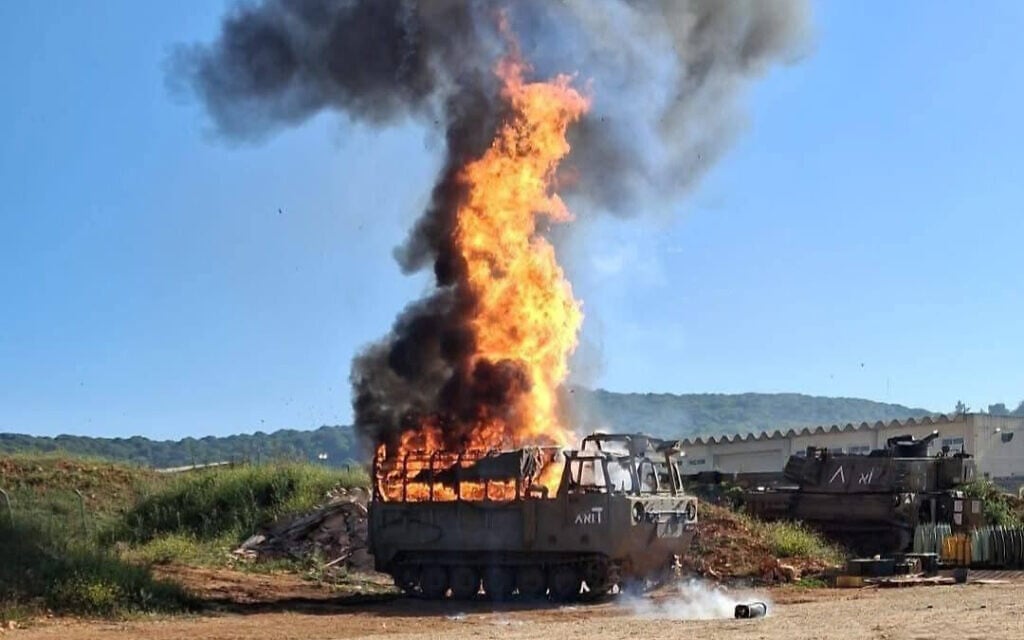
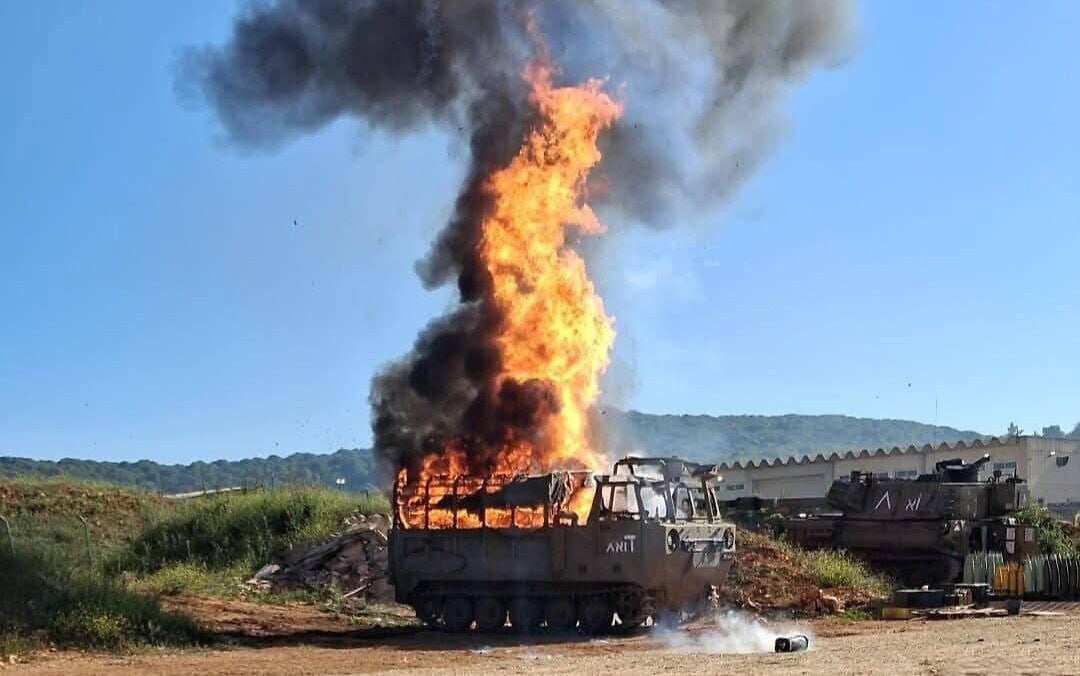
A M548 cargo carrier at an Israeli military artillery site near the northern border community of Shomera that was hit by a Hezbollah drone on April 30, 2026. (Used in accordance with Clause 27a of the Copyright Law)
Israel has a major problem on its hands in Lebanon.
Hezbollah has made an unmistakable leap in its drone capabilities and tactics in recent weeks, and is using explosive-laden unmanned aerial vehicles to deadly effect against IDF troops in southern Lebanon. Whatever countermeasures Israel has are clearly insufficient.
First-person view, or FPV, drones launched by Hezbollah found their way through to Israeli troops again and again on Thursday. Two UAV strikes on IDF positions in southern Lebanon left one soldier dead and three wounded. An attack earlier in the day wounded 12 troops on the Lebanon-Israel border.
Promoted: Jewish Crossroads, Jon Goldberg-PolinKeep Watching
The attacks have continued since, though with less success, but it seems a matter of time until luck runs out. On Sunday, several Hezbollah drones exploded near IDF troops, but did not cause injuries.
Israel should have seen the threat coming.
After decades of military operations in which troops were secure in the knowledge that anything flying overhead was friendly, the IDF is now scrambling to find technological and tactical solutions to the growing Hezbollah UAV threat, including drones guided by fiber-optic cables that are resistant to jamming. Troops of the 7th Armored Brigade operate in southern Lebanon, in a handout photo issued on April 22, 2026. (Israel Defense Forces)
Prime Minister Benjamin Netanyahu and the IDF promise that a solution will be found, but they admit that it will take time.
Until effective countermeasures are developed and deployed, troops in southern Lebanon will find themselves exposed and hounded by Hezbollah’s FPV attack drones.
Advertisement
But not only are troops at risk; so is Israel’s entire buffer zone approach in Lebanon.
A known threat
The use of drones in war is certainly not new. Militaries have developed and used unmanned attack delivery methods, like explosive-armed balloons, for well over a century.
But over the last decade, drones have assumed an increasingly important role in combat operations. Israel, a UAV innovator itself, had plenty of time to recognize that its enemies would also move in that direction.
As drone technology has been commercialized for the consumer market, terrorist and rebel groups have made effective use of off-the-shelf drones against state militaries. At the same time, both small countries and global powers employed UAVs in ways that indicated a new era of combat was on the horizon. Fighters of Hashed Al-Shaabi (Popular Mobilization units) flash the victory gesture as they advance through a street in the town of Tal Afar, west of Mosul, after the Iraqi government announced the launch of the operation to retake it from Islamic State (IS) group control, on August 26, 2017. / AFP PHOTO / AHMAD AL-RUBAYE
During the battle for Mosul in 2016-17, Islamic State made widespread use of small commercial drones to conduct surveillance, strike Iraqi forces and document attacks.
“Despite its clear military and technological superiority, the coalition to defeat [the Islamic State] in Iraq faltered in the face of devices that a 20-year-old with no formal military experience could easily obtain on Amazon,” wrote a US officer who fought in the campaign to free Mosul from Islamic State in 2017. “These cheap and easy-to-use devices, previously little more than toys, herald a democratization of technology on the battlefield that will change the way nations contend with adversaries.”
Advertisement
In Syria, drone swarms were utilized by rebels and by Turkey, among others, since 2018 in an effort to cut through high-powered Russian defenses.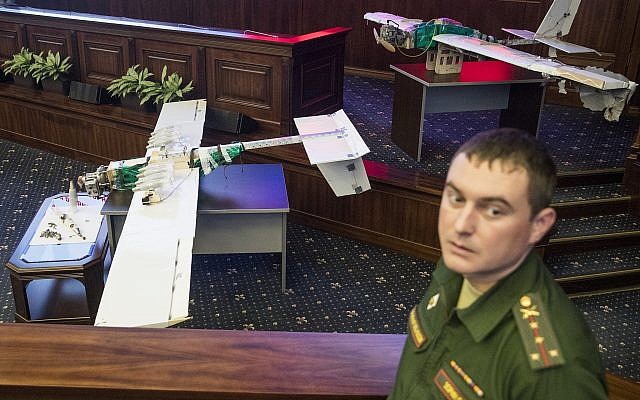 A Russian officer stands next to drones that attacked the Russian air base in Syria and were captured by the Russian military are displayed at a briefing in the Russian Defense Ministry in Moscow, Russia, Thursday, Jan. 11, 2018. (AP Photo/Pavel Golovkin)
In northern Syria, Ankara carried out simultaneous attacks on Syrian bases, Russian-made air defense systems, and Hezbollah fighters in “an air campaign run entirely by armed drone,” according to the Middle East Institute’s Charles Lister.
“Regime attempts to reinforce or resupply previously hit frontlines are being wiped out by [Turkish] drones,” he wrote on X.
Small countries also recognized the offensive potential that drones offered, and used them to hammer their adversaries.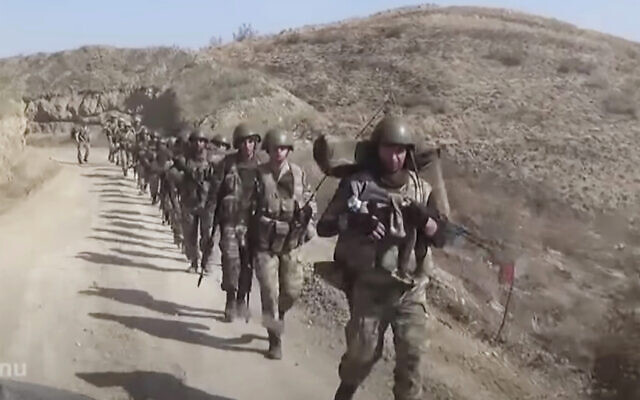 Illustrative: In this image made from a video released by Azerbaijan’s Defense Ministry on Oct. 9, 2020, Azerbaijan’s solders walk in formation on a road during a military conflict in the separatist region of Nagorno-Karabakh. (Azerbaijan’s Defense Ministry via AP)
In 2020, tensions between long-time adversaries Azerbaijan and Armenia over the Nagorno-Karabakh region boiled over into full-scale war.
In 44 days of fighting, Azerbaijan used Israeli and Turkish UAVs to slice through Armenian air defenses. Azerbaijan’s Defense Ministry published daily videos of its drones destroying Armenian platforms. According to the Oryx blog, Azerbaijan took out 185 T-72 tanks, 90 APCs, 182 artillery guns and much more.
Some Israeli civilian military experts recognized the looming threat to Israeli forces.
For decades the Israeli army has been used to fighting without looking up to see whose aircraft was rumbling overhead, knowing with virtually 100% certainty it was Israeli.
Advertisement
“A tactical revolution is not in the offing, however a strategic revolution is. It comes not from the tactical capabilities of the drones, but from their cheapness, simplicity and availability compared to manned aircraft,” wrote Eado Hecht of the Begin-Sadat Center for Strategic Studies in 2022. “For an organization like Hezbollah, which cannot even establish and maintain an air force like Azerbaijan’s and which only began to use armed drones during its involvement in the Syrian Civil War, this is an enormous leap up.”
“For decades the Israeli army has been used to fighting without looking up to see whose aircraft was rumbling overhead, knowing with virtually 100% certainty it was Israeli,” he continued. “It can no longer be certain of that and must prepare to operate under unfriendly skies.”
Two years later, the invasion of Ukraine by Russia provided an even starker warning for Israel of what it might face in the coming years.
Ukraine, facing chronic manpower and equipment shortages against a far larger enemy, organized quickly around unmanned aerial and ground vehicles. Drones also gave Kyiv an answer to Russia’s superiority in artillery.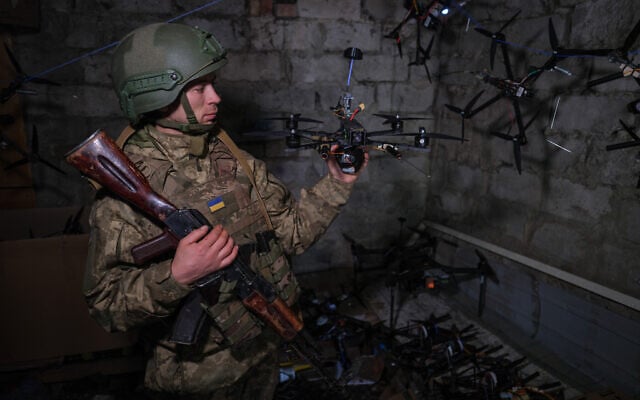 In this photo provided by Ukraine’s 93rd Kholodnyi Yar Separate Mechanized Brigade press service, a servicemen prepares to launch an FPV drone towards Russian positions in a shelter in Druzhkivka, Donetsk region, Ukraine, on April 7, 2026. (Iryna Rybakova/Ukraine’s 93rd Mechanized Brigade via AP)
Initially, Ukraine couldn’t come close to meeting the demands of its front-line units. Volunteer and private sector initiatives filled gaps for specific units, giving commanders in the field the ability to request the exact type of drone they needed. At the same time, this created a reality in which there was no consistency in the quality or make of UAVs, with Ukrainian forces using hundreds of types of drones.
Kyiv has been working to centralize production, and has created a system in which brigades can order first-person view drones directly from approved suppliers.
Ukraine now produces millions of FPV drones every year.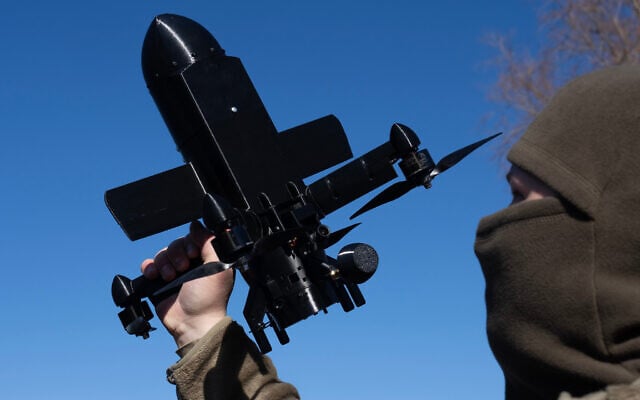 A Ukrainian military instructor demonstrates the operation of an interceptor drone designed to destroy Russian attack drones in the Kyiv region of Ukraine, March 11, 2026. (AP/Efrem Lukatsky)
Russia was first to introduce fiber-optic drones in 2024 to get around Ukrainian electronic warfare defenses that were jamming its attacks, and has created elite units to develop drone technology and tactics.
The drones have completely transformed the war. The conflict initially featured large-scale combat between ground formations, then settled down into trench warfare backed by massive artillery duels. By late 2023, however, drones were starting to dominate the battlefield.
Advertisement
“We have now switched to a drone-versus-drone war,” a retired Ukrainian colonel told Politico. “Drones are now able to sit in ambush, intercept enemy logistics and disrupt supplies. They have also made it more difficult to maintain positions: If you are detected, every weapon in the area will immediately rush to destroy you.”
There is now a 20-kilometer- (12.5-mile-) wide no-man’s land between the opposing lines where few soldiers dare venture, and drone strikes account for most troop casualties on both sides, according to officials. A Ukrainian soldier looks at the sky searching for Russian FPV drones as he gets ready to fire a M777 howitzer towards Russian positions at the frontline near Donetsk, Ukraine, March 3, 2025. (Roman Chop/AP)
It now makes little sense to operate in large formations in Ukraine. Units have spread out and split into small teams in order to avoid the ever-present drone threat.
Without answers to Hezbollah’s drones, Israeli troops may soon find themselves needing to make similar adjustments.
No answers
It didn’t take much imagination to understand that Israel’s enemies would learn the appropriate lessons from Ukraine, Armenia, and Syria, even if it took some time.
Alongside mines and anti-tank weapons aimed at thwarting potential Israeli incursions into Gaza or Lebanon, Hamas and Hezbollah both also invested heavily in building up a credible rocket threat against the Israeli home front.
Israel responded with a focus on air defenses and by airstrikes against storehouses and factories, breaking any deterrence the terror groups hoped to develop against an invasion.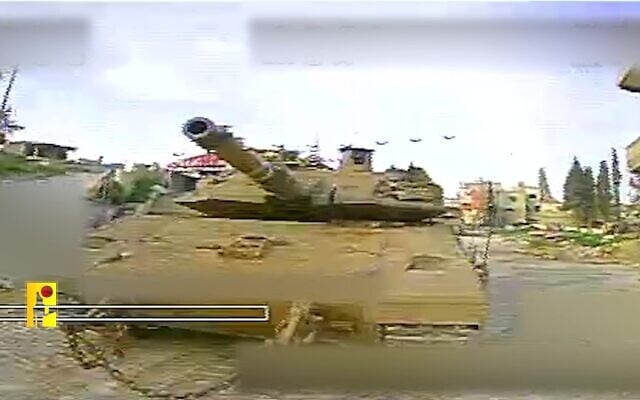 A Hezbollah drone slams into an Israeli tank in the southern Lebanon town of Mays al-Jabal on April 15, 2026, in footage published by the terror group on April 27, 2026. (Hezbollah media office)
But unlike the case with rockets, Israel has few answers against first-person view drones that allow remote operators to deliver deadly blows with unprecedented levels of precision guidance.
The weapons use off-the-shelf technology, making them cheap and easy to manufacture or acquire by the thousands. Many are controlled via a fiber-optic cable that unspools as the UAV travels up to 20 kilometers from the operator, making them impervious to Israeli electronic warfare countermeasures.
Surrounded by Israel in a destroyed territory, Hamas is currently not in a position to develop a significant drone fleet.
But Hezbollah is. The terror group began using FPV drones sporadically in 2024, but Thursday’s attacks, and several before and since, show that Hezbollah’s embrace of the weapon is not only effective but liable to expand. Sgt. Idan Fooks, 19, killed in a Hezbollah drone attack in southern Lebanon, April 26, 2026 (Courtesy)
The IDF has reported dozens of drone-related injuries in recent weeks, though most were minor, and Hezbollah continues to release videos of its FPV drones making it through Israelis defenses to hit Israeli positions.
Back to tactical air defense
In 2022, Lt. Gal Winter argued in an IDF journal that in response to the growing drone threat, the military needed to restore tactical air defense — capabilities in the hands of Israel’s ground forces enabling them to defend themselves as they advance into enemy territory — as they had during Israel’s wars against Arab armies.
The maneuvering force at the front will need air defense in order to fulfill its mission.
“Today, more than ever, ground forces are threatened by unmanned aerial vehicles, small or large, carrying weapons or observation equipment, which could pose a great difficulty in advancing ground forces in the next maneuver,” he wrote.
“The maneuvering force at the front will need air defense in order to fulfill its mission, but the air defense systems in their current form of operation do not take into account ground support.”
Israel once had air defenses for its ground troops. In the 1973 Yom Kippur War, the US supplied the Vulcan system, a self-propelled 6-barrel cannon that fires 3,000 rounds per minute, and the Chaparral surface-to-air missile system.
Vulcan units advanced with Israeli armor and infantry during the First Lebanon War, engaging ground targets while also downing Syrian MiG-21s attacking IDF troopss.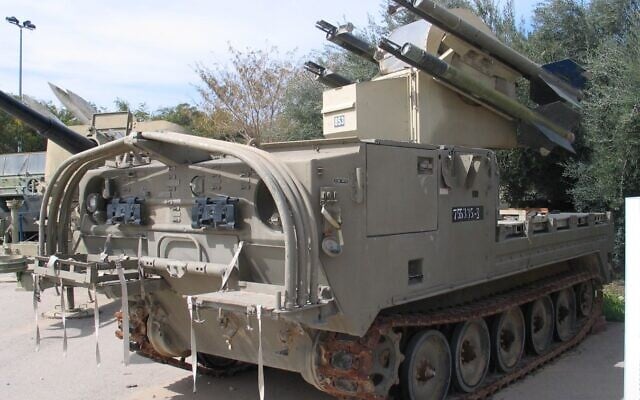 M730 Guided Missile Equipment Carrier (Chaparral) at IAF Museum, Hatzerim, Israel, 2006 (Bukvoed, CC BY-SA 3.0, via Wikimedia Commons)
Israel incorporated shoulder-fired Stinger missiles in the 1990s, giving ground troops an extremely mobile air defense option that could be fired by a single soldier.
But Israeli commanders increasingly saw tactical air defense as a relic of a bygone era. The IDF initiated deep cuts to the ground forces in the 1990s and 2000s, believing that the era of conventional wars was over and that it should focus on terrorist groups and the long-range Iranian threat. Stinger units were closed, and whatever remained was converted in 2009 into the new Iron Dome battalion to defend the home front and bases — though not troops maneuvering in the battlefield — against short-range rocket threats.
In the ensuing years, Israel’s air defense units became key strategic assets, shooting down thousands of rockets from Gaza, and in recent years, missiles and UAVs from Lebanon, Yemen, and Iran. Still, they were deployed to protect Israel’s rear, and were controlled by the air force, not the ground forces.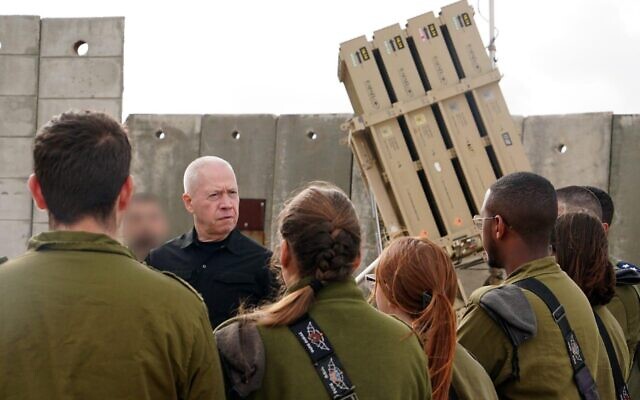 Defense Minister Yoav Gallant speaks to troops at an Iron Dome battery in northern Israel, April 10, 2024. (Ariel Hermoni/Defense Ministry)
Writing a year before the October 7, 2023, Hamas invasion of southern Israel, with the threat of drones attacking advancing troops only a hypothetical, Winter recognized that Israel was unlikely to give ground forces their own air defenses again.
“Since the IDF has not conducted a ground maneuver in enemy territory in recent years,” he wrote, “and has not encountered a threat from the air defense to its maneuvering forces, the need for renewed development of the air defense sector for the forces at the front, the fighters in enemy territory, has not been demonstrated.”
After October 7, senior officers cottoned to Winter’s view.
“The Israeli Air Force continues to unquestionably control the skies of the Middle East,” wrote Brig. Gen. (res.) Eran Ortal and Brig. Gen. (res.) Ran Kochav in 2024, “but under the noses of advanced fighter jets, a new air layer has been created, the ‘low sky.’ The enemy has identified a breach there that beckons to an intruder.”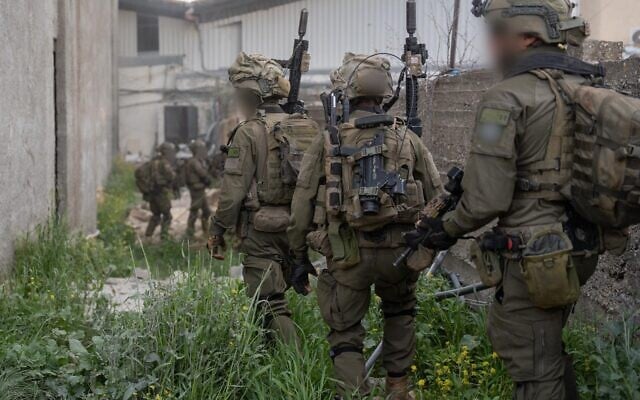 Soldiers of the Commando Brigade operate in the southern Lebanon town of Bint Jbeil, in a handout photo issued by the military on April 13, 2026. (Israel Defense Forces)
“At the front, it will be necessary to (re)establish an organization that operates short-range, more mobile, tactical measures,” they wrote. “This flexible organization will have to be much more coordinated with the picture of the ground combat commanders.”
The IDF has been slowly waking up to the threat. In 2024, it announced it would deploy a gun-based system similar to the Vulcan, but only to defend sensitive points, not to shield advancing troops.
The next year, it reopened a Chaparral battalion, 22 years after it was closed. This unit, according to the military, would train to move alongside ground troops.
But it’s clearly not enough.
“It will take time — but we are on it,” Netanyahu admitted on Sunday. Prime Minister Benjamin Netanyahu in a video statement, May 3, 2026. (Screenshot/GPO)
An IDF official said last week that the IDF has been taking the threat seriously and has been working to develop and test systems to counter the fiber-optic FPV drones, while admitting it is unlikely that any such system will be ready in the short term, nor will it completely neutralize the threat.
Exactly how far behind Israel finds itself was underscored on April 11.
The Defense Ministry’s Directorate of Defense Research and Development issued a public call for solutions to the threat — nearly two years after such systems first surfaced in Ukraine, and weeks into the current conflict with Hezbollah, pointed out Times of Israel military correspondent Emanuel Fabian.
And it won’t only take a technological solution.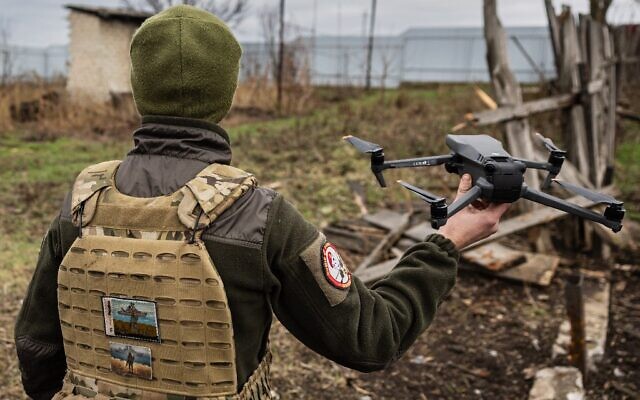 A Ukrainian serviceman flies a drone on the outskirts of Bakhmut, eastern Ukraine, on December 30, 2022. (Sameer Al-DOUMY / AFP)
To make the necessary leap forward, in both offensive and defensive use of drones, the IDF will have to prioritize the UAV realm. Part of that effort would be identifying draftees with the necessary skills and placing them in drone development units.
Russia has improved its capabilities dramatically after creating the Rubicon Center for Advanced Unmanned Technologies in 2024 and staffing it with specialists. Ukraine also opened its own, highly effective Unmanned Systems Force.
A different Ukraine fight
The longer Israel fights without an effective response to Hezbollah drones in the hands of its ground troops, the more its approach to Lebanon will be placed at risk.
Without a ready-to-use technology to stop Hezbollah missiles and rockets, Israel chose a strategic response, reoccupying southern Lebanon and pushing Hezbollah back.
Yet it will struggle to maintain that buffer zone with Hezbollah drones striking its soldiers. The security zone Israel held from 1985 to 2000 to protect northern Israel became untenable as public support for it collapsed in the face of Hezbollah attacks on IDF soldiers.
There is nothing to do at this stage about Israel’s past failure to see what its forces would face only a few years down the road, but it can learn from its lessons. A well-funded, flexible initiative to learn from troops on the ground and international partners could ensure its place as a world leader in offensive and defensive drone capabilities.
With its vast experience, Ukraine is the leading candidate for a foreign partner. Former defense minister Oleksii Reznikov told The Times of Israel in March that Kyiv is willing to “exchange experience and jointly develop technologies” against the Russian and Iranian drone threat. In this handout photograph taken on January 29, 2026 and released on January 30, 2026 by the Ukrainian Presidential Press Service, Ukraine’s President Volodymyr Zelensky (C) chairs a meeting with journalists at his office in Kyiv, amid the Russian invasion of Ukraine. (Handout / UKRAINIAN PRESIDENTIAL PRESS SERVICE / AFP)
But, for some reason, Israel seems to prefer to engage in public spats with Kyiv than to focus on areas of mutual concern.
Even after a bitter fight with Ukraine over shipments of stolen grain reaching Haifa looked like it was resolved, Israel kept the back and forth alive, blaming Ukraine for failing to provide evidence to back up its claims.
The issue seems to affect Ukraine’s willingness to help Israel counter the drone threat. Israel had reached out for assistance, a senior Ukrainian official told The Times of Israel. “We will consider this request in contingency with their behavior with the stolen grain,” he warned.
For now, the grain fight seems to have quieted down. But the Hezbollah attacks have not. It will take a concerted effort from Israel to stymie an emerging Hezbollah advantage, and to prepare for new drone threats that its enemies are sure to throw its way.
===
===
Hunted by drones it should have seen coming, Israel now sees its Lebanon strategy at risk
Years after drone warfare transformed other battlefields, the IDF seems caught off guard by Hezbollah’s effective use of first-person and fiber-optic UAVs, leaving troops in southern Lebanon exposed yet again
By Lazar Berman
Follow4 May 2026, 4:35 pm
Share
11
A M548 cargo carrier at an Israeli military artillery site near the northern border community of Shomera that was hit by a Hezbollah drone on April 30, 2026. (Used in accordance with Clause 27a of the Copyright Law)
Israel has a major problem on its hands in Lebanon.
Hezbollah has made an unmistakable leap in its drone capabilities and tactics in recent weeks, and is using explosive-laden unmanned aerial vehicles to deadly effect against IDF troops in southern Lebanon. Whatever countermeasures Israel has are clearly insufficient.
First-person view, or FPV, drones launched by Hezbollah found their way through to Israeli troops again and again on Thursday. Two UAV strikes on IDF positions in southern Lebanon left one soldier dead and three wounded. An attack earlier in the day wounded 12 troops on the Lebanon-Israel border.
Promoted: Jewish Crossroads, Jon Goldberg-PolinKeep Watching
The attacks have continued since, though with less success, but it seems a matter of time until luck runs out. On Sunday, several Hezbollah drones exploded near IDF troops, but did not cause injuries.
Israel should have seen the threat coming.
After decades of military operations in which troops were secure in the knowledge that anything flying overhead was friendly, the IDF is now scrambling to find technological and tactical solutions to the growing Hezbollah UAV threat, including drones guided by fiber-optic cables that are resistant to jamming.
Troops of the 7th Armored Brigade operate in southern Lebanon, in a handout photo issued on April 22, 2026. (Israel Defense Forces)Prime Minister Benjamin Netanyahu and the IDF promise that a solution will be found, but they admit that it will take time.
Until effective countermeasures are developed and deployed, troops in southern Lebanon will find themselves exposed and hounded by Hezbollah’s FPV attack drones.
Advertisement
But not only are troops at risk; so is Israel’s entire buffer zone approach in Lebanon.
A known threat
The use of drones in war is certainly not new. Militaries have developed and used unmanned attack delivery methods, like explosive-armed balloons, for well over a century.
But over the last decade, drones have assumed an increasingly important role in combat operations. Israel, a UAV innovator itself, had plenty of time to recognize that its enemies would also move in that direction.
As drone technology has been commercialized for the consumer market, terrorist and rebel groups have made effective use of off-the-shelf drones against state militaries. At the same time, both small countries and global powers employed UAVs in ways that indicated a new era of combat was on the horizon.
Fighters of Hashed Al-Shaabi (Popular Mobilization units) flash the victory gesture as they advance through a street in the town of Tal Afar, west of Mosul, after the Iraqi government announced the launch of the operation to retake it from Islamic State (IS) group control, on August 26, 2017. / AFP PHOTO / AHMAD AL-RUBAYEDuring the battle for Mosul in 2016-17, Islamic State made widespread use of small commercial drones to conduct surveillance, strike Iraqi forces and document attacks.
“Despite its clear military and technological superiority, the coalition to defeat [the Islamic State] in Iraq faltered in the face of devices that a 20-year-old with no formal military experience could easily obtain on Amazon,” wrote a US officer who fought in the campaign to free Mosul from Islamic State in 2017. “These cheap and easy-to-use devices, previously little more than toys, herald a democratization of technology on the battlefield that will change the way nations contend with adversaries.”
Advertisement
In Syria, drone swarms were utilized by rebels and by Turkey, among others, since 2018 in an effort to cut through high-powered Russian defenses.
A Russian officer stands next to drones that attacked the Russian air base in Syria and were captured by the Russian military are displayed at a briefing in the Russian Defense Ministry in Moscow, Russia, Thursday, Jan. 11, 2018. (AP Photo/Pavel Golovkin)In northern Syria, Ankara carried out simultaneous attacks on Syrian bases, Russian-made air defense systems, and Hezbollah fighters in “an air campaign run entirely by armed drone,” according to the Middle East Institute’s Charles Lister.
“Regime attempts to reinforce or resupply previously hit frontlines are being wiped out by [Turkish] drones,” he wrote on X.
Small countries also recognized the offensive potential that drones offered, and used them to hammer their adversaries.
Illustrative: In this image made from a video released by Azerbaijan’s Defense Ministry on Oct. 9, 2020, Azerbaijan’s solders walk in formation on a road during a military conflict in the separatist region of Nagorno-Karabakh. (Azerbaijan’s Defense Ministry via AP)In 2020, tensions between long-time adversaries Azerbaijan and Armenia over the Nagorno-Karabakh region boiled over into full-scale war.
In 44 days of fighting, Azerbaijan used Israeli and Turkish UAVs to slice through Armenian air defenses. Azerbaijan’s Defense Ministry published daily videos of its drones destroying Armenian platforms. According to the Oryx blog, Azerbaijan took out 185 T-72 tanks, 90 APCs, 182 artillery guns and much more.
Some Israeli civilian military experts recognized the looming threat to Israeli forces.
For decades the Israeli army has been used to fighting without looking up to see whose aircraft was rumbling overhead, knowing with virtually 100% certainty it was Israeli.
Advertisement
“A tactical revolution is not in the offing, however a strategic revolution is. It comes not from the tactical capabilities of the drones, but from their cheapness, simplicity and availability compared to manned aircraft,” wrote Eado Hecht of the Begin-Sadat Center for Strategic Studies in 2022. “For an organization like Hezbollah, which cannot even establish and maintain an air force like Azerbaijan’s and which only began to use armed drones during its involvement in the Syrian Civil War, this is an enormous leap up.”
“For decades the Israeli army has been used to fighting without looking up to see whose aircraft was rumbling overhead, knowing with virtually 100% certainty it was Israeli,” he continued. “It can no longer be certain of that and must prepare to operate under unfriendly skies.”
Two years later, the invasion of Ukraine by Russia provided an even starker warning for Israel of what it might face in the coming years.
Ukraine, facing chronic manpower and equipment shortages against a far larger enemy, organized quickly around unmanned aerial and ground vehicles. Drones also gave Kyiv an answer to Russia’s superiority in artillery.
In this photo provided by Ukraine’s 93rd Kholodnyi Yar Separate Mechanized Brigade press service, a servicemen prepares to launch an FPV drone towards Russian positions in a shelter in Druzhkivka, Donetsk region, Ukraine, on April 7, 2026. (Iryna Rybakova/Ukraine’s 93rd Mechanized Brigade via AP)Initially, Ukraine couldn’t come close to meeting the demands of its front-line units. Volunteer and private sector initiatives filled gaps for specific units, giving commanders in the field the ability to request the exact type of drone they needed. At the same time, this created a reality in which there was no consistency in the quality or make of UAVs, with Ukrainian forces using hundreds of types of drones.
Kyiv has been working to centralize production, and has created a system in which brigades can order first-person view drones directly from approved suppliers.
Ukraine now produces millions of FPV drones every year.
A Ukrainian military instructor demonstrates the operation of an interceptor drone designed to destroy Russian attack drones in the Kyiv region of Ukraine, March 11, 2026. (AP/Efrem Lukatsky)Russia was first to introduce fiber-optic drones in 2024 to get around Ukrainian electronic warfare defenses that were jamming its attacks, and has created elite units to develop drone technology and tactics.
The drones have completely transformed the war. The conflict initially featured large-scale combat between ground formations, then settled down into trench warfare backed by massive artillery duels. By late 2023, however, drones were starting to dominate the battlefield.
Advertisement
“We have now switched to a drone-versus-drone war,” a retired Ukrainian colonel told Politico. “Drones are now able to sit in ambush, intercept enemy logistics and disrupt supplies. They have also made it more difficult to maintain positions: If you are detected, every weapon in the area will immediately rush to destroy you.”
There is now a 20-kilometer- (12.5-mile-) wide no-man’s land between the opposing lines where few soldiers dare venture, and drone strikes account for most troop casualties on both sides, according to officials.
A Ukrainian soldier looks at the sky searching for Russian FPV drones as he gets ready to fire a M777 howitzer towards Russian positions at the frontline near Donetsk, Ukraine, March 3, 2025. (Roman Chop/AP)It now makes little sense to operate in large formations in Ukraine. Units have spread out and split into small teams in order to avoid the ever-present drone threat.
Without answers to Hezbollah’s drones, Israeli troops may soon find themselves needing to make similar adjustments.
No answers
It didn’t take much imagination to understand that Israel’s enemies would learn the appropriate lessons from Ukraine, Armenia, and Syria, even if it took some time.
Alongside mines and anti-tank weapons aimed at thwarting potential Israeli incursions into Gaza or Lebanon, Hamas and Hezbollah both also invested heavily in building up a credible rocket threat against the Israeli home front.
Israel responded with a focus on air defenses and by airstrikes against storehouses and factories, breaking any deterrence the terror groups hoped to develop against an invasion.
A Hezbollah drone slams into an Israeli tank in the southern Lebanon town of Mays al-Jabal on April 15, 2026, in footage published by the terror group on April 27, 2026. (Hezbollah media office)But unlike the case with rockets, Israel has few answers against first-person view drones that allow remote operators to deliver deadly blows with unprecedented levels of precision guidance.
The weapons use off-the-shelf technology, making them cheap and easy to manufacture or acquire by the thousands. Many are controlled via a fiber-optic cable that unspools as the UAV travels up to 20 kilometers from the operator, making them impervious to Israeli electronic warfare countermeasures.
Surrounded by Israel in a destroyed territory, Hamas is currently not in a position to develop a significant drone fleet.
But Hezbollah is. The terror group began using FPV drones sporadically in 2024, but Thursday’s attacks, and several before and since, show that Hezbollah’s embrace of the weapon is not only effective but liable to expand.
Sgt. Idan Fooks, 19, killed in a Hezbollah drone attack in southern Lebanon, April 26, 2026 (Courtesy)The IDF has reported dozens of drone-related injuries in recent weeks, though most were minor, and Hezbollah continues to release videos of its FPV drones making it through Israelis defenses to hit Israeli positions.
Back to tactical air defense
In 2022, Lt. Gal Winter argued in an IDF journal that in response to the growing drone threat, the military needed to restore tactical air defense — capabilities in the hands of Israel’s ground forces enabling them to defend themselves as they advance into enemy territory — as they had during Israel’s wars against Arab armies.
The maneuvering force at the front will need air defense in order to fulfill its mission.
“Today, more than ever, ground forces are threatened by unmanned aerial vehicles, small or large, carrying weapons or observation equipment, which could pose a great difficulty in advancing ground forces in the next maneuver,” he wrote.
“The maneuvering force at the front will need air defense in order to fulfill its mission, but the air defense systems in their current form of operation do not take into account ground support.”
Israel once had air defenses for its ground troops. In the 1973 Yom Kippur War, the US supplied the Vulcan system, a self-propelled 6-barrel cannon that fires 3,000 rounds per minute, and the Chaparral surface-to-air missile system.
Vulcan units advanced with Israeli armor and infantry during the First Lebanon War, engaging ground targets while also downing Syrian MiG-21s attacking IDF troopss.
M730 Guided Missile Equipment Carrier (Chaparral) at IAF Museum, Hatzerim, Israel, 2006 (Bukvoed, CC BY-SA 3.0, via Wikimedia Commons)Israel incorporated shoulder-fired Stinger missiles in the 1990s, giving ground troops an extremely mobile air defense option that could be fired by a single soldier.
But Israeli commanders increasingly saw tactical air defense as a relic of a bygone era. The IDF initiated deep cuts to the ground forces in the 1990s and 2000s, believing that the era of conventional wars was over and that it should focus on terrorist groups and the long-range Iranian threat. Stinger units were closed, and whatever remained was converted in 2009 into the new Iron Dome battalion to defend the home front and bases — though not troops maneuvering in the battlefield — against short-range rocket threats.
In the ensuing years, Israel’s air defense units became key strategic assets, shooting down thousands of rockets from Gaza, and in recent years, missiles and UAVs from Lebanon, Yemen, and Iran. Still, they were deployed to protect Israel’s rear, and were controlled by the air force, not the ground forces.
Defense Minister Yoav Gallant speaks to troops at an Iron Dome battery in northern Israel, April 10, 2024. (Ariel Hermoni/Defense Ministry)Writing a year before the October 7, 2023, Hamas invasion of southern Israel, with the threat of drones attacking advancing troops only a hypothetical, Winter recognized that Israel was unlikely to give ground forces their own air defenses again.
“Since the IDF has not conducted a ground maneuver in enemy territory in recent years,” he wrote, “and has not encountered a threat from the air defense to its maneuvering forces, the need for renewed development of the air defense sector for the forces at the front, the fighters in enemy territory, has not been demonstrated.”
After October 7, senior officers cottoned to Winter’s view.
“The Israeli Air Force continues to unquestionably control the skies of the Middle East,” wrote Brig. Gen. (res.) Eran Ortal and Brig. Gen. (res.) Ran Kochav in 2024, “but under the noses of advanced fighter jets, a new air layer has been created, the ‘low sky.’ The enemy has identified a breach there that beckons to an intruder.”
Soldiers of the Commando Brigade operate in the southern Lebanon town of Bint Jbeil, in a handout photo issued by the military on April 13, 2026. (Israel Defense Forces)“At the front, it will be necessary to (re)establish an organization that operates short-range, more mobile, tactical measures,” they wrote. “This flexible organization will have to be much more coordinated with the picture of the ground combat commanders.”
The IDF has been slowly waking up to the threat. In 2024, it announced it would deploy a gun-based system similar to the Vulcan, but only to defend sensitive points, not to shield advancing troops.
The next year, it reopened a Chaparral battalion, 22 years after it was closed. This unit, according to the military, would train to move alongside ground troops.
But it’s clearly not enough.
“It will take time — but we are on it,” Netanyahu admitted on Sunday.
Prime Minister Benjamin Netanyahu in a video statement, May 3, 2026. (Screenshot/GPO)An IDF official said last week that the IDF has been taking the threat seriously and has been working to develop and test systems to counter the fiber-optic FPV drones, while admitting it is unlikely that any such system will be ready in the short term, nor will it completely neutralize the threat.
Exactly how far behind Israel finds itself was underscored on April 11.
The Defense Ministry’s Directorate of Defense Research and Development issued a public call for solutions to the threat — nearly two years after such systems first surfaced in Ukraine, and weeks into the current conflict with Hezbollah, pointed out Times of Israel military correspondent Emanuel Fabian.
And it won’t only take a technological solution.
A Ukrainian serviceman flies a drone on the outskirts of Bakhmut, eastern Ukraine, on December 30, 2022. (Sameer Al-DOUMY / AFP)To make the necessary leap forward, in both offensive and defensive use of drones, the IDF will have to prioritize the UAV realm. Part of that effort would be identifying draftees with the necessary skills and placing them in drone development units.
Russia has improved its capabilities dramatically after creating the Rubicon Center for Advanced Unmanned Technologies in 2024 and staffing it with specialists. Ukraine also opened its own, highly effective Unmanned Systems Force.
A different Ukraine fight
The longer Israel fights without an effective response to Hezbollah drones in the hands of its ground troops, the more its approach to Lebanon will be placed at risk.
Without a ready-to-use technology to stop Hezbollah missiles and rockets, Israel chose a strategic response, reoccupying southern Lebanon and pushing Hezbollah back.
Yet it will struggle to maintain that buffer zone with Hezbollah drones striking its soldiers. The security zone Israel held from 1985 to 2000 to protect northern Israel became untenable as public support for it collapsed in the face of Hezbollah attacks on IDF soldiers.
There is nothing to do at this stage about Israel’s past failure to see what its forces would face only a few years down the road, but it can learn from its lessons. A well-funded, flexible initiative to learn from troops on the ground and international partners could ensure its place as a world leader in offensive and defensive drone capabilities.
With its vast experience, Ukraine is the leading candidate for a foreign partner. Former defense minister Oleksii Reznikov told The Times of Israel in March that Kyiv is willing to “exchange experience and jointly develop technologies” against the Russian and Iranian drone threat.
In this handout photograph taken on January 29, 2026 and released on January 30, 2026 by the Ukrainian Presidential Press Service, Ukraine’s President Volodymyr Zelensky (C) chairs a meeting with journalists at his office in Kyiv, amid the Russian invasion of Ukraine. (Handout / UKRAINIAN PRESIDENTIAL PRESS SERVICE / AFP)But, for some reason, Israel seems to prefer to engage in public spats with Kyiv than to focus on areas of mutual concern.
Even after a bitter fight with Ukraine over shipments of stolen grain reaching Haifa looked like it was resolved, Israel kept the back and forth alive, blaming Ukraine for failing to provide evidence to back up its claims.
The issue seems to affect Ukraine’s willingness to help Israel counter the drone threat. Israel had reached out for assistance, a senior Ukrainian official told The Times of Israel. “We will consider this request in contingency with their behavior with the stolen grain,” he warned.
For now, the grain fight seems to have quieted down. But the Hezbollah attacks have not. It will take a concerted effort from Israel to stymie an emerging Hezbollah advantage, and to prepare for new drone threats that its enemies are sure to throw its way.
===
===

No comments:
Post a Comment