Kindle $11.99


Lene Rachel Andersen
The Nordic Secret: A European Story of Beauty and Freedom
by Lene Rachel Andersen (Author)
4.0 4.0 out of 5 stars (2)
Surveys show that the Nordic countries have strong democracies, are among the best for business and startups, score high on human capital, have the most liveable cities, happiest peoples, strong economies, and much more...
How did the Nordics get there?
And what is Rosa Parks doing on the cover?
The Nordic Secret first came out in 2017 and has inspired people around the globe.
Discover how Denmark, Norway, and Sweden went from dirt poor agricultural societies in 1850 to wealthy, modern nations by 1920. Go on an amazing journey together with pastors, poets, common people, some Danish royals, and the so-called schoolmen as they lifted Scandinavia from the bottom. The heroes of this transformation: a stubborn school teacher and some young farmhands.
As new technologies and globalization are revamping our societies, what can we learn from the past and from the Nordics, and how they transformed during industrialization? And how can we approach human flourishing and meaning-making in times of great change?
=
Publication date : 7 November 2017

.png)
==
Lilla PETŐ
Book review: The Nordic Secret
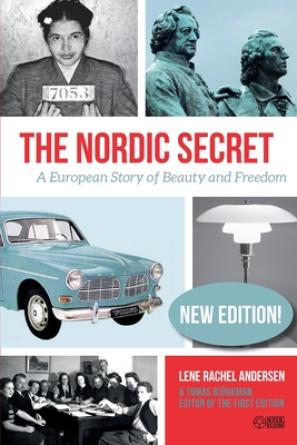
The Nordic Secret: A European Story of Beauty and Freedom, authored by Lene Rachel Andersen and Tomas Björkman,
examines the cultural and educational strategies that transformed the Nordic countries during the 19th and early 20th centuries. It highlights how these nations harnessed the power of Bildung (a German concept encompassing personal and cultural development) to create thriving, democratic societies. The book situates itself within the ongoing discourse on societal evolution and educational reform, offering a historical perspective on challenges that resonate today, such as social polarization and the need for inclusive progress. Their collaboration draws on their combined expertise to provide a deeply researched and compelling narrative. Andersen and Björkman argue that this approach was instrumental in building egalitarian, resilient, and democratic societies, making the Nordic countries a model of modern success. This book stands as part of their broader efforts to explore societal transformation through cultural and personal growth.
The book revolves around Bildung-a German term for education, cultivation, personal formation, and character development, encompassing emotional and moral growth. (Definitions abound, and we may never fully capture its depth.) The authors position Bildung as a central pillar for societal evolution, emphasizing that it is more than education in the conventional sense. Instead, it is a holistic process of individual and collective growth, deeply tied to cultural identity, morality, and critical thinking. They explore how this concept was applied to tackle pressing issues of the 19th century, such as economic disparity, lack of education, and social fragmentation.
Structure of the Book
The book is divided into several cohesive chapters, each addressing a critical aspect of the Nordic transformation:
1] Historical foundations
The opening chapters paint a vivid picture of the challenges faced by Nordic countries in the 19th century. The agrarian economies were struggling with modernization, rural poverty, and illiteracy, necessitating systemic change. The origins of Bildung trace back to the German Enlightenment, where thinkers such as Johann Gottfried Herder and Wilhelm von Humboldt emphasized the importance of personal and communal development. This concept was later implemented through institutions like the folk high schools (folk high schools), envisioned by the Danish thinker N.F.S. Grundtvig. These schools provided rural populations with opportunities for education, fostering not only professional but also cultural and moral development.
2] Philosophical underpinnings
Central to this change were thinkers like N.F.S. Grundtvig, whose ideas about folk education and the importance of cultural heritage shaped the Nordic ethos. Grundtvig believed in creating institutions that would not only teach practical skills but also nurture a sense of community, critical reasoning, and self-awareness.
3] Folk high schools
The book dedicates significant attention to the establishment of folk high schools. These institutions were innovative in their approach, offering non-formal education to rural populations, focusing on lifelong learning, and integrating local culture with global awareness. The authors emphasize that folk high schools were not merely educational institutions but also community centers where people could discuss social and political issues. This was particularly important for strengthening democracy and social cohesion. The Danish and Norwegian governments actively supported these institutions to ensure that individuals from lower social classes could access opportunities for development. These schools played a pivotal role in transforming Nordic societies by empowering individuals to become active participants in democracy and societal progress.
4] Cultural evolution and democracy
Later chapters draw connections between Bildung and democratic development. The authors argue that by prioritizing self-cultivation and collective responsibility, the Nordic countries fostered an environment of trust, collaboration, and resilience, which became the foundation of their thriving democracies.
5] Modern relevance
The final chapters examine how these lessons can be applied today. The authors explore contemporary issues such as environmental degradation, inequality, and polarization, proposing Bildung-inspired strategies to address these challenges.
6] Evaluation
The book provides a detailed account of how intentional cultural and educational strategies can lead to large-scale societal transformation. Andersen and Björkman bridge the gap between theory and practice, showing how Bildung principles can be adapted to contemporary issues. Although focused on Nordic countries, the book's message is universal, advocating for a balance between individual freedom and collective responsibility. The narrative is both scholarly and accessible. Andersen and Björkman use a mix of historical analysis, philosophical reflection, and real-world examples to keep the reader engaged. The incorporation of case studies, such as the role of folk high schools, adds depth and relatability. The authors highlight how the principles of Bildung addressed key issues of their time-poverty, inequality, and lack of education-and argue that similar approaches could resolve modern challenges. For instance, fostering critical thinking and community engagement could counteract the rise of populism and polarization.
Conclusion
The Nordic Secret is not merely a historical analysis but an inspiring read for those who believe that education and culture have the power to change the world. I recommend it to educators, policymakers, and anyone who seeks to understand how a successful and sustainable society can be built. This book is valuable for anyone interested in history, education, or social innovation. The principles of Bildung remain relevant today and can serve as an example for other parts of the world.
Customer Reviews:
4.0 4.0 out of 5 stars (2)
About the author
Lene Rachel Andersen
Lene Rachel Andersen is an economist, author, futurist, and bildung activist. Since 2005, she has written 17 books and has received two Danish democracy awards: Ebbe Kløvedal-Reich Democracy Baton (2007) and Døssing Prisen, the Danish librarians’ democracy prize (2012). Among her books are The Nordic Secret (2017), edited by Tomas Björkman, Metamodernity (2019), and Bildung (2020).
Andersen is a full member of the Club of Rome and one of the co-founders of the Copenhagen based think tank Nordic Bildung. She is also one of the initiators of European Bildung Day and the European Bildung Network.
1 Jonathan Reams is Editor-in-Chief of Integral Review, holds a position at the Norwegian University of Science and Technology, is co-founder of the Center for Transformative Leadership and the European Center for Leadership Practice, and does consulting and leadership development work for a variety of clients in Europe.
Jonathan@Reams.com
2 There are many sources for this claim, but one I found interesting was a speech given in 2016 by then President Obama, where he explicitly mentioned Grundtvig and the folk high school movement and how it contributed to a similar school in the US, which in turn contributed to the education of many prominent civil rights leaders.
https://www.washingtonpost.com/news/reliable-source/wp/2016/05/13/full-transcript-of-president-
obamas-toast-at-the-nordic-state-dinner/?noredirect=on&utm_term=.0edca6988cdf You can also watch the speech here
https://www.youtube.com/watch?time_continue=287&v=UEJLtlAUGGE
=====
The Nordic Secret: What can we
Learn?
Lene Rachel Andersen and Tomas Björkman (2017) The Nordic Secret: A European story of beauty and freedom. Stockholm: Frit Tanke Förlag
Over/reviewed
by Jonathan Reams1
I have lived in Norway for over
ten years now. My early experiences here triggered me as I encountered a
variety of cultural norms that stood out and made me aware of my own North
American background in new ways. This contributed to amplifying many protective
and critical tendencies I had internalized. Despite my initial (and sometimes
continued) aversion to various facets of society here, I have also come to an
appreciation for many aspects of this society. There is a kind of spaciousness
and freedom here. While these are also well espoused and take a specific form
in North American society, they have found expression in the Nordic countries
in a manner that avoids some of the extremes found in North America.
My curiosity about how this came
to be has deepened over time and in this context I had made acquaintance with
the authors of The Nordic Secret,
first Tomas Björkman in early 2014, the Lene Andersen later that year at a
retreat Tomas hosted. Tomas’ passion for the field of ego development was
clear, as well as his passion for fostering healthy societal transformation.
Lene’s intensity and depth of knowledge was immediately apparent. Together,
their collaboration on this project has led to what is, in my view, a
significant contribution to ‘integral’ thought by showing with depth, breadth
and clarity how ideas central to it have played out over time in a particular
context and contributed to what are considered model societies.2
When I first encountered integral thought over 20 years
ago, it appeared to me as a new and enlightening way of understanding the
world. The ego development aspect of integral thought was especially engaging
for me, as one focus of my studies was the area of consciousness, and ego
development theories brought a degree of clarity to my understanding of how
consciousness evolved. Over time, I came to see that integral thought,
specifically in education, had been talked

about and tried
since the mid 1800s.[1] In The Nordic Secret, Andersen and Björkman
have gone even further back in history and traced the threads of what they show
to be ideas very similar to the current theory of ego development we study
today.
Not only this, but they tell a compelling story with details that make for great reading. The relevance of this story – basically how ideas of ego development, along with bildung, have been applied on a significant scale in the Nordic countries and contributed to their current success – is that it offers ideas worth considering as we aim to contribute to the variety of situations being faced in the world today. It is with all this in mind that I have chosen to write an overview more than review – I wish to entice readers to pick up the book and dig into the depth and granularity that it offers and become inspired by the journey key figures in it took. I have little to be critical of here. Of course, it would be possible to unpack and argue with certain points made, perspectives taken and maybe some idealism near the end of the book. However, I believe this would detract from the broader goal of enabling a wider audience to get a taste for what this book offers. The knowledge that integral or ego development has been applied successfully to a large-scale social transformation effort can serve as both inspiration and ideas for our own efforts today. On that basis, I will offer a chapter-by-chapter overview of highlights and elements I find relevant in the narrative woven through examining the journey these ideas have taken through history.
Preface and Introduction
Andersen and Björkman preface
their book by articulating the contextual background that motivated this book.
The Nordic countries are clearly successful by many measures, and while various
attempts to understand this phenomenon are shown to have fallen short, they
feel they have found the secret of this success. From this, they wrote the book
because:
1.
That this recipe for success could be repeated
elsewhere.
2.
This process is grounded in creating healthy
institutions for and in helping people in a society make meaning during large
scale societal transformations.
3.
The current Nordic situation is seen as an undoing of
this success, and being able to contribute to discourse enabling a course
correction would be an ideal outcome.
The current regression is
characterized as a move away from personal responsibility and accountability of
those in power. The move towards utilizing consultant expertise to guide
political policymaking and privatization of key societal institutions is eroding
the very foundations of their success.
In the introduction, Andersen and
Björkman lay out their hypotheses and core message loud and clear right from
the beginning.
We are going to
make the case that the success of the Nordic countries – not least the
successful transition from poor agricultural to rich industrialized countries –
was due to a very specific and targeted political project: key cultural and
political figures in the 1800s saw the need for enculturation and personal
emancipation of the rural population. … In order for all these people to
develop that kind of identification and national loyalty and cohesion, they
needed a richer and more complex inner world. They needed to develop a sense of
responsibility towards self and society; they needed moral, emotional and
cognitive development. They needed what is called ego-development in modern
psychological terms. (pp. 7 – 8)
To provide evidence for this
hypothesis, they foreshadow the main part of the book; a journey back in time
to trace the unfolding and evolving of a set of ideas that enabled this to
happen. They lay out how Enlightenment ideas fueled both popular imagination
through literature and philosophy through a key set of ongoing conversational
relationships and led to the German notion of Bildung, and then was pragmatically applied in Denmark as folk-Bildung. This spread through the
Nordic countries and as they aim to show, was significant in enabling the rapid
transformation of Nordic societies.
They round off
the introduction by laying out five hypotheses:
1.
That the modern concept of ego-development is much the
same as the Enlightenment concept of Bildung.
2.
Folk-Bildung
is different than what we current call adult education.
3.
That in the mid 1800’s folk-Bildung played a significant role in the development of the
Nordic societies.
4.
That this success was due to the intentional
cultivation of moral, emotional and cognitive development among the least
educated in those societies.
5.
That there is a universal lesson that can be learned
from this in relation to how to create stable and healthy democracies.
They close the introduction by
outlining the five parts of the book and then by summing up their findings. The
Nordic secret is folk-bildung. The long journey this book takes us on provides
ample evidence for this claim, leading to the conclusion that “The Nordic and
Swiss histories have shown that good economies develop from responsible
self-governing and self-authoring people who can self-motivate” (p. 445).
Part 1: Setting the Scene
Chapter 1:
Are the Nordic countries really that remarkable?
This chapter opens by introducing
a vignette from Lene’s life, a seemingly ordinary trip by train that
illustrated key principles evident in Nordic society; humanism, trust and
responsibility. First, a winter train ride from Copenhagen into Sweden has a new
twist, a requirement to stop at the Swedish border and to show identification.
This change in practice has emerged in response to the refugee crisis. On this
journey, the inspection officials are extremely polite about their duties to
the Danish and Swedish nationals. However, they also encounter two Syrian women
attempting to cross into Sweden without proper documentation. Here the guards
also display their humanistic values, being extremely kind and respectful to
the women as they made them get off the train, and telling them of their rights
to seek asylum in the friendliest way possible.
The other incident that
illustrates Nordic values comes about when a businessman ends up forgetting his
phone on the train. It rings after he has gotten out, and another passenger
picks it up and answers; they quickly sort out to meet at the next stop and the
man shows up and gets his phone back. This is a high trust society, where
people take responsibility to ensure the well-being of others.
As well, the introduction shows
us an array of statistics that point to the Nordic countries, along with
Switzerland (which becomes relevant later) consistently in the top rankings of
things like; happiness, human capital, global competitiveness, GDP, as well as
interpersonal trust.[2] This is
also shown to be linked to scoring high on secular and self-expression values.
They go through a series of possible explanations, such as political, economic,
technological and even religious (Protestant countries tend to have a different
work ethic). All of these explanations are shown to fall short of explaining
the secret of Nordic success. Which then leads us on to chapter two.
This chapter forms a foundation for what comes after, in that the authors lay out a description and framing of ego development theory. They address Piaget, Kohlberg and Kegan, and do a good job of then doing their own reframing of the language of ego development stages to be less technical and more reader friendly.
They begin by laying out subject object theory to introduce the basic move of development. Their reframing of Kegan’s stages (see figure 1(7)) orients around the self at leach stage. This alignment helps to shift the notion of a socialized mind to the notion of being self-governing. This enables an intuitive bridge to be made later when discussing the moves made in relation to the implementation of folk-bildung.
They do a good job of describing the stages and core issues of moving between them. Their reason for this reframing was that they received pushback from the overly academic sound of both the notions of stages or orders and their descriptions.[3] “… [W]e prefer to use the metaphor of a personal core that builds and expands in new layers” (p. 54). This metaphor also enables them to add in another key component, the social or moral aspect.
For this, Kohlberg’s stages of moral development are
described to ground this, as well as to link to Piaget as a key source of
inspiration for all of this. In order to apply this, they introduce the notion
of “circles of solidarity” (p. 38) taken from Christian Welzel,[4] a
researcher behind the World
Values Survey.
They extend his concept and reframe it to talk about “circles of belonging” (p.
39). They introduce 10 of these:
1.
Ego/self
2.
Family 1 (parent and siblings – the family we are born
into)
3.
Peer group
4.
Family 2 (spouse, children, in-laws – the family we
create ourselves)
5.
Community (neighborhood, church, political party,
sports team, colleagues at workplace etc.)
6.
Imagined community (society / country / nation / people
// religious denomination)
7.
Culture zone
8.
Universal principles / international conventions /
multi-lateral alliances
9.
Humanity today
10. Planet
and future generations beyond great-grandchildren. (p. 39)
This allows them to make a three
dimensional model of how our personal core grows. Figure 1(7) illustrates this,
with the ego-development layers one axis, and the horizontal axis is about the
broadness of scope we consider as well as how wide the perspectives are that we
take into consideration. This “allows us to talk about a deep personality,
depth of character and inner roominess, as our mental complexity grows and we
mature. Only if we mature and add layers in all directions can we become deep,
wise and rounded persons” (p. 57). This model of personal growth becomes the
reference point for discussions later on in the book. What comes next is a
journey back in time to trace the journey of ideas and people who contributed
to how all of this came to be implemented in Nordic society.
Part II Personal Freedom and Responsibility –
Bildung Philosophy
Chapter 3. A Very different kind of Europe
Andersen and Björkman start out
their tour of history with a good framing – that we tend to read historical
events from a frame of reference of our current world – we simply do not have
the experience to have the same tacit view of what things meant, why they were
important and so on. To get us ready for how the ideas they trace developed,
they take us back to 1650 and describe life conditions for the masses of
peasants, burghers, merchants and aristocrats. Small things like that beer was
safer to drink than water.[5]
They describe a number factors;
the introduction of organized education, how literacy was growing, yet still
relatively low and the introduction of salons and encyclopedias that made a
base of knowledge wider and more discussed. The religious influence on the
concept of bildung was also important. They show how the concept of metanoia as
beyond the mind linked with Pietism to create a call to be Christian in what we
would call a more self-authored sense. So rather than simply conforming to a
given set of social norms that one was born into and would die within, there
was a notion that people could improve. Becoming a ‘true’ Christian now meant
having an emotional sincerity and a passion for self-improvement. Protestantism
had until then only dealt with salvation and predestination. Now, with Pietism,
personal improvement was combined with salvation. “With Pietism, people’s soul,
faith, mind, heart, and emotions became their own in a new way” (p. 76). These
and other influences were part of the background context in which key figures
began to articulate and disseminate ideas that came to inform the notion of
bildung.
Chapter 4. The Bildung prelude
This chapter begins with
Shaftesbury, and we see that with John Locke as his tutor, he developed an
understanding of human nature that very much mirrors how ego-development is
described today. The authors use quotes and then interpret them to make this link
more explicit. This reminds me of the perennial philosophy, where these ideas
recur in various shapes and forms over the course of human thought. They not
only make this link explicit, they also do a comparative analysis to show what
was similar and how it was also different, or lacking aspects of how we
understand ego-development today.
The tour of intellectual thought
continues with a brief visit with David Hume, who they show to be “the first
European philosopher to explore how we construct reality” (p. 85). His move was
to step outside and observe his own thinking,[6]
which led to him being interpreted as seeing different stages of mental
complexity. After a couple minor figures are briefly treated (Klopstock and
Wieland) they move on to Rousseau, and in a similar manner show how his
writings reveal a similar pattern of describing stages of thinking. They
approach all of these figures with a combination of historical context,
biographical description and key thoughts related to ego development.
Chapter 5. The German Spring
This long chapter now gets into
the meat of how many of the central ideas that contributed to the core
proposition of The Nordic Secret were
developed. It reads like a detective novel, with the careful attention to
detail of what kind of personal histories and meetings that helped fuel the
spread of key ideas.
The first major character is
Johann Gottfried Herder. As a student, he caught the attention of Immanuel
Kant, who gave him special study privileges and enabled him to gain a degree in
theology at 20. He writes some early texts based on Kant’s influence combined
with his own inquiries that get some traction around Europe. As an example of
the kinds of interesting details of personal meetings, Herder works as a
theologian for a while, writes some books, gets restless, travels for a while,
and ends up in Strasbourg to get eye surgery for a condition he has. A young
student at the university observing the operation knows who Herder is from his
publications and volunteers to do the post-operative care that is required from
this operation, and the two spend two weeks sharing their ideas and
inspirations about the new ideas in the air form the likes of Shaftesbury,
Rousseau etc. The young student is Johann Wolfgang Goethe.
Herder goes on to write
influential texts that for the first time articulate the nature of a national
culture, a Geist that binds people
together. The authors show how this contrasts to the scope of awareness of most
people at that time of only their local family and village, maybe to a local
aristocrat. In Andersen’s and Björkman’s circles of belonging, this means levels
1-5 only. Herder is shown to introduce the concept of a people, or nation.
Herder also writes about bildung as a natural evolution. Being ‘bilded’ is
being shaped, by the cultural conditions of the time.
As mentioned, Goethe met Herder
in 1770 in Strasbourg, and they share their passion for this newly emerging
Enlightenment thinking from Shaftesbury and others. Goethe goes on to become a
writer of popular novels that capture the imagination of the times and are
essentially based on the idea of growing beyond the social norms or constraints
of the current society.
Friedrich Schiller is another
writer of the times and it is shown how his psychological understanding also
illustrates this parallel with ego development. The narrative in the book lays
out the personal journey and challenges he faced, leading to his 1785 authoring
of the Ode to Joy and its inclusion in Beethoven’s 9th symphony. The
links in the Ode to Joy with this Enlightenment
thinking are described.
Then back to Kant, and the
articulation of an a priori structure to our minds that enables the perception
of the external world and events, or a phenomenological turn. They describe
this as a Copernican turn in European philosophy, from an outside perspective
on thinking to an inside-out perspective on the mind itself.
Then there is the larger context
of the American and French revolutions, and how the generation of Enlightenment
thinkers were both inspired and repulsed by some of the political events of
those times.
There is then a description of
how Goethe became a high ranking public official in Weimar, and the foundation
of a free and open (i.e. faculty given freedoms) university in Jena that
attracted the best and brightest of the period. This concentration of German
Enlightenment thinkers and thought is all clearly shown in detail to repeatedly
articulate the same view of human nature and its development as we see in
ego-development today.
Meanwhile, in Switzerland, Johan
Pestalozzi overcomes a life of poverty and repeated failure to find that
Rousseau’s ideas of education don’t actually work. He finds, through arduous
trial and error, methods that do work, and eventually becomes successful and
influential in how modern ideas of pedagogy can be linked to the notion of
bildung.
Which brings us to the person
most associated with the concept of bildung, Wilhelm von Humboldt. The reason
for this association is that Humboldt not only wrote about it, but was in a
position to do something about it. In 1809, he was in charge of the Prussian
education system, and he did a complete reform of it. This was based on two key
principals: freedom of teaching and learning at the universities (like was
piloted in Jena), and that “education must be Bildung, it must be personal development, moral development and a
deep engagement with the academic endeavors.
It must be a path to finding one’s true personality, self-authoring” (p.
155).
What we see in this section of
the book is that the concept of bildung, soon to be traced into Scandinavian
society, has deep roots in the Enlightenment thinking in Germany and that it in
essence embodies modern conceptions of ego-development.
Chapter 6. Bildung and ego-development
In this very brief chapter, the authors circle
back to one of the core questions that united their interests. Having made a
thorough investigation into the currents of thought that contributed to the
conception of bildung, they conclude that while not identical, there is a
significant and strong overlap with ego-development. The people listed above,
as well as others, all tended to describe the ideas of human growth in terms
that clearly match or parallel modern ego development descriptions. Where bildung
appears to differ is primarily in content related areas, which they list as
education, folklore, poetry and aesthetics, a sense of belonging etc. This is
where the notion of circles of belonging appear to help flesh out how the
structural approach of ego-development can show up in the layers of contexts we
inhabit and can expand our consciousness into.
Part III The Scandinavian Spring – Implementing
Bildung
Chapter 7. The Danish Spring
Here our story moves slightly
north. The southern parts of Denmark, Schleswig and Holstein, had always been
Germanic in culture, and eventually, after a couple wars, politically as well.
The narrative follows a mentally ill king and his successors who held on to
absolute monarchy until about 1849, when reforms finally arrived. In the period
leading up to this, various philosophical developments went on that are again
traced with meticulous detail. Beginning with the Norwegian Henrik Steffens
studying in Jena and then giving the first lectures in Denmark on German
Romanticism in Copenhagen in 1802. Two sets of rival cultural and philosophical
salons are traced, with various visiting luminaries seeding new ideas, such as
Fichte, who is fleeing Napoleon.
Then Grundtvig, the “Moses of the
Danes,” (actually Steffens’ cousin), comes into the picture as a man of God who
is also inspired by the ideas of romanticism. He also brings Norse mythology
into his writings, evoking a sense of people, or the Geist of the Nordic
nations. Grundtvig is quite contentious and outspoken and is actually banned
from speaking and writing for a period, during which he goes to England and is
(perplexed and) inspired by his encounters with liberties of religion, the
press and trade, pragmatism, collegialism between professors and students and
even falls in love with a married woman.
All this contributes to his ideas of combining English
pragmatism with German Idealism and Romanticism to envision a school where the
peasants of Danish society can be ‘bilded’ or shaped into responsible citizens
who can participate in and contribute to the betterment of their society. In
1836, he writes a
pamphlet about ‘education for life’ that attempts to bring all this into
practice and challenges contemporary ‘dead’ classical education. He goes on to
write popular songs with lyrics inspiring a generation. For Grundtvig, freedom,
both individual and political comes through bildung.
The political upheavals of 1848
strike Denmark as well, in addition to war with Prussia, which goes on again in
1864, and shrinks the Danish borders. In this context, the desire to begin to
strengthen the national identity through this idea of small folk high schools[7] grows and
the first experiments take hold.
Into this mix comes Christen
Kold, who, having wandered about thus far in life (literally walking from
Trieste to Denmark) and read all the same figures noted thus far, takes
Pestalozzi’s admonition to ‘just do it’ to heart and finds a way to begin his own
school. Kold seemed to hit just the right combination of elements and
‘marketing.’ The folk high schools began to flourish, both in numbers and
gender as they opened for young women as well. The authors describe that an
average of 6000 Danes attended these schools each year. They then estimate that
it is possible that by 1940 200,000 out of the population of 2.5 million could
have attended these schools. We also hear that concurrently the cooperative
movement began and took off with great success.
Chapter 8. The Norwegian Spring
As the story moves north to
Norway, the narrative moves back to 1800 to set the stage. Norway has been
under Danish rule for about 400 years. However, a combination of politics
around who is given the governorship of Norway, a financial crisis in Denmark
in 1813 and being on the losing end of war in 1814, led to Norway ending up in
the hands of Sweden. During this time of flux, the Norwegians draft a very
progressive constitution, drawing inspiration from the Americana and French
constitutions. However, it does not give them the same progressive school
legislation as the Danes, nor does it give them religious freedom.
The idea of a folk-bildung is a
harder sell in Norway than Denmark, but eventually the ideas take root in
government legislation that enables rural education to have the same standards
as schools in the city. Ole Vig and Hartvig Nissen contribute to bringing some
of Grundtvig’s ideas into Norwegian schools. The first folk high schools are
established in Norway in 1864, and we see that in Norway this set of ideas is
re-arranged a bit to show that “the goal is personal fulfillment, political
freedom is the tool” (p. 240) and that stages of ego development are clearly
laid out in texts from that time. The authors propose that the uptake is more
powerful in Denmark because of losing the war and part of their country to
Bismark, where in Norway it was not so strong a need for nationalistic
sentiment.
Chapter 9. The Swedish Spring
The Swedish case is different yet
again. An extremely high rate of literacy is one foundation for this
difference. This came from a strong religious formalism, with parents required
to teach reading to their children, and everyone tested on their ability to
read and show their knowledge of the bible. Swedish peasants were never serfs
and had some form of representation in the Swedish parliament. There was of
course a strong German influence in Sweden, coming from the Reformation and the
importation of Kantian philosophy and relationships between influential Swedish
philosophers and German figures like Fichte and Klopstock. A kind of
nationalism arose in Sweden as a response to the loss of Finland in 1809. The
rise of Göticism inspires a host of romantic and nationalistic literature to
spark the public imagination. In addition, things like gymnastics took root as
a form of youth development.
It is noted that the Swedish term
in use for bildung has more of a connotation of upbringing than of education.
Thus the idea of parents (like the teaching of reading) bringing up or bilding
their children is closely linked. This is seen in layers, starting with the
family and local community, expanding to the country, then specific civic
professional positions and finally an office in the state requiring in depth
knowledge in a subject area.
A host of influential figures are
described before going into how Swedish feminism is launched by a man. Visits
to Danish folk high schools leads to journals publishing influential articles
like About Hans Who Went to the Folk High School. This small article captures the
heart of the folk high school movement and inspires many to attend. Hans is a
peasant youth, the proverbial ‘lump of clay’ destined to a life of toil on the
farm with little change in his life course. He meets a stranger who tells him
of a place (the folk high schools) where you can find real gold. This gold is
actually inner growth, maturing into a higher stage of ego-development and
expanding one’s circles of belonging into the 6th circle, a sense of
nationalistic identity.
Chapter 10. Summing up the Scandinavian Spring –
Folk-Bildung 1.0
This chapter brings together and
revisits the threads so far. The urge to grow into circle 6 or find a sense of
national identity, especially in Denmark, emerges as a result of civil war /
war with Germany.[8] Running
though all three countries’ implementation of bildung is how “to get young
people from the traditionally least educated parts of society to become loyal,
inspired selfgoverning citizens with enthusiasm and a sense of purpose” (p.
272). This is seen as taking them from a level two ego to a socialized mind,
self-governing level 3.[9] The voices
around the further move to self-authorship or the “moral man” (p. 273) was not
yet the driving force. However, this turn was about to be voiced in a stronger
way as the next generation built on this foundation.
Chapter 11. The Modern Spring – Folk-Bildung 2.0
This move into the modern
Scandinavian society that emerged out of the folk high school movement drew on
radical progressive and modern values that were arising, the so-called
‘cultural radicalism’. Georg Brandes is shown to have published a six volume series,
Main Currents in Nineteenth Century
Literature, which describes how literary trends have been shaping people’s
ways of understanding their worlds. These are translated into ten languages and
cause a stir, while essentially saying that people’s opinions are the result of
social constructs informed by literary trends. It thus pushes for the move to
level 4 of self-authoring.
A key voice in this was the
Norwegian writer Henrik Ibsen. Many of us may have read Kegan’s In Over Our Heads where he uses an
example from a key section of Ibsen’s A
Doll’s House. In this play, Nora embodies both the feminist move of
liberation, but more importantly, the move to self-authoring, happening live in
a moment where she breaks free not only of her husband and the current social
norms, but more importantly, the hold of those norms on her meaning and
decision making process.
All of this and more contributes
to the evolution of not only folk high schools, but of things like gymnastics,
sports associations, unions and workers movements, scouting, and the
development of libraries. The degree to which this movement becomes mainstream
is shown in the Swedish context through the political exploits of two men,
Staaf and Branting. Both are champions of the bildung agenda and both become
prime minster of Sweden, influencing and governing between them from the late
1890s until about 1920. Andersen and Björkman characterize Branting’s
description of bildung as paralleling level four, self-authoring.
The move into what is described
as ‘cultural radicalism’ and Nordic design, which is fueled by things like WWI,
the peaceful division by referendum of the Danish German border in Schleswig
region, and a new kind of aesthetics. The different experiences of the three
countries during WWII is highlighted as well.
Having a culture that promotes individualism and
self-authoring is seen to have contributed to a number of things that were
investigated in chapter one. A line has now been drawn, from German Idealism
and English pragmatism, along with influences from the French and American
revolutions, to the elite of Scandinavian society who realized the need for an
educated citizenry in order for democracy to actually work.12
====
from the ideas of the time as described above, as well as their implementation in the American and French constitutions.
12 I had the impact of this strong democratic tendency on large corporations described to me one evening over dinner by an executive of a Norwegian based multi-national company. He told how it was difficult to get people to align in such organizations, because earlier, there were no large farms or large fishing boats where people went to work for others. Everyone had their own farm or fishing boat and worked independently of any kind of authority. It occurs to me that this might also have contributed to the
But why did these ideas and influences not play out the same elsewhere?
Part IV Exploring what we have found
Chapter 12. What happened elsewhere? – control
cases
In this chapter, six other cases
are explored to see the effects of these ideas in shaping the experience and
current state of other countries and groups. We see that Finland also adopted
the folk high school idea, participating in some of the Scandinavian gatherings
on this in the 1860s. The Swiss are seen to have forgotten about Pestazolli,
and adopted a more conservative set of values in society. Otherwise, the Swiss
appear to rank in similar ways around the opening chapter ideas, happiness etc.
The case of most interest is of
course Germany. Clearly, a number of differences were in play and contributed
to a very different outcome, especially in the first half of the 20th
century. The deaths of a number of key figures of the Romantic era, such as
Goethe, Herder, Schilling, Fichte and more, was followed by Wagner composing
operas based on Norse mythology and German Romantic Nationalism. Then along
came Marx. The upheavals of 1848, followed by Bismarck’s unification of the
German states under Prussia, created a mood in Germany among the conservative
elements in power of concern for worker uprisings. Thus, folk education was
shaped in a different way. For example, the lectures were never to be
interrupted and no questions, discussion or debate of the ideas presented was
allowed. As well, subjects such as social, economic or religious topics were
not allowed. Then along comes Nietzsche, who Andersen and Björkman see as
achieving a self-transforming mind, but feeling very alone and out of step with
society.
The authors then describe the
tensions between the lower middle class who just want to be better off or upper
middle class, thus focused on personal and social and economic concerns and not
societal change and emancipation. They just want to become part of the
bourgeoisie. And
‘bildung’ becomes
associated with conformity with those norms. Bismarck and his regime take an
authoritarian stance towards the lower classes.
Then comes the aftermath of WWI,
and any ideas of the type of bildung we have read about in the Nordic countries
is far from reality. They quote Thomas Mann, showing that in this period, for
Germans, the idea of asking “[the German] to transfer his allegiance from
inwardness to the objective, to politics, to what the people of Europe call
freedom, would seem to him to amount to a demand that he should do violence to
his own nature, and in fact give up his sense of national identity” (p. 320).
Thus all of the core ideas of development and growth to a self-governing and
self-authoring conscience was never related to contributing to society; even
being able to think for one self, was never related to political responsibility
in this period in Germany.
Andersen and Björkman then briefly describe the creation of
a folk high school in Tennessee, the Highlander school inspired by folk high
schools in Denmark. They trace famous alumni of this school among the American
Civil Rights movement (see footnote 2).
“Norwegian
model” in organizations, which is characterized by very lower power differences
and flat, democratic governance structures.
A brief examination of Nordic immigrants in
the US shows that they tend to suffer less poverty than the rest of the
American population, and the premise here is that this is partly due to the
flip side of the high trust culture, that of also having high personal
responsibility.
Finally, the cooperative
phenomenon is examined, showing again the Nordic countries having a higher than
normal per capita relationship to this form of economic activity.
Chapter 13.
Does our thinking hold up?
Here the authors
look back at the 2-4th hypotheses they began with:
2.
Folk-bildung is different from mere adult education.
3.
Folk-bildung has played a significant part in the
development of the Nordic societies as of the mid-1800s.
4.
The Nordic countries became successful due to a
deliberate cultural, intellectual, moral, and emotional cultivation of the
least educated part of the population.
What they see is
that while it is not possible to make clear causal assertions, there is good
evidence to say that folk bildung had a positive impact on the development of
Nordic society. They also say that the authors of the folk high schools were
aware of the ego or personal development aspects, so it was a conscious effort
with clear intentions. They also see that bildung is a broader and deeper
construct than ego development.
Chapter 14. Scandinavia today – self-destruction in the
making
Here Andersen and Björkman get
into the forces of empiricism and logical positivism and how they can take away
the positive impact of bildung. For example, school reforms in Denmark and
Sweden are described as hollowing out the personal development aspect. In
Sweden, during the 1990s, commercial and investment companies were allowed to
run private schools and they note that while Swedish students had been top
performers on the standardized PISA tests, they fell below the average for OECD
countries. The government worked to address this and enabled Sweden to climb
back to average by 2015.
In Denmark, they
show the changes in mission statements for public schools, staring in
1958.
The purpose of
the public schools is to promote and develop the traits and talents of the
children, to strengthen their character and to provide them with useful
knowledge.
In 1960, the goal changed to
developing “harmonious, happy and good people.” The Danish 2012, reform focused
on values such as “community, well-being, informal approaches, democratic
decision-making processes and an emphasis on practical knowledge.” A school
reform in 2014 brought back knowledge and personal development to the mission
statement but the number of hours and students in the classrooms were increased
without extrafunding, considerably messing up the working conditions for the
teachers. (p. 349)
They go on to
describe how the latest university reforms make it “virtually impossible to
study more than one topic, the students are supposed to get a pre-defined
degree without the possibility of adding another perspective” (p. 350). This
narrowing of education into specialization takes away the breadth necessary to
expand the inner world.[10]
The authors also see corruption,
lack of vision and lack of competence as key issues. While perceived corruption
may be low, they point to recent political scandals in Denmark and attempts to
digitize the tax system that never worked and doubled the amount of tax owing
to around 100 billion Danish kroner. The authors make a strong set of claims
about the impact these and other issues have had.
We fear that the lack of
self-governance, self-authoring, systems perspective, and a sense of duty in
Nordic politics is a sign of a deeper problem …. Too many voters and
politicians are struggling to self-govern at the level of national belonging
and solidarity. People may be able to self-govern in concrete groups such as
family and local communities, but in abstract entities such as nation, culture
zone or regarding global issues, they flunk. (p. 352)
Andersen and
Björkman list five reasons they believe have contributed to this.
1.
That in the first half of the 20th century,
there was a strong shift in the Nordic countries away from Idealism to
empiricism, positivism and nihilism.
2.
After the two world wars, everything German had an
image problem and bildung wasn’t sexy anymore.
3.
The Marshall Plan, while enormously helpful in many
ways in rebuilding Europe after WWII, pried our attention away from bildung
towards the glamor of Mickey Mouse, Coca Cola and Elvis Presley.
4.
The youth revolts of 1968 brought valuable
self-authoring, but also threw the baby out with the bathwater, leaving bildung
as a reactionary concept that was not updated.
5.
This all led to bildung being renamed adult education,
or life-long learning.[11] Evening
classes for adults lost their political edge and became harmless hobby lessons.
All of this has an effect on the
population. They show statistics that place Sweden, Denmark and Finland among
the top on consumption of anti-depressants (with Norway not so far behind).
They propose this reason; “that our expectations of happy and meaningful lives
became extremely high in the Nordics over the past generations and that
something has fundamentally changed in the way we live, something that caused
high number of people to seek medication in order not to feel certain kinds of
pain” (p. 356). This pain is linked to;
a lack of meaning and purpose in
people’s lives, a lack of deep, intimate, lasting, and committed relationships.
There is a mismatch in the need for belonging and the actual sense of
belonging, there is a mismatch between meaning making and purpose. (p. 357)
Chapter 15.
What have we discovered writing this book?
Here is where the authors put
forward some really interesting propositions. They articulate the importance of
nationalism, the 6th circle of belonging, and how it takes people
beyond self-interest, and helps them self-govern according to a larger set of
symbols and meanings or standards. They see the value and importance of each
step and each circle, and examine what happens if we don’t get a rounded out
personally with experiences in each circle or sphere. This leads into a nice
discussion of three types of freedom, American, (freedom from the state),
French, (freedom that comes from the state), and then German as bildung
(freedom that is not political but existential).
The authors are quite clear when
they discuss the implications of the education necessary for contributing to
democracy.
Particularly politicians, bureaucrats
and consultant companies must pay attention here: If you only studied economics, political science, law, and/or
communication, you do not have an education that qualifies you to solve our
current problems. Your knowledge is inadequate and you are most likely
contributing to ruining our democracies. (p. 370)
Andersen and
Björkman say they are not trying to be arrogant in writing this, but believe
strongly that the professionalization of political governance is actually
wrong.
To close this
chapter, they look into the role that the Freemasons have played in all of
this. Many of the main characters in the book were masons. The authors describe
how it would make sense 2300 years ago that free thinking men, living under
absolute monarchies, would need to find some way to gather in order to discuss
ideas freely. They developed an hypotheses that there is some alignment between
these ego-development principles, bildung and Freemasonry, and this was
confirmed by the feedback they received from a high ranking Mason in Denmark
who read the first draft of this book.
Part V Looking Forward
Chapter 16.
Can the Nordic Experience Benefit the Rest of the World?
Here the authors look at their 5th
hypothesis: Is there a universal lesson about creating democracies and stable
societies to be learned from the Nordic countries? They propose two parts to
this question. One is about the Nordic experience benefitting the rest of the
world and the other is to see if there are lessons in how this transition was
made that can be applied to the current transition to a digitized and
globalized economy and community.
Their argument, harking back to the first chapter, is that
the Nordic countries did not have any special natural resources – they were
poor agrarian societies (although some would say now that
Norway’s oil
helps). Nor were they set up any differently in terms of governance – they were
feudal monarchies. What they had was a few visionary people who fostered
bildung among the masses during the transition into democracy. They list a
number of key ingredients in the formula for this, which depend primarily on
dedicated teachers being given the freedom to teach bildung.
The authors also recognize that
today is a different transition than the one of 150 years ago. The basic
response is that increasing complexity in society can best be met with
requisite increases in complexity of mind. They see self-authoring also as self-initiating
and not being in the grip of others’ expectations, which, combined with a basic
sense of economic security, contributes to a robust and happier society.
However, all is not a rosy
picture. The authors acknowledge that the disappearance of bildung in Nordic
society combined with the disappearance of shared national heritage that
contributes to fleshing out our connection to the 6th circle of
belonging, leaves us with an over-abundance of narcissistic elements of
culture. Rather than asking teens to internalize a lasting set of moral values,
they are invited to share how they feel, and connect more to peer groups.
“[E]verybody is increasingly surrounded by self-consolidators and fewer feel
that they are surrounded by committed persons and communities who truly care
about them” (p. 390). Thus we can have all the means of support to develop, but
if all we develop is our level two ego, then all does not bode well for
society.
Chapter 17. Societal Transitions
The second part of the 5th
hypothesis is explored more fully in this chapter. The authors examine how a
transition today into a BINC (Bio-, Info-, Nano-, and Cognitive technologies)
world contributes to shaping a more complex society and culture to navigate.
Here they make the case that in order to face this kind of constant change at
this level we need a self-transforming mind capable of handling a changing
inner landscape.
On the cultural side, they
explain the evolution of cultural codes from indigenous, through premodern,
modern and postmodern, and then go into the notion of meta-modernity. They do
an analysis of clashes between these layers of culture and our ego meaning
making systems, pointing to the need for both meaning and purpose being
developed through layers of bildung in order to adequately navigate current
transitions.
Chapter 18. Where are We Now? – Challenges, Obstacles
and Choices
Here the authors lay out their
analysis of our current situation as a species. They focus on collective
challenges in the outer world (society and environment), collective inner
challenges to our circles of belonging, individual challenges of making it in
the world and inner individual challenges. They list a number of such issues in
each area. Their description of these areas show how bildung, or more
specifically the lack thereof in today’s society, contributes to these
challenges. They address the issue of finding appropriate leaders for political
governance, redressing imbalances in a market ideology and how to deal with the
clashes of cultural codes, including the issue of terrorism. The illustrate
this by asking a question that places the core idea of the Nordic secret into a
modern context.
How would Hans Who Went to Folk High
School have reacted if the person who wanted to find the gold inside him had
not been a religious folk high school teacher offering heroic Danishness but a
religious madrassa teacher offering ‘heroic’ Islamism? Would Hans have known
the difference? (p. 429)
They articulate a
need to “develop meta-modern cultures that, each in its way, strengthen their
particular heritage without having to impose it on everybody else” (p. 430).
They note that transitions like the one they describe in their book, and the
one we face today to move into a metamodern society do not happen without the
active participation of visionaries who enable an appropriate kind of bildung
for the times.
One illustration in this chapter
I found interesting was how economic value is created in today’s economy
compared to yesterdays. The Swedish car manufacturer Volvo was sold in 2010
after 83 years of operation, with value created by 23,000 employees amounting
to $1.5 billion USD. On the other hand, the Swedish company Mojang was formed
in 2010 and bought by Microsoft in 2014 for $2.5 billion USD. It had only 40
employees, who created the game MineCraft.
Chapter 19.
What Could Bildung 3.0 Look Like?
What would Bildung for
meta-modernity look like? “… meta-modern folk-Bildung must offer paths towards inclusion in all circles of
belonging as the homesickness for them appears or evolves” (p. 437). The
authors note that knowing about the various circles of belonging is not the
same as having a sense of belonging or being at home in them. “… our task is to
awaken 8 billion people to feel homesick regarding the well-being of their
peers” (p. 437). Then they lay out what they perceive developmental psychology
is offering us, emphasizing that while we should not judge people in general
based on their ego development, we should definitely take this into
consideration for those who wish to influence society, such as politicians,
teachers, or leaders of companies. A list of questions we can ask of ourselves
for each level are offered to help us assess our place in this sequence of
development.
They then turn to what bildung
has to offer, essentially that “Bildung
allows us to find beauty and meaning at all stages of life, throughout all
layers” (p. 442). This includes connecting personal ego development to cultural
heritage, expressions of art and beauty and narratives that enculturate us and
enable meaningful participation in society.
To create folk-bildung 3.0, the
authors explore a number of ideas that emerged for them during their journey of
creating this book. This is in the context of how our life spans today have
extended well beyond norms from the recent past. We can expect to have 60-70
years of active adult work life, where our careers evolve through various
meanderings.[12]
In this context, the need for a
new kind of life long education becomes clear. Andersen and Björkman lay out
key points that focus on enabling people to be supported and challenged to grow
into successively later stages of ego development, as well as to expand into
circles of belonging.
As well, this
education needs to promote meta-modernity as they have described it, introduced
at age appropriate times in our lives. Beyond this, they lay out a number of
concrete measures to support this, such as focusing on hiring teachers from
later ego development stages and keeping technology in context in education.
This is to counter what they perceive missing today: “What is missing from
today’s goals for education is the meaning-making, the sense of cultural
connectedness, moral depth, and allowing the student to develop a rounded
character” (p. 455).
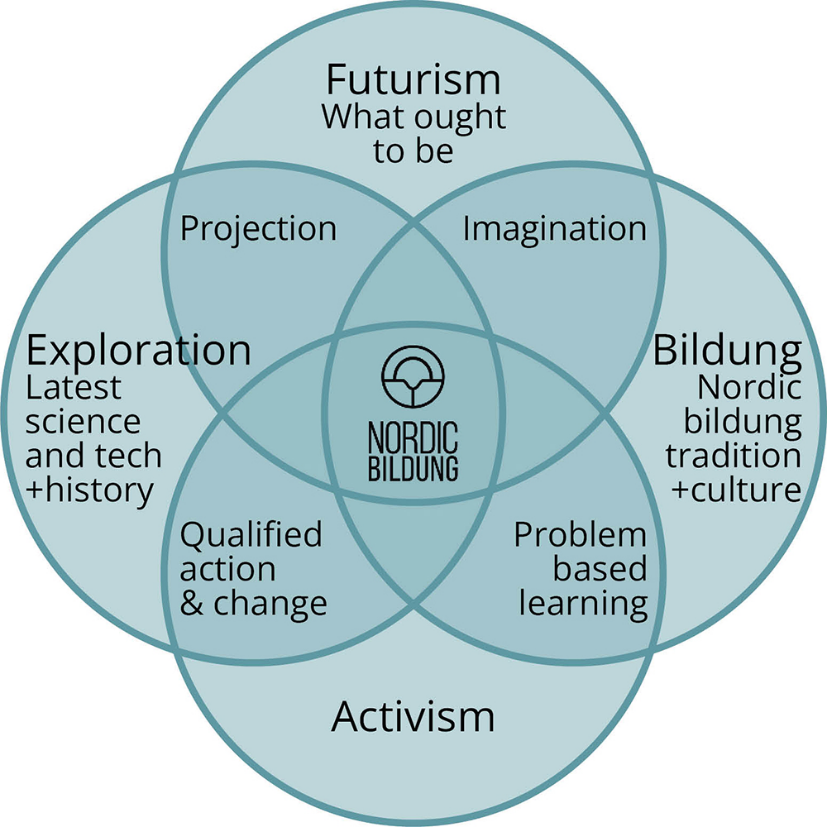
All this is
illustrated in the following figure.

In addition, they
make a number of specific suggestions relating to updating things like the
scouts organizations to this 3.0 version, executive education as a type of
bildung, implementing Grundtvig’s idea of a folk-bildung university in
Gothenburg and a European bildung university in Strasbourg.
Chapter 20. Looking Forward to our Conversations
Here a brief summary shows how
they have traced the development of bildung philosophy from Shaftesbury through
a number of key German philosophers to the Scandinavian folk-bilders who
created the high schools that brought personal growth and development to a
broader range and number of people in those societies. They characterize this
journey as a story of freedom and beauty (thus the subtitle of the book) and a
history of increasing the understanding and sense of responsibility of members
of a set of democratic societies.
They note that the lack of such
development can lead to falling prey to the emotional need for
authoritarianism, or the desire for someone else to take responsibility. In the
face of increasing complexity in society, can we fall prey to the same pattern?
Reflections
With all of this, I hope a) that
I have done justice to the work put into this book and that b) I have whetted
your appetite for reading the book itself. Not simply for the reading and
taking in of interesting ideas, but for the sake of motivating you to find new
possibilities for participating in society.
For myself, reading this book has
helped me recognize some of the qualities in the culture where I live that have
in recent years been emerging more into the foreground of my awareness. When I
came to Norway, everyone her asked how long I would stay. I responded that I
didn’t know, maybe 5, 10 or 15 years. Now I find myself comfortably settled,
enjoying the foundation living in a high trust society with basic means
reasonably attained. What I have learned reading this book helps make explicit
for me at least some of the reasons this is the case.
We all face challenges. These
offer us the opportunity to grow. Yet we need to do more than grow. Essential
to our growth at some point is the need to pass along what we learn to others.
There are many ways this can happen and I hope that this small contribution can
stimulate next steps for each of us in doing this.
[1] See Molz and Hampson. (2010). Elements of the unacknowledged history of integral education, in Integral education. New directions for higher learning. Eds. Esbjörn-Hargens, S., Reams, J., & Gunnlaugson, O.
Albany. New York: State University of New York Press.
[2] In other background research I have done, Norway also scores high on; corruption perception (lack of) index (2014, #5), UN human development index (2015, #1), legal system and property rights (2015, #3), credit market regulations (2015, #1) and political participation, electoral process, functioning of government and democratic political indexes (2015, #1).
[3] I have certainly encountered similar pushback even and maybe especially in academic circles here.
[4] Welzel, C. (2014). Freedom rising. Human empowerment and the quest for emancipation. Cambridge: Cambridge University Press.
[5] I saw a recent TEDx talk by Steven Johnson (Where Good Ideas Come From) that showed the influence of coffee houses on the English enlightenment – before then, everyone was a bit too drunk to think new ideas. After they drank coffee and tea instead of alcohol, ideas started to be discussed in these places without the limitations of constant drink. https://www.youtube.com/watch?v=0af00UcTO-c
[6] It seems to me that this is not new with Hume, as Descartes seems to have done this is some manner.
[7] I have learned that the term high school is here more in reference to what in North America would be considered community college. The age group targeted is around18 or 19, which fits between secondary and tertiary education.
[8] This happens to a lesser degree in Sweden with the loss of Finland. In Norway, my understanding is that the desire for a national identity came more from the 400 years of Danish rule, then another 100 of Swedish rule.
[9] The interesting thing for me, living in Norway the past ten years, is that the culture around which people internalize a capacity for self-governance appears to be around a set of relatively higher order values. Thus, they are socialized into a highly progressive and humanistic set of values, yet are often unreflected about them. I have understood these values as emerging from the founders of the constitution taking inspiration
[10] While I am not sure of this overall, I do notice that this kind of breadth of study is difficult to obtain here in Norwegian university study as well. One except I am familiar with is a course required of all master students at the university I teach at, (about 2300 students take this course each year), where they have to work in interdisciplinary teams on projects, and 50% of their grade is based on a group dynamic process report. Called Experts in Teams (EiT), the course was developed at the urge from industry to help the university’s graduates have some skills beyond their disciplinary expertise, specifically in collaborative teamwork.
[11] My position at NTNU is in a department named Pedagogy and Life-long Learning, and I can vouch for the current focus of this field not really being aligned with the ideas of bildung laid out in this book.
[12] I can attest to this not only in my own life, where my transitions have been from farming, through carpentry and truck driving into academia and consulting, but also in that of my father, who in his early 80s is well into his third major career and successfully working as much as he wants.
==

No comments:
Post a Comment