Silence (novel) - Wikipedia
Silence (novel)
From Wikipedia, the free encyclopedia
Silence
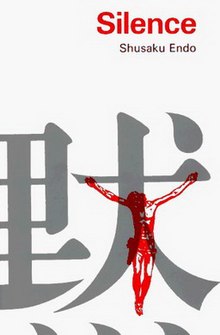
Author
Shūsaku EndōOriginal title Chinmoku
Translator William Johnston
Country
JapanLanguage
JapaneseGenre
Historical fictionPublisher Peter Owen (UK) / Taplinger Publishing Company (USA)
Publication date 1966
Published in English 1969
Media type Print
Silence (沈黙 Chinmoku
?) is a 1966 novel of historical fiction by
Japanese author
Shūsaku Endō, published in English by
Peter Owen Publishers. It is the story of a
Jesuit missionary sent to 17th century Japan, who endures persecution in the time of
Kakure Kirishitan ("Hidden Christians") that followed the defeat of the
Shimabara Rebellion. The recipient of the 1966
Tanizaki Prize, it has been called "Endo's supreme achievement"
[1] and "one of the twentieth century's finest novels".
[2] Written partly in the form of a letter by its central character, the theme of a silent
God who accompanies a believer in adversity was greatly influenced by the
Catholic Endō's experience of
religious discrimination in Japan,
racism in France, and a debilitating bout with
tuberculosis.
[3]Contents [hide]
1Plot summary2Reception3Adaptations4See also5References and notesPlot summary[
edit]
The young
Portuguese Jesuit Sebastião Rodrigues (based on the historical Italian figure
Giuseppe Chiara) is sent to Japan to succor the local Church and investigate reports that his mentor, a Jesuit priest in Japan named Ferreira, based on
Cristóvão Ferreira, has committed
apostasy. Less than half of the book is the written journal of Rodrigues, while the other half of the book is written either in the
third person, or in the letters of others associated with the narrative. The novel relates the trials of Christians and the increasing hardship suffered by Rodrigues.
Fr. Rodrigues and his companion Fr. Francisco Garrpe arrive in Japan in 1639. There they find the local Christian population driven underground. To ferret out
hidden Christians, security officials force suspected Christians to trample on a
fumi-e, a crudely carved image of
Christ. Those who refuse are imprisoned and killed by anazuri (穴吊り), which is by being hung upside down over a pit and slowly bled.
Rodrigues and Garrpe are eventually captured and forced to watch as Japanese Christians lay down their lives for the faith. There is no glory in these martyrdoms, as Rodrigues had always imagined – only brutality and cruelty. Prior to the arrival of Rodrigues, the authorities had been attempting to force priests to renounce their faith by torturing them. Beginning with Fr. Ferreira, they torture other Christians as the priests look on, telling the priests that all they must do is renounce their faith in order to end the suffering of their flock.
Rodrigues' journal depicts his struggles: he understands suffering for the sake of one's own faith; but he struggles over whether it is self-centered and unmerciful to refuse to recant when doing so will end another's suffering. At the climactic moment, Rodrigues hears the moans of those who have recanted but are to remain in the pit until he tramples the image of Christ. As Rodrigues looks upon a fumi-e, Christ breaks his silence: "You may trample. You may trample. I more than anyone know of the pain in your foot. You may trample. It was to be trampled on by men that I was born into this world. It was to share men's pain that I carried my cross." Rodrigues puts his foot on the fumi-e.
An official tells Rodrigues, "Father, it was not by us that you were defeated, but by this mudswamp, Japan."
[4]Reception[
edit]
Silence received the
Tanizaki Prize for the year's best full-length literature. It has also been the subject of extensive analysis.
[5] William Cavanaugh refers to the novel's "deep moral ambiguity" due to the depiction of a God who "has chosen not to eliminate suffering, but to suffer with humanity."
[6]Endō, in his stage version of this story, The Golden Country, has the official telling Ferreira, "But the mudswamp too has its good points, if you will but give yourself up to its comfortable warmth. The teachings of Christ are like a flame. Like a flame they set a man on fire. But the tepid warmth of Japan will eventually nurture sleep."
[4] In his book A Life of Jesus, he states that Japanese culture identifies with the "one who 'suffers with us' and who 'allows for our weakness....with this fact always in mind, I tried not so much to depict God in the father-image that tends to characterize Christianity, but rather to depict the kind-hearted maternal aspect of God revealed to us in the personality of
Jesus."
[7]Adaptations[
edit]
Besides Endo's
stage version, The Golden Country, there have been several adaptations:
Masahiro Shinoda directed the 1971 film
Chinmoku, an adaptation from the novel.
[8]It was re-adapted by
João Mário Grilo as
The Eyes of Asia in 1996.
[9]Composer and poet
Teizo Matsumura wrote the libretto and music for an opera with the same title, which was premiered at the
New National Theatre in Tokyo in 2000.
[10]The novel inspired
Symphony no. 3, "Silence", composed in 2002 by Scottish musician
James MacMillan.
[11]In 2007, American film director
Martin Scorsese announced his intention to direct
an adaptation of the book which he had hoped to film in summer 2008.
[12] In 2009, it was announced on
Empireonline.com that
Daniel Day-Lewis and
Benicio del Toro were signed to star in Scorsese's film adaptation. In 2013,
Andrew Garfield,
Liam Neeson,
Issei Ogata and
Ken Watanabe were attached, and the film entered production in January 2015.
[13] In 2014,
Adam Driver was attached to the film adaptation.
[14]In January 2015, Watanabe was forced to leave the project due to scheduling issues and was replaced by
Tadanobu Asano.
[15] The film premiered at the
Pontifical Oriental Institute in Rome on November 29, 2016.
[16]See also[
edit]
 Novels portalChristian martyrsUrakami CathedralHistory of Roman Catholicism in JapanSilence (2016 film)
References and notes[
edit]
Jump up^ "Shusaku Endo's Silence" by Luke Reinsma, Response of
Seattle Pacific University,Volume 27, Number 4, Autumn 2004
Jump up^ "We Have Never Seen His Face" (PDF). (121
KiB) by Brett R. Dewey for the Center for Christian Ethics at
Baylor University, 2005, p. 2
Jump up^ Dewey 2005, p. 3
^
Jump up to:a b Francis Mathy,
SJ, of
Sophia University, (1974), "Introduction", Endo Shusaku, Wonderful Fool (Obaka San), Tokyo: Tuttle, p. 6,
ISBN9780068598534 .
Jump up^ "Suffering the Patient Victory of God: Shusaku Endo and the Lessons of a Japanese Catholic" by Brett R. Dewey, Quodlibet: Vol 6 Number 1, January–March 2004
Jump up^ "The god of silence: Shusaku Endo's reading of the Passion – critique of the Japanese novel 'Silence'" by William T. Cavanaugh,
Commonweal, March 13, 1998
Jump up^ "The Christology of Shusaku Endo" by Fumitaka Matsuoka,
Theology Today, October 1982, p. 295 [Accessible on
The Internet Archive]
Jump up^ "Chinmoku (1971)",
Internet Movie Database (accessed 20 February 2010)
Jump up^ Bradshaw, Peter (10 December 2016).
"Silence review: the last temptation of Liam Neeson in Scorsese's shattering epic". Retrieved 19 January 2017 – via The Guardian.
Jump up^ "Tokyo NNT website" (accessed 15 February 2011)
Jump up^ "BBCSSO/Runnicles" by Rowena Smith,
The Guardian, 28 April 2008
Jump up^ "Next for Scorsese: 17th-century Japan" by Angela Doland,
Associated Press, 24 May 2007
Jump up^ Foundas, Scott (7 May 2013).
"Andrew Garfield to Star in Martin Scorsese's 'Silence' (EXCLUSIVE)". Retrieved 19 January 2017.
Jump up^ "Martin Scorsese Casts Adam Driver in Silence". 13 January 2014. Retrieved 19 January 2017.
Jump up^ http://twitchfilm.com/2015/01/asano-replaces-watanabe-in-scorseses-silence.html/ "Asano Replaces Watanabe In Scorsese's SILENCE"
Jump up^ Nick Vivarelli (30 November 2016).
"Martin Scorsese Meets Pope Francis and Talks Jesuit History Prior to 'Silence' Screening". Variety. On Tuesday, “Silence” screened for roughly 300 Jesuit priests at the Pontifical Oriental Institute in Rome, in what amounted to the film’s de facto world premiere. Attendees were able to discuss the film with Scorsese afterwards.
Categories:
1966 novelsNovels by Shusaku EndoSociety of JesusRoman Catholic novelsChristian martyrsChristianity in JapanNovels set in JapanJapanese novels adapted into filmsCrypto-ChristianityNovels adapted into operas
 1924년 황푸군관학교 교장
 1943년 카이로회담에서 루즈벨트, 처칠과


 ウィキメディア・コモンズには、