June 2026 — Camp
And That’s How I Became Korea’s Most Famous Denialist
Even sensitive and painful topics must be subjected to open inquiry
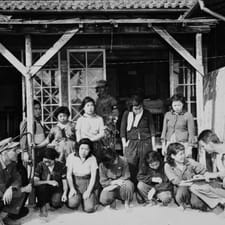
Korean Comfort Women liberated by U.S. Marine Corps, 1945. Wikimedia Commons, Public Domain.
Following a longstanding request from the author’s university department leadership, certain names in the essay, including the author’s, have been removed.
In March 2021, students starting the spring semester at my South Korean university were greeted by a banner suspended across a central walkway calling for my removal from the faculty. Inside the social science building where I worked was a poster listing virtually every campus student organization also petitioning for my dismissal. Fifteen hundred students—including most in my department—had signed the petition. Meanwhile, national media writers, such as The Korea Herald, labeled me one of the “different shades of denialism” regarding Japan’s colonial and war crimes in Korea.
How did I become Korea’s—or least my university’s—most famous denialist? The immediate trigger was an essay I had co-authored in the foreign policy journal The Diplomat calling for more open, self-reflective debate about the “comfort women” issue—which involves allegations that during World War II tens of thousands of women from Korea and elsewhere in East Asia were forced into sexual slavery to serve the needs of Japanese military personnel.
Specifically, the piece was a response to the controversy over Harvard law professor J. Mark Ramseyer’s article on the status of these comfort women that deviated from the accepted narrative that these women were simply sex slaves. My co-author and I argued that “debating not censuring” was the more principled and productive path to finding out the truth about this episode in history.
But the deeper story is the long path—personal and intellectual—that brought me back to Korea and eventually into collision with one of its most powerful taboos.
A Second Chance in My Birth Country
When a tenure-track position at a teaching-focused American university did not work out, returning to work in Korea offered a chance to reset. I taught two years at one Seoul-based university before formally joining “H University” in 2013. The position was non-tenure track, but provided long-term employment (renewable two-year contracts), time to focus on research, and access to family housing in the bustling capital of Seoul.
I was born in South Korea, in Gwangju, the epicenter of the progressive opposition to the nation’s authoritarian regimes (1945-87), and was eager to teach and contribute to the country’s development. By 2015, I had settled into my new role and was teaching and publishing regularly. The next year, I was named one of H University’s 23 “Excellent Scholars,” prompting the social science administration team leader to predict that the division would promote me to a tenured position. But this promise quickly turned to controversy over perhaps the most sensitive topic in Korea: Japanese colonialism, and specifically the use of comfort women for the Japanese military during their occupation of Korea both before and during World War II.
The Biggest Taboo
Like most Koreans, I had grown up with a simple and morally satisfying binary: Japanese Imperialists were oppressors; Koreans were victims. It wasn’t a narrative one usually questioned. But several incidents pushed me to look more closely—especially one involving Junko, a Japanese exchange student in my class, who was verbally abused on the Seoul subway simply for speaking Japanese on her cellphone. I quoted her reflections in an article for The Korea Herald:
[The man] said, “Hey damn the child of disseizor [sly invader]. Go out from Korea as soon as possible!” I shall never forget this word. The word “disseizor” was too cruel. It was like a stab in the chest to me. Intellectuals should stop using [these kinds] of harsh words because they have a big effect on people.
Her experience made me ask why Korea’s anti-Japanese narrative had taken on such intense moral absolutism. And the more I questioned, the more I realized that the narrative—like all grand narratives—contained truths, half-truths, and politically convenient simplifications. The most devoutly held, but empirically contested, narrative was that the Japanese military had kidnapped, enslaved, and mostly killed 200,000 Korean girls; that the current Japanese government was hiding or denying these crimes; and that any deviation from this view reflected “far-right denialism.”
The Korean media explicitly compared comfort women to Jewish Holocaust victims. For instance, an editorial in The Korea Times argued that “by no means would the suffering of the comfort women be less painful than that of those killed en masse in the Nazi gas chambers” and the world needs to “see Korea’s misery as compelling[ly] as they see the Jewish Holocaust.”
Like most Koreans, I had grown up with a simple and morally satisfying binary: Japanese Imperialists were oppressors; Koreans were victims.
But rigorous, “revisionist” research, such as Korean-American anthropologist C. Sarah Soh’s 2008 book, The Comfort Women, critiques each of these claims. Instead of comparing Japan’s Korean comfort women to the Jewish Holocaust, a more realistic comparison is to other military brothel systems, such as those operated by France during World War I and the U.S. military in post‑1945 Korea.
Soh revealed how some former comfort women changed their personal testimonies over time, coinciding with the nationalist abduction narrative, and how academics and journalists declined to question the shifting testimonies and instead labeled any critique as right-wing denialism. Reading her book profoundly challenged my worldview, as much as Allan Bloom’s The Closing of the American Mind (1987) had years ago before I started graduate school.
Heterodoxy in the Classroom
Virtually none of my students had heard of Soh’s book, as no publisher would translate it into Korean. But her book was not an exercise in denialism. Instead, it was scholarship—rigorous, meticulously sourced, and praised by even progressive historians such as the University of Chicago’s Bruce Cumings. Starting in 2013, I introduced Soh to my students, including those in my Civil Society & Social Movements class, along with more mainstream views of the issue. For the latter, I assigned the U.N.’s 1996 Coomaraswamy Report on sexual slavery during World War II and organized field trips to the House of Sharing (a home to surviving comfort women).
Most of the young people in my classes—a mix of international and Korean students—appreciated the balance. Some pushed back. A few expressed discomfort. But the disagreements were civil—until 2016. That fall semester, a large group of Korean students enrolled. They didn’t talk much or challenge me in class. But after the semester ended—and after I had already flown to the U.S. for winter break—I received a terse email from the Student Council president:
The Student Union of the College of Social Science and Department of Politics & Diplomacy heard of your statement in class. We and many students seriously worried about your statement because it can be advocating war crimes and totalitarianism…. So we need your official position and apology for this issue. Please refer to the attached document. P.S. I sincerely hope that this will not happen again.
Student activists then contacted sympathetic reporters, sparking a national controversy. The department chair—who believed only a trivial number of comfort women had voluntarily joined—declined to communicate with me throughout the entire winter break. My family and I were paralyzed for two and a half months, wondering whether I’d lose my job.
When I returned to Korea, I endured hours-long meetings with a faculty committee and student representatives. Finally, the committee issued a formal “warning” and prohibited me from assigning Soh’s book for one year, a compromise from its initial demand to never assign the book again. That was my first strike.
A Deliberately Edited Misquote
After 2016, I redesigned my curriculum, assigning Soh’s The Comfort Women to my Comparative Politics course, along with Katharine Moon’s book about U.S. military comfort women, Sex Among Allies, to the aforementioned Civil Society course. Students were required to submit weekly reading reactions to assess comprehension. Sensitive topics were introduced only after discussions of less politicized cases, such as human rights abuses in North Korea. I encouraged students to compare the rhetorical patterns of comfort women testimonies with those of North Korean defectors, to examine how narratives of suffering function within advocacy movements.
The classroom atmosphere remained volatile, even though activist students were mostly silent throughout the semester. They then submitted highly negative course evaluations. But after 2016, the number of such students was minimal, as most simply boycotted my elective courses.
Starting in the 2018 fall semester, I was asked to teach the Political Science Methodology course, required for all undergraduate students. I received excellent student evaluations for my teaching: I invited guest speakers and organized various field trips, including to the nation’s largest mosque.
I expected the same in 2019, but that year coincided with the publication of former Seoul National University economics professor Lee Young-hoon and colleagues’ revisionist bestseller, Anti-Japan Tribalism, criticizing Koreans’ anti-Japanese views and arguing that many were based on historical falsehoods. The book sold over 130,000 copies and triggered a flood of media coverage. To connect my course to current events, I discussed Lee’s book as an attempt to overturn historical consensus and usher in a paradigm shift.
One or more students secretly recorded my lecture, edited out my attribution, and circulated the clip as if the statement were my own to like-minded reporters. Without contacting me for verification, the national public news agency, Yonhap, published the headline: “H University professor: ‘Korean scholars researching comfort women are liars’… Student Council pushes back.” The incident solidified my reputation as a member of Korea’s far-right or “new-right” who deny Japan’s war crimes and personally insult our nation’s historians. Meanwhile, the Student Council president requested that I acknowledge that Anti-Japan Tribalism is bad social science. I declined since I do not publicly endorse or reject any book that we may discuss in class.
That was strike two, for allegedly stirring political controversy that hurt H University’s reputation and consuming the time of tenured faculty. My department subsequently banned me from teaching Political Science Methodology, or any other mandatory undergraduate course. (I was, however, still assigned to teach the methods class for graduate students.)
As my number of undergrad courses shrank, I was assigned to teach general English writing classes for graduate students university-wide, mostly in the sciences and engineering. Some would consider this a humiliating demotion, but I feel that all teaching is honorable, whatever the subject. I adapted by assigning various writing and communication exercises—short stories, essays, research papers, small team meetings, and games—and earned nearly 100% positive student evaluations.
Defending a ‘Privileged Denialist’
I had already suffered two strikes in 2016 and 2019, with ever-diminishing chances of tenure promotion at H University or at any other university in Korea, when another potentially difficult situation arose. In 2020, Harvard law professor Ramseyer published an article theorizing that most Korean women signed contracts to become comfort women, and that such contracts offered more pay and shorter terms during wartime than during peacetime because of the difficulty of recruiting wartime workers.
I felt immense pressure not to defend the academic freedom of such a supposedly incendiary and privileged scholar. But to not speak about academic and civil freedoms, when no one else would, would violate my core beliefs.
In the end, I chose the “hard” that I could best live with. The response was immediate, intense, and inevitable. Posters across campus demanded my removal. Student Councils issued similar statements. Media outlets repeated earlier allegations against me. A confidential university panel reviewed my case and voted 11–2 against termination, but I was neither invited to speak in my defense nor even informed that the review had occurred.
My department requested that I permanently refrain from writing about comfort women. We ultimately agreed that I would pause writing for one year and that any future publications would not mention my university affiliation.
Choosing My ‘Hard’
Academics often respond to controversies with the flight-or-fight response. A silent majority probably choose flight, promising to avoid sensitive topics or never to touch them again, at least until they receive tenure. A vocal minority choose to fight, to lean into oppositional activism. I choose neither flight nor fight, but the Heterodox Way—an ethos of rigor, curiosity, humility, and openness. I want to engage, not retaliate. To understand, not demonize. To criticize systems and practices, not individuals.
By God’s grace, I found a community where this ethos was not only accepted but encouraged. When colleagues at H University and at the Korean Studies Association disavowed me, Heterodox Academy accepted me. Through HxA, I found colleagues who believed, as I did, that intellectual diversity and open inquiry are essential to a healthy academic culture and to what should be every university’s core mission: the unfettered pursuit of truth.
Together with Kyushu University’s Shaun O’Dwyer, and later joined by scholars like Frances An from the University of Western Australia, Wondong Lee from South Korea’s Inha University, Meredith Shaw from the University of Tokyo, and Alexandre Erler from Taiwan’s National Yang Ming University, we created the Heterodox East Asia Community, hosting four to six forums a semester on sensitive topics across East Asia. Our community shares the premise that curiosity flourishes where fear recedes.
Why I Still Believe
Some may assume that my ordeal radicalized me—turned me against the left, activists, or even Koreans. It did not. In fact, it deepened my understanding and appreciation of the liberal principles of procedural fairness, viewpoint diversity, self-criticism, and institutional openness. Open vetting of claims—even painful ones—remains the foundation of legitimacy in liberal, pluralistic societies. When institutions suppress heterodox ideas rather than examine them, they erode their own moral authority.
I believe Korea can embody a more open, self-reflective and intellectually pluralistic culture and that classrooms should be safe spaces for criticism, and not only for conformity. I believe in its many citizens—students, journalists, scholars—who quietly told me they wanted open debate, even if they could not say so publicly. The core principles of academic freedom helped persuade the 11 faculty members who ultimately voted not to terminate me—and for that, my family and I remain grateful.
In the end, heterodoxy is not rebellion, it is responsibility. And that is how I became Korea’s most famous “denialist;” not because I denied anyone’s suffering, but because I refused to deny the values of open inquiry and the pursuit of truth.
About the author
J, Ph.D., teaches political science at H University in South Korea, and has received Heterodox Academy’s Open Inquiry Award for Courage.
===
Welcome to inquisitive
Where intellectuals meet to think more deeply about open inquiry, viewpoint diversity, and constructive disagreement in today’s colleges and universities.
What is inquisitive?
An intellectual magazine published quarterly by Heterodox Academy, inquisitive uses a “small plate” approach to exploring the values of and challenges to open inquiry, viewpoint diversity, and constructive disagreement in higher ed. With compelling art and text, inquisitive functions as a medium where intellectual change-makers meet over uncomfortable questions and great ideas.
Each issue of inquisitive is wrapped around a theme meant to provoke novel takes and insights. In addition to theme-based essays, each issue also features a books column, historical vignettes, a “field guide” to a contested academic discipline, and “Heterodox Life,” first-person takes on life in the modern academy. We invite contributions to inquisitive particularly from graduate students and faculty in higher ed. Find our current call for proposals here.
inquisitive is available online for free. The print edition will be mailed to donors of Heterodox Academy who give at least $120 per year - just $10 per month. Please consider making a donation today to protect open inquiry in higher education.
inquisitive is published under Creative Commons license CC-BY-NC-ND 4.0. Read more here.
Our TeamDavid MasciManaging Editor of inquisitive
Janelle DeliaGraphic Designer
Nicole Barbaro Simovski , Ph.D.Director of Communications, Marketing & Events
Joseph (Jake) KleinCommunications Content Manager
About Heterodox Academy
Heterodox Academy (HxA) is a nonpartisan, nonprofit membership organization composed of thousands of faculty, staff, and students advocating for policy and culture changes to ensure our universities are truth-seeking, knowledge-generating institutions grounded in open inquiry, viewpoint diversity, and constructive disagreement.
Founded in 2015, HxA has been working for nearly a decade to educate about the value of viewpoint diversity in research and teaching and to help create campus cultures in which open inquiry thrives. With 82 HxA Campus Communities and thousands of members across more than 1,800 institutions, HxA advances its mission through policy recommendations, member organizing, and a positive belief in the potential of our institutions of higher education.
===
요약: 학문적 다양성을 향한 여정과 '부정론자'라는 낙인
1. 사건의 발단과 배경
한국에서 태어나 미국에서 학업을 마친 저자는 2013년 한국의 H 대학교 정치외교학과 교수로 부임했다
2. 세 번의 충돌 (Three Strikes)
저자는 강의와 저술 활동을 통해 주류 서사에 도전하며 세 차례의 커다란 위기를 겪었다
첫 번째 위기 (2016년): 한국계 미국인 인류학자 C. 사라 소(C. Sarah Soh)의 저서 <위안부>를 교재로 채택하여 위안부 문제를 다각도에서 조명하려 했다
. 학생 서사는 이를 '전쟁 범죄 옹호'로 규정하며 사과를 요구했고, 언론 보도로 확산되면서 대학 당국으로부터 해당 도서 지정 1년 금지 처분을 받았다 . 두 번째 위기 (2019년): 정치학 방법론 수업에서 당해 베스트셀러였던 <반일 종족주의>의 학문적 현상을 설명하던 중, 발언의 맥락이 거세된 채 비밀리에 녹취되어 언론에 "위안부 연구 학자들은 거짓말쟁이"라고 발언한 것처럼 왜곡 보도되었다
. 이로 인해 전공 및 필수 과목 교수 자격을 박탈당하고 대학원 영어 글쓰기 수업으로 전보 조치되었다 . 세 번째 위기 (2021년): 마크 램지어(J. Mark Ramseyer) 하버드대 교수의 논문을 둘러싼 학문적 검열 조치에 반대하며, <디플로맷>지에 "규탄이 아닌 토론"을 촉구하는 기고문을 공동 집필했다
. 이에 학생들의 파면 요구 시위가 격렬해졌고 교내 징계 위원회가 열렸으나, 최종 표결(11 대 2)로 해고는 면했다 . 대신 1년간 위안부 관련 저술 금지와 소속 대학 명기 금지라는 조건에 합의했다 .
3. 헤테로도크스(Heterodox) 정신과 결론
동료 학자들과 학회로부터 외면당한 저자는 학문적 다양성과 열린 탐구를 지향하는 '헤테로도크스 아카데미(HxA)'에서 연대를 찾았다
평론: 성역화된 민족 서사와 학문의 자유가 부딪히는 전장
1. 단일 서사 사회에 던지는 헤테로도크스(비정통)의 도전
본 에세이는 민족주의적 집단기억이 지배하는 사회에서 '학문의 자유'와 '관점의 다양성'이 어떻게 억압받는지를 생생하게 보여주는 고발장이자 고백록이다
저자가 인용한 C. 사라 소의 연구나 램지어 논쟁에 대한 접근은 결코 일본의 전쟁 범죄를 면책하려는 목적이 아니다
2. 대학의 관료화와 미디어 포퓰리즘의 결탁
글에서 묘사된 대학 당국과 언론의 행태는 현대 지식인 사회의 취약성을 적나라하게 드러낸다.
학문적 보호망의 부재: 대학은 학문의 자유를 수호하는 최후의 보루여야 함에도 불구하고, 학생 서사의 압박과 대외 평판 저하를 이유로 강의 과목을 제한하거나 저술을 검열하는 등 관료주의적 타협을 선택했다
. 언론의 맥락 왜곡과 낙인찍기: 일부 언론은 강의실 내의 학술적 맥락을 거세한 채 자극적인 헤드라인으로 '마녀사냥'식 보도를 일삼았다
. 이는 복잡한 역사적 쟁점을 단순한 선악 구도로 환원시켜 대중의 공분을 유도하는 미디어 포퓰리즘의 전형이다 .
3. '도망'과 '투쟁'을 넘어선 제3의 길, 연대라는 대안
가장 돋보이는 지점은 시련 속에서도 저자가 냉소주의나 우경화에 빠지지 않고, 학자로서의 방법론적 엄밀함과 자유주의적 원칙을 고수했다는 점이다
국내 학계가 침묵으로 일관할 때 외부의 '헤테로도크스 아카데미' 및 동아시아 학자들과 국경을 넘는 학술적 연대를 구축한 것은 매우 유의미한 돌파구다
4. 총평
이 글은 한국 민주주의와 학계가 진정한 지적 성숙을 이루었는지 묻는 무거운 질문이다. "진리 탐구는 고통스러운 주장까지도 열린 검증의대에 올려놓을 때 비로소 정당성을 얻는다"라는 저자의 신념은, 지적 도그마에 갇힌 한국의 공론장이 반드시 되새겨야 할 명제다

No comments:
Post a Comment