I’m a research fellow at Stanford University’s Hoover History Lab. Previously, I was a fellow at the Yale Law School’s Paul Tsai China Center, and before that, I covered technology at Gavekal Dragonomics. For the better part of a decade, I’ve been trying to figure out China’s technology capabilities while I lived in Hong Kong, Beijing, and then Shanghai. In addition to my annual letters, my essays have appeared in the New York Times, Foreign Affairs, the Financial Times, New York Magazine, Bloomberg Opinion, and The Atlantic. I'm the author of Breakneck: China's Quest to Engineer the Future.
From an 'indispensable voice on China' (Evan Osnos) comes a riveting, first-hand account of China's seismic progress
America used to pride itself on ambition. Today, it looks stuck. Meanwhile, China has been busy building the future. Over the past six years, technology analyst Dan Wang lived through China's astonishing, messy progress and the dissolution of its relationship to the West.
In Breakneck, Wang offers a new framework for understanding China - which helps us to see global geopolitics more clearly too. While China is an engineering state, fearlessly building megaprojects, America is a lawyerly society, reflexively blocking everything, good and bad. Building big has fuelled China's economic ascent. At the same time, social engineering has led to unbearable costs, including the traumas of zero-Covid and the one-child policy. Wang traverses China's dazzling metropolises and factory complexes, blending political and economic analysis with reportage to show how the Communist Party's darkening ambitions have unsettled its people.
As the US and China are gearing up for a new Cold War, Breakneck reveals both the remarkable strengths and the appalling weaknesses of the engineering state. China has learned from the West's successes and failures - and now we in turn can learn from China, not least by taking its global ambitions seriously.
The first is an elevation of process over outcomes. In American government and society, designing new rules and committees have so often become the substitute for thinking hard about strategy and ends.
Translated by Amazon
See original
From Australia
Mike N
5.0 out of 5 stars UNDERSTAND A BIT ABOUT CHINA
Reviewed in Australia on 5 December 2025
Format: KindleVerified Purchase
With a person who lived in a communist system before, the book contents are something that a normal person living in a normal "free" country could not understand. The book will help people understand a bit on how communist China as a run.
The most interesting view is the "country of engineers" & "country of lawyers" (CHINA & US).
It is highly recommended book!
Helpful
Report
David
3.0 out of 5 stars Good analysis of the Engineering State but poor on the Lawlerly Society
Reviewed in Australia on 18 January 2026
Format: HardcoverVerified Purchase
The author adopts a novel way of comparing China and the USA. The former he characterizes as the engineering state and the latter, the lawyerly society. The engineering state is good at getting things done. The lawyerly society is more focused on stopping things from getting done. Early in the book the author gives the amusing example of the way China planned and built their VFT network versus the hapless approach of the Californian government to build a VFT linking LA and SF.
Unfortunately the engineering state is prone to over-engineer people lives. The chapter on the one child policy demonstrates this well.
I found the chapter on Shenzhen to be the best in the book. It outlines how a manufacturing "ecosystem" has come into being and once established, goes from strength to strength. No question that the "hollowing out" of US manufacturing has led to the destruction of their "ecosystems" and subsequent manufacturing decline.
I thought the weakest part of the book was the author's analysis of the lawyerly state. He touches on the failure of California's inability to complete its VFT project but offers no detailed analysis of why it has stalled. He talks about rich people in Massachusetts halting the construction of offshore wind farms. He suggests that the lawyerly society protects the interest of the rich. I think the author's political petticoat is showing here. Sure the rich will use all the levers of political and legal power to protect their interests but does that explain why all projects stall? I can think of three projects in the USA that faltered that would proceed unhindered in the engineering state: The Keystone Pipeline, The Quebec Hydro interconnect into New England and the TMT on Moana Kea in Hawaii. (I will let the readers search for details.) These projects were/are halted or stalled not by rich folks and their attorneys but by a political activist class. The origin, growth, make-up, funding and modus operandi of this class is worthy of analysis. You won't find it here.
2 people found this helpful
Helpful
Report
Jim burns
5.0 out of 5 stars a really interesting read
Reviewed in Australia on 26 October 2025
Format: KindleVerified Purchase
Dan offers a unique view of America and China and the problems that they face in the near future.Highly recommended.
Helpful
Report
Snappy Dresser
5.0 out of 5 stars A useful but simplistic contribution to understanding USA and China
Reviewed in Australia on 3 December 2025
Format: Hardcover
This is a very enjoyable and interesting book which argues that the lines of division between USA and China are less political and more in terms of lawerly vs engineering mindsets. Undeniably, Wang puts his finger on an interesting issue which has long term political, social and economic outcomes. For this reason, the book deserves a 5* rating. Yet at the same time, the simplicity of the argument is also its downfall despite its superficial charm. The reality is that there are so many other issues and lens which also help explain where we are and why we are where are. Don't be fooled by the simplicity of the argument but revel in the joy of the idea. And then critique it :-)
Helpful
Report
From other countries
Andreas Costabile
5.0 out of 5 stars A unique perspective on how and why China became the industrial capital of the world
Reviewed in Sweden on 11 December 2025
Format: HardcoverVerified Purchase
An extremely interesting view of China's industrial come-up, with a unique comparison to the mentality commonalities and differences to the US.
The author is very well-positioned to explain this comparison, given his heritage and work experience.
Report
luca venturini
5.0 out of 5 stars Great !
Reviewed in Italy on 25 March 2026
Format: HardcoverVerified Purchase
Fundamental book !
Report
Pascal Kraft
5.0 out of 5 stars Flawless
Reviewed in Germany on 4 May 2026
Format: KindleVerified Purchase
Must-Read, nothing else to say. In general I think the perspective is extremely interesting and the range of topics and views is great. Personally, I never thought too much about the reality of the one-child-policy "on the ground" and how it played out in rural areas. It's a scary example of the individual fighting against the large machine and the human suffering involved is largely unknown to younger people these days in the west I believe. On the other hand, the immense impact of infrastructure in lifting people out of poverty cannot be overstated yielding an interesting field of tension between two extremes.
Report
Carla Dutra
5.0 out of 5 stars Perfect
Reviewed in Brazil on 8 April 2026
Verified Purchase
Great
Report
Translated from Portuguese by Amazon
See original ·Report translation
Cliente de Kindle
4.0 out of 5 stars Impressive what happened and is happening in China
Reviewed in Mexico on 21 April 2026
Format: KindleVerified Purchase
Impressive things happened and are happening in China, good and bad,
Made me feel I want to know more about that country.
Report
VincentB
5.0 out of 5 stars A fascinating book to better understand the upcoming Sino-American conflict
Reviewed in France on 17 March 2026
Format: HardcoverVerified Purchase
Dan Wang is one of the few truly bi-cultural people who has thoroughly understood the structure of American and Chinese societies - societies that I know well.
His analysis is fascinating and very instructive for the world to come.
A funny anecdote: I asked DeepSeek (so a Chinese AI, which I use a lot) to do a comparative analysis between Dan Wang's book and the new Chinese five-year plan.
Like all AIs, he started to give me a brilliant analysis that I managed to understand despite the speed, then all of a sudden it stopped, everything disappeared and was replaced by a message “Sorry, but this analysis is out of my scope”.
That says more than a long speech 😂
Report
Translated from French by Amazon
See original ·Report translation
Translated by Amazon
See original
Mk
5.0 out of 5 stars Great book
Reviewed in Poland on 13 December 2025
Format: HardcoverVerified Purchase
Great book
Report
dmn
4.0 out of 5 stars Worth reading
Reviewed in Singapore on 29 December 2025
Verified Purchase
Pretty good book. The CCP is rotten. The last chapter was weak and needs to be rewritten.
Report
Amazon Customer
5.0 out of 5 stars Explains China incredibly well - a must read if you think China is a Soviet-style communist country
Reviewed in the United Kingdom on 19 April 2026
Format: KindleVerified Purchase
The author explains extremely well some key differences between China and Western democracies, most often using the US as contrast. I have always felt uneasy about the idea of spending time in China because of my perception that it's easy to come to harm in a society that does not value the individual. But the book is not really about personal freedom; rather it's about the control structures (constitutional and economic) of China that enable massive projects conducted at whiplash-speeds, and the downsides of that. If you still think China is a "traditional" communist country where there is no private property and the government makes all the decisions all the time, you really need to read this
Report
Gary
5.0 out of 5 stars Great description of where the world stands now
Reviewed in the United States on 14 September 2025
Verified Purchase
This is an excellent, easy to read, informative book. I had just read “Abundance,” by Klein and Thompson. This was a great book to follow that one. Not really similar, but both books provide perspectives that help make sense of today’s world. Both books make it clear that we liberals really need to get the lawyers and ourselves out of the way of critically needed construction projects. And conservatives really should stop destroying government.
Dan Wang is an excellent writer with very relevant experiences that make him the perfect candidate to write this book. At the broadest level, Wang sees China as an Engineering state, and the US as a lawyerly state. He compares strengths and weaknesses of the two as they relate to governing a nation’s resources (including its people).
China and the US are very opposite each other in governing. The US (lawyerly) model has gotten us to a point where we can no longer build anything quickly or cheaply - especially something large like high-speed rail. But we are (were?) very good at protecting individual rights while the communist (engineering) model uses people as state property to be used as any other commodity.
At one point in the book, Wang describes how some Chinese citizens were accumulating great wealth and with it, some political clout. Xi effectively shut them down like any dictator would if someone else is flexing any political muscle. That took my mind to wonder which model is really better? The one that prevents big money from taking control (engineering), or the one that seems to be controlled by big money (lawyerly). Neither seems to me a model to strive for. Alas.
Wang’s first-hand experience with China’s zero covid shutdown was very informative and depressing in its disregard for its citizens. And the one-child policy China imposed on its people for over three decades was a very dumb “engineering” move. Over the three decades, it is estimated that the equivalent population of the US was aborted - especially the girls.
Upon returning to the US in 2023, Wang found “quite irksome” a yard sign that read, “In this home we believe science is real.” I initially found it irksome that anyone would find that yard sign irksome. The point Wang was making was that he had just returned from a China that “followed the science” and created great misery. He soon writes that, of course science is real but engineering works only if it uses good data. I cannot argue against garbage-in, garbage-out, but a qualified engineer would use nothing but reliable data. China’s government uses whatever data saves “face” for Xi - a very Chinese attribute. That’s not really engineering, but I do see Wang’s point.
Wang points out how important it is for any society to possess process knowledge. This is the knowledge gained from the experience of building things - experience the U.S. once had in spades but has lost.
Of course, generalizing societies as lawyerly or engineering goes just so far. Either of an engineer or a lawyer can fail or succeed. If Xi cared for or listened to the Chinese people’s concerns, or if the communist government gave its people the rights they deserve, then the engineering state would be awesome. And if Trump listened to scientists (or anyone, really) then the U.S. could continue its leading role in medicine and the sciences. And if he wasn't hell-bent on destroying government then he would see its potential awesomeness. And if liberals like me don’t begin to see that some of our concerns are blown out of proportion and that these concerns are killing our country’s ability to build great projects, then we’re doomed. Let’s not be doomed!
Report
Cliente Amazon
5.0 out of 5 stars Very updated status on China
Reviewed in Spain on 8 March 2026
Format: HardcoverVerified Purchase
Great update on current China's vision, with few touches on what key points in history has driven to the current status. The comparison China vs US is sublime at times. 100% recommendable
Report
Filip Dheere
5.0 out of 5 stars A must read if you’re interested in China
Reviewed in Belgium on 20 May 2026
Format: HardcoverVerified Purchase
In this book the writer compares China with the USA. Very interesting approach. He analyses the economic and the political context of both countries. It helped me to increase my understanding of the actual China. He also explains why both countries can learn from each other.
Report
Michael Walker
5.0 out of 5 stars A Must‑Read Comparison of American and Chinese Systems
Reviewed in Canada on 29 April 2026
Verified Purchase
Breakneck is a must read book for those who want to understand the dynamics of the modern China–United States relationship. Dan Wang examines China’s rapid industrial and technological development, drawing on his work as a technology analyst and his extensive on the ground experience.
The book’s central idea is that China operates with an engineering, problem-solving mindset, while the United States operates with a more legalistic, process-focused one. Wang provides a balanced and detailed look at both countries, using concrete examples to illustrate this contrast and fairly assessing their respective advantages and disadvantages. He contrasts China’s ability to rapidly build infrastructure such as factories, dams and roads with the United States’ slower, process-focused approach. With its emphasis on legal and procedural safeguards, the U.S. system often struggles to deliver projects in a timely and cost-effective manner. At the same time, Wang addresses the human costs of China’s system, including the hardship caused by the one child policy and its response to the COVID pandemic.
Overall, the writing is excellent and engaging. Despite the complexity of these topics, the book is highly accessible and can be read easily by readers with no background in foreign policy or international relations. The book also includes some personal stories from the author’s life and from his parents, which add a human dimension and provide a nice contrast to the broader, big picture issues.
Report
B.Sudhakar Shenoy
5.0 out of 5 stars Lawyers Vs Engineers at the helm
Reviewed in India on 18 April 2026
Format: HardcoverVerified Purchase
This is an extremely well researched, insightful and timely book in a world where China emerges as an economic and military superpower in a multi polar world. The young author, with excellent academic credentials, has the unique advantage of having spent several years in both China and USA, thus providing an unbiased and multifaceted view of the land and the people. Outlining the economic, social and technological trajectories, with primary focus on China he draws parallels and highlights contrasts between China and America on key points.
The chapter ‘Engineers Vs Lawyers’ sets out to compare present day China with USA in the later half of the nineteenth century, that saw an gilded age of economic expansion, the rise of mega industries, highways and manufacturing capabilities. There was much to be done and money to be made, giving rise to the infamous robber barons and the negative externality that impacted the environment and society in equal measure. As a means to fight against this, lawyers emerged as a profession, in white armor, and with a furious rigor to litigate and legislate.
Today, USA has over 400 lawyers per one hundred thousand population, perhaps the highest in the world. Lawyers do what they do best: litigate, and block. Thus, the profession has now become a major barrier to building America, that is lost in a labyrinth of laws that are self-defeating and a system that chases procedures and forgets the outcome. The result is obvious. America’s infrastructure is archaic and crumbling. Its manufacturing capability is outsourced. Its universities lack funding. America has lost its preeminent position on this planet.
China on the other hand is managed by qualified engineers. As a matter of fact, all top leaders and ministers including President Xi Jinping are engineers, and are elevated to higher positions, only after a proven track record of having managed multi-billion-dollar projects. Engineers do what they do best: Build.
China’s capability to build, and manufacture on a scale that surpasses our imagination many times over, is not communist propaganda, as brushed aside by some. Take the high-speed train example. Launched in 2008, a 800-mile Beijing-Shanghai stretch was opened in 2011 at a cost of $36 billion. Within a decade, it completed 1.35 billion passenger trips, safely. The California’s rail line began construction in 2008. Till date, nowhere near completion, it has a revised cost of $128 billion, and estimated to be functional between 2030 and 2033.
Shanghai moved more containers in 2022 than all US ports combined. From 2018 to 2019, China produced 4.4 billion tons of cement, that is close to the entire amount of cement produced by USA in one the twentieth century.
Interestingly, China is more capitalistic than USA in some aspects. Business friendly, extremely flexible business laws and low taxation.
But then, the book quickly changes to the human side of China. For a state that is managed by engineers, human beings are merely an input into the manufacturing process. People are controlled like any other raw material. The chapters ‘One Child’ and ‘Zero Covid’ narrate the most disturbing part of China, and I found it very hard to read. I teared up while reading some pages.
The final question in this book is to find ways and means of human progress with human rights as guaranteed and celebrated in USA, and to build the nation with the efficiency and scale of China. That would be a reality that we might see soon, in a multi-polar world order, that respects all nations as equals, and with humanity at its core.
This is the most invaluable book that I have read in the last decade. An excellent guide to all nations to learn, reflect and thrive. God bless you Dan.
Report
Kindleのお客様
5.0 out of 5 stars Learn about the modern history and present of China
Reviewed in Japan on 25 October 2025
Format: KindleVerified Purchase
I have lived in Shanghai, and I was amazed by the evolution of technology in China when I lived there. Why has it developed so far? The history of Shenzhen, and the one-child policy up until now, and COVID-19 response, etc., but I was able to learn deep details, and I think it is a must-read for people involved in China. It is not a biased Japanese report, and I want many Japanese people to read the Japanese translation in order to correctly understand China today.
Report
Translated from Japanese by Amazon
See original ·Report translation
Rapaces
5.0 out of 5 stars Great book
Reviewed in Belgium on 21 February 2026
Format: HardcoverVerified Purchase
Very good. Like the mix of personal experience and in-depth comparative analysis.
Report
Translated by Amazon
See original
✨HongmeiCH
4.0 out of 5 stars A very good read 🥰
Reviewed in France on 15 December 2025
Format: HardcoverVerified Purchase
D. Wang’s Breakneck offers a refreshing view over the expectations, strategies and growth of the “Middle Country”. It holds the merit of efficiently addressing dated prejudices and assumptions, projecting the reader to what a country has become and how it is NOW conceived by its citizens. The author’s personal trajectory facilitates the weaving of contrast anecdotes, and an interesting captivating flow.
Wang masterfully argues, as some other authors, that merit lies on countries focusing in highly investing resources in STEM education, and on the positive spill-over effects this bet holds for the overall society in a very short time span, 2-3 generations.
On governance, Wang presents a slightly concurrent analysis to that made by Peter Turchin… asymmetry and lack of elite’s heterogeneity leads to stasis, in time to atrophy and the replacement of the incumbents by the aspirants.
A very good read 🥰!
Customer image
Report
Mike & Jennifer Rivers
4.0 out of 5 stars Intriguing narrative with outstanding deep-dives into China’s one-child and Covid policies
Reviewed in the United Kingdom on 22 December 2025
Format: KindleVerified Purchase
This was a very fun read. The author comes across as a very open-minded, intelligent observer of China and the U.S. Although I think his engineering and lawyerly state narratives oversimplify, it is a useful framework to look at how things have evolved. His deep-dives into China's one-child policy and his experience of Covid in China were enlightening and fascinating. The author's solutions: China should be more lawyerly, and the U.S. should build like engineers is too naive to be taken seriously, though. China doesn't care about making itself more focused on individual rights because the Communist Party has an iron-grip of control and sees individual rights as its unmaking. The U.S. has evolved out of a British system which took hundreds of years to form, so just saying be more build-focused seems to imply that culture can or would be changed just by pointing out flaws. That dog won't hunt. Plus, the author confuses legitimate state programs like nuclear bombs and space races that are defense oriented with all building programs. The government makes a mess when it tries to steer economies, as China illustrates all too well. The author also looks at a snapshot of where things are and doesn't recognize the continuum of time. The same things could have been said about Japan and the U.S. in 1988, and it would have proven very wrong as Japan's state-led system crashed for 4 decades and the U.S. rebounded and became stronger. Where things go depends on more than where they are this snapshot.
Report
José Macaya
4.0 out of 5 stars Good but comprehensive
Reviewed in Spain on 6 January 2026
Format: KindleVerified Purchase
The introduction and the first chapter are spectacular. That only more than pays for the book. Then I found it much more exhaustive and detailed, without an attractive wording. The information is very relevant to the subject of the book, but it is a lot and a little difficult to read.
The book is good but exhaustive. As it progresses, it goes from being a good analysis to becoming an attack and accusation by the Chinese government. In phases, it gets mixed up with personal and family stories that are a little disorienting.
He comments on everything, but more focused on what he doesn't like. The explanation of China's flaws is good, which must be taken into account, but his dislike with Xi leads him to a defeatist analysis
Report
Translated from Spanish by Amazon
See original ·Report translation
Desmond Brady
4.0 out of 5 stars great read
Reviewed in Canada on 10 May 2026
Verified Purchase
It speaks more about China than what is needed in the U.S.A. It is very interesting and it is my belief North Americans need to work together .
Report
S. M.
4.0 out of 5 stars Gives a good perspective on how China operates.
Reviewed in India on 11 October 2025
Format: KindleVerified Purchase
Interesting spin on engineering vs lawyerly state! Could have done without the last chapter, though. Regardless, recommended reading, for sure!
Report
Gary Moreau, Author
4.0 out of 5 stars I, too, survived COVID in China but had a very different experience.
Reviewed in the United States on 8 September 2025
Verified Purchase
I am an American from the Northeast who lived in China for 13 years, where I managed an industrial plant wholly-owned by a US corporation. And I, like the author, also lived there during the three years of COVID.
The overall theme that China is an engineering state while the US is a lawyerly state is fundamentally right on the money. Before moving to the tier-4 city in which the plant was located I lived in Beijing with my wife and two young daughters. The author does seem to look down on Beijing a bit, vis a vis Shanghai, but we loved Beijing. My work took me to Shanghai quite frequently, so I do feel I had a good sense of the city. The best comparison I heard came from a diplomat at the US Embassy who had lived in both. His assessment: If you are young and single Shanghai is more exciting. If you want to raise a family Beijing has more to offer.
Regarding their building ethos I saw them fully replace a ten-lane bridge in downtown Beijing in 48 hours. Complete with lane markings. I also watch them build fourteen miles of new subway along the route I traveled to work in something less than two years. And those are just examples. The landscape I passed to work everyday changed with mind-boggling speed. ‘When did they start building that?’ frequently crossed my mind.
The Chinese advantage in building things, as Wang points out, goes well beyond what used to be lower wages. Their biggest strength is process control. They admire it, they teach it, and they practice it like a religion. It’s a bit ironic, really, because, as Wang notes, the US is consumed with process. It’s exactly why we can’t get anything done. (The difference is engineering process versus legal process, oc course.)
When I first moved to China in 2007, the plant had just opened, and we were just entering the Chinese market. All sales were cash-in-advance, and our customers demanded we ship the same day we got the cash. Fair enough. All our Chinese competitors did it. But our IT system, brought from the US, could not accommodate such a feat. Undeterred, our people figured out how to work around the system and accomplished our objective. I made sure we had adequate financial controls in place and was overall very proud of the fact that my Chinese staff had risen to the challenge in such a short period of time. Then corporate found out what we were doing, however, and they weren’t happy. We were violating corporate practice. (I survived.)
Which brings me to culture. The author suggests that the US and China are much more alike than most people believe. I disagree. Culture is driven by worldview, how you interpret reality, and the Chines culture is very inductive while American culture is very deductive. America: process. China: results. America: cause and effect. China: reality is gray.
Where I disagree with Mr. Wang the most, however, is his lengthy narrative on China’s handling of COVID. I, too, was locked down in my apartment and my plant was locked down for close to six weeks. We were, however, allowed to keep 30 employees in the plant to maintain equipment that literally couldn’t be shut down without destroying it. They slept on cots in the offices, several to a room, and ate food dropped off at the gate. (They loved it. They earned a lot of overtime and most young Chinese live to earn.)
Yes, I trotted down to the common courtyard of my apartment complex for 28 consecutive days and had to show my tracking app every time I went to the grocery store. Still, I always had food, water, and heat.
I, as a result, gave China an 11 out of 10 for its handling of the COVID crisis. I was in my late 60s at the time, knew full well that the hospital system would be overwhelmed if the crisis got out of control, and was genuinely pleased that the government was going to such length to keep everyone safe, including the few foreigners still living there.
I believe that President Xi is an outstanding world leader who genuinely cares about his people and the country. And, yes, the government knew where I was at all times, as I was a foreigner. I never once, however, felt oppressed or disrespected. As a businessman I dealt with the government on a frequent basis and I found them to be, to a person, professional and pragmatic. They saw the bigger picture and we could always work out a reasonable solution to any problem that came up.
In the end, the writing is superb and the basic theme of the book is right on the money. I have since retired back to the US and am continually stunned by the lack of knowledge most Americans have of the real China. This book is a much-needed effort to fill that gap.
Report
Jose Antonio Okada Zerbini
5.0 out of 5 stars The Price of Absolute Efficiency
Reviewed in Brazil on 2 February 2026
Verified Purchase
The book offers great insights into how China reached its current position, consistently contrasted with other major economies—especially the United States. By examining their divergent paths—the U.S. as the legal-driven economy and China as the engineering-driven one—it challenges readers to question who is right, who will prevail in an uncertain global landscape, and, above all, whether they can truly succeed alone—or only together. The answers, however, depend entirely on perspective. On this chessboard, there are no absolute winners or losers.
Report
Maya
5.0 out of 5 stars great insights from a young Chinese American who has lived in both nations
Reviewed in India on 1 June 2026
Format: KindleVerified Purchase
Wise and timely book for policy wonks in USA, China and perhaps even India about what ails their societies and how much they could learn from one another
Prashant
Report
Alberto Sicre Díaz
5.0 out of 5 stars Excellent exposure from China
Reviewed in Spain on 22 January 2026
Format: HardcoverVerified Purchase
Excellent analysis of the techno-social situation in China and the USA
Report
Translated from Spanish by Amazon
See original ·Report translation
Ansgar Eussner
5.0 out of 5 stars very knowledgable and informative comparison of US and China development and technology policies
Reviewed in France on 1 March 2026
Format: KindleVerified Purchase
I found this book very informative and rich in analysis and detail comparing the general approaches to technology and infrastructure development in the USA and the PR China. The author calls the US a lawyers society and notes the dominance of engineers in decision making in China. While lawyers are questioning and delaying projects, engineers push them forward, often neglecting environmental concerns. I find this categorisation enlightening, albeit simplifying. At the end the author pleads for combining these approaches in both countries and advocates that both would benefit by learning from each other.
Report
Translated by Amazon
See original
P. Caetano
5.0 out of 5 stars Modern day Marco Polo: Case for a golden mean between China & US
Reviewed in the United States on 28 November 2025
Verified Purchase
This book is extremely informative and a thrill to read! Felt like I was reading the travel's of Marco Polo in China and is comparisons with the West all over again except that contemporary and immediately useful for investing and business today.
The author Dan Wang goes deep into many regions of China including Zengzhou, Foxconn's Iphone city, and tells us both his positive and negative impressions. Wang emotionally mostly seems in Awe and genuinely amazed with all the transformations in China which include literally moving mountains (explode and level them up, build bridges around them, skyscrapers, etc) or quickly turn old poor regions in fantastic places for technology processes and people who quickly grasp what the US is doing it and immediately proceed to beat it (in phones, biotech, etc).
However, when Wang shifts to a more rationale and analytical mode he also recognizes the cons including environment damage and people suffering. Hence, we are fully informed about the pros and cons of the gigantic and fast paced transformations in China up to 2025 and including (already discusses Trump's 2n mandate Tariffs and attempts to bring back manufacturing from China to the US).
Through all this Wang compares what he sees and analyzes in China with what he sees in the West, specifically the US.
For the author basically China is an engineering nation focusing on building and manufacturing, modernizing at fast pace no matter what and the environment or human costs, where Xi and 7 most powerful other figures, are all engineers.
This while the US is a lawyerly nation, with politicians being mainly lawyers, focused on impeding building and losing manufacturing abilities due to an obsession with regulations to protect the environment which results in a rusty infrastructure where people dont see the benefit of their taxes and things are not modernized. He does admit that besides lawyers the US also dominates in basic scientific and academic research being the origin of the ideas and technology that then China adopts and runs with them much faster than the US can implement. This due to China having a pool of millions of engineers and technology workers who know technology processses and can improve them versus US focused more on services, digital and finance (or what the Chinese call the false economy has opposed to the real one for them which is the one focused on building products).
Thus, the neat division between Engineering China vs Lawyerly US established in the beginning of the books, later on at times in the book feels a bit exaggerated. For example, US is led by a businessman and real estate mogul not a lawyer and that shows in the current tensions and US desire to bring back manufacturing. However, engineers versus lawyers distinction is a nice and simple model or lens to understand the dynamics that have been setting appart the two most powerful countries in the world in the 21st century.
In one hand that model fits neatly in transportation and what one can see for example in the US east cost where highway I-90 in Boston/MA or New York State looks dilapidated with rusty old bridges made many many decades ago and never really modernized, and old roads everywhere, old trains (where even Acela looks dated and slow) and subways in Boston or NYC from almost a century ago and showing it, are night and day compared what can be visited in Shangai's modernized highways everywhere, subway and bullet trains. On the other hand in terms of financial advancements and financial industry, venture capitalism, start-ups, medical devices, insurance, pharmaceuticals, health care services, software, advanced electronic chips, digital technologies, AI, datacenters etc is a bit difficult to argue that US is a pure lawyer state not allowing for any innovation or entrepreneurship, humiliated by China engineers as at times the author seems to argue when he goes from his analytical mode to his emotional mode.
In any case the book most fantastic and important contribution is that we realize that if humankind is to advance further what it needs is a golden mean between China excessive focus on production and US excessive focus on consumption. Between China's excessive freely building no matter the cons for environment or people suffering and US excessive focus on impeding building for environmental reasons and all sorts of red tape and regulations, denying real benefits and increase in quality of life to people enjoying better roads or houses, because it just worries about avoiding all possible suffering.
In conclusion it is a great reading overall which tells it like it is without any political bias one way or another, if there's any bias is the emotions of the author which in any case make the book more fun to read and are corrected by his rationale and analytical sides. So there's no political agenda just a desire for human progress in a balanced way that makes different cultures understand each other. The world needs more books like this. Congratulations and thank you to the author Dan Wang for such an informative and fun book on a crucial book in 2025!
Report
Mzu
5.0 out of 5 stars Divergent institutional and production systems.
Reviewed in Germany on 24 February 2026
Format: HardcoverVerified Purchase
Nearly half way through. So far, excellent read. The author is a great story teller based on his travels to the places he mentions as examples. He has lived in the US, Canada and China, and with familiarity with both Silicon Valley and Shenzhen. His is a simple story of how China and US trajectory turned out so differently, with one highly procedural-laden and the other engineering-driven. It is also a story of normative divergences over human rights, environmental measures, and bureaucratic systems. Wang shines light on the limitations of both, and suggests a pathway to balanced development.
Report
RAFAEL KELMAN
5.0 out of 5 stars Breakneck Book Review
Reviewed in Brazil on 9 March 2026
Verified Purchase
Excellent book, with great insights. Very well written and interesting.
Report
Translated from Portuguese by Amazon
See original ·Report translation
paula gaul
5.0 out of 5 stars Great intro to China's rise and challenges
Reviewed in Canada on 11 November 2025
Verified Purchase
Excellent read on the rise of China. Highly recommend to anyone with interest in learning more about China's inner workings.
Customer image
Report
Joe Zhang
5.0 out of 5 stars I enjoyed it
Reviewed in Canada on 22 January 2026
Verified Purchase
A good story with depths.
Report
Nikhil Jain
5.0 out of 5 stars Great book
Reviewed in India on 15 March 2026
Format: HardcoverVerified Purchase
This book is as important for Indians as it might be for an American or a Chinese.
Report
Raymond A Thomson
5.0 out of 5 stars Great insights
Reviewed in the United Kingdom on 1 January 2026
Format: HardcoverVerified Purchase
Bery full of insights
Report
A. Menon
5.0 out of 5 stars Wise book from a young author on the differing natures of government in China and the US
Reviewed in the United States on 6 October 2025
Verified Purchase
Breakneck is more of a comparison of the US vs China than what the title says. The author, being Canadian Chinese, has slightly more impartiality on judging both the US or China than a national of either. Having covered China as a financial analyst/journalist for Gavekal, he has definitely witnessed how the state has impacted the private sector in its own unique fashion. Being a financial analyst has also given him perspective on how the US government approaches the business of government for which he has weighed in heavily. Overall the conclusion is that China is an engineering state while the US is a lawyerly state and with it come benefits and problems for which each of them could learn from the other to their benefit.
Breakneck examines the nature of China (and similarly the US) through the education of the leadership. He highlights the engineering dominance of the Politburo and their preponderance for trying to engineer solutions for all problems. He starts by highlighting the engineering input that led to the one child policy, and the mathematical forecasts used and relied upon for the logic. Of course these were not only wrong but ridiculous in premise and are symptomatic of a state which believes civilization can be engineered like a railway system. Thus the author highlights with critical examples the natural gravitation to society wide targets for decision making and with that the miscalculations that trickle down to the individual's life. This was repeated during COVID to dramatic effect and eventually reversed, thus the book relies on these two real social engineering projects to highlight the tails. The author questions the ability of some kinds of innovation under such a regime but believes innovation in manufacturing comes naturally.
On the other hand the US is dominated by lawyers. The fraction of graduate school dedicated the the study of law is uniquely high and from this comes a litigious preference. As a result the debacles like one child policy or zero covid would not occur but neither can and practical engineering projects given the immediate NIMBY responses that emerge getting in the way of much needed repairs. The relative cost to build is almost an order of magnitude higher in the US than in China and it is causing more and more issues for their competition and growing friction. The author believes the people of China and the US are quite similar but both are impeded by their governments now though there is a sense of optimism for some rejuvenation in the US.
Overall this provides a good overview of how the government interacts with the private sector and how that is a function of a deep nature in China whereas it has been cyclical in the US, which has been an engineering state in the past. It is hard to look at the US with much optimism but the book gives a big picture overview of where that has come from at the administrative level and what should be part of a solution. For the main country of inspection, China, one also will fear its rise less but still be reminded of how a government that builds can provide its citizens a sense of improvement that is very real.
Report
Amazon Customer
5.0 out of 5 stars Breakneck
Reviewed in France on 14 June 2026
Verified Purchase
THE book to read for anyone interested in China
Report
Miguel Encinas
5.0 out of 5 stars Very informative
Reviewed in Spain on 16 December 2025
Format: HardcoverVerified Purchase
Very informative and easy to read. An eye opener and great tool to understand China.
Report
Translated by Amazon
See original
Obino
5.0 out of 5 stars Award worthy
Reviewed in Germany on 10 April 2026
Format: HardcoverVerified Purchase
Easily one of the best books I have come across. Captivating, and well built arguments throughout
Report
Bayard B.
4.0 out of 5 stars 4 1/2 Stars! Perfect combination of statistical data, ideological philosophizing, anecdotal history.
Reviewed in the United States on 15 September 2025
Verified Purchase
Terrific book! Author Dan Wang compares the manufacturing and infrastructure dynamism of the China of the past 40 years with the stagnation of the United States. I thought the book was just the right combination of statistical data, ideological philosophizing, and anecdotal history of what the US formerly was as a manufacturing and big-project public works giant. He recites what the US once accomplished: we fought and won a world war, developed the atomic bomb, built a continental highway system, sent a man to the moon. Now we depend on China for cotton face-masks, smart phones, clothing, robot machine tools, steel tubes and shapes, bicycles— you name it. He also describes the decline of American manufacturing over the past 40 years.
Wang also discusses in detail the decline in American public infrastructure . We struggle to maintain infrastructure built 60 to 100 years ago. It cost five times as much per mile or kilometer to construct a subway in the US as it does in the European Union.
He specifically cites the financial fiasco of the California high- speed rail project that is 10 - 15 years late and over budget by a factor of four and compares it to the Chinese high-speed system. Both projects began in 2008. In the ensuing years, China has constructed 24 000 miles of high - speed rail — more than the rest of the countries in the world combined. During that same time period, California constructed 110 miles of its system.
Wang doesn’t discuss it, but I have also read elsewhere of the serious decline in the US defense industry. Consider :
* In the late 1950s - early 1960s the US built 41 Polaris nuclear ballistic missile submarines in eight years. We now build one nuclear submarine per year.
* We built a nuclear-powered aircraft carrier in four years, and we built one every two years. Today it takes eight years to build an aircraft carrier and we build one every four years.
* We developed and manufactured an entire technology of Saturn rockets and Apollo space craft in the 1960s to send a man to the moon by 1968. Today we depend on imported Russian rocket engines designed in the 1950s - 1960s to launch our reconnaissance and weather satellites.
The only reason I did not give the book a 5-Stars rating is because Wang does not discuss several technological, social, or scientific subjects in detail such as housing, highways, aviation, the Chinese military, ship building, and so forth. He also only briefly mentions the Chinese governmental structure that controls and develops the Chinese economy.
Report
Sam Stacey
4.0 out of 5 stars Engineers versus lawyers
Reviewed in the United Kingdom on 1 March 2026
Format: HardcoverVerified Purchase
An excellent thesis that has given birth to a new model of the engineering versus lawyerly society. As an engineer I can’t help but lean in that direction.
Report
Rafael Quintanilla
5.0 out of 5 stars Highlighter
Reviewed in Spain on 10 December 2025
Format: HardcoverVerified Purchase
A very clear and illuminating reflection of China's “engineering” orientation appeared to me both from an industrial and social point of view.
Report
Translated from Spanish by Amazon
See original ·Report translation
WG
5.0 out of 5 stars Insightful
Reviewed in Germany on 25 May 2026
Format: HardcoverVerified Purchase
Very insightful.
Report
Customer
4.0 out of 5 stars Good read!
Reviewed in Canada on 8 February 2026
Verified Purchase
Very interesting book. A bit overpriced for its extension.
Report
Maria S
5.0 out of 5 stars Indispensable
Reviewed in France on 22 December 2025
Format: KindleVerified Purchase
An essential read, I recommended it to at least twenty people around me.
Report
Translated from French by Amazon
See original ·Report translation
ARIJIT NANDI
5.0 out of 5 stars Wgat works well in US and China and what doesn't
Reviewed in India on 11 January 2026
Format: HardcoverVerified Purchase
One of the best books on China ever written. Great perspective on what Technology really means - ths tools, receipe and the production process itself. Amazing.
Report
Dusty
4.0 out of 5 stars A topical book om China
Reviewed in India on 25 May 2026
Format: HardcoverVerified Purchase
a book which gives some insights to both the USA and more in China. .
Report
Thierry J
5.0 out of 5 stars Our present future!
Reviewed in France on 9 May 2026
Format: HardcoverVerified Purchase
A striking parallel between China and the United States by someone who lives on horseback between the two cultures. Note that Europe is explicitly avoided, irrelevant when it comes to evolution, development, growth...
Report
Translated from French by Amazon
See original ·Report translation
Translated by Amazon
See original
Yvan St-Arneault
5.0 out of 5 stars Recent book on progress in China
Reviewed in Canada on 15 December 2025
Verified Purchase
This gives a good idea of what is happening in China right now.
Report
Translated from French by Amazon
See original ·Report translation
marta kinally
5.0 out of 5 stars China and America compared
Reviewed in the United Kingdom on 13 October 2025
Format: HardcoverVerified Purchase
This is a fascinating and well written comparison between America and China. It’s been so helpful in helping in furthering my understanding of the current , tense political situation.
Report
JayCee
5.0 out of 5 stars Great read!
Reviewed in the United States on 12 May 2026
Verified Purchase
Loved reading and learning about China! He writes well and describes his experiences explicitly 👍🏽
Shared it with my brother who loves reading about China.
Report
Juan Berenguer
5.0 out of 5 stars Memorable
Reviewed in Spain on 28 March 2026
Format: KindleVerified Purchase
To better understand today's world, you have to know China and this book helps you do that. I think it's not just a recommended book but a necessary one.
Report
Translated from Spanish by Amazon
See original ·Report translation
Miquel
5.0 out of 5 stars China today and also US
Reviewed in the United Kingdom on 20 October 2025
Format: HardcoverVerified Purchase
A complete vision of situation in China. And good analisis of our relation with them, and the
of failures of both sides.
Report
Francois Painchaud
2.0 out of 5 stars Simplistic, clumsy and repetitive, interspersed with interesting kernels .
Reviewed in Canada on 3 October 2025
Verified Purchase
Sections that provide historical narrations are generally interesting. The analytical sections are overly simplistic. The text tends to be quite repetitive and the reading often becomes boring.
Report
Jose A. Delgado
5.0 out of 5 stars May the book arrive well and on time
Reviewed in Spain on 23 January 2026
Verified Purchase
Interesting book
Report
Translated from Spanish by Amazon
See original ·Report translation
Ministerialdirigent
5.0 out of 5 stars Great book with thesis that essentially also applies to Germany
Reviewed in Germany on 11 October 2025
Format: HardcoverVerified Purchase
Anyone who wants to know how China became a modern high-tech country in key areas and how the USA (and in the West in general) came to a standstill and regress, should read this book. It describes the achievements of the Chinese “engineering state” in building infrastructure and modern industries, but also the deficits, such as those in the one-child policy. In contrast, the author shows why and how blockades have arisen in the West as a result of legal regulation (he calls this the “law society”). An interesting approach beyond the antiquated discussion of capitalism versus socialism.
Report
Translated from German by Amazon
See original ·Report translation
Mahima Nidhi
5.0 out of 5 stars Everyone should read this
Reviewed in India on 4 June 2026
Format: HardcoverVerified Purchase
Brilliant read
Report
Dale Kutnick
3.0 out of 5 stars a solid premise, but he too often get’s bogged down in cliche politics and personal anecdotes
Reviewed in the United States on 8 September 2025
Verified Purchase
I enjoyed the book (I actually rated it a 3.5) and the basic facts (about China’s emphasis on an “engineering state” contracting the US “labor state.” I concur with most of his analyses of the past, but because he’s now a US resident and citizen, he treads carefully and exaggerates China’s current situation, which is evolving. I felt much of his analysis covering the past 8-9 years was quite unfair to China, since the US has effectively declared “war” (nonviolent at this point — mostly on technology sharing; limiting student and work visas; revocation of visas; et al) — on China, and US public opinion is now absurdly anti-China.
Wang blames much of this on Xi, when it’s pretty obvious that Trump I, then Biden and now Trump II. ..began this “purge” and ridiculous tariffs and sanctions (against Chinese entities and US-Chinese citizens). Wang barely addresses the US’s illegal detention for (2 years in Canada) of the Huawei vice-chair for violating Iran sanctions that were total BS, since neither Canada (or Europe) didn’t recognize them. Then Trump (and Biden) charged (and persecuted) numerous native Chinese scientists with “illegal activities,” much of which was false, and destroyed their academic careers in the US. . The US also cut off access to some semiconductors and other high tech gear, and tried to destroy Huawei, Xiaomi, and other Chinese companies. The US has also been more aggressive in the S. China Sea and about Taiwan. While generally positive about aspect of the “engineering state,” I believe that Mr. Wang has written a clever shill for the US’s current anti-China rhetoric. . .since he now lives in the US and (like many in the US) has determined that anti-China bias “sells.”
Report
Translated by Amazon
See original
Richard
5.0 out of 5 stars Absorbing
Reviewed in the United Kingdom on 16 November 2025
Format: HardcoverVerified Purchase
A fascinating and absorbing book combining personal experiences of China and America.
Report
Jody Slagle
5.0 out of 5 stars Good view into a country that most of us know little about
Reviewed in the United States on 2 June 2026
Verified Purchase
Good perspective on China and the US from someone who has spent time in both countries, contrasting strengths, weaknesses and projecting forward
Report
girts rungainis
5.0 out of 5 stars Everything’s great!
Reviewed in Germany on 26 December 2025
Verified Purchase
👍🏻
Report
PRATAP
5.0 out of 5 stars Great insight on Chinese evolution!
Reviewed in India on 3 January 2026
Format: KindleVerified Purchase
A great read with good information on the Chinese transformation and the deficits in US. A good perspective through comparison of the two superpowers.
Report
Rene Gaulin
4.0 out of 5 stars Engineer versus lawyer
Reviewed in Canada on 7 December 2025
Verified Purchase
Excellent analysis of the different ways of thinking and acting between communist China and the US.
Report
Translated from French by Amazon
See original ·Report translation
Philip S Kruis
5.0 out of 5 stars Engineers vs. Lawyers
Reviewed in the United States on 12 May 2026
Verified Purchase
Wang's characterization of China as an engineering state and the United States as a lawyerly state helped set the comparisons and contrasts between the two nations for the entire book. Wang understands the cultural baggage both nations carry while highlighting the advantages and disadvantages produced by each. As tensions between the two nations ebb and flow, this book helps readers navigate the confusing waters. It served as a primer on socialism and the workings of the communist party.
Report
Nona
5.0 out of 5 stars Breakneck and the Forgotten Art of Building
Reviewed in the United States on 12 January 2026
Verified Purchase
Dan Wang’s Breakneck feels like the post-globalization sequel to Thomas Friedman’s The World Is Flat. Friedman wrote about how ideas, knowledge, and opportunity were spreading around the world. Wang is writing about what happened after that. Ideas spread, but the ability to actually make things did not spread evenly.
That is the heart of this book.
One of the most striking things in Breakneck is how much China has been able to build. Entire cities, massive factories, high-speed rail, and huge supply chains appeared in just a few decades. That kind of progress creates something very powerful. It gives people a feeling that the future is moving forward and that tomorrow will be better than today.
At the same time, the book also shows the darker side of this kind of power. Policies like the one-child policy and zero-Covid reveal what happens when a government becomes obsessed with hitting targets and numbers. When everything is measured, people can start to feel like they are just part of a system instead of human beings with lives and choices.
What makes the book interesting is that it is not really only about China. It also raises uncomfortable questions for the United States and other Western countries. In many places, it has become very hard to build big things. Housing, infrastructure, clean energy, and manufacturing move slowly. There are many ideas and many debates, but much less visible progress.
When a society stops building, it does not just slow down economically. It also starts to lose confidence. People stop feeling that the future is something they can see taking shape. That creates anxiety and frustration, even if life is still comfortable.
Breakneck is really a reminder of something simple but important. A healthy society needs both freedom and the ability to get things done. Too much control can crush people, but too little ability to act can leave a country stuck.
The real challenge for the future is not choosing between China’s model or America’s model. It is finding a way to build and improve everyday life without losing human dignity and openness.
Report
Scott Wright
5.0 out of 5 stars Exceptional and Insightful
Reviewed in the United States on 28 May 2026
Verified Purchase
Exceptional read and scholarship. Balanced and informative. I have bought extra copies to give as gifts.
Report
Emmett W.
5.0 out of 5 stars Full.of Informative and Interesting Takes
Reviewed in the United States on 29 April 2026
Verified Purchase
Wang provides convincing arguments about the strengths and weaknesses of both China and the USA. I found this to be an interesting and quick read with great insights. I strongly recommend reading it!
Report
Lewis Jones
4.0 out of 5 stars Novel perspective on PRC/US economic competition
Reviewed in the United States on 22 September 2025
Verified Purchase
As a long-time reader of Dan Wang’s annual letters, this book was an instant purchase for me. While many writers describe China through a single lens (political, economic, or military), Wang takes a more holistic approach. Breakneck moves effortlessly from macroeconomic analysis to bicycle trips through China's provincial backwaters. His observations carry the vibrancy of lived experience, and his prose stays casual and accessible. He is balanced in his critiques of both China and the U.S., writing with the authority of someone who knows both places well. Bottom line: an informative read from a writer who knows what they’re talking about.
Two quick gripes. First, some material is lifted directly from his annual letters. That won’t matter to new readers, but longtime followers may feel they’re paying for repackaged leftovers. Second, the book sometimes reads like a loose collection of essays tied together by a framework that doesn’t quite hold. The ideas and observations are strong, but the overarching structure feels disjointed in parts.
Those complaints aside, Breakneck is a rewarding read. It’s like having coffee with a well-traveled intellectual and leaving with keen insights into the world’s two most important economies. NB-- don't miss the 'Suggestions for Further Reading' section after the bibliography!
Report
Translated by Amazon
See original
Randy Mi
3.0 out of 5 stars Light read, important message
Reviewed in the United States on 22 May 2026
Verified Purchase
Very straightforward in its prose and ideas. To be expected given it's more current events than history. The author didn't perform analysis on the level you would demand from an academic work.
The author argues that China and the US are today structurally very different societies and each should adopt aspects of the other. I felt his analysis on China hindged too much on his own experience during COVID and his small circle of expat friends in Shanghai.
Report
Mateo Buriticá
5.0 out of 5 stars An excellent book to understand the virtues and defects of China...
Reviewed in the United States on 18 February 2026
Verified Purchase
An excellent book to understand the virtues and defects of China, which is the society that is in fashion and is seeking to change the world order vs. The United States is the benchmark for the West and the largest economy.
The author talks to us about how a society of engineers (China) sees everything as a function to be minimized/maximized and how lawyers (United States) see a world that must be limited.
It shows us that the West has forgotten that a government is there to build and allow development, not only to generate balances of power and also the dangers of seeing everything as a function that must be maximized/minimized without respect for individuality.
Report
Translated from Spanish by Amazon
See original ·Report translation
John R. Meyers
5.0 out of 5 stars A realistic appraisal of modern China vis-a-vis the US
Reviewed in the United States on 28 February 2026
Verified Purchase
Many books about modern China are either wholly pro-China (the Thomas Friedman types), or intensely anti-China. Myself, I am profoundly skeptical of the CCP’s governance and believe it is deeply wicked; yet, I also think China—even modern China—has some admirable and impressive qualities. The author manages to strike a reasonable balance between these two perspectives, even though he neglects certain topics. A useful follow-up book that addresses some of these deficiencies is Lee Smith’s recent book on US-China relations. I liked Dan Wang’s book very much and I think you will too.
Report
rol
3.0 out of 5 stars A Mixed Bag
Reviewed in the United States on 15 March 2026
Verified Purchase
This book is a mixed bag with some parts containing genuinely informative information with occasional interesting insights, but other parts and its somewhat tediously repeated thematic messaged suggest an author with undo confidence in his perspective and a failure to appreciate what he doesn't understand or know. The biggest failure is that while blaming most of what he sees as wrong with the U.S. on lawyers, he never asks where and why the legalistic practices he sees as dooming the country, if not corrected, come from. Rather he neglects politics and our system of government as well as how the power and logic of American style capitalism affects the matters that concern him. While I found some portions of the book interesting, especially those relating to the author's personal experiences in China, the book was not nearly as good or as helpful a read as reviews led me to expect. A DeToqueville he is not.
Report
L. Lemanski
4.0 out of 5 stars Great topic well covered
Reviewed in the United States on 23 January 2026
Verified Purchase
I enjoyed this book. It's not so much scholarly as experience and opinion, but it's a valid opinion. I don't agree with many of the conclusions (having traveled to China and living in the US) but the ideas ave valid and thought provoking.
Report
Anya Krasik
5.0 out of 5 stars very interesting comparison between the systems in US and China
Reviewed in the United States on 3 April 2026
Verified Purchase
It you want to know more about China, this book is for you. It is quite informative and is well written. The second part is more interesting than the beginning.
Report
Amazon Customer
3.0 out of 5 stars Ponderous, repetitive and shallow
Reviewed in the United States on 12 December 2025
Verified Purchase
This book gives some poignant and accurate descriptions of how things are in China and and an excellent description of recent history and ordinary people's lives. For this alone it's worth reading.
But it's annoyingly repetitious and often plain stupid. Wang's so-called big idea - that the USA is society driven by lawyers and China one driven by Engineers is stated hundreds of times without real support and as such is an empty explanation for events. He attributes behavior and thought patterns to both professions that any member of either will find deeply insulting and naive.
Stating his big idea he goes on to make idiotic statements like "engineers can't take a joke" to explain a crackdown on political satire. There are literally tens of equally banal and poorly thought through statements.
Often immediately following such statements Wang hints at what is a more likely explanation - a group of old men addicted to privilege, power and saving face who will do anything to preserve those. Wang also hints that the CCP has simply stepped into the role created by thousands of years of emperors, but does nothing to explore this idea either.
I kept looking for hints that "engineer" is a clever pseudonym for autocrat, but never found this.
Sadly, the lack of actual analysis undermines what could be a good book.
Report
Amanda M.
5.0 out of 5 stars Great perspective of why our government is disfunctional
Reviewed in the United States on 1 April 2026
Verified Purchase
By comparing the strengths and weaknesses of both the US and Chinese systems of government we can build a path forward to fix our country.
Report
michael
5.0 out of 5 stars Important, timely, and fun to read
Reviewed in the United States on 28 August 2025
Verified Purchase
There’s only been four times where I’ve found a book to be so good/important that I bought copies for friends and family and embraced my inner Chairman Mao and forced them to read it—this is one of them.
The review: I appreciated Breakneck for how clearly Dan Wang frames China as an engineering state, a place that builds first and litigates later, and then tests that idea with on-the-ground reportage rather than armchair punditry. The book’s best passages marry factory-floor detail with big-picture strategic questions: what it takes to scale real industry, how policy shapes supply chains, and why execution beats rhetoric. I also liked that Wang doesn’t romanticize China; he keeps the human and political costs in view, which makes the argument feel honest rather than boosterish. There were numerous times where it felt like he was putting words to thoughts I had but hadn’t fleshed out fully.
As a reader who cares about building things, the practical takeaways landed: talent pipelines, industrial depth, and institutional speed matter more than slogans. Even in small places I disagreed with parts of the “engineers vs. lawyers” framing, it still sharpened my thinking about what a serious pro-production agenda should look like in the West. Brief, lucid, grounded—Breakneck is the rare book that’s useful.
Report
Amazon Customer
5.0 out of 5 stars China a Global Giant
Reviewed in India on 14 February 2026
Format: HardcoverVerified Purchase
Must read for people interested in China's current global dominance
Report
Bondi Harry
5.0 out of 5 stars Must read Book if you work across any industry
Reviewed in the United States on 15 February 2026
Verified Purchase
Very on point view if the huge infrastructure build out in China and the pace with which they work. The productivity is enormous , the drive of the young people around tech in particular is so amazing and great people overall to work with . Dan’s book covers a lot of the comparatives of both copy ties and history are building further future.
Report
Kindle Customer
5.0 out of 5 stars insightful look at the real China and an honest comparison to the U.S.
Reviewed in the United States on 19 February 2026
Verified Purchase
A well researched and thoughtful book from a young man who has experienced much of what he expounds upon
Anyone looking to understand modern China and who wants to explore an extraordinary comparison to the current U.S. would do well to read this work
I say well done to Dan Wang
Report
Atulya Mittal
2.0 out of 5 stars Shallow and dumb book.
Reviewed in India on 23 April 2026
Format: KindleVerified Purchase
The best ideas and evidence comes in the early part of the book with the rest of it being the authors own views written out with little substance backing it except a few interviews with people who seem to all confirm his views. Dumb and shallow book mostly except for the first few chapters on the stats of what china has built. Avoidable book.
Report
Alan G
5.0 out of 5 stars China explained to an engineer
Reviewed in the United States on 13 November 2025
Verified Purchase
I come from an engineering family. My father received a letter of commendation from Admiral Rickover for his work on developing the nuclear power plant for the Nautilus. I began my career in Silicon Valley in 1970 working as an engineer for GE Nuclear Power. This was followed by numerous engineering positions in a number of exciting start-ups in diverse fields. Although I was very fortunate to have been working in Silicon Valley during this time, my children and grandchildren face unaffordable housing, school costs and declining employment opportunities. This book has really explained what has enabled China’s remarkable economic growth and America’s painful decline. A must read!
Report
Christian E.
5.0 out of 5 stars Transformative-ly Good
Reviewed in the United States on 29 January 2026
Verified Purchase
This is a wake up for the US to get back to building in a way that benefits us all. It’s a call to action to return to American dynamism. For me personally as a project manager it reminds me that speed is very importan and that process should not hinder progress.
Report
Hugh Curley
5.0 out of 5 stars The strengths and weaknesses of China and the USA.
Reviewed in the United States on 23 October 2025
Verified Purchase
The author was born in China, raised in Canada, lived in France, and lives in USA (wide background). He writes about China's engineering leadership and shows how successful it is. Then he writes about USA's leadership and show how successful it is. Then he writes about the problems of each. All four of these sections is in depth and I would guess fair. The questions I came up with is, can either system continue to lead the world? From this book, I do not think so. But the problems are in plain print, will either side fix the problems? Right now both sides are moving at breakneck speed toward their downfall.
Report
Consumer
5.0 out of 5 stars Learning about the US and China
Reviewed in the United States on 15 January 2026
Verified Purchase
The first few chapters of this book are among the strongest that I’ve read in a long time. The author talks about the differences between China and America and the reasons behind them. I hope that this book and its solutions will help breathe a breath of fresh air and push America to become more of an engineering state.
Report
Amazon Customer
4.0 out of 5 stars Interesting but already dated
Reviewed in the United States on 12 November 2025
Verified Purchase
Keen analysis of recent China events and current politics.
Underestimates rapidity of change now afoot in USA.
Too many snide remarks about Trump.
Report
ATN
5.0 out of 5 stars A phenomenal book on China and the US
Reviewed in the United States on 10 September 2025
Verified Purchase
Dan has written the most insightful book on China I have read I ages and has put up a mirror to the US as well. He captures the dynamism and the strength, the Chinese society, and how they are well positioned for certain elements of the future well, also highlighting the very real risks of the engineering society as he lays it out his insights into the strengths and also very real weaknesses of the US system are no less poignant. He interviews throughout this very personal and touching stories about his and his family’s life in China and the US and it makes me remember my time in Shanghai and coming and all the amazing people that populate China.
Report
Audrey
5.0 out of 5 stars Best book on China and United States
Reviewed in the United States on 28 January 2026
Verified Purchase
A great book understanding the difference between China and the United States. This author did a great job in breaking down all aspects and details of economic development and the history of each country. A great read! Highly recommended
Report
Translated by Amazon
See original
Servando Patlan
5.0 out of 5 stars A real honest view of both China and USA
Reviewed in the United States on 31 January 2026
Verified Purchase
If you want to understand and see ahead, this book is critical. Casting one another as enemies is lazy. We share the planet and the way forward is together, taking the best each has to offer.
Report
A
5.0 out of 5 stars Fascinating
Reviewed in India on 24 November 2025
Verified Purchase
Highly recommended. Mix of firsthand experiences, and linking the past with the present. Contrasts the US as a 'land of lawyers' with China as a land of engineers. Extremely interesting and insightful.
Report
Steve Walker
4.0 out of 5 stars Is it too late?
Reviewed in the United States on 4 September 2025
Verified Purchase
This is a really interesting tale of how China has become the China of today, with comparisons to how the United States has become the United States of today. It’s really interesting, but not encouraging for either country.
This is the story of the 21st century’s future. Good luck to us all.
Report
Jerry W Soukup
5.0 out of 5 stars Perspective from an author who has creditbility and credentials.
Reviewed in the United States on 19 February 2026
Verified Purchase
A an ensightful look at the 2 super powers strengths & weaknesses over this Century.
Report
Jorge C. Avila
5.0 out of 5 stars A very good description of the effects of one-child and anti-COVID policies.
Reviewed in the United States on 18 December 2025
Verified Purchase
I liked Wang's book. If this is the first book you read about China's formidable economic expansion, it will be surprising. I think his characterization of North American society as legalistic (lawyerly) and of China as engineering is revealing. Vivid descriptions of the effects of anti-COVID and single-child policies.
Report
Translated from Spanish by Amazon
See original ·Report translation
William Bingham Gordon
5.0 out of 5 stars a wake up call that the sleepy are unlikely to read
Reviewed in the United States on 7 February 2026
Verified Purchase
A beautiful insight about the lawyerly state versus the engineering state, why Elon Musk can out-compete the US government, but maybe not China.
Report
Forza1
5.0 out of 5 stars Great summary of what ails the US: too many lawyers and too few engineers!
Reviewed in the United States on 21 December 2025
Verified Purchase
Great book. It explains why China is surging ahead and the US falling behind: too many lawyers holding us back. We need more engineers and fewer lawyers in the US government. Every one of our legislators should read this.
Report
Thomas M.
3.0 out of 5 stars Bit of an overreach
Reviewed in the United States on 14 October 2025
Verified Purchase
I heard Dan Wang talk about this book and was intrigued. His thesis is that China is a product of management by engineers and the US is a culture of lawyers. His concept is too easy and he doesn't know enough about the nuances to sustain his argument. When asked who his target audience is, he responded that the book is aimed at smart readers who want to better understand contemporary China. On this, he delivers. The reporting on changing policies of various Chinese leaders is well done and very interesting.
Report
Bill Wolfson
5.0 out of 5 stars makes you think
Reviewed in the United States on 20 December 2025
Verified Purchase
We need to move from a I society to a WE society Learn from our mistakes. to become better for all our citizens
Report
efried
5.0 out of 5 stars Read it!
Reviewed in the United States on 14 November 2025
Verified Purchase
Frankly, "Mr. & Mrs. America .... and all our people on the land ... and all the ships at sea..."' Read the book and then look in the mirror for the person to contribute and solve the problem!
Report
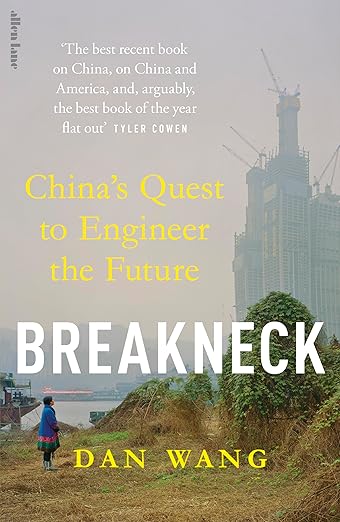


No comments:
Post a Comment