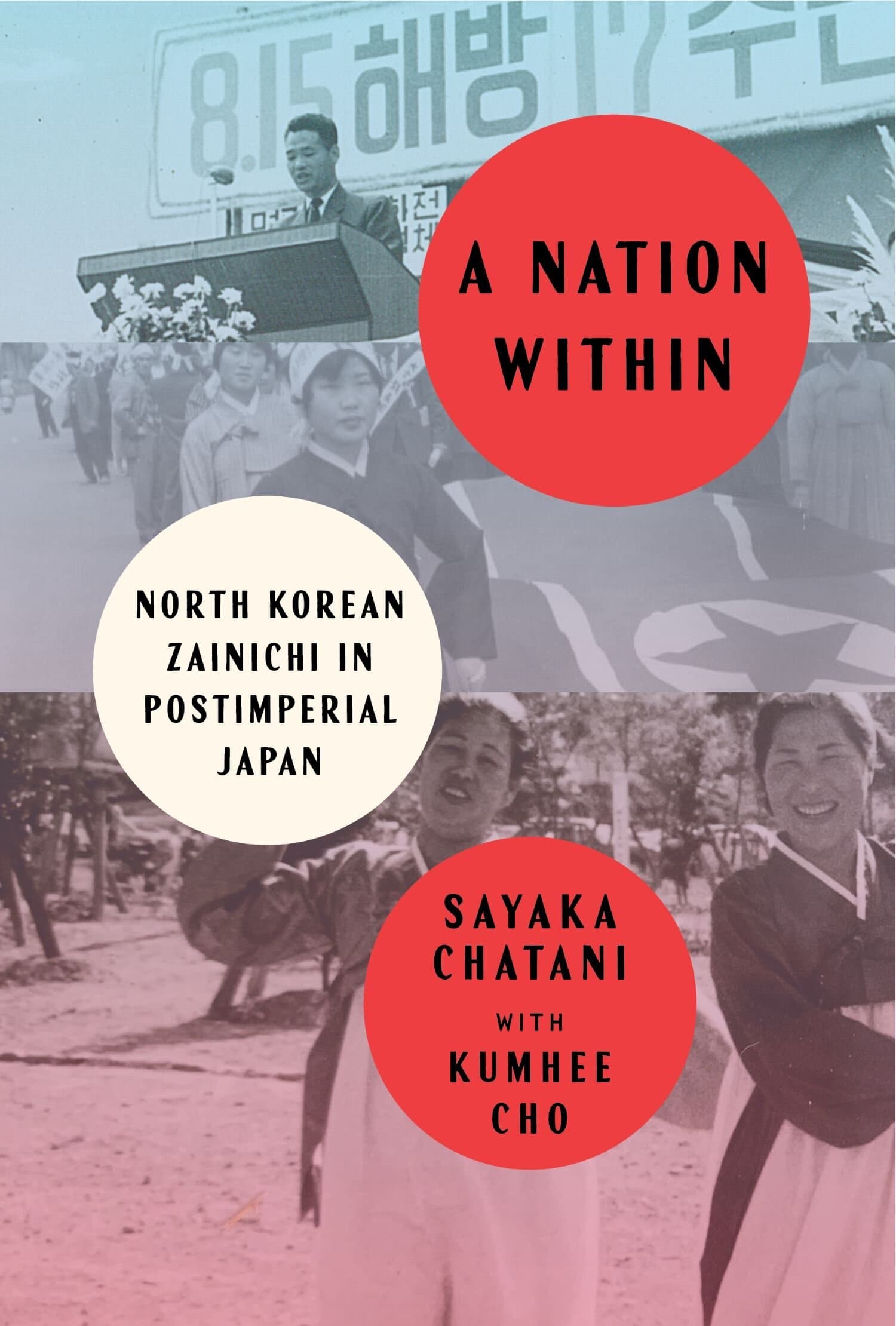
The presence of hundreds of thousands ethnic Koreans in Japan, or "zainichi Koreans," is one of the visible legacies of Japanese colonialism. A surprising and influential group among zainichi Koreans that persists to this day is Chongryon, the only pro–North Korean diasporic group based in a capitalist society. Chongryon historically represented the central grassroots force seeking to liberate Koreans from Japan's imperial and neo-imperial influences. At the heart of the Chongryon community stands a political organization equipped with a central bureaucracy in Tokyo, with a headquarters in nearly every prefecture. Often called a de facto embassy of North Korea, the Chongryon organization has, in effect, functioned as a state within another state—operating hundreds of schools, banks, hospitals, business associations, publishing houses, and many other institutions across Japan.
Based on extensive archival research and nearly 250 original interviews collected with co-researcher KumHee Cho, who was raised within the Chongryon community, Sayaka Chatani offers a sweeping social history of this secretive, protective community in xenophobic Japanese society. Weaving together personal accounts and situating them in a multi-layered, transnational political context, the book offers a finely textured, intimate narrative of the community's tumultuous history and decolonial praxis. Through the stories of Chongryon, this book provides a bottom-up analysis of power politics among zainichi Koreans and reshapes our understanding of Japanese history, Korean history, and the Cold War in Asia.
Sayaka Chatani is Associate Professor of History at the National University of Singapore. She is author of Nation-Empire: Ideology and Rural Youth Mobilization in Japan and Its Colonies (2018).
Introduction
"PEOPLE ROSE UP." KIM TAL-SU began his 1947 autobiographical story, 8.15 igo (After August 15), with this line.1 The "people" were his people, Koreans living in the land of their colonizer, Japan. "They threw away their lives, as if they were a dream. They cast aside their uncompensated, despised, and abused lives, the lives they had tirelessly built from the very bottom up for many months and years. These people created an avalanche toward the homeland, toward the independent Korea."2 Known as a prolific proletarian writer, Kim Tal-su wrote stories with vividness that "exuded an ethnic body odor," as one Japanese critic puts it.3 With a sense of urgency, he depicted Korean lives during these critical years. The empire was crumbling, and new rulers were arriving from the United States. Koreans were supposedly liberated from forty years of colonial subjugation.
The Korean people in Japan were rising up in another way, as the same story captured. They established a powerful mass organization, called the League of Koreans, within just two months after Japan's surrender. The league took on many tasks. It "negotiated hard to get the Japanese government to operate trains" for the Korean exodus. "A lot of mouths, mouths that are open but mumbling, unable to speak their national language yet" had to be taught Korean. The league asserted the status of Koreans as a liberated people and sought to protect them from racist attacks. Working for the organization brought an indescribable joy, as a protagonist in one of Kim Tal-su's 1948 stories summarized in a rhetorical question: "Why did the fact that we were able to openly create an organization of our own people without any interference generate so much excitement?"4
The explosive energy of these Koreans in immediate postwar Japan sprang from their anticolonial impetus, similar to the one that had driven Korean masses into the streets in March 1919. The lives of impoverished Koreans in the Japanese metropole had been harsh and humiliating under imperial hierarchy. After Japan's surrender on August 15, 1945, their material and legal conditions were still severely restricted. About 1.4 million Koreans left Japan quickly, but 600,000 to 800,000 of them still lived throughout Japan. Operating a mass organization that could both influence high-level politics and help people in local circumstances required solidarity and laborious work. As they pursued this effort, Koreans in Japan adopted a narrative of finally achieving—as opposed to receiving as a gift—the independence Koreans had desired since the early years of colonization on through the March First movement of 1919 and the years when many served in the Japanese Imperial Army. Korean activists and writers were convinced that a historic moment was at hand.
This book tells the story of a community of Koreans who were engaged in a major decolonization project within Japan from 1945 to the 1980s. With the postwar Japanese legal environment proving almost as hostile to Koreans as the one before the war and with US dominance in the region trapping them in a distinctive position, a series of Korean mass organizations—the League of Koreans (Chae-Il Chosŏnin ryŏnmaeng) up to 1949; Minjŏn (Chae-Il Chosŏn t'ongil minju chŏnsŏn) between 1951 and 1955; and Chongryon (Chae-Ilbon Chosŏnin ch'ongryŏnhaphoe) since 1955—and the dedicated community around them intensified their anticolonial convictions. This community dominated resident-Korean society at least up to the late 1960s and exercised hegemony for another few decades. Reliable statistics on the number of supporters are unavailable from either the records of the Korean organizations themselves or the Japanese government, but a Japanese officer wrote that 70 to 80 percent of Koreans in Japan supported the League of Koreans in the late 1940s.5 According to the Japanese Public Security Intelligence Agency's estimates, the size of Chongryon membership reached its height in the late 1960s at about 48 percent of all Korean residents in Japan and remained around that level into the early 1980s (see table A.1 and fig. A.2).6 The community, of course, included those who did not officially belong to the organization. In one way or another, all Korean lives in Japan were influenced by this series of organizations.
This Korean community was a child of a global moment. During the late 1940s and 1950s, national independence movements were spreading around the world. Immersed in the tide of the times, these Koreans pledged their commitment to new goals: they would put an end to their status as a second-class minority of Japan, be their own people, speak Korean, raise their children as proud Koreans, liberate their homeland from foreign powers, and return home to a unified Korea. They did not use the word "decolonization," but the goals they set and the actions they took over the next decades suggest that it was nothing other than a decolonization project.
These Koreans—consisting mainly of underclass laborers, small-shop owners, elderly people, mothers, children, youths, and other ordinary individuals with no political clout—operated under a rigid asymmetry of power in occupied Japan. Just like independence fighters demanding a transfer of power from an empire, however, they pursued autonomy and dignity as a liberated people. The choices were limited for a diasporic minority still under the former colonizer's control, but the community did not let the power structure alter its goal of decolonization. Their endeavors paralleled a global trend in the 1940s and 1950s as national leaders and intellectuals of decolonizing societies imagined new forms of citizenship and political solidarity, such as a French-African federation, Eurasia, and the Third World.7 These Koreans in Japan also aspired to internationalism and attempted a coalition with the Japanese Left, but in the aftermath of the Korean War, they gathered firmly around Korean ethnic nationalism and worked to build a unified Korean nation-state in the Korean peninsula.
The Korean activists instinctively understood that liberation from the empire would require a rejection of the colonizer's worldview. Their search for an independent epistemology led them to establish two major orientations, both of which seem peculiar to us today. The first of these was their affinity with the Democratic People's Republic of Korea (DPRK), or North Korea. Immediately after World War II, leftism gained momentum among Koreans and the Japanese alike. Communist parties in Korea and across the world, as well as their own neighborhood activists, enhanced their authority as leading anticolonial fighters. Kim Il Sung made his debut in Korean politics as an energetic anticolonial guerrilla leader, thrilling Korean residents of Japan. Kim Il Sung also eagerly reached out to these Koreans, offering them a much-needed sense of belonging to the homeland. The DPRK also established a socialist and nationalist theory of Korean and world histories, which provided an epistemological anchor to the decolonizing Korean community.
The DPRK's worldview was buttressed by the socioeconomic success that it symbolized. Until the 1970s, the DPRK appeared to many people, not only Koreans, to be running a successful socialist country. In contrast, Syngman Rhee and the US presence in the Republic of Korea (ROK) in the southern half of the peninsula were a nightmare in the eyes of most diasporic Koreans. The ROK was ruled almost continuously by dictatorships up to the late 1980s. Their crackdowns on leftist activism, violence against the people, and friendliness to former colonial collaborators appeared to be the antithesis of decolonization. The tie between North Korea and the Korean community in Japan deepened further after the beginning of the "repatriation program" in December 1959. More than 93,000 resident Koreans, along with their Japanese family members, moved to North Korea in the following years and decades, seeking a better life and hoping to help build a great nation in their homeland.
The other orientation that puzzles outsiders today is Koreans' disengagement from Japanese politics after 1955. Unlike many minority groups in the United States and elsewhere, this group of Koreans did not seek full integration into the host society. Despite the phenotypical similarity between Koreans and Japanese, most of these leftist Koreans did not try to pass as Japanese, although outsiders often could not distinguish them based on their appearances alone. Nor did their organization launch any version of a civil rights movement demanding voting rights and equal opportunities. Rather, they focused on establishing and protecting authentic "Koreanness" and viewed becoming Japanese as a betrayal. In the same vein, they did not claim hybrid identity. They abhorred the idea of becoming a conglomerated "Korean Japanese" people. Only in the past two decades or so has the community become more accepting of the category of zainichi (literally, "residing in Japan," usually referring to resident Koreans with colonial roots)—a label popular since the 1980s that emphasizes the permanence of their residence in Japan and differentiates them from both Koreans living on the Korean peninsula and the Japanese.8
This disengagement from Japanese politics reflects the Koreans' colonial experience. In part, it was a logical course taken to reverse the Japanization policies of the colonial era. Even compared to other assimilationist colonial regimes, such as French Algeria, the Japanese Empire placed a totalizing emphasis on the assimilation of Korea and Koreans.9 Especially during the wartime years (1937–1945), the authorities took harsh measures—banning the Korean language and customs, forcing them to change their names to fit the Japanese registry system, and trying to reprogram them in the image of the ideal Japanese. Kim Si-jong, a writer born on Cheju Island in 1929, often remarked that he had become a complete "imperial boy" who despised Korea and enjoyed Japanese emperor worship.10
Equally strong as the assimilationist drive was Japanese people's prejudice toward Koreans. In the Japanese metropole as well, Koreans suffered daily under the imperial hierarchy and experienced blatant discrimination. The number of Korean migrants to the metropole increased steadily in the 1920s and 1930s. The population of the registered Koreans rose from 40,755 in 1920 to 625,678 by 1935.11 A small proportion of them were students pursuing higher education, intellectuals, entrepreneurs, and highly skilled workers. But the majority came from rural areas in the southernmost provinces, seeking to escape depressed rural economies. Their farming and livelihoods had been severely affected by unusual weather and the loss of their long-held rights of cultivation under colonial policies. These rural, mostly illiterate Korean migrants concentrated in Japanese industrial areas and around coal mines, doing dirty and dangerous work for low wages.12 They were subject to the vagaries of the Japanese labor market, constantly having to move from one city to another and enduring frequent and long periods of unemployment.13 As the number of Korean laborers increased, Japanese city dwellers complained that filthy Korean "ghettos" had formed nearby.14 Japanese racism, fear, and hatred were on full display in the wake of the 1923 Great Kantō Earthquake. Rumors of Koreans looting and burning houses, poisoning wells, raping women, and attacking Japanese spread through the police and newspapers. The Japanese police, military, and mobs lynched and murdered thousands (around 6,000, according to one widely accepted estimate) of Koreans and others mistaken for Koreans.15 The fear and mistrust created by these events remained deep in the hearts of resident Koreans, even as new Korean migrants continued to arrive.
Wartime demands reinforced the Japanese view of Koreans as a disposable labor force. About 1.5 million Koreans arrived in Japan to fill the labor shortage, as either recruits or conscripts.16 By the end of the war, more than 2 million people, or about 10 percent of the total Korean population, were living in Japan. Historian Pak Kyŏng-sik has estimated that 300,000 laborers were forced to live and work in abysmal conditions, about 60,000 of them died, and many of them were carelessly buried under a thin layer of soil at the work site.17 Activists and volunteers are still digging up their remains today.
Japan's total surrender in 1945 ended the explicit policies of Japanization and wartime exploitation. Many of these Koreans embraced a simple desire to undo Japanization and to belong to their own nation-state. The League of Koreans received support from the overwhelming majority, who shared this desire. Their decolonization, however, faced a new set of obstacles. The Korean peninsula was divided, and the United States occupied their hometowns in southern Korea as well as their place of residence in Japan. Japanese state leaders wrapped their persistent racism toward Koreans, now exacerbated by the humiliation of total surrender, in language that US occupation officers would understand: these Koreans were communist threats to the free world.
THREE DIMENSIONS OF "DIASPORANESS"
This book focuses on the community of leftist Koreans in Japan, rather than covering the broader population of resident Koreans. In fact, Koreans remaining in postwar Japan made a variety of decisions. Some sought naturalization. Others opposed communism, rallying around the ROK and another mass organization of resident Koreans called Mindan. Despite Mindan's affiliation with the ROK, many Mindan Koreans—especially among the younger generation who had attended Japanese schools—addressed their Korean heritage as individuals without turning to a collective ideology of the homeland. Their selfhood could be described by adjectives such as ambiguous, fluid, stateless, hybrid, subaltern, cosmopolitan, or transnational.18 In contrast, the Chongryon community stood out by having a more stable identity as "Korean" and a relatively self-contained, multigenerational, "diasporic" community.19 This does not mean that no hybridity or boundary crossing happened or that they maintained the same identity across regions and through generations. But their goal of decolonization led them to create and cherish "diasporaness."
The diasporic nature of the Chongryon community revealed itself in at least three important ways. First, although the community revered the first generation, the organization was largely about the second generation. Unlike their parents, second-generation Koreans in Chongryon, many of whom had been born during or after the war, grew up not knowing life outside the community and took it for granted. The number of members of this generation quickly surpassed that of the first generation. In 1950, 50 percent of registered resident Koreans were born in Japan, rising to 64.5 percent by 1959.20
Some scholars assume that second-generation resident Koreans largely lost interest in Chongryon and pursued their own forms of activism to achieve better integration in Japan.21 On the contrary, for young resident Koreans growing up outside the Chongryon community, Chongryon appeared hegemonic. Granted, as is typical of migrant societies, the generational gap was stark in many families. Unless they had come to Japan at a very young age, the first generation had clear memories of their birthplaces, spoke Korean dialects as their first language, and knew what it meant to live as colonial subjects. In contrast, their children had no knowledge of the Korean homeland or experience of colonial rule. Most of them could not speak Korean well. Many did not speak a word of the language and were unaware of their Korean nationality as small children. They had no strong reason to assert their Korean identity, and yet they had to start submitting their fingerprints at age fourteen—a full set of ten fingers—and they increasingly faced systemic discrimination in school options, employment, housing, credit card application, marriage, medical care, political participation, and retirement.22 These second-generation youths born in the 1940s and 1950s could easily fall into what Pak Kyŏng-sik calls "ethnic nihilism":
Getting sick of being a Korean. Koreans are always despised and cannot find employment. Forget the jobs you like. Even if you work hard, you won't get paid. Children are always bullied in school. . . . Japan prevented zainichi Koreans from having an ethnic subjectivity throughout the prewar and postwar periods. Zainichi Koreans are still considered useless beings in Japanese society today. Some Koreans themselves think that way. Not only the Japanese authorities but the majority of Japanese view Koreans as troublesome people who always do bad things. Hence, [they think Koreans should] go home, or else, naturalize and become Japanese. But even if Koreans become Japanese, they are still discriminated against.23
In the 1960s, many second-generation Korean youths were gripped by fears of facing a social dead end. Some became involved in criminal organizations, and not a few took their own lives. This "ethnic nihilism" was the greatest menace for resident-Korean families. Zainichi magazines that avoided supporting either South Korea or North Korea frequently discussed the "second-generation problem" during the 1960s and 1970s. Scholar Yoon Keun Cha, himself of the postwar second generation, writes, "There was no place where 'zainichi' could live outside of the ethnic organizations. Good or bad, that was the belief of zainichi Koreans in the 1960s."24
Not coincidentally, Chongryon's membership reached its peak around this period. The Chongryon Koreans exuded ethnic confidence, which attracted the youths who were at a loss. According to an estimate by the Japanese Public Security Intelligence Agency, the membership of Chongryon among zainichi Koreans increased from 189,100 to 295,300 between 1961 and 1972 (see table A.1 and fig. A.2).25 The Chongryon community provided an entire world that could transform these youths into "Koreans"—from homes in Korean neighborhoods to friendships in Korean schools, language-training sessions, distinctive historical narratives, working for the ethnic organization, and close interactions with the homeland. This is not to say, however, that the second generation in Chongryon faced no crisis. As we will see, the psychology of the second generation influenced the internal dynamics of Chongryon.
Second, and relatedly, the community manifested the merger of kinship and a political structure. In early kinship studies, as scholar Heonik Kwon explains, kinship was understood as a political concept, indicating a structure that defined basic principles of political and moral life under stateless conditions.26 Since the colonial period, migrant lives had produced such "stateless conditions" and accentuated the political function of kinship among Koreans. Family connections, characterized by ethics of altruism, had provided a lifeline and a social order. After liberation, "ethnic Koreans" as a whole were assumed to be a kinship group both by resident Koreans and by the Japanese government, as evidenced by the way they attached collective responsibility to the category. The League of Koreans and its successor organizations institutionalized kinship relations and centralized the moral order. Korean schools and dormitories played a large role in the continuous reproduction of communal, ethnic, and political kinship. Indeed, the organization became a state-like institution by standing upon and undergirding moral relationships that were densely intertwined throughout the community.
Over the course of the 1960s, as DPRK policies affected Chongryon more directly, state ideologies began to intervene more conspicuously into the nature of their intimate relations. Kwon describes the early Cold War period as a time when forces of nation building and decolonization penetrated kinship relations, producing frictions and contradictions with the ethics of generosity and amity prescribed in kinship relations.27 Resident-Korean families became exactly this sort of locus of politicization. But as the stories in this book show, families and individuals also felt the need for an ideological vision, or they appropriated it for the salvation of the self and family relations as they were thrown into chaos and self-destruction at the same time. Assertions about what constituted essential Korean culture and history, goals of anti-imperialism and decolonization, DPRK socialism, symbols of women heroes, and the personality cult of Kim Il Sung all had a range of implications for family dynamics. The bottom-up perspective adopted here treats these grassroots experiences as the main story.
Finally, the Chongryon community is characterized by its distinctive mental geographies. Diasporas, through their experiences of dislocation and seclusion, often develop a sharp awareness of space and borders. "Home" is a particularly important and multifaceted notion. Scholars find "the double, triple, or multiplacedness of 'home'" in diasporic life.28 I noticed, however, that Chongryon people's spatial understanding was not limited to dots and routes that marked their homes and journeys. They had larger mental maps that encompassed Japan and the two Koreas, if not the entire Asian region, with intricate and intersecting boundaries showing power relations, flash points, and gradations of friends and foes, as well as their most intimate community spaces. These maps are highly political, underpinned by a strong sense of territoriality. I argue that their sense of territory began with the postwar (re)formation of Korean slums and continued in the space of Korean schools (see chapters 2 and 3). A sense of proprietary cultural spaces is common to many migrant societies. But in the case of this community, a uniquely politicized sense of territory and a strong manifestation of defiance were intrinsic to their decolonization project. I attribute much of their emphasis on "ethnic nation" and "ethnicity" (minjok) and their political attachment to the DPRK government to these shared mental maps.
A strong sense of territoriality colored their lives. In many interviews, I learned that although they lived physically alongside Japanese neighbors, took Japanese trains, and did business with Japanese people, the Chongryon Koreans felt a strong sense of not living in Japanese society. This was true even when they were bombarded by flashy images of advanced material culture. In the late 1960s, the Japanese economy entered a high-growth phase. Scenes from the 1964 Tokyo Olympics, the new bullet train, and the 1970 Osaka Expo filled the media. In the midst of this thriving Japan, the Koreans' community space continued to develop separately. When a resident-Korean woman lost her wallet in an unfamiliar town, she looked for a Chongryon office, not a Japanese police station, for help. A Korean man, who was a middle school student in a small rural town in the late 1960s, recalled just one interaction with Japanese youths—when Japanese girls asked him to hand a letter to a handsome Korean friend of his at a train station. Another schoolboy described his Korean neighborhood as "in the state of a closed-off country" (sakoku jōtai).29 This did not mean complete physical seclusion. After all, he and his friend shoplifted from Japanese stores and became embroiled in fights outside their own neighborhood.30 But they did not live in Japanese society. They spread their own mental maps over the Japanese landscape.
The Koreans' community space also extended beyond Japan. People living in Korean neighborhoods felt connected to their hometowns in South Korea because new Korean refugees continued to arrive. Their confrontations with the Japanese police during the Korean War made them realize how coldly detached their Japanese neighbors were from their plight. In contrast, Korean schools created direct connections to North Korea through the educational materials and financial aid sent from the DPRK. The repatriation ferries and visits to North Korea decisively expanded their sense of community space. Through intimate interactions, the community space stretched to include North Korean villages and towns.
The politics of kinship and the politics of space converged to produce a crucial phenomenon in zainichi society. In the late 1960s, the Chongryon organization conducted thought-purification campaigns and intense political mobilization, mirroring the DPRK's factional purges, cult of personality, and aggressive anti-ROK policies of that time. The ROK and Mindan, for their part, escalated anticommunist terror and infiltration. Zainichi Korean society thus became an ideological battleground, with people pulled toward competing homeland allegiances. Both Chongryon and Mindan desperately sought to secure member loyalty while recruiting new adherents. The boundary between these communities meant more than a split of the diasporic society—it effectively recreated the physical national border between North and South Korea. People, goods, and information from both Koreas crossed the ocean into zainichi communities, transforming these spaces into strategic sites for infiltration operations against the opposing Korean regime. This transnational competition profoundly complicated kinship politics, as extended families frequently harbored loyalists from both organizations. In short, zainichi society—and individual zainichi families—became volatile and porous borderlands. Chapter 5 and the book's conclusion will examine the process and the consequence of zainichi and Japan becoming a borderland.
Characterized by the goal of decolonization and their diasporaness, the Chongryon community became one of a kind. Members developed a strong sense of agency—even while caught in the enormous turmoil of the Cold War. The organization exercised cultural hegemony over zainichi Koreans at large by claiming to represent authentic Koreanness. Its rival, Mindan, competed for this claim through its tie with the ROK. But Mindan, despite its legal protection and preferential treatment from the Japanese government, always feared the extent of Chongryon's grassroots strength, acknowledging that "they have an iron will."31 At the same time, Chongryon refused to be understood by or merge with Japanese leftists and sympathizers. As a result, Chongryon produced a space of its own, which remains a large blind spot in our understanding of Japanese society.
THE COMMUNITY TODAY AND OUR INTERVIEWS
The primary goal of this book is to understand the experiences and perspectives of the Chongryon community. Most of its pages reveal an intimate, gendered, dynamic, and multilayered history. This investigation was only possible because of the cooperation of KumHee Cho, who, unlike me, is an insider researcher. KumHee and I met in the graduate program at Columbia University in 2013 and began field research together about five years later. She grew up in the Chongryon community, attended Korean schools, and worked for a Chongryon-affiliated credit union before leaving for the United States to pursue a college education against her father's strong opposition. Her grandfather was a popular Chongryon executive cadre in the western part of Japan, and her father also worked as a high-ranking cadre. She began by arranging interviews with her teachers, the parents of her schoolmates, and family friends, who then introduced us to others in the community. During our visits to many places, from Hokkaidō in the north to Saga in the south, KumHee contacted local Chongryon offices, which introduced us to more members, but we also had our own contacts and sometimes specifically sought out people who had distanced themselves from Chongryon. Although she is a third-generation zainichi, KumHee related extremely well to members of the older generations, perhaps because of her close relationship with her own grandfather. Many interviewees enjoyed talking to her, calling her "very much like a second-generation zainichi Korean."
Altogether, we spoke with more than two hundred individuals and their family members, often repeatedly. Chongryon's political and financial power and its membership size have shrunk significantly, especially after its credit unions collapsed in the 1990s and the North Korean abductions of Japanese civilians were confirmed in 2002. Many in the younger generations have distanced themselves from Chongryon and the DPRK, rendering the community a small minority among zainichi Koreans today. In 2016, the Public Security Intelligence Agency estimated the number of active Chongryon members as "approximately seventy thousand."32 But the organization retains an extensive network and deep roots in many localities. Chongryon-leaning people are the most visible and vocal in various zainichi groups and events. It was not difficult to locate Chongryon community members of the past or the present. KumHee conducted some of the interviews alone, especially during the COVID-19 years, while I interviewed some non-Chongryon zainichi Koreans and academics by myself. KumHee also came to know many former zainichi repatriates who had escaped North Korea, based in Seoul or Japan.33
In most interviews, KumHee took the lead in the conversation while I listened and occasionally asked questions. About 80 percent of our contacts were second-generation Koreans in their seventies and early eighties, with varying degrees of loyalty or hostility to the Chongryon organization. We explained that we were writing a community-centered history of Chongryon, especially its grassroots activities, including its negative aspects, and we asked them to share their life courses. An interview session typically lasted two hours or more. In Japan, about 90 percent of the conversations were held in Japanese with some Korean words thrown in. This language use seems common among second-generation Chongryon Koreans for private conversations, even if no Japanese person is present. Only very occasionally did the interviewees speak entirely in Korean. Many of them generously shared their family photos, a copy of the historical clan record, letters, and other personal archives. We interviewed men and women in roughly equal proportions. All the interviewees appeared to live heterosexual lives, but we did not ask questions about sexuality.
Our timing was fortunate. In April 2018, DPRK leader Kim Jong Un and ROK President Moon Jae In met in the demilitarized zone. In June 2018, Kim Jong Un and Donald Trump held a summit in Singapore. KumHee and I began our interviews in the summer of 2018, when the resulting excitement of the Chongryon community was at its peak. An elderly couple welcomed us at an entrance hall that was decorated with pictures of Trump and Kim Jong Un shaking hands. I received a warm welcome 99 percent of the time. Some were surprised and excited that a Japanese woman would be interested in zainichi Koreans, and others asked if I was sure I was not of Korean descent after observing my interactions with KumHee and my demeanor, which apparently did not seem to resemble that of a typical Japanese woman.
Still, nearly all Chongryon Koreans we met displayed a certain degree of skepticism, not necessarily about us as interviewers but about their ability to communicate their stories to outsiders. They were not secretive about their Korean heritage, of course. Many hang a North Korean painting of Mount Paektu at the entrance to their homes, display photos of themselves in colorful Korean dresses, and share kimchi and Korean dishes with their Japanese neighbors. But they rarely discuss internal issues of Chongryon or even Japanese politics with their Japanese friends.
Renewed Japanese hostility toward zainichi over the past two decades may have contributed to their general mistrust of communication, although, as we will see, the social walls between Chongryon Koreans and Japanese have been in place for a long time. Even as South Korea's impressive economic growth and Japanese enthusiasm for K-pop and other cultural exports significantly improved the image of South Korea in Japan, Japanese criticisms of North Korea increased in number and intensity. Since the 1990s, the Japanese publishing industry has produced a flood of sensational anti–North Korean books, with exposés of Chongryon scandals written by former members becoming a popular genre in the mass media.34 During the past decade, vicious hate speech has become widespread on social media platforms, and populist politicians have been quick to exploit Japanese fear of North Korea to justify further forms of legal discrimination against the zainichi population. Repeated media attacks on North Korea and Chongryon; physical harms inflicted on Korean school students, Koreans' historical memorials, and even Mindan offices; and subtle but persistent policies of discrimination against Korean schools and businesses have all naturally reduced Chongryon members' expectations of fair communication with Japanese society. At the same time, Chongryon Koreans have become more accustomed to receiving help from outside supporters. A 2007 South Korean documentary about a Chongryon school, Uri hakkyo (Our school), sparked a wave of interest among South Koreans.35 Groups of Japanese neighbors and supporters also cooperate with Chongryon activists to protect their remaining schools and raise funds for their operation. The network of school supporters is spreading in Japan, South Korea, the United States, Europe, and Australia.36
Once we began the interviews, I learned a few things very quickly. The first was the definition of "generations," which was not as simple as I had assumed. Resident-Korean families tended to marry early and have a large number of children. Having seven or eight children over the course of twenty years was not considered unusual in the 1950s and 1960s. As a result, generations do not necessarily indicate age difference or chronological age order—an "uncle" is not always older than his "niece," for example. Extended families tended to have close interactions, but family composition could be very complicated and required close attention.
Among the second and third generations, the term "the first generation" evokes a special affect. Beyond the symbol of suffering it represented, we could sense that the first generation indeed carried the weight of their history. We were much more likely to encounter a wall of silence with first-generation (or very early second-generation) Koreans, especially women. KumHee recalls that first-generation elders often used the phrase "I must take this [memory] to the grave." "This memory" seemed to refer to the complexity of conflicts and politics that could harm the very cause for which they fought. In their caution and skepticism toward others, we perceived the firm determination required to build and maintain this community. This may explain why many Chongryon members harshly criticize those who seem to "sell" information about the community for Japanese mass consumption, such as exposé writers and documentary filmmakers, especially when they paint a one-sided picture and thus endanger the community's safety.
The way in which KumHee introduced herself to each new interviewee reflected Chongryon kinship relations. Regardless of generation, age, location, or gender, they asked KumHee many questions to locate her on their social maps. In return, KumHee provided a considerable amount of information: who her father and mother were, where they and she grew up, which zodiac years they and she were born in, which schools they and she went to, her siblings, and more. From there, the interviewees and KumHee narrowed in on overlapping points. It was astonishing that they never failed to find at least one connection, usually several: "My sister-in-law taught in your school, and you must know her"; "I remember your grandfather giving a speech at my school, and I met your sister on a study trip"; and, in one case, "I taught your father; I remember his naughtiness clearly."
As we expanded the scope of the interviews, we realized that we were relying most frequently on the network of Chongryon women. Women's Union staff were particularly closely connected across Japan. Within their families, women often maintained intergenerational ties. Many daughters and daughters-in-law listened to their aging parents, becoming familiar with the early history of the community activities. During our interviews, the interviewees' daughters, daughters-in-law, or Women's Union staff tactfully bridged our communication gaps and provided background information. The fact that both KumHee and I were women enabled us to seek their cooperation, stay in touch, and ask casually about everyday experiences and gender dynamics. Insights gained from these conversations provided the core of chapter 4.
Within the community, people shared a moral system, norms, and a social hierarchy that made people quite sensitive to family reputations. For instance, in Osaka and Hyōgo, most people in their seventies or older knew who Madame Elisé was—a legendary businesswoman in the region—even though she was not a known figure in Japanese society. Our interviewees often mentioned how "popular" or "famous" someone was, but that fame was usually limited to the community. Matchmakers paid great attention to family status as defined by their original clans, occupations, and positions and reputations within the organization. The community shared internal jokes. I was surprised that they could joke about North Korea's political problems, even referring to its prison camps with dark humor.
I have reconstructed a history of the Chongryon community based on the testimonies of these people as well as a variety of memoirs, printed records, and secondary sources. Of course, memories are fluid, and our presence as interviewers doubtless influenced their recalling and retelling. Some people were much more accustomed to narrating their lives than others, and their crafting (or lack of crafting) of the narrative became another useful source of information. My work of interpretation was also fluid. After conducting interviews, we continuously found new information related to the interviewees through the community network. The interviews thus required constant recontextualization. Some interviewees were inspired by KumHee's international experience, and others became curious regarding my public engagement in fighting comfort women denialism. Most notably, I sensed that our interviews made the informants realize that the community was turning into a history, something that would be forgotten unless it was recorded now. Some local Chongryon staff arrived at that realization when they accompanied us for interviews, becoming motivated to collect more stories on their own. In short, KumHee and I, many interviewees, and many other people who helped us changed through interacting with one another. The research was thus a multivalent, evolutionary process rather than scientific data collection.
Although I learned as much as I could from insiders, and however much I got to know them, this book is ultimately an outsider's analysis. KumHee and I often exchanged views, and KumHee generously offered the best sounding board with which to test my interpretations, but I accept sole responsibility for synthesizing and contrasting information and constructing arguments. Against my repeated suggestions that we write a book together, KumHee explained that she was too close to the community and to her family memories and that she felt too vulnerable to commit to a coherent analytical voice. To be clear, this is not an exposé. My priority is to protect the safety of our interviewees (including KumHee) against internal or external criticisms. The book presents individual accounts as if they were separate samples, but in reality, they are well connected. I divided each person's life course into separate parts where that was necessary in order to maintain their anonymity. I use pseudonyms unless the interviewees wanted me to use their real names or unless I refer to their publications. Quotation marks and block quotes relay their words directly, and italics indicate my paraphrase of them. I mostly refer to these long-term Korean residents and their descendants in Japan as "resident Koreans" to stay close to the original meaning of the phrase zainichi Chōsenjin, but I sometimes use the word zainichi for the sake of readability. No political meaning is intended by the alternation between these two expressions.37
Engaging with the history of this community was a journey of self-scrutiny. It caused me to reflect constantly on my abhorrence of nationalisms. I first left Japan for New York and became an academic in order to analyze and resist nationalism. Even if I could explain why people embrace nationalism, I did not know how to engage with it sympathetically, just as scholarship more broadly condemns nationalisms and looks for ambiguity, hybridity, fluidity, dilemmas, identity crises, and resistance to the state. Japanese readers' fascination with zainichi literature, I believe, consumes exactly these aspects. Any hint of the Chongryon color quickly turns off outside readers, who reduce such work to "propaganda poems" and consider them "not worth studying" despite the deep dilemmas and quagmires experienced by Chongryon writers.38 I began to suspect that our preference for stories of zainichi's identity crises rather than accounts of identity affirmation reflects a subconscious desire to view them as a precarious and thus fascinating minority, in accordance with academic trends, or as something that soothes the pain of our own ignorance: we should not feel guilty for not understanding them because they themselves are not sure of who they are. Throughout this research, the exuberant sense of pride shared among the Chongryon community destroyed this buried prejudice of mine. I began to find new messages and signals in their expressions of nationalism. I will return to this point in chapter 8.
A POSTIMPERIAL JAPAN
I had contradictory desires in writing this book. On one hand, I hoped to situate zainichi stories in a global history, available for comparisons. Toward this goal, I used academic concepts generated from other cases. On the other hand, I desired to avoid using the Chongryon history as a lens through which to demonstrate a theoretical point. I am not only an outsider but also a descendant of the former colonizing nation and a member of the current oppressor society that discriminates against them. I am also writing this book in English—a completely foreign language for the community and a neoimperial mode of communication. Operating in these layers of power, I tried my best to place Chongryon experiences at the center of the work, but the book embodies the tension inherent in a project that values both intimacy and generalizability. In the end, I resisted most suggestions by others and my own inclinations to develop the research into a theory-building contribution to the study of diaspora and borders, ethnic identities, decolonization, or the Cold War. I hope, however, that this book offers the necessary foundation for such projects.
I made one critical exception. At the end of the book, I use the Chongryon history as a lens and propose ways in which we can reconceive postwar Japan as postimperial Japan. A postimperial history investigates how new forms of imperial domination characterize the social and legal system of Japan today. It requires a sharp focus on the legal foundation, including the principle stated in the constitution, that deliberately excluded "foreigners" from legal protection. This legal assumption penetrated both government surveillance systems and diplomatic goals.
This is not a simple story of top-down domination, however. The postimperial structure developed through intertwining forces, a major part of which was Chongryon's decision to separate itself from Japanese politics. I am aware that this is a bold hypothesis, but I propose that Chongryon became a critical enabler of the long-term one-party dominance of the conservative Liberal Democratic Party in Japanese politics, widely known as the "1955 system." Examining such a hypothesis will awaken us from methodological parochialism and link Japanese politics more closely with peninsular and regional Cold War tensions, which are often overshadowed by the usual emphasis on the Japan-US relationship.
Perspectives gained from a history of the Chongryon community productively destabilize what we take for granted about postwar Japan. A postimperial history does not show much democratic transaction between the government and the people. The society was neither safe nor peaceful. The police were far from friendly. These facts reflect that the Japanese government had difficulty maintaining sovereign control over its territory. Zainichi society, where Korean national spaces overlapped and national borders kept shifting, constituted an important reality for Japan and the Japanese. These spaces and boundaries were not mere imaginations of resident Koreans or forces that mattered only to them. Japan's function as a borderland of the two Koreas produced grave consequences, possibly relating to the assassination attempt of Park Chung Hee by a second-generation zainichi man and the DPRK abductions of Japanese civilians in the 1970s and 1980s. My proposal adds a new dimension to the growing set of Korean-and Japanese-language works in cultural studies that critically examine "postwar" Japan.39 The lens of zainichi Koreans, along with that of Okinawans and the Ainu, has played a major role already. But my proposal suggests that zainichi histories can more specifically highlight Japan's legal and political structure and teases out the complex role that resident Koreans themselves played in reproducing this structure.
THE PLAN OF THE BOOK
The chapters are organized according to components of the community and do not follow a strict chronological order. Chapter 1 presents an overview of institutional changes from the League of Koreans through Minjŏn to Chongryon from 1945 to the mid-1960s. It addresses the rapidly changing political situations of Japan, the Koreas, and the world as well as the shifting political goals of leftist Koreans. It pays particular attention to how the mental geographies of these Koreans were shaped in relation to the Japanese Left.
Bottom-up social histories of the community follow in the subsequent chapters. Chapter 2 examines the emergence of a sense of territoriality in Korean slums (tongne). After August 1945, the exodus of Koreans from Japan to their Korean hometowns as well as their relocations within Japan assigned new functions to Korean slums. Frequent clashes with the police and autonomous life within the Korean neighborhoods heightened a sense of territoriality. The idea of ownership of physical space continued in the Korean schools that people built in or near the Korean neighborhoods.
Chapter 3 explores the internal dynamics of the Korean schools (hakkyo). In the 1960s and 1970s, schools formed a cultural bubble that protected Korean children from outside prejudice and discrimination but also created community edges that were violent and inaccessible. The stronger and more coherent the community grew inside the cultural bubble, the larger a quagmire many non-Chongryon Koreans fell into. Today, Korean schools often appear in Japanese (and sometimes international) news as either sacred ethnic havens or dangerous North Korean outposts. Their history, in contrast, offers a microcosm of the power and dark shadow of leftist Koreans' efforts to build a community sphere.
Chapter 4 recounts how women members and cadres produced community stability to counter the precarious realities of Korean lives. Navigating socialist feminism and Korean patriarchal norms, the Women's Union (Nyŏmaeng) of Chongryon elevated the value of women's work and opened up new educational and career avenues for women. At the grassroots level, women cadres fulfilled the role of cultural arbiter, making judgments on conflicting values and customs. The chapter also shows how kinship relations were reshaped by ideological messages. At the microlevel, widespread assumptions about the mother-child emotional bond in the 1960s influenced young women's relations with their mothers, often generating an unbridgeable gap. Chongryon intervened in this gap, producing both tighter bonds and seeds of defiance.
Chapter 5 analyzes Chongryon's heyday in the 1960s with a focus on the roles of men cadres (ilkun). As dedicated community activists, men cadres became more directly tied to the DPRK government during this decade. Reflecting the heightened political tensions in the Korean peninsula, the organization underwent a period of radicalization—a version of a cultural revolution—in the late 1960s and early 1970s. The severe thought control, filled with individual and mutual criticisms, tends to be the focus of later exposés of Chongryon. But this radicalization reflected larger Cold War tensions and a generational turnover in diasporic politics. Stories of those mobilized reveal how zainichi society became a porous borderland where state borders were projected onto resident Koreans. As information, goods, and people from South Korea, North Korea, and Japan crossed the borders through zainichi society, Japan as a space was virtually turned into a volatile borderland between the two Koreas.
Chapter 6 discusses the experiences of some Japanese women who married into leftist Korean families (Ilbon ŏmŏni, or "Japanese mothers"). This focus may seem unusual at first, but it reveals the contradictions and confluences between Chongryon's decolonization and postwar Japan's national reconstruction. These Japanese women had diverse backgrounds before stepping into the Chongryon social circle. Some of them sought to atone for Japan's imperial sins through their dedication to the community, while others, without much political conviction, found a home in the community's network of mutual support. By largely submitting to Korean patriarchy and Chongryon's aversion to "Japaneseness," many of these women protected the "Koreanness" of the community and resolved the contradictions between the reality of ethnic hybridity and the idea of ethnic purity.
Chapter 7 traces the meanings of the repatriation program to North Korea for the Chongryon community. Although most scholarship views this program as a catastrophe, the relocation of their families and friends to North Korea ushered in an important new phase for the community. In the late 1970s, temporary visits to North Korea became possible, and Chongryon businesspeople began to earnestly make investments in the homeland. Through repatriated families, frequent visits, and business relations, Chongryon members extended their community space to include North Korean society, where they developed nuanced and complex views of the realities of the homeland.
Chapter 8 very briefly summarizes the major crises that have hit the organization and the community in more recent decades. They include Chongryon credit unions' bankruptcies and the broached news of the DPRK abductions of Japanese citizens, which have influenced the present public image of Chongryon in Japan. A new crisis is ongoing since the 2024 DPRK denunciation of the goal of Korean reunification.
Many important aspects of and groups within Chongryon have been omitted from this book, including the Youth Union, the Business Owners' Association, professional soccer and rugby teams, the newspaper Chosŏn sinbo, professional stage performers, the work conducted by Chongryon doctors for the zainichi population and for North Korean medical personnel, and the organization's human rights committee, among others.
The book ends by suggesting new research directions regarding postimperial Japan. I believe that gaining knowledge of Chongryon's experiences not only helps us understand its influences on more recent zainichi activism or immigration policies. It also forces us to reexamine the dominant narratives of both "postwar" as a temporal frame and "Japan" as a national space and to unlearn and relearn the politics of East Asia. Although it is a rough form of proposal, I present a new narrative thread that brings the Chongryon history back into Japanese society—and the Korean peninsula back into Japanese history—in the hope of inspiring further critical historical research on zainichi Koreans and postimperial Japan.
Notes
1. Sakasai and Palmer 2023, 9. Unless otherwise noted, all translations are my own.
2. Kim Tal-su (1947) 1980, 144.
3. Nozaki 2008, 116–17.
4. Kim Tal-su (1948) 1980, 144, 159, 165.
5. Tsuboi 1977, 728.
6. Kōan chōsa-chō 1981, 6.
7. Cooper 2014; Burbank and Cooper 2023; Prashad 2007.
8. Scholars have argued that later generations have used the word zainichi to indicate their opposition to the earlier generations' attachment to the homeland around the 1970s; see, e.g., Wender 2000, 77–79; Chapman 2008, 4–6, 44–50.
9. Chatani 2018.
10. Kim Si-jong 2015, 37, e.g.
11. Morita Yoshio 1996, 33.
12. M. Weiner 1994, 126. On Korean residents in prewar and wartime Japan, see also Tonomura 2004.
13. Kawashima 2009.
14. M. Weiner 1994, 94–153.
15. Ishiguro 1998.
16. Morita Yoshio 1996, 74–75.
17. Pak Kyŏng-sik 1992, 194. On the issue of "forced" and "volunteer" laborers, see Morris-Suzuki 2010, 37–41.
18. For these categories of zainichi, see Lie 2008; Chapman 2008.
19. Brubaker 2005; Akao and Hayao 2009. I am aware that the term is contested in Sinophone studies, such as by Shih 2010; Chan 2015.
20. Morita Yoshio 1996, 126.
21. E.g., E. Chung 2010.
22. Fingerprinting became a requirement in 1955. The age of fingerprinting changed from fourteen to sixteen in 1982. The requirement was abolished for permanent residents in 1993 and for all foreigners in 1999 but was reinstated in 2007 for non-permanent-resident foreigners.
23. Pak Kyŏng-sik 1989b, 24–25; also see Fukuoka 2000 on the issues and identities of the second generation onward.
24. Yoon 2015a, 5.
25. Kōan chōsa-chō 1981, 6. Mindan, which had not enjoyed the same popularity as Chongryon, also expanded its membership during this period from 64,700 in 1961 to 200,100 in 1971. The normalization treaty signed in 1965 between the ROK and Japan triggered the expansion of Mindan membership most directly; see chapter 1.
26. H. Kwon 2020, 10–20.
27. H. Kwon 2020, 18.
28. Brah 1996, 191.
29. Sakoku refers to the policy of avoiding foreign influence by the Tokugawa shogunate in early modern Japan.
30. Pak T'ae-sik 2012, 31–32.
31. Hwang Ch'il-bok 2018.
32. "Chōsen sōren wa yaku 7 man nin, Jimin kaigō de kōhyō Kōan chōsa-chō," Tere-Asa nyūsu, February 17, 2016, https://news.tv-asahi.co.jp/news_politics/articles/000068557.html.
33. We are aware that some escapees from North Korea are known to make things up and dramatize their stories to make money or become celebrities. We did not interview anyone who requested money. As a gesture of gratitude, we offered about fifty United States dollars to the few interviewees who were minimum-wage workers or were hospitalized.
34. Wada and Takasaki 2003.
35. Kim Myeong-joon 2007.
36. See the International Network in Solidarity with Korean Schools, n.d.
37. In the very early postwar period, zainichi Chōsenjin referred to all Koreans remaining in Japan, but as some took ROK nationality, many writers now use zainichi Kankoku Chōsenjin or zainichi Korian or just zainichi to refer to the entirety of these Korean people and their descendants.
38. Nozaki 2008, 98, 272; Song Hyewon 2023. An art historian, Pek Rum also makes a similar point: "As soon as the artwork contains a little bit of political message, the viewers tend to lose the ability to assess it." Pek 2021, 120.
39. For scholarship that questions common narratives of postwar Japan, see, e.g., H. T. Kwon and Cha 2017; Ko Youngran 2010; Nakano 2024; Yoon 1997; Choi Seungkoo 2020; Koga 2016; Nishikawa, Ōno, and Banshō 2014.
 Excerpts + more
No comments:
Post a Comment