From other countries
Amarpreet
5.0 out of 5 stars Important testimonies
Reviewed in the United States on 29 January 2026
Format: KindleVerified Purchase
What surprised me most was how certain testimonies were elevated, how translations were treated as authoritative even when they weren’t, and how contradictions quietly disappeared once a narrative hardened. The way the author reconstructs timelines and shows how media, NGOs, and academia reinforced each other feels less like commentary and more like an audit.
I also found the geopolitical angle interesting, especially the argument that the comfort women issue became strategically useful to North Korea regardless of who initially drove it. The book connects this to Pyongyang’s long-standing interest in anti-Japan messaging and shows how certain narratives aligned almost too neatly with that agenda, even without direct coordination. That framing was new to me and changed how I think about the issue.
Definitely worth it!
Report
DeepThinkingReader
5.0 out of 5 stars A new dimension to the comfort women issue by scholars who took the ultimate risk
Reviewed in the United States on 5 February 2024
Format: HardcoverVerified Purchase
This groundbreaking work adds an entirely new dimension to the controversial comfort women issue, the military brothel system by the Imperial Japanese military.
In addition to going over the history of the comfort women controversy since the early 1990s as well as sharing their academic persecution by taking an unpopular stance on the issue, professors Ramseyer and Morgan meticulously expose the deep multinational network involving Communist North Korea (which no doubt is tied to CCP China) working with allies in South Korea to disrupt the U.S.-Japan-S. Korean alliance that is vital to peace and stability in the Far East.
Readers will realize that regardless of how emotionally attached they may be to the issue, there was always a latent geopolitical agenda behind what has become a decadeslong women's rights movement depicting Imperial Japan for never sufficiently repenting, let alone paying for her past crimes. Ultimately, one can say that the real victim of this ongoing propaganda against Japan is South Korea - there's simply nothing the country can benefit from this, unless she has chosen to strategically join the Communist regimes in the north.
But what's quite shocking is how the systematic abuse and professional ostracism both Ramseyer and Morgan have suffered at the hands of Western humanities eggheads professing to be experts on Japan Studies. The book details their ordeal in length, illustrating the extent of today's English-speaking academia becoming an intolerant agenda-driven, narrative-driven cult that has done away with superior scholarship by way of critical thinking and solid research. What's simply amazing is that many in Japan Studies do not seem to value academic work in the Japanese language. Why, especially when the vast amount of literature on a topic is found in that language? This can only be explained as a bizarre form of elitism that evidently pervades that clannish community.
Report
Aspire Technology Systems
5.0 out of 5 stars The Most Dangerous Book Is Often the Most Honest
Reviewed in the United States on 1 December 2025
Format: KindleVerified Purchase
I’ve followed the Comfort Women controversy for years, and honestly, I was expecting a lot of hyperbole. Instead, what I got was meticulous sourcing and a level of detail that makes denial genuinely impossible. This book, The Comfort Women Hoax, systematically peels away layers of myth and propaganda until all you have left is the original documents. It's a deeply uncomfortable read, sure, but that’s exactly what honest, unvarnished history should feel like. If you want the facts, this is where you'll find them.
Report
Nadia Hassan
5.0 out of 5 stars Unsettling but such an important read
Reviewed in the United States on 3 November 2025
Format: KindleVerified Purchase
I found “The Comfort Women Hoax: A Fake Memoir, Northern Spies, and Hit Squads in the Academic Swamp” to be a bracing and uncompromising investigation into one of the most contentious topics in modern East Asian studies. Ramseyer and Morgan’s painstaking archival research, combined with their willingness to challenge entrenched narratives and shine a harsh light on the political machinations within academia, make this book an unsettling but important read. The authors’ call for integrity, intellectual honesty, and courage in the scholarly pursuit of truth resonated deeply. This is a work for those who value rigorous debate and aren’t deterred by controversy.
Report
Novatech Innovations
5.0 out of 5 stars Unsettling but such an important read
Reviewed in the United States on 22 September 2025
Format: KindleVerified Purchase
I found “The Comfort Women Hoax: A Fake Memoir, Northern Spies, and Hit Squads in the Academic Swamp” to be a bracing and uncompromising investigation into one of the most contentious topics in modern East Asian studies. Ramseyer and Morgan’s painstaking archival research, combined with their willingness to challenge entrenched narratives and shine a harsh light on the political machinations within academia, make this book an unsettling but important read. The authors’ call for integrity, intellectual honesty, and courage in the scholarly pursuit of truth resonated deeply. This is a work for those who value rigorous debate and aren’t deterred by controversy.
Report
Khalid Nadeem
5.0 out of 5 stars A thought-provoking book
Reviewed in the United States on 24 June 2025
Format: KindleVerified Purchase
This book offers a much-needed challenge to a heavily politicized narrative. Ramseyer and Morgan present an alternative perspective grounded in legal analysis and raise important questions about academic freedom and censorship. Whether one agrees or not, The Comfort Women Hoax encourages critical thinking and invites readers to question widely accepted historical claims. A thought-provoking and timely contribution.
Report
A Movie Lover
5.0 out of 5 stars An amazing expose of "Cancel Culture" at work in academia
Reviewed in the United States on 3 March 2024
Format: HardcoverVerified Purchase
The authors describe what happened to them in today's academic world in which certain thoughts and beliefs which run counter to the leftist narrative are punished by both mob action through social media as well as by the failure of the very institutions which are supposed to support truth and intellectual diversity. The motto of Harvard is "Veritas" - Truth - but Harvard's reality is far different from the ideal. Anyone concerned about the leftish takeover of academia and the extremes to which wokism will go to extend its power should read this book.
Report
The Comfort Women Hoax: A Fake Memoir, North Korean Spies, and Hit Squads in the Academic Swamp
J. Mark Ramseyer
,
Jason M. Morgan
3.50
14 ratings9 reviews
During World War II, the Japanese military extended Japan’s civilian licensing regime for domestic brothels to those next to its overseas bases. It did so for a simple to impose the strenuous health standards necessary to control the venereal disease that had debilitated its troops in earlier wars. In turn, these brothels (dubbed "comfort stations") recruited prostitutes through variations on the standard indenture contracts used by licensed brothels in both Korea and Japan.
The party line in Western academia, though, is that these “comfort women” were dragooned into sex slavery at bayonet point by Japanese infantry. But, as the authors of this book show, that narrative originated as a hoax perpetrated by a Japanese communist writer in the 1980s. It was then spread by a South Korean organization with close ties to the Communist North.
Ramseyer and Morgan discuss how these women really came to be in Japanese military comfort stations. Some took the jobs because they were tricked by fraudulent recruiters. Some were under pressure from abusive parents. But the rest of the women seem to have been driven by the same motivation as most prostitutes throughout want of money. Indeed, the notion that these “comfort women” became prostitutes by any other means has no basis in documentary history. Serious intellectuals of all political perspectives in both South Korea and Japan have understood this for years.
Ramseyer and Morgan’s findings caused a firestorm in Japanese Studies academia. For explaining that the women became prostitutes of their own volition, both authors of this book found themselves “cancelled.” In this book, the authors detail both the history of the comfort women and their own persecution by academic peers. Only in the West—and only through brutal stratagems of censorship and ostracism—has the myth of bayonet-point conscription survived.
==
388 pages, Hardcover
Published January 23, 2024
==
Rate this book
Write a Review
Friends & Following
No one you know has read this book. Recommend it to a friend!
Community Reviews
3.50
Displaying 1 - 9 of 9 reviews
Profile Image for Quratulain.
Quratulain
742 reviews
11 followers
Follow
May 28, 2026
“The comfort women were prostitutes who worked at the brothels near Japanese military bases during the Greater East Asian War.”
1931-1945
1983 an obscure Japanese communist published a fake memoir about comfort women . In 1991 several Korean women claiming to be comfort women filed lawsuits against Japan.
Japanese formally apologized in Kono Statement of 1993.
2014 Asahi newspaper finally acknowledged the comfort women hoax and retracted all Yoshida-based articles.
We are learning more about the people in our lives than we wanted to know, but Mephistopheles insisted on showing us still more. We would have preferred never to see what he showed us. Desperately we did not want to know this.
Some of the best lack all conviction while the worst are full of passionate intensity.”
Hanlon’s razor: never attribute to malice that which is explicable through stupidity or incompetence .”
Anti-Catholicism remains one of the last acceptable prejudices in some circles…Prejudice against conservative Protestants runs a close second.
We confess to being old-fashioned enough to find the junkyard prose off-putting.”
There is a long history of violence against scholars whose research relates to the comfort women topic.
It was Lee’s pride, her hatred of Japan, and her pride about her hatred that did her in.”
When Suk-Gersen contacted the people involved in the campaign to cancel me, she was apparently unable to see that they were dissembling.
Second-generation immigrants in the US don’t have a clue what’s going on in their parents home country. But they are incredibly patriotic about that home country.
Defend their right to hold unpopular opinions— and assassinate their character.”
These efforts by scholars in Asian Studies to block the dissemination of any material that contradicts the party line can turn nearly comical.”
Like so many of the American scholars involved, it did not want to study history. It wanted to pronounce morality.
Something about the way history had been presented to me in my American years did not add up. Retrograde forces were in command of the present, and had not been confined in the dark corners of the past, a past that liberal democracy claimed to have overcome.
First of all, very few students read the assigned books.
In principle, my professors work in theory. In practice, they used whatever theory they needed to ferry them over the gaps in what they knew. They created narratives and then spent their careers protecting that narrative.”
One of the main causes of this complicated exercise in applied ignorance is a refusal to read books in Japanese, or in any other language besides English.”
Yamatai-Koku
The Americans had conducted interrogations of captured comfort women during WWII. These interrogations confirmed that the comfort women were prostitutes.”
Wealthy Korean alumni and their money were in the heads of those in the History Department who were making decisions related to Asia.
I grew increasingly convinced that the American narrative was not just wrong. It was deliberately wrong.
Overton window of social plausibility. An offer made plausible by the crushing poverty of the people to whom it was made.”
The comfort women chose what they thought—whether rightly or wrongly— was their least bad option.
Kings shilling
We think that respecting people means honoring their agency, their ability to think and act for themselves and to navigate deep uncertainty with only their wits and their guts to guide them.
If comfort women were slaves, then so is every soldier. So is everyone who is not financially independent and must work for a living. Constraints shape human life. But the human will works both within and against those constraints.”
Almost uniformly, the comfort women in the Korean Council’s anthology claimed to have been defrauded.
1995 Compensation: The Korean Council urges the comfort women to refuse the compensation and attacked those who accepted the money.”
The Japanese government did not draft either Japanese or Korean civilians into factory work until the fall of 1944.
The testimonies of the North Korean-based comfort women have been overwhelmingly the most bizarre— and it is precisely those testimonies in which Western observers have relied.”
1998: Second UN Report McDougall
Judges do not decide questions that the parties do not contest. Whether the military forcibly conscripted women into the comfort stations was not at issue in the Shimonoseki case.”
The plurality of comfort women were Japanese.”
She would later assert that questioning the Yoshida-school assumptions about the comfort women is a form of hate-speech as it is defined in some countries and even compatible to what in Germany would bring criminal charges of Holocaust denial.”
Only two types of evidence back the claim that the Japanese military dragooned Korean comfort women by force: the account of several comfort women-none produced corroborating witnesses or documentary evidence— and Yoshida’s 1983 book.
On the Korean Peninsula, advance loan/human purchase and recruiter fraud was common. There is testimony and court material indicating that forcible impressment by government officials occurred in occupied territories like China and Southeast Asia.”
Christine Fang was later outed as a Chinese operative who had been running an extensive influence and espionage campaign targeting Democratic politicians in the US.
Russell Lowe: PRC spy who for 20 years ran espionage operations against his employer Diane Feinstein as a staff liaison to the Asian-American community.”
Mike Honda’s resolution was anti-Japanese in a way that tracked the Chinese and North Korean sympathies of the South Korean organization masterminding the comfort women campaign.”
With Yoshida’s memoir exposed as a fraud, the oral testimonials of several comfort women constitute virtually the only evidence that the Japanese army ever dragooned Korean women.”
C. Sarah Soh found no mention of comfort women before 1964. The beginning of public discourse in Korea on comfort women was 1970.
1981: first Korean-authored volume devoted to topic of Korean comfort women.”
Prior to 1980, the Korean newspapers included virtually no mention of the comfort women who had worked next to Japanese bases.”
Comfort women massacre story traced back to Arafune Seijuro a conservative Japanese politician. He invented the story out of whole cloth.”
Losers in wars don’t keep souvenirs. They try to get home alive.”
George Hicks, the man who could not read Japanese but through a translator spread the Yoshida story across the English-speaking world and into the 1996 UN report.”
North Korea claims there were 200,000 women. There were likely 20,000.
The comfort women only started to claim that they were dragooned after the Korean translation of Yoshida’s memoir.
Several of the most vocal of the comfort women have changed their stories, and of them Lee Yong-soo is the most notorious.”
Hwang Uiwon CEO of Media Watch first reported the rampant fraud of Lee and the Korean Council.”
Korean Council is allied with North Korea.
The comfort women dispute in South Korea is a story about brutal censorship.”
Korean Council lies at the center of the continuing controversy over the comfort women. It is the Korean Council that controls the comfort women who speak, launches criminal complaints against scholars who question the dragooning line, and that has relentlessly sabotaged rapprochement between Korea and Japan.”
North Korea has been kidnapping Japanese citizens and forcing them to teach its spies Japanese language since the 1970s.”
North Korean government first demanded compensation for the comfort women.
The modern Korean Conservative party traces its antecedents to the Park Chung-hee regime in the 1960s and one of that regimes key achievements was rhe 1965 treaty with Japan.”
The point was never to arrange a better deal for the surviving elderly women. The point all along was to prevent reconciliation between South Korea and Japan.”
Korean Council has roots among the Korean Christian elite. Yoon Mee-hyang
The central management of UPP now works through Korean Council.”
The past haunts us, for that is what ostracism does. Meidung to the Amish, canceling to the acedemic- ostracism haunts everyone it touches. It haunts because it divulges character, the nature of the people who inhabit our lives .
Forgive your enemies but never forget their names. Jack Kennedy
Sorrow takes us back to faith. Sorrow marries us again to God.”
The South Korean Left was born anti-Japan starting with the provisional government in exile in Shanghai during the 1920s and 1930s.
North Korea was pursuing its nuclear weapons program and the last thing it wanted was a United front from Japan and South Korea.
In traditional societies, older men and women try to canon this criminal proclivity through the dense and overlapping networks of social and family ties they maintain within the community- Social Capital.”
The people who remained in the observably Korean communities were the men and women left over after the most low-crime, educated, and industrious members of the group had integrated into Japanese society.
To be canceled is to go through the day clueless about who will decide to sabotage what part of your life next. You do not know who will attack, when they will attack, what they will attack. You will not know where it will come from until after it has destroyed another facet of your life.”
Sweet faces attacks that he knew were disingenuous and that everyone involved knew were disingenuous. He responded by parroting a public apology that itself was disingenuous. A confession like this will not leave a speaker comforted; it will leave him with a profound sense of moral failure.”
The awful thing about life is this: everyone has his reasons.
A group that decides to ostracize someone will not just ostracize the designated victim. It will also ostracize everyone who tries to sit out the ritual and most people would rather be wrong than alone.”
The Nonspecialist men and women knew nothing about Japanese or Korean history beyond what they could read in English but even the specialists assured them it did not matter. Everything significant was available in a language they could understand.”
But because they were operating in an environment of omnipresent, existential personal threat, because they knew people might attempt to destroy them if they said they wrong thing, they said this privately.”
Whenever any of these people lie, they violate norms that go to the very heart of what it means to live in a community.”
The modern ostracism that is cancellation is about death.”
Honesty never constrains attackers in an ostracism.”
Lies live. They endure. They destroy.
The mood of rebellion closes up the channels of the soul and shuts out the airs of Heaven.”
At the outset of the controversy, the women had held wildly varying memories of the past. The Korean council allowed only a few to speak.. those who remember its preferred version of the past. The other it prevented from appearing in public and publicly shamed.”
A man without enemies is a donkey. Algerian proverb
We know that scholars have enemies and rivals; we know that modern mob policies it orthodoxies viciously; we know that university disciplinary offices typically share the mob’s biases; and we know that these offices smother all of their disciplinary proceedings with gag orders.”
In the modern university, the individually rational choice for a scholar is almost always to skirt conflict.”
Like
Comment
Profile Image for Nedam.
Nedam
456 reviews
3 followers
Follow
June 6, 2026
Being wrong loudly can be more profitable than being right quietly, huh? Ramseyer holds a chair at Harvard that is funded by Mitsubishi 🤣 Ramseyer and Morgan’s claims have been rejected by virtually all historians of Japan, including conservative Japanese scholars who really don't like to say anything against Japan, so...
I get it, shocking contrarian claim gets far more attention than a careful, evidence‑based one. But academics ask for evidence. Rejecting your baseless claims without a shred of evidence or scientific rigour doesn't mean you're canceled. Write something true, back it up by citations and you'll witness how you're not canceled at all.
But anyway, here we go:
Estimates vary, but historians generally place the number of women forced into the Japanese military sex slave system somewhere between about 20,000 and 200,000, mostly from Korea, China, the Philippines, Indonesia, Taiwan, and other occupied territories, with some Dutch and other European women as well, although Korean women were by far the most numerous victims. Now, getting that many women from so many different countries and languages to somehow all give the same false testimony is not even remotely a possibility. Global hoaxes so well-coordinated, elaborate and far reaching are just not possible.
Now, if you're the type of person to dismiss women's voices even when there are tens of thousands of them, then maybe you would listen to male voices: there is extensive documentary evidence from that time, including Japanese military records, Dutch and Chinese government documents, and later UN reports, showing that the system involved coercion and sexual slavery.
It is true that the system was justified as a way to control venereal disease and ‘regulate’ soldiers’ sexual activity, but in practice it quickly became a large‑scale system of coercion and sexual slavery. And one more nail in the coffin of this ridiculous hoax claims is that some of the first victims were Japanese women, before the system expanded massively into Korea.
Even where contracts existed, they were often fraudulent, signed under deception, or signed by functionally illiterate women, many of whom were minors, meaning below the age of consent so their "contract" means nothing. Also, Japanese Imperial Military’s control over movement, and punishment made the system coercive regardless of paperwork.
The issue was not “invented” in the 1980s. The existence of comfort stations was known during and after the war, but large‑scale survivor testimony and public debate only gained international visibility from the late 1980s. In 1948, Dutch military courts convicted Japanese officers for forcing Dutch women into military brothels in the East Indies, a well‑documented case that alone disproves the ‘hoax’ narrative. At the Tokyo Trials in 1946, sexual violence was not systematically prosecuted as a separate category, which contributed to the marginalization of these crimes in early postwar narratives. That legal and political neglect does not erase the historical record. It just shows how long it has taken for these women’s experiences to be taken seriously.
Like
Comment
Juliet Anderson
2 reviews
Follow
December 28, 2025
I don’t usually finish books like this feeling unsettled in a good way, but that’s where I landed.
What stayed with me most was the material on the alleged North Korean connections. The discussion of pro-Pyongyang networks in Japan, Chongryon-linked actors, and how certain activists and academics may have overlapped with those circles was genuinely intriguing. The book doesn’t just hint at this... it walks through names, institutions, political alignments, and the strange silences around them. The parts about pressure tactics, reputational threats, and how some scholars learned very quickly what not to question felt uncomfortably plausible.
I also appreciated how the author avoids the usual soft explanations. There’s no hand-waving about “misunderstandings” or everyone simply meaning well. Instead, the book argues that incentives, ideology, and career protection shaped the story in ways people prefer not to admit. That approach won’t please everyone, but it feels far more honest than the sanitized version that dominates public discussion.
You don’t have to agree with every claim to get value from this book. What it does exceptionally well is force you to re-examine assumptions that are often treated as settled fact and morally off-limits to challenge. It’s sharp, uncomfortable, and meticulously argued.
Like
Comment
Profile Image for Ivy Smith.
Ivy Smith
4 reviews
Follow
November 20, 2025
I picked up The Comfort Women Hoax because, honestly, Asian history is such a tangled mess and I’m tired of getting the “two-sentence version” every time I talk to people here in the UK. I figured this book would help me understand at least one corner of the whole thing.
What hit me hardest is how they describe the pressure to stick to one approved storyline. It’s like an unspoken rulebook everyone pretends doesn’t exist, but also… absolutely exists. And as someone who’s seen how picky people can get around anything involving East Asia, I felt that in my bones.
The Harvard “Veritas” thing actually made me laugh a bit, not because it’s funny, but because the gap between the slogan and what happened is so painfully ironic. “Truth,” they say. Meanwhile, everyone is panicking because someone dared to publish an uncomfortable idea. Sure, Jan.
So yeah. Interesting, unexpectedly gripping and very worth reading if you’re trying to understand how history, politics, and academic egos all collide in real time.
Like
Comment
Profile Image for Webster Jacobs.
Webster Jacobs
7 reviews
Follow
October 27, 2025
This book doesn’t gently ask you to rethink the comfort women narrative, it kicks the door open and demands evidence. Ramseyer and Morgan dig into contracts, archives, and political context to argue that the widely taught “bayonet-point” version emerged far later than most realize, shaped by activism and ideology more than history.
The second half reads like an academic thriller: blowback, reputational hit squads, and how dangerous it can be to ask the wrong questions in the university world.
If you believe history should be challenged and not just repeated, this belongs on your shelf.
Highly recommended for readers who aren’t afraid of controversy.
Like
Comment
Profile Image for Raymond Cohen.
Raymond Cohen
3 reviews
Follow
February 1, 2026
Look, regardless of how you feel about the subject matter, the way Ramsayer writes is honestly refreshing. It’s got this sharp, legal precision to it that you just don't see in most history books. There’s no fluff and no dancing around the point he writes like a man who has spent a lifetime looking at contracts and fine print, and that clarity makes the complex economic stuff surprisingly easy to follow.
Like
Comment
Profile Image for Andre Mitchell.
Andre Mitchell
7 reviews
Follow
June 16, 2025
Remember that this topic is not just theory , it involves real lives, real trauma, and real memory. Even if you're skeptical or questioning things, hold space for empathy.
Such a great book, people should definitely read it.
Like
Comment
Profile Image for Mia Edwards.
Mia Edwards
3 reviews
Follow
July 7, 2025
It’s a thought-provoking read for anyone interested in history, memory, and the role of scholarship in shaping public understanding. While the subject matter is sensitive and important, this book provides valuable insight into the challenges of understanding history fully.
Like
Comment
Profile Image for Ken Waters.
Ken Waters
6 reviews
Follow
October 21, 2025
This book takes a blowtorch to one of the most entrenched historical narratives of the last half-century. Ramseyer doesn’t tiptoe: he calls out fabricated memoirs, covert political agendas, and an academic culture too comfortable with repeating myths when they serve a cause.
The strength here is the documentation. Every claim is backed with sources, and while the subject matter is politically explosive, the writing stays precise. It’s less about relitigating World War II and more about exposing how stories get constructed, weaponized, and defended long after the facts collapse.
Reading it is unsettling, not because of ghosts in the past, but because of how easily institutions and audiences can be swayed by narratives that feel righteous. Agree or not, Ramseyer forces you to confront uncomfortable questions about truth, memory, and power.
Like
Comment


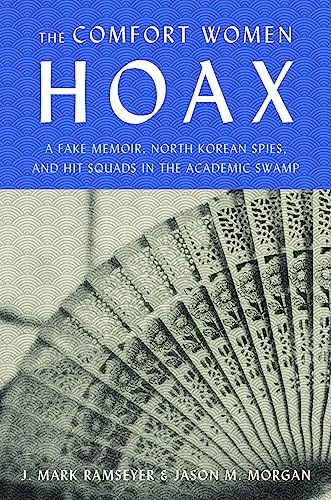 The Comfort Women Hoax: A Fake Memoir, North Korean Spies, and Hit Squads in the Academic Swamp

No comments:
Post a Comment