Every year after Yom Kippur, the sounds of hammer blows could be heard from the yard behind our apartment house. Three days later the sukkah stood, made of plywood covered with white sheets and decorations, and we, the most secular
==
‘You’re Literally Brainwashed’: Jewish-School Students Speak Out
The Maple spoke with 13 former students about the role Jewish schools may play in Canadians joining the Israeli military.
A photo of a classroom with a pink Israeli flag drawn on the chalkboard at the front
Image created by The Maple staff using a photo via Diana on Pexels.
In February, I released Find IDF Soldiers, a database containing profiles of Canadians that have joined the Israeli military.
Many of the soldiers attended Jewish schools in Canada, and sometimes attributed their decision to join the Israeli military in part to their time at these institutions. A subsequent review of the schools in question — including curricula, mission statements and activities — revealed many openly support the Israeli military and celebrate students who join it.
To better understand how these schools may help influence students to join the Israeli military, I spoke with 13 former students and the parent of a young student about what they experienced. These students collectively attended 11 Jewish elementary and/or high schools, in six cities (London, Ont., Los Angeles, Montreal, Ottawa, San Francisco, and Toronto), from 1979 to 2024.
Taken together, the former students told me about the “brainwashing,” Zionist “indoctrination” and inculcation of anti-Arab racism they endured during their formative years. They also offered their opinions on the role the schools play in creating future Israeli soldiers.
Here’s what they had to say.
Israel As God
The type of Judaism taught at the schools varied, but they all shared at least one thing. Israel was “omnipresent,” Amir Fleischmann, 31, told me. A version of this claim was made by everyone I spoke with.
Several former students said their schools flew Israeli flags. Tyler Levitan, 38, told me the first thing students would see upon entering his elementary school was a portrait of Israel’s prime minister, which at the time was Benjamin Netanyahu.
Every day of school would start with the Israeli and Canadian national anthems being played. Some of the former students I spoke with said the anthems were treated differently by their peers and teachers. Chelsey Lichtman, 42, said, “We knew the Israeli anthem was more important and more directly connected to us than the Canadian one.” Shoshana Schwebel, 34, stated, “Nobody cared about the Canadian anthem, but the Israeli anthem you had to stand, you had to sing it.”
Israeli national holidays were also marked at the schools.
Schwebel told me that her school always celebrated “‘Israeli Independence Day,’” stating: “They’d bring in bouncy castles and blue and white donuts for everyone. The whole day would just be a day of snow cone machines, popcorn machines, cotton candy machines; it was basically carnival time and everyone would be encouraged to drape themselves in Israeli flags, get their face painted with Israeli flags, and do Israeli-style dancing.”
This experience was shared by other students I spoke with. Jeremy Appel (who writes for The Maple), 34, recounted how the day would be marked: “They brought falafel to us, and told us that it’s Israeli food. And they sat us in rows, like we were on a plane going to Israel. I remember this very euphoric feeling.”
Israel also made its way into Jewish holidays and days of commemoration, according to several of the students. Noam Fleischmann, 28, pointed to International Holocaust Remembrance Day and Hanukkah as specific examples, noting that his school’s framing of the days would include the claim that they illustrated why Israel was needed.
Israel was also incorporated into the school curriculum from the earliest stages, according to Davita Guslits, 34, who recounted learning the alphabet in preschool with Israeli references being used as the examples for letters.
The days at these schools were generally divided into halves: standard, secular curriculum and then Torah study, Hebrew, and Jewish history.
Students were subjected to Israeli propaganda in many of these courses, they told me. Guslits, for example, recalls being repeatedly told a story about European Jews turning barren swamp land in Israel into “beautiful farmland,” saying it was “one of those stories that is older to me than Cinderella.”
Others mentioned that the “land without a people for a people without a land” myth was at the heart of their lessons on Israeli history. Several students also said they were taught to revere the Haganah, a Zionist paramilitary organization in Palestine founded in 1920 that took part in the atrocities committed during the 1948 ethnic cleansing of Palestinians, and sometimes the Irgun, a terrorist offshoot of the Haganah that is best known for its 1946 bombing of the King David Hotel in Jerusalem that killed 91 people.
Mentions of Israel were not limited to Jewish history lessons, however. Appel said, “There was no distinction between being Jewish and supporting Israel. It was an extension of our culture and our heritage.”
Others went further, framing their schools as more concerned with Zionism than Judaism. Schwebel, for example, said the religious aspect of her schools was “really tangential” to their real purpose: “You were sent there if you wanted a Zionist education.”
The parent of a child who was attending a Jewish high school as of Oct. 7, 2023, meanwhile, said, “They will train children in how to be good Zionists,” adding that Israel is “elevated to godliness.”
Fear And Racism
A significant part of the “brainwashing” at the schools, former students said, was being told that Israel was their real home. Amir Fleischmann told me: “‘You’re only safe because the state exists, and the only place you’re really safe is there.’ That’s something they would say explicitly.”
Anna Lippman, 34, meanwhile, recounted a question that was often posed to her and other students in California: “We were always asked by our teachers, ‘Do you consider yourself an American Jew or a Jewish American?’” The correct answer according to the teachers, she said, was “American Jew”: “‘You’re Jewish first and foremost, and you just happen to live in America.’”
Part of the reason the United States and Canada weren’t portrayed as real homes for Jews, the former students said, was that their non-Jewish inhabitants could supposedly turn on them any day, potentially leading to another Holocaust, which, Appel said, led to a “sense of unease and anxiety.”
Olivia Dooley, 35, told me, “We were taught to stay together as Jewish Canadians. We were taught to be insular with each other. We were taught to fear others.” Lichtman, meanwhile, said, “I came out of there and I didn’t know how to interact with anybody other than Jews. It’s such a disservice, honestly, but that’s why people send their kids to those schools: they don’t want them to interact with anybody else.”
Most of the students outside of Montreal also said their classmates were almost exclusively white, and from well-off families, which narrowed down the sort of person they were exposed to even further. A review of the most-recent tuition rates for the schools revealed that they cost as much as nearly $20,000 and $24,000 per year for elementary and high school, respectively.
But not all outsiders were viewed with equal levels of suspicion, with the vast majority of students claiming the schools pushed anti-Arab racism on them.
Schwebel said they were taught that “Arab people are raised with a mandate to kill all the Jews.” Appel said that part of the “indoctrination” at the schools was “instilling this contempt for Arabs.” Louise Smith, 51, said she remembers feeling “that we had to protect ourselves from Arabs.” Jordan Zaitzow, 42, said Jews were portrayed as “good” and Arabs as “bad,” and animosity between them was “built into our DNA.”
Several former students gave specific examples of racism from their teachers.
Lippman recounted: “I had a teacher when I was 10 or so. He was studying to be a rabbi, and he would pose these questions, like: ‘There’s an Arab woman at a checkpoint, and she’s pregnant. You can’t touch her, because there’s no women around, and men can’t touch women. Should you let her in, even though she might be hiding a bomb and blow up the entire hospital? Or should you not let her in?’” Students who chose to let the woman in, Lippman said, were told they had allowed the hospital to be blown up.
Guslits remembered: “[Arabs] were talked about as inhuman, not caring about their children like we were. We were told that they put their children in front of them in the line of fire, that they send their children out as suicide bombers.” She mentioned an incident with a particular teacher in grade eight: “There was one day where she said something to us about all Arabs being evil, and we all pushed back on her, and she left the room crying when we pointed out that it’s racist to say that. And then when she came back into the room and had composed herself, she told us that it had been a test.” Guslits believes the teacher was lying.
Dooley said the anti-Arab racism at the schools was crucial to their purpose: “The story of children coming to support Israel through these educational institutions isn’t complete without the fact that the children are also taught to dehumanize Palestinian people.”
The aforementioned parent, meanwhile, said things became significantly worse after Oct. 7, 2023, with a “complete collapse into this very insular, ethnonationalist, racist, warmongering nastiness.”
Another component of this racism, many of the former students said, was the erasure of Palestinians as a national group. In fact, multiple students told me they didn’t hear the words “Palestine” and “Palestinians” until leaving these schools.
There was also little to no opposition to this ideology within the schools, the former students told me. Appel acknowledged that there were teachers who were “more unhinged about this than others,” but added, “If you’re a teacher who is teaching your students there that Palestinians exist, that their lives are of equal worth to Israelis, and that Israel is occupying them, you wouldn’t last very long.”
Dooley recounted examples of even the simplest questioning of Israel during high school being shut down.
In one case, she recalls her and a group of friends who were part of a social justice club at the school putting up posters that had a “loose anti-war bent.” One of the facts included on the poster was that the U.S. and Israel had refused to sign an agreement to ban cluster munitions. The students got in trouble because the school considered the poster to be “anti-Israel,” Dooley said, adding, “It was hard and confusing to have a fact framed as being anti-Israel.”
In another case, Dooley gave a class presentation that mentioned a Toronto Star article about Israel cutting off drinking water to Gaza. She said, “My teacher cut me off and then someone in the class said that I was a self-hating Jew. And then the teacher was like, ‘Whoa, you need to understand that the Toronto Star is antisemitic.’”
This trend has intensified in recent years, the parent of the younger student told me, saying, “There’s absolutely no space for flourishing as a human being if you, as a student, even slightly differ from the perspective of all out war, flattening Gaza.”
Support The Troops
Support for Israel included the defence and promotion of its military, the students told me. This was reflected in curriculum and school activities, but also occurred in several other unique ways.
Nearly every student I spoke with mentioned that in high school, they had many Israeli teachers referred to as shlichim (emissaries).
The Jewish Agency for Israel, which sometimes works in coordination with the Israeli government and other major Jewish organizations, runs the shlichim program. It says it trains young Israelis on how to be good emissaries for Israel, and adds: “These role models are placed in schools, synagogues, JCCs, camps, universities, youth movements, and Federations all over the globe. There, they engage with Jewish and non-Jewish people about Israel, teach Jewish heritage, and speak about issues of national and religious identity.”
The former students I spoke with said that these shlichim — who they felt typically may not have been qualified to teach — played a crucial role in promoting the Israeli military.
Lippman recalls that the shlichim often had recently finished their military service, and would discuss it openly, including “romantic stories about bonding with your unit in the middle of the desert, making coffee together, praying together,” as well as emphasizing the “important significance the army plays in Israeli society and in the lives of Israelis, and how it’s this key way to give back to your people, to give back to your land, to gain honour within the society.”
The Jewish Agency for Israel did not respond to The Maple’s comment requests.
Another key component most former students mentioned to me was the March of the Living, where thousands of Jewish students from around the world go on a two-week trip consisting of a week in Poland visiting concentration camps and other sites of the Holocaust, and then a week in Israel celebrating the state, culminating in Israeli Independence Day.
Schwebel told me that while the trip wasn’t mandatory, classes would shut down during it and it was seen as “embarrassing” to not go. Describing the trip, Schwebel said, “It was really like, ‘Let’s whip them into a froth, and then they’ll be primed to join the IDF.’”
Explaining how this would occur, Schwebel said, “The Israel part was very, very directly a recruiting breeding ground. It was very clearly using this shock of the Holocaust and death camps and concentration camps — a very straight line, like ‘point a’ to ‘point b,’ where ‘point b’ is joining the army and ‘point a’ is the Holocaust. So it’s like, ‘Okay, now you’ve seen the Holocaust. Now it’s your duty as a Jewish person to join the army and make sure that never happens again.’”
Schwebel provided a specific example from her trip: “I remember one activity that they ran for us when we were in Israel where they had us sort ourselves into, ‘Which type of Jew are you?’” The options put forward were “soldier,” “diaspora philanthropist,” “rabbi” and “pacifist.” Schwebel and her boyfriend at the time chose pacifist, the only ones to do so. Then, she said, “[The soldiers] literally just laughed at us and called us naive treehuggers. The soldiers were like, ‘These naive treehuggers are going to get killed. You guys are going to get killed first because you’re so naive.’”
She added, “The idea was that the top tier that everyone should be aspiring to was ‘soldier,’ and if you weren’t ‘soldier,’ you should be ‘rich philanthropist’ donating to the soldiers.”
The March of the Living’s website links to a 2015 study exploring the impacts the trip has on its participants, and approvingly cites several examples, including that: 86 per cent “assert that it’s very important that their spouse be Jewish”; 91 per cent “intend to give their children a Jewish education” (though just under half attributed that intention to the March); 65 per cent “feel that it’s important to live in a Jewish neighborhood”; and almost 90 per cent “said that the March had made it more likely that they would financially support Jewish causes.” The article adds: “Given the overwhelmingly positive results, it’s fair to say that the March has been and continues to be an enormously successful program in terms of ensuring and enhancing Jewish identity.”
The March of the Living did not respond to The Maple’s comment requests.
Then there was the portrayal of the Israeli military at school, which former students said framed it as an essential part of Judaism whose members were heavily valorized.
Guslits, who told me she had wanted to join the Israeli military as early as elementary school, though she never did so, said, “We were definitely taught to love Israel, to admire the IDF, to want to join it.” Schwebel said, “I do definitely remember being pretty heavily incentivized to join the army straight out of high school.” Dooley said, “It was certainly valorized to move to Israel and fight for the country.” Lippman said, “It was presented as almost a fact of life. Like, if you are Jewish, and if you care about Israel, [joining the Israeli military] is what you do.”
Smith added: “The narrative I’d been raised on was, everybody hated us, and we needed to defend ourselves. And so it does feel like you’re taking one on for the benefit of our culture, and the nation that represents our culture and our religion.”
Amir Fleischmann, meanwhile, knows multiple students who joined the Israeli military after high school. In one case, he said the student, a former friend, had been heavily influenced by the War on Terror culture at the time to want to join an army in general. But the school was “probably a determining factor” in the choice to join the Israeli military in specific, he said: “The sense they give you is that the IDF is really on the front lines. The IDF is dealing with this stuff every day, and the IDF is keeping you as a Jewish person safe in a way that it doesn’t necessarily feel like the Canadian military, which is pretty far removed from day to day life, does.”
Guslits, who also knows several students that joined the Israeli military, said something similar: “I don’t know anyone from my Jewish community who ever joined or thought of joining the Canadian Army.” She added, “They get this idea in their head that joining the IDF is the most noble thing they can do. And then they count down the four years in high school until they can go and do that.”
Amir Fleischmann added, “If you joined the IDF, you were applauded by the school, and at graduation they would specifically call out the people.” Noam Fleischmann, Amir’s brother, added that he remembers the prospective soldiers receiving standing ovations.
Several of the former students recalled that Israeli military apparel, such as t-shirts and hoodies, was trendy in high school.
They also remembered Israeli soldiers on leave or that had recently finished their service coming in to speak to students. Amir Fleischmann recalled that in 2006, a soldier who had recently fought in Lebanon spoke to his elementary school class and showed them a video of his unit bombing what was described as a “guerrilla,” which at least one student mistakenly understood to be a “gorilla.”
The former students added, however, that while schools play a significant role in Jewish Canadian youth joining the Israeli military, they aren’t the only factor.
Schwebel said, “Every Jewish institution that I was part of did this.” Appel added, “The Jewish day schools are part of a broader constellation of Jewish institutions that support what Israel is doing, and normalize it, and normalize feeling this really personal attachment to it.” He pointed to Jewish summer camps as another key component, as many others did.
Dooley, meanwhile, told me, “The Zionist education system is one big piece of a broader isolationist propaganda mode of ensuring that children end up as Zionists [...] They don’t have a point of entry into the real world until they’re 18 or something, at which point it’s so ingrained in people.”
Noam Fleischmann added: “It’s institutional Judaism. That’s what it is. This entire thing is all just built to keep Zionism alive, and this sort of Spartan military cult alive.”
After Graduation
The former students I spoke with now identify as anti-Zionists, and have come to oppose much of what they were taught at their schools. As a result, they often find themselves isolated from the vast majority of former classmates, who failed to break out of what several referred to as “the bubble.” I asked how they feel about these sorts of former classmates, and their responses included anger, embarrassment, sympathy, and sadness.
One former student told me: “The thing that I think about most is actually how traumatized these individuals are, how much they’ve absorbed and not processed the inter-generational trauma that makes it so that this is their behaviour in the face of a televised genocide.” But they added, “If you taught an entire generation of people about a genocide and those people can’t recognize another one, literally, what the fuck is hope for anything? [...] I look at my own family — Holocaust survivor grandparents, my mom, who’s their descendant — and all of them are genocidal and they can’t see it.”
Guslits said, “What really horrifies me is that if I know people who have served in the IDF, then almost certainly I know people who have terrorized Palestinian homes in the West Bank.” Amir Fleischmann told me, “I don’t have a lot of respect for them, to be honest. These people are not in my life at this point.” Dooley said, “We all have the ability to read books. It was on them a long time ago.” She added, though, that she gives a bit more leeway to teens than those her age.
Lichtman said, “The project of introducing Israel with no critique at all from like three, four years old, that’ll do it for most people, you know what I mean? You’re literally brainwashed from a young age.” She added that even when students graduate, “It’s just so much easier to stay a Zionist and stay in this very incredibly privileged vacuum of a community that there’s no real incentive for people to leave that.”
Schwebel told me she has mixed feelings: “If they’re Zionist, and they believe in that and they promote it, they do bear responsibility the same way anyone else would.” But, she added, she’s aware of the “decades-long, extremely well-funded project of propaganda that has gone into insulating these people from other realities.”
Appel, meanwhile, told me that the consequences of students attending these schools end up manifesting later on in life in shared environments where they’re exposed to non-Jews: “You see this a lot with the discourse about antisemitism on campus and Jews feeling safe on campus, and what does it come down to? It’s hearing perspectives that were withheld from you growing up and not being able to reconcile that with what you were told was the truth, and that we’re inherently victims.”
Levitan, who attended Jewish elementary school and then public high school, recalled something similar, stating: “I remember in grade nine, my math teacher didn’t grade me in the way that I thought I should have been graded, as in my math skills were not as good as I thought they were. And I attributed that to her being antisemitic. This is sick thinking, right?”
The former students I spoke with who are now parents told me they’d never send their children to these schools. The parent of the younger student said they eventually pulled their child out, and wouldn’t have sent them in the first place had they known what was to come.
When asked about whether the schools could be reformed in some way, most of the former students told me they didn’t think so. The Zionism, they said, was the point, and so stripping Zionism from the schools would not only go against what the vast majority of parents who send their kids there want, but perhaps more importantly what attracts those who help fund the schools.
The former students, nearly all of whom have been out of the schools for at least a decade, now have considerably varying relations with Judaism.
Some told me their activism is not only compatible with Judaism but motivated by it. Zaitzow, for example, said, “It’s because of my Judaism that I do my activism, for sure.”
Lippman, who described a more religious school experience than others, said, “What has saved Judaism for me is all the sort of non-Zionist stuff that I learned in school. I learned about Jewish values, I learned about how and why Jews care about social justice, why they care about reclaiming the world or repairing the world. And so I think since breaking with Zionism, my Judaism has really become more of an ethic, a way of living that isn’t centred on a place or a nation, but is centred on living the values of Judaism and really enacting them in my everyday life.”
Another former student told me: “My Judaism, my relationship with my ancestors and my own spirituality and relationship with divinity fuels my resistance work [...] I don’t know how you live through this kind of fascism without any connection to something higher.”
Others, however, feel differently.
Schwebel said, “I feel like if you had asked me [about my relationship with Judaism] like five years ago, I would have responded that I do feel like there is a part of Judaism that was not really taught at my high school that has this deep tradition of anti-fascism and community and solidarity with other oppressed groups, with other minority groups. But now I’m not sure if I still agree with that. I think that was a very optimistic feeling, and now I’m back to feeling mostly like I’m not that interested in saving the project of Judaism anymore.”
Lichtman told me, “Mainstream Judaism is lost. It’s completely lost. And Zionism, in my opinion, Zionism can have it.”
She added, “The Stars of David being branded onto Palestinians’ faces and the genocide in the name of Jewish safety really has just … I can’t. There’s nothing there for me anymore. Absolutely nothing.”
Check out Find IDF Soldiers and its accompanying analysis article to learn more about Canadians that have joined the Israeli military, including what they’ve had to say about Jewish schools.
==
Indoctrination and brainwashing in Israel and Zionism
This is a key part of my chapter on indoctrination and brainwashing in Israeli society
Aside from a few changes and additions, I only wrote the Summary here, not the introductory sections:
Challenging belief sets and inherent attitudes
Cognitive dissonance
Cognitive dissonance is a psychological concept that refers to the mental discomfort experienced by a person who holds two or more contradictory beliefs, values, or ideas at the same time. This discomfort often leads to an alteration in one of the attitudes, beliefs, or behaviors to reduce the discomfort and restore balance.
For example, for a relatively trivial example, if someone claims and believes that they are environmentally conscious, but frequently uses single-use plastics, they might experience a form of cognitive dissonance. To alleviate this discomfort, they may change their behaviour by reducing plastic use, or they might adjust their belief by convincing themselves that their own individual actions don't significantly impact the environment.
Cognitive dissonance was first introduced by psychologist Leon Festinger in 1957. He suggested that people have an inherent desire to maintain consistency among their cognitions (beliefs, attitudes, etc.). When inconsistency arises, it creates psychological tension, motivating individuals to reduce the dissonance through various means, such as changing their beliefs, acquiring new information that outweighs the dissonant beliefs, or inappropriately rejecting the dissonant belief as irrational or illogical even when it wholly or largely true, or simply reducing the importance of the conflicting belief. It helps explain partly how people rationalise their decisions and behaviors.
Black and white thinking
'Black and white thinking' is nothing to do with racism in itself. It is commonly referred to as **"splitting"** in north america,) or **"dichotomous thinking,"** mostly in the UK and Europe.
It is a cognitive distortion where a person views situations, people, or concepts in absolute terms, such as all good or all bad, with no middle ground or nuance.
This type of thinking is often associated with certain mental health conditions, such as **borderline personality disorder (BPD)**, but it can also occur in everyday thinking patterns. It can lead to rigid, extreme perspectives and difficulty in seeing complexity or grey areas in life.
That is not to say that sometimes issues are indeed 'black and white.'
Brainwashing and indoctrination
Brainwashing and indoctrination are related concepts but differ in their methods, intensity, and intent. Here's a breakdown of their differences:
### **Brainwashing**
- **Definition**:
Brainwashing is a process of forcibly and systematically altering someone's beliefs, attitudes, or behaviors, often against their will.
- **Methods**:
It typically involves extreme psychological manipulation, coercion, isolation, and sometimes physical or emotional abuse. The goal is to break down an individual's existing beliefs and replace them with new ones.
- **Context**:
Brainwashing is often associated with captivity, cults, or authoritarian regimes where the victim has little to no control over their environment.
- **Intent**:
The intent is usually to completely control the individual's thoughts and actions, often for the benefit of the manipulator or group.
- **Example**:
Prisoners of war can sometimes be subjected to relentless propaganda, sleep deprivation, and psychological torture to change their loyalties. This is particularly true in Israeli prisons and detention centres.
### **Indoctrination**
- **Definition**:
Indoctrination is the process of teaching or instilling a specific set of beliefs, ideologies, or values, often in a one-sided or uncritical way.
- **Methods**:
It relies on repetition, education, persuasion, and social influence rather than coercion or force. It often occurs in environments like schools, religious institutions, or political groups.
- **Context**:
Indoctrination is typically a gradual process that happens over time, often starting in childhood or within a community.
- **Intent**:
The intent is to shape an individual's worldview or loyalty to a particular ideology, but it may not involve the same level of control or manipulation as brainwashing.
- **Example**:
Children being taught a specific religious or political ideology without exposure to alternative perspectives.
### **Key Differences**
1. **Volition**:
Brainwashing is usually involuntary and coercive, while indoctrination can occur with the individual's participation, even if they are unaware of the bias.
2. **Intensity**:
Brainwashing is more extreme and often involves breaking down the individual's identity, whereas indoctrination is more about shaping beliefs.
3. **Control**:
Brainwashing seeks total control over the individual, while indoctrination aims to influence their thinking.
Summary
In summary then, brainwashing is a more aggressive and manipulative process, while indoctrination is generally a subtler, often institutionalized form of influencing beliefs.
In other words, the subjects of indoctrination are generally unaware that they are being gradually indoctrinated (a form of gaslighting, if there are lies or distortion of the truth involved.)
Therefore, Israeli society, and particularly secular and religious Zionism, are nearly always highly vulnerable to extreme examples of indoctrination, elements of brainwashing, and black and white thinking's inherent bias and polarisation.
The very strong religious and secular nationalistic element of Israeli society, means that the majority of Israelis will struggle to challenge their inherited belief set and inherent attitudes. They will be unlikely to realise that much of what they were taught (and expected to fully accept, almost without question,) particularly about Palestinians and Islam, is, in fact, either not true, or a distortion of the truth.
Peer pressure, plus living in a centrist or right-wing Zionist bubble greatly reduces the chance of Israelis changing their belief set and attitudes. Even with left-wing Zionists (whatever that really means,) the problem is not that different, albeit slightly easier.
When you add to most Israelis irrational state of mind in constantly living in existential fear, to wit, their largely unfounded paranoia of a complete genocide, destruction, or constant attacks on their country.
These facts alone make it very difficult for Israelis, particularly Zionists, to open their eyes to an alternative narrative but, unfortunately, there is an even worse problem to overcome:
The problem is that Israel is a strongly nationalistic, highly militarised State. This State enforces compulsory military service in their I.D.F. or I.A.F. (Israeli Air Force,) for all of their younger citizens, with rare exceptions. They are mandated to serve at least two or three years in the Israeli military. Refusal to become a part in these military units, even on grounds of conscientious objection, is usually punishable by imprisonment.
On top of this, there is quite extreme censorship and inherent political bias in Israel, particularly in Israeli media.
Ex-Zionists, particularly those living in, or from, Israel, are therefore a very special breed of Israelis and/or Jews. Whilst they may never fully recover from their indoctrination and brainwashing, they can slowly - and occasionally quite quickly - change a lot of their belief set and attitudes. This is especially true when otherwise logical, intelligent Zionists are presented with clear facts and evidence, which they can go away and fact check to verify whether it is true or not.
The difficulties of recovering from indoctrination and brainwashing is common in every single cult, religion and religious sect in the world. Indeed, it is even transparently evident in politics. It is not just a problem for Israelis and Zionists.
However, the cult of Zionism - and it is indisputably a quite extremist cult - is so closely intertwined with Israeli society, education, family tradition and Judaism, that it is akin to separating twenty cables and wires which have been repeatedly moved around and put in a storage box. The difference being, of course, that this storage box is the human brain, and the cables and wires are actually entrenched beliefs, and ways of thinking, often impressed deeply in the mind, usually from a very young age.
===
==
Young Jews share experiences of Israel-Palestine ‘brainwashing’ on TikTok
Young Jewish people, mostly based in Israel and the United States, have been sharing videos on social media in which they criticise what they were taught about Israel and Palestine.
“I grew up being told that Palestine was an invented country for an invented people and I shouldn’t use the word,” said Jerusalem-based TikTok users Lexie and Lara, who post as shtender.bender.
“The two books I own more copies of than any other are Myths and Facts and A Case for Israel, because about half a dozen Jewish organisations gave them to me for free.”
They go on to say that their youth group gave frequent training on how to “combat anti-Israel sentiments on campus”, and that they grew up learning that the media reported on Israeli crimes because it “hates Jews and Israel”.
In a separate video, another user states: “You grow up learning that Israel is good, you don’t learn the word Palestine until your late teens.”
“There’s no discussion of the injustices, you only learn about Israel and the IDF and the fun, cultural things in Israel,” she continues.
“Because when you find out about all these injustices - especially when most of them are being said in the name of your religion that you love so much - it’s a fucking gut punch.”
In another video, Los Angeles-raised comedian and social media personality Michael Schirtzer outlines why he believes it’s harmful to associate Jews with the state of Israel. https://www.tiktok.com/@shtender.bender/video/7018266648578706690?is_from_webapp=1&sender_device=pc&web_id7031843244837914118
One Jewish teacher explains how the term Eretz Yisrael (the Holy Land) is “thousands of years old”, and is used in the Torah to describe the land “regardless of who is ruling it”.
“My question for you is: if you believe in the Torah, and if you believe that Hashem [God] is a God of justice, why are you simping for colonialism and apartheid?”
A survey of US Jewish voters taken after Israel's most recent offensive on Gaza last year found that a quarter of respondents agreed that "Israel is an apartheid state", siding with both Human Rights Watch and Amnesty International.
This article is available in French on Middle East Eye French edition. Middle East Eye delivers independent and unrivalled coverage and analysis of the Middle East, North Africa and beyond. To learn more about republis == How students are brainwashed to hate Israel At Duke University, the approved antisemitic narrative is never questioned.
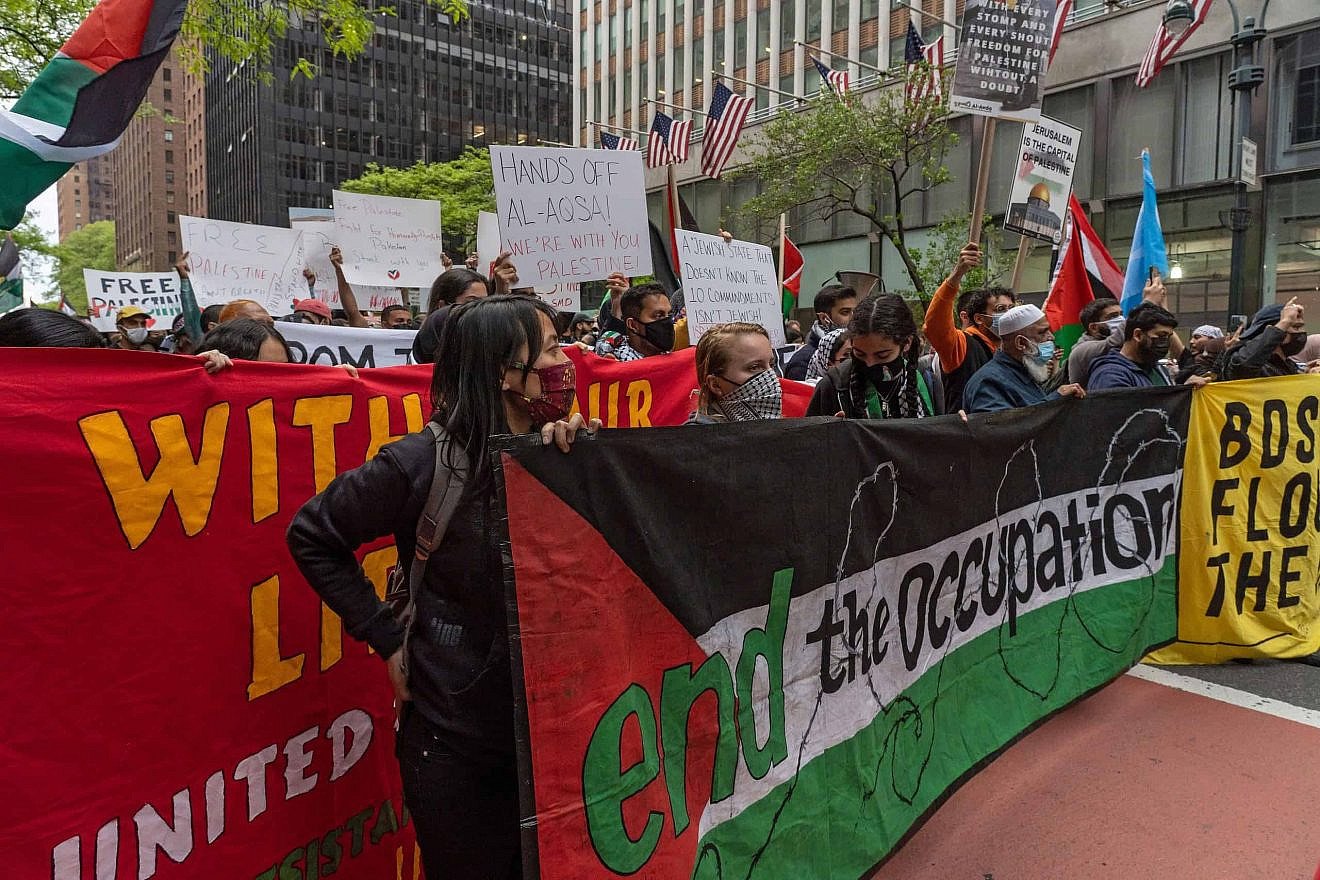
Anti-Israel, pro-Palestinian activists in New York City, May 11, 2021. Credit: Ron Adar/Shutterstock. Amy Rosenthal Amy Rosenthal, who lived in Israel as a child, is co-founder of the North Carolina Coalition for Israel.
(May 7, 2024 / JNS)
It’s appalling to watch students at prestigious institutions shout in support of terrorism and a place that doesn’t exist: “Palestine.” How did young people become so delusional, misinformed and morally bankrupt?
The seeds are sown at our once-venerable academic institutions. Since students don’t know what they don’t know, they are vulnerable to propaganda and manipulation by faculty with a political agenda. Duke University is an excellent example.
In response to “the violence in the Middle East,” Duke’s provost Alec Gallimore established a yearlong Initiative on the Middle East in February. By assigning Bruce Jentleson, a professor of public policy and political science, to lead the initiative, Gallimore put the fox in charge of the hen house.
Jentleson deliberately ignores certain essential issues, such as Muslim antisemitism, the repeated rejection of Israel’s right to exist and ongoing terrorist attacks against Jews. By doing so, Jentleson presents the Middle East he wants students to see.
Up next was Humanizing the Humanitarian Crisis. Speakers claimed that assigning blame to one side or the other would not bring peace, thereby absolving Hamas. A visiting scholar at the “Palestine Program” at Harvard spewed anti-Israel propaganda by imposing a false narrative of the “nakba” on students and calling Israel an apartheid state. She also falsely claimed that “both sides are causing terrorism.”
Then came Finding Common Ground in the Middle East, based on the Roots program. Its stated goal is to “humanize the other” (which other, one wonders), especially in Judea and Samaria. Since 82% of Arabs in these areas support the Oct. 7 massacre, perhaps Hamas supporters should have been the target audience rather than college students.
On April 1, former Palestinian Authority Prime Minister Salam Fayyad spoke, with Jentleson as moderator. Fayyad began with the ridiculous claim, “Everyone is entitled to their own truth,” which is antithetical to the purpose of academia. He decried the Oslo Accords, angrily proclaiming that the agreement “did not recognize not one of our national rights as a people; none, none whatsoever.” Clearly, Fayyad believes peace is incompatible with Palestinian “rights.”
Not once was the word “terrorism” mentioned. When Fayyad praised terror attacks on Jews, Jentleson said nothing. The P.A.’s pay-for-slay program, which funds Palestinians who murder Jews, was not discussed. The audience heard nothing about the P.A. security forces’ complicity in terrorist attacks. The fact that a Muslim “Palestinian” people did not exist until Yasser Arafat colluded with the Soviets to create it in the 1960s was ignored. When Fayyad was born in the 1950s, a “Palestinian” people that he claims are owed the right to kill Jews was a nationalist fantasy.
Jentleson fawned over Fayyad and avoided challenging him. When asked if Israel can be accused of genocide, Fayyad said that the International Court of Justice took up the case, so the blood libel must be legitimate.
Jentleson then asked, “What can Arab Americans do to make their voices heard to support the Palestinians?”
Voices in support of “Palestinians” and Hamas are heard quite well at Duke. When Students Supporting Israel and others held an event calling for the return of hostages taken by Hamas, their voices were drowned out. A pro-Hamas group banged on drums and shouted the pro-terror slogan “Long live the intifada,” among others. They marched up to the pro-Israel group yelling, “Resistance is justified when people are occupied.” The agitators faced no consequences for their disruption of Jewish voices.
Other events held by Jentleson’s initiative included Adania Shibli, who is praised for her focus on “Palestinian” victimhood, and Robert Satloff, who is excited about the prospect of partnering with the terror-supporting P.A. Satloff fawned over Jentleson, praising him for fostering “civil discourse.” Civility is easy, of course, when the approved narrative is never challenged.
Finally, on April 16, Duke neurosurgeon David Hasan spoke about his experience volunteering in Gaza. He mentioned “innocent people on both sides” but his focus was overwhelmingly on suffering in Gaza. The starvation, torture and murder of Israeli hostages were ignored and excluded.
This is how anti-Israel propaganda works: It excludes ugly and uncomfortable truths about terrorism and Jew-hatred in the Islamic world. This propaganda by exclusion has been relentless and pervasive, sewing the moral confusion, ignorance and antisemitism we see on campus today.
Duke is just one example. Similar programs exist at other institutions, so it’s no surprise that antisemitism and pro-Hamas activism have exploded across the country.
Until academia returns to the standard of teaching the whole truth and nothing but the truth, the hate we see on campus will only escalate. The opinions and facts presented in this article are those of the author, and neither JNS nor its partners assume any responsibility for them.
Excellent article. Is the Jewish community helping you at all? It reads like you are working alone. Are Jewish students on campus organized at all? Duke has a Board of Trustees. They should be briefed on this. The ADL should be involved in this situation. They have deep pockets. Forget about the US Department of Education. They could not care less about Jews. If you were an. African A.erican, it might be a different story. ===
Tory candidate: Jews become 'brainwashed extremists' in Israel
Candidate for British Parliament Amjad Bashir claimed before EU parliament that rabbis brainwash young Jews visiting Israel.
A candidate for British parliament representing the Conservative Party said that local Jews who go to Israel “have come back as extremists – as people that are brainwashed.”
In a 2014 speech delivered to the European Parliament in Brussels, Amjad Bashir, who is running for parliament in a Leeds constituency, said this of “Young men are going over from England where I come from – people of the Jewish faith who my grandchildren have grown up with as decent young men,” he explained, according to a report Monday by The Jewish Chronicle.
“They will not listen to reason. There is something very peculiar and wrong going on in Israel,” he added, blaming “rabbis and politicians.”
Bashir apologized for his remarks, expressing “deep regret” and adding they were “born from personal experience.”
The elections are set for Dec. 12.
On Sunday, Prime Minister Boris Johnson reiterated his opposition to anti-Semitism in a letter to Jewish Agency Chairman Isaac Herzog. “The safety of Jewish people is a top priority for the UK Government,” he wrote.
Separately, a candidate for parliament for Labour, which has been dogged by allegations of anti-Semitism, has co-managed a group on Facebook that coached Holocaust deniers and other purveyors of hate speech about Israel and Jews on how to conduct themselves when dealing with disciplinary action by the party, the Daily Mirror reported Sunday.
The candidate, Maria Carroll of Wales, told the paper she was not aware of the hate speech or she “would have immediately condemned them.”
===
Haaretz | Israel News Analysis | From the First Grade to the Grave, Israelis Are Taught to Dehumanize Palestinians Or Kashti Aug 3, 2023 The Israeli Palestinian Bereaved Families for Peace, a grassroots organization promoting reconciliation, has been experiencing in recent years what Breaking the Silence went through before: a ludicrous branding as enemies of the people, systematic threats, and attempts to sabotage any public appearance, as well as a ban from schools. ===
How Israel teaches its children to hate Much like white South Africans, Jewish Israelis will never voluntarily give up their privileged position as settlers
Dissident Israeli scholar Nurit Peled-Elhanan’s important academic study, “Palestine in Israeli School Books” is essential reading for anyone who wants to understand some important realities about the Israeli state and Israeli society.
As a settler-colonial entity, real change can never come from within Israeli society. It must be imposed from the outside. Much like white South Africans, Jewish Israelis will never voluntarily give up their privileged position as settlers.
South African apartheid was defeated by the masses of South Africa (with the support of some white dissidents), and their political leaders, in alliance with a global solidarity campaign.
In the same way, Israeli apartheid will be defeated by the Palestinian struggle. This struggle is supported by a minority of Israeli dissidents, and by the international solidarity movement – especially the Boycott, Divestment and Sanctions (BDS) movement.
Peled-Elhanan’s book was a major study of 17 Israeli school textbooks on history, geography and civic studies. As you can see from what she says in the interview above, she came to some stark conclusions.
When they even mention Palestinians at all, Israel’s official schoolbooks teach a “racist discourse”, which quite literally wipes Palestine off the map. Maps in the schoolbooks only ever show “the Land of Israel”, from the river to the sea.
She explained that not a single one of the schoolbooks included “any positive cultural or social aspect of Palestinian life-world: neither literature nor poetry, neither history nor agriculture, neither art nor architecture, neither customs nor traditions are ever mentioned.”
Of the rare times that Palestinians are mentioned, it is in an overwhelmingly negative and stereotypical fashion: “all [the books] represent [Palestinians] in racist icons or demeaning classificatory images such as terrorists, refugees and primitive farmers — the three ‘problems’ they constitute for Israel.”
She concluded that the children’s schoolbooks “present Israeli-Jewish culture as superior to the Arab-Palestinian one, Israeli-Jewish concepts of progress as superior to the Palestinian-Arab way of life and Israeli-Jewish behaviour as aligning with universal values.”
All this is quite the opposite of the stereotypical and misleading story about children’s schoolbooks in Palestine. The books printed by the Palestinian Authority since the 1990s are frequently portrayed in anti-Palestinian demonology as putting forth the worst anti-Semitic calumnies about Jewish people.
Overall, this narrative is a crude fabrication instigated by anti-Palestinian propaganda groups, such as that run by Israeli settler Itamar Marcus and his “Palestinian Media Watch”.
Peled-Elhanan’s book comprehensively demolished a second, complementary, Israeli myth: that Israelis – by way of contrast to the dastardly Palestinians – instead “teach love thy neighbour”, to quote Israel’s war criminal ex-foreign minister Tzipi Livni.
Former Minister of Foreign Affairs of Israel, Tzipi Livni [file photo]
Seven years ago, when Peled-Elhanan’s book was published, she warned that, in contrast to liberal hopes for change from within Israeli society, things were moving “backwards and backwards” and that the then-current textbooks were little more than “military manifests”.
“We have three generations of students who don’t even know where the borders,” between the West Bank and the rest of historic Palestine are, she despaired in the interview above, filmed back in 2011.
Seven years on from the book’s publication, things have only got progressively worse.
That can be seen in the video that circulated on social media this week of young Israeli soldiers celebrating and cheering after they dynamited Palestinian homes east of Jerusalem. Those same soldiers are a product of Israel’s education system.
As Israel’s violent oppression of an entire indigenous people become more and more blatant for the world to see, so public opinion is increasingly shifting against Israel – even among the previously supportive voter and activist base of the Democratic Party in the US.
As Israel can rely less and less on outside support, it becomes more important for the apartheid state to circle the wagons, and ensure the next generation of settlers and soldiers are inculcated into the Israeli state’s official ideology – Zionism.
Last month it emerged that Israel has begun requiring all high school students – including those Palestinians who are second-class “citizens” of Israel – to pass an online government propaganda course before they can participate in overseas trips.
According to the Palestinian human rights group Adalah, the course “promotes racist ideology”, brainwashing students with the myth that Palestinians are inherently violent savages.
Adalah says that one question asks: “How do Palestinian organizations use digital social networks?” The required answer is “encouraging violence.”
“Another question asks students to identify the origins of modern anti-Semitism,” Adalah explains. “The exam’s correct answer is ‘Muslim organizations’ and the BDS movement.”
In this way, Israel is teaching its children to hate: hate Palestinians, hate Muslims, hate the Arabs in general and hate anyone who supports or stands in solidarity with them against oppression.
The views expressed in this article belong to the author and do not necessarily reflect the editorial policy of Middle East Monitor.





No comments:
Post a Comment