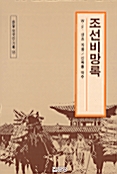
조선비망록 | 한말 외국인 기록 18
W.F.샌즈 (지은이),신복룡 (옮긴이)집문당1999-09-10
May 14, 2024 ·
윌리엄 F. 샌즈(William Franklin Sands),
『조선비망록(Undiplomatic Memories)』
신복룡 역주, 『조선비망록』, 집문당, 2019년 개정판, 49~54쪽
https://archive.org/details/undiplomaticmemo0000sand
책소개
미국 외교관인 저자가 냉정함과 사실성, 남다른 지식으로 한국 근대사의 현장을 묘사한 책. 일본과 조선의 관계, 서울의 외교사절, 영사재판, 황제의 고문관, 조선인의 신뢰성, 이재수의 난 등을 예리하게 관찰했다.
1. 서론:외교란 무엇인가?
2. 일본
3. 조선
4. 서울의 외교 사절들
5. 황제
6. 영사재판
7. 선교사들
8. 공사관생활
9. 황제의 고문관
10. 대궐에서의 생활과 민속놀이
11. 고문, 산적 그리고 반란
12. 여인의 나라 제주도:이재수의 난
13. 조선 사람의 신뢰성과 친절
14. 이권 외교
15. 외교 정책
16. 결론
저자 및 역자소개
W.F.샌즈 (지은이)
저자파일
신간알림 신청
1898년 조선주재 미국 외교관.
https://archive.org/details/undiplomaticmemo0000sand
책소개
미국 외교관인 저자가 냉정함과 사실성, 남다른 지식으로 한국 근대사의 현장을 묘사한 책. 일본과 조선의 관계, 서울의 외교사절, 영사재판, 황제의 고문관, 조선인의 신뢰성, 이재수의 난 등을 예리하게 관찰했다.
CONTENTS
PROLOGUE: Upon Diplomacy
CHAPTER I: Japan
CHAPTER II: Korea
CHAPTER MI: The Diplomatic Corps and the Foreig Colonies at Seoul
CHAPTER IV: The Emperor
CHAPTER V: Consular Courts, Foreign Jurisdiction and Higher Politics
CHAPTER VI: Missionaries
CHAPTER VII: Life in the Legations
CHAPTER VIII: The Adviser to the Emperor
CHAPTER IX: Life at Court and Native Sports
CHAPTER X: Torture, Bandits and Rebellion
CHAPTER XI: The Amazons
CHAPTER XII: Native Trust and Hospitality
CHAPTER XIII: Concession Diplomacy
CHAPTER XIV: Foreign Policy
CHAPTER XV: The End
=============
목차1. 서론:외교란 무엇인가?
2. 일본
3. 조선
4. 서울의 외교 사절들
5. 황제
6. 영사재판
7. 선교사들
8. 공사관생활
9. 황제의 고문관
10. 대궐에서의 생활과 민속놀이
11. 고문, 산적 그리고 반란
12. 여인의 나라 제주도:이재수의 난
13. 조선 사람의 신뢰성과 친절
14. 이권 외교
15. 외교 정책
16. 결론
저자 및 역자소개
W.F.샌즈 (지은이)
저자파일
신간알림 신청
1898년 조선주재 미국 외교관.
===
PROLOGUE UPON DIPLOMACY
T HESE memories of the early days of a "career" diplomat are, perhaps, incomplete without some explanatory comment upon career di-plomacy in general and American diplomatic practice in particular. It is generally accepted to-day that American career foreign service started with Roose-velt, quite probably because there is nobody left in the diplomatic service who started there earlier than the Roosevelt administration. Veterans are not encouraged.
As a matter of fact the career service actually antedates Roosevelt. It had been felt that too many juniors in diplomacy were wealthy young men wanting posts at European courts for the sole purpose of making acquaintance there which would advance them socially at home, and that much reasonably good material was being spoiled in the process with no satisfactory results for anybody. They believed it scarcely possible to send an impressionable youth to a court in Europe and have him come out un-affected by the point of view of the golden gentlemen around whom it centred. They decided to pick a few youngsters whom they knew, and to send them first to the Pacific, either to the South American capitals or to the Far East, to study the working of concession diplomacy, spheres of influence and dollar diplomacy generally, away from the attractions of courts; to watch European diplomacy in the raw, in the regions where presently American interests would be greatly affected. After service
there, these first career diplomats were to come home and take a special course at some good American college supplementary to what they had been seeing, mainly in history and economics. They were to study America from their new point of view and get a sound interpretation of what American interests really are. Then they were to go through a clerkship in the State Department and learn not only the routine of the Department itself, but the manner of working of the whole American system of govern-ment. Only after that were they to be permitted to go to Europe, and only the most tried and reliable of them then.
There was no particular reason why I should be appointed to be the first of these, except that both the President and the Secretary of State were friends of my father, and that I had several European languages to begin with and had matriculated for university in Europe.
I had felt frightfully important, of course, and when I was given the choice between first secretary in Chile and second secretary at the legation in Tokyo, I chose the latter, in order to " finish" Asia, work back to South America and then display my accumulated wisdom and experience in Europe. I was not yet twenty-one years old when I was appointed, and had to wait before my commission could be legal.
It seemed to me quite natural then that a Presi-dent and a Secretary of State should take the trouble to explain to me exactly what they wanted and why they wanted it. I felt that it was hardly respectable not to be on easy terms with Presidents and Secretaries of State.
Had not Presidents, from Grant on, been frequent and informal visitors in my grandfather's house
(except Chester Arthur, who was not approved of, and not received) ?
Even the complete lack of interest in my existence of everybody in the State Department except the Secretary did not shake my serene confidence. "The department," in those days, consisted of a close corporation within the Department; of a Secretary of State who in the eyes of the inner circle was an outsider and was expected to be an unreliable and possibly a dangerous person, to be watched and thwarted if necessary, and two bodies of "public enemies "-the diplomatic service and the consular body. Both these latter bodies were usually made up of political appointees, like postmasters at home. They were not expected by the departmental family to last long, nor to do anything worth the trouble of doing while in office. The main hope of the inner departmental circle was that "lame ducks" would do nothing too preposterous before they vanished into the outer darkness to be replaced by other lame ducks.
Flaming youth of twenty years made a mental note, during the statutory thirty days' period of instruction, to undertake considerable reform in the Department after salvaging the Far East. He never got around to that, however.
My own foreign service covers a period of transi-tion in the diplomatic service, but, living continually on the firing line where immediate action was often necessary, without available precedent or anyone to consult before acting, that experience was very different from the well-ordered routine of diplomatic life to-day. It is the personal experience of those early years that I have sketched here.
===
===
Experiments
Search inside (3 results) neutral
==
Page 22 — The most generally liked people in the corps were the Spaniards. Two years later, when we were at war, the members of the Spanish and the American legations conformed rigidly to the etiquette pre¬ scribed in a neutral country. When one of them happened to call and found an “ enemy ” there, the
==
Page 137 — Two men meeting by chance, unknown to each other even by name, but apparently belonging to the noble class, would spar for hours in conversation, never ending a verb, each trying to conceal his own rank and place the other’s exactly, by every possible device. They would develop a kind of neutral language until one would triumphantly guess the precise status and social antecedents of his adversary partner in the game and use the corresponding verbal form. If he were wrong the other would at once use a form of verbal ending obviously lower than the guesser’s rank, to indicate that had he been quite a gentleman he could not have made such a social blunder.
==
Page 233 — the French and British cruisers. Finally, an English officer and one of our own came up to the club and 4t was possible to get the news. The Russian ships had made a good try. When they came back, all living men from both were removed to the French and British cruisers, ours remaining neutral. The French, of course, took all they could, as Russia’s ally ; but Japan’s ally, the Englishman, took all the rest, out of which grew a complication. The little destroyer had brought in a peremptory message to both to give up the Russians as prisoners of war. Both refused. According to our informant another message stated that, if refused, the Russians would be taken. The English captain’s answer was :
===
Search inside (2 results) neutrality
===
Page 119 — In the welter of competition for spheres of influence and special interests neutrality could not possibly mean anything to the Oriental mind but weakness ; in this case it might even mean to them disapproval of me on the part of my own government. Nor was it likely that any European diplomat would understand it. As adviser to the emperor I was either the instrument of the American minister’s policies near the throne, or I represented nothing at all and was open prey to any other diplomat in the place. Protection of foreign officials in Asiatic governments by diplomacy ranging from official protest through naval demonstrations, to actual bombardment and landing expeditions had been drilled too deeply into backward countries for anyone to succeed as an independent and impartial adviser.
Page 122 — I knew all that, but I also knew that I had some influence with the emperor ; he listened to me with confidence. I also knew that there was a considerable body of Korean officials who would prefer to be honest and were as decent as the system let them be. Several powerful nobles were heartily ashamed of the backwardness of their country and might be expected to help in a reform programme. I counted on the American party in the palace to become the chief advocates for reform, and on the American mission-trained natives and the oppressed peasants to support it enthusiastically. I believed that I could secure the co-operation of honest men like Sir John McLeavy Brown and Sir John Jordan, and that I could get the beginnings of an educational system out of unification of the various language schools, controlled by foreigners and supported by the Korean government, and could make all minor appointments from their graduates until we could develop further. Eventually I hoped to work out a definite tax system based upon a census, and to extend a definite code of procedure to the district and provincial courts. If I could get that far, and if I could show some measure of progress and reform, it seemed to me possible to hope for peace treaties and international agreements to guarantee our neutrality. I did not realize that it would take thirty years and a world war to bring people to the Kellogg treaties.
===

No comments:
Post a Comment